© 2017, IRJET | Impact Factor value: 5.181 | ISO 9001:2008 Certified Journal
| Page 1596
POSITION RECOGNITION OF NODE DUPLICATION ATTACKS IN WIRELESS
NETWORK
P.Gayathri
1,
S.Divya
2,
K.Prithivi
3, S.M.Poonkuzhali
4123
IV-CSE, Panimalar Institute of Technology
4
Assisstant Professor, Department of ComputerScience and Engineering,Panimalar Institute of Technology,
Chennai, Tamilnadu, India
---
Abstract
: In this paper set forth an overview that combines the different usage of mocking detection. 1) The PHY-layer validationthat adventures radio channel data, (for example, got flag quality pointers) to distinguish ridiculing assaults in remote systems recognizing caricaturing assaults; 2) deciding the quantity of assailants when various foes taking on the appearance of a similar hub personality; and 3) restricting numerous enemies. We propose to utilize the spatial relationship of got flag quality (RSS) acquired from remote hubs to recognize the caricaturing assaults. We then figure the issue of deciding the quantity of aggressors as a multiclass discovery issue. Bunch based instruments are produced to decide the quantity of aggressors. At the point when the preparation information are accessible, the Support Vector Machines (SVM) strategy to additionally enhance the precision of deciding the quantity of aggressors. What's more, we built up a coordinated discovery and limitation framework that can confine the places of various assailants.
Keyword : Spoofing , PHY-Layer Authentication , Masquared, Wireless Network , RSS ,support vector machines(SVM) ,
Localization
1. INTRODUCTION
Remote systems are powerless against satirizing assaults, in which a spoofer casesto be another hub by utilizing a faked personality, for example, the MAC address of the last mentioned. Spoofers can acquire unlawful favorable circumstances and further perform man-in-the middle assaults and dissent of administration assaults [2].
PHY-layer validation systems misuse physical layer properties of remote interchanges to identify parodying assaults. Gotten flag qualities (RSSs) [2]–[4], channel motivation reactions [5], [6], got flag quality pointers (RSSIs), channel state data [7]–[9] and channel recurrence reactions [10], [11] have been utilized as the fingerprints of remote channels to distinguish ridiculing assaults.
© 2017, IRJET | Impact Factor value: 5.181 | ISO 9001:2008 Certified Journal
| Page 1597
We propose the PHY-layer confirmation calculations by abusing the channel conditions of the radio parcels, which decide the test edge in view of support learning, in element remote systems without knowing complete channel parameters, for example, the channel time varieties. More in particular, the ideal test limit in the theory test is accomplished by experimentation to augment the long haul utility in the element PHY-layer verification amusement. The proposed PHY-layer confirmation can be incorporated with customary confirmation instruments at MAC and system layers. For case, every bundle acknowledged by PHY-layer confirmation can be further confirmed at MAC/IP levels utilizing the standard plans in light of the particular convention stack. By joining with higher-layer verification, the proposed PHY-layer verification plan can spare the time and vitality to prepare most parodying parcels at higher layers. The proposed ridiculing location plans are actualized over all inclusive programming radio peripherals (USRPs) and their execution is checked by means of field tests in average indoor situations.2. RELATED WORK
[1] Detection and Localization of Multiple Spoofing Attackers in Wireless Networks by Jie Yang , Yingying Chen,Jerry Cheng. This paper proposes to utilize spatial data, a physical property related with every hub, difficult to adulterate, and not dependent on cryptography, as the reason for (1) distinguishing satirizing assaults; (2) deciding the quantity of assailants when different enemies taking on the appearance of a same hub character; and (3) restricting various foes. We propose to utilize the spatial relationship of got flag quality (RSS) acquired from remote hubs to recognize the ridiculing assaults. We then figure the issue of deciding the quantity of assailants as a multi-class location issue. Group based instruments are produced to decide the quantity of assailants. At the point when the preparation information is accessible, we investigate utilizing Support Vector Machines (SVM) technique to additionally enhance the exactness of deciding the quantity of assailants.We assessed our systems through two testbeds utilizing both a 802.11 (WiFi) arrange and a 802.15.4 (ZigBee) organize in two genuine office structures.
[2]Gathering Co-OperativeProximity-Based Authentication by Andre, Kalamandeen, AdinScannell ,Eyal de Lara, AnmolSheth,AnthonyLaMarca. Gathering is a framework that uses an accumulation of trusted individual gadgets to give closeness based confirmation in inescapable situations. Clients can safely match their own gadgets with beforehand obscure gadgets by basically putting them near each. Group use a client's developing accumulation of confided in gadgets, for example, telephones, music players, PCs and individual sensors to watch transmissions made by matching gadgets. These gadgets break down varieties in got flag quality (RSS) with a specific end goal to figure out if the blending gadgets are in physical vicinity to each other. We demonstrate that, while individual trusted gadgets can not legitimately recognize nearness in all cases, an accumulation of trusted gadgets can do as such dependably. Our Ensemble model amplifies DiffieHellman key trade with closeness based verification. Our analyses demonstrate that an Ensemble-empowered gathering of Nokia N800 Internet Tablets can recognize gadgets in nearness and can dependably identify assailants as close as two meters away.
[3]Fingerprints in Ether: Using Physical Layer for Wireless Authentication by Liang Xiao, Larry Greenstein, Narayan Mandayam. The remote medium contains area particular data that can be utilized to supplement and upgrade conventional security components. In this paper we propose approaches to misuse the way that, in a regularly rich dispersing environment, the radio channel reaction decorrelates quickly in space. In particular, we portray a physical-layer calculation that joins channel examining ( M complex recurrence reaction tests over a transmission capacity W) with speculation testing to figure out if present and earlier correspondence endeavors are made by the sam e client (same channel reaction). Along these lines, true blue clients can be dependably verified and false clients can be dependably distinguished. To assess the practicality of our calculation, we recreate spatially factor divert reactions in genuine situations utilizing the WiSE beam following device; and we dissect the capacity of a recipient to separate between transmitters (clients) in light of their direct recurrence reactions in a given office environment. For a few rooms in the limits of the building we considered, we have affirmed the viability of our approach under static channel conditions.
© 2017, IRJET | Impact Factor value: 5.181 | ISO 9001:2008 Certified Journal
| Page 1598
that of the past message? In this paper we define this issue as one of contrasting two arbitrary flag acknowledge with find out whether they have indistinguishable power ghostly densities. A double speculation testing methodology is defined, broke down and shown by means of reproductions.[5]Cognitive Jamming Game in Dynamically Countering Ad-hoc Cognitive Radio Netwoks by William G. Conley & Adam J. Miller. This paper shows that diversion hypothesis arrangements can adjust in realtime to empower a psychological radio system and an intellectual jammer to take part in an amusement for control of the range. Learning happens as upgraded activities are chosen and played out in a dynamic RF engendering environment. Framework particular asset parameters are enhanced for both the subjective radio system and psychological jammer. The objectives of the two frameworks are distinctive; the CRN tries to be frightfully effective while the jammer looks to limit information throughput. It is eccentric to model this connection as a zero total amusement, in this manner a nonzero entirety diversion is played. Extra adaptability of the jammer is considered when contrasted and past works. Assessed execution comes about.
[6]Anti-Jamming Games in Multi-Channel Radio Networks by Yongle Wu, Beibei Wang, K.J. RayLiu andT. Charles Clancy. In this paper, we concentrate on protecting against the sticking assault, one of the real dangers to psychological radio systems. Auxiliary clients can misuse the adaptable access to numerous channels as the method for against sticking resistance. We first explore the circumstance where an optional client can get to just a single channel at once and bounce among various channels, and model it as a hostile to sticking diversion. Dissecting the collaboration between the optional client and assailants, we determine a channel bouncing protection procedure utilizing the Markov choice process approach with the presumption of impeccable information, and afterward propose two learning plans for auxiliary clients to pick up learning of enemies to deal with cases without immaculate learning. Moreover, we stretch out to the situation where optional clients can get to every single accessible channel all the while, and reclassify the counter sticking amusement with randomized power designation as the barrier procedure. We determine the Nash balance for this Colonel Blotto amusement which limits the most pessimistic scenario harm.
[7] Spoofing Detection in Wireless Network Using Reinforcement Learning by Liang Xiao, Yan Li, Guolong Liu, Qiangda Li, WeihuaZhuang .The PHY-layer validation in remote systems, which misuses PHY-layer channel data, for example, the got flag quality markers to distinguish satirizing assaults. The communications between a honest to goodness collector hub and a spoofer are defined as a PHY-verification amusement. All the more particularly, the beneficiary picks the test limit in the speculation trial of the mocking location to expand its normal utility in light of Bayesian hazard to distinguish the spoofer. Then again, the parodying hub chooses its assault quality, i.e., the recurrence to send a mocking parcel that cases to utilize another hub's MAC address, in view of its individual utility in the zero-whole diversion. As it is trying for most radio hubs to acquire the correct divert models ahead of time in a dynamic radio environment, we propose a caricaturing location conspire in light of support learning methods, which accomplishes the ideal test edge in the satirizing recognition by means of Q-learning and actualize it over widespread programming radio peripherals (USRP). Test results are introduced to approve its effectiveness in caricaturing discovery.
[8] Phy- Layer Authentication Protocol in Wireless Network for Spoofing Detection by Liang Xiao , Alex Reznik,Wade Trappe, Chunxuan Ye, Yogendra Shah, Larry Greenstein and NarayanMandayam. This paper proposes a PHY-verification convention to recognize satirizing assaults in remote systems, abusing the rapidde-correlation property of radio channels with separation. In this convention, a PHY-verification plot that adventures channel estimations that as of now exist in many remote frameworks, participates with any current—either straightforward or progressed—higherlayer process, for example, IEEE 802.11i. With minimal extra framework overhead, our plan lessens the workload of the higher-layer prepare, or gives some level of mocking security for "bare" remote frameworks, for example, some sensor systems. We depict the execution of our approach as an element of the parodying design and the preview execution that can be effectively measured through field tests. We examine the usage issues of the validation convention on 802.11 testbeds and check its execution by means of field tests in a run of the mill office building.
3.PROPOSED SYSTEM
© 2017, IRJET | Impact Factor value: 5.181 | ISO 9001:2008 Certified Journal
| Page 1599
themselves.Generalized attack detection model (GADE) that can both detect spoofing attacks as well as determine the number of adversaries using cluster analysis methods grounded on RSS-based spatial correlations among normal devices and adversaries.Integrated detection and localization (IDOL) system that can both detect attacks as well as find the positions of multiple adversaries even when the adversaries vary their transmission power levels. [image:4.612.48.572.539.729.2]SYSTEM ARCHITECTURE
Fig 3.1 Proposed System Architecture
POSITION RECOGNITION OF NODE DUPLICATION IN WIRELESS NETWORK
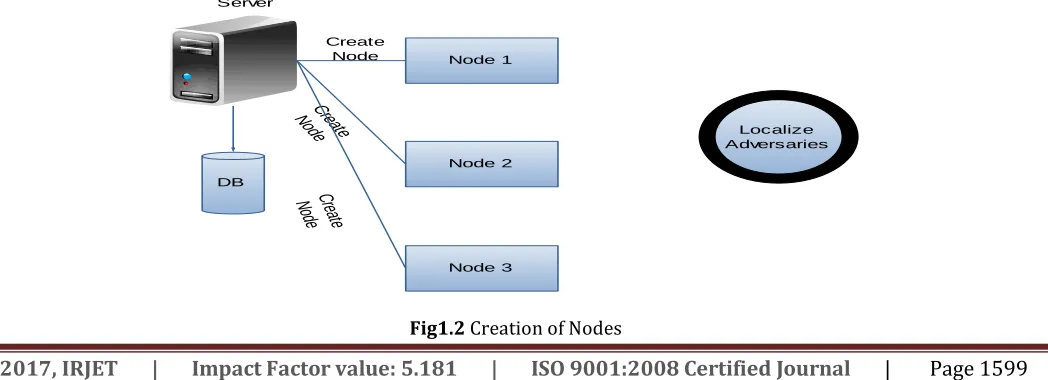
Phase 1: Node Creation
This Module is mainly to create a node with specific kind of information such as Node Name, IPAddress, Port Number and those information’s are stored in the database. The wireless Communication established between the Nodes created on. Each and every node must be requesting to its server connected to the database. Multiple Adversaries may also obtain in the wireless communication.
Fig1.2 Creation of Nodes Server Data base User A User B User C User D Spoofing attacker 1 Spoofing attacker 2 Spoofing attacker 3 Accessing information about user A
Spoofing attacker 4 Accessing
information about user B
Accessing information about user C
Accessing information about user D
Detect the Spoofing attacks and the Number of attacker
© 2017, IRJET | Impact Factor value: 5.181 | ISO 9001:2008 Certified Journal
| Page 1600
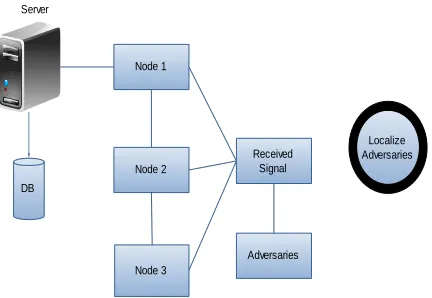
Phase 2: GADE (Generalized Attack Detection )
Generalized attack Detection Model is used to detect both the Spoofing attack and the number of attackers. Cluster based mechanisms are used to detect the Spoofing attack and the adversaries based on the RSS (Received signal strength). In GADE, the Partitioning Around Medoids (PAM) Cluster analysis method is used to perform attack detection. The problem of
determining the number of attackers as a multiclass detection problem. Cluster-based methods to determine the number of
attacker
Fig1.3 Generalized Attack Detection
Phase 3: SILENCE
[image:5.612.200.416.191.340.2]Silhouette Plot and System Evolution minimum distance of clusters, to improve the accuracy of determining the number of attackers. Additionally, when the training data are available the Support Vector Machines (SVM) method to further improve the accuracy of determining the number of attackers.
Fig 1.4 Support Vector Machine
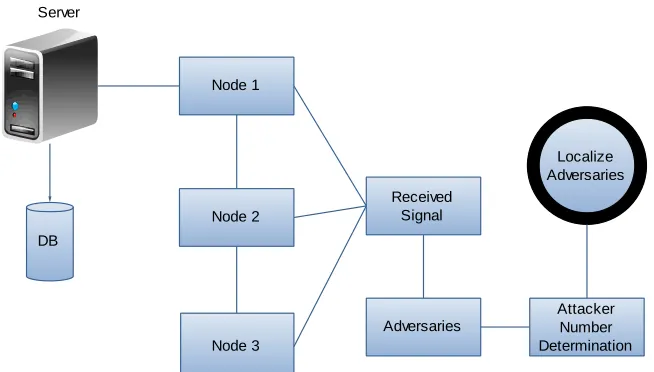
Phase 4: IDOL( Integrated Detection and Localization)
An integrated detection and localization system that can both detect attacks as well as find the positions of multiple adversaries even when the adversaries vary their transmission power levels. IDOL can achieve similar localization accuracy when localizing adversaries to that of under normal conditions. One key observation is that IDOL can handle attackers using different transmission power levels, thereby providing strong evidence of the effectiveness of localizing adversaries when there are multiple attackers in the network.
Node 1
Node 2 DB
Server
Node 3
Localize Adversaries Received
Signal
Adversaries
Node 1
Node 2 DB
Server
Node 3
Localize Adversaries Eulicudean
distance
© 2017, IRJET | Impact Factor value: 5.181 | ISO 9001:2008 Certified Journal
| Page 1601
FIG 1.5 Integrated detection and localization system4.EXPERIMENTAL RESULTS
4.1AVAILABLE NODES
This image given below represents the server node with list of available nodes in network.
4.2 CALCULATION OF EUCLIDEAN DISTANCE
This gives the Euclidean distance that is calculated using Euclidean algorithm for the list of available nodes in range. Node 1
Node 2
DB Server
Node 3
Localize Adversaries
Received Signal
Adversaries
© 2017, IRJET | Impact Factor value: 5.181 | ISO 9001:2008 Certified Journal
| Page 1602
4.3 RSS GENERATION
This step involves three process which is sending packets , receiving packets , and RSS value generation. sending of packets need a document or file that needed to be sent and the nodes receive the sent file or document.
4.4 NOTIFICATION
Notification message box for document or file that has been sent to nodes.
4.5 CLUSTERING
© 2017, IRJET | Impact Factor value: 5.181 | ISO 9001:2008 Certified Journal
| Page 1603
4.6 LOCALIZATION
Localization identifies the original node and the duplicate nodes in that cluster.
4.7 NOTIFICATION OF DUPLICATE NODE REMOVAL
After clustering the process of localization identifies and removes the duplication node and notification is obtained.
4.8 AFTER REMOVAL OF DUPLICATE NODE
© 2017, IRJET | Impact Factor value: 5.181 | ISO 9001:2008 Certified Journal
| Page 1604
5.CONCLUSION
The process of node duplicaction detection uses spatial information and PHY-layer authentication exploiting radio channel using RSS that detects spoofing attacks ,determining the number of attacks and localization of multiple adversaries by the filtering method of cluster-based mechanism. Using SVM the accuracy of detecting spoofing attacks are increased in addition with integrated and localization system the efficiency are increased.
REFERENCES
[1] L. Xiao, Y. Li, G. Liu, Q. Li, and W. Zhuang, “Spoofing detection with reinforcement learning in wireless networks,” in Proc. IEEE Global Commun. Conf. (GLOBECOM). San Diego, CA, 2015.
[2] K. Zeng, K. Govindan, and P. Mohapatra, “Non-cryptographic authentication and identification in wireless networks,” IEEE Wireless Commun., vol. 17, no. 5, pp. 56–62, 2010.
[3] J. Yang, Y. Chen, W. Trappe, and J. Cheng, “Detection and localization of multiple spoofing attackers in wireless networks,” IEEE Trans. Parallel and Distributed Syst., vol. 24, no. 1, pp. 44–58, 2013.
[4] A. Kalamandeen, A. Scannell, E. Lara, A. Sheth, and A. LaMarca, “Ensemble: Cooperative proximity-based authentication,” in Proc. Int’l Conf. Mobile Syst., Applications and Services, 2010, pp. 331–344.
[5] F. Liu, X. Wang, and H. Tang, “Robust physical layer authentication using inherent properties of channel impulse response,” in Proc. Military Commun. Conf. (MILCOM), 2011, pp. 538–542.
[6] F. Liu, X. Wang, and S. Primak, “A two dimensional quantization algorithm for CIR-based physical layer authentication,” in Proc. IEEE Int’l Conf. Commun. (ICC), 2013, pp. 4724–4728.
© 2017, IRJET | Impact Factor value: 5.181 | ISO 9001:2008 Certified Journal
| Page 1605
[8] J. Tugnait, “Wireless user authentication via comparison of power spectral densities,” IEEE J. Sel. Areas in Commun., vol. 31, no. 9, pp. 1791–1802, 2013.[9] Z. Jiang, J. Zhao, X. Li, J. Han, and W. Xi, “Rejecting the attack: Source authentication for WiFi management frames using CSI information,” in Proc. IEEE Int’l Conf. Computer Commun. (INFOCOM), 2013, pp. 2544–2552.