
© 2017, IRJET | Impact Factor value: 5.181 | ISO 9001:2008 Certified Journal | Page 1709
EMBEDDED DECISION SUPPORT SYSTEM FOR SMART FARMING
Mr. Rohit M Bhekane
1, Dr. Udaykumar L Naik
21 M.Tech(VLSI Design and Embedded Systems) Student, Dept. of E&C Engineering, KLE Dr.MSSCET,
Belgaum-590008, Karnataka, India.
2 Professor, Dept. of E&C Engineering, KLE Dr.MSSCET, Belgaum-590008, Karnataka, India.
---***---Abstract -
Presently India is facing huge agrarian crisiswhich is affecting the productivity. Technological solutions based on Internet of Things (IoT) and information technologies helps to provide solutions to the few of the unpredictable challenges in agricultural sector. This work proposes the conceptual model and system design for decision support of smart farming with wireless sensor so that necessary decisions can be taken by farmers. We propose a comprehensive technique using IoT approach which will be applied to agriculture. Data acquisition via sensors, control and tasks management, and data analysis are considered in the development of model and system design. The data analysis of Wireless Sensor Network (WSN) based temperature, humidity, soil moisture on the fields are uploaded onto IoT site ThingSpeak. The IoT supports analysis and visualization of the uploaded data. IoT helps to visualize the data anywhere, anytime and by anyone. This technical assistance system will help farmers to improve the crop yield by providing information with regard to soil testing based on sensor network in agriculture.
Key Words: Environmental monitoring, wireless Sensor, IoT, precision agriculture, soil testing.
1. INTRODUCTION
In recent decade’s farmers are facing many problems due to shortage of soil testing units and lack of knowledge to utilize the technology. Because of wrong weather predictions desired yield is not been obtained. Soil fertility is the measure factor to be looked for getting better yield [1]. Measure constrain in promoting balanced use of fertilizers includes inadequate soil testing facilities, wide gap in dissemination of knowledge, lack of awareness among farmers about benefits of balanced fertilization.
This technical assistance system will help farmers to improve the crop yield by providing information with regard to soil testing based on sensor network in farming such as monitoring ecological conditions like soil moisture, soil temperature, soil fertility, also providing information about weather predictions.
This technical system maintains database of farmer, their field with present, previous and standard crop details. Using “Embedded Decision Support System for Smart Farming” farmers are guided to improve their agricultural
production by predicting current crop and also we can analyze agricultural parameters on ThingSpeak through internet.
With the proposed work crop health and yield shall be improved and farmers are updated regularly with cultivation information. By using this system farmers can grow the suitable crop and can get desirable yield & profit.
Our objectives are to develop and implement practical embedded decision support system for smart farming with precisely implemented sensors and sensor network.
Proposed work presents a means to identify the field parameters using wireless sensor network communication system.
The main contribution of the project is the development of data base maintenance unit and wireless sensor network system to monitor the agriculture farm.
Technological development in wireless sensor network (WSN) made it possible to use it in monitoring and controlling field parameters.
Parameters are monitored and sent to the Technical Database Monitoring Station (TDMS) using ZigBee and to the IoT site ThingSpeak using GSM modem [2].
In this entire system two interrelated units are proposed.
In the existing work they have proposed a application based Agricultural Crop Predictor and Advisor using ANN for Smartphone’s. This system uses artificial neural network to predict crop. In this system we have to give various parameters such as pH, phosphate, potassium, nitrogen, depth, temperature and rainfall as input then by using ANN it will predict the output [3].
1.1
Related Work
© 2017, IRJET | Impact Factor value: 5.181 | ISO 9001:2008 Certified Journal | Page 1710 Piyush K. Surkar et al. have proposed a arduino based
Automatic Testing of Soil Samples Using Ion Selective Electrodes (ISEs). In this work they have used three different sensors that are pH Sensor, Electro conductivity Sensor and Potassium ISE to measure various soil properties. They used arduino uno as control unit which converts analog information and gives suitable data to output unit consisting of LCD and printer [5].
Giritharan Ravichandran et al. have proposed a application based Agricultural Crop Predictor and Advisor using ANN for Smartphones. This system uses artificial neural network to predict crop. In this system we have to give various parameters such as pH, phosphate, potassium, nitrogen, depth, temperature and rainfall as input then by using ANN it will predict the output [3].
Aakash G Ratkal et al. have proposed a Farmer’s Analytical Assistant system based on sliding window non-linear regression technique to predict crop yield and price by analysing patterns in past data. For this they have analyze and collect past data of several districts of the state of Karnataka, India. In this system we have to give area, district, previous crop and sowing date as input then it will predict crop, price of crop, yield, water requirement and soil requirements as output [6].
1.2 Proposed System
The proposed work helps farmers to update the agricultural parameters and cultivation information regularly.
Using “Embedded Decision Support System for Smart Farming” farmers are guided to improve their agricultural production by predicting current crop and also we can analyze agricultural parameters on ThingSpeak through internet.
The system provides information to the farmers in their regional language automatically through voice recorder.
2. METHODOLOGY
Sensing Unit
Fig -1: block diagram of the sensing unit
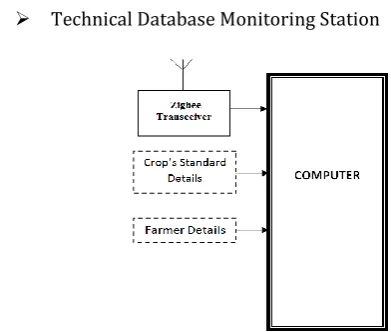
Technical Database Monitoring Station
Fig -2: Block diagram of the Technical Database Station
The Embedded Decision Support System for Smart Farming uses simple components like sensors, display units, ZigBee Tx & Rx, ARM7 processors, Voice Bank and speaker etc, which are easily available in market and smaller in size which makes it portable. The sensor section used in this system gives accurate values of all the parameters necessary to test the soil fertility. When the user presses the button on the sensing section, the respective responses are obtained quickly and display the result on GLCD. The necessary assistance information stored in voice bank is triggered by RF unit as a voice output. Then the necessary parameter values are obtained at Technical Base Station via ZigBee Modems and those values are display on moniter for database purpose. Also the data is send to IoT site ThingSpeak through GSM modem.
2.1 System Diagram
[image:2.595.319.515.96.262.2] [image:2.595.308.576.511.676.2] [image:2.595.41.287.588.749.2]© 2017, IRJET | Impact Factor value: 5.181 | ISO 9001:2008 Certified Journal | Page 1711 Fig -4: Implemented board (Technical database
monitoring station)
2.2 ThingSpeak
It is an IoT application which stores and receives the data using Hypertext Transfer Protocol (HTTP) via internet. This is the website where it can upload the information and also can locate the tracking applications [2]. ThingSpeak support numerical computing software. The data which is uploaded on the website can be analyze and visualize.
In this work, information about the weather in terms of temperature, humidity, pressure, and soil moisture will be displayed in the website. Hence every user can check the information any where globally. Initially every user needs to do register on the website. Some of the Steps are involved to do create the website is as follows:
First step is needed to create an account by providing user name and password.
Every user having the unique channel id on which the information can be seen. Once the account is created need to do the channel settings.
Fig -5: Channel settings of ThingSpeak website
The fig-5 shows the steps for channel settings where it containing the channel ID which will be unique for every user. Need to do the channel naming and giving short description about it. There are four fields are named field1 for temperature, field2 for humidity, field3 for soil moisture and field4 for pressure. In this project displayed the information about the farming of fields on the ThingSpeak website.
Step 3 is for displaying the fields information
Fig -6: display of the field information
The fig-6 shows the monitored parameters information in terms of fields. Field1 shows the temperature in terms of degree Celsius. Field 2 shows humidity occurs. Field 3 and 4 are for the soil moisture and pressure.
3. RESULTS AND DISCUSSIONS
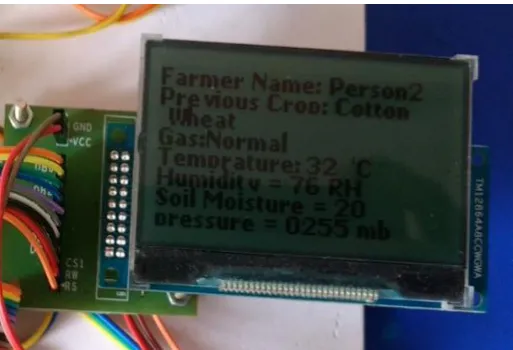
Fig -7: Display of person2 farm information on GLCD
[image:3.595.35.306.90.257.2] [image:3.595.315.551.210.389.2] [image:3.595.312.569.505.680.2] [image:3.595.55.267.560.748.2]© 2017, IRJET | Impact Factor value: 5.181 | ISO 9001:2008 Certified Journal | Page 1712 Fig -8: Terminal display farmer’s details at technical
database station through ZigBee.
Fig -9: Display of temperature of various lands on the web server
Fig -8 shows agricultural parameters and crop to be cultivated of person1 in terminal software. We have used terminal software to display data received from ZigBee.
Fig -10: Display of humidity of various land on the web server
[image:4.595.314.553.292.450.2]Fig -11: Display of soil moisture of various lands on the web server
Fig -12: Display of pressure on the web server
[image:4.595.43.281.322.466.2]Fig-9 and fig-10 shows the temperature and humidity calculated in various farm with date and time.
Table -1: Comparison between proposed and existing systems [3].
Criterion/issue Proposed
System Existing System
Crop prediction Done Done
IoT application
(ThingSpeak) Used Not used
Voice recorder Used Not used
Training No Yes
Temperature sensor Used Not used
Humidity sensor Used Not used
Soil moisture sensor Used Not used
[image:4.595.299.559.551.759.2] [image:4.595.41.282.557.710.2]© 2017, IRJET | Impact Factor value: 5.181 | ISO 9001:2008 Certified Journal | Page 1713 From table -1 we can analyze that Artificial Neural
Network (ANN) technique demands a complex prediction model and anonymous major data at different points on the field.
4. CONCLUSION
In this work the essential constituents of smart agricultural system are proposed. The data analysis of Wireless Sensor Network (WSN) based temperature, humidity, soil moisture on the fields are uploaded onto IoT site ThingSpeak. The IoT supports analysis and visualization of the uploaded data. Iot helps to visualize the data anywhere, anytime and by anyone. In the work IEEE 802.15.4 protocol has been used. This provides 2.4GHz ZigBee connectivity which supports connectivity around 100 meter.
In future it is possible to provide android application for embedded decision support system for smart farming. It is also possible to add authentic and privacy issues to see the particular farms agricultural parameters.
ACKNOWLEDGEMENT
The first author would like to thank i3Concepts, pune, India for providing internship on the IoT based project and also for strong support for motivation and my special thanks to my guide Dr. Udaykumar L Naik, Professor, Dept. of E&C for encouraging me for this work.
REFERENCES
[1] R. van Hooijdonk, “Smart farming: the new agricultural benchmark - Trendwatchter en Futurist Richard van Hooijdonk,” 2015. [Online]. Available: https://en.richardvanhooijdonk.com/smart-farming-newbenchmark/.
[2] ThingSpeak (www.ThingSpeak.co.in)
[3] Giritharan Ravichandran, and Koteeshwari R S, “Agricultural Crop Predictor and Advisor using ANN for Smartphones”, 978-1-4673-6725-7/16/$31.00 ©2016 IEEE.
[4] Sinung Suakanto, Ventje J. L. Engel, Maclaurin Hutagalung and Dina Angela, “Sensor Networks Data Acquisition and Task Management for Decision Support of Smart Farming”, 2016 International Conference on Information Technology Systems and Innovation (ICITSI) Bandung – Bali, October 24 – 27, 2016 ISBN: 978-1-5090-2449-0.
[5] Piyush K. Surkar and A. R. Karwankar, “Automatic Testing of Soil Samples Using Ion Selective Electrodes (ISEs)”, International Conference on Communication and Signal Processing, April 6-8, 2016, India.
[6] Aakash G Ratkal, Gangadhar Akalwadi, Vinay N Patil and Kavi Mahesh, “Farmer’s Analytical Assistant”, 2016 IEEE International Conference on Cloud Computing in Emerging Markets.
[7] Internet of things
(http://en.wikipedia.org/wiki/Internet-of-Things) [8] Arturo MEDELA, Bruno CENDÓN, Lucía GONZÁLEZ, Raúl
CRESPO and Ignacio NEVARES, “IoT Multiplatform Networking to Monitor and Control Wineries and Vineyards”, Future Network & MobileSummit 2013 Conference Proceedings Paul Cunningham and Miriam Cunningham (Eds) IIMC International Information Management Corporation, 2013 ISBN: 978-1-905824-37-3.
[9] Mohanraj I, Kirthika Ashokumar and Naren J, “Field Monitoring and Automation using IOT in Agriculture Domain”, 6th International Conference On Advances In Computing & Communications, ICACC 2016, 6-8 September 2016, Cochin, India.
[10] F. Guerrini, “The Future Of Agriculture? Smart Farming,” 2015. [Online]. Available:
http://www.forbes.com/sites/federicoguerrini/2015/0 2/18/thefuture-of-agriculture-smart
farming/#338e9d6e337c.
[11] FAO, “Agriculture to 2050 – the challenges ahead,” FAO News. [Online]. Available:
http://www.fao.org/news/story/en/item/36193/icode /.
[12] “FAOSTAT,” Food and Agriculture Organization of the United Nations (FAO). [Online]. Available: http://faostat.fao.org/site/291/default.aspx.
[13] CoiNet Technology solutions LLP, LPC2148 ARTIST Instruction manual
[14] A. McBratney, B. Whelan, T. Ancev, and J. Bouma, “Future Directions of Precision Agriculture,” Precis. Agric., vol. 6, no. July 2004, pp. 7–23, 2005.
[15] V. Lakshmi Narasimhan, Alex A. Arvind and Ken Bever, “Greenhouse Asset Management Using Wireless Sensor-Actor Networks”, International Conference on Mobile Ubiquitous Computing, Systems, Services and Technologies 2007.
![Table -1: Comparison between proposed and existing systems [3].](https://thumb-us.123doks.com/thumbv2/123dok_us/8154151.803544/4.595.299.559.551.759/table-comparison-proposed-existing-systems.webp)
