© 2018, IRJET | Impact Factor value: 6.171 | ISO 9001:2008 Certified Journal | Page 2784
EXPERIMENTAL EVALUATION AND ANALYSIS OF SEMI ACTIVE
PARTICLE BASED DAMPING SYSTEM USING MAGNETIC FIELD.
Miss. Swati V. Kolekar
1, Pravin A. Dhawale
21P.G. Student, Department of Mechanical Engineering, FTC, College of Engineering and Research, Sangola-413 307,
Maharashtra , India
2 Assistant Professor, Department of Mechanical Engineering, FTC, College of Engineering and Research,
Sangola-413 307, Maharashtra , India
---***---Abstract -
When planning to design a suspension systemfor an automobile it involves clear examination about the tires, linkages, springs (dampers) and other parts that are connected with the tire and the vehicle itself. In today’s automobile industry, more concentration is on how comfortable the vehicle drives and by all means, its suspension system. The concept of structural control containing both passive and active control systems have been developing in consent. A semi-active control system is a compromise between passive and active control systems which has been developed recently. A semi-active control system keeps the reliability of passive control systems while taking advantage of the variable parameter characteristics of an active control system. In this report, the effect of electric flux, size of magnetic particles, materials of piston with respect to the amplitude of vibrations is studied for simply supported beam in which a magnetic particle bed is utilized to dissipate the energy of a vibrating piston. The system is magnetized by a magnetic field generated by supplying an electric current to an electromagnetic coil. Semi-active control is obtained by changing the electric current supplied to the coil. From the analysis, it is observed that the performance of semi active particle based damping controlled by magnetic field is dependent on the various parameters such as materials of the particles, size of particles, material of piston and supplied current. The damping efficiency of the system increases as the magnetization of the piston and particles increases up to saturation level. This system can be effective in aerospace, automobile and structural engineering applications, particularly in severe environments.
Key Words:Semi active control, Electric flux, Magnetic
field, Vibration amplitude, FFT analyser, frequency response analysis.
1. INTRODUCTION
Damping systems are classified into three categories namely passive, semi-active and active suspensions [9]. Passive, active and semi-active vibration control methods are used to provide external damping for aerospace, automotive and civil engineering applications. Passive systems use viscous fluids viscoelastic materials or tuned masses as dampers to dissipate energy without the use of actuators and external power supply. However, such
systems are most effective only in a narrow Frequency range. Active damping systems can produce desired response characteristics for a variety of disturbances by using actuators to provide an active force to the vibrating structure. However, active systems are often limited in their use because their actuators require a large external source of power. A semi-active damping system addresses the limitations of the passive and the active system by integrating tunable control into a passive device by replacing force actuators with continually adjustable control elements which are capable of modifying a dampers energy dissipation rate in response to excitation conditions. Therefore, semi-active devices are also referred to as variable-rate or adaptive-passive dampers. This damping method is attractive because it requires a significantly lower amount of external power supply, as compared to the active system.
1.1 Problem Definition
The operation of any mechanical system will always produce some vibration so it is necessary to minimize the vibrations, because while it is undesirable, vibrations are unavoidable. The result of excess vibration can vary from annoying disturbance to a disastrous failure. All automobile vehicles, aerospace vehicles and industrial machineries must generate some vibration. These vibrations may just be an indicator of some problem with a mechanism, or it may be a cause of other problems. Viscoelastic damping is one of the most common methods of damping. However, the damping properties of viscoelastic materials are highly dependent on various parameters including strain rate, aging, temperature and pressure. At extremely low and high temperatures viscoelastic material properties may get changed. In such damping systems the damping properties are precisely decreases. In short, the performance of viscoelastic damper is affected in cryogenic environment. Therefore viscoelastic damper cannot be used at very low or high temperature and pressure. This problem can be avoided by using semi active particle based damping system.
© 2018, IRJET | Impact Factor value: 6.171 | ISO 9001:2008 Certified Journal | Page 2785 2. EXPERIMENTAL ANALYSIS OF A PARTICLE
BASED DAMPING SYSTEM
Fig -1: Experimental setup The experimental setup consists of-
1. An oscillating piston to transfer energy from a vibrating medium to the damping medium. It is made from either steel (carbon steel) to produce a magnetic piston or aluminium to produce a non-magnetic one.
2. Magnetic particles (chrome steel) of different sizes (1 and 2 mm diameter) to dissipate the vibration energy and serve as a damping medium, and
3. An electromagnetic coil to generate a magnetic field of desired strength.
2.1 Procedure to obtain required results 1. Assemble the entire setup.
2. Connect the damper unit consisting of piston, cylinder filled with particles and an electromagnetic coil around the cylinder to the system.
3. An acceleration sensor with its magnetic probe is placed on the motor base frame. The probe is mounted on the frame near the motor because vibrations are more at that point.
4. A motor is started and readings are taken by varying current (0 – 1.2A) supplied to the coil.
5. Recorded the amplitude of oscillation of a damper having the magnetic piston (steel) and non magnetic (aluminum) piston with 1mm and 2mm diameter particles with the help of FFT analyzer.
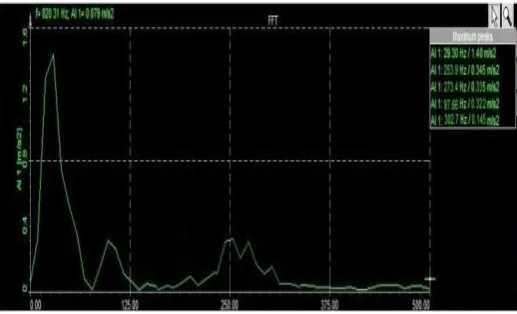
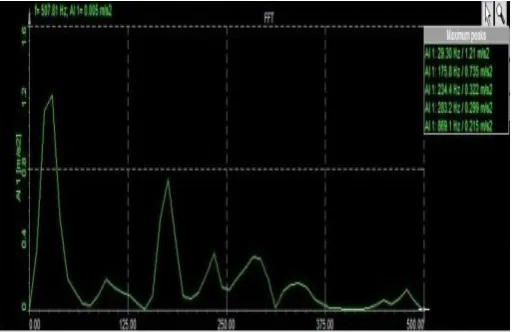
Case 1:Effect of flux with steel (Magnetic) piston and particles of 1 mm size.
[image:2.595.38.258.120.295.2]For current 0.0 A
[image:2.595.309.569.136.304.2]Fig 2: Frequency Response plot for 0.0A current For current 0.2 A
Fig 3: Frequency Response plot for 0.2A current For current 0.4 A
[image:2.595.310.569.363.525.2] [image:2.595.309.568.581.738.2]© 2018, IRJET | Impact Factor value: 6.171 | ISO 9001:2008 Certified Journal | Page 2786 For current 0.6 A
[image:3.595.36.295.97.266.2]Fig 5: Frequency Response plot for 0.6A current For current 0.8 A
Fig 6: Frequency Response plot for 0.8A current For current 1.0 A
Fig 7: Frequency Response plot for 1.0A current For current 1.2 A
Fig 8: Frequency Response plot for 1.2A current Similarly following cases are analysed,
Case 2: Effect of flux with steel (Magnetic) piston and particles of 2 mm size.
Case 3: Effect of flux with Aluminium (Non magnetic) piston and particles of 1 mm size.
Case 4: Effect of flux with Aluminium (Non magnetic) piston and particles of 2 mm size.
3. FINITE ELEMENT ANALYSIS
3.1 Modal analysis
[image:3.595.37.295.324.490.2]It is used to determine the natural frequencies and mode shapes of the structure. The natural frequencies and mode shapes are important in the design of a structure for dynamic loading conditions. A modal analysis is a technique used to determine the vibration characteristics of structures.
Table -1: Different modes and corresponding frequencies
Modes Frequency (Hz)
1 11.794
2 14.694
3 24.237
4 47.365
5 61.65
6 62.291
7 99.086
8 130.9
9 199.72
10 248.7
3.2 Frequency Response Analysis
[image:3.595.36.290.547.722.2]© 2018, IRJET | Impact Factor value: 6.171 | ISO 9001:2008 Certified Journal | Page 2787 Variation of Displacement:
Acceleration v/s frequency
[image:4.595.316.571.102.643.2]Displacement v/s Frequency
Fig 9: Variation of amplitude without flux and steel as piston material.
Case 2- With Flux Piston Material – Steel
Variation of Displacement:
Acceleration v/s frequency
[image:4.595.313.574.496.653.2]Displacement v/s frequency
Figure 10: Variation of amplitude with flux and steel as piston material.
© 2018, IRJET | Impact Factor value: 6.171 | ISO 9001:2008 Certified Journal | Page 2788 4. RESULTS AND DISCUSSION
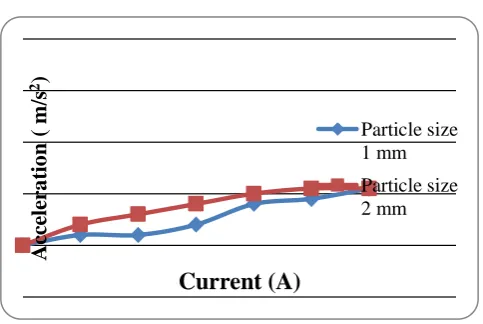
[image:5.595.310.554.115.258.2]4.1 Effect of flux with steel (Magnetic) piston and particles of 1 and 2 mm size.
Fig 11: Combined effect of size of particles on damper with steel (magnetic) piston.
[image:5.595.40.283.121.273.2]4.2 Effect of flux with Aluminum (non-magnetic) piston and particles of 1 and 2 mm size.
Fig 12: Combined effect of size of particles on damper with aluminum (non magnetic) piston 4.3Result of frequency response analysis using FEA
Table -2: Result of frequency response analysis using FEA
Sr.
NO. Condition Material of piston
Acceleration (m/s2)
Displacement (mm)
1 Without
flux steel 1.496 0.1173
2 Without
flux aluminum 1.413 0.2129
3 With flux steel 0.3144 0.033
4 With flux aluminum 1.815 0.433
5. COMPARISON BETWEEN EXPERIMENTAL AND FINITE ELEMENT ANALYSIS RESULTS
Figure 13: Comparison between FEA and Experimental results.
6. CONCLUSIONS
The performance of a semi active particle based damping system, using a dry magnetic particle bed as a damping medium to absorb and dissipate the energy of a vibrating piston is analyzed. The damping efficiency is achieved by controlling the electric current supplied to an electromagnetic coil to generate a magnetic field. From the analysis it is concluded that
1. In case of a magnetic (steel) piston, the magnetization of both particles and piston can enhance the damping efficiency until the magnetization saturates. It shows that as current goes on increasing acceleration goes on decreasing. Thus we get variable damping effect with the help of semi active particle based damper controlled by magnetic field.
2. On the other hand, for the case with a non- magnetic (Aluminum) piston, the damping system achieves the highest efficiency when particles are not magnetized, and the damping efficiency decreases with increasing magnetization.
3. Also the effect of particle size on the damping is studied. It is observed that for 2 mm particle size, the damping is precisely lower when compared with 1 mm particle size.
ACKNOWLEDGEMENT
I am very thankful to my project guide Prof. P. A. Dhawale Assistant Professor & P.G. Coordinator, Mechanical Engineering Department, Fabtech Technical Campus, COER, Sangola, for his continuous support and encouragement in completing this work.
[image:5.595.41.283.349.511.2]© 2018, IRJET | Impact Factor value: 6.171 | ISO 9001:2008 Certified Journal | Page 2789 REFERENCES
[1] Vikas L. Shinde, Ajay K. Pathak, “Review on Particle Damping Technique for Vibration Suppression”, International Journal of Innovative Research in Science, Engineering and Technology Vol. 5, Issue 3(2016).
[2] Chiranjit Sarkar, Harish Hirani, “Effect of Particle Size on Shear Stress of Magnetorheological Fluids”, Smart Science Vol. X, No. X, pp. X-XX (201x), January 26, 2015.
[3] Mr. Pravin H. Lokhande, Mr. Avinash K. Mahale, “Experimental Evaluation of Effect of Various Material Parameters on the Performance of Particle Impact Damper to Reduce Vibrations”, International Engineering Research Journal Page No 1345-1351 (2014).
[4] Ashwani Kumar and S. K. Mangal, “Finite Element Analysis of Magneto-Rheological Damper”, Asian Journal of Engineering and Applied Technology ISSN: 2249-068X Vol. 3 No. 2, 2014.
[5] Vijay Tripathi, U. K. Joshi, “Experimental analysis of fabricated magneto rheological damper”, International journal of science, engineering and technology, Volume 02 issue 04 (2014).
[6] C. Booty, Bowyer E.P. and Krylov, V.V., “Experimental investigation of damping flexural vibrations using granular materials”, Proceedings of the International Conference on Noise and Vibration Engineering (ISMA 2014), Leuven, Belgium,15-17 September 2014, pp. 547 - 558.
[7] S. Devaraj, D. Shivalingappa, Channankaiah, Rajesh S Jangaler, “Surface quality enrichment using fine particle impact damper in boring operations”, International Journal of Research in Engineering and Technology eISSN: 2319-1163, Volume: 03 Issue: 02 Feb-2014.
[8] Mohammad Meftahul Ferdaus, “Temperature Effect Analysis on Magneto-Rheological Damper’s Performance”, Journal of Automation and Control Engineering Vol. 2, No. 4, December 2014.
[9] Abroon Jamal Qazi, Afzal khan, M. Tahir Khan, Sahar Noor, “A Parametric Study on Performance of Semi-Active Suspension System with Variable Damping Coefficient Limit”, 2013 AASRI Conference on Intelligent Systems and Control, Elsevier, Sciencedirect.
[10] Zheng Lu, Xilin Lu, Wensheng Lu & Weiming Yan, “An Experimental Investigation into the Use of Buffered Particle Dampers”, 15 WCEE, LISBOA 2012.
[11] Binoy M. Shah, Jeremy J. Nudell, Kevin R. Kao, Leon M. Keer, Q. Jane Wang, Kun Zhou, “Semi-active particle-based damping systems controlled by magnetic fields”, Elsevier Journal of Sound and Vibration 330 (2011) 182–193.
[12] M. Senthil kumar, K. M. Mohanasundaram and B. Sathishkumar, “A case study on vibration control in a boring bar using particle damping”, International Journal of Engineering, Science and Technology Vol. 3, No. 8, (2011)
[13] H. R. Owji, A Hossain Nezhad Shirazib, H. Hooshmand Sarvestanib, “A Comparison between a New Semi-Active Tuned Mass Damper and an Active Tuned Mass Damper”, Department of Mechanical Engineering ,Yazd University, Iran, ELSEVIER Procedia Engineering 14 (2011) 2779–2787.
[14] Yanchen Du, Shulin Wang, “Modeling the fine particle impact damper”, Elsevier International Journal of Mechanical Sciences 52 (2010) 1015–1022. [15] Binoy M. Shah , Davy Pillet, “Construction and
characterization of a particle-based thrust damping system”, Department of Mechanical Engineering, Northwestern University, 2145 Sheridan Road, Evanston, IL 60208-3109, USA (2009).
[16] Jeong-Hoi Koo, Amit Shukla, Mehdi Ahmadian, “Dynamic performance analysis of non-linear tuned vibration absorbers”, Elsevier Communications in Nonlinear Science and Numerical Simulation 13 (2008) 1929–1937.
[17] Mehdi Ahmadian, James A. Norris, “Experimental analysis of magnetorheological dampers when subjected to impact and shock loading”, Elsevier Communications in Nonlinear Science and Numerical Simulation 13 (2008) 1978–1985.
[18] Kun S. Marhadi and Vikram K. Kinra, “Particle impact damping: effect of mass ratio, material, and shape”, Elsevier Journal of Sound and Vibration 283 (2005) 433–448.
[19] M. Saeki, “Analytical study of multi-particle damping”, Elsevier Journal of Sound and Vibration 281 (2005) 1133–1144.
[20] ZhiweiXu, Michael Yu, Tianning Chen, “A particle damper for vibration and noise reduction”, Elsevier Journal of Sound and Vibration 270 (2004) 1033– 1040.
© 2018, IRJET | Impact Factor value: 6.171 | ISO 9001:2008 Certified Journal | Page 2790 [22] Fernando D. Goncalves and Mehdi Ahmadian, “A
hybrid control policy for semi-active vehicle suspensions”, Shock and Vibration 10 (2003) 59–69. [23] G. Yang, B.F. Spencer. “Large-scale MR fluid
dampers: modeling and dynamic performance considerations”, Department of Electrical Engineering, University of Notre Dame, Notre Dame, IN 46556, USA (2002).
[24] Swaroop K. Yalla, Ahsan Kareem, Jeffrey C. Kantor, “Semi-active tuned liquid column dampers for vibration control of Structures”, Elsevier Engineering Structures 23 (2001).
[25] R. D. Friend and V. K. Kinra, “Particle impact damping”, Journal of Sound and vibration (2000) 233(1).
[26] T. T. Soong And B. F. Spencer, “Active, semi-active and hybrid control of structures”, 12 WCEE 2000. [27] Michael D. Symans, Michael C. Constantinou,
“Semi-active control systems for seismic protection of structures: a state-of-the-art review”, Engineering Structures 21 (1999) 469–487.