Enhanced Insertion Sort Algorithm
Tarundeep Singh Sodhi
Assistant Professor in CSEdept. at ARNI University, Kathgarh Indora-H.P. H.NoB-5/108, Ganga Singh Nagar
Jandiala road,Tarn-Taran. Pincode-143401
Surmeet Kaur
Assistant Professor in CSE dept. at Lovely Professional University,
Jalandhar.
H.No-170A , 2 Partap Nagar, Opposite Kamal Palace, Sangrur.
Pincode-148001
Snehdeep Kaur
Student of MCA at Guru NanakDev University, Regional campus, jalandhar. H.NoB-5/108, Ganga Singh Nagar
Jandiala road,Tarn-Taran. Pincode-143401
ABSTRACT
Sorting is integral part of many computer based systems and applications, as it involves rearranging information into either ascending or descending order. There are many sorting algorithms like Quick sort, Heap sort, Merge sort, Insertion sort, Selection sort, Bubble sort and Freezing sort. However, efforts have been made to improve the performance of the algorithm in terms of efficiency, indeed a big issue to be considered. Major Emphasis has been placed on complexity by reducing the Number of comparisons, hence reducing complexity. This paper presents new sorting algorithm EIS, “ENHANCED INSERTION SORT”.It is basically an enhancement toINSERTION SORT (a kind of Hybrid sorting technique) by making it impressively faster algorithm with
O(n)complexity as compared to O(n2) of insertion sort in worst case and less than O(n1.585) in average case which is much better than insertion sort O(n2). It works flawlessly with huge lists of elements. To prove the effectiveness of the algorithm, the new algorithm is analyzed, implemented, tested and results has been carried out and compared with other major sorting algorithms and the results were promising.
General Terms
Sorting Algorithm, Hybrid technique, EIS-Enhanced Insertion sort, NOC- Number of Comparisons, NOE- Number of elements.
Keywords
Enhanced Insertion sort, EIS, NOC, NOE, Freezing Sort, complexity, selection sort, bubble sort, transition element.
1.
INTRODUCTION
Algorithm is a stepwise method to solve a problem, efficiently and expressed as a finite sequence of steps. Algorithms are used for calculation, data processing, and many other fields.
Sorting has been considered as a fundamental problem in the study of algorithms, that due to many reasons:
The need to sort information is inherent in many applications.
Algorithms often use sorting as a key subroutine and efficient sorting is important to optimize the use of other algorithms that require sorted lists to work correctly.
The output should satisfy two major conditions:
The output is a permutation, or reordering, of the input. \
The output is in non decreasing order.
Many researchers considered all sorting techniques had been discovered, but many useful new sorting algorithms are recently introduced, for example, library sort was first published in 2004.
Insertion sorting algorithm is another important algorithm, used for sorting small lists. But the study shows that the EIS is more efficient, theoretically, analytically, and practically as compared to the original (insertion) sorting algorithm and also good for sorting bigger lists. Section III presents the concept of EIS algorithm and its pseudo code. Furthermore, the implementation, analysis, and comparison with insertion sort and other algorithms are highlighted.
2.
ABOUT INSERTION SORT
The insertion sort, as its name suggests, inserts each item into its proper place in the final list. The simplest implementation of this requires two list structures: the source list and the list into which sorted items are inserted.
2.1
Example
45 30 60 25 70 20 80 75 15 10
30 45 60 25 70 20 80 75 15 10 30 45 60 25 70 20 80 75 15 10
25 30 45 60 70 20 80 75 15 10 25 30 45 60 70 20 80 75 15 10
20 25 30 45 60 70 80 75 15 10 20 25 30 45 60 70 80 75 15 10 20 25 30 45 60 70 75 80 15 10
15 20 25 30 45 60 70 75 80 10
10 15 20 25 30 45 60 70 75 80
Calculating the number of green elements, we can observe that no of comparisons in all are 31.
Red elements show the transitioned elements
3.
ENHANCED INSERTION SORT
3.1
Concept
Insertion Sort(EIS) algorithm is an enhancement to the IS algorithm, but the difference is in the approach as it compares with the very first element i.e.A[0] in the sorted part of array, which in fact is the smallest element in the
list at instant , after comparing ith element with (i-1)th. This is called as hit method; more we get hit more the efficiency increases.
Basically sometimes we have element which gets sorted after (n-1) comparisons i.e at first place A[0] in insertion sort. So for reducing these useless comparison, why not we compare the element to be sorted with the very first element A[0] in the part of list, which is already sorted i.e.
before ith element, which we know is the smallest element up till now.
Further list is divided, selecting a middle element and comparing to part on its left or right based on the condition for middle comparison and then comparing after leaving one element in that particular part, hence reducing the no of comparisons. The technique is more efficiently suitable
for bigger lists and efficiency increases when the ith is less than A[0] which gives O[n] in worst case.
3.2
Procedure
The whole procedure which shows the enhancement in the insertion sort technique as described below:-
1. Instead of comparing all the elements from right to left, we just compare the ith element with (i-1)th element.
2. If ith > (i-1)th then the element is simply added/appended to the list i.e no swapping. Else
3. Compare ith element with ptr, (i.e. first element which is smallest in current sorted list) as the elements from A[0]th to A[i-1]th are already sorted.
4. If ith<ptr then insert ith element before ptr and ptr to this element. (which is now smallest and first element in the list )a n d s w a p further list accordingly. Else
5. If the element lies between A[0]th and the (i-1)th element, then we further divide the total number of sorted elements or ith by 2 i.e k = (i-1)/2 or k=i/2. We take the later one.
6. Now compare the ith element with kth element and check again.
7. If ith < kth, then compare with k-2 and so on until we find an element kth < ith and then compare with (k+1)th and swap based on conditions. 8. If ith > kth then compare with k+2 and so on until
we find an element kth > ith and then compare with (k-1)th and swap ith based on condition 2.
3.3
Pseudo code
1. Calculate length n 2. var i=1,j3. if (a[i] < a [i-1]), then 4. if (a[i] < a [0]), then 5. set j = 0 and goto-35 6. else j = i/2 and goto-10 7. end if
8. else i++ and repeat-3 9. end if
10. if (a[i]<a[j]), then goto-16 11. elseif (if (a[i] = = a[j]), then 12. set j = j+1 and goto-35 13. end if
14. else goto-25 15. end if
16. while((j-1)>=0), do 17. j = j-2 and if (a[i]>a[j]), then 18. if (a[i] < a [j+1]), then 19. set j = j+1 and goto-35 20. else set j = j+2 and goto-35 21. end if
22. else if (a[i] = =a[j]), then 23. Set j = j+1 and goto-35 24. Else return
25. While (((i-1)-j) > = 0 ), do 26. J = j+2 and (a[i] < a[j]), then 27. If (a[i] < a [j-1]), then 28. Set j=j-1 and goto-35 29. Else set j+j+0 and goto-35 30. End if
31. Else if (a[i]= = a[j]), then 32. Set j=j+1 and goto-35 33. Else return
34. End if
35. Swap a[i] and a[j] 36. j++
37. while(j=i-1), do 38. i++ and goto-3 39. END
3.4
Analysis and Comparisons
EIS algorithm is easy to analyze as compared to IS algorithm since the loop does not requires scanning all i-1 elements (this takes i-1 comparisons) and
then swapping the ith element into its appropriate position as in IS algorithm.
3.4.1. Swaps
We can very well observe that there is no change in number of swaps in this technique as compared to insertion sort as the previous list is already sorted in both the techniques and we just have to find the place for the next element. For example:
For 10 Elements
5,60,37,28,50,20,160,7,89,10
Number of swaps in Insertion sort 22
Number of Swaps in Enhanced insertion sort 22
3.4.2. Complexity
3.4.2.1. Best Case
3.4.2.2. Average Case
The average case of enhanced insertion sort is also quadratic as is the case with insertion sort when we have an unsorted array, but it reduces the number of comparison as compared to insertion sort, as it is observed that the average case of insertion sort can often be as bad as worst case i.e there may be a need to compare each element A[i] with each elements in the entire sorted sub array A[1],A[2],…….A[i-1] and thus the time can be expressed as a quadratic equation i.e O( n2 ), but this is never the case with any unsorted array in EIS.
So in an unsorted array, when the ith element to be
sorted lies at A[2]th or A[i-2]th position we have maximum number of comparisons which is much less than the worst case of insertion sort.
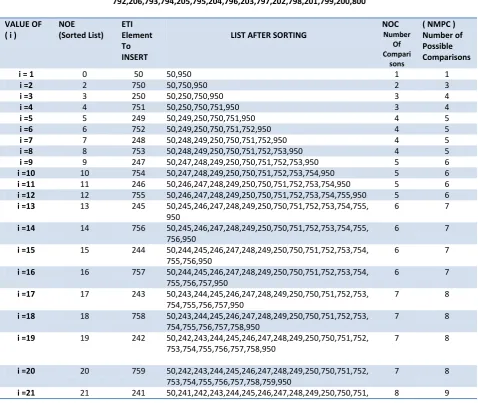
For example, consider the list of 106 elements as below, where we have maximum number of comparisons when sorted with EIS:
950,50,750,250,751,249,752,248,753,247,754,246,755,245 ,756,244,757,243,758,242,759,241,760,240,761,239,762,2 38,763,237,764,236,765,235,766,234,767,233,768,232,769 ,231,770,230,771,229,772,228,773,227,774,226,775,225,7 76,224,777,223,778,222,779,221,780,220,781,219,782,218 ,781,217,782,216,783,215,784, 214,785, 213,786, 212,787, 211,788,210,789,209,790,208,791,207,792,206,793,794,20 5,795,204,796,203,797,202,798,201,799,200,800
[image:3.595.73.552.366.769.2]Let us include them one by one.(Green shows the element to be compared, red represent the current element which is being added and brackets represents the number of times it is compared)
Table 1: LISTING
LIST INPUT
NUMBER OF Elements (NOE) =
106
950,50,750,250,751,249,752, 248,753, 247,754, 246,755,245,756, 244,757,243,758,242,759,241,760,240,761,239,762,238,763,237, 764,236,765, 235,766, 234,767, 233,768, 232,769, 231,770, 230,771, 229,772,228,773,227,774,226,775, 225,776, 224,777, 223,778, 222, 779, 221,780,220,781,219,782, 218,781, 217,782, 216,783, 215,784, 214,785, 213,786, 212,787, 211,788, 210,789, 209,790, 208,791,207, 792,206,793,794,205,795,204,796,203,797,202,798,201,799,200,800
VALUE OF ( i )
NOE (Sorted List)
ETI Element To INSERT
LIST AFTER SORTING
NOC Number
Of Compari
sons
( NMPC ) Number of Possible Comparisons
i = 1 0 50 50,950 1 1
i =2 2 750 50,750,950 2 3
i =3 3 250 50,250,750,950 3 4
i =4 4 751 50,250,750,751,950 3 4
i =5 5 249 50,249,250,750,751,950 4 5
i =6 6 752 50,249,250,750,751,752,950 4 5
i =7 7 248 50,248,249,250,750,751,752,950 4 5
i =8 8 753 50,248,249,250,750,751,752,753,950 4 5
i =9 9 247 50,247,248,249,250,750,751,752,753,950 5 6
i =10 10 754 50,247,248,249,250,750,751,752,753,754,950 5 6
i =11 11 246 50,246,247,248,249,250,750,751,752,753,754,950 5 6
i =12 12 755 50,246,247,248,249,250,750,751,752,753,754,755,950 5 6
i =13 13 245 50,245,246,247,248,249,250,750,751,752,753,754,755,
950
6 7
i =14 14 756 50,245,246,247,248,249,250,750,751,752,753,754,755,
756,950
6 7
i =15 15 244 50,244,245,246,247,248,249,250,750,751,752,753,754,
755,756,950
6 7
i =16 16 757 50,244,245,246,247,248,249,250,750,751,752,753,754,
755,756,757,950
6 7
i =17 17 243 50,243,244,245,246,247,248,249,250,750,751,752,753,
754,755,756,757,950
7 8
i =18 18 758 50,243,244,245,246,247,248,249,250,750,751,752,753,
754,755,756,757,758,950
7 8
i =19 19 242 50,242,243,244,245,246,247,248,249,250,750,751,752,
753,754,755,756,757,758,950
7 8
i =20 20 759 50,242,243,244,245,246,247,248,249,250,750,751,752,
753,754,755,756,757,758,759,950
7 8
752,753,754,755,756,757,758,759,950
i =22 22 760 50,241,242,243,244,245,246,247,248,249,250,750,751,
752,753,754,755,756,757,758,759,760,950
8 9
i =23 23 240 50,240,241,242,243,244,245,246,247,248,249,250,750,
751,752,753,754,755,756,757,758,759,760,950
8 9
i =24 24 761 50,240,241,242,243,243,245,246,247,249,250,750,751,
752,753,754,755,756,757,758,759,760,761,950
8 9
And so on….So to arrange any nth element in the list, number of comparisons required are ┌n/4┐+12.
So as we can notice, after n=4 we have 4 times the same number of comparisons starting from 5,6,7……so on. So talking about n=48, no of comparisons will be
15+15+15+15+14+14+14+14+13+13+13……….=449
The number of comparisons as calculated are always less than n1.585. So the complexity in the worst scenario of average case will be O(n1. 585)for constant 1.
The complexity may vary from O(n) to O(n1. 585)
For example….for n=48,the number of comparisons calculated manually are 449 which is less than 481.585 i.e 462.
3.4.2.3 Worst Case
In the worst case of Insertion Sort , when the array is in decreasing order, one must compare each element A[i] with each elements in the entire sorted sub array A[1],A[2],…….A[i-1] and thus the time can be
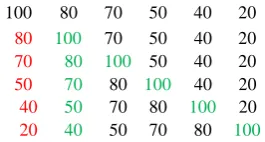
expressed as a quadratic equation i.e O(n2) But in case of enhanced insertion technique, it is O(n) as we have just 1 comparisons for the first two elements, rest n-2 have just 2 comparisons. For example:
For the average case like this:-
100 80 70 50 40 20
80 100 70 50 40 20
70 80 100 50 40 20
50 70 80 100 40 20
40 50 70 80 100 20
20 40 50 70 80 100 We get 1+2*4=9comparisons
In general 1+2(n-2) comparisons=O (n)
3.4.3.Example
Consider the same example as below
45 30 60 25 70 20 80 75 15 10
30 45 60 25 70 20 80 75 15 10 30 45 60 25 70 20 80 75 15 10
25 30 45 60 70 20 80 75 15 10 25 30 45 60 70 20 80 75 15 10
20 25 30 45 60 70 80 75 15 10 20 25 30 45 60 70 80 75 15 10 20 25 30 45 60 70 75 80 15 10
15 20 25 30 45 60 70 75 80 10
10 15 20 25 30 45 60 70 75 80
Here as compared to insertion sort there are only 16
So there is always reduction in no of comparisons.
3.4.4 Pseudo code
Insertion sort works by removing an element from the input data for every repetition of insertion sort, inserting it into the correct position in the already sorted list, until no input elements remain. The insertion sort has a
complexity of O(n2). In simple pseudo code, insertion sort algorithm might be expressed as:
1. for j ←1 to length (A)-1 2. key ← A [ j ]
3. > A[j] is added in the sorted sequence A [1... j-1]
4. i ← j - 1
5. while i >= 0 and A [i] > key 6. A [ i +1 ] ← A[ i ]
7. i ← i -1 8. A [i +1] ← key
3.4.5 Stability
[image:4.595.111.244.475.546.2]As insertion sort is a stable algorithm, enhanced insertion sort is also stable as a sorting algorithm is stable if whenever there are two records R and S with the same key and with R appearing before S in the original list, R will appear before S in the sorted list. Table showing comparisons:
Table2: Comparison with recently used algorithm
Enhanced Insertion Sort
Bubble Sort
Selection Sort
Insertion Sort
Best Case Complexit y
O(n) O(n2) O(n2) O(n)
Average Case Complexit
y Less than
O(n1.585)
O(n2) O(n2) O(n2)
Worst Case Less than
O(n1.585)
Table3:Comparison with various enhanced algorithms
Enhanced Insertion Sort
Enhanced Selection Sort[3]
SMS Algorithm[ 8]
Enhanced Bubble Sort[3]
Best Case
Complexity O(n) O(n2) O(nlgn) O(nlgn)
Average Case
Complexity Less than O(n1.585)
O(n2) O(nlgn) O(nlgn)
Worst Case Less than O(n1.585)
O(n2) O(nlgn) O(nlgn)
4.
CONCLUSION
This work focuses to provide an enhancement in insertion sort and making enhanced insertion sort more efficient for bigger list as it gives less than O(n1.585) complexity in worst case and reduces near about half comparison. I t does not requires scanning all elements, because of its hit method it provides a boost to sorting, also reduces the number of comparisons while sorting an array as
compared to O(n2) complexity of insertion sort, in fact it is O(n) in best as well as s o m e t i m e s i n average case. Furthermore the proposed algorithm is compared with some recent used algorithms like bubble sort, selection sort etc. Basically its complexity varies from O(n) to O(n1.585) .
5.
ACKNOWLEDGEMENT
I would like to express my gratitude to all those who gave me the possibility to complete this work. I would like to thank my GOD for giving me strength to
complete this task and to my mentor, Mr. Parveen Kumar for providing support and material related to the area of this research.
6.
REFERENCES
[1] Cormen T, Leiserson C, Rivest R and Stein C. 2001. Introduction to Algorithms, Tata Mc Graw Hill.
[2] Surmeet Kaur, Tarundeep Singh Sodhi and Parveen Kumar, May 2012. Freezing Sort, International Journal of Applied Information Systems VOL2.
[3] Jehad Alnihoud and Rami Mansi, 2010. An Enhancement of Major Sorting Algorithms, The International Journal of Information Technology VOL7.
[4] Rupesh Srivastava, Tarun Tiwari Sweetesh Singh, 2009. Bidirectional Expansion–Insertion Algorithm for Sorting. Second International Conference on Emerging Trend in Engineering and Technology, ICETET-09.
[5] Muhammad Anjum Qureshi 2010. Qureshi Sort: A new sorting Algorithm.
[6] Seymour Lipschutz, 2011. Data Structures with C, Shaum Series.
[7] Wang Min, 2010. Analysis on 2-Element Insertion Sort Algorithm, International Conference on Computer Design And Appliations (ICCDA).
[8] Rami Mansi,2010. Enhanced Quick Sort Algorithm International Arab Journal of Information Technology.
[9] Basit Shahzad and Muhammad Tanvir Afzal, 2007.Enhanced Shell Sort Algorithm, World Academy of Science,Engineering and Technology.