Munich Personal RePEc Archive
Discrete Time or Continuous Time, That
is the Question: the Case of Samuelson’s
Multiplier-Accelerator Model
Luo, Yinghao
4 January 1998
Online at
https://mpra.ub.uni-muenchen.de/74738/
Discrete Time or Continuous Time, That is the Question:
the Case of Samuelson
’
s Multiplier-Accelerator Model
Yinghao Luo
Dushiwangjing B-1507, 123 E. Road, Zhongguanchun, Haidian Dist. Beijing, 100086, P.R.China
E-mail:[email protected]
Jan. 4,1998
Abstract
A basic problem in economic dynamics is the choice of continuous-time or discrete-time in mathematical modeling. In this paper, we study the continuous-time Samuelson’s multiplier-accelerator model and compare this continuous-time model with its classical discrete-time model. We find that time scales have an influence on the perfect symmetry of periodic motion.
Keywords: Samuelson’s multiplier-accelerator model, time scales, perfect symmetry
_______________________
1
、
Introduction
Measurement cannot be separated from theory. Theoretical thinking is better through a mathematical representation. The choice of mathematical representations depends on the essential features in empirical observation and theoretical perspective. A mathematical representation should be powerful enough to display stylized features to be explained and simple enough to manage its mathematical solution to be solved.
The choice of the kind of ‘time’(continuous or discrete ) to be used in the construction of dynamic models is a moot question. We know that such a choice implies the use of different analytical tools: differential equations in continuous time and difference equations in discrete time. In mathematical economics and econometrics, many models are in the forms of difference equations in discrete-time without much justification. There were only a few economists using continuous-time models. Only financial economics is dominated by the continuous-time model (Merton, 1990). The economist, who first proposed definitely to use continuous-time model in economic modeling, is an economic theorist (Goodwin, 1948). Koopman (1950) affirmed that when time series are correlative in long-run, continuous-time models are necessary. Gandolfo(1981) gave a good summary about the continuous-time models and related estimation problems.
Economists like use discrete-time models more than continuous-time model in economic modeling because, on the one hand, economic data are reported in terms of discrete-time such as annual data、 seasonal data and monthly data, on the other hand, discrete-time
model is easy to run regression. However, compared with discrete-time model, continuous-time models have different behavioral solutions and different stability conditions in nature. Moreover, the advantage of the continuous-time model is its invariance of theoretical form under a changing time-unit while the specification of a discrete-time model for annual data is different from that for quarterly data. Some economists have compared the continuous-time model with the discrete-time one, such as Kaldor business cycle model (Kaldor,1940) and cobweb model by Gandolfo(1996) and Logistic model by Stutzer(1980). Gandolfo(1996) argued that using difference-differential equations can deal with dynamic economic phenomenon more better than using difference equations or differential equations separately. Chen(1993) used difference-differential equation to describe money growth mechanism. Wen(1996 ) uses difference-differential equation to describe stock market dynamics.
In this paper we study the continuous-time Samuelson’s multiplier-accelerator model and compares this continuous-time model with its classical discrete-time model. We find that time scales have an influence on the perfect symmetry of periodic motion.
2
、
Discrete time Samuelson’s multiplier-accelerator model
The original version of the Samuelson’s multiplier-accelerator is in discrete time (Samuelson, 1939):
Ct=aYt-1 (2.1)
It=b(Ct-Ct-1) (2.2)
Yt=Ct+It+G (2.3)
Where C is consumption, I is investment ,G is government expenditure, Y is income, and 0<a<1, b>0.
We have a second-order difference equation
Yt- a(1+b)Yt-1+ abYt-2= G (2.4)
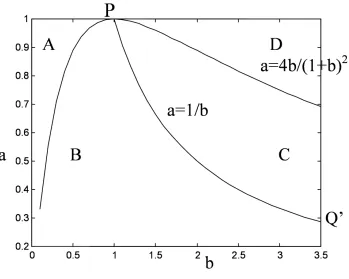
The model has five types of solutions: (1) Monotonically converging regime A and its borderline; (2) Damped oscillation regime B;(3)Explosive oscillation regime C;(4) Monotonically diverging regime D and its borderline;(5) Periodic oscillation curve PQ’. We should notice that the periodic oscillation occurs only at the borderline between B and C regime , i.e. curve PQ’. Patterns in the parameter space are shown in Figure 1.
3
、
Continous time Samuelson’s multiplier-accelerator model
We discuss the continuous time version of the above Samuelson’s model to demonstrate the relation between discrete time and continuous time linear models.
We simply replace the difference by the derivative in the above Samuelson’s model. We have
C(t)=aY(t-1)=a[Y(t)-(Y(t)-Y(t-1))]=a[Y(t)-Y’(t)] (2.5)
I(t)=b[C(t)-C(t-1)]=ba[(Y(t)-Y’(t))-(Y(t-1)-Y’(t-1))]=ba[Y’(t)-Y”(t)] (2.6)
In (2.5), Y(t)-Y’(t) stands for the correction of current income , so the consumption at time t , C(t), can be regarded as linear function of the correction of the income at time t, Y(t). In (2.6), Y’(t)-Y”(t) stands for the correction of the change of current income , so the investment at time t, I(t), can be regard as linear function of the correction of the change of the income at time t, Y(t).
As a result, we have continuous time Samuelson’s multiplier-accelerator model
I(t)= ba[Y’(t)-Y”(t)] (2.6)
Y(t)=C(t)+I(t)+G (2.7)
We have a second-order differential equation
Y”(t)+ b b 1 Y’(t)+ b a a * 1 Y(t)=G/(a*b) (2.8)
In (2.8), taking Y”(t) = Y’(t) = 0 we have equilibrium solution
Y(t) = G/(1-a) (2.9)
The correspondent homogeneous equation of (2.8) is
Y”(t)+ b b 1 Y’(t)+ b a a * 1 Y(t)=0 (2.10)
The characteristic equation is
2+
b b
1 + b a a * 1 =0 (2.11)
two roots of the characteristic equation are
1=(-b1+ )/2
2==(-b1- )/2
Where b1=
b b
1 ,=b
12-4(1-a)/(ba)
converging.
If b1<0, i.e.1< b,1,2are all positive roots and the solutions are monotonically
diverging.
If b1=0,= -4(1-a)/(ba)<0 ( for 0<a<1,b>0), so b1=0 is impossible .
B. When=0, equation (2.11) have two same real roots and the general solutions of
(2.8) are
Y(t)=(C1+C2t )exp(-t b1/2) + G/(1-a)
If b1>0, i.e. 1> b, the solutions are monotonically converging.
If b1<0, i.e. 1< b, the solutions are monotonically diverging.
If b1=0, i.e. 1= b, a= 1, but 0<a<1, so b1=0 is impossible .
C. When<0,1,2=+ i, Where=-b1/2,= /2.
The general solutions of (2.8) are
Y(t)=(C1COS(t)+C2SIN (t))exp(t)+ G/(1-a)
If>0, i.e. b1<0, i.e.1 < b, the solutions are explosive oscillation
If<0, i.e. b1>0, i.e. 1> b, the solutions are damped oscillation,
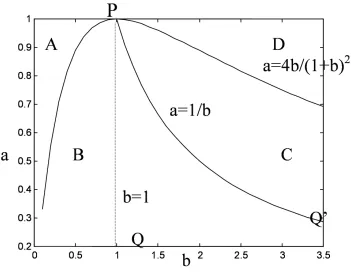
We have a periodic solution only when b = 1.
Similarly, this continuous-time model also has four dynamic regimes. Its pattern regimes are shown in Figure 2. Compared with the discrete-time Samuelson’s model, the only difference is the changing of the periodic border.
4
、
Conclusion
In this paper, we study the continuous-time Samuelson’s multiplier-accelerator model
and compare this continuous-time model with its classical discrete-time model. We find that time scales have an influence on the perfect symmetry of periodic motion.
References
Chen, P.(1993).Searching for Economic Chaos :A Challenge to Econometric Practice and Nonlinear Test. In eds. R.Day and P.Chen. Oxford Universitu, New York.
Gandolfo, G.(1981).Quantitative Analysis and Econometric Estimation of Continuous time Dynamic Models, North-Holland, New York.
Gandolfo, G.(1996).Economic Dynamic, Springer, Germany.
Goodwin, R, M.(1948).Secular and Cyclical Aspects of the Multiplier and the Accelerator , In: Income, Employment and Public Policy :Essays in Honor of A.H. Hansen(various authors),New York ,Norton,108-132.
Kaldor, N,(1940).A model of the trade cycle. Economic Journal 50,78-92.
Koopman,T.C.(1950).Models Involving a Continuous Time Variable, in: T. C.Koopman eds., Statistical Inference in Dynamic Economic Models, New York ,Wiley,384-389.
R. Merton,(1990), Continuous-time finance, Cambridge: Blacwell publishers
Samuelson P.A.(1939).Interactions between the multiplier analysis and the principle of acceleration, Review of Economics and Statistics,75-78.
Stutzer, M.J. (1980) Chaos dynamics and bifurcation in macroeconomic model, Journal of Economic Dynamics and Control, 2, 253-276.
Fig.1 Discrete-time Samuelson’s multiplier-accelerator diagram.
Fig.2 Continuous-time Samuelson’s multiplier-accelerator diagram