1
Connecting the dots: The Washington Consensus and the
"Arab Spring"
Shampa Roy-Mukherjee
Abstract
This article investigates the socio-economic causes that have led to the recent political instability in the Middle East and North Africa (MENA) region. The MENA region is characterised as one which holds massive hydrocarbon resources and yet suffers from low economic growth and development and high levels of unemployment. This article shows that the Arab uprisings are linked to the inequalities created by the opening up of the Arab countries to foreign capital and financial agencies, a project that is commonly referred to as Washington Consensus. This neo-liberal globalisation programme has been highly diverse in its effectiveness throughout the MENA region. However the state still remains the dominant economic player in this region and the Arab population still regards it as the primary provider. The state has been able to hold on to its power by limiting the role of private enterprise and also by maintaining an exclusive nexus between itself and the few prominent private sector companies. Although the wave of disillusionment and frustration amongst the Arab youth washed over the entire region with the same passion and propensity, the reaction of individual governments has been very varied. The future of the region lies in how effectively and efficiently the interim or newly elected governments are able to move their country beyond the pincers of, on the one hand, the Washington Consensus and, on the other, the old, state-centric and inefficient developmental regime.
Introduction
The current political turmoil in the Middle East and North Africa (MENA) region has brought ‘democratisation’ and ‘economic liberalisation’ to the forefront of political debate. The dramatic political developments since December 2010 have created uncertainty over future economic policy and reform in the MENA region1. Transitional governments in countries
2 1990s, in line with the Washington Consensus, will continue on the same path or if the political transition triggered by the Arab Spring will force them to take an alternative route to economic growth. Furthermore, although the Arab Spring provides an unprecedented opportunity for political, economic and social reform in the long term its immediate impact has been devastating, characterised by social unrest, sectarian violence, massive displacement of communities and deterioration of living standards in general2.
The countries belonging to the MENA region are hugely diverse at multiple levels such as history, population size, resources, policy and ideological orientation however they have
several unifying characteristics3. First, they all have similar demographic profiles
characterised by a disproportionately large youth population – ‘youth bulge’. The median age in Arab countries is 25, the second lowest in the world, with only Sub–Saharan African countries being younger4. Second, all countries within the MENA region have a dominant
public sector. Third, the main source of revenue for these countries comes from rents derived from oil and other hydrocarbons, international aid or remittances from abroad. Fourth, political power in these countries is concentrated in the hands of few, inasmuch as a robust civil society is absent and Islam plays an important role in the articulation between the public and the private sphere. The Arab uprisings have had very wide ranging impact in the region with some governments resorting to appeasement through increased subsidies and welfare and political reform while in a handful of countries the political elite have taken an extreme hard-line stance to remain in power.
Over the past few decades, the economic development strategies adopted by the MENA countries follow a path similar to most developing countries. From the 1950s to the mid-1980s the development strategy comprised of Import Substituting Industrialisation (ISI) policies which included strict controls on international trade, overvalued exchange rates and government controlled foreign exchange and credit markets5. The objective of such a
3 within this region. The collapse of oil prices in the 1980s and 1990s has led to significant reversal in economic growth and prosperity. Since the 1990s many MENA countries have embraced market-led, outward looking economic reform by adopting the structural adjustment programmes (SAP) introduced by the International Monetary Fund (IMF) and World Bank. These reforms were based on the neo-liberal policies prescribed in the Washington consensus which encouraged trade liberalisation, fiscal discipline and private-sector driven growth.
The objective of the paper is to review the recent economic developments and prospects of the MENA region in light of the policies outlined in the ‘Washington Consensus’ and the implications of the Arab uprising on short term economic performance and policy. The paper is divided into three sections. The first section defines the Washington Consensus, focussing on global impact of policy reforms and the ‘post Washington Consensus’, which was an effort to address inadequacies of neo-liberal globalisation innate in the term. The second section is a review of the economic performance and development of the MENA region before the Arab uprising in 2010 and how successfully countries within this region were able to adopt and implement the Washington Consensus policies. The third section links up the impact of reforms, driven by the neo-liberal policies of the Washington Consensus, upon social classes and categories, thus deciphering the cause of the Arab Spring in certain countries of the MENA region.
Washington Consensus
The Washington Consensus was a set of economic policies following a term introduced by the English economist, John Williamson, in 1989 and in response to the Latin American experience during the 1980s and 1990s. Post-Allende Chile, in fact, was the first country in the 1970s, and well before Thatcher's Britain, that experienced the key tenets of Washington consensus (privatizations, liberalisation of financial and banking system, welfare cuts and so on). Latin American countries were struggling to overcome devastating debt crisis, triple digit hyperinflation and balance of payments problem. Government spending was very high, monetary and fiscal policies were unstable and the weak central banks were unable to
control unsustainable credit expansions6. Export competitiveness was stifled by overvalued
currencies and unsustainable exchange rate policies leading to ever-widening trade gap. The 1980s were the famous lost decade when Latin American countries experienced stagflation and decline in per capita income7. In light of the Latin American crisis the
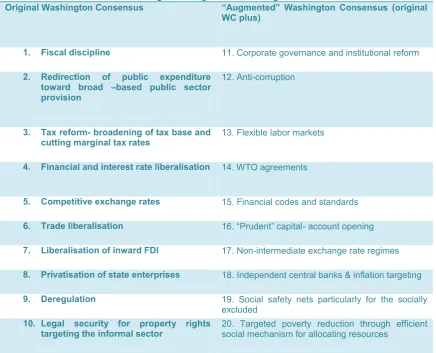
4 basis for developing countries. The Consensus included a list of policy reforms shown in table 1.
Table 1: The Original & Augmented Washington Consensus
Original Washington Consensus “Augmented” Washington Consensus (original WC plus)
1. Fiscal discipline 11. Corporate governance and institutional reform
2. Redirection of public expenditure toward broad –based public sector provision
12. Anti-corruption
3. Tax reform- broadening of tax base and
cutting marginal tax rates 13. Flexible labor markets
4. Financial and interest rate liberalisation 14. WTO agreements
5. Competitive exchange rates 15. Financial codes and standards
6. Trade liberalisation 16. “Prudent” capital- account opening
7. Liberalisation of inward FDI 17. Non-intermediate exchange rate regimes
8. Privatisation of state enterprises 18. Independent central banks & inflation targeting
9. Deregulation 19. Social safety nets particularly for the socially excluded
10. Legal security for property rights
targeting the informal sector 20. Targeted poverty reduction through efficient social mechanism for allocating resources
Source: Authors compilation of items from Rodrik (2006) and Williamson (2004)
Broadly speaking the Washington Consensus advocated that governments should pursue economic reform through policies (a) that lead to macroeconomic stability through fiscal austerity and inflation control; (b) that encourage liberalisation of trade and capital account;
(c) that promote privatisation and deregulation of domestic good and factor markets8. The
Washington Consensus policies inspired a wave of reforms that significantly transformed the
policy landscape in developing areas9. These reforms were introduced and propagated
through IMF and World Bank Stabilisation and Structural Adjustment Programmes and have become the prominent orthodoxy in development since the 1990s. This was a completely new approach to development and constituted a complete shift in paradigm.
5 planning was considered the most efficient system of resource allocation not only in socialist economies but also in the developing economies of Asia, Africa and Latin America. Government control over domestic development was the underlying theme in most development models during that time namely Rostow’s stages of growth hypothesis, Paul Rosentein-Rodan’s big push industrialisation hypothesis, the Harrod Domar growth model and the Gunnar Myrdal circular and cumulative causation model10. Prescribed policies
included import substitution, protection of domestic infant industry, direct involvement of the state in economic production and decision making, highly regulated financial and capital markets and restrictive trade and foreign investment policy. This approach to development slowly died out in the late 1970s as a result of the poor economic performance of the countries that had embraced such state controlled policies. The failure of state interventionism to promote effective and sustainable growth caused a significant shift in paradigm in favour of ‘economic liberalisation’. Economic liberalisation focussed on reducing the size and control of the state, promoting privatisation and liberalising foreign trade. These policy prescriptions have their foundations in neo-classical economics which also forms the basis of the Washington Consensus. Thus the mantra of the Washington Consensus in line with neo-liberal orthodoxy was to “stabilise, privatise and liberalise’11.
Neoliberal economists such as Lal, Little, Krueger and Bauer argued that market-led short term efficiencies would lead to long term growth. They believed that long term economic growth was the only way to achieve the key development goals of poverty reduction and welfare enhancement and that growth could be achieved through market driven economic policies by ensuring the most efficient allocation of resources. Empirical analysis reinforced his conviction that ‘market failure’ in itself did not justify government intervention and that ‘bureaucratic failure’, more likely to be prevalent in less developed economies, would only make matters worse. He proposed the slogan ‘Get the prices right !’ and ardently opposed economic policy that encouraged ‘political pricing’ most commonly manifested in developing countries with artificially maintained high exchange rates, government controlled interest rates, subsidised agricultural products and import tariffs on luxury and consumer goods12.
The concept of ‘poverty traps’ based on the notion that poverty and stagnation were self-perpetuating and that foreign aid was the only way that the poorer economies could escape
this trap was completely dismissed by Bauer and other neo-classical economists13. Implicit in
6 Equalisation Theorem and Stopler-Samuelson Theorem that international trade liberalisation would raise returns to an abundant factor, which in most poor countries is unskilled labour.
A comprehensive empirical study covering a period from 1970 to 2005 clearly indicates that countries that have embraced the trade liberalisation policy prescription of the Washington Consensus by lowering the tariffs on capital and intermediate goods have shown a significantly higher rate of growth than those where trade barriers remain14. The results
validate the neoclassical growth model proposed by Robert Solow (1956) which states that a country starting off with a low per capita capital stock will experience faster rate of growth of per capita income as it approaches the steady state and will ultimately converge with the developed economies. Theoretical models suggests a mechanism where lower tariffs will lead to cheaper capital and intermediate goods imports resulting in accelerated growth rates in countries with low per capita capital stock.
The proponents of the Washington Consensus believed that economic development would lead to an inverse U-shaped pattern of inequality as proposed by Kuznets15. Empirical
studies conducted by Kuznets demonstrated that as a country developed inequality would initially increase, then peak and eventually start to decrease. This is because industrialisation would cause a significant urban-rural inequality gap initially. As more and more of the work force moved away from low paid jobs in rural areas in search of better job prospects in the urban areas inequality was expected to decrease. This dual economy dynamics would eventually lead to fairer distribution of wealth. Many empirical studies have been conducted to test the validity of the Kuznets curve. Williamson carried out a study of wealth inequality in Britain between 1823 and 1915 and found that it followed a pattern consistent to the Kuznets curve16. A similar trend for US wealth inequality data was found17.
Empirical studies investigating European countries show that data from France, Germany and Sweden are consistent with Kuznets curve but other countries such as Norway and Netherlands demonstrate patterns of monotonically declining inequality from the mid-19th
century18. However the pattern of inequality in most Latin American and South East Asian
7 with Kuznets either because development does not lead to rising inequality – the case of the ‘East Asian Miracle’ or because of low levels of political mobilisation.
Post Washington Consensus
Although policy reforms propagated by the Washington Consensus were broadly embraced by Latin America, Sub-Saharan Africa, MENA region and East Asia they have were unable to produce the desired results in majority of these countries. Per capita GDP growth in Latin America has been below expectations and short-lived, rising from 0.06% in the period
1975-89 to 1.5 % in 1990-200119. During the same period the GDP per capita in Latin American
has grown from -1.5 to -0.5%20. Moreover in 24 African countries the GDP per capita is less
than 1975 level21. Although East Asian economies experienced high and sustained levels of
per capita growth of 5.9 % in throughout the 1080s and 90s, since the financial crisis in
1997-98 they have been widely condemned for their misguided economic policies22.
Moreover transitional economies that embraced the policy reforms of the Washington Consensus experienced significant reductions in their GDP. The phenomenal growth of India and China since the 1990s highlights the fact that both followed the development paths
significantly different from those proposed by the Washington Consensus23.
Over the past decade the policy prescriptions proposed by the Washington Consensus have come under fire from many different quarters. The policy makers realised that the original list had a very narrow scope and focussed predominantly on macro and microeconomic policy reforms and did not feature any institutional reform24. This gave birth to the ‘Augmented
Washington Consensus’ that included a list of reforms that were focused on institutional reforms (Table 1). The realisation was that the stabilisation, liberalisation and privatisation policy reforms would not be sustainable if institutional conditions were poor. Strong governance, rule of law, political equality, social justice and economic efficiency were the
key elements to long term sustainable growth25.
Critics of the Washington Consensus proposed an alternative development path that had broader goals and objectives. This has been termed by many policy makers as the ‘Post Washington Consensus’. Stiglitz argued that the new consensus should include the broader development objectives of ‘sustainable development, egalitarian development and
democratic development’26
8 policy regime27. It is based on the concept of an ‘inclusive-neoliberal development regime’ in
the global economy. This new consensus advocates that governments, and not the international financial institutions, should take the lead in both owning and directing the neo-liberal policies. Proponents of the new consensus believe that giving the recipient government ownership is more likely to result in a genuine commitment towards implementing the structural adjustment policies as well as wider participation from civil society. Inclusive neo-liberalism can only succeed if public institutions are transparent, accountable and responsive. It is this kind of Post Washington Consensus path that should be the way forward in the Middle East.
The MENA Region: Economic Performance and Challenges
Following the collapse of oil prices in the mid-1980s and the subsequent balance-of-payments crisis, some of the MENA countries adopted macroeconomic stabilisation programmes promoted by the World Bank, IMF and other western donors28. By the early
1990s nearly all MENA economies followed suit. These structural adjustment programmes included neo-liberal reforms that were in line with the Washington Consensus guidelines. The objective was to promote growth and prosperity in the region by opening up the political
economies and integrating them into global markets29. Pre-1990 development strategies had
led to inward-looking, state led economic systems that were unable to compete in the global market. The economic fortunes of this region were, and still are, heavily reliant on rents derived from fuel exports, international aid and remittances resulting in volatile and unsustainable long term growth. Reforms were introduced to dismantle the system of centralised bureaucratic control and to promote a market-driven economy with a strong private sector and an increased focus on international trade liberalisation. This section of the paper will be concentrating on the impact of these reforms on the economic performance of this region.
The MENA region may be characterised as one which holds massive hydrocarbon resources and yet suffers from low economic growth and development and high levels of
unemployment30. Based on the availability of hydrocarbon resources and population size the
World Bank (2007) has classified the countries within this region into the following three groups:
Resource-rich, labour abundant countries (RRLA) – this group includes countries that
9
Resource-rich, labour importing countries (RRLI) – the Gulf States of Bahrain, Qatar,
Oman, Saudi Arabia, United Arab Emirates, Kuwait and Libya fall into this group and are characterised as countries that have large expatriate populations and high reserves of hydrocarbon resources
Resource poor, labour abundant countries (RPLA) – this class includes small
producers or importers of oil and natural gas – Egypt, Tunisia, Morocco, Jordon, Lebanon, Mauritania, Djibouti, and the Palestinian Authority fall in this group.
Source: Authors calculations from World Bank database and DataStream
Any analysis of the economic performance of this region will be done in the context of these three distinct groups in mind.
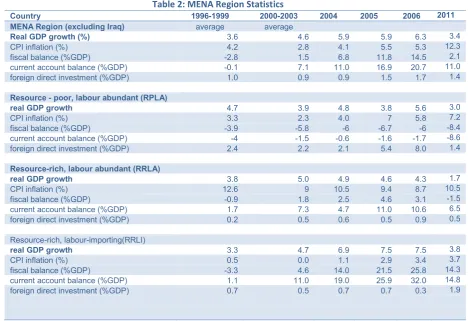
[image:9.595.62.531.230.551.2]The economic performance in terms of GDP growth shows a positive trend in the MENA region, rising from 3.5% in the late 1990s to 6.3% in 2006 and 3.4% in 2011 (Table 2). Although there has been a significant improvement in the overall GDP growth in the region (pre-global recession 2007 and political turmoil in MENA 2010) the pattern of growth has been different for each of the separate groups. The major driver of growth has been oil
Table 2: MENA Region Statistics
Country 1996-1999 2000-2003 2004 2005 2006 2011
MENA Region (excluding Iraq) average average
Real GDP growth (%) 3.6 4.6 5.9 5.9 6.3 3.4
CPI inflation (%) 4.2 2.8 4.1 5.5 5.3 12.3
fiscal balance (%GDP) -2.8 1.5 6.8 11.8 14.5 2.1
current account balance (%GDP) -0.1 7.1 11.0 16.9 20.7 11.0
foreign direct investment (%GDP) 1.0 0.9 0.9 1.5 1.7 1.4
Resource - poor, labour abundant (RPLA)
real GDP growth 4.7 3.9 4.8 3.8 5.6 3.0
CPI inflation (%) 3.3 2.3 4.0 7 5.8 7.2
fiscal balance (%GDP) -3.9 -5.8 -6 -6.7 -6 -8.4
current account balance (%GDP) -4 -1.5 -0.6 -1.6 -1.7 -8.6
foreign direct investment (%GDP) 2.4 2.2 2.1 5.4 8.0 1.4
Resource-rich, labour abundant (RRLA)
real GDP growth 3.8 5.0 4.9 4.6 4.3 1.7
CPI inflation (%) 12.6 9 10.5 9.4 8.7 10.5
fiscal balance (%GDP) -0.9 1.8 2.5 4.6 3.1 -1.5
current account balance (%GDP) 1.7 7.3 4.7 11.0 10.6 6.5
foreign direct investment (%GDP) 0.2 0.5 0.6 0.5 0.9 0.5
Resource-rich, labour-importing(RRLI)
real GDP growth 3.3 4.7 6.9 7.5 7.5 3.8
CPI inflation (%) 0.5 0.0 1.1 2.9 3.4 3.7
fiscal balance (%GDP) -3.3 4.6 14.0 21.5 25.8 14.3
current account balance (%GDP) 1.1 11.0 19.0 25.9 32.0 14.8
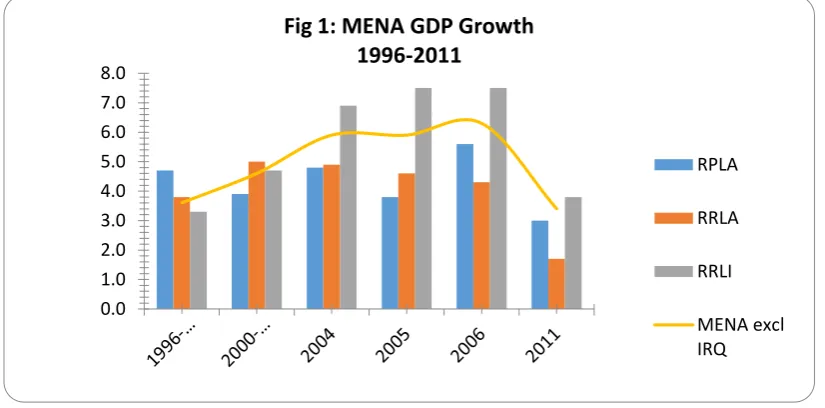
10 revenues. The surge in GDP growth of the RRLI countries from approximately 3.3% in the late 1990s to nearly 7.5% in 2006 (Fig1) is due to soaring oil prices during this time period. RRLA countries also show significant increase in GDP between 1996 and 2003 and then seem to have stagnated. GDP of the RPLA countries dropped between 2000 and 2003 however this group has shown signs of recovery since 2004, led mainly by Egypt. Egypt introduced a wave of new economic reforms in 2004 as part of SAP steered by the IMF. This has resulted in a phenomenal 6.8% growth in GDP in Egypt in 2006. The Egyptian policy makers have focussed on speeding up privatisation, creating new opportunities in manufacturing, construction and finance industries, contributing to the acceleration in industrial production to 3.4% in 2006 in the RPLA group countries.
The Egyptian government has also reduced import tariffs and income tax thus boosting domestic consumption, which has been the main driving force behind Egyptian economic boom. FDI inflows rose from 0.3% of GDP in 2003 to 5.0 % in 2006 which is significantly higher than any other country in this RPLA group. The main findings of the studies carried out by World Bank demonstrate that GDP growth has been higher in those groups of countries, namely RRPI and RPLA, where there has been strong evidence of implementation of reforms in order to achieve better business environment31.
[image:10.595.70.483.278.482.2]0.0 1.0 2.0 3.0 4.0 5.0 6.0 7.0 8.0
Fig 1: MENA GDP Growth
1996-2011
RPLA
RRLA
RRLI
MENA excl IRQ
Source: Authors calculation based on data collected from the World Bank Database and DataStream
11 Although the MENA region has experienced positive GDP growth rates since the mid-1990s this has not been reflected in the GDP per capita growth rates in the region. This is because the population has grown faster in this region than the GDP. Between 2000 and 2010 the annual average GDP growth rate was 4.8% however in the same the per capita GDP grew by only 2.5%.
Source: Authors calculations based on World Bank and IMF-IFS data base.
The gap between the GDP and per capita GDP in this region is very high, second only to the Sub-Saharan African region. This gap varies amongst countries in the MENA region, the widest being in Iraq, Yemen and UAE and narrowest being in Morocco, Tunisia and Lebanon (World Bank Data).
The overall fiscal position in the MENA region shows a vast improvement from a deficit of 2.8% of GDP in 1996 to a surplus of 14.5% of GDP in 2006 mainly due to the large revenues from oil exports. However the surplus fell back to 14.3% in 2011 mainly due to the global recession post 2007 and the political turmoil in the MENA region since 2010.
The growth in oil revenues from $180 billion in 2002 to $620 billion in 2007 (IDB) has mainly been due to the rise in oil prices and has led to huge increases in capital account and fiscal balances. The main driver of positive increase in fiscal balances within the region has been RRLI group with a fiscal balance of 25.8% in 2006. Kuwait, UAE and Saudi Arabia have reported the largest surpluses in this group. The RRLA saw their fiscal balance deteriorate from 4.6% in 2005 to 3.1% of GDP in 2006 and further fall to -1.5% in 2011.RPLA has shown a slight improvement in fiscal deficit from -6.7% of GDP in 2005 to -6.0% in 2006 but
0.0 1.0 2.0 3.0 4.0 5.0 6.0 7.0 8.0
Sub Saharan
Africa
MENA Latin
America & Caribbean
East Asia & Pacific
[image:11.595.70.502.178.388.2]European Union
Fig 2 :GDP and per capita GDP growth by region 2012
Average GDP per capita growth Average GDP growth
12 IHOO WR EDFNIXUWKHU WR LQ +LJK OHYHO RIILVFDO GHILFLW LQ WKH 53/$ FRXQWULHV ZDV GULYHQE\ZHDNHUUHYHQXHVDQGKLJKHUSXEOLFVSHQGLQJ$UHGXFWLRQLQLPSRUWWDULIIVGURYHXS
LPSRUW GHPDQG OHDGLQJ WR KLJK FXUUHQW DFFRXQW WKXV IXUWKHU GHWHULRUDWLQJ WKH EDODQFH RI SD\PHQWV
7KHUH LV QR GRXEW WKDW WKH PRVW LPSRUWDQW IDFWRU RI *'3 JURZWK DQG SRVLWLYH ILVFDO DQG
FXUUHQW DFFRXQW EDODQFHV LQ WKH 0(1$ UHJLRQ KDV EHHQ GXH WR WKH VXUJH LQ RLO UHYHQXHV KRZHYHUWKHUHKDVDOVREHHQDSRVLWLYHLPSDFWRQWKHHFRQRPLFSHUIRUPDQFHRIWKHUHJLRQ DVDUHVXOWRIWKHVWUXFWXUDOFKDQJHVDQGUHIRUPVLQWURGXFHGVLQFHWKHPLGV2QHRIWKH
PRVWLPSRUWDQWDUHDVRIUHIRUPKDVEHHQWUDGHSROLF\
7UDGHKDVLQFUHDVHGGXHWRWKHJURZLQJHFRQRPLFRSHQQHVVVHWWLQJXSRIIUHHWUDGHDUHDV
VXFK DV ± $UDE 0DJKUHE 8QLRQ $08 *XOI &RRSHUDWLRQ &RXQFLO *&& DQG *UHDW $UDE )UHH7UDGH$JUHHPHQW*$)7$DQGWKHVLJQLQJRIIUHHWUDGHDJUHHPHQWVZLWKWKH(XURSHDQ
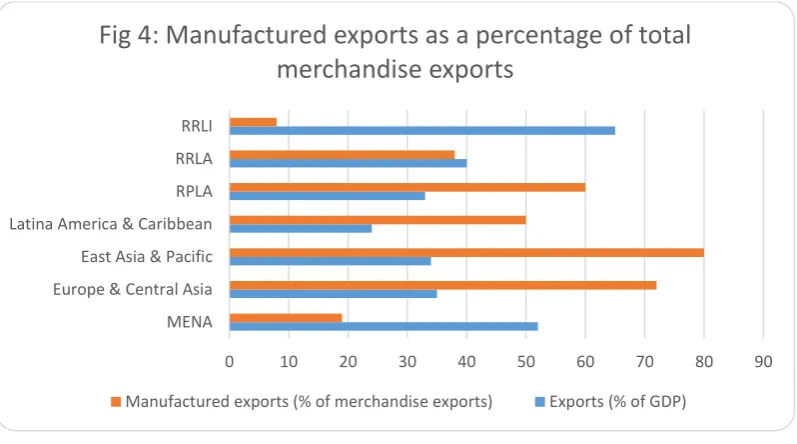
8QLRQDQG8QLWHG6WDWHV1HDUO\RIDOOH[SRUWVLQWKH0(1$UHJLRQDUHIXHODQGUHODWHG H[SRUWVPDQXIDFWXUHGH[SRUWVFRQVWLWXWHDYHU\VPDOOSDUWRIWRWDOH[SRUWVDQGLVRQHRIWKH ORZHVWFRPSDUHGRWKHUHFRQRPLFUHJLRQV)LJ53/$FRXQWULHVKDYHWKHKLJKHVWSURSRUWLRQ
RIPDQXIDFWXUHGH[SRUWVZLWKLQWKHUHJLRQDQG(XURSHDQ8QLRQLVWKHLUPDLQH[SRUWPDUNHW ,QWUD0(1$LVRQO\DVPDOOIUDFWLRQRIWKHUHJLRQV¶WRWDOWUDGH2QHRIWKHUHDVRQVIRUSRRU
LQWUDUHJLRQDOWUDGHLVWKHODFNRISURGXFWFRPSOHPHQWDULW\0(1$UHJLRQFRXQWULHVKDYHQRW EHHQDEOHWRGLYHUVLI\WKHLUSURGXFWEDVHHVSHFLDOO\LQPDQXIDFWXULQJ+RZHYHUVXUSULVLQJO\
13
[image:13.595.74.473.199.421.2]0 20 40 60 80 100
Fig 5: Tariff Reform Index (percentile ranking) 2000-2007
the intraregional trade pattern shows that RRLI (mainly GCC) countries tend to trade amongst themselves, where lack of product complimentarity is greatest, rather than with Maghreb countries. High transportation and communication costs are an impediment to intraregional trade. The difficult terrain in the Arab regions and lack of infrastructure increase trade costs. Geographically the Maghreb countries are closer to Europe than other Arab countries making it easier to trade with Europe.
Although there has been a greater emphasis on trade reforms in recent years, tariff rates remain very high in the MENA region compared to anywhere else in the world (IDB).
Egypt has introduced trade reforms in 2004 and 2007 to reduce tariffs from 17% to 6%. The strongest reformers in the region are Egypt, Jordan, Lebanon, Yemen and Saudi Arabia. The difference in tariff rates within the region is one of the main reasons for poor intra-MENA trade.
0 10 20 30 40 50 60 70 80 90
[image:13.595.90.461.606.789.2]MENA Europe & Central Asia East Asia & Pacific Latina America & Caribbean RPLA RRLA RRLI
Fig 4: Manufactured exports as a percentage of total
merchandise exports
Manufactured exports (% of merchandise exports) Exports (% of GDP)
Source: World Bank 2011a
14
7KHUHKDVEHHQDVLJQLILFDQWLQFUHDVHLQ)RUHLJQ'LUHFW,QYHVWPHQWLQWKH0(1$UHJLRQRYHU
WKH SDVW IHZ GHFDGHV PDLQO\ GXH WR LQFUHDVHG LQYHVWPHQWV LQ WKH HQHUJ\ VHFWRU 7KH PDMRULW\ RIWKH LQIORZV KDYH EHHQ WDUJHWHG WRZDUGV WKH 55/, FRXQWULHV ,Q WKH UHJLRQ
UHFHLYHG 86 ELOOLRQ RI )', WKUHH TXDUWHUV RI ZKLFK ZHQW WR WKH 55/, FRXQWULHV ZLWK 6DXGL $UDELD UHFHLYLQJ RI WKH WRWDO LQIORZ 7KH 53/$ FRXQWULHV UHFHLYHG D KLJK
SURSRUWLRQRIWKH)',LQIORZVZLWK(J\SWDQG-RUGRQEHLQJWKHPDLQUHFLSLHQWV$OWKRXJKWKH 55/,FRXQWULHVUHFHLYHGPRVWRIWKH)',LQIORZVLQDEVROXWHWHUPVWKH53/$FRXQWULHVGLG
VLJQLILFDQWO\ EHWWHU LQ UHODWLYH WHUPV )', LQIORZV LQFUHDVHG IURP RI *'3 LQ WKH ODWH VWRRI*'3LQ7KLVLVVLJQLILFDQWO\KLJKHUWKDQWKH55/,DQG55/,FRXQWULHV ,QRUGHUWRDWWUDFWPRUH)',)UHH(FRQRPLF=RQHVKDYHEHHQVHWXSLQWKHUHJLRQZLWKWKH
REMHFWLYHRISURYLGLQJILQDQFLDOILVFDODQGUHJXODWRU\LQFHQWLYHVWRWKHLQYHVWRUV
7KH 0(1$ UHJLRQ VXIIHUV IURP ORQJ WHUP VWUXFWXUDO XQHPSOR\PHQW HVSHFLDOO\ DPRQJVW WKH
\RXWKZRPHQDQGWKHHGXFDWHG2QHRIWKHORQJWHUPLVVXHVKDVEHHQWKHRYHUUHOLDQFHRQ WKHSXEOLFVHFWRUIRUMREFUHDWLRQDQGWKHODERXUPDUNHWULJLGLWLHVWKDWKDYHSUHYHQWHGSULYDWH
VHFWRUMREFUHDWLRQ:RUOG%DQN3HRSOHSUHIHUWRZRUNLQWKHSXEOLFVHFWRUEHFDXVHRIMRE VHFXULW\DQGWKHJHQHURXVEHQHILWV
Source: Authors compilation based on DataStream and World Bank databases
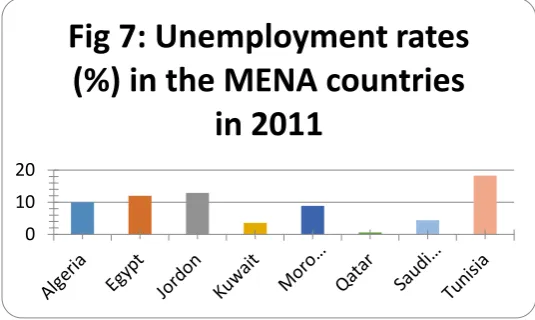
15 In general public sector salaries are higher than the private sector salaries in this region. Unemployment rates vary across the MENA region where the GCC countries have lowest rates of unemployment. However unemployment rates amongst GCC nationals is high as it employs a high proportion of foreign nationals. The unemployment rates in Egypt, Tunisia and Morocco have been around 10% over the past decade. Yemen, Algeria and The Palestinian Authority high witnessed very high rates of unemployment over the past decade.
Unemployment figures in the MENA region can be slightly misleading as a very large percentage of the population works in the informal sector where wages are low, jobs are insecure and working conditions are very poor. Demographic changes in the MENA region is
the main cause of such high unemployment rates amongst the youth in the region.
The MENA region has vast endowments of human, financial and natural resources making it an economically significant player in the global market. A review of the recent developments and economic performance in the MENA countries show that overall GDP growth in the region between 1996 and 2006 has been steadily increasing. However the pattern of growth between RRLA, RRLI and RPLA countries vary significantly with oil revenues being the main driver of economic growth. The strong economic acceleration in the recent years has been matched by rapid increase in total population and the labour force. As a result the gap between GDP growth and GDP per capita growth has been increasing along with the unemployment rate. Unemployment is higher amongst graduates and the female population, and the region experiences large inter-regional labour movements triggering substantial financial flows in the form of workers’ remittances from abroad. Oil and oil-related products account for three quarters of the regions exports with the EU being the regions’ most important trading partner however there is very limited inter-regional trade. This is mainly
[image:15.595.71.339.73.233.2]0 10 20
Fig 7: Unemployment rates
(%) in the MENA countries
in 2011
16 due to the poorly diversified export base of countries in this region. The region is also vulnerable to exogenous shocks mainly oil price and commodity price shocks. Oil price shocks directly affect the government revenues of oil exporting countries. As the region is a net importer of food and other non-fuel primary goods the recent rise in food and primary commodity prices has affected the current account balance, fiscal balance and inflation rates of most MENA countries adversely. A large proportion of government revenues are spent on subsidising food and fuel prices. The region has limited integration with the international capital markets. Most of the foreign direct inflows accounted for in this region are accrued by the GCC countries, Saudi Arabia in particular. Portfolio investment is also insignificant, resulting in undercapitalised equity markets. Governments have realised that long term stable economic growth cannot be achieved without sustainable foreign investment and greater capital market integration34.
Causes of the uprisings
Social and political unrest still rumbles on in the Arab countries in transition (including Egypt, Jordan, Libya, Morocco, Tunisia, Syria and Yemen) two years after the Arab Spring uprisings started in December 201035. The political transitions in these countries can be
characterised intense political and social unrest culminating in either regime change or a consolidation of power through political repression and income redistribution. In some countries within the MENA region political tensions remain high despite democratic transition. Although the patterns and demographics of the protests varied widely amongst the different countries the unifying purpose was to achieve personal dignity, human rights
[image:16.595.71.452.307.482.2]0 5 10 15 20 25 30 35
Fig 8:Unemployment in percentage among youth, women
and educated in 2009
Youth Women
17 and responsive government. However there has also been a strong economic rationale for the uprisings. A recent survey conducted in Egypt revealed that two thirds of the respondents identified either a lower level of inequality or provision of basic necessities for all citizens to be the essential characteristic of democracy36. I argue that the Arab uprisings
have been fuelled by poverty, inequality, unemployment and lack of economic opportunity and if the transitional economies fail to address these concerns democracy will fail. But addressing this means reversing neo-liberal globalisation and moving towards a political and economic regime that goes beyond the deficiencies of both, the old, state-centric developmental model and that of neo-liberal globalisation and the Washington Consensus.
Despite the neo-liberal reforms introduced the 1990s an arteriosclerotic state remains the most important economic player in the MENA region stifling out the scope for private-sector led sustainable economic growth. Gilbert Achcar describes the recent political turmoil in the
MENA region as ‘revolutionary shock wave’ 37 and draws on Marxist ideology to explain its
cause. He goes on to identify the main trigger to be the struggle between ‘relations of production’ and ‘productive forces’ thus leading to a general blockade in the region’s economic development. He describes in great detail the characteristics of Arab capitalism that is ‘politically determined’ rather than driven by ‘profit motive’ as in rational systems of capitalism. He argues that one of the main features of MENA capitalism are the ‘patrimonial’ ( in most RRLA and RPLA countries) and ‘neo-patrimonial’ (in most RPLA countries) regimes that dominate the state. These patrimonial/neo-patrimonial regimes, in the absence of adequate legal systems and fuelled by corruption and nepotism, have given rise to ‘state bourgeoisie’ rather than what Achcar refers to as ‘free-market bourgeoisie’. This in turn along with rentierism and expansion of financial capitalism has caused investors to shy away from long term productive investment in this region resulting in stagnated economic growth and high unemployment.
Most countries in the MENA region rely on the state for food and energy subsidies and for employment in the public sector. This has led to has led to large fiscal burdens that the resource rich Arab nations have managed to balance with rents derived from fuel exports, resource poor Arab nations are heavily reliant on foreign aid and remittances to balance fiscal outlays. The MENA region has operated the subsidy system for the past 40 yrs and the current government spending on subsidies for the whole region is approximately $50 billion38. This system however is inefficient and volatile and does not encourage human
18 the cost of redistribution has risen significantly due to escalating global food prices and the MENA regions’ massive reliance on food imports. Over 90% of food requirements of the GCC are imported39. The volatile fuel prices have also led to fiscal instability and high levels
of inflation in the region.
The state is still the largest employer in the MENA region. Public sector employment ranges from 22% of the work force in Tunisia to around 33-35% in Jordan, Egypt and Syria. People working in public sector receive high salaries, job security and other benefits that private sector is unable to deliver. Thus young graduates are attracted to public sector jobs where remuneration is not linked to skill or performance. This has resulted in a shortage of skilled workers in the private sector. Also there is a massive gap in the skills acquired by graduates at university and the skills required by business. This complete mismatch of skills is a major source of unemployment in the MENA region. As the labour force in this region is growing at a much faster rate than jobs created in the public sector the only way forward is reform the welfare and subsidy system and promote private sector led industrialisation. This has led to a tremendous amount of discontent amongst the youth of this region.
The state in the region is an agent of neo-liberal globalisation, not an agent of reform for itself. Studies carried out by the World Bank on the quality of public administration in the MENA region measures the efficiency of the bureaucracy, rule of law, protection of property rights, level of corruption, quality of regulations and mechanisms of internal accountability40.
The findings of this study show that in terms of public sector accountability the region shows very high reform rankings indicating a positive change in the attitude of public sector institutions. Public accountability measures transparency and openness of political institutions, public representation and participation, civil liberties and freedom of press. This may be explained partly by the conditional ties imposed by aid donors to be more transparent and open and partly due to the pressures from international trading partners and investors.
19
Conclusion
The paper has tried to demonstrate that the economic success in the region has been mostly confined to the RRLI countries with vast reserves of hydrocarbon resources. These countries have been able to invest their fiscal reserves in infrastructure projects and in subsidising fuel and food prices. This group of countries have also been the able to attract considerable amount of investment from abroad. Economic success in RRLA countries has also been driven by fuel resources and remittances from abroad making them highly susceptible to international oil prices and labour market fluctuations. The economic performance of the RPLA countries has been heavily reliant on foreign aid and labour remittance from abroad. Tied in with the aid and investment are conditions imposed by donor countries and institutions insisting on structural changes in goods, labour and capital markets. These conditions impose restrictions on the size and role of the governments in these countries. Evidence over the past couple of decades shows that these structural changes have been implemented in the MENA countries at different rates and with different degrees of success. The state still remains the dominant economic player in this region and the Arab population still regards it as the primary provider. The state has been able to hold on to its power by limiting the role of private enterprise and also by maintaining an exclusive nexus between the state and the few prominent private sector companies.
20 The future of the region lies in how effectively and efficiently the interim or newly elected governments are able to implement the political and economic changes they have promised in their election manifestoes, and how able they will be to move their country beyond the pincers of, on the one hand, the Washington Consensus and, on the other, the old, state-centric and inefficient developmental regime.
Notes
[1] Khan, M (2012) 'What economic model is Egypt going to adopt ?' , VoxEU.org, 8 November
[2] O’Sullivan, A., Rey, M.-E. and Galvez, M. (2011) 'Opportunities and Challenges in the
MENA Region', The Arab world competitiveness report, 2011–2012
[3] Malik, A. and Awadallah, B. (2013) 'The Economics of the Arab Spring', World
Development, 45(0), pp. 296-313.
[4] Springborg, R. (2011a) 'The political economy of the Arab Spring', Mediterranean Politics, 16(3), pp. 427-433.
[5] Dahi, O. S. and Demir, F. (2008) 'The Middle East and North Africa', International
Handbook of Development Economics, 2.
[6] Feinberg, R. (2008) 'Competitiveness and Democracy', Latin American Politics and
Society, 50(1), pp. 153-168.
21
[8]
Gore, C. (2000) 'The rise and fall of the Washington Consensus as a paradigm fordeveloping countries', World Development, 28(5), pp. 789-804.
[9] Rodrik, D. and Bank, W. (2006) 'Goodbye Washington Consensus, Hello Washington Confusion? A Review of the World Bank's "Economic Growth in the 1990s: Learning from
a Decade of Reform"', Journal of Economic Literature, 44(4), pp. 973-987.
[10] Woo, W. T. (2004) 'Serious inadequacies of the Washington Consensus:
misunderstanding the poor by the brightest', Diversity in Development: Reconsidering
the Washington Consensus, FONDAD, The Hague.
[11] Nonneman, G. (1996) Political and economic liberalization: dynamics and linkages in
comparative perspective. Lynne Rienner Publishers.
[12] Lal, D. (2012) 'Is the Washington Consensus Dead?', Cato Journal, 32(3).
[13] World Bank Staff (1997) World development report 1997: the state in a changing world. Oxford University Press.
[14] Estevadeordal, A. and Taylor, A. M. (2008) 'Is the Washington consensus dead?
Growth, openness, and the great liberalization, 1970s–2000s', Review of Economics
and Statistics, (0).
[15] Kuznets, S. (1955) 'Economic growth and income inequality', The American economic
review, 45(1), pp. 1-28
[16 ] Lindert, P. H. and Williamson, J. G. (1985) 'Growth, equality, and history', Explorations
in Economic History, 22(4), pp. 341-377.
[17] Goldin, C. and Katz, L. F. (1999) The returns to skill in the United States across the
twentieth century: National Bureau of Economic Research.
[18] Acemoglu, D. and Robinson, J. (2008) 'The Role of Institutions in Growth and
Development', World Bank, Washington DC.
[19] Woo 2004
[20] Woo 2004
[21] Milanovic, B. (2003) 'The two faces of globalization: against globalization as we know it',
World Development, 31(4), pp. 667-683.
[22] Stiglitz, J. E. (1999) 'More instruments and broader goals: moving toward the post-Washington
22
[23] Buckley, R. (2009) 'The Economic Policies of China, India and the Washington
Consensus: An Enlightening Comparison', UNSW Law Research Paper, (2009-22).
[24] Rodrik, D. and Bank, W. (2006) 'Goodbye Washington Consensus, Hello Washington Confusion? A Review of the World Bank's "Economic Growth in the 1990s: Learning from a Decade of Reform"', Journal of Economic Literature, 44(4), pp. 973-987.
[25] Held, D. (2005) 'At the global crossroads: The end of the Washington Consensus and the rise of global social democracy?', Globalizations, 2(1), pp. 95-113.
[26] Stiglitz 1999
[27] Ruckert, A. (2006) 'Towards an inclusive-neoliberal regime of development: From the
Washington to the post-Washington consensus', Labour, Capital and Society, 39(1).
[28] http://siteresources.worldbank.org/INTMENA/Resources/Privilege_complete_final.pdf
[29] Naím, M. (2000) 'Washington Consensus or Washington Confusion?', Foreign Policy, (118), pp. 87-103.
[30] Dahi, O. S. and Demir, F. (2008) 'The Middle East and North Africa', International
Handbook of Development Economics, 2.
[31]Nabli, M. K. (2011) 'Middle East and North Africa: Recent Economic Developments and
Prospects'. IDB Lecture Series: Islamic Development Bank, Saudi Arabia.
[32] http://web.worldbank.org/WBSITE/EXTERNAL/COUNTRIES/MENAEXT/Development Prospects in
MENA
[33] http://siteresources.worldbank.org/INTMENA/Resources/EDP07_CHAPTER_1_Aug7.pdfnd
Short-Term
[34] http://www.imf.org/external/pubs/ft/mena/05econ.htm
[35] Khandelwal, P. and Roitman, A. (2013) 'The Economics of Political Transitions:
Implications for the Arab Spring', IMF Working Paper No. 13/69.
[36]Desai, R. M. (2011) 'The Economic Imperatives of the Arab Spring', The G-20 Cannes
Summit 2011: Is the Global Recovery Now in Danger.
[37] Achcar, G. (2013) The People want: A radical Exploration of the Arab Uprising, Berkley:
23 [38] Springborg, R. (2011b) 'The Precarious Economics of Arab Springs', Survival, 53(6), pp.
85-104.
[39] Malik, A. and Awadallah, B. (2013) 'The Economics of the Arab Spring', World
Development, 45(0), pp. 296-313.
[40] Nabli, M. K. (2011) 'Middle East and North Africa: Recent Economic Developments and Prospects'. IDB Lecture Series: Islamic Development Bank, Saudi Arabia
Shampa Roy-Mukherjee is the Subject Head for Finance, Economics and Risk at the University of East London. She holds a PhD in Economics from the University of Birmingham and her research interests include endogenous growth models, structural reforms, development economics, social inclusion, economics of happiness and well-being.