Analysis and Design of Power System Stabilizers and FACTS Based
Stabilizers using GA
Kailash Singh
1Mahadeer Dubey
2Sudeep Shrivastava
3Neeraj Kumar Soni
41,4
M.Tech Scholar
2,3Assistant Professor
1,4
Department of Power System & Control
2,3Department of Electrical Engineering
1,2,3,4Vac Ambikapur (C.G.), India
Abstract— Transmission networks of modern power systems are becoming increasingly stressed because of growing demand and restrictions on building new lines. One of the consequences of such a stressed system is the threat of losing stability following a disturbance. Flexible ac transmission system (FACTS) devices are found to be very effective in a transmission network for better utilization of its existing facilities without sacrificing the desired stability margin. Flexible AC Transmission System (FACTS) such as Static Synchronous Compensator (STATCOM) and Static VAR Compensator (SVC), employ the latest technology of power electronic switching devices in electric power transmission systems to control voltage and power flow. A static synchronous compensator (STATCOM) is a shunt device of the flexible AC transmission systems (FACTS) family. The STATCOM regulates voltage at its terminal by controlling the amount of reactive power injected into or absorbed from power system. When system voltage is low, STATCOM generates reactive power and when system voltage is high it absorbs reactive power. In this research work, STATCOM controller based on Genetic algorithm is proposed in single machine infinite bus system (SMIB). Proposed controller is implemented under MATLAB/SIMULNK environment.
Key words: STATCOM, MATLAB, FACTS, Transmission
System
I. INTRODUCTION
The power transfer capability of long transmission lines is usually limited by thermal capability, dielectric strength and a number of stability issues. Economic factors, such as high cost of long lines and revenue from the delivery of additional power, give strong incentives to explore all economically and technically feasible means of raising the stability limit. The family of FACTS devices makes use of gate turn-off thyristors (GTOs) in high power converter conjurations that can be controlled to behave as three phase sinusoidal voltage sources, to provide fast control of active and reactive power through a transmission line. The family of FACTS devices includes the Static Var Compensators (SVCs), Static Synchronous Compensators (STATCOMs), Thyristor Controlled Series Compensators (TCSCs), the Static Synchronous Series Compensators (SSSCs), and the Unified Power Flow Controllers (UPFCs). The FACTS technology is not a single high power controller but rather a collection of controllers which can be applied individually or in coordination with other to control one or more of the inter related system parameters like voltage, current, impedance, phase angle and damping of oscillations at various frequencies below the rated frequency. Among all FACTS devices, static synchronous compensators (STATCOM) plays much more important role in reactive power compensation and voltage support because of its attractive
steady state performance and operating characteristics. The fundamental principle of a STATCOM installed in a power system is the generation ac voltage source by a voltage source inverter (VSI) connected to a dc capacitor.
A. Working Principal of STATCOM
The basic principle of reactive power generation by voltage-sourced converter is akin to that of the conventional rotating synchronous machine. The basic voltage-sourced converter scheme for reactive compensation is shown schematically in Figure 1. From a dc input voltage source, the converter produces a set of controllable three-phase output voltages provided by the charged capacitor Smith the system frequency of the ac power system.
A phase shift between the two voltages, d, allows real power to flow and thus can be used to regulate the dc bus voltage, as in (1).In addition, the reactive current or power can be controlled by adjusting the relative voltage of the converter output voltage, as in (2). Figure-1: A single-line diagram of var generator by rotating
a voltage-sourced switching converter .
𝑃(𝛿) = 𝑉𝑃𝐶𝐶𝑉𝑠𝑡
𝑋 𝑆𝑖𝑛𝛿 (1)
𝑄(𝑉𝑠𝑡) =
𝑉2𝑃𝐶𝐶− 𝑉𝑃𝐶𝐶𝑉𝑠𝑡𝑐𝑜𝑠𝛿
𝑋 (2)
B. Mathematical Description of STATCOM
According to mathematical model of STATCOM, thedynamic model of STATCOM can bedescribed as in equation (2)
𝐿𝑑𝐼𝑎𝑏𝑐
𝑑𝑡 + 𝑅𝐼𝑎𝑏𝑐= 𝑈𝑎𝑏𝑐− 𝑉𝑎𝑏𝑐 (3)
Equations (3) can be transformed to synchronously rotatingreference frame using the Park’s transformation, as in (4)
[image:1.595.303.537.381.649.2]WhereT (θ)is the matrix of converting three-phase abcframe into the synchronous reference frame involved with the d an d q components when it is not considered the zero components.
𝑇(𝜃) = 2
3|
cos 𝜃 cos (𝜃 −2
3𝜋) cos (𝜃 +
2 3𝜋)
− sin 𝜃 − cos (𝜃 −2
3𝜋) − cos (𝜃 + 2 3𝜋)
|(5)
The power balance equation of the converter is
𝑃 = 𝑢𝑑𝑐𝐶 𝑑𝑈𝑑𝑐
𝑑𝑡 (6)
So, the state equation for STATCOM is
𝑑 𝑑𝑡| ∆𝑖𝑑 ∆𝑖𝑞 ∆𝑢𝑑𝑐 | = [ −𝑅 𝐿 𝜔 −𝑚 𝐿 cos 𝛿
−𝜔 −𝑅
𝐿
𝑚 𝐿sin 𝛿 3𝑚
2𝑪cos 𝛿 −3𝑚
2𝐶 sin 𝛿 −𝑅𝑝𝐶 ]
| ∆𝑖𝑑 ∆𝑖𝑞 ∆𝑢𝑑𝑐 | + −1 𝐿 0 𝑚
𝐿sin 𝛿0𝑢𝑑𝑐0
0 1
𝐿
𝑚
𝐿cos 𝛿0𝑢𝑑𝑐0
0 0 −3𝑚
2𝐶 (sin 𝛿0𝑖𝑑0+ cos 𝛿0𝑖𝛿𝑞0)
| ∆𝑖𝑑
∆𝑖𝑞
∆𝑢𝑑𝑐
|(7)
C. V-I Characteristics of STATCOM
The V-I characteristics are depicted by the following equation:
𝑉 = 𝑉𝑟𝑒𝑓+ 𝑋𝑠. 𝐼 (8)
Where
V = Position voltage I = Reactive Current Xs = Slope
Pnorm= Converter rating
D. Motivation and Objective
If a fault occurs in single machine infinite bus (SMIB) system then the quality of power degrades. It is called small signal disturbance. Asecure system provides a constant frequency and constant voltagewithin limits tocustomers. To achieve this aim a highly reliable and cost effective longterm investmenttechnology is required. Stability limits can define transfer capability.Also in a complexinterconnected system, stability has a great impact to increase thereliability and theprofits.Although this interconnection gives the system a complicated dynamic. It hasadvantages such as reduced spinning reserves and a lower electricity price.
Toachievethese benefits, appropriate control is required to synchronize the machinesafter adisturbance occurs.
II. LITERATURE REVIEW
The design problem of PSS and STATCOM controllers are formulated as an optimization problem.Using the developed linearized model of a power systemequipped with STATCOM-based stabilizer & PSS, theparticle swarm optimization (PSO) algorithm is employedto search for optimal controllers parameters. In addition,the paper presents a singular value decomposition (SVD) based approach to asses and measures the controllability of the poorly damped electromechanical modes bydifferent controllers’ inputs.
static synchronous compensator (STATCOM)in order to simultaneous voltage support and damping of Low Frequency Oscillations(LFO) at a Single-Machine Infinite-Bus (SMIB) power system installed with STATCOM.PI type controllers are considered as STATCOM internal controllers and the parameters ofthese PI type controllers are tuned using Particle Swarm Optimization (PSO) and GeneticAlgorithms (GA). Also a stabilizer supplementary controller based STATCOM isconsidered for increasing power system damping. In order to comparison and analysis, thePSO and GA controllers are compared. Numerous simulations show the ability o f STATCOM in simultaneous control of voltage and damping of power system oscillations.Also simulation results emphasis on the better performance of PSO in comparison with GA.
Power system stability enhancement via a power system stabilizer (PSS) and FACTS-based stabilizers is thoroughly investigated in this paper. The design problem of PSS and different FACTS controllers is formulated as an optimization problem. An eigenvalue-based objective function to increase the system damping and improve the system response is proposed. Then, a real-coded genetic algorithm (RCGA) is employed to search for optimal controller parameters. In addition, this study presents a singular value decomposition (SVD) based approach to assess and measure the controllability of the poorly damped electromechanical modes by different inputs.
III. PROBLEM DEFINITION
The STATCOM basically consists of a step-down transformer with a leakage reactance, a three-phase GTO or IGBT voltage source inverter (VSI), and a DC capacitor. The AC voltage difference across the leakage reactance produces reactive power exchange between the STATCOM and the power system, such that the AC voltage at the bus bar can be regulated to improve the voltage profile of the power system, which is the primary duty of the STATCOM.
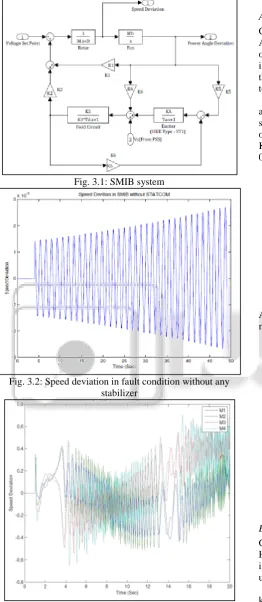
Fig. 3.1: SMIB system
Fig. 3.2: Speed deviation in fault condition without any stabilizer
Fig. 3.3: Speed Deviation without STATCOM The Single machine system has wide application in real time power distribution systems but its response in fault condition make it unstable and unreliable as shown in figures above. The in this work we are analysing performance of STATCOM under the fault conditions for both system.
IV. PROPOSED METHODOLOGY
A. Modelling of SMIB
Consisting the generator, excitation system, AC network etc. A SMIB power system model as shown in Fig. 1 is used to obtain the Modified Heffron-Phillip’s model parameters.This is a simplified representation of a generator is connected to the load through a transmission line. IEEE Model 1.0 is used to model the synchronous generator
For the study of single machine infinite bus system a Heffron Phillips model can be obtained by linearizing the system equations around an operating condition. The obtained hefffron model is as in figure and the parameters are K1 = 0.5320, K2 = 0.7858, K3 = 0.4494, K4 = 1.0184,K5 = -0.0597, K6 = 0.5746, KA = 20, M = 7.
Fig 4.2: Heffron Phillips model – SMIB
[image:3.595.47.310.74.678.2]After all these STATCOM is installed in SMIB phillipheffron model as shown below:
Fig. 4.3: Simulink Implementation of SMIB
B. Genetic Algorithm
Genetic algorithms (GA) were first introduced by John Holland in the 1970s (Holland 1975) as a result of investigations into the possibility of computer programs undergoing evolution in the Darwinian sense.
GA are part of a broader soft computing paradigm known as evolutionary computation. They attempt to arrive at optimal solutions through a process similar to biological evolution. This involves following the principles of survival of the fittest, and crossbreeding and mutation to generate better solutions from a pool of existing solutions.
[image:3.595.303.545.174.594.2]is particularly suited for optimization, a problem solving technique in which one or more very good solutions are searched for in a solution space consisting of a large number of possible solutions. GA reduce the search space by continually evaluating the current generation of candidate solutions, discarding the ones ranked as poor, and producing a new generation through crossbreeding and mutating those ranked as good. The ranking of candidate solutions is done using some pre-determined measure of goodness or fitness.
1) How GA Works
[image:4.595.308.539.64.495.2]A genetic algorithm is a probabilistic search technique that computationally simulates the process of biological evolution. It mimics evolution in nature by repeatedly altering a population of candidate solutions until an optimal solution is found
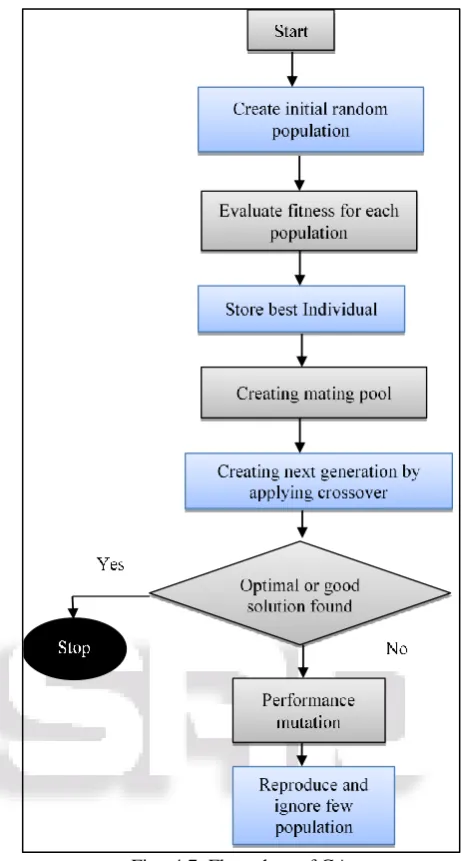
Fig. 4.5: Genetic algorithm evolutionary cycle The GA evolutionary cycle starts with a randomly selected initial population.The changes to the population occur through the processes of selection based on fitness, and alteration using crossover and mutation. The application of selection and alteration leads to a population with a higher proportion of better solutions. The evolutionary cycle continues until an acceptable solution is found in the current generation of population, or some control parameter such as the number of generations is exceeded.
The smallest unit of a genetic algorithm is called a gene, which represents a unit of information in the problem domain. A series of genes, known as a chromosome, represents one possible solution to the problem. Each gene in the chromosome represents one component of the solution pattern.
The steps in the typical genetic algorithm for finding a solution to a problem are listed below:
1) Create an initial solution population of a certain size randomly
2) Evaluate each solution in the current generation and assign it a fitness value.
3) Select “good” solutions based on fitness value and discard the rest.
4) If acceptable solution(s) found in the current generation or maximum number of generations is exceeded then stop.
5) Alter the solution population using crossover and mutation to create a new generation of solutions. 6) Go to step 2.
Fig. 4.7: Flow chart of GA
V. RESULTS AND SIMULATION
Proposed work is modelled in MATLAB/SIMULINK R2009b and simulated..
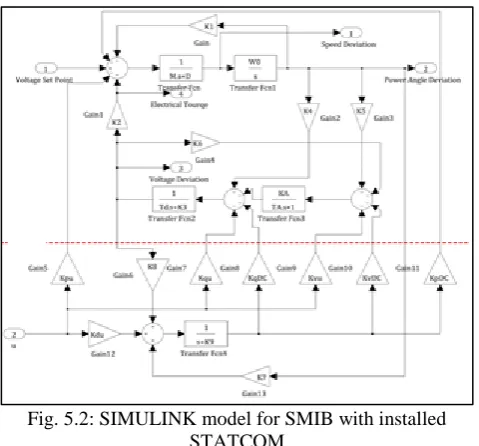
[image:4.595.307.549.553.726.2]Fig. 5.2: SIMULINK model for SMIB with installed STATCOM
The test system for SMIB is a heffronphillip model of SMIB which feeding by a signal with disturbance and the results when no STATCOM is installed.
Fig. 5.3: Rotor angle deviation in SMIB with no controller a same signal is feed to after the STATCOM is installed with Genetic algorithm and the rotor angle deviation is as shown
[image:5.595.309.549.65.243.2]in figure 5.2.
Fig. 5.4: Rotor angle deviation in SMIB with GA optimized STATCOM
Fig. 5.5: Convergence graph for Genetic Algorithm
VI. CONCLUSION AND FUTURE SCOPE
In this Thesis, dynamic behavior of single machine system installed with STATCOM is investigated under 3-phase fault using genetic algorithm. STATCOM is designed to improve the transient stability of the given system. Proposed work is implemented using MATLAB/SIMULINK. The STATCOM is used to control power flow of power system by injecting appropriate reactive power during dynamic state. Simulation results show that STATCOM not only considerably improves transient stability but also compensates the reactive power in steady state. Therefore STATCOM can increase reliability and capability of AC transmission system .It is quite clear that before compensating a power system with FACTS device to improve transient stability, we need to assess the system stability conditions for different locations of the fault and the compensator and also with different amounts of compensation. The transient stability improvement of the single machine power system at different fault condition is investigated in this work.
The future work could be directed on:
The arrangement rules with evolutionary algorithm to obtain the better power oscillation damping effects. The study can be extended by using larger power system
that contains a number of FACTS-based stabilizers.
REFERENCES
[1] Safari, H. Shayeghi, H.A. Shayanfar, “Optimization Based Control Coordination of STATCOM and PSS Output Feedback Damping Controller Using PSO Technique”, International Journal on Technical and Physical Problems of Engineering (IJTPE),Issue 5, Vol. 2, No. 4, pp. 6-12, December 2010.
[2] C.Schaduer and H.Mehta, “Vector analysis and control of advanced static var compensator,” IEEE Proceedings on generation, transmission and distribution, Vol 140, No 4, pp: 299-306, July 1993. [3] Laszlo Gyugi, “Dynamic compensation of ac
[image:5.595.46.293.326.473.2][4] Gyugyi, L., “Dynamic compensation of ac transmission line by solid-state synchronous voltage sources”, IEEE Trans. PD., Vol. 9, No. 2, 1994, pp. 904-911.
[5] Higorani, N.G., and Gyugyi, L., “Understanding FACTS: concepts and technology of flexible ac transmission systems”, IEEE Press, New Jersey., 1999. [6] Chen, J., Milanovic, J.V., and Hughes, F.M., “Selection
of auxiliary input signal and location of a SVC for damping electromechanical oscillations”, Power engineering society winter meeting, Vol. 2, 2001, pp. 623-627.
[7] Ying, Y., Chen, J., and Han, Y., “STATCOM modeling and analysis in damping power system oscillations”, Proceeding of the Energy Conversion Engineering Conference and Exhibit, Vol. 2, 2000, pp. 756-762. [8] Haque, M.H., “Optimal location of shunt FACTS
devices in long transmission lines”, IEEE Proc.-Gener.
Transm. Distrib., Vol. 147, No. 4, 2000, pp. 218-222. [9] Zhou, E.Z., “Application of static var compensators to
increase power system damping”, IEEE Trans. PD., Vol. 8, No. 2, 1993,pp. 655-661.
[10]El-Emary, A.A., “Effect of Static Var Compensator Upon Synchronizing Torque Coefficient”, Electric Machine and Power Systems, Vol. 25, 1997, pp. 371-386.
[11]Zhao, Q., and Jiang, J., “Robust SVC controller design for damping improving power system damping”, IEEE Trans. PD., Vol. 10, No. 4, 1995, pp. 1927-1931. [12]Chun Li Ohrang Jiang, Z.Wang,“Design of rule based
controller for STATCOM.” IEEE Industrial electronics society conference, Vol 1, Aachen, pp: 407-472, 1998. [13]N. G. Hingorani and L. Gyugi, Understanding FACTS:
Concepts and Technology of Flexible AC Transmission Systems. New York: Wiley-IEEE Press, 1999.
[14]N. G. Hingorani and L. Gyugi, Understanding FACTS: Concepts and Technology of Flexible AC Transmission Systems. New York: Wiley-IEEE Press, 1999.
[15]Saleh M. Bamasak, M. A. Abido, “Robust coordinated design of pss&STATCOM controllers for damping power system oscillation” 15th PSCC, Liege, 22-26 August 2005.
[16]H. Barati, A. Marjanian, E. Jafari, “Transient stability improvement with NEURO-FUZZY control of
STATCOM in SMIB”,December2011 Issue 9 Volume 3,Number 4 Pages 52-58.
[17]SayedMojtabaShirvaniBoroujeni, Reza Hemmati, HamidehDelafkar, ElaheBehzadipour, “Voltage Support and Stability Enhancement using STATCOM”, American Journal of Scientific Research ISSN 1450-223X Issue 20(2011), pp.27-36.
[18]PrechanonKumkratug, “Evaluation of Critical Clearing Time of Power System Equipped with a Static Synchronous Compensator”, American Journal of Applied Sciences 8 (2): 141-146, 2011 ISSN 1546-9239. [19]S. Sowjanya, Prof. J. Srinivasarao, “Design of FACTS Device For The Improvement of Power System Stability using Mathematical Matching Controller”, IOSR Journal of Electrical and Electronics Engineering (IOSRJEEE) ISSN: 2278-1676 Volume 1, Issue 3 (July-Aug. 2012), PP 07-11
[20]P. Kumkratug and M.H. Haque, “Improvement of damping of a power system by STATCOM”.
[21]Ying, Y., Chen, J., and Han, Y., “STATCOM modelling and analysis in damping power system oscillations”, Proceeding of the Energy Conversion Engineering Conference and Exhibit, Vol. 2, 2000, pp. 756-762. [22]Haque, M.H., “Optimal location of shunt FACTS
devices in long transmission lines”, IEEE Proc.-Gener. Transm. Distrib., Vol. 147, No. 4, 2000, pp. 218-222. [23]Zhou, E.Z., “Application of static var compensators to
increase power system damping”, IEEE Trans. PD., Vol. 8, No. 2, 1993,pp. 655-661.
[24]Zhao, Q., and Jiang, J., “Robust SVC controller design for damping improving power system damping”, IEEE Trans. PD., Vol. 10, No. 4, 1995, pp. 1927-1931. [25]Kumaratunga, P., and Hague, M.H., “Versatile model of