University of East London Institutional Repository: http://roar.uel.ac.uk
This paper is made available online in accordance with publisher policies. Please scroll down to view the document itself. Please refer to the repository record for this item and our policy information available from the repository home page for further information.
To see the final version of this paper please visit the publisher’s website. Access to the published version may require a subscription.
Author(s): Moore, Derek G; Goodwin, Julia E.; George, Rachel; Axelssona, Emma L; Braddick, Fleur M.B.
Title:Infants perceive human point-light displays as solid forms
Year of publication: 2007
Citation: Moore, D.G., Goodwin, J.E., George, R., Axelsson, E., & Braddick, F. (2007) ’Infants perceive human point-light displays as solid forms.’ Cognition, 104 (2), 377-396.
Running Head: INFANTS PERCEIVE HUMAN POINT-LIGHT DISPLAYS AS SOLID FORMS
Infants Perceive Human Point-Light Displays as Solid Forms
Derek G. Moore Julia E. Goodwin
Rachel George Emma L. Axelsson Fleur M.B. Braddick
School of Psychology, University of East London.
Abstract
While five-month-old infants show orientation-specific sensitivity to changes in the motion and occlusion patterns of human point-light displays, it is not known whether infants are capable of binding a human representation to these displays. Furthermore, it has been suggested that infants do not encode the same physical properties for humans and material objects. To explore these issues we tested whether infants would selectively apply the principle of solidity to upright human displays. In the first experiment infants aged six and nine months were repeatedly shown a human point-light display walking across a computer screen up to ten times or until habituated. Next, they were repeatedly shown the walking display passing behind an in-depth representation of a table, and finally they were shown the human display appearing to pass through the table top in violation of the solidity of the hidden human form. Both six- and nine-month-old infants showed significantly greater recovery of attention to this final condition. This suggests that infants are able to bind a solid vertical form to human motion. In two further control experiments we presented displays that contained similar patterns of motion but were not perceived by adults as human. Six- and nine-month-old infants did not show recovery of attention when a scrambled display or an inverted human display passed through the table. Thus, the binding of a solid human form to a display in infants only seems to occur for upright human motion. The paper considers the implications of these findings in relation to theories of infants’ developing conceptions of objects, humans and animals.
Introduction
While much has been learned about infants’ developing sensitivities to human faces (Turati, Simion, Milani, & Umilta, 2002) relatively little is known about infants’ developing representations of the properties of the human body. Recently, it has been discovered that eight-month-old infants show differential event related potentials (ERPs) for biologically plausible and implausible movements of the human arm (Reid, Belsky, & Johnson, in press) and that five-month old infants appear to be sensitive to violations involving a moving hand passing through a hidden object behind a screen (Saxe, Tzelnic, & Carey, in press). Thus, there is evidence that infants are able to understand some of the properties and actions of arms and hands (Woodward & Guajardo, 2002). However we still know relatively little about infants’ representations of the wholehuman form.
This area is surprisingly under-researched, given that a ‘body concept’ may be a precursor to infants’ developing understanding of other people as agents with a single, unified goal (Gallagher, 1995, 2005). Also the development of a representation of the whole body could underpin infants’ developing abilities to differentiate humans from other animals (Quinn & Eimas, 1998). Of specific importance may be the ability to represent the vertical human trunk. Particularly at a distance, the vertical trunk distinguishes humans from most animals, and the direction the trunk is facing also gives an indication of the focus of a person’s attention. Therefore, one could speculate that while infants may initially have a prototype that applies to people and animals alike, consisting of a face combined with a generic body form, later there may emerge a specific human prototype that consists of a human face combined with a vertically aligned body (Quinn, 2004).
The few studies that have looked at infants’ understanding of the whole human body are intriguing. One study found that not until eighteen months do infants show differential attention to scrambled pictures of whole human bodies where the arms and legs are moved to atypical locations (Slaughter, Heron and Sim, 2002). This shows a surprisingly
late-developing ability in comparison to infants’ early responses to scrambled human faces
infants do not have access to an explicitpictorial representation of the human form before 18 months, younger infants may have access toimplicitrepresentations, at least of parts of bodies, which allow them to make sense of others’ movements and intentions. However, it is not clear what form such representations might take and which properties of humans would be incorporated into these representations.
Furthermore, it is even possible that infants may encode the properties of humans, animals and objects in different ways. Kulmeier, Bloom, & Wynn (2004) have suggested that 5-month-old infants may not apply the same constraints to the continuity of human versus object motion. They found that, while infants were able to track the number, location and continuous motion of boxes that disappear behind screens, they did not appear to track the continuous motion of humans in the same way. They speculate that infants may construe some of the physical properties of humans differently from those of material objects. However, others have suggested that this data may not support such a strong conclusion (Rakison & Cicchino, 2004), and there is other, more recent, evidence which conflicts with this view, suggesting that 5-month-old infants do apply at least some of the same physical constraints to humans and object. Specifically, infants appear to perceive the hands of humans as solid inviolable objects (Saxe, Tzelnic & Carey, in press).
Clearly, there is still much to be learned about infants’ abilities to represent the whole human form, and to establish which of the material properties of humans are encoded by infants. Moreover, we need to consider the role that specific patterns of motion might play in the formation of these representations. We know that moving objects are generally more salient than static objects, and that some aspects of motion, such as being self-starting and having an irregular path, may be of particular importance for infants’ categorisation of animate versus inanimate objects (Opfer, 2002; Rakison & Poulin-Dubois, 2001). However, there has been little research examining how more specific aspects of so-called biological
upright, compare, for example, with penguins or bears that do not swing their arms when walking. Consequently, we might hypothesise that infants would incorporate these specific patterns of biological motion into their developing prototype of a human.
We might further speculate that if both the physical properties of the human form and the associated motion patterns of humans are incorporated into infants’ developing human prototype, then the presentation of human biological motion, in the absence of other cues, might directly tap into infants’ emerging representation of the physical properties of the human form. To explore these issues we adapted and extended work that has examined infants’ responses to people presented as point-light displays. These are created by filming reflective patches attached to the legs and arms of people as they move in the dark (Mass, Johansson & Jansson, 1971), and can also be made for moving animals (Arterberry & Bornstein, 2001, 2002; Mather & West, 1993) and objects (Moore, Hobson & Lee, 1997; Hubert, Wicker, Moore, Monfardini, Duverger, Da Fonséca, & Deruelle, in press). These displays present motion patterns but do not provide the surface information that might
normally be used for recognition. Indeed, static point-light displays are rarely recognised, and are often described as a collection of stars or as a Christmas tree. Thus, to make sense of these displays, observers need to be sensitive to the patterns of motion depicted, and be able to link these to a representation of the likely underlying form.
Notably, for point-light displays of fixed rigid structures like a box, there is only one solution that fits the available perceptual data. For human displays, however, there are many perceptual solutions that could account for the spatial relationships between the moving lights (Johansson, 1973). Despite this fact, human point-light displays are recognised rapidly (in less than half a second), and usually much more quickly than point-light displays of objects (Moore, Hobson & Lee, 1997). Interestingly this is the case even for people with intellectual delays (see Moore, Hobson & Anderson, 1995). It has also been found that there are specific areas of the brain that are particularly sensitive to these movements (Bonda, Petrides, Ostry, & Evans, 1996; Downing, Jiang, Shuman & Kanwisher, 2001) and observers find human displays compelling and attractive, and appear well attuned to the meanings they depict. For example, adults can detect the identity, gender and age of the person filmed (Cutting &
Troscianko, Lea & Morgan, 1996; Moore, et al., 1997; Pollick, 2002), and even can tell a person’s real versus deceptive intentions (Runeson & Frykholm, 1983).
Significantly, if the lights in these displays are temporally or spatially scrambled in some way, or if a human display is inverted, the perceptual effect is completely lost, and participants no longer see the displays as human (Verfaillie, 1993). Thus, at least for adults, there appears to be a direct correspondence between the orientation and phase of the motion of human point-light displays and the perception of an underlying human form, and this process appears to occur rapidly, with little conscious cognitive effort, and delivers rich levels of meaning. The question for this study is whether this is also true for young infants.
Studies have shown that infants do find point-light displays compelling, often looking at them continuously for long periods (Fox & McDaniel, 1982). Infants are also sensitive to subtle changes in the movements of these displays (Bertenthal, Proffit, & Cutting, 1984; Bertenthal, Proffit, Kramer & Spetner, 1987). Notably, three-month-old infants discriminate between in- and out-of-phase presentations of human movements, where the motion of some of the individual lights are delayed, and can also discriminate typical from atypical occlusion patterns, suggesting that they might process the displays globally (Bertenthal & Pinto, 1994). However, infants’ sensitivity to changes in movement patterns does not necessarily mean that they are aware that the movement of the point-light display is specifically human, and even if they were aware of this, it would not necessarily mean that infants are binding a prototype of a human form to these displays. Indeed, this process is likely to be dependent on the
development of the dorsal and ventral streams of the brain which integrate form and motion (Johnson, Mareschal & Csibra, 2001; Ungerleider & Haxby, 1994). As these neural streams are not believed to be integrated until around the middle of the first year (Johnson, Bremner, Slater, Mason, & Foster, 2002), it is unlikely that three-month-old infants would have the necessary neural architecture to allow them to link the motion of human point-light displays with an associated human form.
displays by employing knowledge constraints and linking a developing orientation-specific representation of the human form to the human motion depicted (Bertenthal, 1993). However, this might be overstating infants’ abilities. Infant sensitivity to changes in the motion of right-way-up human displays may occur simply because, by five months of age, an infant’s
perceptual system will have had far more exposure to human arms and legs operating under gravity constraints in the upright orientation. Thus, one might parsimoniously explain infants’ selective responses to upright point-light displays purely in terms of familiarity with upright human motion. Furthermore, even if some knowledge constraints are applied to human point-light displays and a developing human representation is mapped onto the motion patterns of the point-light display, it is not necessarily the case that infants would incorporate the same physical properties into this representation as they would for a physical object (Kulmeier et al, 2004). Specifically, even though they may bind a form to the human point-light display they may not perceive a point-light display as having solid and inviolable properties like a material physical object.
Thus, this study set out to determine whether, in the second half of the first year infants were capable of binding a human representation to upright human motion depicted in human point-light displays, and to ascertain whether this representation would incorporate some of the same physical properties that are applied to other material objects, as might be predicted by Saxe et al (in press). Specifically, we wished to see if infants represented a human point-light display as a solid vertical form, and correspondingly applied the principle of solidity, such that it would be seen as a violation of this principle if the hidden solid form underlying the display occupied the same physical space as a visible material object
(Baillargeon, Spelke, & Wasserman, 1985; Spelke, Breinlinger, Macomber, & Jacobson, 1992). As we were unclear whether or not six-month-old infants would apply solidity to these displays, we tested groups of six-month-old and nine-month-old infants. By nine months of age infants appear able to use biological motion to categorise animals and vehicles, and make distinctions when subsequently presented with an out-of-category picture, thereby suggesting that they are at least able to link motion to a basic pictorial form (Arterberry & Bornstein, 2001, 2002). Thus, we anticipated that, even if six-month-old infants might not apply solidity to these displays, nine-month-old infants may be able to do so.
space occupied by an in-depth representation of a table. It is known that, from four months of age, infants can use perspective and gradient cues in two dimensional computer arrays to represent three dimensions (Durand & Lecuyer, 2002), thus it was expected that infants would interpret the table as a solid object. The question was whether infants would also treat the human point-light walker as a solid object and show increased attention when the table and human walker appeared to occupy the same physical space.
In Experiments 2 and 3 we went on to explore whether the application of the solidity principle was uniquely applied to a typical human point-light walker or would occur for other vertically aligned versions of point-light displays that contained similar motion patterns. Thus in Experiment 2 we assessed infants’ sensitivity to violations of a scrambled point-light display, which contained the same overall movement as a human display and was arranged along the same vertical dimension, but in which the motion patterns of the point lights were ‘phase-shifted’ and transposed. Finally in Experiment 3 we tested the orientation-specificity of the effect, by seeing whether or not infants would show an equivalent response to the violation of an inverted version of the walking human display, which was equally as coherent as an upright display.
Experiment 1: Violation of the solidity of a human point-light display The experiment had a repeated measures design and consisted of three phases administered in a fixed order. In the first phase, a human point-light display walked
repeatedly from right to left across the computer screen (each repeat is henceforth termed an event). In the second phase a table was introduced and the point-light walker repeatedly crossed the screen behind the table (henceforth called the behind-the-tablephase). Finally, the human point-light walker repeatedly passed through the space occupied by the table top (through-the-tablephase). It was hypothesised that, if infants begin to bind a prototypical representation of humans to the unique movement of human point-light displays during the first year, then infants would show greater attention during the phase when the human point-light display apparently walked through the table, than when passing behind the table.
movement of the human point-light display over the two preceding phases. Furthermore, the through-the-table stimulus differed from the behind-the table stimulus only in terms of the occlusion pattern of the familiar walker. In phase two, however, infants were introduced both to a new pattern of occlusion, as the familiar walker passed behind the new table, and to a brand new object, the table itself. Thus, in terms of surface perceptual features, local
movement patterns and occlusion information, the second phase had more surface perceptual novelty than third phase. Consequently, unless infants perceived the point-light walker as a solid form, infants would be expected to show greater recovery of attention during the second phase, which came earlier and was more perceptually salient.
Participants
Infants were recruited via health professionals in the UK and were full-term. Two age groups of infants were tested. One group consisted of infants aged 6 to7 months (N= 16, age,
M= 205.8 days SD= 22 days) and the second group consisted of infants aged 8 to 10 months (N= 16, age,M= 285.2 days, SD = 24 days). Henceforth these are referred to as the 6- and 9-month-old age groups. Three of the 6-9-month-old infants and three of the 9-9-month-old infants were excluded from the analysis, five due to fussing and one infant who looked continuously throughout a phase. The two groups were similar in terms of the SES of the family and in level of maternal education and age.
Stimuli
The stimuli were created using Macromedia Director and displayed on a Sony Trinitron 17” monitor set to a 640 by 480 resolution. Initially, a five second video clip of a walking human point-light display was filmed. This film was digitised to produce 100 bitmaps which were imported into the animation program. The coordinates of each point-light over time were then recorded in a digital array. This allowed the on-line manipulation of the displays during their presentation in Experiments 2 and 3. During each walking sequence the coordinates were used to animate nine circles, measuring 10 pixels in diameter. When, in the original clip, a point-light was occluded, the animated circle was deleted from the
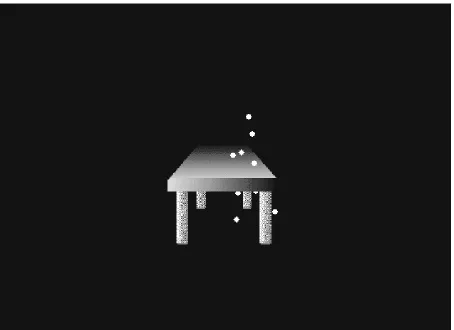
[Figure 1 here]
The table remained visible throughout phases two and three when the walker passed behind, or through, the table. The table was coloured blue and was drawn in perspective and shaded to give the impression of depth. See Figure 1 for a black-and-white version of a frame taken from the violation animation sequence (also see the electronic annex). The table
consisted of two bitmaps located in the centre of the screen. One bitmap was of the table top and front legs and was 180 pixels in height and width and positioned 90 pixels from the bottom of the screen. The two back legs constituted a second bitmap of 90 x 90 pixels. During the second phase, when the light walker passed behind the table, all the point-lights passed behind both bitmaps. Note that the background was set to transparent so that only the table legs and table top, and not the area of the bitmaps between the table legs, occluded the point-lights as the walker passed behind the table.
During phase three, when the point-light walker appeared to walk through the table, the lights in the upper half of the display passed in front of the table top while the point-lights in the bottom half of the display passed behind the front legs, but in front of the bitmap of the back legs of the table (see Figure 1). Note that in phase three the length of the back legs was reduced by five pixels to make the table appear slightly further back and more directly in the path of the point-light display. The height of the point-light displays as they appeared on the screen was 10 cm and the height of the table was 6cm. Thus the top of the table was level with the waist of the human point-light display.
Procedure
and offset times of each look towards the screen. There were large and significant
correlations between on- and off-line assessments of number of looks and of the recorded durations of peak looks for all phases of the experiments (Phase 1, number of looks r = .83 and duration of longest look r= .83, p<.01; Phase 2, number of looks r= .76 and duration of longest look r= .80, p< .01; Phase 3, number of looks r= .80 and duration of longest look r
= .88, p <.01). Thus 'on-line' key pressing proved a reliable estimate of true infant looking behaviour.
At the beginning of the experiment, and at the beginning of each new test phase, infants’ attention was brought towards the computer screen by the presentation of changing shapes of different sizes and colours and by a computer-generated ‘quacking’ sound. For each phase, therefore, some small initial recovery in attention was induced in response to this stimulus. As soon as infants fixated on the screen, the attention grabbing stimulus was
replaced by the point-light display stimulus and this was recorded as the beginning of the first look.
Infants may be long or short lookers depending on the way in which they process the global properties of the display (Columbo, Freeseman, Coldren & Frick, 1995). To ensure that short lookers were not over exposed to the displays, and to prevent the long lookers becoming too fatigued and unlikely to complete all three phases, infants moved on to the next phase when they had habituated, orhad seen a maximum of ten events1. Habituation was determined on-line using a computer algorithm. As for standard habituation measures, a decrease in the lengths of looks was taken as an indication that habituation had occurred. An infant had habituated if the average of the most recent two looks to the screen, divided by the average of the most recent two looks away, was less than 50% of the total average duration of looks divided by the total average of the looks away2.
1
Note that for the first six infants tested the number of events was set to 20, but two of these infants did not reach the final phase due to fussing. Four infants were presented with more than ten events for the first two phases only and examination of the data showed there to be no differences in the mean duration of peak looks between these and the other infants.
2
Results
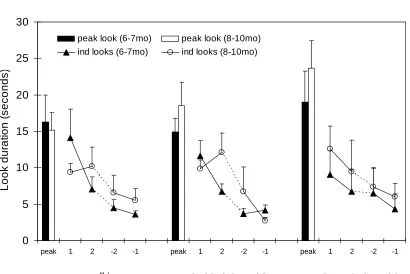
The first thing to note was that the number of events we presented across the phases appeared to be appropriate, as the majority of infants did not become overtired by phase three and all infants showed a clear decrement of attention within each phase (see Figure 2). Six-and nine-month-old infants were presented with a similar number of events, around 8 for each phase3and this number did not differ significantly across phases, ages or across subsequent experiments. Thus, setting the maximum number of events to ten appeared both to be sufficient to enable infants to demonstrate a clear decrement in attention within each phase, and to allow some of the ‘shorter lookers’ to habituate and move on to the next phase.
[Figure 2 here]
Figure 2 shows the mean lengths of the first two and last two looks made by the groups of infants in each phase. The figure also shows the mean peak looks made by the two groups of infants during each phase. The prediction was that if infants were ‘surprised’ by the violation of the solidity of a human point-light display, then they should show a greater recovery of attention during the third phase, when the point-light walker repeatedly walked through the table, than during the second phase, when the human display walked behind the table. Note that we predicted that this recovery would be larger during the third phase even though the second phase introduces more perceptual novelty, involving as it does both the introduction of a new object (the table) and a change in the occlusion patterns of the point-lights.
Thus, the main dependent variable to be used in the analysis was the amount of recovery from the first to the second phase, and from the second to the third phase. This was the calculation, with habituation being primarily determined by changes in the duration of looks to the screen.
3
calculated by subtracting the duration of the final look during one phase from the duration of the peak look for the next phase. Figure 2 suggests that, in line with the hypothesis, infants’ amount of recovery was greater for the final phase when the human point-light display passed through the table top than in the second phase when it walked behind the table: Six-month-old infants, behind-the-table recovery, M= 11.22, SD= 2.5, through-the-table, M= 14.85, SD
= 3.9; Nine-month-old infants, behind-the-table recovery M= 13.0, SD= 2.4, through-the-tableM= 20.4, SD= 3.9.
To further examine this effect we performed a Phase (behind-the-table v through-the-table) by Age (6mo v 9mo) analysis of variance on amount of recovery. The analysis of variance revealed a significant Phase effect, F(1,24) = 4.38, p = .047, partialEta-squared= .15. Both the younger and older infants showed significantly greater recovery to the final phase where the point-light display passed through the table than to the second phase when the point-light display passed behind the table There was no significant Age effect and no Age-by-Phase interaction.
Conclusion
The data provide clear evidence that both the younger and older infants perceived the human point-light display as representing a solid form, with all infants showing recovery in attention when this form was violated as it passed through the table top. However, from this experiment alone it is not possible to assess the extent to which infants respond selectively to human motion. It may be that infants would bind a solid form to any similar vertical
combination of global and local motion patterns, even those that might appear relatively meaningless to adults. Thus, to explore the specificity of this effect we presented two further versions of the experiment using displays containing vertically-aligned patterns of point-light motion derived from the original human motion, but that are not perceived by adults as representing a human form.
Experiment 2: Violation of a ‘scrambled’ point-light display
human form and so, when this pattern of moving lights was intersected by the table, we predicted that infants would not show the same recovery in attention as found in Experiment 1 for the human display.
Participants
In order to contrast performance with that of the infants tested in Experiment 1, two new comparable groups of 6-month-old and 9-month-old infants were tested: six-month-old-infants N= 15, age,M = 207.6 days,SD= 19 days; Nine-month-old infants, N= 12, age, M= 282.9 days, SD= 26 days. Two of the six-month-old infants were excluded from the analysis because they looked continuously throughout a phase. All infants were recruited via health professionals and were full term. All groups were similar in terms of the SES of the family and in level of maternal education and age.
Stimulus and procedure
The same procedure was used as in Experiment 1, but for this experiment the point-light display was an out-of-phase and partly inverted display. This ‘scrambled’ display was made to be out-of-phase by randomly moving the start time of each point-light by up to four animation frames forwards or backwards in time (there being 20 frames per second). Thus the point-light representing the knee joint could be moving up to eight frames before or after the point-light on the corresponding ankle. Inversion of displays is known to interfere with recognition of human point-light displays by adults, however inverting the whole display would have changed the overall degree of movement in the bottom and top halves of the display which may lead to differences in the salience of the stimulus. Thus, to preserve the amount of movement in the upper and lower halves, but to further scramble the display, we inverted the point-lights only for the upper half of the display. During the second and third phases the same bitmaps of the table and legs were used as in Experiment 1.
Results
The mean numbers of events seen by infants across each phase were comparable to Experiment 1 (see footnote4.) Again the critical variables were the recovery made by infants
4
during the second phase, when the point-light display passed behind the table, and the
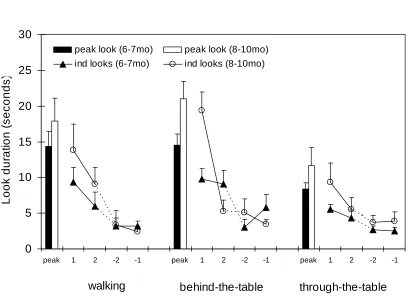
recovery made during the final phase, when the display passed through the table top. Figure 3 shows the mean lengths of the first two and last two looks made during each phase by the two age groups for the scrambled stimulus. The figure also shows the mean peak looks made by the two groups of infants during each phase. The amount of recovery in seconds shown for this stimulus for phases two and three respectively were: Six-month-old infants’ recovery, behind-the-table, M= 11.3, SD= 2.5, through-the-table, M= 2.7, SD= 3.3; Nine-month-old infants’ recovery, behind-the-table, M= 16.0, SD= 2.6, through-the-table M= 6.4, SD = 3.4.
[Figure 3 here]
To test whether infants showed significantly different patterns of recovery for the scrambled versus the human display, we performed a mixed model analysis of variance comparing the performance of the two new groups of infants tested on Experiment 2 with the performance of the infants presented with the human point-light display in Experiment 1, the prediction being that there would be a significant interaction of stimulus type by phase. A 2 (Stimulus: human v scrambled) by 2 (Phase: behind-the-table v through-the-table) by 2 (Age: 6mo v 9mo) analysis of variance on amount of recovery revealed no overall significant effects of Age, F(1,47) = 2.9, ns, nor of Phase, F(1,47) = .92, ns. There was however a significant effect of Stimulus,F(1,47) = 6.28, p < .05, partialEta-squared= .12, and a significant and predicted interaction of Phase by Stimulus F(1,47) = 15.34, p < .001, partial
Eta-squared= .25, with both the six-month-old and nine-month-old infants looking longer during the violation phase when the display was human compared with when the display was scrambled5
Conclusion
There was a clear difference in the responses of both younger and older infants to the violation of a human point-light display in Experiment 1 compared to the scrambled display presented in Experiment 2, suggesting that the responses of infants are not generalised to all
SD=1.6. Across the three phases six, five and five infants respectively of the six-month-old, and five, five and four of the nine-month-old infants were presented with the full ten events.
5
displays that contain similar relative and global motion to that of a human. The 6- and 9-month-old infants shown the human display passing through the table in Experiment 1 made a mean recovery of 14.9 seconds and 20.4 seconds respectively compared with only 2.7 seconds and 6.4 seconds for the infants in Experiment 2. However, while this finding of differential responses to a normal human versus a scrambled display is compelling, this does not mean that infants will respond only to violations of human displays. It is possible, for example, that infants responded to the violation of the display in Experiment 1 , not because it was human, but simply because the motion between lights in the human display are more highly correlated than in the scrambled display.
Experiment 3: Violation of the solidity of an inverted display
Thus, to test the robustness of the violation effect, and to see whether or not infants show sensitivity to orientation when attributing solidity to coherent point-light displays, we presented another two groups of infants simply with an inverted version of the walking point-light display from Experiment 1. This display was equally coherent to the upright display used in Experiment 1. Furthermore, in order to present the same patterns of occlusion as those presented in Experiment 1, we inverted both the table and the point-light display. Inverted human point-light displays contain all the same perceptual cues for rigidity and global coherence as upright displays, yet are not readily perceived by adults as meaningful (Verfaillie, 1993). Research with infants (Berthenthal, 1993) has shown that, by five months of age, infants’ discriminations to changes in the coherence and occlusion patterns of point-light displays become orientation specific, suggesting that human point-point-light displays come to have an orientation-dependent meaning. While it is unknown at what age infants will begin to show orientation specific sensitivities to a violation of the solidity of the displays, it was anticipated, following on from the findings of Bertenthal (1993), that by six months of age infants would show lessened recovery to the violation of the solidity of an inverted display compared to an upright display.
Participants
Again, in order to contrast performance with that shown by infants in Experiment 1, two new comparable cohorts of infants were recruited: Six-month-old infants,N= 13, age, M
from the analysis, two because of fussing and two because they looked continuously throughout.
Stimulus and procedure
The same procedure was used as previously. We presented the same stimulus and table bitmaps from Experiment 1 except that the human point-light display was inverted throughout and, during the second and third phases, the table bitmaps were also inverted. Note that, although inverted, the point-light display continued to move in the same direction as in Experiments 1 and 2, from right-to-left across the screen.
Results
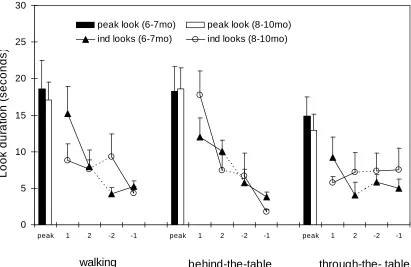
Once again, the mean numbers of events seen by infants across each phase was comparable to those for Experiments 1 and 26. Figure 4 shows the mean lengths of the first two and last two looks made during each phase by the two age groups for the inverted stimulus. The figure also shows the mean peak looks made by the two groups of infants during each phase. The amount of recovery in seconds shown for this stimulus for phase two and three respectively were: six-month-old infants, behind-the-table recovery, M= 10.6, SD= 3.3, through-the-table recovery, M= 11.3, SD= 3.5, nine-month-old infants, behind-the-table recovery, M= 14.2, SD= 3.3, through-the-table recovery M= 7.3, SD= 3.5.
[Figure 4 here]
Again, we compared the performance of the groups of infants tested on this control experiment with the performance of the infants in Experiment 1. It was hypothesised that the infants tested with the inverted human stimulus would not show a significant recovery of attention when the point-light display passed through the table, thus there would be a significant interaction of stimulus type by phase.
6
For six-month-old infants, walking, M =9.0,SD=1.7, behind-the-table, M= 9.0, SD
A 2 (Stimulus: upright human v inverted human) by 2 (Phase: behind-the-table v through-the-table) by 2 (Age: 6 v 9mo) analysis of variance of amount of recovery revealed no overall significant effects of Age, F(1,46) = .46, ns, and Phase, F(1,46) = .31, ns. There was also no significant effect of Stimulus F(1,46) = 2.41, ns. There was, however, a
significant and predicted interaction of Phase and Stimulus F(1,46) = 4.04, p=.05, partial
Eta-squared = .08.
Conclusions
The findings show that, even though infants were presented with a display containing the same occlusion information as the display used in Experiment 1, they did not show the same recovery to the violation of the solidity of the display. Note that, while infants clearly showed interest in these displays, they did not appear to find the inverted and unsupported table of specific interest, showing similar recovery in attention to the introduction of the table in Experiment 3 as the infants did during the same phase in Experiment 1. Thus the lack of a violation effect for the inverted display can not explained simply by infants attending more or less to the inverted table.
Discussion
The results suggest that both age groups of infants interpreted the in-depth
representation of the table and the upright human point-light display as representing solid objects (Durand & Lecuyer, 2002). Critically, even six-month-old infants showed greater recovery of attention when the solidity of the human point-light display was apparently violated as it passed through the space occupied by the table, compared to when it passed behind the table. No comparable effect was observed when infants were shown either a scrambled or an inverted point-light display passing through the table top. Specifically, the amount of recovery shown by infants to the apparent violation of the solidity of the human display was around twice the amount shown by infants who witnessed the control stimuli pass through the table. The response to the apparent violation of the human point-light
In summary, the results show that, from six months, infants seem to bind a solid form to an upright human display. The findings also indicate that capacities for binding a solid form to human motion are sensitive to motion coherence and are orientation specific. To our knowledge this study is the first to demonstrate infants’ application of the solidity principle to human point-light displays, and is one of the first to demonstrate sensitivity to the violation of the solidity of an object or human when this occurs in full view of the infant rather than behind an occluder. Furthermore, previous studies looking at infants’ sensitivity to violations of whole body representations of humans have only violated the form by moving the location of the arms and legs (Slaughter, Heron & Simm, 2002; Gliga & Dehaene-Lambertz, 2005). None so far have violated the vertical human trunk. Thus, this is also the first study to show that infants incorporate a solid and apparently inviolable human trunk into their developing representations of the human form. The findings support the proposal of Bertenthal and colleagues (see Bertenthal, 1993) that, from five months, infants may use a whole body representation as a knowledge constraint when making orientation-specific discriminations between in- and out-of-phase point-light displays.
In terms of the current debates about whether infants apply the same physical constraints to humans as they do for objects, our results lend some support to the view that infants treat humans and objects alike in terms of solidity (see Saxe, et al, in press). Infants could be using general processes for recovering form from motion and, indeed, it could be predicted that infants would apply the solidity principle to any upright point-light display that depicts an equally familiar animate or inanimate object. However the findings do not rule out the possibility that infants could differentially ‘construe’ other important properties, such as the continuity of the location of objects and humans (Bloom, 2004; Kulmeier, Bloom, & Wynn, 2004). Thus, the findings as they stand do not exclude the possibility that infants might process the motion patterns of humans and objects using different neural pathways. Also the findings can not determine whether or not infants are utilising specialised,
Certainly, further studies are needed to examine the extent to which the results here generalise to other types of point-light displays. We need to establish, for example, the role that horizontal motion plays in triggering the binding of representational prototypes to light displays. Do infants show the same effect when presented just with a ‘treadmill’ point-light display that walks on the spot and is intersected by a moving solid object? Also do infants show similar effects when humans are shown crawling rather than walking upright, and do they show the same responses to violations of horizontal point-light displays of animals? Furthermore, we may wish to explore whether infants show sensitivity to violations of point-light-displays depicting only parts of the human form such as an individual arm.
Abilities to represent the movement of the human trunk may have other important benefits apart from allowing infants to discriminate people from animals. In particular, this may provide infants with additional indicators of a person’s focus of attention, particularly at a distance, and help infants to gain important information about a person’s intentions. For example, a person backing away from an object (or animal) while facing towards it, conveys a different meaning, one of wariness or fear, from a person who walks away from an object that is behind them. Indeed, there is evidence for specialist neurons that independently process the direction the human trunk is facing versus the overall direction of a person’s movement. (Perrett, Harries, Benson, Chitty, & Mistlin, 1990). Further work might look at when infants first differentiate the direction of a person’s trunk independently of the direction of motion, and assess the importance that trunk direction plays in understanding other’s intentions relative to the importance of the direction of a person’s eyes, face and head.
Indeed, it may be the case that infants’ abilities to represent the human form and the qualities of the human body, such as the direction of the trunk and the location of arms and legs, plays an important role in the development of an understanding of intentional human action. Thus we need to consider how infants’ development of a whole-body prototype fits with accounts of the development of bodily imitation and the development of the understanding of the intentions and agency of self and others (Gallagher, 2005; Gergely, Bekkering & Kiraly, 2002; Nielsen, Dissanayake & Kashima, 2003).
Notwithstanding these important remaining questions, the findings do suggest that human motion patterns could play an important role in the formation of an infant’s
them in distinguishing people from other animals. Arterberry and Bornstein (2001, 2002), for example, have demonstrated that three-month-old infants seem to be able to categorise the movements of animals and vehicles presented as point-light displays, and that by
nine-months they link these to same-category, static pictures. Taken together with our findings, we might propose that, from six months, infants incorporate not only surface information
regarding faces and body shape into their developing animal and human prototypes (Pauen, 2000; Quinn & Eimas, 1998), but may also utilise unique patterns of biological movement that are specified by skeletal structures (see also Mather & West, 1993). This opens the possibility that sensitivity to biological movement, and the development of an associated whole-body, vertically-oriented representation may contribute to infants’ development of a specific human category during the middle of the first year, and that this orientation-specific human representation could play an integral part in infants’ segregation of their
Acknowledgements
References
Arterberry, M.E. & Bornstein, M.H. (2001) Three-month-old categorisation of animals and vehicles based on static and dynamic attributes. Journal of Experimental Child Psychology, 80,222-246
Arterberry, M.E. & Bornstein, M.H. (2002) Infant perceptual and conceptual categorisation: the roles of static and dynamic stimulus attributes. Cognition, 86, 1-24
Atkinson, J. (2000) The Developing Visual Brain. Oxford University Press. NY
Baillargeon, R., Spelke, E., & Wasserman, S. (1985). Object permanence in 5-month-old infants. Cognition, 20,191–208.
Bertenthal, B. (1993) Infants’ perception of biomechanical motions: intrinsic image and knowledge-based constraints. In C. E. Granrud (Ed.), Visual Perception and Cognition in Infancy. New Jersey: Lawrence Erlbaum Associates. Pages 175-214.
Bertenthal, B. I., & Pinto, J. (1994). Global processing of biological motions. Psychological Science, 5, 221-225.
Bertenthal, B. I., Proffitt, D. R., Spetner, N. B., & Thomas, M. (1985). The development of infant sensitivity to biomechanical motions. Child Development, 56, 531-543. Bertenthal, B., Proffitt, D. & Cutting, J. (1984). Infant sensitivity to figural coherence in
biomechanical motions. Journal of Experimental Child Psychology,37, 213-230. Bertenthal, B., Proffitt, D., Kramer, S. & Spetner, N. (1987). Infants’ encoding of kinetic
displays varying in relative coherence. Developmental Psychology, 23(2), 171-178.
Bloom, P. (2004). Descartes' Baby: How the science of child development explains what makes us human. New York: Basic Books.
Columbo, Freeseman, Coldren & Frick, (1995). Individual differences in infant visual fixation: dominance of global and local stimulus properties. Cognitive Development, 10,271-285
Cutting, J.E. & Kozlowski, L.T. (1977). Recognising friends by their walk: Gait perception without familiarity cues. Bulletin of the Psychonomic Society, 9,353-356. Dittrich, W. H., Troscianko, T., Lea, S. E. G., & Morgan, D. (1996). Perception of emotion
from dynamic point-light displays represented in dance. Perception, 25, 727-738. Downing, P., Jiang, Y., Shuman, M., & Kanwisher, N. (2001). A cortical area selective for
visual processing of the human body. Science, 293, 23–26.
Durand K. & Lecuyer, R. (2002) Object permanence observed in 4-month-old infants with a 2D display. Infant Behaviour and Development, 25, 269-278
Fox, R. & McDaniel, C. (1982). The perception of biological motion by human infants.
Science, 218,486-487
Frykholm, G. (1983). Perceived identity I: recognition of others by their kinematic patterns.
Uppsala Psychological Reports, 351
Gallagher, S. (1995). Body schema and intentionality. In J. Bermúdez, A. Marcel & N. Eilan (Eds.) The Body and the Self. Cambridge: MIT/Bradford Press. pp 225-244. Gallagher, S. (2005).How the Body Shapes the Mind. Oxford: Oxford University
Press/Clarendon Press.
Gergley, G., Bekkering, H. & Kiraly, I. (2002). Rational imitation in preverbal infants.
Nature, 413,755-755
Gliga, T., Dehaene-Lambertz, G. (2005). Structural encoding of body and face in human infants and adults. Journal of Cognitive Neuroscience.17(8): 1328-40.
Hubert, B., Wicker, B., Moore, D.G., Monfardini, E.A., Duverger, E.H., Da Fonséca, D., & Deruelle, C. (in press) Recognition of emotional and non-emotional biological motion in individuals with autistic spectrum disorders. Journal of Autism and Developmental Disorders
Johansson, G. (1973). Visual perception of biological motion and a model for its analysis.
Johansson, G. (1976). Spatio-temporal differentiation and integration in visual motion perception: An experimental and theoretical analysis of calculus- like functions in visual data processing. Psychological Research, 38,379-393.
Johnson, M. H., Dziurawiec, S., Ellis, H., & Morton, J. (1991). Newborns’ preferential tracking of face-like stimuli and its subsequent decline. Cognition, 40, 1- 19. Johnson, M.H., Mareschal D. & Csibra, G. (2001). The functional development and
integration of the Dorsal and Ventral visual pathways: A neurocomputational approach. In: Nelson, C.A. & Luciana, M. Handbook of Developmental Cognitive Neuroscience.MIT press.
Johnson, S.P, Bremner, J.G. Slater, A.M, Mason, U.C & Foster, K. (2002). Young infants’ perception of unity and form in occlusion displays. Journal of Experimental Child Psychology, 81,358-374
Kozlowski, L.T. & Cutting, J.E. (1977). Recognizing the sex of a walker from a dynamic point-light display. Perception and Psychophysics, 21,575-580.
Kuhlmeier, V., Bloom, P., & Wynn, K. (2004). Do 5-month-old infants see humans as material objects?Cognition, 94,95-103.
Maas, J. B., Johansson, G., & Jansson, G. (1971). Motion Perception, Parts 1& 2 (Films). Boston: Houghton Mifflin.
Mather, G., & West, S. (1993). Recognition of animal locomotion from dynamic point-light displays. Perception, 22, 759-766.
Moore, D. G., Hobson, R. P., & Lee, A. (1997). Components of person-perception: An investigation with autistic, non-autistic retarded and typically developing children and adolescents. British Journal of Developmental Psychology, 15, 401-423 Moore, D.G., Hobson, R.P. & Anderson, M. (1995). Person perception: Evidence for
IQ-independent perceptual processing? Intelligence, 20,65-86
Opfer, J. (2002). Identifying living and sentient kinds from dynamic information: The case of goal-directed versus aimless autonomous movement in conceptual change.
Cognition, 86, 97-122.
Pauen, S. (2000). Early differentiation within the animate domain: are humans something special? Journal of Experimental Child Psychology, 75, 134-151.
Perrett, D. I., Harries, M. H., Benson, P. J., Chitty, A. J., & Mistlin, A. J. (1990). Retrieval of structure from rigid biological motion: An analysis of the visual responses of neurones in the Macaque temporal cortex. In A. Blake & T. Troscianko (Eds.), AI and the eye. Wiley.
Pollick, F.E., Paterson, H.M., Bruderlin,A. & Sandford, A.J. (2001). Perceiving affect in arm movement. Cognition, 8251-61
Quinn, P. & Eimas, P. (1998). Evidence for global categorical representation of humans by young infants. Journal of Experimental Child Psychology, 69,151-174.
Quinn, P. C. (2004). Is the asymmetry in young infants' categorization of humans versus nonhuman animals based on head, body, or global gestalt information?
Psychonomic Bulletin & Review, 11, 92-97.
Rakison, D.H. & Ciccchino, J.B.(2004). Is an infant a people person?Cognition, 94,105-107. Rakison, D.H. & Poulin-Dubois, D. (2001). The developmental origin of the
animate-inanimate distinction. Psychological Bulletin, 127, 209-228.
Reid, V.M., Belsky, J., & Johnson, M.H. (in press). Infant perception of human action: Toward a developmental cognitive neuroscience of individual differences.
Cognition, Brain, Behavior.
Runeson, S. & Frykholm, G. (1983). Kinematic specification of dynamics as an informational basis for person-and-action perception: Expectation, gender recognition, and deceptive intention. Journal of Experimental Psychology General, 112,585-615. Runeson, S., & Frykholm, G. (1986). Kinematic Specification of Gender and Gender
Saxe, R., Tzelnic, T., & Carey, S. (in press). Five-month-old infants know humans are solid, like inanimate objects, Cognition.
Slaughter, V., Heron, M. & Sim, S. (2002). Development of preferences for the human body shape in infancy. Cognition, 85(3),71-81.
Spelke, E. S., Breinlinger, K., Macomber, J., & Jacobson, K. (1992). Origins of knowledge.
Psychological Review, 99, 605–632.
Turati, C., Simion, F., Milani, I. & Umilta, C. (2002). Newborns’ preference for faces: What is crucial? Developmental Psychology, 38,875-882.
Ungerleider, L.G. & Haxby, J.V. (1994) 'What' and 'where' in the human brain. Current Opinion in Neurobiology, 4(2)157-165
Vaina, L. M., Lemay, M., Bienfang, D. C., Choi, A. Y., & Nakayama, K. (1990). Intact biological motion and structure from motion perception in a patient with impaired motion mechanisms - a case-study. Visual Neuroscience, 5, 353-369.
Verfaillie, K. (1993). Orientation-dependent priming effects in the perception of biological motion. Journal of Experimental Psychology: Human Perception and
Performance, 19(5),992-1013.
Figure legends
Figure 1: A representation of a frame of the event in which the human point-light display passed through the perspective table (for the actual event the table was blue). Note that at this point in the event the two lights corresponding to the knees of the human are partly occluded by the table top while the wrist and hip lights are passing in front of the table top.
Figure 2: The average peak look and the first pair and last pair of individual looks made by the two groups of infants across the three phases of presentation of the upright humanpoint-light display (Experiment 1). Note error bars denote standard error.
Figure 3: The average peak look and the first pair and last pair of individual looks made by the two groups of infants across the three phases of presentation of the scrambled
point-light display (Experiment 2).
Figure 4: The average peak look and the first pair and last pair of individual looks made by the two groups of infants across the three phases of presentation of the inverted
Figure 2
0 5 10 15 20 25 30
peak 1 2 -2 -1 peak 1 2 -2 -1 peak 1 2 -2 -1
L
o
o
k
d
u
ra
ti
o
n
(
s
e
c
o
n
d
s
)
peak look (6-7mo) peak look (8-10mo) ind looks (6-7mo) ind looks (8-10mo)
Figure 3
0 5 10 15 20 25 30
peak 1 2 -2 -1 peak 1 2 -2 -1 peak 1 2 -2 -1
L
o
o
k
d
u
ra
ti
o
n
(
s
e
c
o
n
d
s
)
peak look (6-7mo) peak look (8-10mo)
ind looks (6-7mo) ind looks (8-10mo)
Figure 4
0 5 10 15 20 25 30
peak 1 2 -2 -1 peak 1 2 -2 -1 peak 1 2 -2 -1
L
o
o
k
d
u
ra
ti
o
n
(
s
e
c
o
n
d
s
)
peak look (6-7mo) peak look (8-10mo)
ind looks (6-7mo) ind looks (8-10mo)