network
Georgia Sakellari and Christina Morfopoulou and Toktam Mahmoodi and Erol Gelenbe
Abstract Admission control in wired networks has been traditionally used as a way
to control traffic congestion and guarantee quality of service. Here, we propose an admission control mechanism which aims to keep the power consumption at the lowest possible level by restricting the more energy-demanding users. This work relies on the fact that power consumption of networking devices, and of the network as a whole, is not proportional to the carried traffic, as would be the ideal case [1]. As a result some operating regions may be more efficient than others and ”jumps” may arise in power consumption when new traffic is added in the network. The proposed mechanism aims to keep power consumption in the lowest possible power consumption level, hopping to the next level only when necessary.
1 Introduction
The carbon imprint of ICT technologies is estimated to be over 2% of the world total, similar to that of air travel [7]. Yet, research on the energy consumption of ICT systems and its backbone, the wired network infrastructure, is still at an early stage.
Georgia Sakellari
University of East London, Computer Science Field, School of Architecture, Computing and En-gineering, E16 2RD London, UK, e-mail: [email protected]
Christina Morfopoulou
Imperial College London, ISN Group, Electrical & Electronic Engineering Department, SW7 2BT London, UK e-mail: [email protected]
Toktam Mahmoodi
Kings College London, Centre for Telecoms Research, Division of Engineering, WC2R 2LS Lon-don, UK e-mail: [email protected]
Erol Gelenbe
Imperial College London, ISN Group, Electrical & Electronic Engineering Department, SW7 2BT London, UK e-mail: [email protected]
In this paper we acknowledge the fact that the behaviour of power consumption in today’s networks is not proportional to the carried traffic, as has been identified to be the ideal case [1], though, several techniques are being examined as solutions to increase proportionality in future devices. But even if these techniques are applied, this would result in a distinct number of possible operation states, thus a multi step power profile, close to the ideal fully proportional case. Another way investigated in the literature in order to increase energy efficiency of future devices is by putting links or nodes into a sleep state [3].
The implementation of such solutions in network devices will lead to a more complicated behaviour of the power consumption of a network with relation to the carried traffic. Some operating regions may be more efficient than others while ”jumps” may arise in power consumption when new traffic is added in the network. The mechanism proposed in this paper acknowledges these changes and aims to keep power consumption in the lowest possible level, by avoiding the more energy demanding operating regions. More specifically, in our experiments we examine the potential savings in energy by using the case of a multi-step power profile in each network node. The admission control mechanism then aims to keep the power consumption at the lowest possible level by restricting the more energy-demanding users and by hopping to the next power consumption level only when necessary. Performance investigations show savings up to 17% in the total network power con-sumption revealing that this idea of admission control can be of large importance on top of energy saving mechanisms of future network devices.
2 Previous Work
2.1 Admission Control
Admission control in wired networks has been traditionally used as a way to control traffic congestion and guarantee QoS [6, 13].The metrics considered in the decision of whether to accept a new flow into a network are mainly bitrate, delay, packet loss and jitter [2, 11]. To the best of our knowledge admission control has never been used as a tool to restrict user entrance in a wired network in order to minimise energy consumption. However, the concept of admitting users according to their power consumption has been used in wireless networks where flows are accepted based on the estimated residual energy or the transmit power of the nodes along a routing path [4, 5].
2.2 Power consumption in energy-aware networks
frequency can enable dramatic reductions in energy consumption. Also, operating at a lower frequency allows the use of Dynamic Voltage Scaling (DVS) that reduces the operating voltage. DVS is already common in general purpose processors for these reasons and is particularly appealing given that reducing the voltage has a dramatic effect (quadratic decrease) on energy consumption. The technique of Adaptive Link Rate (ALR) assumes that individual links can switch performance states adapting to the carried traffic. Hence the savings that are obtained apply directly to the con-sumption at the links and interface cards of a network element. Adaptive Link Rate and Dynamic Voltage Scaling is also examined in an energy-aware online technique, proposed in [15], which aims to reduce energy consumption of the backbone inter-net by spreading the load among multiple paths. Their proposed technique is based on the assumption that the hardware is designed to automatically switch to one of four possible operating rates according to its load and that the power consumption of the hardware would follow the curve shown in Figure 1.
As described in the survey [3] these techniques of DVS and ALR are widely pro-posed in order to enable energy efficiency in networks. The result of the application of these techniques would be a multi step profile much closer to the ideal case of energy proportional as shown in Figure 2, where energy coarsely adapts to the load. Our work builds upon these proposals for future design of networking devices. In this paper we examine the case of multistep power profiles of the network devices, though the same mechanism could be implemented in the single step case (sleep state) or any set of given non-linear power profiles.
3 Energy aware admission control mechanism
[image:3.595.157.451.500.600.2]As discussed in the previous section, the proposed algorithm assumes a non linear power consumption behaviour of the network with relation to the carried traffic, where ”plateaus” and ”jumps” may arise. Since some of the operation areas are more power efficient than others, by using admission control we could reduce the total
Fig. 1 Predicted power consumption of a
de-vice vs load [15]
Fig. 2 Power consumption for proportional
network energy consumption. Our proposed centralised Energy Aware Admission Control (EAAC) mechanism follows the steps described next:
1. A new user i informs the EAAC about its source si, destination diand demanded
bandwidth bwi. It also sets a maximum time limit wi that the user is willing to
wait until it is admitted into the network.
2. The EAAC calculates the minimum hop path πi from si to di and collects the
information about the current power consumption of the nodes n on this path. 3. Using the known power profile and the bandwidth of the flow, it estimates the
increase in power consumption after the acceptance of the new flow.
δP=
∑
n∈πi
pn(λn+bwi)−
∑
n∈πipn(λn) (1)
where pnis the instantaneous power consumption of node n andλnis the current
packet rate of the node n on pathπi.
4. If the estimated wattage increaseδP is smaller than a fixed value∆ the flow is accepted and admitted into the network (∆ is the threshold in increasing the power consumption that is acceptable by the EAAC). If not, the new flow is sent to a waiting queue. Note that the flows are stored in the waiting queue in a ascending order of their remaining wait time.
5. If a new flow arrives while the mechanism is busy estimating theδP of the
pre-vious flow, it joins a request queue. The mechanism checks in first-come-first-served order the flows in the request queue, going back to step 2. If no flow waits in the request queue, the mechanism picks a waiting user from the waiting queue and follows the same process from step 2.
6. If the waiting time of a flow wiexpires, the flow is immediately admitted into the
network, irrelevantly of its estimated power increase.
4 Experiments
4.1 Configuration of the experiments
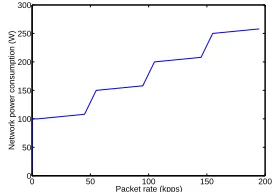
In order to evaluate our mechanisms we conducted our experiments on the real testbed located at Imperial College London. Our testbed consists of 18 PC-based routers and we assume that the power consumption profile of these machines has a step-like behaviour as shown in Figure 4. For less than 100 packets/sec a minimal power consumption of 10W is assumed.
source nodes will queue there in order to enter the network. After making a request, each user waits for a random time intertime and then makes a request again. We set this random intertime among requests, so as to have different rates for the arrivals.
Our experiments covered two cases, one with EAAC fully enabled and one with the admission control enabled (flows are queued up) but where the flows are always accepted. The second approach was chosen over not having admission control at all, in order to study the efficiency of our algorithm under the same conditions, since it is a centralised algorithm, and not allowing all users to enter the system at the same time, by itself, contributes to reducing the number of flows entering the network.
We point out that the experiments reported here are not carried out on a standard test-bed that runs the Internet Protocol. Instead, the router software is written for a QoS aware protocol called the ”’Cognitive Packet Network” (CPN) [9]. However, while CPN can collect energy and QoS information and modify paths so as to min-imise such metrics, our experiments were run on a test-bed that uses CPN but which selected all paths to be fixed minimum-hop paths. Furthermore, delays are measured via pinging and energy consumption of the nodes is estimated from the power pro-file. Therefore we think that the results we obtain will mimic the energy and delay characteristics that one would obtain in a standard IP network.
4.2 Power Consumption
In this experiment we have 4 source-destination pairs(103,209),(108,212),(111,214) and(209,215). We assume that new flows are generated every intertime seconds, where intertime is randomly distributed between 10 and 40 secs. We also assume a random flow duration of 10−30 seconds and a randomly distributed bandwidth request of 1−10Mbps. The packet size is set to 100bytes. Finally, we assume that all the users are willing to wait up to 30 seconds before they are admitted into the network.
[image:5.595.312.450.508.604.2]We ran the experiment with our EAAC and without (accepting in the network every new flow). New flows are generated for 300secs. Note that for the EAAC after
Fig. 3 Network topology
0 50 100 150 200 0
50 100 150 200 250 300
Packet rate (kpps)
Network power consumption (W)
Fig. 4 Step-like router power profile used in
the 300secs we accept all the flows in order to compare the total energy spent for serving the same amount of users in the network.
The total network power consumption over time, for both cases, is shown in Fig-ure 5, where the dashed lines correspond to the average values. As we can observe from this figure, there is an average power saving of around 17%. Note that all the presented results are averaged over three runs of the experiment. Also, the energy consumption is higher for the EAAC in the last part of the experiment since after the 300th second the EAAC accepts all remaining flows, regardless their energy consumption or waiting times. In Figure 6 the average waiting time of the users is plotted with and without the EAAC. As expected, the energy saving comes at a cost of delaying the users before they are admitted into the network.
4.3 The impact of the
∆
value and the effect of delaying traffic
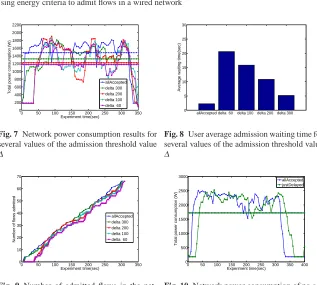
In order to study the effect of the threshold value∆, we load the network with higher rate of flows’ arrivals, i.e. the intertime is set randomly between 10 and 20 seconds. Several values for∆ are examined and their impact on the energy saving is plotted in Figure 7. These results suggest that the best energy saving is for∆equal to 60 and 100. Further observation from figure 8 reveals that the more strict the∆value is, the greater the average waiting time is. The results plotted in Figure 9 clearly show this effect on the total number of admitted flows in the network. Thus, as we can see in figure 9, the more strict the∆ value is, the less flows are admitted into the network, and in all cases, the EAAC always accepts less flows compared to the no admission control case.
The value of∆ could affect the efficiency of our proposed method and should therefore be selected carefully. As we can see from figures 7 and 8, if the∆ value is too large, the admission control admits almost all new flows and the savings are negligible. On the other hand, if the∆value is selected to be too small, the admission control will be very strict and users will be obliged to wait until their waiting times
0 50 100 150 200 250 300 350 0
200 400 600 800 1000 1200 1400 1600 1800 2000 2200
Experiment time(sec)
Total power consumption (W)
allAccepted AdmissionControl
Fig. 5 Network power consumption results for
the admission control and no admission control case
allAccepted AdmissionControl 0
5 10 15 20 25 30
Average waiting time(sec)
Fig. 6 User average admission waiting time for
0 50 100 150 200 250 300 350 0 200 400 600 800 1000 1200 1400 1600 1800 2000 2200 Experiment time(sec)
Total power consumption (W)
allAccepted delta 300 delta 200 delta 100 delta 60
Fig. 7 Network power consumption results for
several values of the admission threshold value
∆
allAccepted delta 60 delta 100 delta 200 delta 300 0 5 10 15 20 25 30
Average waiting time(sec)
Fig. 8 User average admission waiting time for
several values of the admission threshold value
∆
0 50 100 150 200 250 300 350 0 10 20 30 40 50 60 70
Number of flows admitted
[image:7.595.140.457.79.364.2]Experiment time(sec) allAccepted delta 300 delta 200 delta 100 delta 60
Fig. 9 Number of admitted flows in the
net-work for the for several values of the admission threshold value∆
0 50 100 150 200 250 300 350 400 0 500 1000 1500 2000 2500 3000 Experiment time(sec)
Total power consumption (W)
allAccepted justDelayed
Fig. 10 Network power consumption of no
ad-mission control compared to delaying of flows
expire. The selection of the most appropriate value is not straightforward and should be carefully examined. Our future work will involve finding the optimal value of∆ under several conditions. For example, a careful selection could be made based on the power profile of the nodes. Additionally, this value could also be readjusted online, based on the observed power savings and waiting times.
In order to see whether energy savings result from just delaying the flows, we run an experiment where all new flows are delayed up to their maximum waiting time with maximum waiting times wj selected uniformly in [10,40]sec. The result is compared to the case where all flows are accepted as soon as they arrive, see Figure 10, and we observe that initially the power consumption is lower but the overall average is the same. Thus there is no energy saving in just delaying the traffic.
5 Future work
show the effectiveness of the method and reveal room for potential energy savings, but these energy savings come at the expense of increased waiting delay for users before being admitted into the network. Additional memory transfers and packet processing at the sources can have energy consequences that will be considered and evaluated in future work so that the overall impact of admission control can be con-sidered both on total delay and total energy consumed for the flows and the network. Another aspect that we plan to pursue is the use of analytical models to predict and optimise the energy and delay related to the admission process; mathematical per-formance modeling tools are well established [8, 12] and will be applied to this particular problem in future work as we have done for energy-aware routing [10].
References
1. Barroso, L., Holzle, U.: The case for energy-proportional computing. Computer 40(12), 33 –37 (2007). DOI 10.1109/MC.2007.443
2. Bianchi, G., Borgonovo, F., Capone, A., Fratta, L., Petrioli, C.: Endpoint Admission Con-trol with Delay Variation Measurements for QoS in IP Networks. Computer Communication Review 32(2), 61–69 (2002)
3. Bianzino, A., Chaudet, C., Rossi, D., Rougier, J.: A survey of green networking re-search. Communications Surveys Tutorials, IEEE PP(99), 1 –18 (2010). DOI 10.1109/SURV.2011.113010.00106
4. Dilip Kumar, S., Vijaya Kumar, B.: Eaac: Energy-aware admission control scheme for ad hoc networks. International Journal of Wireless Networks and Communications 1(2), 201–219 (2009)
5. El-Dolil, S., Al-Nahari, A., Desouky, M., Abd El-Samie, F.S.: Uplink power based admission control in multi-cell wcdma networks with heterogeneous traffic. Progress In Electromagnet-ics Research B 1, 115–134 (2008). DOI doi:10.2528/PIERB07101302
6. Floyd, S.: Comments on Measurement-based Admissions Control for Controlled-Load Ser-vices. Computer Communication Review (1996)
7. Gartner, I.: Gartner estimates ICT industry accounts for 2 percent of global CO2 emissions (2007). URL www.gartner.com/it/page.jsp?id=503867
8. Gelenbe, E.: A unified approach to the evaluation of a class of replacement algorithms. IEEE Transactions on Computers 22(6), 611– 618 (1973)
9. Gelenbe, E.: Steps towards self-aware networks. Communications ACM 52(7), 66–75 (2009) 10. Gelenbe, E., Morfopoulou, C.: A framewok for energy aware routing in packet networks. The
Computer Journal 54(6) (2011)
11. Gelenbe, E., Sakellari, G., D’ Arienzo, M.: Admission of QoS Aware Users in a Smart Net-work. ACM Transactions on Autonomous and Adaptive Systems 3(1), 4:1–4:28 (2008) 12. Gelenbe, E., Stafylopatis, A.: Global behavior of homogeneous random neural systems.
Ap-plied Mathematical Modelling 15(10), 534 – 541 (1991). DOI 10.1016/0307-904X(91)90055-T
13. Lima, S., Carvalho, P., Freitas, V.: Admission Control in Multiservice IP Networks: Architec-tural Issues and Trends. IEEE Communications Magazine 45(4), 114–121 (2007)
14. Nedevschi, S., Popa, L., Iannaccone, G., Ratnasamy, S., Wetherall, D.: Reducing network energy consumption via sleeping and rate-adaptation. In: NSDI’08: Proc. 5th Symp. on Net-worked Systems Design and Implementation, pp. 323–336. USENIX Association, Berkeley, CA, USA (2008)
![Fig. 1 Predicted power consumption of a de-vice vs load [15]Fig. 2 Power consumption for proportionaland non proportional cases [3]](https://thumb-us.123doks.com/thumbv2/123dok_us/443090.1043815/3.595.157.451.500.600/predicted-power-consumption-power-consumption-proportionaland-proportional-cases.webp)