PR O C E SS C A U SA TIO N A N D Q U A N T U M
PH Y SIC S
Cynthia Kwai Wah Ma
SUBMITTED IN PARTIAL FULFILLMENT OF THE REQUIREMENTS FOR THE DEGREE OF
DOCTOR OF PHILOSOPHY AT
THE DEPARTMENT OF PHILOSOPHY, LOGIC AND SCIENTIFIC METHOD THE LONDON SCHOOL OF ECONOMICS AND POLITICAL SCIENCE
UNIVERSITY OF LONDON LONDON, ENGLAND
JUNE 2001
All rights reserved
INFORMATION TO ALL U SE R S
The quality of this reproduction is d ep en d en t upon the quality of the copy subm itted.
In the unlikely even t that the author did not sen d a com plete m anuscript
and there are m issing p a g e s, th e se will be noted. Also, if material had to be rem oved,
a note will indicate the deletion.
Dissertation Publishing
UMI U 1 5 0220
Published by ProQ uest LLC 2014. Copyright in the Dissertation held by the Author.
Microform Edition © ProQ uest LLC.
All rights reserved. This work is protected against unauthorized copying under Title 17, United S ta tes C ode.
ProQ uest LLC
789 East E isenhow er Parkway
The undersigned hereby certify that they have recommend to the Faculty of Graduate School for acceptance a thesis entitled “P ro cess C a u sa tio n an d Q u a n tu m P h y sics” by C y n th ia K w ai W ah M a in partial fulfillment of the requirements for the degree of D o c to r o f Philosophy.
Dated: July 2001
External Examiner:
Research Supervisor: ________________________________ Professor Nancy Cartwright (LSE)
Examing Committee: _______________________________ Professor Phil Dowe (Tasmania)
UNIVERSITY OF LONDON
Date: J u ly 2001 Author: C y n th ia K w ai W ah M a
Title: P ro cess C au satio n a n d Q u a n tu m P hysics
Department: D e p a rtm e n t o f Philosophy, Logic a n d Scientific M e th o d
Degree: P h .D . Convocation: J u ly Year: 2001
Perm ission is herew ith granted to T h e L ondon School o f E conom ics and P olitical Science U niversity o f London to circulate and to have copied for non-com m ercial purposes, at its discretion, th e above title u p on th e request of individuals or institu tion s.
Signature o f A uthor
THE AUTHOR RESERVES OTHER PUBLICATION RIGHTS, AND NEITHER THE THESIS NOR EXTENSIVE EXTRACTS FROM IT MAY BE PRINTED OR OTHERWISE REPRODUCED WITHOUT THE AUTHOR’S WRITTEN PERMISSION.
A bstract vii
Acknowledgem ents viii
1 Prelude0 1
1.1 Introduction... 1
1.2 Causal Connotations and David Hume’s Theory of C ausation... 2
1.3 Russell’s Objection to Hume’s Temporal Contiguity T h e s is ... 10
1.4 Causal Continuity and Recent Physicalist Accounts of Causation . . . 13
2 R ussell on the N otion o f Cause 21 2.1 Russell’s 1913 P a p e r ... 21
2.2 A Definition of C au sality ... 23
2.3 The Issue of Temporal Contiguity between C ause-and-Effect... 27
2.4 Is There a Notion of Cause in P h y sic s? ... 38
2.5 Possible Solutions to the Temporal Gap Problem ... 41
2.6 Russell’s Causal Lines ... 47
2.7 Reflections and A fterth o u g h ts... 50
3 Process Theories o f Causation 54 3.1 Introduction... 55
3.2 Salmon’s 1984 Process Theory of C a u s a tio n ... 56
3.2.1 Causal processes ... 59
3.2.2 Causal T ran sm issio n ... 64
3.2.3 Casual In teractio n s... 70
3.3 The Epistemology of C a u s a tio n ... 79
3.3.1 The Circularity C h arg e... 86
3.3.2 The Problem of C ounterfactuals... 90
3.4 Discussions and S u m m a ry ... 99
4 Process Theories: Subsequent D evelopm ents 101 4.1 Introduction... 101
4.2 The Conserved Quantity T h eo ry ... 105
4.2.1 Causal P ro c e s s e s ... 106
4.2.2 Causal Interaction ... 116
mission ... 123
4.4 Continuity, Identity Over Time and the Worldline View of Causal Pro cesses 135
4.4.1 Spatiotemporal Continuity, Identity Over Time and Causal Pro cesses ... 136
4.4.2 A Critique on the “Worldline View” of Causal Processes . . . 146
4.5 The “Histories View” of Causal Processes: A Modest Emendation . . 156
4.6 In terlu d e... 158
5 On th e Way to Quantum Paths: The Superposition o f P otentials 163 5.1 Intro d u ctio n ... 163
5.2 Superposition and the Schrodinger Wavefunction... 164
5.3 The Superposition of Classical W av e s... 172
5.4 The “Quantum” Principle of Superposition and the probabilistic inter pretation of ^ ... 182
5.4.1 The Strange Case of Quantum Interference... 182
5.4.2 When Physics meets Probability: the Superposition of Potentials 195 6 The W avefunction and Caused Processes 220 6.1 In troduction... 220
6.2 Process causation and Quantum P h y s ic s ... 221
6.3 The Wavefunction and Conserved Q uantity... 225
6.4 The Wavefunction as a Causal P r o c e s s ... 233
6.5 The Problematic Wavefunction ... 235
6.6 Towards Feynman’s P a t h s ... 245
6.7 Postscript: Bohmian Quantum Mechanics ... 251
7 Feynm an’s P ath Integrals (Sum -Over-Histories) Form ulation o f Quan tum M echanics and Causal Processes 254 7.1 In troduction ... 254
7.2 The Principle of Least A c t io n ... 255
7.3 The Principle of “Least” Action in Quantum Mechanics... 264
7.4 Feynman’s Path Integral (Sum-Over-Histories) Formulation of Quan tum M e c h a n ic s 268
7.5 Feynman Paths and Causal P rocesses... 285
7.6 P o s tlu d e ... 289
Philosophical analyses of causation take many forms but one major difficulty they all aim to address is that of the spatiotemporal continuity between causes and their effects. Bertrand Russell in 1913 brought the problem to its most transparent form and made it a case against the notion of causation in physics. The issue highlighted in Russell’s argument is that of temporal contiguity between cause and effect. This tension arises from the imposition of a spectrum of discrete events occupying space time points upon a background of spacetime continuum. An immediate and natural solution is to superpose instead spatiotemporally continuous entities, or processes, on the spacetime continuum. This is indeed the process view of physical causation advo cated by Wesley Salmon and Phil Dowe. This view takes the continuous trajectories of physical objects (worldlines) as the causal connection whereby causal influences in the form of conserved quantities are transported amongst events. Because of their reliance on spatiotemporal continuity, these theories have difficulty when confronted with the discontinuous processes in the quantum domain.
This thesis is concerned with process theories. It has two parts. The first part introduces and criticizes these theories, which leads to my proposal of the History
Conserved Quantity Theory with Transmission. The second part considers the exten
First and foremost, I would like to express my deep gratitude to my thesis supervisor, Professor Nancy Cartwright for introducing me to this research and her inspiration. In particular, her inexorable insistence on my careful study of Russell’s argument has sown the seeds of many of the thoughts on the subject of this work. I also thank her for granting me the intellectual freedom to pursue a philosophical topic I find truly interesting. Her support (both professionally and on a personal level) and permission to become a research associate on the project “Modeling in Physics and Economics” - which she directed at the Center for Philosophy of the Natural and Social Science (CPNSS) at the LSE - is gratefully acknowledged. From her, I have learnt the art of articulation.
I would like to show my appreciation to Dr. Carl Hoefer for his guidance and pa tience, his philosophical insights and un-selfish sharing of the secrets of thesis writing, and kind encouragement throughout the past two years when he acted as co-supervisor of my thesis. As I put the final touches to this thesis, Dr. Hoefer has been named the next Director of CPNSS - an appointment for which he is well deserved. I extend to him my hearty congratulations and good wishes.
ways of thinking, insights, discussions and conversations. The following list is by no means complete and exhaustive: Dr. Joseph Berkovitz, Dr. Harvey Brown, Profes sor Jeffrey Bub, Professor Jeremy Butterfield, Dr. Bob Coecke, Professor Raymond Chiao, Professor Francesco De Martini, Dr. Marco del Seta, Professor Lajos Diosi, Dr. Fay Dowker, Professor Augusto Garuccio, Professor Donald Gillies, Dr. Jonathan Halliwell, Dr. Etienne Hofsetter, Professor Bei-Lok Hu, Professor H.I.G. Hughes, Dr. Makoto Itoh, Dr. Adrian Kent, Dr.Yoon-Ho Kim, Professor Willis E. Lamb Jr., Dr. Fotini Markopolou, Professor David Malament, Professor Sarben Sarkar, Professor Marian Scully, Dr. Orly Shenker, Professor Lee Smolin, Professor Rafael Sorkin, Professor Abner Shimony, Dr. Towfic Shomar, Professor Jan Von Plato, Dr. Ting Yu.
Thanks also go to the following individuals for friendship and encouragement: Ms. Klementina Balint, Dr. Sebastiano Bavetta, Dr. Vincenzo Berardi, Mr. Sze-Ting Chen, Dr. Michael Dash, Miss Sadaf Hafiz, Dr. Makiko Ito Harrison, Mr. William Irvine, Professor Josephine Lai, Dr. James McAllister, Mr. Robert Northcott, Ms. Antigone Nounou, Dr. Miya Paczuski, Miss Dorota Rejman, Dr. Michael Selby, Mr. Neeshmal Shah, Dr. Antony Valentini, Mr. Rafaelo Vardavas, Mr. Vincenzo Vitelli, Mrs. Kate Workman and Mr. George Zouros.
The staff members at the Imperial College Central Library have gone out of their ways to provide a haven during the research and writing phases of this thesis. My warm appreciation goes especially to: Bert, Clive, Emma, Ken, Kenny, Monica, Rita and Ronnie; who have all made me feel welcomed and at home.
Simon, the “big-bear” has occupied an episode of my life, with his human strengths and weaknesses. Strangely enough, our interactions have led me closer to discovering my true self, which perhaps, one day, he will develop the sensitivity to understand.
Last, but not least, I wish to express my love and gratitude to my family. Dad has imbued in me a life-long interest in physics and a passion for academic pursuits; since he first introduced to me the delights of algebra when I was at the tender age of nine. Mum is very much loved and thanked for showing endless interest, care and support in every single way through my early school years (and ever since) that laid the foundation for my intellectual developments. My sister Iris and brother Kenneth both have an extraordinary understanding of my character and have provided their unfailing support all through the years. Their constant looking up to me as the “big sister” figure has granted me strength to carry on when times are hard. Kenneth showed his unique way of support by racing me to the “Dr.” title, which he has so admirably won last June (though, however, his title is of the medical profession!).
Cynthia K.W. Ma London, June 2001
P relu d e0
1.1
Introduction
Causation is an active area of philosophical research and it is one notion th at is deeply entwined with the foundational aspects of both classical and quantum physics.
When asked, “W hat is Causation? W hat do we mean when we think that one object is the cause of another or one event causes another to happen?” , no doubt different connotations would immediately come to mind. And indeed we ought to ask “W hat are the connotations of causation?” These basic connotations, being largely empirical in character in the sense that they come from our experience and inter actions with the physical world, generally receive different treatments by physicists and philosophers. The distinction is a matter of the difference in practice. Physicists accept these basic intuitions as facts about causation and physical theories are con structed to conform to these “conditions of causality” , which are not to be violated. A good example would be that of the “past-future” directed Minkowski light-cone structure defined in terms of “cause-effect” relations1. Philosophers, on the other hand, approach the subject from a different angle; they conduct conceptual analyses of these causal connotations and see whether they do make good logical sense or are infected with grave inconsistencies. With the advent of relativity theories, physics has added important items to the stock of causal facts. Perhaps the most significant one is th at special relativity places a limit on the velocity of propagation of causal
°Adopted with modifications and expansion from the paper by C.K.W. Ma (2000) p.631-641. 1See for example, Taylor and Wheeler (1966), p.39.
influences. For the serious philosophical minds, these results cannot afford to go un noticed and it would indeed be of considerable interest to investigate the extent of the possible interplay between the findings from the respective disciplines.
With this motivation in mind, the plan of this chapter goes as follows. In Section 1.2, I shall consider a number of basic causal connotations and the various aspects that may be deduced from these considerations. We are then in a position that leads naturally to the main ideas of David Hume’s theory of causation. Hume’s theory is the start of the empiricist philosophical analysis. The Humean account and its more modern variants collectively still represent the predominant philosophical view on causation among anglophone philosophers. However, in a clever paper in 1913, Bertrand Russell was able to show that the Humean view is not free from inconsis tencies given an important assumption on the nature of time. Russell’s argument will be examined in Section 1.3. Section 1.4 focuses on the issue of causal continuity and the recent physicalist approaches to causation that attem pt to resolve some of the more pressing difficulties associated with this issue.
It is my modest aim to bring into focus, in the following pages, some major philosophical worries on the subject of causation, which may be fairly regarded as one of the underlying puzzles encountered in the foundations of both classical and quantum physics.
1.2
Causal C onnotations and D avid H u m e’s T he
ory o f C ausation
When one event (or something2) is regarded as the cause of another, we have “postu lated”3 the existence of a special relation or connection between the two events. How special is it? We may want to emphasize the importance of such a connection by the expression that the event we have chosen to call the cause and the one that is called
2What kind of entities does the causal relation relate is an important aspect of philosophical analyses of causation. Some argue that the “relata” should be events, while others insist that they may be facts, processes or states of affairs. However, as both Hume and Russell take events as the proper causal relata, we may therefore focus on events in the present work.
the effect are necessarily connected to each other so that had the cause not happened,
the effect would not have happened either. Put slightly differently, this counterfactual
mode of representation of the special connection refers to an element of necessity in the sense th at given the cause, the effect “must” follow and any other situations just simply cannot and would not happen.
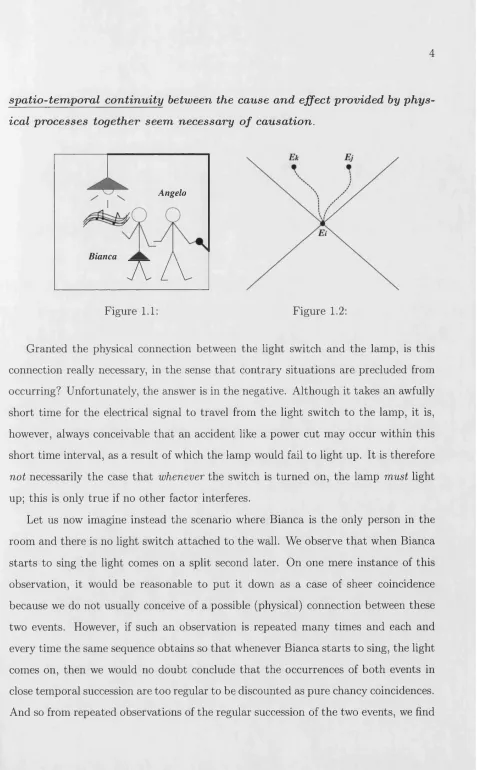
How then are we to discover this necessary connection, whatever it may be? One useful place to look is to start from our observations of how causes and effects behave generally. An obvious observation is that 11 causes precede their effects” ; namely, causes occur earlier in time than their effects. One realizes of course that not every pair of events happening at the same two respective instants of time are to be thought of as causes and effects. A concrete everyday example illustrates (Figure 1-1). Suppose we have two individuals, Angelo and Bianca, standing side-by-side in a room and Angelo, who is nearer to the light switch, turns it on and at the same moment in time, Bianca starts to sing. Even though Angelo’s action and Bianca’s singing are
both events happening prior to the lamp being lit up, we would deem it appropriate to attribute the cause of the lamp lighting to the switching action provided by Angelo but not to Bianca’s singing. Why? It is in part because a continuous physical connection is envisaged between the light switch and the lamp and there is in general no obvious and direct correlation between the processes of singing and the lamp lighting.
So temporal succession between two events alone is not a sufficient condition for causation. To place the matter in a more scientific perspective, consider the Minkowski lightcone in Figure 1-2. Events Ej and Ek4 both lie in the future light- cone of the event Ei and hence are causally connectible to Ei since signals sent from Ei can reach either Ej or Ek. However, neither Ej nor Ek is necessarily con
nected to Ei for there need not be an existing connection after all. Whether there
is in fact an actual connection depends upon the existence of actual physical pro cesses linking Ei to Ej and/or Ek. Therefore, tem p o ra l su c ce ssio n a n d the
spatio-tem p o ra l c o n tin u ity between the cause and e ffect provided by p h y s
ical processes together seem n ecessary o f causation.
Bianca
A / V
Angelo
Figure 1.1: Figure 1.2:
Granted the physical connection between the light switch and the lamp, is this
connection really necessary, in the sense th at contrary situations are precluded from
occurring? Unfortunately, the answer is in the negative. Although it takes an awfully
short time for the electrical signal to travel from the light switch to the lamp, it is,
however, always conceivable th at an accident like a power cut may occur within this
short time interval, as a result of which the lamp would fail to light up. It is therefore
not necessarily the case th at whenever the switch is turned on, the lamp must light
up; this is only true if no other factor interferes.
Let us now imagine instead the scenario where Bianca is the only person in the
room and there is no light switch attached to the wall. We observe th a t when Bianca
starts to sing the light comes on a split second later. On one mere instance of this
observation, it would be reasonable to put it down as a case of sheer coincidence
because we do not usually conceive of a possible (physical) connection between these
two events. However, if such an observation is repeated many times and each and
every time the same sequence obtains so th at whenever Bianca starts to sing, the light
comes on, then we would no doubt conclude th at the occurrences of both events in
close temporal succession are too regular to be discounted as pure chancy coincidences.
[image:16.595.26.503.27.797.2]it proper and indeed justified to “infer” a special connection (Figure 1-3) between this pair of events and set out to search for the “hidden” mechanism th at could have been responsible for giving rise to such a correlation.
The question remains: is such a connection we have so inferred upon repeated observations of regularities a necessary one? Although experience teaches us that fre quent correlations are usually prima facie good indicators of causation, it is however well-known that correlations do not have to imply causation. Logic does not prohibit the apparent correlations we see as arising from pure chance. One may well imagine the world to be a chancy enterprise in such a way that “it so happens” that whenever
E\ occurs, E2 follows later. Still, one may argue th at quite unbeknown to us, there could exist some kind of a voice-recognition device which provides the physical con nection between Bianca’s singing and the lighting up of the lamp. But what gives us the impression and prompts us to look for this “unknown device” in the first place? Nothing other than the constant conjunction of the two events of the singing and the lamp being lit - given the same cause, the same effect follows. Once again, such a physical connection is by no means necessary as for instance, a power cut may occur and tamper with the normal functioning of the device, thus rendering the succession of the two events unattainable.
E i E2 Ei---►---E2
Direct
E l---E2 El Ei
E i---E2 V
• \ .
/
• /
•
c*E l ---E2 Indirect
Figure 1.3: Figure 1.4:
has found to be followed by the same effect on a great number of occasions also gives us the feel of a causal correlation and induces us to look for an underlying connec tion. It is in this way that it is often thought that spatio-temporal continuous physical processes are essential for making sure that “the same cause is to be followed by the
same effect”. Unforeseen circumstances may happen during the spatial and temporal
course of this continuous physical process and frustrate the connection between the two events. Due to the absence of necessity, in the sense th at unforeseen circum stances can always occur, it follows that there can never be any guarantee without fail th at the same cause is to be followed by the same effect. This clearly indicates an incompatibility between these two causal connotations and th at in reality, “the same
cause is always followed by the same effecf is not warranted by “spatio-temporal
continuity. This is quite contrary to our ordinary way of thinking.
Spatially and temporally continuous physical processes, though they are by no means necessary connections, do nevertheless impress upon us the idea of the existence of causal relations by way of the physical connections. Such physical connections between two events may, however, either be (i) direct or, (ii) indirect. In the latter case, we seek a third event C* that existed in the overlap region of the respective past lightcones of the two events so that both events are direct consequences of
significant achievement of Bell’s 1964 inequalities5 rests on their success in dispelling local hidden variable models in favour of quantum mechanics, as has since then been so forcibly confirmed by many sophisticated experiments6.
In relation to the spatio-temporal continuity between causes and effects, another common connotation we have for causation is to suppose th at a certain cause event has occurred but nevertheless the expected effect has somehow failed to materialize. The situation is usually explained by the presence of other events th at must have got in-between them and inhibited the occurrence of the effect. In other words, the spatio-temporal continuity between the supposed cause and the supposed effect is disturbed. In order to diminish the opportunity for other events to go “in-between” and behave mischievously, it is desirable to make both the spatial and temporal inter vals between the cause and the effect as short as possible. The shorter these intervals are, the smaller the probability generally for other factors to interfere. Causes and effects are expected to be spatially and temporally close to each other, so th at they should exhibit a degree of spatio-temporal “nearness” . For events happening at vastly separated spacetime locations to be causally connected, we look for events to provide the intermediate links between these two spacetime locales, and hence, we arrive at the idea of a “causal chain” to ensure causal continuity across spacetime regions.
The foregoing discussions now lead appropriately to the introduction of the major ideas of David Hume’s theory of causation, which exerted tremendous influence over the logical positivists and their contemporaries such as Bertrand Russell.
Hume maintains that there are two basic elements to human understanding that form the pillars to his philosophical system: impressions and ideas. Impressions correspond to all “lively signals” we receive from the physical world through our senses, like perceptions, sensations, feelings etc. Ideas, on the other hand, consist in the formation of a conception of the impressions. The general principle he adopts for his philosophical analyses is that: uall ideas originate from the association and
combination of the different impressions”. So any idea we may possess for some entity
5Bell, J.S. (1964).
has to come from our perceptual experience with it through our senses.
Armed with this principle, he then asks, from which impressions do we form
the idea of cause-and-effect as some sort of a necessary connection1 He is able to
identify three such impressions from our empirical experience of two events behaving like causes and effects. These are: “ p r io r ity in tim e ” of the cause , “c o n sta n t
c o n ju n c tio n” between the cause and the effect and “ c o n tig u ity ” in space and time
between causes and effects. And these should be of some familiarity to the reader since they refer to none other than the three causal connotations we have considered in the above: “causes precede their effects”, “given the same cause, the same effect
follows” and “continuity' respectively. But as we have already discussed, from these
three properties and these three alone, one can never deduce the element of necessity. Hume argues th at even though there may actually exist connections in the world which are necessary in the above sense, beyond this, the only real idea we can have of this connection is of the three properties above. Since these properties are not sufficient to entail necessity, philosophical prudence must now compel us to take a skeptical view of the idea of necessary connection between causes and effects.
Granted that our experience is incapable of furnishing us with the idea of a neces sary causal connection, how are we able to associate the three impressions of causes and effects to arrive at the idea of a necessary connection between two events? Hume answers that after many instances of observing the behaviours of constant conjunc tion, priority in time and contiguity in time and space between the two events without
exception, the mind has in the course grown accustomed to expect th at the second
It must again be emphasized that it is never Hume’s intention to deny the existence of necessary connections in Nature. Rather, the three impressions are all we possess by way of a source for the idea of causal necessity. Since this evidence alone is not adequate to reveal to us such an element of necessity, it would be more reasonable not to impose its existence on Nature, leaving this instead as an open question. And Hume concludes7,
A s to w h at m a y be sa id , th a t the operation s o f n atu re are in
depen den t o f o u r thought and reason ing
,
I allow it; an d accordingly have observed, th a t objects bear to each o th er the
rela tio n s o f con tigu ity and succession; th a t like objects m a y be
observed in several in sta n ces to have like rela tio n s; and th a t
all this is in d ep en d en t of, and anteceden t to the opera tio n s o f
the u n d ersta n d in g . B u t i f w e go a n y fa r th e r , an d ascribe a
p o w er o r n ecessa ry connection to th ese objects; th is is w hat we
can n e v er observe in th em , but m u st draw the idea fr o m w hat
we feel in te rn a lly in con tem platin g them .
1.3
R u ssell’s O bjection to H u m e’s Tem poral Con
tig u ity T hesis
In 1912, Bertrand Russell made his presidential address8 to the Aristotelian Society the occasion to cast doubt on the tenability of the Humean account of causation and to argue against the notion of cause in physics.
We have already taken pains to stress the inherent incompatibilities among the three causal impressions of priority in time, contiguity in space and time and constant
conjunction. In particular, it has been indicated th at in the absence of the ingredient
of necessity, spatio-temporal continuity is not really capable of ensuring the constant conjunction of the causes and effects. The main reason for this is th at even if there is a continuous spatio-temporal physical process connecting the cause and the effect, anything can still happen during the time interval while the causal influence is trans mitted down the connection and this results in an uncertainty in the production of the effect. The light switch and the lamp in the last section form a good example. This is why events which are too removed from each other in both spatial and temporal dimensions are not considered as reliable causes and effects.
An immediate solution would be to require th at both the spatial and temporal distances between the two events be decreased to such an extent for them to stand
11 adjacent' (or contiguous) to each other, so that other factors cannot impose them
selves and thwart the occurrence of the effect. But what exactly does one mean by two events being “ adjacent' to each other when they are embedded in a background of spacetime continuum? The criterion of spatial contiguity between two events is easily satisfied and in the limit it is met by the case where two events, happening at different times, may indeed occupy the same location in space. The notion of temporal contiguity is, however, more problematic since given th at two events occur at the same spatial location with one after another, how are we to ensure that they are temporally contiguous to each other? This problem reduces to one th at concerns temporal contiguity and this is indeed the important issue addressed by Russell in
his paper.
Russell’s argument begins with a statement of the temporal contiguity thesis
{ TC) . The properties of priority in time and temporal contiguity between cause and
effect can be summarised as follows:
TC: W h en ever the f ir s t e ven t (cause) ceases to e x is t, the
secon d com es in to existen ce im m e d ia tely a fter.
To place T C in the correct perspective, Russell makes the major assumption that time is to be modeled as a mathematical continuum and is therefore considered as a dense series. A dense series has the distinctive feature th at the notion of a “next point” does not make sense because between any two points there always exist others, no m atter how close these two points are to each other. It is instructive to contrast the idea of a dense series such as the real number line with the discrete series of positive integers where the notion of consecutive (or “next”) members does take on a well- posed meaning. Having specified how the temporal continuum is to be represented, we now consider two point events c and e occurring at two respective instants of time
ti and t2 (ti < £2)* Because time is a dense series, it follows that between any two
instants (points) of time, there are always other instants (points) no m atter how short we make the interval t2~ t\. That is, there exists always a temporal gap between c and
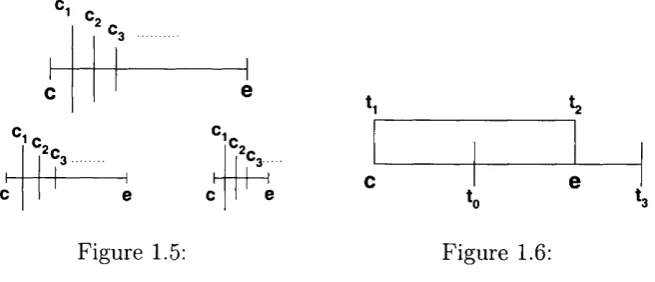
e and so c cannot be regarded as contiguous in time to e. Furthermore, this temporal gap provides ample opportunities for other events to creep in between c and e and to interfere. Whilst these other factors may not prove harmful to the production of e at t 2, they may, however, also behave otherwise and hinder the occurrence of e (Figure 1-5). Under these circumstances, one cannot be certain th at the same cause is always followed by the same effect since there can always be the chance of e not occurring
whenever there is to be this temporal gap between the two events.
cause would have to be a static, unchanging event9, occupying the half-open interval
just previous to the effect. For imagine the cause changed. Then we would need to
postulate a cause-effect relation between the part of the cause before the change and
the part after, and we would be no further ahead. Thus the cause must be supposed
to sit there from time ti to t 2, filling the temporal gap and all of a sudden, turns into
e at t 2- However, Russell objects: he argues th a t it is not at all logical why, being
unchanging and sitting there complacently, c has to tu rn into e at t 2 but not at any
other moment, say the earlier to or the later t 3?
Figure 1.5: Figure 1.6:
And so static, unchanging events are dismissed outright by Russell as an impos
sibility. But these static, unchanging events seem to be the only means by which
the temporal gap can be occupied. Since these are not plausible, one must draw
the conclusion th a t there always exists a temporal gap between c and e as a result
of which c cannot be contiguous to e. Our intuition about the tem poral continuity
of causes and effects comes under threat given the assumption of physical time as
a mathematical continuum and as a consequence, constant conjunction cannot be
guaranteed. Russell has succeeded in showing th a t there exist tremendous tensions
between our usual connotations of the causal relation.
[image:24.601.94.422.328.469.2]1.4
Causal C ontinuity and R ecent P h ysicalist A c
counts o f C ausation
Despite the difficulty brought to light by Russell’s critique of the Humean temporal contiguity thesis, one is, of course, entitled to argue th at the major issue is really the feasibility of the definition of events as points occurring at discrete temporal instants within the temporal continuum. There is simply no place for the notion of discreteness within a temporal continuum. A more congenial approach would then be to “superpose” a continuum of events - a continuous rope of events - upon this temporal continuum, in the sense that we consider all the events th at happen locally within this time interval. One finds a convincing example on causal continuity from Elizabeth Anscombe10: “Find an object here and ask how it comes to be there?” (Figure 1-7),
A
B
» --- #
Before
After
Figure 1.7:
A causal explanation, says Anscombe, would be “it went along some path from
A to B”. The locution “along some path” in fact entails more than the case where
the object just turns up at location B after having been at A previously. It requires the object to occupy also all the intermediate positions between A and B. To satisfy
constant conjunction, it is sufficient for the object to turn up at location B after hav
ing been at A some moments earlier and without having to assume the intermediate positions between the two locations. But this would not be deemed to be an adequate causal explanation11. And so to “explain causally” , a path has to be imposed to pro vide the connection between the two events of the object being at the two respective
10Anscombe, E (1974), p.150.
spacetime locations. For the purpose of explanation, it is therefore proper to consider
spatio-temporal continuous connections when thinking about causation.
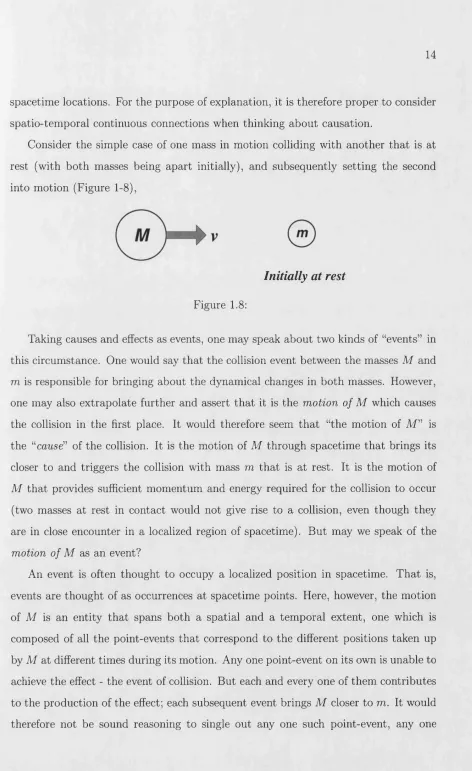
Consider the simple case of one mass in motion colliding with another th at is at
rest (with both masses being apart initially), and subsequently setting the second
into motion (Figure 1-8),
this circumstance. One would say th at the collision event between the masses M and
m is responsible for bringing about the dynamical changes in both masses. However,
one may also extrapolate further and assert th a t it is the motion of M which causes
the collision in the first place. It would therefore seem th a t “the motion of M ” is
the “cause” of the collision. It is the motion of M through spacetime th at brings its
closer to and triggers the collision with mass m th at is at rest. It is the motion of
M th at provides sufficient momentum and energy required for the collision to occur
(two masses at rest in contact would not give rise to a collision, even though they
are in close encounter in a localized region of spacetime). But may we speak of the
motion of M as an event?
An event is often thought to occupy a localized position in spacetime. T hat is,
events are thought of as occurrences at spacetime points. Here, however, the motion
of M is an entity th at spans both a spatial and a temporal extent, one which is
composed of all the point-events th at correspond to the different positions taken up
by M at different times during its motion. Any one point-event on its own is unable to
achieve the effect - the event of collision. But each and every one of them contributes
to the production of the effect; each subsequent event brings M closer to m. It would
therefore not be sound reasoning to single out any one such point-event, any one
Initially at rest
Figure 1.8:
[image:26.595.29.501.30.801.2]specific position of M at a certain instant of time and ask how it might relate to the
collision.
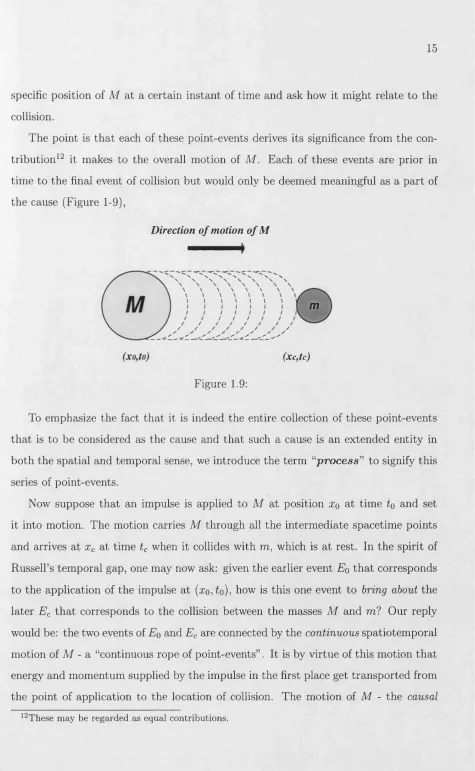
The point is th a t each of these point-events derives its significance from the con
tribution12 it makes to the overall motion of M . Each of these events are prior in
time to the final event of collision but would only be deemed meaningful as a part of
the cause (Figure 1-9),
Direction of motion of M
m
(X C y tc )
Figure 1.9:
To emphasize the fact th at it is indeed the entire collection of these point-events
th a t is to be considered as the cause and th at such a cause is an extended entity in
both the spatial and temporal sense, we introduce the term “p ro c e s s” to signify this
series of point-events.
Now suppose th at an impulse is applied to M at position xq at time to and set
it into motion. The motion carries M through all the intermediate spacetime points
and arrives at x c at time tc when it collides with m, which is at rest. In the spirit of
Russell’s temporal gap, one may now ask: given the earlier event Eo th at corresponds
to the application of the impulse at (xo,to), how is this one event to bring about the
later E c th at corresponds to the collision between the masses M and m l Our reply
would be: the two events of Eo and E c are connected by the continuous spatiotemporal
motion of M - a “continuous rope of point-events” . It is by virtue of this motion th at
energy and momentum supplied by the impulse in the first place get transported from
the point of application to the location of collision. The motion of M - the causal
[image:27.595.27.502.35.806.2]process - provides the missing link to restore spatiotemporal continuity
In physics, the motion of a system is usually represented either by spatially and
temporally continuous paths or by trajectories in phase space. These spacetime paths
and phase space trajectories are the solutions of differential and integral equations
- the expressions of spatiotemporal continuity. Whilst these differential and integral
equations guarantee continuity, it is, however, a fact th at they lack the crucial causal
aspect of an explicit temporal order for cause and effect.
Consider once more the example of mass M colliding with mass m and setting
the latter into motion from an initial state of rest. The same state of affairs can be
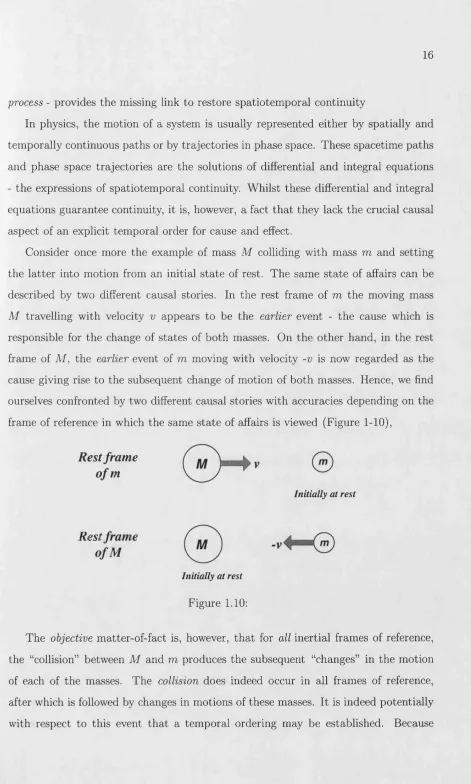
described by two different causal stories. In the rest frame of m the moving mass
M travelling with velocity v appears to be the earlier event - the cause which is
responsible for the change of states of both masses. On the other hand, in the rest
frame of M, the earlier event of m moving with velocity -v is now regarded as the
cause giving rise to the subsequent change of motion of both masses. Hence, we find
ourselves confronted by two different causal stories with accuracies depending on the
frame of reference in which the same state of affairs is viewed (Figure 1-10),
The objective matter-of-fact is, however, th at for all inertial frames of reference,
the “collision” between M and m produces the subsequent “changes” in the motion
of each of the masses. The collision does indeed occur in all frames of reference,
after which is followed by changes in motions of these masses. It is indeed potentially
with respect to this event th a t a temporal ordering may be established. Because
Rest fram e o f
Initially at rest
Rest f r
o f
Initially at rest
[image:28.595.30.501.28.812.2]of this “causal interaction” between the masses M and ra, their respective energies and momenta are modified accordingly. This interaction may be thought of as an encounter between the two masses as their respective path crosses. Both masses, having interacted, will carry the causally modified dynamical properties via their continuous spatio-temporal trajectories and may participate in further interactions.
The idea of a continuous spatiotemporal path hence forms the backbone of the physicalist theories of causation. Although there are variations amongst these the ories of physical causation that have been put forward, they nevertheless share one basic underlying idea: causal continuity is guaranteed by the transmission of causal influences (objective physical quantities) along continuous space-time paths governed
by physical laws. The “objective physical quantities” being transferred refer usually
to either momentum or energy in the group of approaches subsumed under the title of “transference theories of causation”13. A more sophisticated version is the class of the so-called “process-theories” of causation as pioneered by Wesley Salmon in the early 1980’s, which has subsequently undergone substantial further developments by both Salmon himself and Phil Dowe during the 1990’s14.
“ Casual processes” and “causal interactions” thus form two fundamental causal
notions of process theories. These approaches take p ro c e sse s, entities construed as spatio-temporally continuous paths of physical objects, as the basic unit of causal analysis. Events - the interactions - are fixed by the crossings of processes on these accounts. When two processes meet so that changes are brought to at least one of them as a result, then it is said that the processes llin te ra c f. Interactions are thus of prime importance for they are responsible for the production and modifications of the participating processes by introducing changes in their dynamical properties and structures. The two notions of process and interaction lie at the very heart of process theories of causation.
13Dieks, D. (1981), Ehring, D. (1986), Fair, D. (1979).
Processes are the vehicles by which causal influences, such as physical informa tion and signals, are propagated. Any changes in the make-up of a process are due to its interactions with other processes. Perhaps the analogy with the special rela- tivistic representation of events may be too plain a correspondence to deserve any attention. On Minkowski spacetime diagrams, all the encounters experienced by a physical object, that is, a history of events which involves the object, are connected by a spatio-temporally path, the worldline of the object. When the object interacts with another object, the interaction is an event common to the histories of both ob jects and is hence represented as the intersection of both worldlines. So if we take the analogy at face value, the processes may then be identified with the worldlines of objects and the interactions given by the crossings of these worldlines. This is the current view held by both Salmon and Dowe.
to the discussion in Section 1.2 and Figure 1-2.
To cast the discussion in a more concrete context, imagine the case of a large circular building with a spotlight mounted on a rotating platform at its center, which Salmon used in first introducing his account of causal processes. Once the spotlight is switched on and set into rotation a spot of light will sweep across the wall of the building in circular motion. Although the moving spot of light appears to be spatio-temporally continuous and travelling at a speed th at is below c, it nevertheless cannot provide any sort of connection between two events due to its inability to transfer information and signals. If the spot of light is intercepted by a red lens at one single spot on its path, it would become red at th at very point but then such a change (the change from being a white light spot to one being red) would not be transmitted beyond this point: the information that it has interacted with the red lens is not permanently registered. The travelling spot of light “reverts” back to its original state of being a white spot once it has moved beyond the lens.
Why is this process not capable of carrying or transmitting this information? Con trast this spot of light with the light ray that travels from the spotlight at the center and impinges on the wall. The ray of light, being spatially and temporally continuous, is also a good paradigm of a process. Suppose a red lens is placed somewhere along its path, the light ray will be coloured red at this point and would remain red from then on. In this case, the information that it has been intersected and interacted with a red lens is registered and propagated down the process itself.
ray, with its every stage being physically connected to the previous (and also to the next) via the transfer of energy (and hence information) between the various stages of the process. It is by virtue of transmission of causal influence th at the successive stages of a proper causal process are linked. It is thus of paramount importance that only processes th at are endowed with the ability to transmit the results of changes introduced by their interacting with other processes are regarded as causal ones. In short, the capability of some processes to transmit causal influences like energy and information is the criterion for being causal processes.
Both the theories of Salmon and of Dowe strive to capture how causal influences are carried across spacetime regions in genuine causal processes by imposing their respective criterion for when a transference has occurred. Dowe maintains that the
“possession of a conserved quantity by an object along its worldline is a sufficient
condition to ensure the transference of causal influences. Salmon, however, argues th at Dowe’s condition of 11 mere possession” does not capture the fact the the pos session of a conserved quantity at each of the spacetime points must not arise from interactions.
The foregoing serves only as a concise outline of the contents of Chapters 3 to 4 of this thesis, where we shall follow the development of the process causal theories closely. Salmon’s 1984 theory of process causation will be introduced in Chapter 3 and the key problematic issue of counterfactuals th at plagues Salmon’s program will be discussed in detail. The subsequent developments form the main subject of Chapter 4, which leads to my proposal of the “history vievd' th at takes the place of the worldline view of process causation in order to pave the way for the consideration of discrete processes in the quantum domain.
R u ssell on th e N o tio n o f C ause
“Then I must discover the truth about Causality - in
the paper I read the other day, I only showed that all current views are wrong, and I am at a loss as to what is right.”
(Bertrand Russell - from a letter to Lady Ottoline
Morrell, 23 February 1913)
2.1
R u ssell’s 1913 Paper
In the essay “On the Notion of Cause”, his presidential address to the Aristotelian Society in 19121, Bertrand Russell attempts to show how the philosophical and the scientific concepts of causality differ from each other. Today, there are two important inter-related reasons for one who desires to investigate the concept of causality in physics to begin with Russell’s 1913 paper. First, in this paper Russell masterfully cast the Humean viewpoint in a precise form that makes it possible for him to analyse more fully, and to subsequently raise the important issue of the temporal contiguity
between cause and effect with this standard philosophical picture of causation. Second,
troubled by this worry with the standard picture, Russell provided an argument against the notion of cause in physics. He concludes th at the strict, certain and universal doctrine of causation - the same cause always produces the same effect
-1Delivered on 4 November 1912. The ensuing essay was published in the Proceedings of the Aristotelian Society, 13 (1912-13) and reprinted in Russell, B. (1917), p .180-208.
“which philosophers advocate is an ideal, possibly true, but not known to be true in
virtue of any available evidence. What is actually known , as a matter of empirical
science, is that certain constant relations are observed to hold between the members
of a group of events at certain times"2.
The difficulty with the temporal contiguity between cause and effect arises mainly because of the fact that events defined in physics are conceived of as occurrences at spacetime points - spatial points at specific instants. Two events being temporally contiguous means that one event must happen immediately after the other. But since instants of time are described by the mathematical continuum in which all the points are subjected to a dense ordering; it follows therefore th at between any two events happened at two respective instants, there always exist other instants in-between, which could have accommodated the occurrences of other events. And the existence of these other events implies that, after all, the two events in question cannot be occurring immediately one after another. The spatiotemporal continuity between two events cannot be attained. Here lies Russell’s challenge: given th at there is a temporal gap between the cause and effect, how are we to fix it?
In fact, we note that there always exists a continuum of these other events in- between any two specified events because there is a continuum of instants between any two specified instants. Any one of these events can be considered as contributing to the production of the effect, and is thus deemed a cause of the effect; although not the sole cause. An appropriate view is to take all these “causes” into account and not isolating any one of them. This then forms the key to a solution of Russell’s temporal gap problem.
We need to take a spatiotemporally continuous sequence of events as the “cause” that is to be met immediately by the effect. In physics, these continuous sequences are provided by the continuous trajectories of physical objects in spacetime. Indeed, in the simple case of two balls colliding, we speak about the motion of one ball bringing it close to and eventually into contact with another. These spatiotemporally continuous trajectories of physical objects take care of Russell’s temporal gap by encompassing
a continuous sequence of events and it is the way to causation in physics. Moreover, since the “causal connection” between one instance of cause and effect is now given by a physical connection linking the two, one finds a meaning for singular causation in physics. These continuous trajectories of physical objects form the basic units of analysis for the process view of causation advocated by Wesley Salmon and Phil Dowe, which are discussed in Chapters 3 and 4 th at follow. The process view of causation therefore provides a solution to the temporal gap problem.
In the present chapter, I first present a study of Russell’s argument against the problem of the temporal contiguity between cause and effect (Section 2.2) and then show how his analysis poses an seemingly insuperable challenge for the advocates of singularist theories of causation (Sections 2.3 and 2.4). I will also indicate the possible ways to resolve this difficulty (Sections 2.5-2.6).
2.2
A D efinition o f C ausality
Russell begins his investigation in the 1913 paper by first establishing what was at his time of writing the philosophical “received notion” of causality. W ith this aim in mind, he turns to the definition of causality as given in James Baldwin’s 1902 edition of the Dictionary of Philosophy and Psychology3. There, this definition of causality is given as: th e n e ce ssa ry c o n n ec tio n o f e v e n ts in th e tim e se r ie s4. Being “necessary” implies that the “connection of events in the time series” must hold under all circumstances. First to notice is that the definition reveals no details about the nature of the “connection” except that those events which stand in such a connection must obey certain temporal relations, simply because events are taken as temporally ordered. This is consistent with our usual empirical observation of events that we see as causes and effects since they all bear a “before-after” relation to each other. That is to say, causes precede their effects5. Any two events standing in a cause-effect
3Baldwin, J.M. (ed.) (1902).
4As an interesting historical note, I should remark that this entry on causation is a contribution by G.E. Moore who provides what is essentially a Humean account on causation.
C E
Y esterd a y 7.00am 10.00am
Today 5.00am 8.00am
T o m o rro w 3.00pm 6.00pm
D a y a fte r T o m o rro w 9.00pm 12.00am
Table 2.1:
relation must satisfy this temporal ordering. This is so in both common sense and in physics. Put differently, whatever the nature of this “connection” of the events may be, the events so connected would have to be found to be organized into a temporal schema of “before-after” as an observational consequence.
Now we must probe deeper and ask in what sense is such a connection “necessary”? We have already remarked th at for something6 to be necessary, it ought to hold under all circumstances. To be precise, some feature(s) of it has to hold in all cases. In respect to the relation of cause-and-effect, this would mean, at the minimum and without assuming any particulars about the nature of the “connection” , that the “before-after” temporal ordering between the cause and its effect must hold under all circumstances. In the first instance, a specific temporal ordering holds under all circumstances if these “circumstances” refer to all times.
A simple example illustrates. Let C and E be two events th at we refer to as the cause and effect respectively. On each of the four days in Table 2.1, C occurs earlier than E. This “earlier than” ordering is a prerequisite for C and E to qualify as cause and effect. In addition, the table brings to our attention another important point: not only does the temporal-order between C and E remain invariant through a translation in time, so does the temporal-interval between the two; there is a three-hour delay of the occurrence of E in relation to that of C. To help the reader to appreciate the point, the scenario depicted in Table 2.1 is compared with th at in Table 2.2.
In the scenario given in Table 2.2, although the temporal ordering of “earlier earlier than the one we call the “effect”.
Ei E2
Y esterd a y 6.00am 9.00am
Today 3.00pm 4.00pm
T o m o rro w 7.00pm 11.00pm
D a y a fte r T om o rro w 12.10pm 15.45pm
Table 2.2:
than” is also obeyed by the same two events E\ and E^ in each of the four instances, one would be reluctant to infer a cause-effect relation between them as the temporal intervals between the occurrences of Ei and £ 2 are not constant. Insofar as our causal
intuition7 is concerned, they fail to become causes and effects.
So for a “connection” between two events to be necessary, two primary conditions must be satisfied,
(1) the temporal-ordering remains invariant under a translation in time and, (2) the interval between the times of occurrences of both events stays constant
under a temporal translation.
The definition of causality given as an entry in Baldwin’s Dictionary may now be stated with more accuracy as Russell suggests8,
G iven a n y e v e n t e\, there is a n e ve n t a n d a tim e -in te r v a l t
su c h th a t, w h e n ev er e\ occurs, e2 fo llo w s a fte r a n in te r v a l r.
To cast the definition into the vocabulary of cause-and-effect, the principle of causality amounts to the statement that given the same cause (ei), there is always
the same effect (e2) but only after the lapse of an (constant) interval r.
7I should point out that this intuition holds provided all the conditions under which the events C and E occur remain the same. Take the simple example of an individual urinating after the consumption of some liquid. Of course, the time interval between the occurrences of the two events varies since in hot weather, perspiration would have helped to lengthen the interval. On the other hand, when perspiration is less likely in cold weather, the event of urination would be brought closer in time to that of the consumption of the liquid. In both cases, then, the conditions under which the events occur differ.
So far we have only indicated that the interval r must be constant and nothing has been said about its duration. It is indeed legitimate to inquire about how long or short this interval should be. For the longer the interval is, the greater the possibility there is for other events to occur within the interval th at may frustrate the production of the effect. And so ideally, it is desirable to keep this interval as short as possible, which in the limit would mean that there is no lag of time between the cause and the effect. Hence, according to the Baldwin dictionary’s definition of cause and effect,
C ause and effect are correlative te r m s d en otin g a n y tw o d is
tinguishable th in gs, p h a ses, o r aspects o f rea lity
,
which are sorelated to each o th e r th a t w h en ever the fir s t ceases to ex ist the
second com es in to existen ce im m ed ia tely a fte r
,
an d w h en everthe second com es in to existen ce, the f ir s t has ceased to ex ist
im m ed ia tely before
.
2.3
T he Issue o f Temporal C ontiguity betw een
Cause-and-Effect
The thesis of temporal contiguity between two events can be stated as: w h e n ev er th e fir s t e v e n t ceases to e x ist th e second e v e n t co m es in to e xisten ce
im m e d ia te ly a fte r .
Let us first be clear about one thing. In this discussion, the causal relata9 are taken to be events. The reason is because these are the entities th at stand in causal relations to each other in physical formulations. And the focus on events as causal relata then allows us to pave the way towards an investigation into causation in physics.
Events happen in spacetime and are therefore characterized by their spatial lo
cations and times of happening. Events in real life have both spatial and temporal
extent; they occur in a region of space and over a finite interval of time. However, unlike real events, events in physics are idealized mathematical points. They are supposed to occur at single spacetime points10.
Conceiving physical events as point events occurring at abstract spacetime points constitutes indeed the root of the problem of temporal contiguity between cause-and effect. We shall now explain why.
There exist essentially four possible kinds of spatial and temporal relation that any two events may bear to each other,
(1) Events located at the same spatial location but occur at different times or,
(2) Events located at different spatial locations and happen at different times or,
(3) Events located at different spatial locations and happen at the same time or,
(4) Events located at the same location and happening at the same time.
9Discussions on causation may also center around the possible relata of a causal relation of which events are but amongst one of the candidates.
These four categories provide the basis for discussing both spatial and temporal contiguities. We first show that spatial contiguity11 is less of a problem than temporal contiguity and this will help us to appreciate why indeed Russell takes issue with the latter and not the former.
Being spatially continuous means that two events must be so closely adjacent to each other in space that there is overlap between them to some extent. In the limit, this is trivially attained by the two events happening at the same spatial location to achieve maximum overlap. Events that occur at the same location may happen at different times (as in (1)) or at the same time (as in (4)). It is easy to visualize events of the first kind but events happening at the same location at the same time requires some clarification.
Suppose a piece of coal, initially kept at room temperature, is to be heated in a furnace. We may speak of the following two events as occurring simultaneously at the very same location where the piece of coal is situated: the supplying of heat to
the piece of coal by the fire as the piece of coal becoming red-hot
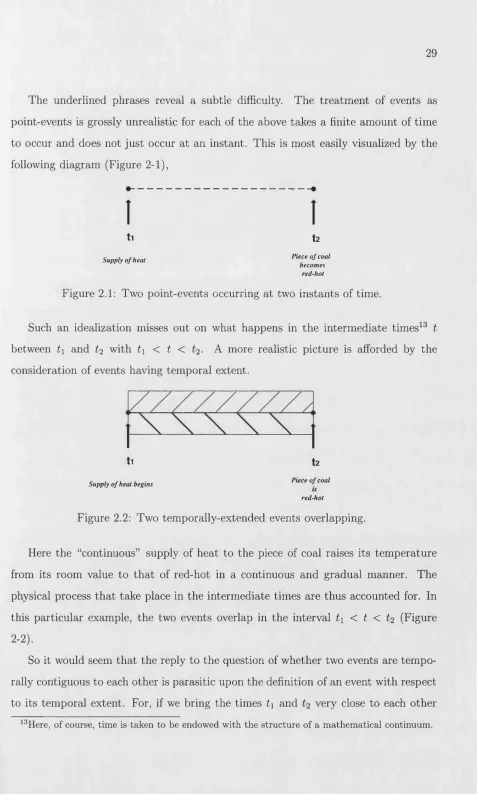
Two interesting observations arise. First, it is possible for distinct events to oc cupy the same spatial location at the same time. The supply of heat by the furnace fire and the piece of coal reaching its red-hot temperatures are distinct, though re lated events12. Second, both events have temporal extent as implied by the usage of words like “supplying” and “becoming”. No doubt the supply of heat to the piece of coal by the furnace fire is an event which precedes that of the piece of coal be coming red-hot. But these events are not point events in the sense of the supply of heat at an instant being followed by the piece of coal becoming red-hot, happening also at an instant The supply of heat is a gradual undertaking and the tempera ture of the piece of coal is raised from its initial value to th at of red-hot through a series of intermediate temperatures. It is emphatically not the case th at the temper ature jumps from one instant at room value to its red-hot value at the next instant. 11 As we shall see later in the chapter, a solution of the temporal contiguity problem in terms of spatiotemporally continuous (physical) entities, would also make good causal connections for events described in (2) and (3) above (given that events described in (3) are not spacelike separated).
The underlined phrases reveal a subtle difficulty. The treatm ent of events as
point-events is grossly unrealistic for each of the above takes a finite amount of time
to occur and does not just occur at an instant. This is most easily visualized by the
following diagram (Figure 2-1),
tl
t2
Supply o f heat Piece o f coal
becomes red-hot
Figure 2.1: Two point-events occurring at two instants of time.
Such an idealization misses out on what happens in the intermediate times13 t
between t\ and t<i with t\ < t < A more realistic picture is afforded by the
consideration of events having temporal extent.
ti
t2
Supply o f heat begins Piece ofcoal
red-hot
Figure 2.2: Two temporally-extended events overlapping.
Here the “continuous” supply of heat to the piece of coal raises its tem perature
from its room value to th a t of red-hot in a continuous and gradual manner. The
physical process th at take place in the intermediate times are thus accounted for. In
this particular example, the two events overlap in the