0095-1137/11/$12.00 doi:10.1128/JCM.01120-10
Copyright © 2011, American Society for Microbiology. All Rights Reserved.
Genotyping of
Enterococcus faecalis
and
Enterococcus faecium
Isolates
by Use of a Set of Eight Single Nucleotide Polymorphisms
䌤
†
I. U. Rathnayake, M. Hargreaves, and F. Huygens*
Cell and Molecular Biosciences, Faculty of Science and Technology, Queensland University of Technology, Australia
Received 2 June 2010/Returned for modification 17 August 2010/Accepted 21 October 2010
A single nucleotide polymorphism (SNP) genotyping method for Enterococcus faecalis and Enterococcus
faeciumwas developed using the “Minimum SNPs” program. SNP sets were interrogated using allele-specific
real-time PCR. SNP typing subdivided clonal complexes 2 and 9 ofE. faecalisand 17 ofE. faecium, members of which cause the majority of nosocomial infections globally.
Enterococcus faeciumandEnterococcus faecaliscause 80 to 90% of human enterococcal infections (9). The genetic subset ofE. faeciumnamed clonal complex 17 (CC17) seems to be responsible for the worldwide emergence of nosocomial infec-tions by this pathogen (6, 7, 13, 14). CC17 is characterized by quinolone and ampicillin resistance and the presence of a
putative pathogenicity island carryingespandhylgenes (2, 5, 7,
16). As in the case ofE. faecium, it is suggested that an
adap-tation to the hospital environment has occurred inE. faecalis.
CC2 and CC9 might be designated high-risk CCs ofE. faecalis
because they contain members that are vancomycin and
gen-tamicin resistant, produce-lactamase, and carry
pathogenic-ity islands (3, 6). The characterization and study of the
popu-lation structure ofE. faecalis and E. faeciumis important to
investigate how nosocomial enterococcal populations are evolving toward a predominance of highly specialized entero-coccal genetic subpopulations that are capable of surviving, spreading, and infecting patients with increasing frequencies in the hospital environment. Recent efforts have focused on the development of methods for the characterization of entero-cocci (1, 15–19); however, there is a need to develop and apply new robust, rapid, and cost-effective techniques which are likely to yield more definitive results.
Multilocus sequence typing (MLST) has emerged as a pow-erful tool for determining the population structure of many bacterial pathogens (4, 8, 13, 14). In the case of enterococci, Homan et al. (4) concluded that MLST is an appropriate technique to establish an unambiguous international database ofE. faeciumgenetic lineages; however, MLST is impractical
for routine monitoring ofE. faecalisand E. faecium outside
major research facilities (10). To overcome this shortcoming, the use of informative single nucleotide polymorphisms (SNPs) has been described as a cost-effective alternative to full MLST characterization (12). Currently, MLST costs around AUD$91.00 per strain, compared to AUD$7.00 per strain
for our SNP profiling method, a considerable cost saving. Pre-vious studies have demonstrated that a small number of SNPs derived from the MLST database can be used to define
bac-terial populations, includingStaphylococcus aureus(4),
Neisse-ria meningitidis(12), andCampylobacter jejuni(11). The aim of this study was to develop an SNP-based genotyping method to
study the population structure of clinical isolates ofE. faecalis
andE. faeciumfrom South East Queensland.
E. faecalisandE. faeciumisolates sourced from clinical sam-ples were obtained from Pathology Queensland and the QUT
culture collection and were confirmed as eitherE. faecalisorE.
faeciumby performing real-time PCR to detect theddlE. faecalis
andddlE. faeciumgenes. The primers used were 5⬘CAAACTG
TTGGCATTCCACAA3⬘and 5⬘TGGATTTCCTTTCCAGTC
ACTTC3⬘ (E. faecalis forward and reverse primers,
respec-tively) and 5⬘GAAGAGCTGCTGCAAAATGCTTTAGC3⬘
and 5⬘GCGCGCTTCAATTCCTTGT3⬘ (E. faecium forward
and reverse primers, respectively) (F. Huygens, unpublished
data).E. faecalisATCC 19433 andE. faeciumATCC 27270
strains were used for method development. The Corbett X-tractor Gene automated DNA extraction system was used to extract DNA from all cultured isolates (Corbett Robotics, Aus-tralia) using the Core protocol no. 141404 version 02. Infor-mative SNP sets that provide a high Simpson’s diversity index
(D) value (12) were identified forE. faecalis andE. faecium
using the software program “Minimum SNPs,” which has been described in detail elsewhere (12). Allele sequences and
cor-responding sequence types (STs) from the E. faecalis (http:
//efaecalis.mlst.net/) andE. faecium(http://efaecium.mlst.net/)
MLST databases were used as input data for the Minimum SNPs software. An allele-specific real-time PCR (AS kinetic PCR) methodology was developed to interrogate these
high-D-value SNPs. The allele-specific primers, designed using
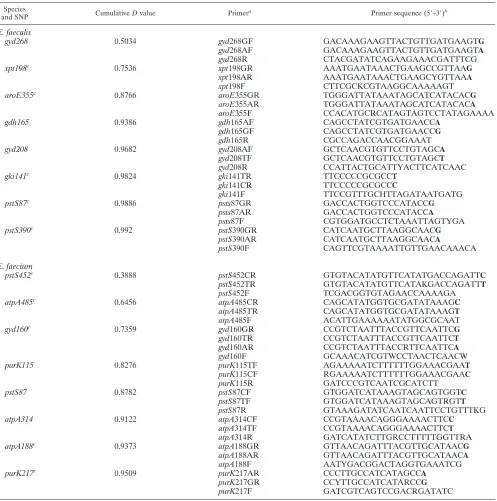
Primer Express 2.0 (Applied BioSystems), are listed in Table 1.
Each AS kinetic PCR mixture contained 2l of DNA and 8l
of reaction master mix containing 5l of 2⫻SYBR green PCR
master mix (Invitrogen, Australia) and 0.125l of reverse and
forward primers (0.5M final concentration). The cycling
con-ditions were as follows: 50°C for 2 min and 95°C for 10 min, followed by 40 cycles of 95°C for 15 s and 60°C for 60 s and a melting stage of 60°C to 90°C (RotorGene 6000; Corbett
Ro-botics, now Qiagen). The kinetic PCR results for thexpt198,
aroE355,gdh165,gyd208,gki141, andpstS390SNPs ofE.
fae-* Corresponding author. Mailing address: Cell and Molecular Bio-sciences, Faculty of Science and Technology, Queensland University of Technology, 2 George St., Brisbane, Queensland 4001, Australia. Phone: 61 7 3138 9252. Fax: 61 7 3138 1534. E-mail: f.huygens@qut .edu.au.
† Supplemental material for this article may be found at http://jcm .asm.org/.
䌤Published ahead of print on 27 October 2010.
367
on May 16, 2020 by guest
http://jcm.asm.org/
calisand thepurK115,atpA314, andpurK217SNPs ofE.
fae-ciumgave sufficiently large differences in cycle threshold (⌬CT)
values to provide a clear distinction between the matched and
mismatched reactions. The primers forgyd268andpstS87ofE.
faecalisandpstS452, atpA485,gyd160,pstS87, andatpA188of
E. faecium were redesigned with a subterminal mismatched
nucleotide at the 3⬘ end of the primer to improve the allele
specificity by increasing the⌬CTbetween the matched and the
mismatched primers while having little or no effect on CT
values for the matched primers. The likely reason for this effect is that the mismatch lowers the melting point of the target-primer duplex, thus reducing the probability that the target-primer site will be occupied at any given time point during the anneal-ing step.
[image:2.585.46.543.79.580.2]Isolate-specific SNP profiles were generated, consisting of the polymorphism present at each of the SNP positions. SNP
TABLE 1. Primers used for the interrogation of high-D-value SNPs inE. faecalisandE. faecium
Species
and SNP CumulativeDvalue Primer
a Primer sequence (5⬘–3⬘)b
E. faecalis
gyd268 0.5034 gyd268GF GACAAAGAAGTTACTGTTGATGAAGTG
gyd268AF GACAAAGAAGTTACTGTTGATGAAGTA
gyd268R CTACGATATCAGAAGAAACGATTTCG
xpt198c 0.7536 xpt198GR AAATGAATAAACTGAAGCCGTTAAG
xpt198AR AAATGAATAAACTGAAGCYGTTAAA
xpt198F CTTCGCKCGTAAGGCAAAAAGT
aroE355c 0.8766 aroE355GR TGGGATTATAAATAGCATCATACACG
aroE355AR TGGGATTATAAATAGCATCATACACA
aroE355F CCACATGCRCATAGTAGTCCTATAGAAAA
gdh165 0.9386 gdh165AF CAGCCTATCGTGATGAACCA
gdh165GF CAGCCTATCGTGATGAACCG
gdh165R CGCCAGACCAACGGAAAT
gyd208 0.9682 gyd208AF GCTCAACGTGTTCCTGTAGCA
gyd208TF GCTCAACGTGTTCCTGTAGCT
gyd208R CCATTACTGCATTYACTTCATCAAC
gki141c 0.9824 gki141TR TTCCCCCGCGCCT
gki141CR TTCCCCCGCGCCC
gki141F TTCCGTTTGCHTTAGATAATGATG
pstS87c 0.9886 psts87GR GACCACTGGTCCCATACCG
psts87AR GACCACTGGTCCCATACCA
psts87F CGTGGATGCCTCTAAATTAGTYGA
pstS390c 0.992 pstS390GR CATCAATGCTTAAGGCAACG
pstS390AR CATCAATGCTTAAGGCAACA
pstS390F CAGTTCGTAAAATTGTTGAACAAACA
E. faecium
pstS452c 0.3888 pstS452CR GTGTACATATGTTCATATGACCAGATTC
pstS452TR GTGTACATATGTTCATAKGACCAGATTT
pstS452F TCGACGGTGTAGAACCAAAAGA
atpA485c 0.6456 atpA485CR CAGCATATGGTGCGATATAAAGC
atpA485TR CAGCATATGGTGCGATATAAAGT
atpA485F ACATTGAAAAAATATGGCGCAAT
gyd160c 0.7359 gyd160GR CCGTCTAATTTACCGTTCAATTCG
gyd160TR CCGTCTAATTTACCGTTCAATTCT
gyd160AR CCGTCTAATTTACCRTTCAATTCA
gyd160F GCAAACATCGTWCCTAACTCAACW
purK115 0.8276 purK115TF AGAAAAATCTTTTTTGGAAACGAAT
purK115CF RGAAAAATCTTTTTTGGAAACGAAC
purK115R GATCCCGTCAATCGCATCTT
pstS87 0.8782 pstS87CF GTGGATCATAAAGTAGCAGTGGTC
pstS87TF GTGGATCATAAAGTAGCAGTRGTT
pstS87R GTAAAGATATCAATCAATTCCTGTTTKG
atpA314 0.9122 atpA314CF CCGTAAAACAGGGAAAACTTCC
atpA314TF CCGTAAAACAGGGAAAACTTCT
atpA314R GATCATATCTTGRCCTTTTTGGTTRA
atpA188c 0.9373 atpA188GR GTTAACAGATTTACGTTGCATAACG
atpA188AR GTTAACAGATTTACGTTGCATAACA
atpA188F AATYGACGGACTAGGTGAAATCG
purK217c 0.9509 purK217AR CCCTTGCCATCATAGCCA
purK217GR CCYTTGCCATCATARCCG
purK217F GATCGTCAGTCCGACRGATATC
aF, forward primer; R, reverse primer.
bThe allele-specific primers are indicated with a nucleotide base in boldface at the 3⬘end of the sequence. Key to symbols: H⫽A⫹T⫹C, K⫽G⫹T, R⫽A⫹G, W⫽A⫹T, Y⫽C⫹T.
cThe SNP is in the reverse primer.
368 NOTES J. CLIN. MICROBIOL.
on May 16, 2020 by guest
http://jcm.asm.org/
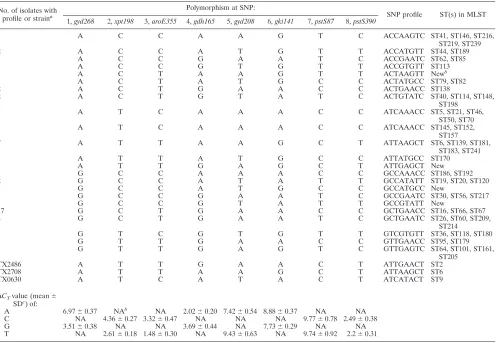
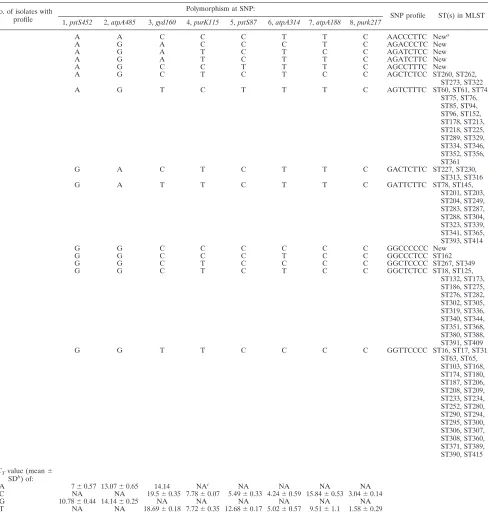
profiles were determined for 55E. faecalisisolates and 30E. faeciumisolates (Tables 2 and 3). The SNP profiles were as-signed to either STs or CCs. Amounts of between 18 and 30 ng
of template DNA from randomly chosen isolates ofE. faecalis
and E. faeciumwere sequenced to validate the SNPs as
de-scribed previously (17). The SNP profiles for 160E. faecalis
STs and 414E. faecium STs (listed on the MLST database)
were determinedin silico. The nucleotides present at the SNP
positions were manually determined for all the STs to
deter-mine thein silicoSNP profile. The web-based eBURST (Based
Upon Related Sequence Types) algorithm was used to aid the
visualization of the relationship between high-D-value SNP
profiles and MLST sequence types generated for E. faecalis
andE. faeciumisolates.
The relationship between the SNP profile of each isolate and the MLST-defined population structure was determined for bothE. faecalisand E. faeciumisolates, using the MLST da-tabase and the “working backwards” mode of the Minimum SNPs program. Twenty-one and 19 SNP profiles were
identi-fied for E. faecalis and E. faecium isolates, respectively. A
number of SNP profiles were new, and these isolates are likely to be new STs that warrant further characterization. The most
dominant SNP profile forE. faecalisclinical isolates was GCT
GAACC (corresponding to STs 16, 66, and 67), which is shared by 17 isolates in our collection. SNP profile GGCTCCCC
(cor-responding to STs 267 and 349) is the dominant profile forE.
faecium, which is shared by six isolates in our collection.
One hundred sixty STs (350 isolates) ofE. faecalisand 414
STs (1,319 isolates) ofE. faeciumwere subjected to in silico
analysis of the high-D-value SNPs. The 160E. faecalisSTs were
resolved into 86 SNP profiles. The 414 E. faeciumSTs were
subdivided into 55 SNP profiles. The SNP profiles of all STs listed in the MLST database are shown in the supplemental material.
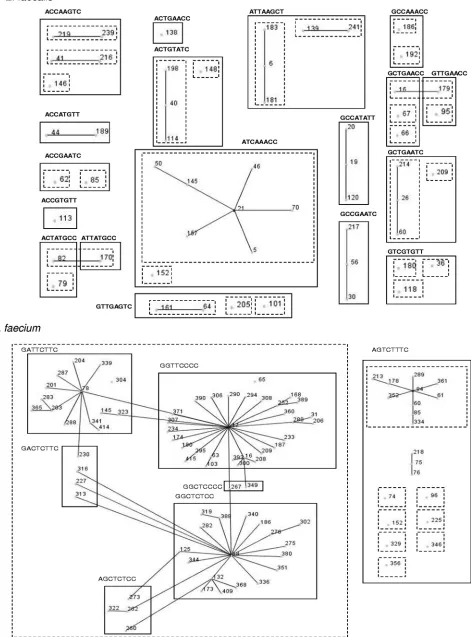
eBURST analysis of all STs was correlated with the SNP
profiles ofE. faecalisandE. faecium(Fig. 1). The STs of the
majorE. faecalisclonal complex CC21 were found to share the
same SNP profile, ATCAAACC. The most prevalent ST in MLST, ST 16, has the GCTGAACC SNP profile. Previous
studies of theE. faecalispopulation structure have found that
CC2 contains STs 6, 2, and 51 and CC9 contains STs 9, 17, 18, 42, and 52 and that these CCs were associated almost exclu-sively with hospital-derived isolates (6). In contrast, our study found that none of the clinical isolates belonged to either CC2 or CC9. To date, members of CC2 and CC9 have not been
[image:3.585.46.546.80.423.2]documented in Australia.In silicoSNP analysis of the MLST
TABLE 2. SNP profiles ofE. faecalisisolates No. of isolates with
profile or straina
Polymorphism at SNP:
SNP profile ST(s) in MLST 1,gyd268 2,xpt198 3,aroE355 4,gdh165 5,gyd208 6,gki141 7,pstS87 8,pstS390
1 A C C A A G T C ACCAAGTC ST41, ST146, ST216,
ST219, ST239
2 A C C A T G T T ACCATGTT ST44, ST189
1 A C C G A A T C ACCGAATC ST62, ST85
1 A C C G T G T T ACCGTGTT ST113
1 A C T A A G T T ACTAAGTT Newb
1 A C T A T G C C ACTATGCC ST79, ST82
2 A C T G A A C C ACTGAACC ST138
2 A C T G T A T C ACTGTATC ST40, ST114, ST148,
ST198
1 A T C A A A C C ATCAAACC ST5, ST21, ST46,
ST50, ST70
1 A T C A A A C C ATCAAACC ST145, ST152,
ST157
7 A T T A A G C T ATTAAGCT ST6, ST139, ST181,
ST183, ST241
1 A T T A T G C C ATTATGCC ST170
1 A T T G A G C T ATTGAGCT New
1 G C C A A A C C GCCAAACC ST186, ST192
2 G C C A T A T T GCCATATT ST19, ST20, ST120
1 G C C A T G C C GCCATGCC New
1 G C C G A A T C GCCGAATC ST30, ST56, ST217
1 G C C G T A T T GCCGTATT New
17 G C T G A A C C GCTGAACC ST16, ST66, ST67
4 G C T G A A T C GCTGAATC ST26, ST60, ST209,
ST214
1 G T C G T G T T GTCGTGTT ST36, ST118, ST180
1 G T T G A A C C GTTGAACC ST95, ST179
1 G T T G A G T C GTTGAGTC ST64, ST101, ST161,
ST205
TX2486 A T T G A A C T ATTGAACT ST2
TX2708 A T T A A G C T ATTAAGCT ST6
TX0630 A T C A T A C T ATCATACT ST9
⌬CTvalue (mean⫾ SDc
) of:
A 6.97⫾0.37 NAb NA 2.02⫾0.20 7.42⫾0.54 8.88⫾0.37 NA NA C NA 4.36⫾0.27 3.32⫾0.47 NA NA NA 9.77⫾0.78 2.49⫾0.38 G 3.51⫾0.38 NA NA 3.69⫾0.44 NA 7.73⫾0.29 NA NA T NA 2.61⫾0.18 1.48⫾0.30 NA 9.43⫾0.63 NA 9.74⫾0.92 2.2⫾0.31
aStrains were obtained from University of Texas and are fully MLST characterized. bNew, STs not found in MLST database; NA, not applicable.
cFrom pooled results for each polymorphism.
on May 16, 2020 by guest
http://jcm.asm.org/
STs, together with thein vitroSNP profiling of ST 2, ST 6, and ST 9 strains (obtained from the University of Texas) (Table 2), revealed that CC9 and CC2 can be subdivided by using the SNP method. For these CCs, SNP typing is able to further discriminate between STs in the same clonal complex, indicat-ing that it is ideally suited to further discriminate very closely
related STs. The 91E. faeciumSTs were grouped into seven
SNP profiles. Based on MLST typing, a distinct high-risk en-terococcal clonal complex, CC17, can be differentiated. This CC is associated with the majority of hospital outbreaks and clinical infections on five continents (6, 13). Recently, genetic population studies have shown that the majority of
vancomy-cin-resistantE. faeciumstrains associated with nosocomial
in-fections worldwide are part of the same CC17. The eight
high-TABLE 3. SNP profiles ofE. faeciumisolates No. of isolates with
profile
Polymorphism at SNP:
SNP profile ST(s) in MLST 1,pstS452 2,atpA485 3,gyd160 4,purK115 5,pstS87 6,atpA314 7,atpA188 8,purk217
1 A A C C C T T C AACCCTTC Newa
1 A G A C C C T C AGACCCTC New
2 A G A T C T C C AGATCTCC New
1 A G A T C T T C AGATCTTC New
1 A G C C T T T C AGCCTTTC New
3 A G C T C T C C AGCTCTCC ST260, ST262,
ST273, ST322
1 A G T C T T T C AGTCTTTC ST60, ST61, ST74,
ST75, ST76, ST85, ST94, ST96, ST152, ST178, ST213, ST218, ST225, ST289, ST329, ST334, ST346, ST352, ST356, ST361
2 G A C T C T T C GACTCTTC ST227, ST230,
ST313, ST316
5 G A T T C T T C GATTCTTC ST78, ST145,
ST201, ST203, ST204, ST249, ST283, ST287, ST288, ST304, ST323, ST339, ST341, ST365, ST393, ST414
1 G G C C C C C C GGCCCCCC New
2 G G C C C T C C GGCCCTCC ST162
6 G G C T C C C C GGCTCCCC ST267, ST349
2 G G C T C T C C GGCTCTCC ST18, ST125,
ST132, ST173, ST186, ST275, ST276, ST282, ST302, ST305, ST319, ST336, ST340, ST344, ST351, ST368, ST380, ST388, ST391, ST409
2 G G T T C C C C GGTTCCCC ST16, ST17, ST31,
ST63, ST65, ST103, ST168, ST174, ST180, ST187, ST206, ST208, ST209, ST233, ST234, ST252, ST280, ST290, ST294, ST295, ST300, ST306, ST307, ST308, ST360, ST371, ST389, ST390, ST415
⌬CTvalue (mean⫾ SDb
) of:
A 7⫾0.57 13.07⫾0.65 14.14 NAc NA NA NA NA C NA NA 19.5⫾0.35 7.78⫾0.07 5.49⫾0.33 4.24⫾0.59 15.84⫾0.53 3.04⫾0.14 G 10.78⫾0.44 14.14⫾0.25 NA NA NA NA NA NA T NA NA 18.69⫾0.18 7.72⫾0.35 12.68⫾0.17 5.02⫾0.57 9.51⫾1.1 1.58⫾0.29
aNew, STs not found in MLST database. bFrom pooled results for each polymorphism. cNA, not applicable.
370 NOTES J. CLIN. MICROBIOL.
on May 16, 2020 by guest
http://jcm.asm.org/
[image:4.585.51.539.79.594.2]FIG. 1. An eBURST population snapshot of 51E. faecalisSTs grouped into 18 SNP profiles and 27E. faeciumSTs grouped into 7 SNP profiles. The dotted-line boxes represent clonal complexes as defined by theE. faecalisandE. faeciumMLST databases; the solid-line boxes represent STs grouped according to their corresponding 8-nucleotide high-D-value SNP profiles. Single local variants are connected by solid lines.
371
on May 16, 2020 by guest
D-value SNPs were able to further differentiate this major CC17 into 6 SNP profiles. The SNP profile with the most STs (29 in total) had the GGTTCCCC profile. This subdivision of CC17 can be useful in investigating the association of these STs with specific disease profiles, something that MLST is unable to perform, as all these STs are grouped into the same clonal complex by MLST.
The Simpson’s index of diversity (Dvalue) was calculated for
bothE. faecalisandE. faeciumto determine the comparative discriminatory powers of MLST and SNP typing. An important finding was that there was little difference in resolving power
between MLST and SNP typing either forE. faecalisisolates
(MLSTD⫽0.97 and SNPD⫽0.96) or forE. faeciumisolates
(MLST D ⫽ 0.96 and SNP D ⫽ 0.91). This finding clearly
demonstrates that the high discriminatory power of the SNP genotyping method is as good as that of MLST.
In conclusion, we have developed a novel and widely
appli-cable approach for the typing of E. faecalis and E. faecium
isolates that has a high discriminatory power and can be ap-plied to the investigation of nosocomial enterococcal out-breaks. SNP typing subdivided isolates of clonal complexes 2
and 9 ofE. faecalisand 17 ofE. faecium, members of which are
known to be the major causative agents of nosocomial infec-tions globally. This method represents an efficient means of
classifyingE. faecalisandE. faeciumisolates into groups that
are concordant with the population structure of these organ-isms. These SNPs can be used on their own or combined with other rapidly evolving markers, such as virulence genes and antibiotic resistance genes, to yield highly informative geno-typing methods.
We acknowledge Narelle George (Pathology Queensland) and Sue Gill (Queensland University of Technology) for kindly providing theE. faecalisandE. faeciumisolates. We also acknowledge Barbara Murray and Karen Jacques-Palaz (Health Science Center at Houston, Univer-sity of Texas) for supplyingE. faecalisST 2, 6, and 9 strains.
Irani U. Rathnayake is in receipt of an International Postgraduate Research Scholarship (IPRS), and the study is supported by the Insti-tute of Sustainable Resources, QUT.
REFERENCES
1.Coque, T. M., P. Seetulsingh, K. V. Singh, and B. E. Murray.1998. Appli-cation of molecular techniques to the study of nosocomial infections caused by enterococci, p. 469–493.InN. Woodford and A. Johnson (ed.), Methods in molecular medicine, vol. 15. Molecular bacteriology: protocols and clinical applications. Humana Press, Totowa, NJ.
2.Coque, T. M., R. Willems, R. Canton, R. Del Campo, and F. Baquero.2002. High occurrence ofespamong ampicillin-resistant and vancomycin-suscep-tibleEnterococcus faeciumclones from hospitalized patients. J. Antimicrob. Chemother.50:1035–1038.
3.Hiraga, N., T. Muratani, S. Naito, and T. Matsumoto.2008. Genetic analysis of faropenem-resistantEnterococcus faecalisin urinary isolates. J. Antibiot.
61:213–221.
4.Homan, W. L., D. Tribe, S. Poznanski, M. Li, G. Hogg, E. Spalburg, J. D. Van Embden, and R. J. Willems.2002. Multilocus sequence typing scheme forEnterococcus faecium. J. Clin. Microbiol.40:1963–1971.
5.Huygens, F., J. Inman-Bamber, G. R. Nimmo, W. Munckhof, J. Schoon-eveldt, B. Harrison, J. A. McMahon, and P. M. Giffard.2006.Staphylococcus aureusgenotyping using novel real-time PCR formats. J. Clin. Microbiol.
44:3712–3719.
6.Leavis, H. L., M. J. Bonten, and R. J. Willems. 2006. Identification of high-risk enterococcal clonal complexes: global dispersion and antibiotic resistance. Curr. Opin. Microbiol.9:454–460.
7.Leavis, H. L., R. J. Willems, J. Top, E. Spalburg, E. M. Mascini, A. C. Fluit, A. Hoepelman, A. J. de Neeling, and M. J. Bonten.2003. Epidemic and nonepidemic multidrug-resistantEnterococcus faecium. Emerg. Infect. Dis.
9:1108–1115.
8.Maiden, M. C. J., J. A. Bygraves, E. Feil, G. Morelli, J. E. Russell, R. Urwin, Q. Zhang, J. Zhou, K. Zurth, D. A. Caugant, I. M. Feavers, M. Achtman, and B. G. Spratt.1998. Multilocus sequence typing: a portable approach to the identification of clones within populations of pathogenic microorganisms. Proc. Natl. Acad. Sci. U. S. A.95:3140–3145.
9.Ogier, J.-C., and P. Serror.2008. Safety assessment of dairy microorganisms: theEnterococcusgenus. Int. J. Food Microbiol.126:291–301.
10.Persing, D. H., F. C. Tenover, J. Versalovic, Y.-W. Tang, E. R. Unger, D. A. Relman, and T. J. White (ed.).2004. Molecular microbiology: diagnostic principles and practice. ASM Press, Washington, DC.
11.Price, E. P., V. Thiruvenkataswamy, L. Mickan, L. Unicomb, R. E. Rios, F. Huygens, and P. M. Giffard.2006. Genotyping ofCampylobacter jejuniusing seven single-nucleotide polymorphisms in combination withflaAshort vari-able region sequencing. J. Med. Microbiol.55:1061–1070.
12.Robertson, G. A., V. Thiruvenkataswamy, H. Shilling, E. P. Price, F. Huy-gens, F. A. Henskens, and P. M. Giffard.2004. Identification and interroga-tion of highly informative single nucleotide polymorphism sets defined by bacterial multilocus sequence typing databases. J. Med. Microbiol.53:35–45. 13.Top, J., R. Willems, and M. Bonten.2008. Emergence of CC17Enterococcus faecium: from commensal to hospital-adapted pathogen. FEMS Immunol. Med. Microbiol.52:297–308.
14.Valdezate, S., C. Labayru, A. Navarro, M. A. Mantecon, M. Orteqa, T. M. Coque, M. Garcia, and J. A. Saez-Nieto.2009. Large clonal outbreak of multidrug-resistant CC17 ST17 Enterococcus faecium containing Tn5382 in a Spanish hospital. J. Antimicrob. Chemother.63:17–20.
15.Vos, P., R. Hogers, M. Bleeker, M. Reijans, T. Van De Lee, M. Hornes, A. Frijters, J. Pot, J. Peleman, M. Kuiper, and M. Zabeau.1995. AFLP: a new concept for DNA fingerprinting. Nucleic Acids Research.23:4407–4414. 16.Willems, R. J., J. Top, M. van Santen, D. A. Robinson, T. M. Coque, F.
Baquero, H. Grundmann, and M. J. Bonten.2005. Global spread of vanco-mycin-resistantEnterococcus faeciumfrom distinct nosocomial genetic com-plex. Emerg. Infect. Dis.11:821–828.
17.Woodford, N., L. Tysall, C. Auckland, M. W. Stockdale, A. J. Lawson, R. A. Walker, and D. M. Livermore.2002. Detection of oxazolidinone-resistant
Enterococcus faecalisandEnterococcus faeciumstrains by real-time PCR and PCR-restriction fragment length polymorphism analysis. J. Clin. Microbiol.
40:4298–4300.
18.Zdragas, A., P. Partheniou, C. Kotzamanidis, L. Psoni, O. Koutita, E. Mo-raitou, N. Tzanetakis, and M. Yiangou.2008. Molecular characterisation of low-level vancomycin-resistant enterococci found in coastal water of Ther-maikos Gulf, Northern Greece. Water Res.42:1274–1280.
19.Zhu, X., B. Zheng, S. Wang, R. J. L. Willems, F. Xue, X. Cao, Y. Li, S. Bo, and J. Liu.2009. Molecular characterisation of outbreak-related strains of vancomycin-resistant E. faeciumfrom an intensive care unit in Beijing, China. J. Hosp. Infect.72:147–154.
372 NOTES J. CLIN. MICROBIOL.