A Secure And Efficient Video Watermarking
Approach Using DNA Encryption
Jasmeet Kaur1 , Manpreet Kaur2
1,2
Electronics and Communication Surya World Institutes of Academics and excellence Punjab, India
Abstract: Video watermarking is a method employed to hide some kind of data such as audio, text and image into frames or video sequences. In order to hide the image into frames, several techniques have been proposed such as DCT, DWT, DFT, PCA etc. which have various disadvantages like the DCT technique is less robust to additive noise, localization was comparatively poor and the visual image quality provided by the DCT was not of that good quality. These techniques were not efficient in finding the interest points where to embed the watermark. Thus to overcome these issue, a novel approach is proposed in this work which hides an image as a watermark into video frames. Considering issues in the existing techniques, spatial domain method is utilized in a proposed technique and working on fractal encoding. Moreover, DNA algorithm is also used to encrypt the image before hiding it into a video and then Fractal encoding technique employed to hide the data into a frame. The proposed technique enhanced the level of security and reduced the chances of losing the authenticity of the secret data.
Keyword: Video Watermarking, Fractal Encoding, DNA encryption and DNA Decryption
I. INTRODUCTION
The most advance technique that is emerging in the field of multimedia is Video Watermarking which is growing rapidly. Some of the factors that contributed to draw attention towards this advancement are mentioned below:
1) The issue of protecting the private digital data from being copied by through various techniques is the major concern.
2) To protect and fight against “Intellectual property rights infringement” is the requirement of the business related to multimedia area.
3) Despite several malicious attacks the copyright should be protected and retained essentially. 4) Manipulation of digital data in controllable manner is highly required.
With the gradual advancement in multimedia systems the demand for highly secured data transfer for transmitting digital data has increased [1]. A highly protected digital data transfer must be accomplished as digital data is more vulnerable to manipulations leading to loss of data integrity which is common in images. Watermarking is the new emerging advance technique for safeguarding copyright and Intellectual Property rights. The data with copyright can be text, under invisible watermarking is hardly visible but in case of visible watermarking the watermark is quite visible. Through video watermarking the annotation, identification and copyright of embedded data is achieved. Several techniques for achieving video watermarking are available through which a robust watermark is embedded into video in order to obtain actual reliable video [2]. Through traditional encryption algorithms the authorized users were allowed to access the encrypted data in digital form. Therefore encrypted data cannot be accessed by unauthorized users till the time it is not decrypted. The protection of data from illicit users cannot be guaranteed once it is decrypted. The extension of various image watermarking algorithms is employed for achieving video watermarking due to the following reasons that are mentioned below:
5) Large redundant data is present between adjacent frames.
6) The stationary and non-stationary areas must be in properly balanced. 7) Applications involving real-time and video streaming must be the main focus.
II. PROBLEMSTATEMENT
robust than spatial domain techniques since they disperse the watermark in the spatial domain of the video frame making it difficult to remove the watermark through malicious attacks like cropping, scaling, rotations and geometrical attacks. The commonly used transform domain techniques are Discrete Fourier Transform (DFT), the Discrete Cosine Transform (DCT), and the Discrete Wavelet Transform (DWT), PCA and SVD. The conventional techniques like DCT, DWT, DFT, PCA etc. have various disadvantages like the DCT technique is less robust to additive noise, localization was comparatively poor and the visual image quality provided by the DCT was not of that good quality. The DWT technique was better than the DCT but it also had various demerits like complexity, higher computation cost and higher computation time. The DWT was less used because of its drawbacks only. Then came DFT, DFT was introduced to overcome the disadvantages of the earlier used techniques but it also had some drawbacks like the output of DFT is always in complex values and it requires more frequency rate. Also the computational efficiency of the DFT is poor. All the conventional techniques used for watermarking worked in frequency domain so the capacity to hide data was lesser of these techniques. These techniques were not efficient in finding the interest points where to embed the watermark. Even they all are not so stable. Thus to overcome these issue a new technique is introduced in implementation of watermarking.
III. PROPOSEDWORK
In this research work it is found that the Discrete Fourier Transform (DFT), the Discrete Cosine Transform (DCT), and the Discrete Wavelet Transform (DWT), PCA and SVD methods that are previously used were all working in frequency domain and lesser amount of data could be hidden in these techniques. The computational cost and computational time of these techniques were higher and the computational efficiency was poor. These techniques could not be used to embed the video watermark are not efficient in finding the interest point i.e. where to embed the watermark and these methods are also not so stable. We proposed a new technique with video watermarking.
So a new technique was proposed in which advance media i.e. video was used for watermarking. As per tradition literature the transform based approach are not that much effective on basis of quality, so spatial domain is much better and new approaches are available for the video watermarking we in this thesis working on fractal encoding and finally as we are moving from image to video processing as it is much effective to hide the content in video in place of images the reason behind the popularity of the approach is that it is difficult to decode the content from a set of frames than an single image. Moreover, DNA encryption approach is used to encrypt the data before hiding it under a cover.
The application of DNA algorithm enhanced the level of security and reduced the chances of losing the authenticity of the secret message.
IV. METHODOLOGY
The proposed work has divided into two parts such as Embedding and Extraction Process. At first, embedding has performed and image is hiding into a frame and then extraction is done where image is extracted from frame. The methodology of both processes is shown as:
A. Embedding Process
In the embedding process, an image considered as watermark is hided into a video frame. The steps followed in this process are as follows:
1) Initially, fetch information from a video to extract the frames. 2) Secondly, extract the frames of the video.
3) Simultaneously, fetch information of the watermark to perform further encryption.
4) After extracting the watermark, DNA is used to encrypt the image before hiding it under a frame. 5) Then convert string format to an ASCII format and then from ASCII to binary for data hiding. 6) Lastly, data is hided under a frame and a watermarked frame has acquired.
Figure 1. Framework of Embedding
B. Extraction Process
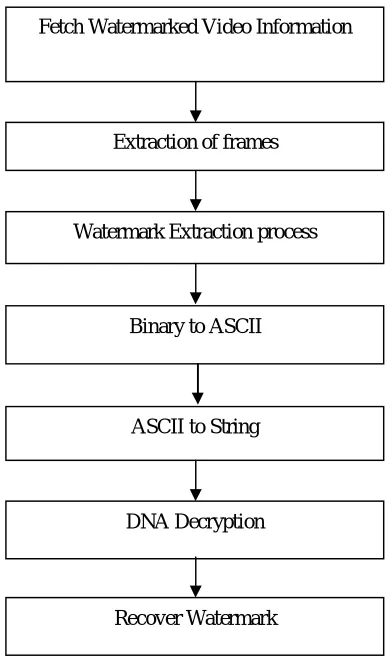
Once the watermark is hided into a video frame, the extraction will be performed. The steps which are followed for extraction are as follows:
1) Firstly, a watermark is fetched from the video information.
2) Then frames are extracted from the video and then forwarded for further extraction. 3) Watermark from the frames are then extracted and their conversion are performed. 4) Format from binary to ASCII is converted in this step.
5) ASCII to String format is performed and then decryption will be performed.
6) At last, DNA is used to decrypt the image which was encrypted at the time of embedding. Fetch Video information
Extraction of Frames
Data Hiding Process
Fetch watermark Information
DNA Encryption
String to ASCII
ASCII to Binary
Watermarked Frame
Figure 2 Framework of Extraction
V. RESULTSANDDISCUSSION
In order to conclude the performance of proposed technique, several parameters are used for evaluation. Some of the performance parameters are shown as:
A. Standard Deviation
This parameter is used to evaluate the amount of variation or dispersion of a set of data values. The low standard deviation concludes that data points are closer to the mean or expected values whereas high standard deviation concludes data points are spread out or far from mean values. The formula of Standard Deviation is:
S= ∑ ( ̅) …….(1)
In the above equation, x1 , x2…..xN values are observed values of the sample items, ̅ is the mean value of given observations and number of observations in the sample are shown as N.
B. Variance
Expectation of squared deviation of a random variable from its mean is considered as Variance. In other words, it also measures the set of random numbers i.e. how far these numbers are spread out from the average value. The square of standard deviation, second central moment of distribution as well as the covariance of random variable is the variance which is represented through σ2, s2, or Var (x). The evaluation of variance is the expected value of the square deviation from mean of X,µ= E[X]:
Var (X) = E[(X- µ)2]………..(2) Fetch Watermarked Video Information
Extraction of frames
Watermark Extraction process
Binary to ASCII
ASCII to String
DNA Decryption
C. Peak Signal to Noise Ratio (PSNR)
The ratio between maximum possible power of a signal and noise ratio is considered as Peak Signal to Noise Ratio. The PSNR is measured through:
PSNR (db) = 20 log 255 √3MN
√∑ ∑ ( ( , )− ( , )) … … (3)
In the above equation, B is the image, B’ is the processed image to be assessed, pixel row and column index is i and j respectively. M and N is row and column.
D. Mean Squared Error(MSE)
This parameter employed to measure the image quality index. The larger value of MSE means image is of poor quality and vice versa. The formula used for the valuation is as:
= 1 ( − ) … … … . . (4)
In the above equation, original image is shown as A and B is the processed image, pixel row and column index is i and j respectively. M and N is row and column
E. BER
Number of bits error per unit is exemplified in Bit Error Rate. The number of bit errors is divided by the number of transferred bits during a time interval. The BER can be evaluated as:
= ………(5)
In the above equation, Eb is the number of errors divided by N0 number of bits.
F. Experimental results
The proposed work employed DNA encryption technique to hide the image over a video. In this work, different traditional and proposed techniques are compared to evaluate their performance. For the comparison purpose, different performance parameters such as Standard deviation, Variance, Peak signal to noise ratio, Bit Error Rate and Mean Square Error are evaluated. The experiments are performed using four different images such as Flowers, Barbara, Lena and Penguin. Each image has been evaluated on different parameters to conclude individual efficiency in watermarking.
[image:6.612.181.432.527.707.2]Mean Square error of individual frame in video is depicted in below figure. This parameter is used to evaluate the quality of a technique. The simulation analysis performed using proposed technique confirmed that initially quality is high but with the increase in number of frames the quality has been decreased as it is normal.
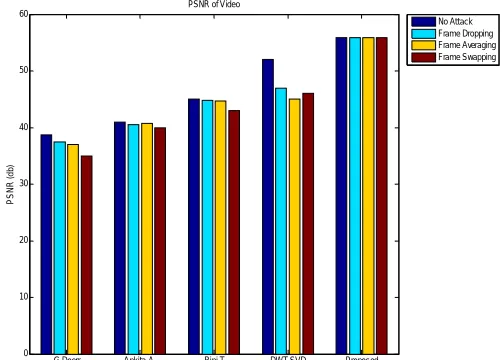
Figure 3 PSNR Comparison between different techniques G.Doerr Ankita A. Rini T DWT-SVD Proposed
0 10 20 30 40 50 60
PSNR of Video
Comparison between different techniques is shown in the above figure. For the comparison, different techniques are considered such as G.Doerr, Ankita A., Rini T and DWT-SVD. Results acquired from these techniques are compared with the proposed technique with respect to different parameters such as No attack, Frame Dropping, Frame Averaging and Frame Swapping. Among different traditional techniques, proposed technique provides superior outcomes with respect to each parameter in terms of PSNR. Consequently, the results acquired confirmed the efficiency of proposed technique.
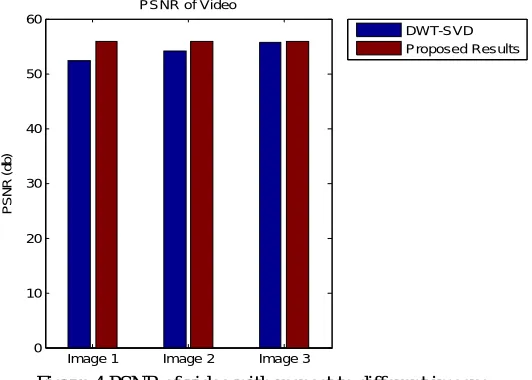
Figure 4 PSNR of video with respect to different images
The figure above exemplifies the results of different images with respect to PSNR. Two techniques such as DWT-SVD and proposed technique are compared with each other under different images using PSNR. In every image, proposed technique outperforms the traditional technique in terms of PSNR. As in the proposed technique PSNR varies at 56 db approximately whereas in the traditional DWT-SVD it ranges at 53 db. So, it can be concluded that proposed technique offers considerable outcomes.
VI. CONCLUSIONANDFUTURESCOPE
Video watermarking is used to hide the secret data using a video frames to keep them secret from unauthorized access. There are several traditional techniques have been proposed by several researchers. However, these techniques are suffering from several issues such as high error and noise rate and less quality of acquired image. Considering these issues, a novel approach has proposed in this work utilized both techniques such as fractal encoding and DNA. The proposed technique provides improved level of security as data is hided after performed encryption through DNA. For the evolution, several traditional techniques i.e. G.Doerr, Ankita A., Rini T and DWT-SVD are compared with the proposed technique and the results acquired confirmed that uses of fractal encoding for watermarking has proved efficient. The new proposed technique is more robust to noise and have high localization as compared to the traditional techniques. Moreover, the visual quality of the image obtained after watermarking using the new technique is better than the conventional techniques. The comparison has performed using proposed and traditional technique with respect to PSNR using different images. The simulation analysis concluded that PSNR acquired from proposed technique is 56DB approximately whereas in DWT-SVD it remains at 53DB. Consequently, proposed technique outperforms the traditional technique In the proposed technique fractal encoding is used for embedding the watermark in an image. In this technique the frames having higher color intensity are selected and then the watermark is embedding into it. A more enhancement in watermarking technique can be made if the content of the watermark is compressed and then that compressed watermark is embedding into the image. This will decrease the content to hide and hence will ease the process of watermarking.
REFERENCES
[1]. Doerr.G and J. Dugelay, "A Guided Tour to Video Watermarking," Signal Processing: Image Communication, vol. 18, pp. 263-282, 2014 [2]. Ankita A. Hood and Prof. N. J. Janwe " Robust Video Watermarking Techniques and Attacks on Watermark", IJCTT vol.4, 2014 [3]. Rini T Paul “Robust Video Watermarking Techniques", Computational Science - New Dimensions & Perspectives”, NCCSE, 2015
[4]. Yuan-GenWang, Zhe-Ming Lu, LiangFan, YunZheng, “Robust dual watermarking algorithm for AVS video “, Signal Processing: Image Communication 24, 2009.
[5]. Radu O. Preda *, Dragos N. Vizireanu 1,” A robust digital watermarking scheme for video copyright protection in the wavelet domain”, Measurement 43, 2010.
Image 1 Image 2 Image 3
0 10 20 30 40 50 60
PSNR of Video
[6]. ManeliNoorkami, and Russell M. Mersereau,” Digital Video Watermarking in P-Frames With Controlled Video Bit-Rate Increase”, IEEE Transactions on Information Forensics and Security, Vol. 3, No. 3, September 2008.
[7]. Jordi Serra-Ruiz and David Megias, “DWT and TSVQ-based semifragile watermarking scheme for tampering detection in remote sensing images,” Fourth Pacific-Rim Symposium on Image and Video Technology, 2010
[8]. J. Zhang, A. T. S. Ho, G. Qiu, and P. Marziliano, “Roubust video watermarking of H.264/AVC,” IEEE Trans. Circuits Syst., vol. 54, no. 2, pp. 205–209, 2007. [9]. Y. Wang and A. Pearmain, “Blind MPEG-2 video watermarking in DCT domain robust against scaling,” IEE Proc.-Vis. Image Signal Process., Vol. 153, No.
5, 2006.
[10]. Bhaskaran et al., Fragile Watermark for Detecting Tampering in images, U. S. Patent Number 6064764, may 16, 2000.
[11]. H.-Y. Huang, C.-H. Yang, and W.-H. Hsu, ―A video watermarking technique based on pseudo-3-D DCT and quantization index modulation,‖ IEEE Trans Inf. Forensics Security, vol. 5, no. 4, pp. 625– 637, Dec. 2010.
[12]. Ponni and Dhinakaran S, SabariAshwanth P, Dhamodharan P, “CHAOTIC Map Based Video Watermarking Using DWT And SVD”, International Conference on Inventive Communication and Computational Technologies, Pp. 45-49, 2017
[13]. Md. Asikuzzaman and Mark R. Pickering, “An Overview of Digital Video Watermarking”, IEEE Transactions On Circuits And Systems For Video Technology, Pp. 1-23, 2017
[14]. Miss. Shital Divekar, Prof. Nitin Dawande and Prof. Suresh Rode, “Review on Video Watermarking Techniques”, International Journal of Advanced Research in Computer and Communication Engineering, Vol. 5, No. 5, Pp. 28-31, 2016
[15]. Rini T Paul, “Review of Robust Video Watermarking Techniques”, IJCA, Pp. 90-95, 2011