6
I
January 2018
3418
©IJRASET (UGC Approved Journal): All Rights are Reserved
Load Evaluation on Cloud with Hybrid Technique
using Cloudsim Simulator
Surbhi Saxena1, Harish Patidar2 1
M.Tech Scholar, 2Assistant Professor 1
Department of Computer Science & Engineering, LNCT, Indore, India 2
Department of Computer science & Engineering, LNCT, Indore, India
Abstract: In distributed computing cloud computing is an emerging technology which provides pay per model as per user demand or requirement. Cloud has a collection of virtual machines which facilities both computational and storage requirement. Scheduling and Load balancing are the main challenges in the cloud computing on which we are emphasizing. Scheduling is the process to control the order of work going to be performed by computer system. Load balancing has an important role on the performance in cloud computing. Better load balancing will make cloud computing more efficient and will also increase the user satisfaction it provides a way to handle several inquiries residing inside cloud computing environment set. Complete balancing acquires two tasks one is resource provisioning/resource allocation and task scheduling throughout the system. In the proposed research paper we are presenting a hybrid algorithm created by FCFS and Round Robin algorithms. As the Round Robin is the easiest algorithm that's why it is frequently used and the first preference for implementing easy schedulers. Round Robin algorithm only requires list of nodes. In the proposed solution we have eliminated the drawbacks of simple Round Robin algorithm by introducing assignment of time slices to different processes depending upon priorities.
Keywords: Cloud Computing, Load Balancing, Task Scheduling, Round Robin
I. INTRODUCTION
Cloud Computing is Information Technology Paradigm. In computer science cloud computing describes a type of outsourcing of computer services. Using internet services cloud computing delivers different type of services i.e. infrastructure as a service (Iaas), platform as a service (Paas) and software as a service (Saas). Iaas provides infrastructure as a service in the form of Virtual machine (VM) to the requester. Paas provides application development platform as a service to develop the web based application to the requester. In Saas software application is provided to the requester by the cloud provider. Customers get the services on the basis of subscription using pay as you use model. As cloud computing is under in its development stage, many challenges and issues are being faced, one of them is to improve cloud scheduling process. Cloud scheduling plays an important role in cloud computing to perform effective execution. Scheduling is a set of policies which controls the order of work going to be performed by the computer system. There are different types of scheduling algorithms are available in distributed computing system. We are emphasizing on job scheduling algorithm in cloud computing. The job scheduling algorithm is proposed to achieve high performance computing and the best system throughput. Job scheduling is used to allocate the jobs as per the most efficient resources available corresponding to the requirement in time with a view to satisfy the objective. The algorithm is designed in the way by which execution time can be minimized with maximizing the resource utilization. The job scheduling algorithm's efficiency straightaway affects the performance of the system as per the delivered Quality of Service [5].In short, the efficiency of the system is directly proportional to the Quality of Service. In other words we can say that as much as we increase the efficiency the QoS would be increased too.
Job scheduling problems consists of three main things. They are[10]:
A. Machine Configuration
Machine configuration can be either of a single machine or a cluster of machines having a single or multiple processors in each machine.
B. Optimization Criterion
3419
©IJRASET (UGC Approved Journal): All Rights are Reserved
C. Set of Constraints and Characteristics
For the sake of allocating the tasks properly, the CPU must create a certain execution order and some set of constraints because the scheduling of the tasks can be either dependent on some other tasks or completely independent.
The main characteristics which come under the set of constraints which must be monitored are:-
1) CPU utilization: - It is all about how much efficiently the CPU is being used by the system. The CPU must not come under idle condition with a view to utilize it completely.
2) Throughput: - It is the amount of number of processes completed per unit time.
3) Response time: It is the time of how long a process has to wait for its first response after arriving into the system. In other words, we can say that the time span after arrival of the process till the CPU allotted to it for further processing for the very first time.
4) Waiting time: It is the amount of time which shows the total wait a process did after arrival to the complete execution.
5) Turnaround time: It is the overall time a process spent in a system.
6) Resource cost: It is the amount of cost which is required to use the resources. A cloud model using Cloud simulator consists of four elements namely Datacenters, Datacenter broker, host, Virtual machine and cloudlet.
7) Datacenters: Datacenter is a huge group of networked computer servers which are mainly used by the organizations for facilitating the remote storage, processing or distribution of ample amount of data.
8) Host: - Host is responsible to execute actions with respect to the virtual machine management which includes creation, deletion and updation regarding the task processing. Cloud host is a server that provides all the hosting services. A cloud host is responsible to provide the transparency which allows various numbers of servers to act as a single system.
9) Virtual Machine: - The virtual machine (VM) gives the platform to deploy a software implementation of a machine where the required platform is not present actually on the system, so we create a virtual world which shows the virtual interface as it is in the required platform which is known as a Virtual Machine.
[image:3.612.198.422.423.562.2]10) Cloudlet :- A cloudlet is a datacenter which works on small scale or in another words we can say that it is a cluster of computers which are designed and created with a view to provide various cloud computing services to mobile devices, like smart phones, tablets and many other wearable devices. It comes under the existence after the concept of mobile computing to enhance the facilities.
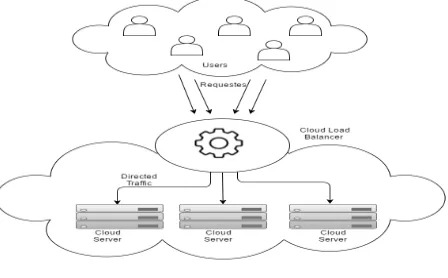
Figure 1. Cloud Load Balancer
II. LITERATURE REVIEW
Pooja Samal et al (2013) [4] load distribution problem on various nodes of a distribution system is solved. The work has been improved both resource utilization and job response time by analyzing the various of Round Robin algorithm.
Kunal Mahurkar et al (2013) [7] presents OCRP (Optimal cloud resource provisioning) algorithm to solve the over provisioning and under provisioning problems in existing cloud mechanism. In the given solution they focused on optimal decisions in demand uncertainty and price uncertainty.
Raj Kumarsomani et al (2014) [2]proposed the hybrid method for VM level load balancing.
A. Round Robin Algorithm
3420
©IJRASET (UGC Approved Journal): All Rights are Reserved
It is also been implemented for IaaS framework in simulated cloud computing environment and the result obtained were analyzed. These two algorithms has been proposed for virtual machine level load balancing that do not consider the current load state of VM while allocating some new job to it.
The concept of circular way to allocate VMs has been taken from Round Robin algorithm and inspiration of checking availability on each step has been taken from throttled algorithm.
Soumen Santraet et al (2015)[1]propose an approach of Round Robin technique in a circular way and by this method author try to clarify the load balancing scenario of cloud server during its execution. According to author it will help to get an effective communication framework between broker and virtual machine to optimize the time and minimize the cost. The author implements it over Cloudsim 3.0 under VM scheduling i.e. space and time-sharing policies.
Ritu Kapur (2015) [3]present a new Cost Effective Resource Scheduling algorithm, which when compared with the algorithm in outperforms it. The Simulations demonstrated prove the above fact. The CERS algorithm considers load balancing as an important Quality of Service parameter performs a check for its necessity and if required does the load balancing and optimizes the performance as well as the overall resource cost.
III. EXITING ALGORITHM
A. Round Robin
This is the simplest algorithm out of all available algorithms for load balancing and hence do not require complex algorithm implementations. It simply maintains a queue of incoming requests and allocates them VM in Time scheduling manner. Thus each request is allowed to be executed for specific time quantum only then after if it is still incomplete, it has to wait for its next round and if the request is complete it allows other process to take charge of that VM based on the algorithm.
B. Fcfs
FCFS for parallel processing and is aiming at the resource with the smallest waiting queue time and is selected for the incoming task. The Cloud Sim toolkit supports First Come First Serve (FCFS) scheduling strategy for internal scheduling of jobs. Allocation of application-specific VMs to Hosts in a Cloud-based data center is the responsibility of the virtual machine provisioned component. The default policy implemented by the VM provisioned is a straightforward policy that allocates a VM to the Host in First-Come-First-Serve (FCFS) basis. The disadvantages of FCFS is that it is non preemptive. The shortest tasks which are at the back of the queue have to wait for the long task at the front to finish. Its turnaround and response is quite low.
IV. PROBLEM DEFINITION
Cloud computing is efficient and scalable but maintaining the stability of processing so many jobs in the cloud computing environment is a very complex problem with load balancing receiving much attention for researchers.
A. The job arrival pattern is not predictable and the capacities of each node in the cloud differ, for load balancing problem, workload control is Crucial to improve system performance and maintain stability.
B. Load balancing schemes depending on whether the system dynamics are important can be either static or dynamic. [12]
C. Static schemes do not use the system information and are less complex while dynamic schemes will bring additional costs for the system but can change as the system status changes. A dynamic scheme is used here for its flexibility.[10]
V. PROPOSED SYSTEM
3421
[image:5.612.144.474.68.318.2]©IJRASET (UGC Approved Journal): All Rights are Reserved
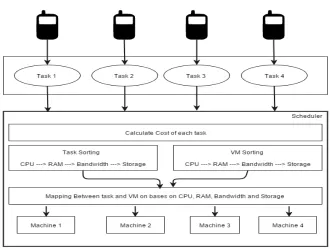
Figure 2. Proposed Architecture
A. Performance Evolution
Proposed System performs the following steps:
1)Calculate the cost of each task
2)Sort the task according the following parameters
a)CPU
b)RAM
c)Bandwidth
d)Storage
3)Also arrange the VM according the following parameters
a)CPU
b)RAM
c)Bandwidth
d)Storage
4)Check the status of Each VM.
5)Schedule the sorted VMs on the basis of sorted task
6)Calculate throughput, response time of each task
VI. RESULT ANALYSIS
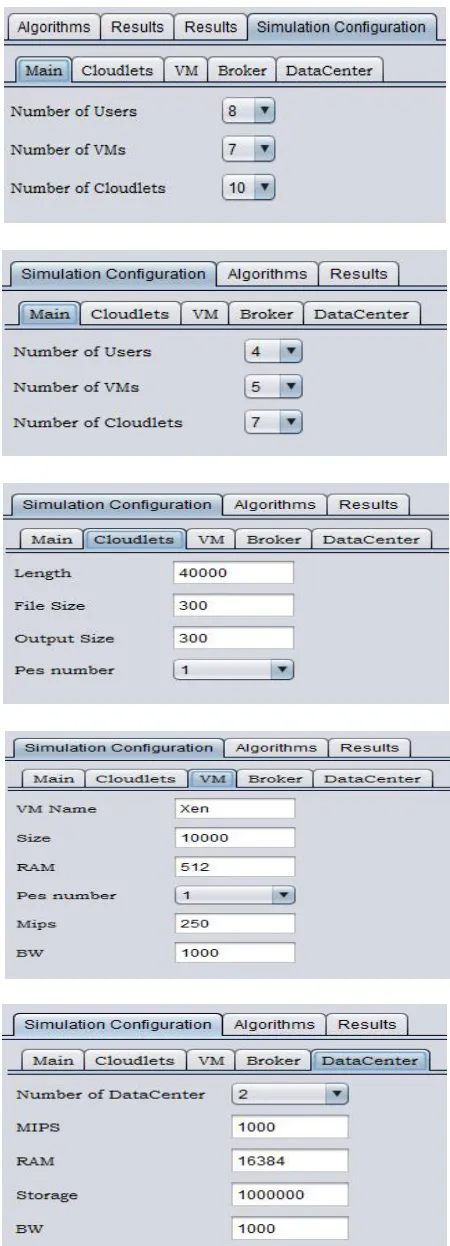
We implemented hybrid algorithm for load balancing algorithm on Net Beans using advanced JAVA. Cloud simulator is simulated for simulation with different configuration. Before simulation we configure many parameters like number of datacenters, number of cloudlets, VM configuration, bandwidth and MIPS. We implemented three algorithm of load balancing are:
A. FCFS
B. Round-Robin
3422
[image:6.612.194.419.74.697.2]©IJRASET (UGC Approved Journal): All Rights are Reserved
3423
©IJRASET (UGC Approved Journal): All Rights are Reserved
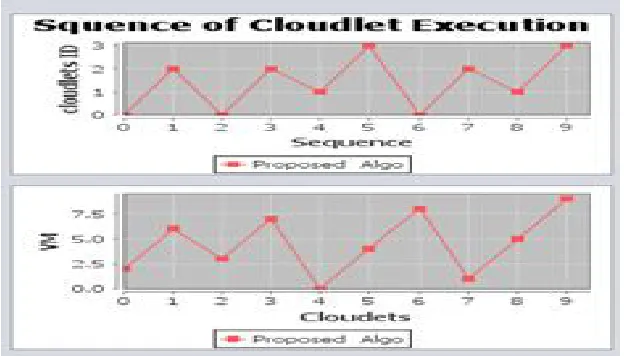
[image:7.612.63.554.104.284.2]Below diagrams 4 and 5 show that execution cloudlets, amount of time needed for execution, it is also showing that which cloudlets assign on which datacenter and virtual machine.
Figure 4: The VM allocation and Sequence of cloudlet Execution is shown according to Proposed Hybrid algorithm.
Figure 5: Cloudlet ID and VM Allocation using Hybrid Load Balancing Algorithm
VII. FUTURE WORK
Future work of our project is to improve efficiency and reduce cost of data centers and VM using new adaptive algorithm. And also improve in such a way so that it will work for heterogeneous environment such as big data.
REFERENCES
[1] SoumenSantra, Dr.KalyaniMali. “A new approach to survey on load balancing in VM in clound computing: using cloudsim”, 2015,IEEEInternational Conference on Computer,Communication and Control (IC4-2015).
[2] Raj Kumarsomani,JyotsanaOjha,“A Hybrid approach for Vm load balancing in cloud using cloudsim”,2014,International Journal of science,Engineering and Technology Research(IJSETR),Volume 3.Issue6,June 2014,page no. 1734-1739.
[3] RituKapur, “A Cost Effective approach for Resource Scheduling in Cloud Computing”, 2015, IEEE International Conference on Computer, Communication and Control(IC4-2015).
[4] Pooja Samal1 and Pranati Mishra2, “Analysis of Variants in Round Robin Algorithms for Load Balancing in Cloud Computing”, (IJCSIT) International Journals of Computer Science and Information Technologies, Volume 4 (3), 2013,page no. 416-419.
[5] Kaur s and Supriya Kinger2, “Analysis of Load Balancing Techniques in Cloud Computing”, International Journal of Computers & Technology, volume 4, No. 2, March- April 2013.
[image:7.612.151.463.320.498.2]3424
©IJRASET (UGC Approved Journal): All Rights are Reserved
[7] Kunal Mahurkar1, Shraddha Katore2 and Suraj Bhaisade3, Pratikawale4, “Reducing Cost of Provisioning in Cloud Computing”, International Journal of Advance in Computer Science and Cloud Computing, Volume- 1, Issue- 2, Nov. - 2013, 6-8
[8] Dr. Rakesh Rathi1, Vaishali Sharma2 and Sumit Kumar Bole3, “Round Robin Data Center Selection in Single Region for Service Proximity Service Broker in Cloud Analyst”, International Journal of Computer & Technology, Volume 4 no. 2, March- April 2013.
[9] Bhatiya Wickremansinghe1, Rodrigo N. Calheiros2and Dr. Raj Kumar Buyya3, “CloudAnalyst: A CloudSim- based VisulModeller for Analyzing Cloud Computing Environments and Applications”, IEEE Computer Society, 2010.
[10] JaspreetKaur, “Comparison of load balancing algorithm in a Cloud”, International Journal of Engineering Research and Applications (IJERA), vol. 2, Issue 3, May- June 2012.
[11] Syed Tauhid Zuheri1, Tamanna Shamrin2 and Rusia Tanbin3, Firoj Mahmud4, “An Efficient Load Balancing Approach in Cloud Environment by using Round Robin Algorithm”, International Journal of Artificial and Mechatronics, volume 1, issue 5, 2013.