Intelligent Train Track Checker System
Niyati Chhatwal1, Palak Monga2, Saurabh Sachdeva3
1Niyati Chhatwal, 2Palak Monga, Student, Dept. Of Electronics and Communication Engineering, The North Cap University, Sector
23A Gurgaon, Haryana (122017), INDIA
3Saurabh Sachdeva, Faculty, Dept. Of Electronics and Communication Engineering, The NorthCap
Abstract: the paper depicts how to avoid railway accidents occurring because of breaks in tracks and collision of trains when on the same track, which can be because of humans, material weakness or natural calamities like floods, etc. As the driver has no clue in both the cases, therefore we want that the accident issues due to train track cracks and collisions be detected effectively and measures can be taken to protect them. In this we demonstrate the idea of track crack checker and this information is send using gsm technology to the driver in charge and the control room. We can detect the collision of two trains on the same track. The train can detect if any vehicle is in between its path. For this we use the concept of ir sensors, which are placed on the train. They send their signal which if gets reflected back and received by the receiver, the train stops as it detects another object in its path. The whole system energy is provided by a propeller, a non conventional source of energy utilization. The mechanical energy is converted to electrical energy and thus power is supplied to the system.
Keywords: gsm module, ir sensors, lcd display, propeller system, gsm module
I. INTRODUCTION
Transport is essential to convey the travellers and products starting with one place then onto the next. The better transport prompts more exchange. Financial level chiefly relies on upon the expanding limit and level of transport. Indian Railways is the world's eighth greatest business and had 1.331 million representatives toward the finish of 2015-16. In 2015–2016 Indian Railways had incomes of ₹1.683 trillion which comprises of ₹1.069 trillion cargo profit and ₹442.83 billion travellers income.
Contingent upon late advancements in railroad frameworks, rapid trains are in effect broadly utilized, and this transport system is being expanded. Grounds for this expansion are high speed, cost effectiveness, eco-friendly, safety, and modern features of railway systems. In railroad tracks, at whatever time the track is harmed it is because of climate conditions, surges, tremors, violent winds and so forth. But Between 2009-10 and 2014-15, there were an aggregate of 803 mishaps in Indian Railways. Each time there is a mishap, the issue of security in Indian Railways goes to the fore.
By far, the most noteworthy number of accidents are a result of crashes and mishaps at level intersections. The vast majority of railroad mishaps amid 2009-10 and 2014-15 have been because of crashes and accidents at level intersections. The other kind of mishaps incorporates collisions. Despite the fact that the quantity of accidents in 2009-10 was more than the number of mishaps in 2010-11, 235 were murdered in 2010-11 contrasted with just 67 in 2009-10. The mishaps in 2010-11 were more lethal contrasted with alternate years. The quantity of those slaughtered has been on the decay since 2010-11 just to increment in 2014-15.
The current track studying frameworks have a few impediments. The finding of cracks in railroads tracks requires time investment because of physical review. The strategy for design has restricted insight and is tedious. They are predominantly because of terrible state of tracks and nonappearance of checking in level intersections. It is difficult to recognize the impediments from the train and on identification it is hard to stop the train all of a sudden.
In this, the proposed framework promptly sees the cracks and detects an object in the track and educates the railroad specialist and subsequently can decrease the prepare mishaps. The framework can be worked in passages without interference. This venture proposes a straightforward plan with adequate roughness appropriate to the Indian situation to track geometry review by utilizing sensor, and GSM Technology which ends up being financially savvy when contrasted with the current strategies.
II. TECHNOLOGY USED
A. GSM Technology
[image:3.612.188.425.323.454.2]GSM/GPRS module is utilized to build up a flow of data linking a computer and a GSM-GPRS framework. Global System for Mobile Communication (GSM) is an manufacturing utilized for portable flow of information in the greater part of the nations. GSM/GPRS module comprises of a GSM/GPRS modem collected jointly with power supply of the circuit and communication interface. MODEM gadgets that are intended for communication of a PC with the GSM and GPRS network. It involves a SIM (Subscriber Identity Module) card simply alike cell phones to enact communication with the network. The MODEM needs AT orders, for cooperating with processor or controller, which are conveyed through serial communication. These are conveyed by the controller/processor. The MODEM sends back an outcome after it gets an order.
Fig. 3- GSM Module
B. IR Sensors
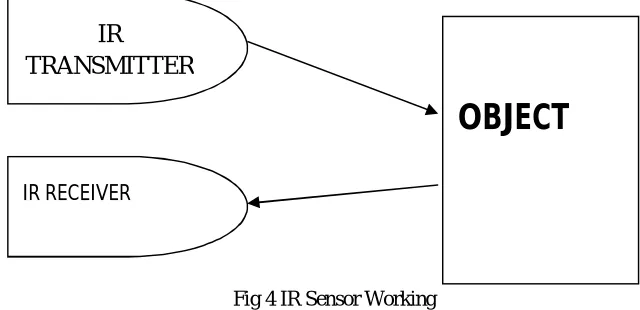
An infrared sensor is an electronic apparatus which detects certain ascribe of its surroundings by either transmitting as well as identifying infrared radiation. Infrared signal are not unmistakable to the human eye. In electromagnetic range, infrared emission can be set up in middle of the noticeable and microwave districts. The infrared signal regularly have wavelengths in the vicinity of 0.75 and 1000µm.
Fig 4 IR Sensor Working
IR Sensors act by employing a particular light sensor to differentiate a select light wavelength in the Infra-Red range. LED creates
OBJECT
IR
TRANSMITTER
[image:3.612.139.459.541.696.2]light at an indistinguishable wavelength from what the sensor is looking for, thus one can take a glance at the intensity of the received light. When an object is close to the sensor, the light from the LED is reflected back to the object and into the light sensor. This sequels in an expansive hop in the intensity, which definitely can be acknowledged by the threshold.
C. Propeller System
Wind turbine uses wind to make power. The wind moves the sharp propellers, which in turn spins a sh
aft, and interfaces with a generator to make power. The wind energy depicts the procedure by which the wind is used to form mechanical power. Wind turbines change over the kinetic energy in the wind into mechanical energy. This mechanical power can be exhausted for particular undertakings, (for example, granulating grain or pumping water) or a generator can change over this mechanical power into electricity.
In our venture , we are utilizing the propeller framework , here a fan is associated with a rechargeable battery which stores vitality and is utilized to give energy to the entire framework.
III. WORK DONE
A. Block Diagram
LCD
GSM Module Microcontroller
At89s52
IR Sensor for Crack Detection
IR Sensor for Anti-Collision Propeller.
Fans.
And dynoma Power Supply
B. Circuit Diagram
Electricity is generated through the wind energy, that stores energy in a rechargeable battery. Then through the battery the train engine gets stated and even the circuit gets its power supply. 12V is generated and is send to IC 7805 which converts it into 5V. This 5V supply is given to the microcontroller and the LCD. As SIM data is switched on, the LCD displays "RAILWAY TRACK SECURITY SYSTEM" and a message is received on the device "SMS DEVICE ON". The supply starts starts the motor and the train moves. For track crack detection, the sensors differentiate between black and white. When the train is on track and moving, is suddenly a white sheet is put on the track, the train stops and thus a message through the GSM module is send on the mobile device that "TRAIN TRACK CRACK". Until the white sheet is removed the train does not starts again. Similarly, for anti collision, if a train/ object comes in front to the train, the train detects it as danger and the train stops, until, the object is removed, the train does not starts again.
The programming in microcontroller is done that first it detects the signal of the GSM module(takes 40sec) . As it receives the signal, a message is send on the device "SMS DEVICE ON", and after that itself the train starts. The motor connection of the train is through the relay system. When the track crack is detected on the microcontroller(which is an input i.e. the LED glows), if it senses a message is send that "RAIL TRACK CRACK" through the GSM module.
For anti collision, the microcontroller gets the input and the relay gets on, thus the motor disconnects and the train stops.
IV. CONCLUSION
The main aim of the project was to make it easier for the authorities for detection of railway track cracks and collision circumstances. We know that it is really difficult for to monitor issues like this for the whole Indian scenario, so designing a system which would operate within the train premises would be the most effective solution.
The proposed broken rail detection and anti collision system automatically detects the faults without any human involvement. There are many advantages with the proposed system when compared with the traditional detection techniques. The advantages include less cost, effective power consumption and less analysis time. Consequently it is normal that, significant prepare incidents can be counteracted and human life spared if this framework is actualized.
The above design can be extended for future enhancements-
A. Along with the proposed system, a GPS module can be attached with would help in detection of the exact location of where the
mishap has occurred.
B. Also fire sensors can be attached on the train. If a fire breaks down on the train, then using fire sensors automatic water sprinklers can be initialised.
C. Can be even used in metro trains, mono rails.
REFERENCES
[1] P. Navaraja, "Crack Detection System for Railway Track using Ultrasonic and PIR Sensors", IJAICT Volume-1,Issue-1,May 2014
[2] V.Muralidharan, V.Dinesh, P.Manikandan, "An Enhanced Crack Detection System For Railway Track", IJETT Volume 21 Number 6,March 2015 [3] Ramavath Swetha ,P. V.Prasad Reddy, "Railway Track Detection Autonomous Vehicle" Global Journal of Advanced Engineering Technologies Volume
Issue 3- 2015