Utilization of Surkhi as a Partial Replacement of
Sand in Concrete
Zamir Irfan1, Syed Zeeshan Shafi2, Altaf Ahmad Bhat3
Abstract: Concrete is globally used material. It is a site-made material unlike other materials of construction and as such can vary to a very great extent in its quality, properties and performance owing to the use of natural materials except cement and sand. The production of natural sand and cement is diminishing and also their use has led to severe environmental problems. Thus, there is a need to replace these materials by some cheap, environmental friendly by-products such as Surkhi (crushed bricks). Surkhi is obtained from brick kilns. In the process of partial replacement it is sieved to the fineness of sand. Surkhi in concrete is an interesting possibility for economy on waste disposal sites and conservation of natural resources. The paper incorporates the physical properties and chemical composition of Surkhi as well as workability, and compressive strength properties of concrete produced by replacing 10%, 15%, 20% Surkhi, by weight of sand. Slump test was carried out on the fresh concrete and compressive strength test on hardened concrete. The concrete cubes were tested at the ages of 14 days and 28 days. The result showed that the slump decreased as the surkhi content increased. Slump value increased on the addition of admixture (FOSROC 440). The compressive strength increased with increasing surkhi replacement. The compressive strength of concrete with surkhi was lower at early stages but improves significantly after 28 days. It was concluded 20% surkhi substitution is adequate to enjoy maximum benefit of strength gain.
I. INTRODUCTION
Scientists, Engineers and technologists are continuously on the lookout for materials which can be used as substitutes for conventional materials or which possess such properties as would enable their use for new designs and innovations. Concrete using alternative materials fall under the first category. The raw materials for making cement and aggregates are essentially limitless, since practically all of earth’s crust can be utilized, if associated costs and energy requirements can be complied with. This course of action cannot be taken as there are other constraints that merit closer examination. One is therefore faced with a question: Is recycling of waste material into a new building material whose binder may not be Portland cement and whose aggregates may not be a mineral a viable solution? Perhaps the answer is affirmative since planned exploitation of waste materials essentially helps to maintain ecological balance.
A. Utilization of waste materials
Although we have been observing the waste materials like surkhi and Quarry dust as a waste materials in the past few decades but these materials are considered to be very useful from the civil engineering point of view. Surkhi is used as a partial replacement of sand in concrete provided to be very useful not only in the strength of concrete but also provided economical support which is considered very useful in engineering. The utilization not only protects the environment from pollution but also maintain an ecological balance in the environment which is caused by the extraction of sand.
B. Analysis of surkhi
Workability effect by surkhi: - The results of the slump indicated that the workability of concrete decreased with the increase in surkhi content. In order to cast the concrete in moulds workability needed to be increased which was done by adding admixture namely FOSROC 440. The demand for admixture as surkhi content increased is due to increased amount of silica in the mixture.
C. Site Details
The project was executed in Concrete Technology laboratory at Islamic University Of Science and Technology, Awantipora and at the lab of Ramky Infrastructure Limited. As the project lies in the subject area of concrete technology, it consists of diverse types of tests to be conducted on concrete. The materials i.e. surkhi was collected from kiln at Lasjan Srinagar.
D. Need and Necessity of replacing cement and sand:
1) First, huge quantities of virgin materials such as sand, gravel, crushed rock, and fresh water are consumed.
2) Second, the principal binder in concrete is Portland cement, the production of which is a major contributor to greenhouse gas emissions that are implicated in global warming and climate change.
3) Third, many concrete structures suffer from lack of strength and durability which has an adverse effect on the resource productivity of the industry. On the other hand, the industrial and agriculture wastes suffering the problem of disposal and are
environmentally hazardous. So these industrial and agricultural wastes need to be utilized in efficient manner. Surkhi cause problems of disposal and lead to environmental pollution. Its adoption will enable concrete construction industry
to become more sustainable.
E. Materials used
The various types of materials used in the project are:
1) Surkhi :Surkhi is called as trass, or brick-dust. Surkhi is used as a substitute for sand for concrete and mortar, and has almost the same function as of sand but it also imparts some strength and hydraulic city. Surkhi is made by grinding to powder burnt bricks, brick-bats or burnt clay; under-burnt or over-burnt bricks should not be used nor bricks containing high proportion of sand
2) Cement: A powdery substance made by grinding calcined lime stone and clay which can be mixed with water and poured to set as a solid mass or as an ingredient in making mortar or concrete. The cement used for the project is Ambuja cement (AC) of 43-grade
3) Fine Aggregates: Sand occurs naturally in granular material made of finely alienated rock and in organic particles. The most common component of sand is Silica (silicon dioxide SiO2), usually in the form of quartz.
4) Coarse Aggregates: Natural aggregates obtained locally were used.
5) Water: Fresh, colorless, odorless and tasteless portable water that is free from organic matter of any kind was used for mixing. Hence locally available purified water is used
.
II. PRELIMINARY WORK
A. Raw Material Collection
It is a physical collection of materials, ranging from innovative new materials to those found every day in the constructed environment. The collection allows users to rethink conventional applications and promote experimentation in practice. The various materials which were used in the project are; 1. Surkhi 2. Cement 3. Fine aggregates 4. Coarse aggregates 5. Water. These materials were collected from the nearby areas of Lasjan srinagar .
B. Sieve Analysis
Particle size is one of the most important properties of solids, which are used in many fields of human activity, such as construction waste management, metallurgy, fuel fabrication etc. urkhi is a waste product resulting from brick kiln. It is obtained from kiln is sieved through IS sieve of 4.75mm and the passed material obtained was used for experimentation purposes.
III. EXPERIMENTATION
A. Concrete mix design (grade M-25)
The mix used in the trials is the design mix M 25. This is a reference mix used. The normal concrete cubes have been casted utilizing the design parameters obtained for this mix. The design method used is the IS 10262-1982. Thus the design parameters are same for every concrete and only the respective replacements are made accordingly from the already obtained design parameters. 1) Design stipulations
a) Characteristic strength at 28 days 25 M pa. b) Maximum size of aggregate 20 mm.
c) Degree of workability 0.8 C.F.
d) Type of exposure Moderate Target mean strength =fck + ts =33.2 MPa
2) Normal Concrete M 25
The various design parameters are: Water cement ratio = 0.45 Compaction factor = 0.80
Fine aggregate = 419.25 kg/m3 Coarse aggregate = 1344 kg/m3 Water content = 177 kg/m3
B. Casting
The concrete was mixed by the power driven mixer and cubes were filled and vibrated on the vibrating table. Dry mixing with the help of hands was first done in large pans and then it was installed in mixer and water was added. The cubes used as moulds are of dimensions 150mm×150mm×150mm. The cubes were filled and vibrated on the mechanical vibrating table. Then they were allowed to set for 24 hours before the moulds could be removed. The cube moulds were cleaned and oiled before pouring concrete mix in them.
Fig.5: Cast Concrete samples.
C. Slump test
Slump test was conducted and slump values have been obtained in observation table.
Percentage SURKHI Replacement (%) Slump (mm)
0 110
10 100
15 95
D. Curing
The cubes and cylinders have been cured after removing the moulds after 24 hours. Curing has been done by keeping the specimens immersed in water for a period of 12 days for the 14 day test and 26 days for the 28 day test from the date of casting.
E. Testing Of Hardened Concrete
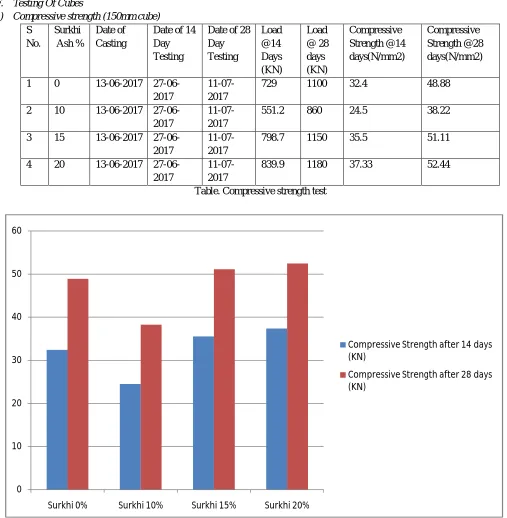
The cubes have been tested for the compressive strength at 14 and 28 days respectively under a compressive testing machine. The specimens after proper curing for the required period were tested. The observations seen in the fresh as well as in post hardening test are given in the table below.
Compressive strength test for normal M 25 mix. Compressive strength test: This test is conducted on cubes which are loaded on their opposite faces in a Compression Testing Machine (CTM). Two samples were cast in each casting, one of which were tested after 14 days, another two were tested after 28 days. The load at which first crack appears is considered as failure load and the compressive strength is calculated corresponding to this particular value of load.
0 10 20 30 40 50 60
Surkhi 0% Surkhi 10% Surkhi 15% Surkhi 20%
Compressive Strength after 14 days (KN)
Compressive Strength after 28 days (KN)
Where, cross-sectional area = (150×150) mm2 {in case of 150 mm cubes}
F. Testing Of Cubes
1) Compressive strength (150mm cube) S No. Surkhi Ash % Date of Casting
Date of 14 Day Testing
Date of 28 Day Testing Load @14 Days (KN) Load @ 28 days (KN) Compressive Strength @14 days(N/mm2) Compressive Strength @28 days(N/mm2)
1 0 13-06-2017
27-06-2017
11-07-2017
729 1100 32.4 48.88
2 10 13-06-2017
27-06-2017
11-07-2017
551.2 860 24.5 38.22
3 15 13-06-2017
27-06-2017
11-07-2017
798.7 1150 35.5 51.11
4 20 13-06-2017
27-06-2017
11-07-2017
839.9 1180 37.33 52.44
[image:6.612.46.553.103.621.2]Table. Compressive strength test
Figure: comparison of strengths at 14 and 28 days of testing.
IV. AKNOWLEDGEMENT
V. CONCLUSION
A. From the results of the various tests performed, the following conclusions can be drawn:
1) SURKHI is a suitable material for use as a pozzolan, since it satisfied the requirement for such a material by having a combined (Sio2+Al2O3+Fe2O3) of more than 70%.
2) Concrete becomes less workable as the SURKHI percentage increases meaning that more water is required to make the mixes
more workable this means that SURKHI concrete has higher water demand.
3) The compressive strength generally increases with curing period and increases with increased amount of SURKHI.
4) It has also been observed that the compressive strength increases with increase in time.
BIBLIOGRAPHY
[1] Celik T, Marar K (1996). Effects of crushed stone dust on some properties of concrete, Concrete Res., 26(7):1121-1130.
[2] De Larrard F, Belloc A (1997). The influence of aggregate on the compressive strength of normal and high-strength concrete. ACI Mater J., 94(5):417–426. [3] Galetakis M, Raka S (2004). Utilization of limestone dust for artificial stone production: an experimental approach. Miner. Eng., 17:355–357.
[4] Gambhir ML (1995). Concrete Technology-Second Edition, Tata McGraw-Hill Publishing Company Limited, New Delhi.
[5] Goble CF, Cohen MD (1999). Influence of aggregate surface area on mechanical properties of mortar. ACI Mater. J., 96(6):657–662. [6] IS: 516-1959. Indian Standard Methods of Test for Strength of concrete. Bureau of Indian Standards, New Delhi.
[7] Nevillie AM (2002). Properties of Concrete –Fourth and Final Edition, Pearson Education Limited, Essex.