5
IX
September 2017
Increasing the Channel Capacity of a Wireless
CDMA Network Using Radio Resource Allocation
Scheme
Ufoaroh S.U1, Ezeagwu C.O2, Ohaneme C.O3
1, 2,3Department of Electronic and Computer Engineering, Nnamdi Azikiwe University,Awka, Anambra state, Nigeria
Abstract: In this paper, an improvement to the adaptive power control algorithms for Wideband Code Division Multiple Access (WCDMA) systems is proposed. The proposed scheme uses an enhanced adaptive power step size technique to mitigate high fluctuations in the radio interface. A buffer zone within the range of a set threshold value was integrated to help reduce oscillations around the target QoS level which is the problem faced by the conventional Adaptive Step Power Control (ASPC) scheme. In this algorithm, intelligence was added to feedback decisions which helped with faster convergence in attaining preferential levels by the mobile and base station. The algorithm can be applied in uplink Frequency Division Duplex (FDD) mode, where closed-loop power control algorithms are used. Simulation results showed that the proposed algorithm decreased the outage probability and reduced drastically the transmitted power when compared to ASPC and its variants, which enhances the channel capacity.
Keywords: Enhanced Adaptive power control, ASPC, WCDMA, Channel capacity, Radio Resource Allocation
I. INTRODUCTION
The demand for higher capacity and better service quality in wireless mobile communication systems has been increasing exponentially in the last decade. This is because of user mobility and flexibility, particularly on the communication channel between Mobile Terminals (MT) and Base Station (BS) that cannot be provided in wired line. Unfortunately this wireless resource is a bottleneck encompassed by limited system capacity and performance due to multipath propagation and large scale fading experienced in wireless channels [1]. In Universal Mobile Telecommunication System (UMTS), coverage and capacity are interdependent. UMTS is based on Wideband Code Division Multiple Access (WCDMA) technologies which are capable of delivering high data rate services. However, when the number of users increases, the capacity will be decreased because the capacity of WCDMA systems is interference limited. Therefore, it is important to minimise the interference in the systems. One of the critical sources of interference is transmission power from other users in the uplink (mobiles to base stations). If the transmission power in the uplink is not properly controlled, a mobile close to the base station may transmission excessive power causing large interference to other users connecting to the same cell. This scenario results to the near–far effect resulting from one user’s transmission power becoming a source of interference to others which significantly reduces system capacity. Consequently, it is vital that a mechanism to control the transmit power be developed, which led to the development of various power control schemes aimed at mitigating the near-far problem. These schemes are aimed at ensuring that the transmission power from and to all entities in the system are just enough for maintaining the minimum SIR requirements of all connections. Thus, to maximize system capacity, transmission should occur at power levels capable of ensuring minimal SIR requirements sufficient to ensure seamless connections.
Therefore in this work, the introduction of EAPC in WCDMA system has helped in the maximization of system capacity through power control algorithm that ensures SIR requirements.
system along with power control mechanisms. The exact impact of the power control mechanisms was analyzed by reviewing some fundamental approaches which showed the impact of the power control schemes on the design of energy efficient design. In [7] a comparison of various power control algorithms such as: Fixed Step Power Control (FSPC), Adaptive Step Power Control (ASPC), and Modified Adaptive Step Power control (MASPC) was done. It was realized that some had better advantages over the other. There were able to deduce that MASPC gives far better stability to the communication system than that of ASPC at the expense of increased complexity.
II. POWER CONTROL IN WCDMA SYSTEMS
Power control is basically classified into open-loop and closed-loop power control. Open-loop power control is employed at the beginning of a connection, it sets the initial transmit power levels for the UE and in downlink direction it determines the transmit power levels for the downlink channels. The open loop power control uses the measurement reports of the UE about the received power from the BS, and it then decides how to set the transmit downlink power levels [8].
Power control for UMTS is closed loop which involve a combination of inner-loop and outer-loop power control algorithms. The inner loop power control is also known as the fast closed loop power control. The fast closed loop controls the transmission power levels for UE and BS based on the received signal-to-interference ratio (SIR) level at BS and UE, to combat fading characteristics of the radio channel [8]. The Transmit Power Control (TPC) commands are sent by UE and BS providing the information either to increase or decrease the transmission power levels. The outer loop power control provides the target SIR level for the inner loop power control. The outer loop power control adjusts the target SIR to achieve the desirable Block Error Rate (BLER) for the particular service (voice or data) carried out by the UE. The change in the mobile speed or the multipath propagation environment also results in the adjustment of the targeted SIR [8].
Power control algorithms in the UMTS were specified in the 3rd Generation Partnership Project (3GPP) standardization forum [9][10] for Frequency Division Duplex (FDD) and Time Division Duplex (TDD) modes respectively. The 3GPP inner loop power control procedures can be described in the following steps:
The Base Station (BS) estimates the received SIR from a particular mobile. The estimated SIR is compared with the corresponding SIR target.
If the estimated SIR is higher than the target, then the base station sends an "up" TPC command. Otherwise, a TPC "down" command is sent. The Mobile Station (MS) obeys the command by increasing or decreasing the transmit power based on a fixed step size, typically I dB [11].
The updated transmit power can be represented as shown by [12]:
( + 1) = ( ) + ( ( )− ( ) (1)
Where all the variables are in decibels, ( ), ( ) and ( ) are the transmission power, SIR target and measured SIR respectively, of user i at time t, while is the fixed step size and the term sign is the sign function where
( ) = 1, ≥0
−1, < 0 (2)
It can be noted that sign ( − ) = −1 is equivalent to a TPC power up command which can be represented by bit 0.
From (1), it can be observed that the transmit power will be increased or decreased by (power control step size) on every time slot. The transmitted power will always change even when there is no change in the channel and this causes oscillations with variations around the SIRtarget in a slow-varying radio environment. In addition to this, when the channel changes rapidly, the fixed step size is unable to adequately control the power to compensate for the changes.
A. Adaptive Power Control
should decrease their transmit power in order to minimise the total interference. However, in the rapid change situation, changing the transmit power by fixed step size of 1 dB is not fast enough to lessen the transmit power, resulting in excessive interference to other MS. Hence, an efficient power control method with an adaptive PC step size mitigates such problems.
Adaptive step size algorithms are designed with a capability of reducing the oscillations and increase the speed of power control to follow the rapid change of QoS of radio channels. However, the limited amplifier precision prevents transmitters from using very low power control steps; therefore, oscillations are not totally eliminated. SIR oscillations appear due to the fact that the power is either increased or decreased even if the SIR is very close to SIRtarget. Therefore, the received SIR may oscillate around SIRtargetwith
high variance. To circumvent this problem, a buffer zone based on hysteresis was introduced in the EAPC algorithm employed in this work. To eliminate the oscillations completely while maintaining a comparable rate of reduction of outage percentage, two threshold levels: the lower critical threshold and the upper critical threshold provided a memory–based damping effect similar to hysteresis which solves the problem of oscillation.
B. Development of the Enhanced Adaptive Power Control System
The EAPC algorithm is simply the combination of the FSPC algorithm, the AS method, and the DCPC algorithm. The FSPC and DCPC algorithm is described respectively by [13]:
P(t + 1) = P(t) +δsign(γ (t)− γ(t)) And
P(t + 1) = min{p max, p (t) + δ (t)} (3) Where: e (t) = γ (t) – γ(t) and u (t) = sign (e(t)) (4)
Considering uplink, the BS generates the commands u(t)⋲{−1,1}. Just like the FSPC algorithm, the commands are transmitted to the MS, which applies Adaptive Step to generate a reconstruction e (t) of the Power Control (PC) misadjustment, and then updates its power as in the DCPC algorithm, but using the reconstructed value instead of the true e(t). This is described by:
e (t) = a(t, 1)e (t - 1) + δ u (t) (5) Where: δ is the update parameter and ( , 1) implements the sign change.
The idea employed here is such that if the two latest TPC commands have the same sign (e.g. if u (t) = u (t-1) = +1), the reconstruction of e(t) is updated by δ to the direction of the last command u(t) so as to increase the step size of the next power update. If the two latest commands have different signs (e.g. if u (t) ≠ u (t-1)), a zero crossing must have happened in the signal e(t), and the reconstruction also crosses zero.
The condition for the change in sign is applied mathematically like in the Adaptive Step (AS) method by the condition:
(t ,1) = { , ( ), ( ) (( )) (6)
The performance of the EAPC algorithm depends on the selection of the update parameter δ . If too small δ is selected, then the reconstruction cannot track the actual misadjustment e(t). This can happen for example during a deep fade in the radio channel. On the other hand, if δ selected is too big, then the advantage of the “fine-tuning” provided by the adaptation method to the power control algorithm is significantly reduced. To circumvent these problems, the update parameter is adapted to meet varying conditions.
The reason for adapting the step size in the first place is to make the transmission power to change faster if the consecutive TPC commands have the same sign. To adapt, the update parameter the FSPC algorithm is considered. In the FSPC algorithm, the PC step size is fixed and the best situation is achieved when the commands (power updates) generated by the FSPC algorithm are consecutively +1’s and -1’s, since in this case the PC misadjustment e(t) oscillates between the opposite sides of the origin at consecutive samples. The amplitude of this oscillation depends on the step size. Now, consider that the decreased step size is applied at the transmitter, while maintaining the consecutive up-down command flow, the amplitude of the oscillation of the PC misadjustment in this case would be decreased. If the continuous up-down command flow breaks, the step size could be increased again. This can be achieved based on the following modification of the update parameter:
δ (t) = δ (t - 1) + δ u (t) u (t - 1) (7)
With this, the developed model for the EAPC algorithm is given as
( + 1) = P( ) + δ ̅ ( ) (8)
Where ̅ (t) = ( , 1) ̅ (t - 1) + δ u (t) (9)
δ (t) = δ (t - 1) + δ u (t) u (t - 1) (10) The pseudo code for the Enhanced Adaptive Power Control algorithm follows these steps:
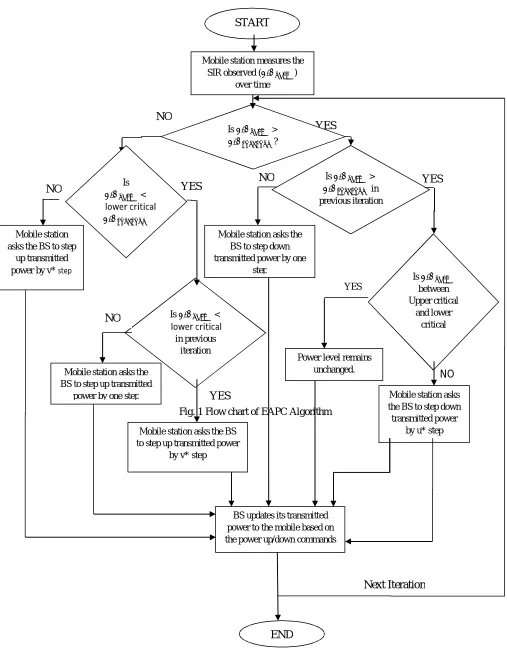
1) The mobile stations measure the observed value of the SIR at each iteration and compare them with the preset lower and upper critical threshold values.
2) If the observed SIR is smaller than the lower critical threshold, then the mobile sends a power–up command to the base station. The first power update command is interpreted as a fixed step modification; however, the EAPC algorithm dynamically adjusts the step size if successive feedback commands request additional change in the power level in the same direction.
3) If the observed threshold is between the lower and the upper critical threshold values, then the mobile does not send any control signal to the base station, thereby eliminating oscillations observed at low outage percentage of Multiple Step Power Control (MSPC) algorithm.
4) The increment in size is chosen larger than the decrement in size. This ensures that MS’s in outage can quickly come out of outage.
Fig. 1 Flow chart of EAPC Algorithm
Is <
lower critical
in previous iteration
Mobile station asks the BS to step up transmitted power
by v* step
YES
NO YES
NO
YES
NO
Next Iteration Mobile station measures the
SIR observed ( )
over time
Is >
?
YES
Is >
in previous iteration Is
< lower critical
NO
Mobile station asks the BS to step down transmitted power by one
step
Mobile station asks the BS to step down transmitted power
by u* step Mobile station
asks the BS to step up transmitted power by v* step
Is between Upper critical
and lower critical
BS updates its transmitted power to the mobile based on the power up/down commands
START
END
Power level remains unchanged. Mobile station asks the
BS to step up transmitted power by one step
NO
III. RESULTS AND ANALYSIS A. Simulation Testbed
The simulation program was implemented using MATLAB. It has seven cells in a hexagonal pattern, where the cell radius is 50 m and base station antenna height is 24 m. At the centre of each cell, a base station with an omnidirectional antenna is located. The thermal noise at the base station receiver is -113 dBm MS’s are uniformly distributed over the seven cells. The chip rate is 5 Mchip/s as in WCDMA. The target bit-energy to interference-spectral-density ratio ( = ) is 6 dB for every user. In the beginning of the simulation, the users were assigned velocities randomly between km/h and km/h and a random direction of movement. These were not changed during simulation. The maximum transmit power of MS was 250mW (24 dBm). Each MS was connected to the closest base station and ideal handovers were assumed in the sense that each user was connected to the base station with the least channel attenuation at all times. The services modelled in the simulation were 12.2 kbps voice services with 100% activity factor. The initial transmit power was based on the open-loop power control. The threshold value used was -14db, while the upper critical and lower critical threshold values were: -13.5db and -14.5dB respectively.
B. Simulation Results
[image:7.612.117.500.341.666.2]System availability is the main performance metric considered in this work. This is a very important parameter that is fundamental in system analysis. The outage probability was one of the performance measures adopted for this work which was described as the probability that the signal-to-noise ratio (SNR) at the output is below a given threshold value. The outage threshold is a limit value for the SNR that measures the quality of service, (QoS). This QoS parameter was simulated and analyzed as outage performance metric since it was applied for different QoS requirements
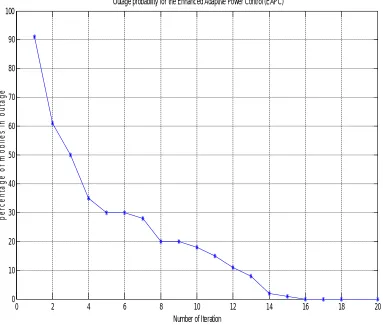
Fig. 2 Outage probability for the EAPC algorithm
Fig. 2 shows the outage probability plot of the EAPC algorithm. From the plot it is seen that as at the 16th iteration, there are no MS in outage.
0 2 4 6 8 10 12 14 16 18 20
0 10 20 30 40 50 60 70 80 90 100
Number of Iteration
p
e
rc
e
n
ta
g
e
o
f
m
o
b
il
e
s
i
n
o
u
ta
g
e
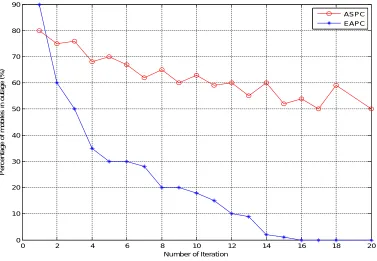
FiG. 3 Comparison of the outage probability of the ASPC and EAPC Algorithms
Fig. 3 shows that there was a reduction in the percentage of outages as the number of iteration increases. However, oscillations were observed in the case of the adaptive step power control (ASPC) algorithm due to the single threshold separating the outage and non– outage regions. This work introduced a buffer zone based on hysteresis in the EAPC algorithm which eliminated the oscillations completely while maintaining a comparable rate of reduction of outage percentage, as seen in Fig. 3.
As the radio channel is highly stochastic, the channel characteristics vary very quickly. So, the power update by any power control algorithm should be fast enough to converge and stabilize the system quickly. So, the speed of convergence is an important performance comparison parameter that gives the responsiveness of the power control algorithm.
Fig. 4 Comparison of Rate of Convergence
0 2 4 6 8 10 12 14 16 18 20
0 10 20 30 40 50 60 70 80 90
Number of Iteration
P e rc e n ta g e o f m o b ile s i n o u ta g e ( % ) ASPC EAPC
0 2 4 6 8 10 12 14
0 0.05 0.1 0.15 0.2 0.25 0.3 0.35
comparsion of Rate of Convergence
V a ri a n c e o f P o w e r
Number of iteration
Fig.4 depicts the variance of power levels in all consecutive iterations for the four algorithms. From the plot it is clear that ASPC converged quicker than the Multiple Step Power Control (MSPC) as discussed in [14] and FSPC, but the EAPC almost converged instantly. The relatively high values of outage probabilities were due to the 'admit-all' policy. A convenient admission policy, which could be associated with power control, would lead to better performances. Yet, Fig. 4 shows the amelioration of the outage probability due to the use of the ASPC algorithm. The faster convergence of the EAPC algorithm lead to a smaller outage probability, as noticed in Fig. 3. For the same outage probability, the EAPC leads to a greater average number of MS per cell and thus increased the network capacity
IV. CONCLUSION AND RECOMMENDATION
Power control in 3G WCDMA System was studied in this work. The performance of different basic distributed power control algorithms were evaluated and compared on the basis of the simulations in Matlab. The algorithm was based on an adaptive modification of the transmitted power update step size. It was observed that the Adaptive-Step Power Control Algorithm, which was easily implemented, was an interesting variant of the one-bit command Power Control of WCDMA System. An enhancement to the ASPC algorithm was obtained using the concept of hysteresis, by introducing a buffer region instead of a single SIR threshold. This resulted in a better performance in terms of mitigating the oscillations of the MS in outage at lower values of outage percentage. This improvement allows the WCDMA system to accommodate more users which by extension means that larger cells can be allowed, thus achieving coverage extension, which was an improvement in the QoS of the network and also increased network capacity.
For future research work, Soft handover in WCDMA should be investigated, Mobile terminal connecting to at least three base station while evaluating signals from them to know which of them has a stronger link quality creates some challenges in effective power control in WCDMA.
REFERENCES
[1] Adit Kurniawa, “Predictive Power Control In CDMA Systems”, Ph.D dissertation, Institute for Telecommunications Research, Division of Information Technology, Engineering, and the Environment, University of South Australia, 2003.
[2] Rasha Ali Mohammed et al, “Performance Evaluation of Direct Sequence WCDMA Power Control”, International Journal of Science and Research (IJSR), 2016, ISSN (Online): 2319-7064.
[3] J Kujenniemi, et al "Signaled Step Size of Downlink Power Control of Dedicated Channels in UTRA TOO," 4th International workshop on Mobile and Wireless Communication Network, 2002, pp. 675- 679.
[4] S N. Siamak, et al "Dynamic Step-Size Power Control in UMTS," , IEEE PIMRC, 2002.
[5] M. Rintamki, "Adaptive Power Control in COMA Cellular Communication Systems", PhD Thesis, Helsinki University of Technology, Department of Electrical and Communication Engineering, Nov 2005
[6] Tondare S. M., et al “Review of Power Control Mechanisms in Cellular System”, Global Journal of Researches in Engineering Electrical and Electronics Engineering Volume 15 Issue 1, 2015.
[7] Sandeep Solanki , et al “Comparative Study of Various Power Control algorithms in WCDMA”, International Journal of Digital Application & Contemporary research Volume 4, Issue 04, November 2015.
[8] Sultan Usama Khan, “Repeaters for Topology Planning in WCDMA Macro Cellular Networks”, Master of Science Thesis Tempere university of Technology finland , 2010.
[9] Physical layer procedures (FDD)", Third Generation Partnership Project, Technical Specification Group Radio Access Network, TS25.214 (Release 5), September 2003.
[10] Physical layer procedures (TDD)", Third Generation Partnership Project, Technical Specification Group Radio Access Network, TS25.224 (Release 5), September 2003.
[11] H, Holma, and A. Toksala, “WCDMA for UMTS”, Fourth edition, Wiley and Sons, 2004
[12] S. Ariyavisitakul, “SIR based power control in a CDMA system”, Proc. IEEE GLOBECOM, Orlando, Florida, USA, Dec. 1992, pp 868-873 [13] J.-H. Wen, et al “A feasible method to implement optimum cir-balanced power control in cdma cellular mobile systems,” IEEE Trans. Veh. Technol., vol. 52,
no. 1, pp. 80–95, Jan. 2003.