Technology (IJRASET)
Improved Face Recognition Using ICP Techniques
in Camera Surveillance Systems
Neela Marimuthu1, Matheshwaran Veerappan2
1,2
Master of Computer Application, Anna University
Abstract— Face Recognition is important task in real time biometric systems. The main difficult problem in the image processing field is Face recognition. Pose and expressions are the most important challenges among the various factors that control the Face recognition. Pose and expression severely affects the performance of face recognition. In existing a novel face descriptor, Local vector pattern (LVP), for robust face recognition that encodes the structural information, and the intensity variations of the face’s texture. In proposed implement the Linear Discriminant Analysis, Principle Component Analysis, Iterative Closest Point. These techniques are not difficult even it includes the expressions but produces much better results. Keywords—principle component analysis, local vector pattern, iterative closest point, face recognition, biometric
I. INTRODUCTION
Biometrics refers to the identification of humans by their characteristics or traits. Biometrics is used in computer science as a form of identification and access control. It is also used to identify individuals in groups that are under surveillance. High security in biometric modalities such as fingerprint and iris, it is still a very challenging task to recognize people from their faces under adverse scenarios. Have challenges caused by illumination, pose, expression and occlusion variations we implement local feature descriptor, local vector pattern (LVP), for face recognition that encodes the directional information of the face's textures. Develop a novel vector representation by calculating the various directions. Comparative Space Transform (CST) is used to reduce the feature length in facial recognition. In proposed, we analyze facial recognition in various variations such as pose, occlusion, illumination and expression variations. And extend work in 3D face model and implement Iterative closest point algorithm to get facial points from face image. Unconstrained face recognition is the important problem in face recognition. Face recognition has received attention due to the large series of commercial, information security and law enforcement and surveillance applications Face recognition is difficult because the identical twins will appear to be more similar and it created the problem. The main factor that produces the challenging problems in face recognition is the pose variation, expressions and occlusion. This paper mainly deals with the problem of recognizing the faces which is taken from the distant camera. The feature extractors used here are local binary pattern and local derivative pattern. Now a days, pose variations and pose variations with expressions was recognized as one of the major unsettled problems in the area of face recognition. The objective of this paper is to construct a face recognizer that works under unstable pose and therefore the important problem in unconstrained face recognition.
II. RELATED WORKS
In [1] X. Xie and K.-M. Lam et al. In this paper, a new method of nonlinear mapping, which is performed in the original feature space, is defined. Principal component analysis (PCA) [21], is the most popular technique; it generates a set of orthogonal bases that capture the directions of maximum variance in the training data, and the PCA coefficients in the subspace are uncorrelated. PCA can preserve the global structure of the image space, and is optimal in terms of representation and reconstruction. This paper has also evaluated the performances of the different face recognition algorithms in terms of changes in facial expressions, uneven illuminations, and perspective variations. Experiments were conducted based on different databases and show that our algorithm always outperforms the other algorithms, such as PCA, Gabor wavelets plus PCA, Gabor wavelets plus kernel PCA with FPP models, under different conditions.
In [2] X. Chai, S. Shan, X. Chen, and W. Gao et al. This paper proposes a simple, but efficient, novel locally linear regression
(LLR) method, which generates the virtual frontal view from a given non frontal face image.In this paper, by formulating virtual
Technology (IJRASET)
extends LLR from the original no overlapping patch partitioning to dense sampling and also reports more extensive and improved experimental results. In LLR, face images are divided into densely sampled patches and linear regression is performed on these patches for better prediction.
III.LOCAL VECTOR PATTERN
Local vector pattern (LVP), for face recognition that encodes the directional information of the face's textures. Develop a novel vector representation by calculating the various directions. Comparative Space Transform (CST) is used to reduce the feature length in facial recognition. The LVP reduces the feature length via comparative space transform to encode various spatial surrounding relationships between the referenced pixel and its neighbourhood pixels. Besides, the concatenation of LVPs is compacted to produce more distinctive features. To effectively extract more detailed discriminative information in a given subregion, the vector of
LVP is refined by varying local derivative directions from the nth-order LVP in (n − 1)th-order derivative space, which is a much
more resilient structure of micro patterns than standard local pattern descriptors.
IV.PRINCIPAL COMPONENT ANALYSIS
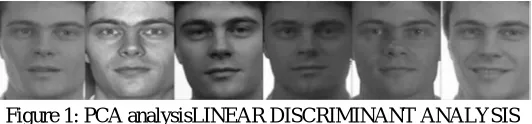
[image:3.612.175.441.431.493.2]Principal component analysis is appropriate when you have obtained measures on a number of experiential variables and wish to develop a smaller number of artificial variables that will account for most of the variance in the experiential variables. The principal components might then be utilized as predictor or criterion variables in following analysis. Principal component investigation is a variable decrease process. It is helpful when you have find data on a number of variables, and consider that there is a little idleness in those variables. In this case, redundancy means that a little of the variables are associated with one a different, perhaps since they are measuring the similar construct. Because of this redundancy, you believe that it should be possible to decrease the observed variables into a smaller number of principal components that will account for most of the discrepancy in the experiential variables. Since it is a variable decrease process, principal component study is like in a lot of respects to tentative factor analysis. In detail the steps chased when behavior a principal component analysis are nearly the same to those chase when conducting an probing factor analysis. However, there are important abstract differences between the two procedures, and it is significant that you do not wrongly maintain that you are performing factor analysis when you are really performing principal component analysis. The differences among these two procedures are explained in greater feature in a later on section titled “Principal Component Analysis is Not Factor Analysis.”
Figure 1: PCA analysisLINEAR DISCRIMINANT ANALYSIS
Linear discriminant analysis (LDA) and the interrelated Fisher's linear discriminant are techniques utilized in statistics, pattern detection and machine learning to discover a linear arrangement of features which distinguish or divides two or more classes of objects or events. The resultant arrangement might be used as a linear classifier, or, additional usually, for dimensionality decrease previous to afterward classification. LDA is closely related to ANOVA and regression analysis, which also effort to articulate one needy variable as a linear arrangement of additional features or measurements. However, ANOVA
uses definite independent variables and a continuous reliant variable, whereas discriminant investigation has
uninterrupted independent variables and a categorical dependent variable. Logistic regression and probit regression are more related to LDA, as they also clarify a definite variable by the values of continuous self-determining variables. These other techniques are preferable in applications where it is not reasonable to assume that the independent variables are usually distributed, which is a basic supposition of the LDA technique. LDA is also closely related to principal component analysis (PCA) and factor analysis in that they both look for linear combinations of variables which best clarify the data. LDA unambiguously efforts to model the dissimilarity among the classes of data. PCA on the other hand does not obtain into account some dissimilarity in class, and factor analysis constructs the feature combinations supports on dissimilarity rather than correspondence. Discriminant analysis is also dissimilar from factor analysis in that it is not an interdependence technique: a distinction between independent variables and dependent variables must be made.
Technology (IJRASET)
[image:4.612.186.467.95.605.2]definite self-determining variables, the corresponding method is discriminant correspondence analysis.
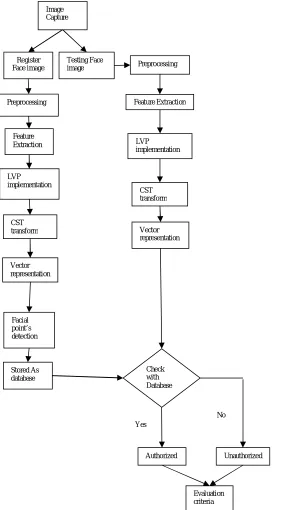
Figure 6: System architecture
V. ITERATIVE CLOSET POINT
Iterative Closest Point (ICP) is an algorithm employed to minimize the difference between two closets of points. ICP is frequently utilized to recreate 2D or 3D surfaces from dissimilar scans, to concentrate robots and accomplish best path planning, to co-register bone models, etc. In the algorithm aim is set aside set while the additional one the basis is distorted to greatest match the orientation. The algorithm iteratively adjusts the transformation wanted to reduce the distance from the source to the reference point cloud. The ICP (Iterative Closest Point) algorithm is widely used for geometric alignment of three dimensional models when an
Register Face image
Preprocessing
Feature Extraction
LVP implementation
CST transform
Vector representation
Facial point’s detection
Stored As database
Image Capture
Testing Face
image Preprocessing
Feature Extraction
LVP implementation
CST transform
Vector representation
Check with Database
Authorized Unauthorized No
Yes
Technology (IJRASET)
[image:5.612.222.393.107.202.2]initial estimate of the relative pose is well-known. A lot of variants of ICP have been anticipated, disturbing all phases of the algorithm from the selection and matching of points to the minimization strategy.
Figure 7: ICP analysis
VII. COMPARISON
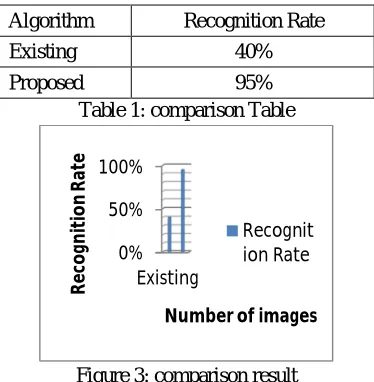
In the experimental results compare with the existing the technique the proposed technique is better to give face recognition rate. The comparison result and the results are shown below.
Algorithm Recognition Rate
Existing 40%
[image:5.612.213.400.237.428.2]Proposed 95%
Table 1: comparison Table
Figure 3: comparison result
VIII. CONCLUSIONS
Biometrics (or biometric authentication) refers to the identification of humans by their characteristics or traits. Biometrics is used in computer science as a form of identification and access control. Pose Variation plays the major role in face recognition. In this paper proposed ICP technique. Compare to the existing it recognize the face in illustration and different expression also. It recognizes rate is higher than the existing technique. In future it extends to analyze the missing data in face to recognize it.
REFERENCES
[1] X. Xie and K.-M. Lam, “Gabor-based kernel PCA with doubly nonlinear mapping for face recognition with a single face image,” IEEE Trans. Image Process., vol. 15, no. 9, pp. 2481–2492, Sep. 2006.
[2] X. Chai, S. Shan, X. Chen, and W. Gao, “Locally linear regression for pose-invariant face recognition,” IEEE Trans. Image Process., vol. 16, no. 7, pp. 1716– 1725, Jul. 2007.
[3] W.-P. Choi, S.-H. Tse, K.-W. Wong, and K.-M. Lam, “Simplified Gabor wavelets for human face recognition,” Pattern Recognit., vol. 41, no. 3, pp. 1186–1199, Mar. 2008.
[4] J. Y. Choi, K. N. Plataniotis, and Y. M. Ro, “Face feature weighted fusion based on fuzzy membership degree for video face recognition,” IEEE Trans. Syst., Man, Cybern. B, Cybern., vol. 42, no. 4, pp. 1270–1282, Aug. 2012.
[5] W. Zhao, R. Chellappa, P. J. Phillips, and A. Rosenfeld, “Face recognition: A literature survey,” ACM Comput. Surv., vol. 35, no. 4, pp. 399–459, 2003. [6] T. Jabid, M. H. Kabir, and O. Chae, “Local directional pattern (LDP) for face recognition,” in Proc. IEEE Int. Conf. Consum. Electron., Mar. 2010, pp. 329–330. [7] J. Y. Choi, Y. M. Ro, and K. N. Plataniotis, “A comparative study of preprocessing mismatch effects in color image based face recognition,” Pattern Recognition., vol. 44, no. 2, pp. 412–430, 2011.
[8] J. Y. Choi, Y. M. Ro, and K. N. Plataniotis, “Boosting color feature selection for color face recognition,” IEEE Trans. Image Process., vol. 20, no. 5, pp. 1425– 1434, May 2011.
[9] J. Y. Choi, Y. M. Ro, and K. N. Plataniotis, “Color local texture features for color face recognition,” IEEE Trans. Image Process., vol. 21, no. 3, pp. 1366–1380, Mar. 2012.
[10] R. Rivera, J. R. Castillo, and O. Chae, “Local directional number pattern for face analysis: Face and expression recognition,” IEEE Trans. Image Process., vol. 22, no. 5, pp.1740–1752, May 2013.
0% 50% 100% Existing R e co gn it io n R at e
Number of images