www.ijraset.com Volume 3 Issue V, May 2015 IC Value: 13.98 ISSN: 2321-9653
International Journal for Research in Applied Science & Engineering
Technology (IJRASET)
©IJRASET 2015: All Rights are Reserved
350
Virtual Manufacturing and Their Application
Shailendra Kumar Bohidar1, Prakash Kumar Sen 2 ,Vivek Modi 3
1,2
Faculty, 3StudentMechanical Engg. Department,
Kirodimal Institute of Technology, Raigarh, Chhattisgarh, INDIA 496001
Abstract-The present paper gives the survey of Virtual Manufacturing, through this paper an attempt has been made to visualize the recent developments and innovations and researches to implement the Virtual Manufacturing techniques. Integrated manufacturing environment which can enhance one or several levels of decision and control in manufacturing process. Several domains can be addressed: Product and Process Design, Process and Production Planning, Machine Tool, Robot and Manufacturing System. As automation technologies such as CAD/CAM have substantially shortened the time required to design production.
Keyword - Virtual Manufacturing, Virtual Design, Virtual Assembly, Product Realization, Mechanical Engineering, CAD/CAM
I. INTRODUCTION
In Virtual Manufacturing, the designer makes use of 3D technology. Three dimensional modal of the product are created to get a clear idea of its appearance. These models can be studied to know more about the length, height and other parameters. It is easy to make change to these models make altering some of the input. They’re dedicated machine for making these models. An Automobile designing is the best example of a field where Virtual Manufacturing is done. CAD/CAM is the software used for making these simulations. They produce the simulation in a very short period of time.Virtual Manufacturing (VM) is a new kind of manufacturing technology. It can build a unified modelling based on simulation technology, information technology and virtual reality technology. The process of the unified modelling can simulate the manufacturing process in real-time and parallel operation, which is also affected the design of the production. It makes one feel the performance or manufacturing system state of future product before its physics come into reality, which make factories organize production with more effective, more economical and more flexible manner. The reasonable allocation of resources to develop new products can achieve successful one-time product development cycle and minimization of the cost as well with the quality of product design and production efficiency optimization. Thus the prospective decision can be made to optimize the operated plan [1]. As per demands of the companies reduce the time and cost involved in taking a product from concept to production. Software for Computer-Aided Design (CAD), Computer Aided Manufacturing (CAM), Design for Assembly (DFA), Design for Manufacture (DFM) and manufacturing simulation have assisted in this reduction of time and cost. Integrated CAD/CAM, solid modelling, parametric design and feature recognition are all valuable tools that have been developed for these software products. The integration of CAD and CAM has allowed engineers to design some of the manufacturing processes using one unified model representation without having to recreate the model several times or transfer the model between software systems.These software systems have provided significant savings in time and cost, but are still not able to provide the support needed by engineers to meet the demands of the modern product development cycle. This has forced companies to look to other emerging technologies to better equip their engineers in the areas of design and manufacturing.
II. VIRTUAL MANUFACTURING (VM)
Technology (IJRASET)
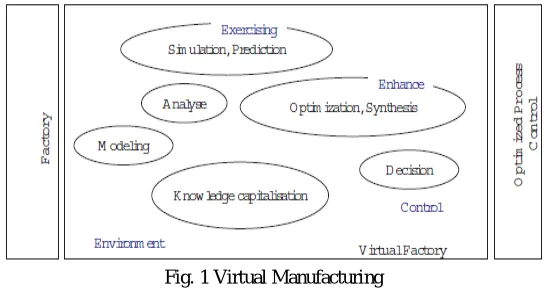
Fig. 1 Virtual Manufacturing
III.CHARACTERISTICS OF VIRTUAL MANUFACTURING
Virtual Manufacturing is not true manufacturing, but in the manufacturing of computer and network system related with software. The machine tool is not the substances but systems and related software performed. Virtual Manufacturing deals with the information and data of the product and manufacturing system. It mainly contains the digital model of product and manufacturing equipment, rather than physical reality raw material. Virtual Manufacturing processing results are digital products, rather than the real material products. The result is a physical model of digital products, which is a virtual product, and is a real product in a virtual environment. Therefore the virtual products must have characteristics and performance of real products [2]. The manufacturing activity and management of an enterprise is based on Internet or Intranet. The entire Virtual Manufacturing activity is highly parallel. The simulation of product design, processing and assembling process can be parallel operated. Virtual Manufacturing is a disperse system. Personnel and equipment can be separated. The technical personnel from different places can finish the same Virtual Manufacturing process through the network.
IV. SCOPE OF VIRTUAL MANUFACTURING
The scope of Virtual Manufacturing (VM) can be to define as the product, processes and resources within cost, weight, investment, timing and quality constraints in the context of the plant in a collaborative environment[3].
A. Design-Centred VM
Provides manufacturing information to the designer during the design phase. In this case VM is the use of manufacturing-based simulations to optimize the design of product and processes for a specific manufacturing goal (DFA, quality, flexibility,) or the use of simulations of processes to evaluate many production scenarios at many levels of fidelity and scope to inform design and production decisions.
B. Production-centred VM
Uses the simulation capability to modelize manufacturing processes with the purpose of allowing inexpensive, fast evaluation of many processing alternatives. From this point of view VM is the production based converse of Integrated Product Process Development (IPPD) which optimizes manufacturing processes and adds analytical production simulation to other integration and analysis technologies to allow high confidence validation.
C. Control-centred VM
Control centred Virtual Manufacturing is the addition of simulations to control models and actual processes allowing for
seamless simulation for optimization during the actual production cycle.
www.ijraset.com Volume 3 Issue V, May 2015 IC Value: 13.98 ISSN: 2321-9653
International Journal for Research in Applied Science & Engineering
Technology (IJRASET)
©IJRASET 2015: All Rights are Reserved
352
process design and, the production phase include part production and assembly.
The vertical planes represent the three main aspects of manufacturing today: Logistics, Productions and Assembly, which cover all aspects directly related to the manufacturing of industrial goods. The horizontal planes represent the different levels within the factory [3].
V. APPLICATION OF VIRTUAL MANUFACTURING (VM)
The application of Virtual Manufacturing include the analysis of the manufacturability of a part and a production, evaluating the feasibility of the production and process plan, optimisation of the production process and the performance of the manufacturing system. Virtual Manufacturing can be used to reliably predict the business risks and this will support the management in decision making and strategic management of an enterprise.
Important application of Virtual Manufacturing (VM):
Virtual Manufacturing can be used in the evaluation of the feasibility of a product design, validation of product plan optimisation of the product design and processes. These reduce the cost in product cycle.
Virtual Manufacturing can be used to internet; it is possible conduct training under a distributed virtual environment for the operators, technicians and management people on the use of manufacturing process.
Virtual Manufacturing can be used to test and validate the accuracy of the product designs. For example the outlook of product design, dynamic characteristics analysis, NC program validation etc.
Virtual Manufacturing can be used to acquire continuously manufacturing know-how, production data etc. This can help to upgrade the level of intelligence of a manufacturing system.
VI. CONCLUSION
As a conclusion of this paper, we can say that we have now reached a point where everyone can use Virtual Manufacturing (VM). It appears that Virtual Manufacturing (VM) will stimulate the need to design both for manufacturability and manufacturing efficiency. Nowadays companies need faster solutions for cost / time saving, for more accurate simulations; leading companies are already demonstrating the successful use of Virtual Manufacturing techniques. By linking such a system to an existing parametric CAD/CAM system, engineers can immediately obtain the benefits of using a VR system. The analysis of designs in a true, three-dimensional environment, manufacturing the part in a replication of the actual factory and the assembly of mating parts are all valuable tasks in the early stages of a product’s design cycle.
REFERENCES