Technology (IJRASET)
Internet of Things Based Health System
Leena Mhatre 1, Neha Rai2
Department of Electronics & Telecommunication Engineering
Pillai HOC College of Engineering and Technology, Raigad, Maharashtra, India. 410206
Abstract — Nowadays some individuals are dying thanks to lack of care or data concerning their health. This can be principally happens because, they don’t have effective health observation devices. This situation will be decreased by increase the potency of healthcare by transferring info from patient to the doctor or clinic through IoT. The Internet of Things (IoT) could be a device that gathers and share info directly with transmitter and receiver, this allows the doctor to gather record and analyze new information streams quicker and a lot of accurate. This technology paves the thanks to improve the quality of care with constant attention and scale back the value of care by eliminating the necessity of a daily health check. The IoT technology presumably obtains the measured information from the sensor for observation and analyzing the health standing of the patient with basic important signs like Pulse sensor.
Keywords — IoT, Microcontroller, Patients health.
I. INTRODUCTION
The objective of this project is to watch and improve the standard of care of individuals in remote location and to provide continuous info concerning the patient for creating better health care selections in important state of affairs and to scale back the regular health check of the aged patients. It helps the doctor to monitor their patients at any time with the exception of their consulting hours. Improved home care facilities and regular health updates to clinicians scale back the probabilities of redundant or inappropriate care. It improves patient care and safety by reduction in overall prices for care.
Internet of Things (IoT), gather and share information directly from patients and it additionally change to collect, record and analyze new information Stream quicker and a lot of accurately. Because the technology for grouping, analyzing and transmitting information within the IoT continues to mature, with the assistance of sensors, actuators, and computing devices. This provides data communication capabilities. These are joined to networks for information transportation. This connected health care setting promotes the fast flow of knowledge and allows straightforward access to diseases like cardiovascular disease, diabetics and viscus diseases that wants continuous observation. This net of Things (IoT) is more and more recognized by the researchers and analysts mutually of the foremost subtle technologies for health observation and its safety for individuals and it additionally tackled by all. The ability of the devices to collect information on their own removes the restrictions of human intervention and it reveals the data-automatically and send it to the doctor whenever they needed. The automation reduces the chance of error. This kind of solution employs sensors to gather comprehensive physiological info and uses gateways and therefore the cloud to analyze and store the knowledge so send the analysed data wirelessly to caregivers for any analysis and review. It replaces the method of getting a professional person return by at regular intervals to visualize the patient’s important signs, instead providing a continual machine-driven flow of knowledge. In this way, it at the same time improves the standard of care through constant attention and lowers the value of care by eliminating the need for a caregiver to actively enhance in information assortment and analysis. Powerful wireless solutions connected through the IoT are currently creating it potential for observation the patients.
II. DRAWBACK DEFINITION
In today's social welfare framework for patients who stays in home throughout post operational days checking is done either via overseer/ medical caretaker. Ceaseless observing might not be accomplished by this technique, on the grounds that something will amendment in well-being parameter inside of a part of seconds and amid that point if guardian/attendant isn't within the premises causes a lot of noteworthy hurt. Therefore with this innovation created amount where internet administers the planet offers an inspiration to feature to another keen health awareness framework wherever time to time constant checking of the patient is accomplished.
III. METHODOLOGY
Technology (IJRASET)
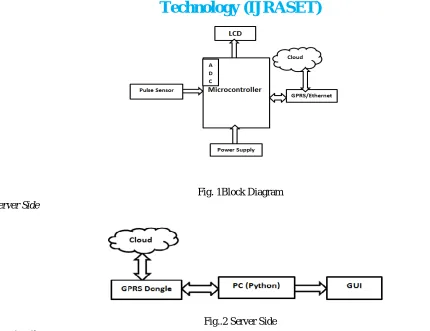
Fig. 1Block Diagram
1) Server Side
Fig..2 Server Side
B. Construction
In this paper, the sensing devices from the patient square measure connected to the PIC microcontroller and programed to convert the detected knowledge from patient to clear digital signals and then transfer the signal wirelessly to IoT for the doctor’s recommendation.
IV. WIRELESSNETWORKING
The data Transmission parts of the system area unit responsible for conveyance records of the patient from the patient’s house (or any remote location) to the information canter of the health care Organization (HCO) with assured security and privacy, ideally in period. The data hubs that collect sensor information and analyze it then communicate it to the IP address, that is made to send the main points regarding the patient condition to doctor. Gateways is designed for clinic transfer the information. Medical device designers also can use this platform to make remote-access devices for remote monitoring.
V. IMPLEMENTATION METHODOLOGY
A. Hardware Description
1) Pulse Sensor: Pulse Sensor is a well-designed plug-and-play heart-rate sensor for Arduino. It can be used by students, artists, athletes, makers, and game & mobile developers who want to easily incorporate live heart- rate data into their projects. The sensor clips onto a fingertip or earlobe and plugs right into Arduino. It also includes an open-source monitoring app that graphs your pulse in real time. Pulse Sensor shown in Fig.3.
Technology (IJRASET)
2) Microcontroller: A microcontroller could be a tiny computer on one integrated circuit containing a processor core, memory, and programmable input/output peripherals. PIC outlined as (Programmable Interface Microcontroller) is employed here to perform the assorted modules. supported the embedded C program it takes management over the modules. All the higher than mentioned modules area unit controlled by embedded computer programme. Once started, the modules can unceasingly run and once the work is completed, whisper-quiet operation can occur. Embedded C uses most of the syntax and linguistics of standard C. it's little and fairly less complicated to find out, understand, program and correct. compared with assembly, C code written is additional reliable and straightforward, additional transportable between completely different systems. C compilers area unit out there for almost all embedded devices in use nowadays. C has the advantage of processor independence i.e. it's freelance of the type of controller or processors used, and isn't specific to any particular microprocessor/microcontroller or any system.PIC microcontroller transfer the data to the IoT devices through that the information from the sensors area unit transfer.
[image:4.612.193.425.235.394.2]VI. EXPERIMENTAL RESULT
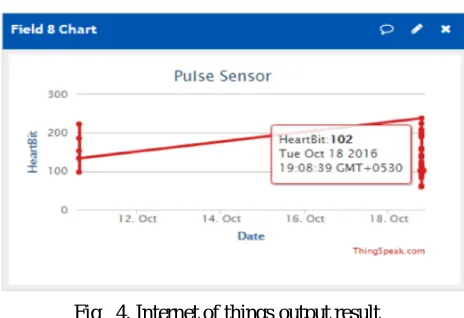
Fig 4. Internet of things output result
The information into thing view app which is useful for patient for monitoring his results.
VII. CONCLUSIONS
Health of the patient’s area unit monitored mistreatment net of things (IOT) and permits the doctor to observe their patients outside the clinic and conjointly apart their consulting hours. Connected health care devices utilize resources to supply AN improved quality of care, resulting in higher clinical outcomes. Measureable advantages of connected medical devices embody reduces clinic visits, as well as reduction in bed days of care and length of keep in hospitals. Mistreatment Internet of Things (IOT), patient conditions area unit obtained and hold on for additional analysis.
In this project the canter rate and Pulse sensor of patient are monitored. From this project it's expected to observe the whole body of the patient from remote location and improve the technology to worldwide for patient observation by providing customized and optimized services, it'll promote a better commonplace of living. Nations across the planet to improve patient care and IoT provides a timely and value effective response to those essential things. Healthy and active individuals also can take pleasure in IoT-driven observation of their well-being. It conjointly permits options for the aged persons who need solely a display which will sight a fall or other interruption in everyday activity and report it to emergency responders or relations.
VIII. ACKNOWLEDGMENT
Mrs Leena Mhatre is a post-graduate pursuing Student from Mumbai University, India. He received B.E.Degrees in electronic engineering from RAIT College of Engineering, Navi mumbai in 2011 and. He was born in Raigad, Maharashtra, India. He is being guided by Prof .Neha Rai for his ongoing final year project for Masters in Electronics& Telecommunication Engineering.
REFERENCES
[1] S. M. Metev and V. P. Veiko, Laser Assisted Microtechnology, 2nd ed., R. M. Osgood, Jr., Ed. Berlin, Germany: Springer-Verlag, 1998.
[2] J. Breckling, Ed., The Analysis of Directional Time Series: Applications to Wind Speed and Direction, ser. Lecture Notes in Statistics. Berlin, Germany: Springer, 1989, vol. 61.
[3] S. Zhang, C. Zhu, J. K. O. Sin, and P. K. T. Mok, “A novel ultrathin elevated channel low-temperature poly-Si TFT,” IEEE Electron Device Lett., vol. 20, pp.
Technology (IJRASET)
[4] M. Wegmuller, J. P. von der Weid, P. Oberson, and N. Gisin, “High resolution fiber distributed measurements with coherent OFDR,” in Proc. ECOC’00, 2000,
paper 11.3.4, p. 109.
[5] R. E. Sorace, V. S. Reinhardt, and S. A. Vaughn, “High-speed digital-to-RF converter,” U.S. Patent 5 668 842, Sept. 16, 1997.
[6] (2002) The IEEE website. [Online]. Available: http://www.ieee.org/
[7] M. Shell. (2002) IEEEtran homepage on CTAN. [Online]. Available: http://www.ctan.org/tex-archive/macros/latex/contrib/supported/IEEEtran/ FLEX Chip
Signal Processor (MC68175/D), Motorola, 1996.
[8] “PDCA12-70 data sheet,” Opto Speed SA, Mezzovico, Switzerland.
[9] A. Karnik, “Performance of TCP congestion control with rate feedback: TCP/ABR and rate adaptive TCP/IP,” M. Eng. thesis, Indian Institute of Science, Bangalore, India, Jan. 1999.
[10] J. Padhye, V. Firoiu, and D. Towsley, “A stochastic model of TCP Reno congestion avoidance and control,” Univ. of Massachusetts, Amherst, MA, CMPSCI
Tech. Rep. 99-02, 1999.