http://dx.doi.org/10.4236/jmp.2014.56056
String Theory with Oscillating Space-Time
Dimension Number
Ding-Yu Chung
P.O. Box 180661, Utica, USA Email: [email protected]
Received 3 February 2014; revised 1 March 2014; accepted 21 March 2014
Copyright © 2014 by author and Scientific Research Publishing Inc.
This work is licensed under the Creative Commons Attribution International License (CC BY).
http://creativecommons.org/licenses/by/4.0/
Abstract
In conventional string theory with fixed space-time dimension number, the extra space dimen-sions are compactized. In string theory with oscillating space-time dimension number, dimension number oscillates between 11D and 10D and between 10D and 4D reversibly, and there is no compactization. Dimension number decreases with decreasing speed of light and increasing rest mass. The 4D particle has the lowest speed of light and the highest rest mass. The two different os-cillations between 10D and 4D are the stepwise oscillation passing through every dimension number and the direct oscillation oscillating directly between 10D and 4D without the interme-diate dimension numbers. Dark energy represents the stepwise oscillation, and dark energy be-comes observable only when it has 4D space-time. 4D baryonic matter and 4D dark matter re- present the direct oscillation directly from 10D to 4D. Our universe is the dual cyclic universe of the dark energy universe and the baryonic-dark matter universe. The Big Bang in the baryonic- dark matter universe produced irreversible kinetic energy that stopped the reversible direct os-cillation. The reversible direct oscillation will resume after the Big Crush to remove irreversible kinetic energy. Our cyclic universe started from the zero-energy universe through the four-stage transformation. The theoretical calculated percentages of dark energy, dark matter, and baryonic matter are 68.3, 26.4, and 5.3, respectively, in agreement with observed 68.3, 26.8, and 4.9, re-spectively. According to the calculation, dark energy started in 4.28 billion years ago in agreement with the observed 4.71 ± 0.98 billion years ago.
Keywords
String Theory, Dimension Number Oscillation, Cosmology, Dual Universe, Big Bang, Inflation, Cyclic Universe, Dark Energy, Dark Matter, Baryonic Matter, Force Fields
1. Introduction
dimensions is the compactization of the extra space dimensions. For example, six space dimensions become hid- den by the compactization, so space-time appears to be four dimensional. Another method to account for extra space dimensions is to place the 4D space-time as a subspace of the full dimensional universe as in the Randall- Sundrum model [1].
This paper posits string theory with oscillating space-time dimension number. Dimension number oscillates between 11D and 10D and between 10D and 4D reversibly. There is no compactization. While the important phenomena, such as cosmology, the four force fields, dark energy, dark matter, and baryonic matter, cannot be explained clearly by conventional string theory with fixed dimension number, these phenomena can be derived directly from string theory with oscillating dimension number. Cosmology and the four force fields result direct- ly from the various stages in the oscillation of space-time dimension number, and the different ways of the oscil- lation lead directly to the differences among dark energy, dark matter, and baryonic matter. The calculated per-centages of dark energy, dark matter, and baryonic matter and the calculated time for dark energy to start are in good agreements with the observed values.
2. The Space-Time Dimension Number Oscillation
In the space-time dimension number oscillation, dimension number oscillates between 11D and 10D and be-tween 10D and 4D for the objects, including 11D membrane (311), 10D string (210), particle (14 to 10), and empty
object (04 to 11) [2] [3]. Different universes and different stages of a universe can have different expressions of the
object structure. Dimension number varies with varying speed of light and rest mass. Varying speed of light has been proposed to explain the horizon problem of cosmology [4]. J. D. Barrow [5] proposes that the time depen-dent speed of light varies as some power of the expansion scale factor a in such way that
( )
0n
c t =c a , (1)
where c0>0 and n are constants. The increase of speed of light is continuous.
In this paper, varying dimension number (VDN) relates to quantized varying speed of light (QVSL), where the speed of light is invariant in a constant space-time dimension number, and the speed of light varies with va-rying space-time dimension number from 4 to 11.
D 4
D ,
c =c
α
− (2)where c is the observed speed of light in the 4D space-time, cD is the quantized varying speed of light in space-time dimension number, D, from 4 to 11, and
α
is the fine structure constant for electromagnetism. Each dimensional space-time has a specific speed of light (Since from the beginning of our observable universe, the space-time dimension has always been four, there is no observable varying speed of light in our observable universe). The speed of light increases with the increasing space-time dimension number D.In special relativity, E=M c0 2 modified by Equation (2) is expressed as
( )
(
2 2 D 4)
0
E=M ⋅ c
α
− (3a)( )
(
2 d 4)
20
M
α
− c= ⋅ . (3b)
the extra space dimensions [6].
The QVSL transformation transforms both space-time dimension number and mass dimension number. In the QVSL transformation, the decrease in the speed of light leads to the decrease in space-time dimension number and the increase of mass in terms of increasing mass dimension number from 4 to 11,
2
D D ,
n n
c =c −
α
(4a)2
0,D,d 0,D ,d ,
n n n
M =M − +
α
(4b)(
) (
)
QVSL
D, d→ Dn , d±n (4c)
where D is the space-time dimension number from 4 to 11 and d is the mass dimension number from 4 to 11. For example, in the QVSL transformation, a particle with 11D4d is transformed to a particle with 4D11d. In terms of rest mass, 11D space-time has 4d with the lowest rest mass, and 4D space-time has 11d with the highest rest mass.
Space-time dimension is basically a structure, like a building. Mass dimension is basically the material that occupies such space-time dimension structure. The decreasing space-time number allows increasing mass di-mension to occupy space-time didi-mension. Therefore, 4D space-time allows the maximum mass didi-mension, while 11D allows the minimum mass dimension.
Since the speed of light for >4D particle is greater than the speed of light for 4D particle, the observation of >4D superluminal particles by 4D particles violates casualty. Thus, >4D particles are hidden particles with respect to 4D particles. Particles with different space-time dimensions are transparent and oblivious to one another, and separate from one another if possible.
3. The Space Structure
The dimension number oscillation is reversible, so it occurs only in the space without irreversible kinetic energy. Such space is attachment space in the digital space structure. The digital space structure [7] consists of attach-ment space (denoted as 1) and detachattach-ment space (denoted as 0). Attachattach-ment space attaches to object perma-nently with zero speed. Detachment space detaches from the object at the speed of light. Attachment space re-lates to rest mass, while detachment space rere-lates to irreversible kinetic energy. Different stages of our universe have different space structures.
The transformation between mass (massive particle) in attachment space and kinetic energy (massless particle) in detachment space is through the scalar Goldstone boson. The Goldstone boson in the Standard Model for electroweak interaction is the Higgs boson [8].
4. Cosmology
The proposed cosmology starts with the multiverseat zero energy, which produces the positive energy 11D membrane universe and the negative energy 11D membrane universe denoted as 311 3‒11, as proposed by Mongan
[9]. The only force among the membranes is the pre-strong force, s, as the predecessor of the strong force. It is from the quantized vibration of the membranes to generate the reversible process of the absorption-emission of the particles among the membranes. The pre-strong force mediates the reversible absorption-emission in the flat space. The pre-strong force is the same for all membranes, so it is not defined by positive or negative sign.
In certain regions of the 11D membrane universe, the local expansion takes place by the transformation from 11D-membrane into 10D-string. With the emergence of empty object (011), 11D membrane transforms into 10D
string warped with virtue particle as pregravity.
11 11 10 10 10
3 s+0 ↔2 s1 =2 sg+ (5)
where 311 is the 11D membrane, s is the pre-strong force, 011 is the 11D empty object, 210 is 10D string, 110 is
the AdS/CFT duality [11] for gravity, the pre-strong force has 10D dimension, one dimension lower than the 11D membrane, and is the conformal force defined on the conformal boundary of the bulk space.
Through symmetry, antistrings form 10D antibranes with anti-pregravity as 2−10g−, where g− is anti-pre- gravity.
11 11 10 10 10
3− s+0− ↔2− s 1− =2− sg− (6)
Pregravity can be attractive or repulsive to anti-pregravity. If it is attractive, the universe remains homogene-ous. If it is repulsive, n units of (210)n and n units of (2−10)n are separated from each other.
(
)
(
210)
(
(
2 10)
)
n n
s g+ g− s − (7)
The dual 10D string universe consists of two parallel universes with opposite energies: 10D strings with posi-tive energy and 10D antistrings with negaposi-tive energy. The two universes are separated by the bulk space, con-sisting of pregravity and anti-pregravity. There are four equal regions: positive energy string universe, pregravi-ty bulk space, anti-pregravipregravi-ty bulk space, and negative energy antistring universe. Such dual universe separated by bulk space appears in the ekpyrotic universe model [12].
Through the dimension number oscillation between 11 and 10, the 10D dual universe returns to the 11D dual universe that coalesces to undergo annihilation and to return to the zero energy universe. The 10D positive and negative universe can also coalesce to undergo annihilation and to return to the zero energy universe. The first path of such coalescence is the annihilation, resulting in disappearance of the dual universe and the return to the zero-energy universe.
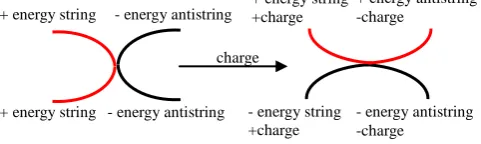
The second path allows the continuation of the dual universe in another form without annihilation from the mixing of positive energy and negative energy. Such dual universe is possible by the emergence of the pre- charge force, the predecessor of electromagnetism with positive and negative charges that provide the new dis-tinction between string and antistring. The mixing of string and antistring becomes the mixing of positive charge string and negative charge antistring instead of positive energy string and negative energy antistring, resulting in the preservation of the dual universe with the positive energy and the negative energy. The process is the charge transformation asFigure 1.
During the coalescence for the second path, the positive energy string and the negative energy antistring in-tersect at the middle asFigure 1, where string and antistring join and split as in conventional string theory. The combination of one half of the positive energy and one half of the negative energy antistring form a new string. As a result, there are two new strings with the top half and with the bottom half ofFigure 1. The top half is transformed into a new positive energy string, while the bottom half is transformed into a new negative energy string. The way to achieve such transformations is through the emergence of charges in the charge transforma-tion. In the top half of Figure 1, a positive charge (e+) emerges in the positive energy string, and a negative charge (e-) emerges in the negative energy antistring to transform the negative energy antistring into the positive energy antistring, resulting in the positive energy antistring with negative charge. The new string from the top half includes the positive energy positive chargestring and positive energy negative charge antistring.
Simultaneously, in the bottom half ofFigure 1, a negative charge emerges in the negative energy antistring, and a positive charge emerges in the positive energy string to transform the positive energy string into the nega-tive energy string, resulting in the neganega-tive energy string with posinega-tive charge. The new string from the bottom half includes the negative energy negative charge antistring and the negative energy positive charge string. In the charge transformation, all transformations and the additions of charges are symmetrical between the two new positive energy and negative energy strings.
+ energy string
+ energy string - energy antistring - energy antistring
+ energy string +charge
+ energy antistring -charge
- energy string +charge
- energy antistring -charge
[image:4.595.193.434.632.704.2]charge
At that time, the space (detachment space) for radiation has not appeared in the universe, so the string-anti- string annihilation does not result in radiation. The string-antistring annihilation results in the replacement of the string-antistring as the 10D string-antistring, (210 2−10) by the 10D particle-antiparticle (110 1−10). The 10D
par-ticles-antiparticles have the multiple dimensional Kaluza-Klein structure with variable space dimension number without the requirement for a fixed space-time dimension number as 10 for string-antistring. After the mixing, the dual 10D particle-antiparticle universe separated by pregravity and anti-pregravity appears as below.
(
)
(
110 110)
(
(
110 110)
)
,n n
s e e+ − − s g+ g− s e e+ − − s (8)
where s and e are the pre-strong force and the pre-charged force in the flat space, g is pregravity in the bulk space, and 110 1−10 is the particle-antiparticle.
The dual 10D particle universe consists of two parallel particle-antiparticle universes with opposite energies and the bulk space separating the two universes. There are four equal regions: the positive energy particle-anti- particle universe, the pregravity bulk space, the negative energy particle-antiparticle universe, and the anti-pre- gravity bulk space.
The formation of our current universe follows immediately after the formation of the charged pre-universe through the asymmetrical dimensional oscillations and the asymmetrical addition of detachment space, leading to the asymmetrical dual universe. The asymmetrical dimensional oscillation involved the direct dimension number oscillation of the positive-energy universe from 10D to 4D followed by the addition of detachment space and the stepwise dimension number oscillation of the negative-energy universe between 10D and 4D. The result was the asymmetrical dual universe consisting of the positive-energy 4D light universe with kinetic ener-gy and light and the negative-enerener-gy oscillating 10D - 4D dark universe without kinetic enerener-gy and light. The light universe contains both attachment space and detachment space.
The asymmetrical dual universe is manifested as the asymmetry in the weak interaction in our observable un-iverse as follows.
(
)
(
)
(
)
(
)
4 4
4 to 10 4 to 10
n
Light Universe and bulk space
1 1
Dark Universe and bulk space
1 1
n s e w e w s g
g s e w e w s
+ + − − +
−
− + + − −
− −
(9)
where s, g, e, and w are the strong force, gravity, electromagnetism, and weak interaction, respectively for the observable universe, and where 141−4 and 14 to 101−4 to −10 are 4D particle-antiparticle for the light universe and
va-riable D particle-antiparticle for the dark universe, respectively.
The dark universe involves the stepwise two-step transformation: the QVSL transformation and the varying supersymmetry transformation from 10D4d to 4D4d. (The particles in the 10D dual particle universe are 10D4d.) The QVSL transformation involves the transformation of space-time dimension, D. The varying supersymmetry transformation involves the transformation of the mass dimension number, d, as follows.
( )
(
) (
)
( )
(
)
QVSL
varying supersymmetry
stepwise two-step varying transformation
1 D, d D 1 , d 1
2 D, d D, d 1
←→ ±
←→ ±
(10)
The repetitive stepwise two-step transformation from 10D4d to 4D10d as follows.
10D4d 9D5d 9D4d 8D5d 4D5d 4D4d
hidden dark universe dark energy
→ → → → → →
← ←
fermion) from one point to the same boson (or fermion) at another point at the same mass. In the “varying su-persymmetry transformation”, the repeated application of the fermion-boson transformation carries over a boson from one point to the boson at another point at different mass dimension number in the same space-time number. The repeated varying supersymmetry transformation carries over a boson Bd into a fermion Fd and a fermion Fd
to a boson Bd − 1, which can be expressed as follows
d,F d,B d,B,
M =M
α
(11a)d 1,B d,F d,F,
M − =M
α
(11b)where Md, B and Md, F are the masses for a boson and a fermion, respectively, d is the mass dimension number,
and
α
d,B orα
d,F is the fine structure constant that is the ratio between the masses of a boson and its fermionic partner. Assuming α’s are the same, it can be expressed as2 d,B d 1,B d 1
M =M +
α
+ . (11c)The mass of 9D4d is α2≈ (1/137)2 times of the mass of 9D5d through the varying supersymmetry transforma-tion. The transformation from a higher mass dimensional particle to the adjacent lower mass dimensional particle is the fractionalization of the higher dimensional particle to the many lower dimensional particles in such way that the number of lower dimensional particles becomes
(
)
2 2d 1 d d 137
N − =N α ≈N (11d)
The fractionalization also applies to D for 10D4d to 9D4d, so
2
D 1 D
N − =N α (11e)
Since the supersymmetry transformation involves translation, this stepwise varying supersymmetry transfor-mation leads to a translational fractionalization, resulting in the cosmic expansion. Afterward, the QVSL trans-formation transforms 9D4d into 8D5d with a higher mass. The two-step transtrans-formation repeats until 4D4d, and then reverses stepwise back to 10D4d for the cosmic contraction.
In the light universe, the dimension number oscillates from 10D to 4D immediately. It involves the two-step transformation: the QVSL transformation and the slicing by detachment space. The Big Bang occurred afterward.
(
)
(
)
(
)
quick QVSL transformation
slicing with detachment space,
10D4d 4D10d
dark matter 4D9d 4D8d 4D7d 4D6d 4D5d
baryonic matter 4D4d cosmic radiation
thermal cosmic expansion the Big Bang →
→ + + + +
+ +
→
(12)
This two-step transformation corresponds to the two-step inflation. In the first step, the quick and immediate QVSL transformation transforms 10D4d from the 10D dual particle universe to 4D10d immediately. Calculated from Equation (4b), the mass of 4D10d is 1/α12≈ 13712 times of the mass of 10D4d, resulting in the first step of the inflation as the rapid expansion of space from 10D4d to 4D10d.
The first step of the inflation does not involve kinetic energy. The second step introduces kinetic energy (de-tachment space) in the slicing of particles for the reduction of the mass dimension number. Bounias and Kras-noholovets [13] propose another explanation of the reduction of >4 D space-time into 4D space-time by slic-ing >4D space-time into infinitely many 4D quantized units surroundslic-ing the 4D core particle. Such slicslic-ing of >4D space-time is like slicing 3-space D object into 2-space D object in the way stated by Michel Bounias as follows: “You cannot put a pot into a sheet without changing the shape of the 2-D sheet into a 3-D dimensional packet. Only a 2-D slice of the pot could be a part of sheet”.
Detachment space (0) involves in the slicing of mass dimensions. Attachment space is denoted as 1. For ex-ample, the slicing of 4D10d particles into 4D4d particles is as follows.
( )
( )
6(
( ) ( )
)
slicing by detachment space
4 6 4 4 4 ,6
1
1 1 0 1
10d attachment 4d core 6 types of 4d units
space attachment force fields
i
i j
+ →
∑
(13)
The two products of the slicing are the 4d-core attachment space and 6 types of 4d quantized units. The 4d core attachment space surrounded by 6 types of many (j) 4D4d quantized units corresponds to the core particle surrounded by 6 types of many small 4d particles, which constitute gauge force fields in “dimensional orbitals”
[15]. The dimensional orbitals of baryonic matter provide the base for the periodic table of elementary particles to calculate accurately the masses of all 4D elementary particles, including quarks, leptons, gauge bosons, and the Higgs boson [8].
As shown in Reference [16], baryonic matter has electromagnetism (charge), while dark matter does not have electromagnetism. Without electromagnetism, dark matter cannot emit light, and is incompatible to baryonic matter, like the incompatibility between oil and water. After the creation of the light-dark dual universe, baryonic matter and dark matter started to separate from each other gradually. Millions years afterward, stars started to appear from baryonic matter. The increasing incompatibility between dark matter and baryonic matter leads to the inhomogeneity like emulsion, resulting in the formation of stars, galaxies, clusters, and superclusters [16]. Dark matter has not been found by direct detection because of the incompatibility that does not allow the direct contact with dark matter by baryonic matter.
The second step (the slicing) introduced detachment space as kinetic energy, and generated baryonic matter, dark matter, and cosmic radiation. Irreversible kinetic energy stopped the reversible direct dimension number oscillation. The detailed description of the inflation is described in Reference [16]. The resulting kinetic energy started the thermal cosmic expansion as the Big Bang.
The dark universe consists of two periods: the hidden dark universe and the dark energy universe. The hidden dark universe composes of the >4D particles. As mentioned before, particles with different space-time dimensions are transparent and oblivious to one another, and separate from one another if possible. Thus, >4D particles are hidden and separated particles with respect to 4D particles in the light universe (our observable universe). The hidden dark universe with D > 4 and the observable universe with D = 4 are the “parallel universes”.
The 4D particles transformed from hidden >4D particles in the dark universe are observable dark energy for the light universe, resulting in the accelerated expanding universe. Since the dark universe does not have detachment space, the presence of dark energy is not different from the presence of the cosmological constant. In terms of quintessence, such dark energy can be considered the tracking quintessence [17] from the dark universe with the space-time dimension number as the tracker. Observable dark energy emerged about 5 billion years ago (more precisely 4.71 ± 0.98 billion years ago at z = 0.46 ± 0.13 [18]).
The four regions in the light-dark dual universe include the light universe, the gravity bulk space, the antigravity bulk space, and the dark universe. Through the symmetry among the space regions, all regions expand syn-chronically and equally (The symmetry is necessary for the ultimate reversibility of all cosmic processes). The light universe is the only region with the four-dimensional space-time and with kinetic energy from the beginning, and all other three regions have variable dimensional space-time without kinetic energy. The light universe oc-cupies 25% of the total universe, while the other regions occupy 75% of the total universe, so the maximum dark energy from the dark universe, the gravity bulk space, and the antigravity bulk space is 75%. The present ob-servable universe about reaches the maximum (75%) at the observed 68.3% dark energy [14]. At 68.3% dark energy, the calculated values for baryonic matter and dark matter (with the 1:5 ratio) are 5.3% (= (100 − 68.3)/6) and 26.8% (= 5.3 × 5), respectively, in agreement with observed 4.9% and 26.4%, respectively [14].
Our universe is 13.7 billion-year old. Dark energy as the transformation from 5D to 4D started in about 4.71 ± 0.98 billion years ago [18]. The ratio of the time periods for the transformations from D → D − 1 is proportional to ln of the total number of particles (Equation (11e)) to be transformed from D → D − 1 for the exponential growth with time as Table 1.
4.71 ± 0.98 billion years ago [18].
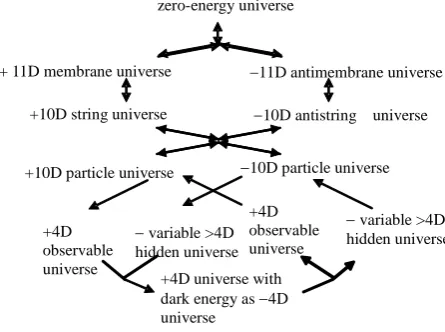
After the maximally connected universe, 4D dark energy transforms back to >4D particles that are not ob-servable. The removal of dark energy in the observable universe results in the stop of accelerated expansion and the start of contraction of the observable universe. The end of dark energy starts another “parallel universe pe-riod”. Both hidden universe and observable universe contract synchronically and equally. Eventually, the Big Crush and the two-step deflation occur in the light universe. In the first step of the deflation, the light universe loses all detachment space, kinetic energy, light, cosmic radiation, and force fields as dimensional orbitals, re-sulting in returning to 4D10d. In the second step of the deflation, without irreversible kinetic energy, the revers-ible direct dimension number oscillation resumes to transform 4D10d into 10D4d for the rapid contraction of space. Meanwhile, hidden >4D particles-antiparticles in the hidden universe transform into 10D4d particles-an- tiparticles. The dual universe can undergo another cycle of the light-dark dual universe. On the other hand, both universes can undergo the reverse charge transformation to become the 10D dual string universe, which in turn can return to the 11D dual membrane universe that in turn can return to the zero-energy universe asFigure 2.
5. Summary
In conventional string theory with fixed space-time dimension number, the extra space dimensions are compac-tized. In string theory with oscillating space-time dimension number, dimension number oscillates between 11D and 10D and between 10D and 4D reversibly, and there is no compactization. Dimension number decreases with decreasing speed of light and increasing rest mass. The 4D particle has the lowest speed of light and the highest rest mass.
[image:8.595.85.540.417.499.2]The two different oscillations between 10D and 4D are the stepwise oscillation passing through every sion number and the direct oscillation oscillating directly between 10D and 4D without the intermediate dimen-sion numbers. Dark energy represents the stepwise oscillation, and dark energy becomes observable when it has 4D space-time during the oscillation. 4D baryonic matter and 4D dark matter represent the direct oscillation di-rectly from 10D to 4D. Our universe is the dual cyclic universe of the dark energy universe and the baryo-
Table 1. The percentages of the periods in the dark universe.
10D → 9D 9D → 8D 8D → 7D 7D → 6D 6D → 5D 5D → 4D
Ratio of total numbers of particles 1 α−2 α−4 α−6 α−8 α−10
Ratio of ln (total number of particles) 0 −2α −4α −6α −8α −10α
Ratio of periods ~0 1 2 3 4 5
Percentages of periods ~0 6.7 13.3 20 26.7 33.3
α is the fine structure constant for electromagnetism from Equation (11e).
+10D string universe
+4D observable universe
− variable >4D hidden universe
+4D universe with dark energy as −4D universe
+4D observable universe
− variable >4D hidden universe −10D antistring universe
+10D particle universe −10D particle universe + 11D membrane universe −11D antimembrane universe
zero-energy universe
+ = positive energy, − = negative energy
[image:8.595.200.423.525.691.2]nic-dark matter universe. The Big Bang in the baryonic-dark matter universe produced irreversible kinetic ener-gy that stopped the reversible direct oscillation in the baryonic-dark matter universe. At present, the dark enerener-gy about universe reaches the maximum 4D space-time. The reversible direct oscillation will resume after the Big Crush to remove irreversible kinetic energy.
Our cyclic universe started from the zero-energy universe through the four-stage cyclic transformation. Emer- ging from the zero-energy universe, the four-stage transformation consists of the 11D positive-negative energy dual membrane universe, the 10D positive-negative energy dual string universe, the 10D positive-negative ener- gy dual particle universe, and the 4D (light)-variable D (dark) positive-negative energy dual particle asymme-trical universe. The transformation can then be reversed back to the zero-energy universe through the reverse four-stage transformation. The light universe is an observable four-dimensional universe started with the infla-tion and the Big Bang, and the dark universe is a variable dimensional universe from 10D to 4D. The dark uni- verse could be observed as dark energy only when the dark universe turned into a four-dimensional universe. The four-stage transformation explains the four force fields in our universe. The theoretical calculated percen-tages of dark energy, dark matter, and baryonic matter are 68.3, 26.4, and 5.3, respectively, in agreement with observed 68.3, 26.8, and 4.9, respectively. According to the calculation, dark energy started in 4.28 billion years ago in agreement with the observed 4.71 ± 0.98 billion years ago.
References
[1] Randall, L. and Sundrum, R. (1999) Physical Review Letters, 83, 4690-4693.
http://dx.doi.org/10.1103/PhysRevLett.83.4690
[2] Chung, D.-Y. and Krasnoholovets, V. (2013) Journal of Modern Physics, 4, 77-84.
http://dx.doi.org/10.4236/jmp.2013.47A1009
[3] Chung, D. and Krasnoholovets, V. (2007) Scientific Inquiry, 8, 165-182. [4] Albrecht, A. and Magueijo, J. (1999) Physics Review, D59, 043516.
[5] Barrow, J.D. (2003) Physics Letter B, 564, 1-7. http://dx.doi.org/10.1016/S0370-2693(03)00573-2
[6] Wesson, P.S. (1999) Space-Time-Matter: Modern Kaluza-Klein Theory. World Scientific Publishing Company, Singa- pore. http://dx.doi.org/10.1142/9789812385475
[7] Chung, D.-Y. and Krasnoholovets, V. (2013) Journal of Modern Physics, 4, 27-31.
http://dx.doi.org/10.4236/jmp.2013.44A005
[8] Chung, D.-Y. and Hefferlin, R. (2013) Journal of Modern Physics, 4, 21-26.
http://dx.doi.org/10.4236/jmp.2013.44A004
[9] Mongan, T.R. (2005) General Relativity and Gravitation, 37, 967-970. http://dx.doi.org/10.1007/s10714-005-0079-y
[10] Bounias, M. and Krasnoholovets, V. (2003) The International Journal of Systems and Cybernetics, 32, 1005-1020.
http://dx.doi.org/10.1108/03684920310483144
[11] Maldacena, J. (1998) Advances in Theoretical and Mathematical Physics, 2, 231-252.
[12] Steinhardt, P.J. and Turok, N. (2002) Physical Review, D65, 126003. http://dx.doi.org/10.1103/PhysRevD.65.126003
[13] Bounias, M. and Krasnoholovets, V. (2003) The International Journal of Systems and Cybernetics, 32, 945-975.
http://dx.doi.org/10.1108/03684920310483126
[14] (2013) Planck Collaboration.arXiv:1303.5062v1.
[15] Chung, D. (1997) Speculations in Science and Technology, 20, 259-268.
http://dx.doi.org/10.1023/A:1026433207862
[16] Chung, D. (2012) arXiv:hep-th/0201115.
[17] Padmanabhan, T. (2003) Physics Reports, 380, 235-320. http://dx.doi.org/10.1016/S0370-1573(03)00120-0