
© 2016, IRJET | Impact Factor value: 4.45 | ISO 9001:2008 Certified Journal
| Page 287
MAC PROTOCOLS FOR WBAN
Jaswinder Kaur
PG Student, Dept ECE, GIMET ASR, Punjab, India
---***---Abstract -
Wireless body area network has become aprominent solution in mobile health. The leading use of wireless sensor networks and constant miniaturization of electric devices has empowered the progress of wireless body area networks. These devices provide continuous health monitoring and real time feedback to the user and medical personnel. The wide variety of sensors offers numerous new practical and innovative applications to improve healthcare system and the quality of life. Scavenging energy in human environment has been locating a new tremendous way to charge body nodes in human environment. In such networks the quality of service in terms of latency, throughput and packet loss is vital important. In this paper we will discuss various MAC protocols to utilize the channel bandwidth and system energy efficiently.
Key Words: Wireless body area network, quality of
service, energy harvesting component, medium access control protocol, body node.
1. INTRODUCTION
An ageing population and desk bound behavior inciting the predominance of chronic diseases such as cardiovascular diseases, hypertension, and diabetes. According to the World Health Organization, cardiovascular disease causes 30 percent of all deaths in the world (about 17.5 million people in 2005). Somnath Chatterji et al. summarize the study on Global Ageing and Adult Health (SAGE) of the World Health Organization (WHO) reveals that the population of aged people increasing globally as the life expectancy is increased around the world. It is the priority for each economy to provide healthy years in their life by lowering the risk of numerous chronic diseases [1].
This type of disease creates a considerable trouble for health system and obligates to invest a huge amount in cure, health infrastructure, services and workers. The burden on the healthcare system is increased beyond limits in the care of aged population effected from chronic diseases [2]. So, patients need regular diagnosis and help to perform basic activities for better quality of life. Increasing demands in the healthcare system put the burden on the healthcare system to provide services to check over quality life and mortality rate. Because of inadequate skilled employees and limited health budgets have annoyed the forthcoming healthcare crises. Moreover higher spending does not imply quality service or prolong lifetime. These economic and social drifts motivate the requirement to use technological innovations to
bring reasonable and economical healthcare solutions to people to improve their quality of life. Along with health crises, the ample advancement in mobile and wireless technology in developing and developed nations is remarkable and provides a new vision in the healthcare system. The Mhealth take advantage of these advancements to carry out various functions associated with access, transmission and diagnosis of patient health. It is an excellent way to improve the existing healthcare system and improving the quality of patient life. Mobile health is an advanced idea which is a component of electronic health that provides health services through mobile phones for better care of patients [3]. Mhealth provides a new way to diagnose patients on regular basis without affecting their regular routine from distant which is essential part of Ehealth that provides a better life with the advent of new technologies such as pacemakers, insulin pumps and provides a better treatment with little cost along with better quality of life [5]. These technologies can become more reliable in overcoming these challenges such as getting tiny in size, healthier and more protected for patients.
WBAN comprise of smart tiny medical devices which may be implanted in the body or wearable one. IEEE 802.15.6 is the latest standard used for short range low power devices and provides service to WBAN. In [5] author describes that IEEE 802.15.6 is the latest international standard for wireless body wideband, human body communication) and medium access control layers for WBAN. The standard defines three different security levels level 0 unsecured communication, level 1 authentication only, level 2- both authentication and communication. Moreover, increase in the payload size improves the bandwidth efficiency [5].
WBAN will be the principal operator in the development of Mhealth system. WBAN system allows remote monitoring, diagnosis and treatment of patients on a regular basis without interrupting their routine life [6]. This will enhance the medical facilities and moreover increase the research potential in telemedicine. WBAN provides quality life along with reduces the risk of chronic diseases and decreasing the financial cost of the health system.
© 2016, IRJET | Impact Factor value: 4.45 | ISO 9001:2008 Certified Journal
| Page 288
sensor network in order to attain the social acceptance.Moreover, as WBAN is associated with human health so the responsibility to provide service through node is enhanced further to fidelity, security, throughput, latency and quality of service and powering body node are the major challenges for WBAN to overcome in practical world which are discussed in next sections.
2. CHALLENGES IN WBAN
To implement WBAN system in telemedicine world, we have to remove several flaws from it. The medical equipments that form the network are called body nodes (BNs), are different from one another and perform distinct functions, where each function requires different amount of power to perform a specific task related to examination, treatment and monitoring of patient health and there is need for varied quality of service for each. Furthermore, the number of nodes and their size is quite limited to a fixed extent as the human body nodes face space constraints. Therefore, because of limited space available the function performed by each node is exclusive and effective. Since, size and weight of body nodes are proportional to the power capacity of the device, this increases the capacity of the battery which further increases the size and weight of body node so, make it as small as possible to make it comfortable for the human body.
Moreover, limited capacity of the battery also put a constraint on the body node life span. A battery powered node can effectively perform its function as long as the battery is charged to an acceptable level at which it performs its function smoothly. But as the battery charge is declined from its ample level, the task performing rate of body node declined from presumed level. At last, the battery is vacant and the node became permanently inactive. To restart the proper functioning of the body node, there is need to replace the battery as soon as possible. But it is may not be practical as it may lead to patient’s life in danger. This problem becomes more worsen when the node is implantable inside the body, as the replacement requires a surgical operation. The author of [7] illustrates that body sensors nodes works on batteries, and this is necessary to recharge the battery at finite intervals to resume the body sensor operation. Since stopping the sensor operation for battery replacement in patients with advisory devices is associated with a substantial risk of complications, including death [7]. The increase in battery capacity may extend the lifetime of the sensor but we can extend the battery capacity to a limit as battery capacity is directly proportional to size and weight of the sensor. Since body sensors may be wearable or implantation, so it put restrictions on sensor size and consequently on battery life [8]. Hence there is a need to utilize the power efficiently while transmitting data from one node to another or sensor to coordinator by using intelligent MAC protocols.
3. MEDIUM ACCESS CONTROL PROTOCOLS
In wireless networks, various cases raised when the common medium is shared which includes the more power is used and hence it reduces the lifetime of the network. Below are the main situations [9] which account for the energy wastage in the wireless network:
Packet Collision: It occurs when more than one packet is transmitted at the same time through same medium. The packets are retransmitted through the medium and hence it increases the energy consumption.
Idle Listening: It occurs when the node hears to the idle channel to send or receive the data over it.
Overhearing: it happens when the node hears the channel to receive the packets that are actually destined for another source.
[image:2.595.328.543.231.593.2] Packet Overhead: It includes the control information in the packet header. This increases the power consumption of a node with the increase in the overhead bits in the packet.
Figure 1 Classification of MAC protocols
© 2016, IRJET | Impact Factor value: 4.45 | ISO 9001:2008 Certified Journal
| Page 289
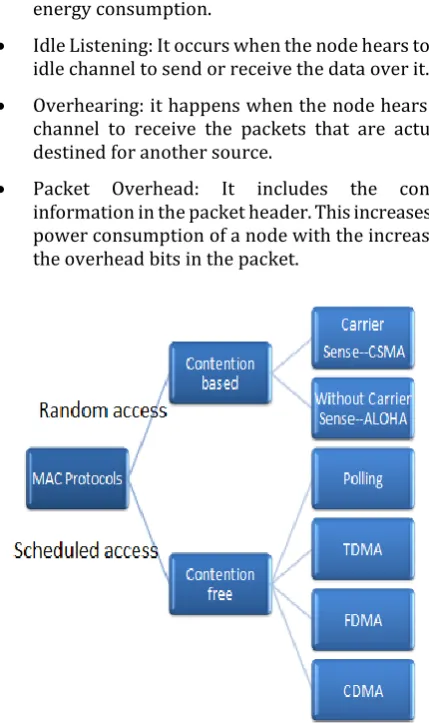
divisions i.e. the contention free and contention based accessschemes (figure 1).
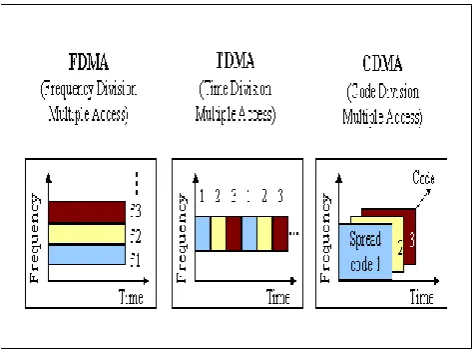
In contention free MAC protocols, each node can utilize the medium without creating any interference with other nodes as the medium to be accessed is properly scheduled. This can be achieved by either of the ways through polling based method i.e. direct channel allotment using polling request message by central controller or by allotting different time slots (TDMA Time Division Multiple Access), different frequency channels (FDMA Frequency Division Multiple Access), or using different unique codes (CDMA Code Division Multiple Access). The figure depicts the TDMA, CDMA and FDMA contention free methods. In TDMA, the node transmits the signal using whole bandwidth of the medium but using different time slots. In FDMA, the nodes transmit the signal simultaneously using different frequency bands in available bandwidth. In CDMA, the nodes transmit signals simultaneously using the whole bandwidth of the system at same time by utilizing the unique codes for the system. As the energy management is at high priority in the system, so the FDMA and CDMA are not feasible to implement in the collision free mechanism as these require the complex circuitry to manage the power division among the nodes [11, 12].
Figure 2 Contention free multiple access methods
On the other part, contention based protocols favor the contingent access of medium and the nodes should struggle to achieve the channel resources. Depending upon the method of checking the availability of channel whether the channel is available or not before initializing the transmissions, these protocols can be divided into two parts. In CSMA/CA i.e. carrier sense multiple access/collision avoidance the node check the availability of the channel, if the channel is idle then node start sending data over it otherwise the channel again check the status of the channel [13]. If the transmission is successful, the receiver sends acknowledgement (ACK) signal to the transmitter for every successful transmission. In case of ALOHA, the node try to send the data as long it has data to transmit. If the data transmission is failed, the node retries to transmit the data
[image:3.595.39.277.396.573.2]after a random time interval in order to further avoid the collision. In case of slotted ALOHA, the data is transmitted in time slots only i.e. when the buffer has data to transmit the node try to send data over transmitting medium. In case of collision, the node resends the data after a random time interval which defines the time of the next slot to avoid further collision. Slotted ALOHA improves the medium utilization and enhance the system performance (see in figure 3).
Figure 3 ALOHA and slotted ALOHA
In this time is divided into slots and action of data transmission and reception is exactly initiated at the beginning of a new time slot. By this packet collision is avoided and hence the performance of the system is enhanced
4. MAC protocols for WBANs:
© 2016, IRJET | Impact Factor value: 4.45 | ISO 9001:2008 Certified Journal
| Page 290
Javaid [14] et al. explains that high packet data drop rate andlow energy efficiency due to packet collision these techniques are not widely used in WBAN. In comparison the TDMA based protocols [15] and [16] are considered as the energy efficient protocol for WBAN networks as the channel is utilized using time slots so there are no any chances for collision, no overhearing problem, high transmission efficiency, low power consumption and hence maximum bandwidth utilization. Since TDMA based protocols are considered as the most efficient and reliable protocols for WBAN networks. Despite this TDMA based protocol has some demerits such as they are not adaptive and flexible according to the data and in this synchronization is required. On the other hand CSMA/CA and ALOHA, based protocols do not require any synchronization. Rahim et al. in [12] consider the CSMA/CA as a better option as compared to TDMA based protocols in the dynamic environment of WBAN network data transmission as provides better mobility to wireless networks. TDMA based protocols works efficiently in a static environment and provides support to heavy traffic but lacks dynamic adaption. Zhen et al. [15] illustrates that CSMA/CA cannot be used in WBAN due to unreliable CCA and also rapid attenuation of electromagnetic waves occurs due to transmission through biological tissues. A study of the differences in the performance and energy consumption of WBAN network, when the system is worked under contention based access method and polling based access method under varying traffic load [16]. A conclusion is drawn from [16] that the energy can be utilized more intelligently in polling access method as compared to contention based access method. In packet transmission, collaboration of small contention period with large polling periods provides the most stable performance with respect to latency i.e. end to end delay. The traffic sources with different data inter-arrival rates are supported by polling based MAC protocols which provide higher network flexibility as compared to TDMA based protocols. It is claimed that for reliable communication of critical medical data packet along with power management polling based and CSMA/CA based protocols are used in aggregation.
5. MAC protocols for WSNs powered by ambient energy
[image:4.595.303.557.101.365.2]harvesting (WSN-HEAP):
Table 1 summary of the aspects of WSN and WSN-HEAP Features Battery
operated WSN
Battery operated WSN powered by energy harvesters
WSN-HEAP
Aim Throughput and latency are
compensated
With the harvested power, lifetime of
Energy is renewable hence maximum
for longer network lifetime
battery is
increased throughput and minimum delay
Protocol
design Sleep wake and up periods can be
determined absolutely
Sleep and wakeup periods can be
determined if future energy availability is precisely supposed
Sleep and wake up periods cannot be predicted
Energy
model Energy model is correctly assumed
Energy model can be predicted with high precision
Energy harvesting may be varied according to the type of harvester, time and space
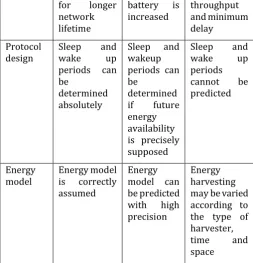
Eu et al.[19] has been conducted significant research in the field of WSN powered by ambient energy harvesting. Moreover in [33] characteristics of WSN powered by HEAP of commercially available thermal and solar energy harvesting sensor nodes are described. This shows that the available energy is varied according to the varying environment and [20] also the mobility of the node and hence the transmission range of the node may vary. The summary of key aspects of WSN and WSNs- HEAP is shown in table 2.1.
Using time slots like slotted ALOHA, slotted version of CSMA/CA and TDMA as MAC protocols are not easy to use in WSN-HEAP because it needs time synchronization. Since the nodes are not aware of the future availability of energy as the energy sources in WSN are not predictable. The performance study of four different MAC protocols is conducted in [20] and [21] based on CSMA based and polling based techniques for WSN-HEAP. And illustrates these protocols: slotted CSMA/CA, unslotted CSMA/CA, ID polling and probabilistic polling. In order to make these protocols function in human energy harvesting system the authors introduce some alterations. Due to a number of advantages in super capacitor they were used as a storage device which is concluded in all these studies. The explanation of the four MAC protocols is given below:
5.1 Slotted CSMA/CA MAC protocol:
© 2016, IRJET | Impact Factor value: 4.45 | ISO 9001:2008 Certified Journal
| Page 291
Charging State: In this the node is busy to collect
energy from the surrounding and both transceiver and processor are inoperative or in off state.
Carrier Sensing State: In this both transceiver and
processor are operative. To find the current state of the channel the node checks the status of the channel by performing the CCA procedure.
Transmit state: In order to transmit the data
[image:5.595.308.567.91.264.2]packets the transceiver will be in transmission mode. Hence both transceiver and processor are operative.
Figure 4 State transmission diagram of slotted CSMA [16]
Figure 4 illustrates that charging is the permanent state. When the node achieves the specified amount of energy it changes its state from charging to carrier sensing state and keep on hold till the beginning of the next time slot. If the channel has been discovered as vacant, then the node starts transmitting data over the next coming slot and sends data packets over it. To achieve the specified threshold energy level the node again returns to charging state. Depending upon the energy harvesting source and the rate of harvested energy the node decides the time for which it remains in charging state. Figure 5 depicts the example of transmission timing slotted CSMA.
Five time slots of duration ts are shown in the example. The
time to send the data packet is represented by parameter Ttx,
from receiving state to transmission state i.e. the hardware turnaround time is given by Tta, to determine whether the
channel is busy or idle is determined by CCA procedure is represented by Tcca. The nodes transmit data packets to the
[image:5.595.36.265.263.404.2]sink in the time slots 1, 2 and 4. Synchronization packets are transmitted by the sink once it detects the ideal slot in time slots 3 and 5.
Figure 5 Transmission timing in slotted CSMA [21]
5.2 Unslotted CSMA/CA MAC protocol:
When the CSMA/CA does not follow the slot system, it is termed as unslotted CSMA/CA. Two additional states are included in unslotted CSMA/CA, idle state and idle state (see in figure 6).
Figure 6 State transition diagram of unslotted CSMA/CA [21]
[image:5.595.308.586.395.576.2]© 2016, IRJET | Impact Factor value: 4.45 | ISO 9001:2008 Certified Journal
| Page 292
5.3 ID Polling MAC protocol:
[image:6.595.307.556.88.297.2]Energy levels of the node must be predicted by the sink, in order to perform ID polling procedure. As nodes are powered by ambient energy harvesting sources, so it is quite difficult to predict the energy level in a particular node. Each node is identified and distinguished from others by its unique ID. An example of the state transition diagram of the ID polling procedure is shown in figure 7.
Figure 7 State transition diagram of ID polling [20]
To operate, the node collects a sufficient amount of energy i.e. node remains in charging state till it achieves a threshold level. Then node changes its state to receiving state and expecting for polling packet from sink. ID of the node to be polled is contained by polling message. The node transmits its packet, if the ID of the polling message is matched with the ID of the node. Otherwise the node returns to the charging state. Figure 9 shows the transmission timing in ID polling.
In figure 8, Tpoll defines the reception time of the polling
packet. Only when the node is in receiving mode then it will receive the polling packet. When the node is in charging state, it cannot receive the polling message and hence unable to transmit data and this is termed as unsuccessful ID polling packet. After unsuccessful polling packet, the node aware the polled sink to resend the polling packet as the node is unable to transmit data without polling packet. The sum of 2Tta and
Tcca defines the separation between two continuous polling
packets. As the node spent most of the time in a charging the state as compared to the time it spent in receiving state hence the probability of successful polling is reduced.
Figure 8 ID polling transmission timings [21]
5.4 Probabilistic polling protocol:
Probabilistic protocol has been proposed and designed by Eu et. al. in order to attain high throughput and fairness in WSN-HEAP. Since in ID polling an exclusive identifier is used for each node but in probabilistic polling, the sink advertises a control packet that comprises of a maximum value of a contention probability (pc). The node creates a random
number x where x € [0, 1] when a node obtains the polling packet. If the value of x is below than pc, then the node sends
its data packet; if not then the node transferred to idle state, hold on its state till next polling state. According to the updated module which looks for the response of nodes to the polling, adjust the value of pc at the node. In figure 9, the
updating algorithm of pc is shown.
• Send a polling packet with contention probability pc.
• If no sensor responds to the polling packet then
• Increase pc.
• Else if a packet is successfully received from one of the sensor nodes
• Or there is packet loss due to weak signal received from single node
• Maintain pc at current value.
• Else if there is collision between two or sensor nodes as indicated by a corrupted data packet
• Decrease pc • End if
• Repeat step 1
[image:6.595.36.265.242.391.2]© 2016, IRJET | Impact Factor value: 4.45 | ISO 9001:2008 Certified Journal
| Page 293
The value of pc is updated as (I) to increase the transmissionprobability of the nodes, the sink increases the threshold value of pc if no node responds to the polling packet. (II) To
reduce the probability of collision, the sink decreases the value of the threshold in case of collision between two nodes. The current value of the threshold is maintained in polling packet in case of successful transmission.
CONCLUSION
The purpose of this review work is to examine existing MAC protocols for WBANs with stress on energy minimization. These protocols are being introduced to extend lifespan of WBANs, reliable communication, flexibility, rational management, and QoS.
REFERENCES
[1] Chatterji: World Health Organisation’s (WHO) Study on Global Ageing and Adult Health (SAGE). BMC Proceedings 2013 7(Suppl 4):S1.
[2] S.Mendis, P. Puska and B. Norrving, “Global Atlas on cardiovascular disease prevention and control,’’ World Health Organization publication, pp.1-164, September 2011.
[3] Global Observatory for eHealth series, “mHealth New horizons for health through mobile technologies,” World Health Organization Publication Geo Publication, vol. 3, pp. 1-112, June 2011.
[4] A. D. Jurik and A. C. Weaver, “Remote Medical Monitoring,” Proc. IEEE, vol. 41, pp. 96-99, April 2008. [5] K. S. Kwak, S. Ullah, and N. Ullah, “An Overview of IEEE 802.15.6 Standard,”Int. Symp. On Applied Sciences in
Biomedical and Communication Technologies (ISABEL),
pp. 1-6, November 2010.
[6] M. A. Hanson, H. C. Powell, A.T. Barth, K. Ringgenberg, B. H. Calhoun, J. H. Aylor, and J. Lach, “Body Area Sensor Networks: Challenges and Opportunities Body Area Sensor Networks: Challenges and Opportunities, ” IEEE Computer, vol. 42, pp. 58-65, January 2009.
[7] P. Gould and A. Krahn, “Complications Associated With Implantable Cardioverter-Defibrillator Replacement in Response to Device Advisories”, Journal of the American Medical Association, vol. 295, no. 16, pp. 529–551, April 2006.
[8] J. Paradiso and T. Starner, “Energy Scavenging for Mobile and Wireless Electronics,” IEEE Pervasive Computing, vol. 4, no.1, pp. 18-27, March 2005. [9] S. Ullah, B. Shen, S. M. R. Islam, P. Khan, S. Saleem and K.
S. Kwak, "A study of medium access control protocols for wireless body area networks", In Proceedings of IEEE GLOBECOM, pp. 1-13,April 2010.
[10] L. Hughes, X. Wang and T. Chen, "A Review of Protocol Implementations and Energy Efficient Cross-Layer Design for Wireless Body Area Networks", Sensors, vol. 12, no. 11, pp. 14730-73, November 2012.
[11] S. Gopalan and J.-T. Park, "Energy-efficient MAC protocols for wireless body area networks:
Survey", Ultra Modern Telecommunications and Control Systems and Workshops (ICUMT) 2010 Int. Congress on, pp. 739-744, October 2010.
[12] A. Rahim, N. Javaid, M. Aslam, Z. Rahman, U. Qasim and Z. Khan, "A Comprehensive Survey of MAC Protocols for Wireless Body Area Networks", Seventh International Conference on Broadband Wireless Computing Communication and Applications (BWCCA) 2012, pp. 434-439, August 2012.
[13] N. Javaid, I. Israr, M.A. Khan, A. Javaid, S.H. Bouk and Z.A. Khan, "Analyzing medium access techniques in wireless body area networks", Research Journal of Applied Sciences Engineering and Technology, July 2013. [14] Javaid, N., Hayat, S., Shakir, M., & Khan, M. A., " Energy efficient MAC protocols in wireless body area sensor networks—A survey",Journal of Basic Applied Scientific Research, pp.1–17,March 2013.
[15] B. Zhen, R Khono and H. B Li "IEEE body area networks and medical implant communications", ICST, March 2008.
[16] A. Boulis and Y. Tselishchev, "Contention vs. Polling: A Study in Body Area Networks MAC Design", Proc. 5th Int. Conf. on Body Area Networks BodyNetS, pp. 151-157, September 2010.
[17] Z. A. Eu, H. P. Tan and W. K. G. Seah, "Wireless sensor networks powered by ambient energy harvesting: an empirical characterization", Proc. 2010 IEEE Int. Conf. Commun., May 2010.
[18] W. K. G. Seah, Z. A. Eu and H.-P. Tan, "Wireless sensor networks powered by ambient energy harvesting (WSN-HEAP)—Survey and challenges", Proc. 1st Int. Conf. Wireless VITAE, pp. 1-5, May 2009
[19] Z.A. Eu, H.P. Tan and W.K.G. Seah, "Design and performance analysis of MAC Schemes for wireless sensor networks powered by ambient energy harvesting", Ad Hoc Networks, vol. 9, no. 3, pp. 300-323, August 2011.
[20] Z.A. Eu and H.-P. Tan, "Probabilistic polling for multi-hop energy harvesting wireless sensor networks", IEEE International Conference on Communications (ICC), pp. 271-275, June 2012. [21] Z.A. Eu, W.K.G. Seah and H.P. Tan, "A Study of MAC
![Figure 5 Transmission timing in slotted CSMA [21]](https://thumb-us.123doks.com/thumbv2/123dok_us/8183412.811362/5.595.36.265.263.404/figure-transmission-timing-slotted-csma.webp)
![Figure 8 ID polling transmission timings [21]](https://thumb-us.123doks.com/thumbv2/123dok_us/8183412.811362/6.595.307.556.88.297/figure-id-polling-transmission-timings.webp)
