Differences in endogenous peptides presented
by HLA-B*2705 and B*2703 allelic variants.
Implications for susceptibility to
spondylarthropathies.
F Boisgérault, … , D Charron, A Toubert
J Clin Invest.
1996;
98(12)
:2764-2770.
https://doi.org/10.1172/JCI119102
.
The association between HLA-B27 and spondylarthropathies is currently being
reinvestigated in the light of HLA-B27 subtyping. At least 11 different subtypes have been
described among which B*2703, B*2706, and B*2709 could be less closely associated with
disease at the population level. Differences in the presentation of antigenic peptides by
these subtypes could be related to differences in disease susceptibility. We focused our
work on the comparison of B*2705 and B*2703 which differ at a single position at residue
59 in pocket A of the peptide binding groove. Endogenous peptides from the human C1R
line transfected by B*2705 or B*2703 were acid-eluted and separated by HPLC. Major
individual fractions were sequenced by Edman NH2-terminal degradation. Differences
observed between B*2705 versus B*2703 individual ligands were confirmed in an in vitro
stabilization assay with T2-B*2705 or B*2703 transfected cells in the presence of synthetic
peptides. One B*2705 associated peptide is derived from the sequence 169-179 in the
second extracellular domain of several HLA class I molecules including HLA-B27. This
sequence (RRYLENGKETL) is highly homologous to a previously reported sequence
(LRRYLENGK) sharing similarities with proteins from enteric bacteria. We show here that it
is naturally presented as a major endogenous peptide by B*2705 and B*2702
disease-associated subtypes and not by B*2703.
Research Article
Find the latest version:
J. Clin. Invest.
© The American Society for Clinical Investigation, Inc. 0021-9738/96/12/2764/07 $2.00
Volume 98, Number 12, December 1996, 2764–2770
Differences in Endogenous Peptides Presented by HLA-B*2705 and B*2703
Allelic Variants
Implications for Susceptibility to Spondylarthropathies
Florence Boisgérault, Vannary Tieng, Marie-Claude Stolzenberg, Nicolas Dulphy, Iman Khalil, Ryad Tamouza, Dominique Charron, and Antoine Toubert
Laboratoire d’Immunogénétique Humaine, INSERM U 396, Institut Biomédical des Cordeliers, 75006, Paris, France; and Hôpital Saint-Louis, Centre G. Hayem, 75475, Paris Cedex 10, France
Abstract
The association between HLA-B27 and spondylarthropa-thies is currently being reinvestigated in the light of HLA-B27 subtyping. At least 11 different subtypes have been de-scribed among which B*2703, B*2706, and B*2709 could be less closely associated with disease at the population level. Differences in the presentation of antigenic peptides by these subtypes could be related to differences in disease sus-ceptibility. We focused our work on the comparison of B*2705 and B*2703 which differ at a single position at residue 59 in pocket A of the peptide binding groove. Endogenous pep-tides from the human C1R line transfected by B*2705 or B*2703 were acid-eluted and separated by HPLC. Major in-dividual fractions were sequenced by Edman NH2-terminal
degradation. Differences observed between B*2705 versus B*2703 individual ligands were confirmed in an in vitro sta-bilization assay with T2-B*2705 or B*2703 transfected cells in the presence of synthetic peptides. One B*2705 associ-ated peptide is derived from the sequence 169–179 in the second extracellular domain of several HLA class I mole-cules including HLA-B27. This sequence (RRYLENGKETL) is highly homologous to a previously reported sequence (LRRYLENGK) sharing similarities with proteins from en-teric bacteria. We show here that it is naturally presented as a major endogenous peptide by B*2705 and B*2702 disease-associated subtypes and not by B*2703. (J. Clin. Invest.
1996. 98:2764–2770.) Key words: autoimmune diseases •
spondylitis, ankylosing • HLA-B27 • peptides, amino acid
sequence • enterobacteriaceae
Introduction
HLA-B27 is a particularly interesting HLA class I molecule since it is associated with the group of inflammatory rheumatic diseases called spondylarthropathies (SA).1 This association
was initially described in 1973 (1, 2) and since that time a con-siderable amount of work (for reviews see references 3 and 4) has been devoted to elucidating the nature of the link in this model of HLA and disease association. One interesting point concerning HLA-B27 is the definition of at least eleven differ-ent natural variants of the molecule, B*2701 to B*2710, B*2705 being split into B*27052 and B*27053 different at a single silent nucleotide substitution (5). These variants differ from each other by one to five amino acids (aa) in the peptide binding groove and they have also a different ethnic distribu-tion. With regard to the association between SA and HLA-B27 subtypes, the following are certainly associated with the disease, B*2705, B*2702, B*2704, and B*2707 (3). It is difficult to assess the disease association of the B*2701 and B*2708 subtypes since these are rarely occurring. Other subtypes could be less tightly associated with SA at the population level, especially B*2703 which is the most frequent subtype in West Africa (6), B*2706 in the Thai population (7) and B*2709 in Sardinia (8). This could reflect a differential binding of pep-tides derived from an autoantigen and/or from environmental agents since the role of bacterial infection on SA triggering has been shown in humans (9) and in the HLA-B27 transgenic rat model (10). Additionally, other genetic factors could influence the disease predisposition in these populations. After the ini-tial report of its lack of association with SA (6), B*2703 has been the most studied HLA-B27 subtype in comparison with B*2705, the major disease associated variant in every popula-tion. Functional studies with B*2703 specific alloreactive lines and in vitro peptide binding studies (11–13) have shown some different behavior of these subtypes. It is considered that B*2703 could bind mainly a subset of the B*2705 peptides se-lected upon their NH2 terminus residue (13). Hydrogen bonds involving the first residue of the peptide and conserved Tyr-7, Tyr-59, and Tyr-171 of the MHC molecule (14) stabilize the peptide and could be disrupted by the single substitution of Tyr by His at position 59 in B*2703. Pool sequencing can give an insight into the peptide anchor and preferred residues but an evaluation at the level of individual peptides is also needed to precisely determine the extent of differences in the peptide presentation between these closely related molecules. For this purpose we have compared acid-eluted peptides from human C1R-B*2703 and C1R-B*2705 transfected cell lines. Pool se-quences showed the conservation of anchor residues at the second position and at the COOH terminus but also demon-strated differences between these two subtypes in the selection of the first residue of the peptide. At the level of individual
Address correspondence to Dr. A. Toubert, INSERM U 396, Centre G. Hayem, Hôpital Saint-Louis, 1, Av. C. Vellefaux, 75475, Paris Ce-dex, France. Phone: 01-42-49-90-81; FAX: 01-42-49-44-49; E-mail: [email protected]
Received for publication 23 July 1996 and accepted in revised form 26 September 1996.
HPLC fractions, some peptides eluted from one variant were not found in the other. Class I stabilization experiments with synthetic peptides conducted in T2-B*2705 and T2-B*2703 cell lines deficient in peptide transporters (TAP) confirmed the subtype specificity of two dominant B*2705 endogenous pep-tides. One major B*2705 peptide found was an eleven aa long sequence, R-11-L (RRYLENGKETL), from position 169 to 179 in the second extracellular domain of several HLA class I alleles including HLA-B27. R-11-L overlaps the peptide LR-RYLENGK predicted by Scofield et al. to bind HLA-B27 and sharing sequence similarities with proteins from enteric bacte-ria (15, 16). We show here that a closely related but non-identi-cal sequence from HLA-B27 can be naturally presented by B*2705 and not by B*2703. Thus a single aa difference at posi-tion 59 in pocket A between these two subtypes can result in clear differences in the presentation of dominant endogenous peptides with possible consequences in the selection of T-cell repertoire and in the development of autoimmunity.
Methods
Cell lines.C1R-B*2705 (B*27052), B*2702, and B*2703 were kindly provided by Dr. J.A. Lopez de Castro (17). For peptide elution, they were cultured in roller bottles in RPMI 1640 medium/10% FCS/ 2 mM glutamine/ penicillin G at 50 U/ml and streptomycin at 50 mg/ml. Murine mastocytoma cell line P815 transfected by B*2705 and human
b2 microglobulin (18) were cultured in the same conditions. Cells were pelleted and stored at 2808C. The levels of HLA-B27 expres-sion were regularly checked by FACS® analysis with ME1 mAb (19).
3.109 to 6.109 cells were used in each peptide fractionation
experi-ment. Lines T2-B*2705 and T2-B*2703 deficient in TAP were ob-tained respectively from Dr. P. Cresswell (20) and Dr. R. Colbert (13). They were cultured in the same complete medium supple-mented with G418 at 0.5 mg/ml (Geneticin; GIBCO BRL, Eragny, France).
HLA purification. The procedure of HLA purification has been described (21). HLA-B27 molecules were captured on cyanogen bro-mide-activated Sepharose 4B columns (Pharmacia, Saint-Quentin en Yvelines, France) coupled to ME1 mAb. Column elutions were done under basic conditions (50 mM diethylamine pH 11.5). The purity and quantity of HLA molecules were estimated by SDS-PAGE anal-ysis. Columns coupled to normal mouse immunoglobulins were treated identically to the specific ME1 coupled columns, in order to provide an internal control for each purification.
Peptide elution and HPLC fractionation.Peptides were acid-eluted from purified HLA-B27 molecules (at least 250 mg) by treatment with 0.1% (vol/vol) trifluoroacetic acid (TFA) at room temperature and collected by centrifugation through a 5-kD cut-off device (Ami-con Inc., Beverly, MA). The extracts were further (Ami-concentrated to 100 ml using SpeedVac (Savant Instruments, Inc., Farmingdale, NY). Reversed-phase HPLC was performed on a C18 column (ODS C18, 4.6 3 150 mm; Beckman Instruments, Gagny, France) using the Beckman system Gold instrumentation (solvant module 126 - UV de-tector 166). The gradient consisted of 0.05% TFA in H2O/0.05% TFA
in acetonitrile 91:9 for 10 min followed by a linear increase to 35% ac-etonitrile/0.05% TFA over 60 min. Absorbance was monitored at 220 nm, the flow rate was 500 ml/min. Fractions of 500 ml were collected on a Gilson 203B collector. HPLC profiles of peptides eluted from purified HLA molecules and mock-treated material were compared.
Automated Edman degradation sequencing and mass spectrometry analysis. Microsequencing by NH2-terminal Edman degradation was
performed using an Applied Biosystems, Inc. (Foster City, CA), 473-A or 494 protein sequencer. Pooled (10% of each HPLC fraction) and individual sequences were performed. Interpretation of pool se-quencing data was according to the convention of Falk et al. (22). Da-tabase searches were performed in the National Biomedical Research
Foundation (NBRF-PIR) data base (release date May 1996). Some individual HPLC fractions were analyzed by matrix-assisted time-of-flight mass spectrometry (MALDI-TOF MS). Molecular weights were calculated from mass-to-charge (m/z) ratio with a 1/2 1D confi-dence.
Synthetic peptides and in vitro binding assay. Synthetic peptides were prepared by solid-phase synthesis (Neosystem, Strasbourg, France). In vitro binding assays were performed on TAP deficient T2 cells transfected with HLA-B*2705 or HLA-B*2703 according to previous protocols (23) including some modifications. Aliquots of 2.105 T2-B*2705 or T2-B*2703 cells were incubated overnight at 378C
with 100 or 200 mM of synthetic peptides in complete RPMI 1640 sup-plemented with 10% FCS. The HLA-B27 molecules stabilized at the cell surface were assessed by indirect fluorescence. Cells were incu-bated with 1 mg of purified ME1 mAb for 60 min on ice, washed in PBS-0.1% BSA and then stained with FITC-conjugated F(ab)92 goat anti–mouse immunoglobulins for 60 min on ice. After washing twice, 104 events from each sample were analyzed on a logarithmic scale
us-ing a FACScan® (Becton-Dickinson, Mountain View, CA). The
re-sults were expressed as relative fluorescence index (RFI) calculated as: RFI 5 geometric mean of samples/geometric mean of controls. Controls are cells without peptide and the samples are peptide-treated cells. Background fluorescence obtained with the FITC con-jugated Ab alone was subtracted in each experiment. Peptide binding was considered significant when RFI . 1.5.
Immunoprecipitation of HLA-B27 heavy chain by TAP specific mAb. 5.106 C1R-B*2705 or B*2703 cells were starved for 1 h in
me-thionine/cysteine-free medium and then labeled with 50 µCi of [35S]methionine/cysteine (Amersham, UK) for 15 min. Cells were
washed once in PBS, and lysed in 0.5 ml of cold lysis buffer (1% digi-tonin, 10 mM Tris pH 8, 140 mM NaCl, 0.2 mM PMSF, 25 mg/ml aprotinin and 100 mM leupeptin). After 30 min on ice the nuclei were removed by centrifugation. The supernatant was precleared for 1 h with a mixture of 150 ml 10% Pansorbin (Calbiochem Corp., San Di-ego, CA) and 2 ml normal mouse serum. After centrifugation the su-pernatant was divided into aliquots and precipitated overnight with 10 mg/ml of TAP2 specific 435.3 mAb kindly provided by Dr. P. van Endert (24), anti-B27 ME1 mAb (19) or anti HLA class1 W6/32 mAb (21). Immunoprecipitates were recovered with 20 ml 50% protein A–sepharose beads and resolved on a 10% SDS-PAGE. The gel was fixed, treated with Amplify (Amersham) for 30 min, dried and ex-posed to Kodak XAR film (Eastman Kodak Co., Rochester, NY).
Results
HPLC profiles of peptides eluted from HLA-B27 C1R trans-fectants. Cell samples from affected patients were not avail-able in the amount needed for peptide elution experiments. To avoid possible differences due to the effect of genes involved in the class I processing machinery, we have chosen to study HLA-B27 transfectants of the same HLA-A, B negative EBV-transformed B cell line, HMy.2C1R (25). The level of expres-sion was compared by FACS® analysis between these lines, C1R-B*2703 being less strongly stained by the B27 specific ME1 mAb than C1R-B*2705 (data not shown). Similar amounts of each B27 purified molecule (z300 mg estimated
TAP association to B*2705 and B*2703 heavy chains. There is now evidence that the physical association between MHC class I heavy chain and TAP heterodimers influences peptide loading to the MHC molecule (26, 27). To analyze the TAP as-sociation to B27 heavy chains, we performed steady-state im-munoprecipitations on C1R-B*2705 and B*2703. As shown in one representative experiment of three (Fig. 2), the overall la-beling intensity in the B*2703 cell line compared with the B*2705 cell line was weaker consistent with the weaker cell surface expression in C1R-B*2703. The intensity of the HLA class I heavy chain precipitates (arrow) were scanned with a densitometer. The ratio of signals obtained with the TAP2
spe-cific 435.3 mAb to those obtained with the B27 spespe-cific ME1 mAb were calculated and did not differ significantly, arguing against a significative difference in binding to TAP between B*2705 and B*2703. In these conditions, the peptide loading efficiency of these allelic variants should be similar and should exclude TAP dependence.
Characterization of endogenous peptides eluted from B*2705 and B*2703. NH2-terminal Edman sequencing of pooled frac-tions was done for these two alleles. A same preference for a length of nine aa was found in each case, as well as the require-ment for Arg as anchor at the peptide second position. At the COOH terminus, in agreement with previous results published for B*2705 (28), aromatic residues (Tyr or Phe) were found preferentially in both B*2705 and B*2703 (data not shown). NH2-terminal differences were carefully investigated for these two subtypes differing in pocket A. An estimation of the rela-tive amount of the different aa at this position showed that ba-sic residues (Arg, Lys, or His) were notably overrepresented in B*2703 (61.6%) compared with B*2705 (25%). The main Arg anchor accounted for 70% of the signal at the second position in case of B*2703 and for 45% in B*2705.
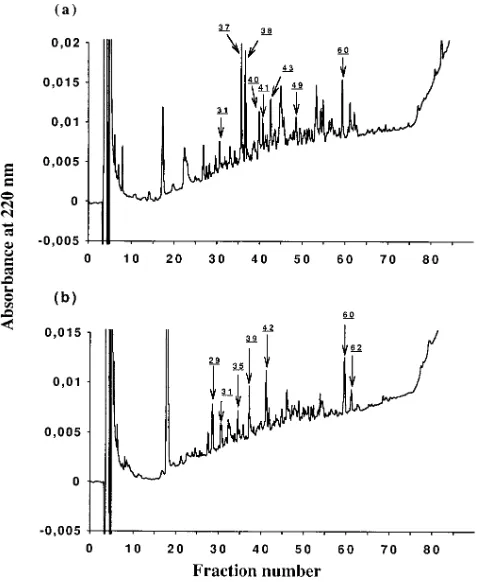
[image:4.612.320.556.57.211.2]In addition to pool sequencing, HPLC profiles were com-pared to select dominant individual fractions for Edman and/ or MS analysis. These are indicated by arrows on the HPLC Figure 1. HPLC profiles of peptides eluted from HLA-B27
trans-fected human C1R cell lines (a, C1R-B*2705; b, C1R-B*2703). Frac-tions sequenced by Edman NH2-terminal degradation are indicated
[image:4.612.58.298.59.350.2]by arrows.
Figure 2. TAP association with B*2705 and B*2703 heavy chains. Im-munoprecipitations were performed with mAbs W6/32 (anti HLA-A, B, C), ME1 (anti HLA-B27), and 435.3 (anti TAP-2). Class I heavy chain (45 kD) is indicated by an arrow.
Table I. Individual Sequences Obtained from C1R-B*2705 and B*2703 HPLC Fractionations
Sequence HPLC fraction Origin Comments
GRLTKHTKF B*2705 (31) Rat ribosomal L36 36–44 Also in B*2705 and B*2702 (ref. 28) RRYLENGKETL B*2705 (37, 38) HLA class I 169–179 Our work
GRFNGQFKTY B*2705 (41) Human ribosomal protein S21 44–53 Our work RRFFPYYVY B*2705 and B*2703 (60) Human proteasome subunit C5 127–135 Our work
RRYQKSTEL B*2703 (29) Human histone H3.3 52–60 Also in B*2705 (ref. 29) HRAQVIYTR B*2703 (31) Human ribosomal protein S25 103–111 Our work
RRISGVDRYY B*2703 (39) unknown Also in B*2705 (ref. 28, 29) KRFEHWRL B*2703 (42) Human translation factor eIF-2 445–453 Our work
RRFMPYYVY B*2703 (62) Human proteasome subunit C5 127–135 Also in B*2705 (ref. 28)
[image:4.612.57.558.581.713.2]profiles shown in Fig. 1 and individual sequences obtained are shown in Table I. They all conformed to the HLA-B27 peptide binding motif (28, 29). In some cases (C1R-B*2705 peaks 40, 43, and 49; C1R-B*2703 peak 35), due to a mixture of pep-tides, no major sequence could be assessed, the only clear sig-nals being anchors at the second position (Arg) and at the COOH terminus (Tyr or Phe). In other cases, a dominant se-quence was obtained yielding a significant match to protein da-tabases. Peak 60, present in B*2705 and B*2703 gave the same sequence KRFFPYYVY, identical to human proteasome sub-unit C5 127-135. This validated the approach of comparing HPLC profiles from these lines. One B*2705 peptide homolo-gous to the rat ribosomal protein L36 (fraction 31) was found in other peptide elutions from B*2705 and B*2702 (28). Sev-eral B*2703 sequences were also identical to previously de-scribed endogenous B*2705 peptides (28, 29) from histone H3.3 (fraction 29), from proteasome subunit C5 (fraction 62) and from unknown origin (fraction 39). The sequence found in fraction 62 of the B*2703 HPLC profile is very close to the se-quence found in fractions 60 of B*2705 and B*2703 albeit with a difference at the fourth residue (Met instead of Phe) and has also been previously observed (28). It could derive from a highly homologous subunit of the proteasome. Finally, other peptides sequenced from major fractions of B*2705 and B*2703 have not been previously found. This is the case for a sequence derived from a ribosomal protein S25 and for a pep-tide homologous to the translational initiation factor eIF-2 in fractions 31 and 42 from B*2703 HPLC. A peptide derived from the 169–179 sequence in the a2 domain of HLA class I which will be named R-11-L and a peptide derived from the human ribosomal protein S21 were isolated from B*2705 (fractions 37, 38, and 41). They appear to be specific for one line since they were not detected in the corresponding frac-tions of the other line, at least within the limits of sensitivity of our MS and Edman sequencing techniques.
Detection of R-11-L in various B27 transfectants. The class I derived peptide R-11-L was further studied. It has been de-tected in MS analysis (138061 D) in two different peptide elu-tions from C1R-B*2705 and was absent from the reciprocal fractions of B*2703 in two different experiments. Instead, a peptide of 128461 D was present in fraction 39 of C1R-B*2703 in agreement with the sequence RRISGVDRYY. It could also be detected in the corresponding fraction 37 of C1R-B*2705 in addition to the dominant R-11-L peptide. A peptide of the same mass as R-11-L was also found in HPLC fractions 38 eluted from the murine mastocytoma cell line P815 transfected with HLA-B*2705 and from the human line C1R transfected with B*2702, another disease-associated B27 subtype. The sequence identity was confirmed by Edman se-quencing of C1R-B*2702 fraction 38. This argues in favor of R-11-L as a dominant endogenous peptide repeatedly found in these subtypes, even in a cell line from another species in the case of B*2705.
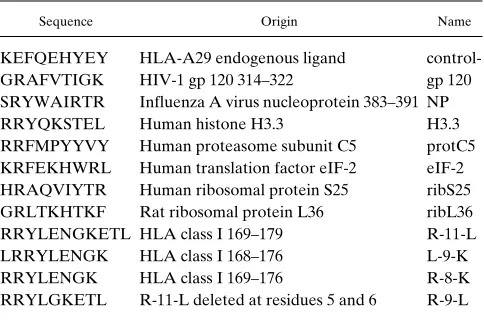
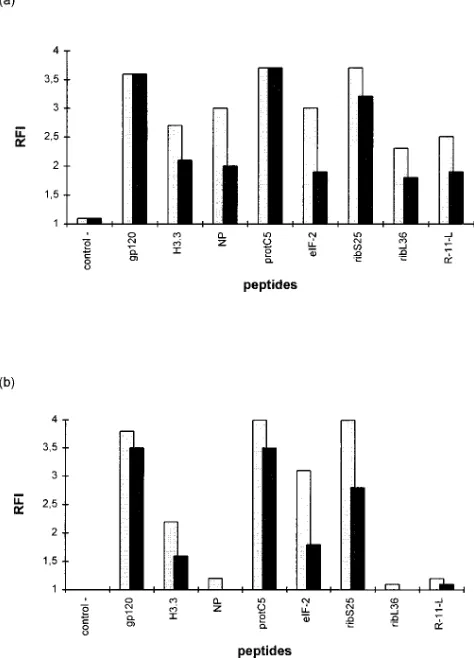
Differential binding properties of endogenous peptides on T2-B*2705 and T2-B*2703. An in vitro stabilization assay of empty class I molecules expressed at the cell surface of TAP deficient T2 cell lines transfected with B*2705 or B*2703 was chosen to evaluate the binding of peptides synthesized accord-ing to sequences of endogenous peptides eluted from the two molecules. Peptides gp120, from HIV-1 gp120 314-322 (12) and NP, derived from the nucleoprotein sequence 383-391 of influenza A virus (13), were used as control peptides
respec-tively known to bind to both alleles (gp120) or preferentially to B*2705 (NP). A peptide derived from an endogenous se-quence of HLA-A29 (21) was used as negative control. Com-plete sequences of the peptides tested are listed in Table II. The molecules stabilized after overnight incubation of pep-tides at 378C were revealed with ME1 (19), a mAb recognizing peptide loaded molecules. Means of at least 3 different experi-ments for each peptide are shown in Fig. 3. As expected, pep-tides eluted from both B*2705 and B*2703 molecules, derived from proteasome C5 subunit (protC5) and from histone H3.3 (H3.3), bound in vitro also to both alleles. Peptides issued from B*2703, eIF-2 and the ribosomal S25 derived peptide, ribS25, bound equally well to B*2703 and to B*2705. Con-versely, two peptides eluted from B*2705, one derived from ri-bosomal L36 protein (ribL36) and the other from HLA class I (R-11-L), bound specifically to B*2705. Since R-11-L overlaps with a previously predicted sequence of a class I molecule which binds to B*2705 in vitro (16), we also tested two tides derived from this sequence, L-9-K and the shorter pep-tide R-8-K. These peppep-tides bound B*2705 specifically (Fig. 4) but less efficiently than the naturally presented peptide R-11-L. To assess the role of the size of the peptide in the specific binding of R-11-L to B*2705 in comparison with B*2703, we synthesized a peptide derived from R-11-L in which two resi-dues were removed at positions 5 and 6 of the peptide which are outside the range of direct peptide-MHC contacts (30). This modified nonamer bound B*2705 to the same extent as R-11-L but also bound to B*2703. However the length of the peptide is probably not the only parameter in the binding to B*2705 versus B*2703 since we also synthesized a 11-mer modified peptide from the histone H3.3 sequence extended with Gly at residues 6 and 7 which still bound efficiently to both subtypes (data not shown).
Discussion
The reasons for having focused our work on the comparison of endogenous peptides from B*2705 and B*2703 molecules are twofold. First, they are an example of very structurally close al-leles, differing at a single residue at position 59 in pocket A of the peptide binding groove. The His residue at this position is unique for B*2703, being Tyr for all other class I molecules
se-Table II. Sequences of Synthetic Peptides Used in Stabilization Assay of T2-B*2705 and T2-B*2703
Sequence Origin Name
[image:5.612.315.557.82.245.2]quenced. This could influence peptide binding without major alterations in the nature of peptide anchor residues. The marked preference for a basic residue at the NH2 terminus and an even greater constraint for Arg at the second position with-out any additional requirement in the B*2703 motif compared to B*2705 is in agreement with this hypothesis. The data pre-sented here provide a direct evidence for differences between dominant individual peptides naturally presented by these two molecules. This is clear since two sequences obtained from B*2705 were not found in the B*2703 elution experiments. Their occurrence in minor B*2703 HPLC fractions cannot be formally excluded but the binding specificity of synthetic pep-tides argues against this possibility. These data should be con-sidered together with other evidence suggesting that closely re-lated HLA-A2 subtypes present different sets of endogenous peptides (31, 32). Differences in binding affinity of a viral pep-tide derived from influenza A virus to B*2705 versus B*2703 have been correlated with the nature of the NH2-terminal tide residue (13). However, the reasons why the B*2705 pep-tides R-11-L and ribL36 did not bind to B*2703 are probably
multiple. As in the case of the NP peptide, the ribL36 peptide could have a lower affinity for B*2703 due to having the small aa Gly as its first residue. The nature of the first aa may not be the single factor responsible since in the case of R-11-L this residue is Arg which is optimal for binding to B*2703. We hy-pothesized that the eleven aa length of the peptide could con-tribute to it having lower binding affinity. The efficient binding to both molecules of a synthetic peptide from this sequence shortened in its central part argues in favor of this hypothesis. Yet the H3.3 peptide extended to eleven aa and sharing with R-11-L the same first (Arg), second (Arg), third (Tyr) and COOH-terminal residues (Leu) still bound to both alleles. Therefore, the specificity of B*2705 versus B*2703 binding is a function of multiple parameters including the first amino-ter-minal residue but also peptide length and/or interactions among peptide residues. This is an example of the difficulty encountered in the prediction of T-cell epitopes based solely on the peptide consensus binding motif.
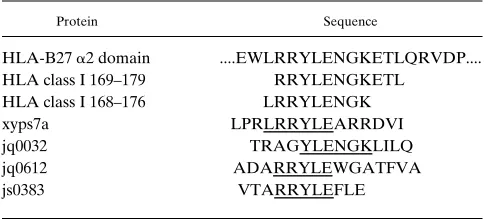
[image:6.612.317.553.57.193.2]The second aspect of this work concerns the links between HLA-B27 and SA. One approach to the study of MHC-dis-ease associations has been to examine the differences between the peptide binding properties of disease-related alleles or sub-types compared with non–disease-related alleles (33). The in-creased accuracy in the description of MHC polymorphism as-sociated with diseases is especially exemplified in the case of HLA-B27 and SA. The lower disease association of B*2703, B*2706, and B*2709 subtypes is based on epidemiological studies (6–8), even if B*2703 or B*2706 patients with B27-associated diseases have been reported occasionally (34, 35). Larger population studies will be needed before final conclu-sions can be drawn. In addition to B27 subtyping, the disease susceptibility could also be influenced by other genetic or envi-ronmental factors which vary in different populations. A se-quence from HLA-B27 itself was predicted to bind to HLA-B27 in view of the B27 consensus binding motif (15). This sequence actually binds to B*2705 in vitro (16) and shares similarities with sequences from enteric bacterial proteins. This article re-ports two observations which are directly related to this hy-pothesis. We showed the natural presentation by B*2705 of a class I derived sequence, R-11-L, which was overlapping but not identical to the sequence predicted by Scofield et al. (Ta-ble III). Although both conform to the B27 peptide consensus Figure 3. Binding of synthetic peptides to T2-B*2705 (a) and
T2-B*2703 (b) cell lines. Sequences and nomenclature of the peptides used are shown in Table II. Cells were incubated overnight at 378C with or without peptide at 100 mM (solid bars) or 200 mM (shaded bars) and the expression of stable HLA-B27 molecules was revealed by indirect fluorescence with mAb ME1. Results are means of three to ten different experiments and are given as relative fluorescence in-dex (RFI) of peptide treated cells to untreated cells (see Methods).
[image:6.612.59.296.64.393.2]motif, it is particularly striking that the naturally presented se-quence was not predicted, probably because of its unusual length of eleven aa. We also showed that the endogenous pep-tide is a better ligand for B*2705 than the predicted nonamer. The R-11-L peptide is probably derived from HLA-B27 itself which is the major class I molecule expressed in our transfec-tants. However, it could also originate from HLA-Cw4, the re-maining expressed class I molecule in this class I deficient line (25). In any case, the interesting feature of this sequence is its binding specificity to B*2705.
The detection of R-11-L among major B*2705 and B*2702 endogenous peptides in comparison with B*2703 and the simi-larities with bacterial sequences presented in Table III are ar-guments for its role in disease pathogenesis. On this basis, the different presentation of endogenous peptides would differen-tially shape the T cell repertoire in B*2705 and B*2703 individ-uals. An autoimmune response could be triggered upon bacte-rial infection if proteins sharing sequence homologies with HLA-B27 induced a break in tolerance towards the endoge-nous class I self peptide. This hypothesis would also fit with some observations made in animal models of SA, such as the relationships between HLA-B27 expression level and disease occurrence in the B27 transgenic rat model (36). In B27 trans-genic mice lacking b2-microglobulin which spontaneously de-velop an inflammatory arthritis (37), high amounts of B27 heavy chain are degraded intracellularly and therefore could be presented by the few B27 heavy chains still expressed at the cell surface. Interestingly, these mice, as well as the B27 trans-genic rats (10) do not develop arthritis when raised in a patho-gen-free environment. The definition of the role of this class I derived peptide presented by HLA-B27 in disease pathogene-sis requires functional studies in order to determine possible differences in T cell recognition of this peptide between pa-tients and healthy B27 individuals. While the influence of en-dogenous self peptides on T cell maturation in the thymus has been shown in different models (38, 39), little is known about the recognition of such self peptides by mature T cells in the periphery. Recently, an agonistic effect of high levels of self peptide on Fas/Fas-ligand mediated cytotoxicity has been de-scribed (40). Moreover, in addition to the conventional HLA
restricted presentation to cytotoxic T cells, peptides bound to class I molecules could also specifically influence recognition by natural killer cells as has previously been shown for HLA-B*2705 (41). The data presented in this study evoke the possi-bility of testing these hypothesis in the privileged example of HLA-B27 association to SA. Answers to these questions could shed a new light on the mechanisms of HLA and disease pathogenesis.
Note added in proof. At the time this manuscript was in press, we have become aware of the independent finding of the HLA class I 169–179 peptide in B*2701, B*2704 and B*2706 peptide elution experiments (Garcia, F., A. Marina, J.P. Albar, and J.A. Lopez de Castro. 1996. HLA-B27 presents a peptide from a polymorphic region of its own molecule with homology to proteins from arthritogenic bacteria. Tissue Antigens. In press).
Acknowledgments
We thank J. d’Alayer and M. Davi (Institut Pasteur, Paris, France) for having performed the automated peptide sequencing, Dr. O. Sorokine (LSMBO, Strasbourg, France) for mass spectrometry analysis and Dr. N. Mooney for a critical reading of the manuscript.
This work was supported in part by the Association de Recherche sur la Polyarthrite (ARP).
References
1. Brewerton, D., F. Hart, A. Nicholls, M. Caffrey, D.C.O. James, and R.D. Sturrock. 1973. Ankylosing spondylitis and HLA-27. Lancet. I:904–907.
2. Schlosstein, L., P.I. Terasaki, R. Bluestone, and C.M. Pearson. 1973. High association of an HLA antigen, w27, with ankylosing spondilytis. N. Engl. J. Med. 288:704–706.
3. Lopez de Castro, J.A. 1996. HLA-B27 and HLA-B73 polymorphism and its role on antigenicity, peptide presentation, and disease susceptibility. Clin. Rheumatol. 15:67–71.
4. Burmester, G.R., A. Daser, T. Kamradt, A. Krause, N.A. Mitchison, J. Sieper, and N. Wolf. 1995. Immunology or reactive arthritides. Annu. Rev. Im-munol. 13:229–250.
5. Bodmer, J.G., S.G.E. Marsh, E.D. Albert, W.F. Bodmer, R.E. Bontrop, D. Charron, B. Dupont, H.A. Erlich, W.R. Mayr, P. Parham, T. Sasazuki, G.M.T. Schreuder, J.L. Strominger, A. Svejgaard, and P.I. Terasaki. 1995. No-menclature for factors of the HLA system, 1995. Tissue Antigens. 46:1–18.
6. Hill, A.V.S., C.E.M. Allsopp, D. Kwiatkowski, N.M. Anstey, B.M. Greenwood, and A.J. McMichael. 1991. HLA-B27 and an African B27 subtype. Lancet. 337:640–642.
7. Lopez-Larrea, C., K. Sujirachato, N.K. Mehra, P. Chiewsilp, D. Isa-rangkura, U. Kanga, O. Domingez, E. Coto, M. Pena, F. Setien, and S. Gonza-lez-Roces. 1995. HLA-B27 subtype in Asian patients with ankylosing spondyli-tis. Evidence for new associations. Tissue Antigens. 45:169–176.
8. D’Amato, M., M.T. Fiorillo, C. Carcassi, A. Mathieu, A. Zucarelli, P.P. Bitti, R. Tosi, and R. Sorrentino. 1995. Relevance of residue 116 of HLA-B27 in determining susceptibility to ankylosing spondylitis. Eur. J. Immunol. 25:3199– 3201.
9. Toivanen, A., and P. Toivanen. 1995. Epidemiologic, clinical and thera-peutic aspects of reactive arthritis and ankylosing spondylitis. Curr. Opin. Rheumatol. 7: 279–283.
10. Taurog, J., J.A. Richardson, J.T. Croft, W.A. Simmons, M. Zhou, J.L. Fernandez-Sueiro, E. Balish, and R.E. Hammer. 1994. The germfree state pre-vents development of gut and joint inflammatory disease in HLA-B27 trans-genic rats. J. Exp. Med. 180:2359–2364.
11. Villadangos, J.A., B. Galocha, R. Garcia-Hoyo, D. Lopez, F. Garcia, and J.A. Lopez de Castro. 1994. Structure of HLA-B27-specific T cell epitopes. Antigen presentation in B*2703 is limited mostly to a subset of the antigenic de-terminants on B*2705. Eur. J. Immunol. 24:2548–2555.
12. Villadangos, J.A., B. Galocha, F. Garcia, J. P. Albar, and J. A. Lopez de Castro. 1995. Modulation of peptide binding by HLA-B27 polymorphism in pockets A and B, and peptide specificity of B*2703. Eur. J. Immunol. 25:2370– 2377.
[image:7.612.56.300.92.202.2]13. Colbert, R.A., S.L. Rowland-Jones, A.J. McMichael, and J. Frelinger. 1994. Differences in peptide presentation between B27 subtypes: the impor-tance of the P1 side chain in maintaining high affinity peptide binding to B*2703. Immunity. 1:121–130.
Table III. Sequence Comparisons of the HLA Class I 169–179 Endogenous Peptide from B*2705 and Related Bacterial Sequences According to Scofield et al. (15)
Protein Sequence
HLA-B27 a2 domain ....EWLRRYLENGKETLQRVDP.... HLA class I 169–179 RRYLENGKETL
HLA class I 168–176 LRRYLENGK xyps7a LPRLRRYLEARRDVI jq0032 TRAGYLENGKLILQ jq0612 ADARRYLEWGATFVA js0383 VTARRYLEFLE
Underlined are aa identical to the HLA-B27 sequence. xyps7a, jq0032, jq0612 and js0383 are accession numbers in the PIR database. xyps7a,
Pseudomonas aeruginosa site-specific methyltransferase (adenine
14. Madden, D.R. 1995. The three-dimensional structure of peptide-MHC complexes. Annu. Rev. Immunol. 13:587–622.
15. Scofield, R.H., W.L. Warren, G. Koelsch, and J.B. Harley. 1993. A hy-pothesis for the HLA-B27 immune dysregulation in spondyloarthropathy: Con-tributions from enteric organisms, B27 structure, peptides bound by B27, and convergent evolution. Proc. Natl. Acad. Sci. USA. 90:9330–9334.
16. Scofield, R.H., B. Kurien, T. Gross, W.L. Warren, and J.B. Harley. 1995. HLA-B27 binding of peptide from its own sequence and similar peptides from bacteria: implications for spondyloarthropathies. Lancet. 345:1542–1544.
17. Rojo, S., F. Garcia, J.A. Villadangos, and J.A. Lopez de Castro. 1993. Changes in the repertoire of peptides bound to HLA-B27 subtypes and to site-specific mutants inside and outside pocket B. J. Exp. Med. 177:613–620.
18. Toubert, A., C. Raffoux, J. Boretto, J. Sire, R. Sodoyer, S.R. Thurau, B. Amor, F.A. Lemonnier, and B.R. Jordan. 1988. Epitope mapping of HLA-B27 and HLA-B7 antigens by using intradomain recombinants. J. Immunol. 141: 2503–2509.
19. Ellis, S.A., C. Taylor, and A.J. McMichael. 1982. Recognition of HLA-B27 and related antigens by a monoclonal antibody. Hum. Immunol. 5:49–59.
20. Cerundolo, V., J. Alexander, K. Anderson, C. Lamb, P. Cresswell, A. McMichael, F. Gotch, and A. Townsend. 1990. Presentation of viral antigen controlled by a gene in the major histocompatibility complex. Nature (Lond.). 345:449–452.
21. Boisgérault, F., I. Khalil, V. Tieng, F. Connan, T. Tabary, J.H.M. Cohen, J. Choppin, D. Charron, and A. Toubert. 1996. Definition of the HLA-A29 peptide ligand motif allows prediction of potential T-cell epitopes from the ret-inal soluble antigen, a candidate autoantigen in birdshot retinopathy. Proc. Natl. Acad. Sci. USA. 93:3466–3470.
22. Falk, K., O. Rötszchke, S. Stevanovic, G. Jung, and H.-G. Rammensee. 1991. Allele-specific motifs revealed by sequencing of self-peptides eluted from MHC molecules. Nature (Lond.). 351:290–296.
23. Stuber, G., S. Modrow, P. Höglund, L. Franksson, J. Elvin, H. Wolf, K. Kärre, and G. Klein. 1992. Assessment of major histocompatibility complex class I interaction with Epstein-Barr virus and human immunodeficiency virus peptides by elevation of membrane H-2 and HLA in peptide loading-deficient cells. Eur. J. Immunol. 22:2697–2703.
24. van Endert, P., R. Tampé, T.H. Meyer, R. Tisch, J.F. Bach, and H.O. McDevitt. 1994. A sequential model for peptide binding and transport by the transporters associated with antigen processing. Immunity. 1:491–500.
25. Zemmour, J., A.M. Little, D.J. Schendel, and P. Parham. 1992. The HLA-A, B “negative” mutant cell line C1R expresses a novel HLA-B35 allele, which also has a point mutation in the translation initiation codon. J. Immunol. 148:1941–1948.
26. Suh, W., M. Cohen-Doyle, K. Fruh, K. Wang, P. Peterson, and D. Wil-liams. 1994. Interaction of MHC class I molecules with the transporter
associ-ated with antigen processing. Science (Wash. DC). 264:1322–1326.
27. Neisig, A., R. Wubbolts, X. Zang, C. Melief, and J. Neefjes. 1996. Al-lele-specific differences in the interaction of MHC class I molecules with trans-porters associated with antigen processing. J. Immunol. 156:3196–3206.
28. Rötzschke, O., K. Falk, S. Stevanovic, V. Gnau, G. Jung, and H.-G. Rammensee. 1994. Dominant aromatic/aliphatic C-terminal anchor in HLA-B*2702 and B*2705 peptide motifs. Immunogenetics. 39:74–77.
29. Jardetzky, T.S., W.S. Lane, R.A. Robinson, D.R. Madden, and D.C. Wiley. 1991. Identification of self peptides bound to purified HLA-B27. Nature (Lond.). 353:326–329.
30. Rognan, D., L. Scapozza, G. Folkers, and A. Daser. 1995. Rational de-sign of nonnatural peptides as high-affinity ligands for the HLA-B*2705 human leukocyte antigen. Proc. Natl. Acad. Sci. USA. 92:753–757.
31. Sudo, T., N. Kamikawaji, A. Kimura, Y. Date, C.J. Savoie, H. Nakash-ima, E. Furuichi, S. Kuhara, and T. Sasazuki. 1995. Differences in MHC class I peptide repertoires among HLA-A2 subtypes. J. Immunol. 155:4749–4756.
32. Barouch, D., T. Friede, S. Stevanovic, L. Tussey, K. Smith, S. Rowland-Jones, V. Braud, A. McMichael, and H.-G. Rammensee. 1995. HLA-A2 sub-types are functionally distinct in peptide binding and presentation. J. Exp. Med. 182:1847–1856.
33. Wucherpfennig, K.W., and J.L. Strominger. 1995. Selective binding of self peptides to disease-associated major histocompatibility complex (MHC) molecules: a mechanism for MHC-linked susceptibility to human autoimmune diseases. J. Exp. Med. 181:1597–1601.
34. Lopez-Larrea, C., M.V. Alvarez, A. Dieye, L. Housan, and S. Gonzalez-Roces. 1996. HLA-B27 alleles and susceptibility and resistance to AS. Hum. Immunol. 47:73a. (Abstr.)
35. Jiang, L., L.A. Fan, J.Q. Yang, and F.J. Yao. 1996. HLA-B27 subtypes in Chinese patients with ankylosing spondylitis. Hum. Immunol. 47:8a (Abstr.) 36. Taurog, J.D., S.D. Maika, W.A. Simmons, M. Breban, and R.E. Ham-mer. 1993. Susceptibility to inflammatory disease in HLA-B27 transgenic rat lines correlates with the level of B27 expression. J. Immunol. 150:4168–4178.
37. Khare, S.D., H.S. Luthra, and C. David. 1995. Spontaneous inflamma-tory arthritis in HLA-B27 transgenic mice lacking b2-microglobulin: a model of human spondyloarthropathies. J. Exp. Med. 182:1153–1158.
38. P.M., Allen. 1994. Peptides in positive and negative selection: a delicate balance. Cell 76:593–596.
39. Ignatowicz, L., J. Kappler, and P. Marrack. 1996. The repertoire of T cells shaped by a single MHC/peptide ligand. Cell. 84:521–529.
40. Brossart, P., and M.J. Bevan. 1996. Selective activation of Fas/Fas ligand-mediated cytotoxicity by a self peptide. J. Exp. Med. 183:2449–2458.