Leptin accelerates the onset of puberty in
normal female mice.
R S Ahima, … , D Prabakaran, J S Flier
J Clin Invest.
1997;
99(3)
:391-395.
https://doi.org/10.1172/JCI119172
.
The fat-derived hormone, leptin, is proposed to serve as an adipostatic signal to the brain to
reduce food intake and body weight. In addition to its effects on body weight, chronic leptin
treatment restores puberty and fertility to ob/ob mice with total leptin deficiency, and acute
treatment substantially corrects hypogonadism in mice starved for 2 d without affecting body
weight. Leptin may therefore be a critical signal, linking adiposity and reproduction. Since
body weight and adiposity appear to play a critical role in the timing of puberty in humans
and rodents, and leptin levels rise with increasing adiposity, we studied the effects of once
daily injections of recombinant leptin on the onset of puberty in female mice weaned on day
21 and fed ad libitum. There was a linear increase in body weight during the study period,
which was not altered by the dose of leptin used. Mice injected with leptin had an earlier
onset of three classic pubertal parameters (i.e., vaginal opening, estrus, and cycling)
compared with saline-injected controls. Leptin is the first peripheral molecule demonstrated
to accelerate the maturation of the reproductive axis in normal rodents. We propose that
leptin is the signal that informs the brain that energy stores are sufficient to support the high
energy demands of reproduction, and may be a major determinant of the […]
Research Article
Find the latest version:
J. Clin. Invest.
© The American Society for Clinical Investigation, Inc. 0021-9738/97/02/0391/05 $2.00
Volume 99, Number 3, February 1997, 391–395
Rapid Publication
Leptin Accelerates the Onset of Puberty in Normal Female Mice
Rexford S. Ahima, Jody Dushay, Sarah N. Flier, Daniel Prabakaran, and Jeffrey S. Flier
Department of Medicine, Division of Endocrinology, Beth Israel Deaconess Medical Center and Harvard Medical School, Boston, Massachusetts 02215
Abstract
The fat-derived hormone, leptin, is proposed to serve as an adipostatic signal to the brain to reduce food intake and body weight. In addition to its effects on body weight, chronic leptin treatment restores puberty and fertility to ob/ob
mice with total leptin deficiency, and acute treatment sub-stantially corrects hypogonadism in mice starved for 2 d without affecting body weight. Leptin may therefore be a critical signal, linking adiposity and reproduction. Since body weight and adiposity appear to play a critical role in the timing of puberty in humans and rodents, and leptin levels rise with increasing adiposity, we studied the effects of once daily injections of recombinant leptin on the onset of puberty in female mice weaned on day 21 and fed ad libi-tum. There was a linear increase in body weight during the study period, which was not altered by the dose of leptin used. Mice injected with leptin had an earlier onset of three classic pubertal parameters (i.e., vaginal opening, estrus, and cycling) compared with saline-injected controls. Leptin is the first peripheral molecule demonstrated to accelerate the maturation of the reproductive axis in normal rodents. We propose that leptin is the signal that informs the brain that energy stores are sufficient to support the high energy demands of reproduction, and may be a major determinant of the timing of puberty. (J. Clin. Invest. 1997. 99:391–395.)
Key words: ob protein • vaginal opening • estrus • cycling
Introduction
Puberty is the final stage of maturation of the hypothalamic-pituitary-gonadal axis, culminating in an adult phenotype (1), and is marked by changes in circulating gonadotropins and in-creased levels of sex steroids (2, 3). The inin-creased gonadotro-pin secretion that promotes gonadal development during pu-berty is itself driven by increased activity of hypothalamic
neurons producing gonadotropin releasing hormone (GnRH)1
(3, 4). Although the GnRH neuron is subject to influence by a number of factors (4), it is unclear whether puberty results from the presence of an activator or the withdrawal of an in-hibitor of GnRH neuronal activity (1, 2). The factors that act on the GnRH neuron to initiate puberty have not been identi-fied. Nutrition has a well recognized influence over pubertal development (5–7), and the attainment of a critical body weight and adipose tissue mass have been proposed to deter-mine the onset of puberty (5, 8–10). In support of this idea, body weight in girls is a better a predictor of the timing of pu-berty than is age (8), and vaginal opening and estrus occur ear-lier in rats as a function of increasing weight and fat mass (5, 11). Likewise, food deprivation can delay or prevent puberty in humans and other mammals (6). Although such studies have suggested that a signal related to energy stores or adipose tis-sue mass may be involved in the timing of puberty (9, 10), the existence of a signal that is related to energy stores and is capa-ble of affecting the timing of puberty has yet to be demon-strated.
The recent discovery of leptin, the product of the obese
(ob) gene (12), has improved our understanding of the
rela-tionship between adipose tissue and energy homeostasis (13– 19). Leptin is produced by adipose cells, and a rising level of leptin as triglyceride stores increase is proposed to serve as a negative feedback signal to the brain, resulting in decreased food intake, increased energy expenditure, and resistance to obesity (13–15). In addition to this role, which has been pro-posed to be its primary function (12–15), circulating leptin also appears to play an important role in the neuroendocrine axis (20), including the regulation of reproduction (21–23). Consis-tent with this hypothesis, ob/ob mice with total deficiency of leptin exhibit infertility (21, 22), in addition to hyperphagia and morbid obesity. Chronic leptin treatment not only reduces
food intake and weight in ob/ob mice, but also restores
pu-berty and fertility (21, 22). Although this result in ob/ob mice reveals the ability of chronic leptin repletion to reverse the ad-verse consequences of total, life-long deficiency of leptin, it does not define a physiologic role of leptin in the regulation of the reproductive axis. Starvation is a physiologic state in which leptin levels fall (17, 19), and we recently have shown that the prolongation of diestrus induced by 48 hours of starvation is substantially prevented by leptin treatment (20). Thus, in sexu-ally mature mice, leptin is a key link between nutrition and the reproductive axis. Here, we substantially extend these findings
Address correspondence to Jeffrey S. Flier, Department of Medicine, Division of Endocrinology, Beth Israel Deaconess Medical Center, 330 Brookline Avenue, Boston, MA 02215. Phone: 617-667-2151; FAX: 617-667-2927; E-mail: [email protected]
Received for publication 10 October 1996 and accepted in revised form 25 November 1996.
by showing that leptin treatment of normal, prepubertal fe-male mice accelerates the onset of puberty as determined by vaginal opening, estrus, and cyclicity. Importantly, the effect of leptin on puberty occurs in the absence of any effect on body weight. Leptin, a critical signal linking energy stores to the re-productive axis, may therefore be a primary factor determin-ing the timdetermin-ing of puberty.
Methods
Female C57BL mice (The Jackson Laboratories, Bar Harbor, ME) were weaned at 21 d, and housed in groups of three in metal shoe box cages with constant environmental conditions at 228C and 12-h light (0600–1800) and dark (1800–0600) cycles. The procedures were ap-proved by the Beth Israel Hospital and Harvard Medical School In-stitutional Animal Care and Use Committee. The mice were allowed ad libitum access to chow and water, and bedding was changed weekly. No males were housed on the same rack. Recombinant mouse leptin was provided by Eli Lilly and Co. (Indianapolis, IN), and radioimmunoassay kits for leptin and estradiol were obtained from Linco Research (St. Charles, MO) and ICN Biomedicals Inc. (Costa Mesa, CA), respectively.
After determining initial weights, the mice were divided into two groups (n5 15). One group was injected daily with leptin, 2 mg per gram body wt in 100 ml saline i.p. and the other with saline alone at 1000–1100 hours during the light cycle. The dose of leptin was ad-justed daily according to body weight. The mice were weighed and in-spected daily for vaginal opening by two independent observers. Vag-inal smears from mice with vagVag-inal opening were examined daily, and the onset of vaginal estrus and cycling was determined as described previously (23). To determine the relation between body weight, se-rum leptin, and estradiol during pubertal development, groups of fe-male mice, housed and fed as above, were killed by rapid carbon di-oxide inhalation, between 1000 and 1200 hours during the light cycle on days 22, 24, and 26 (before the onset of vaginal opening). Subse-quently, groups of mice were killed on the day of vaginal opening and matched with controls without vaginal opening. Blood was obtained for measurement of leptin and estradiol. Data were analyzed by ANOVA and Fisher PSLD.
Results
Fig. 1 A illustrates the growth curves for leptin- and saline-treated mice during pubertal development. Both groups dis-played a linear increase in body weight after weaning, and the dose of leptin had no significant effect on body weight. Despite the normal rate of growth, the onset of puberty was earlier in leptin-treated compared with saline-treated controls, as deter-mined by vaginal opening, estrus, and cycling (Fig. 1 B).
Vagi-nal opening (VO) occurred at 30.360.4 days in saline-treated
mice compared with 29.260.3 d in leptin-treated mice (P,
0.05). The median age for VO was 31 d in saline-treated mice and 29 d in leptin-treated mice. Vaginal estrus (VE) was de-tected in 11 of 15 leptin-treated mice by day 35. In contrast, only 3 of 15 saline-treated mice had VE by day 35. The mean
age for VE was 34.460.6 d in leptin-treated mice compared
with 37.260.6 d in saline-treated mice (P, 0.05). Vaginal cy-cling (VC) was detected in only 1 of 15 saline-treated mice by day 38, in contrast with 8 of 15 leptin-treated mice. The mean
age for VC was 38.260.7 d in leptin-treated compared with
40.760.4 d in saline-treated mice (P, 0.01).
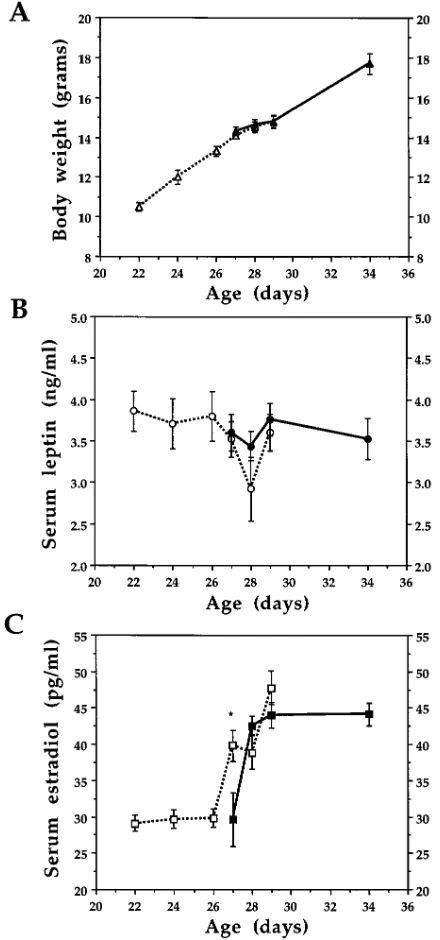
Fig. 2 illustrates the relation between body weight, and se-rum leptin and estradiol during pubertal development. There was a linear increase in body weight from day 22 to 34 (Fig. 2
A). Serum leptin concentration was 3.8060.12 ng/ml on day
22, and was not significantly altered after that (Fig. 2 B). There was no difference between leptin concentrations in mice with
no vaginal opening and those with vaginal opening (P. 0.05).
Serum estradiol concentration was unaltered until day 26, but increased after that (Fig. 2 C). On day 28, estradiol concentra-tion was 25% lower in mice with vaginal opening (Fig. 2 C).
Discussion
[image:3.612.317.553.58.455.2]The timing of puberty is crucial to the regulation of population growth and density (24, 25), and involves a complex interac-tion between genetic and environmental factors, such as nutri-tion and housing (24). A relanutri-tionship between energy homeo-stasis and reproduction is well known (6, 24). Nutrition affects
Figure 1. (A) Growth curves of female C57BL mice injected with lep-tin or saline. The mice were weaned at 21 d, housed in groups of three under 12 h light (0600–1800) and dark (1800–0600) cycles, and al-lowed ad libitum access to chow and water. They were injected once daily at 1000–1100 hours with recombinant mouse leptin, 2 mg/g body wt or saline vehicle, 100 ml i.p., until day 43. Data are means6SEM,
puberty, cyclicity, pregnancy, and lactation (6), and is a critical determinant of population growth (24, 25). In humans, states of negative energy balance (e.g., starvation) uncontrolled dia-betes, and high intensity exercise are associated with disrup-tion of cyclicity (26–28). Fecundity is better correlated with body weight and adiposity than with age (6), and the trend to-wards puberty occurring at younger ages in developed coun-tries during this century may be determined by improved nu-trition and adiposity in children (8). Vaginal opening and estrus in rodents are also influenced by adiposity (11). Rats fed
a high fat diet in which fat was substituted isocalorically for carbohydrate had earlier onset of estrus than low fat rats (11). Carcass analysis showed that despite weighing less, the high fat rats were fatter than low fat rats at first estrus (11).
The existence of metabolic signals capable of regulating the reproductive axis has been postulated (5, 11). Earlier studies suggested that fat-derived signals (e.g., fatty acids and estro-gen) (11, 29, 30) could link adiposity and reproduction, while Wade et al. (31) have proposed instead that glucose is the met-abolic signal involved in the central regulation of reproduc-tion. Since concentrations of the fat-derived hormone, leptin, correlate with adipose tissue mass in the fed state (16–18) and leptin levels fall with starvation (17, 19), leptin could provide the relevant information to the brain. This speculation is sup-ported by two lines of experimentation. Thus, leptin treatment reverses hypogonadism in two distinct states: totally leptin-deficient ob/ob mice (21, 22) and normal mice with partial lep-tin deficiency due to starvation (20). We therefore hypothe-sized that leptin may be a critical determinant of the timing of puberty. In this study we report that treatment of ad lib fed fe-male mice with a dose of leptin that does not alter body weight significantly, results in an earlier onset of vaginal opening, es-trus, and cycling. The ability of exogenous leptin to accelerate puberty without affecting body weight in normal mice suggests that leptin may be the factor that normally links body weight and energy stores to the timing of puberty. How do these find-ings relate to the actions of leptin to regulate body weight?
Whereas totally leptin-deficient ob/ob mice respond to low
doses of leptin with marked weight loss (13–15), treatment of normal mice with similar doses of leptin causes less weight loss (13–15). Our observation that daily treatment with recombi-nant leptin accelerates puberty in normal mice at doses that do not change body weight suggests that actions of leptin to regu-late neuroendocrine and reproductive function in normal mice are not secondary to effects on energy balance.
Puberty may be thought of as the period when reproduc-tion is first possible, and in rodents may manifest as the first display of lordosis. However, since the latter behavior is often not observed in laboratory animals, other parameters have been used to characterize the onset and progression of puberty (23, 32). Of the three parameters used in this study, vaginal opening correlates less with ovulation than do vaginal estrus and cyclicity (32). Vaginal opening and estrus have been corre-lated with changes in estradiol levels during pubertal develop-ment in mice (33). Estradiol has been reported to peak one day before vaginal opening, decrease thereafter and increase to another peak during vaginal estrus (33). We determined the relationship between body weight, leptin, and estradiol during pubertal development in a population of female mice in an at-tempt to detect a relationship between the onset of vaginal opening and the level of leptin in the blood. Although body weight rose linearly between days 22 and 34, the mean leptin level remained constant across this period. Although we were unable to detect a difference in mean leptin levels in mice of the same age with and without VO, in preliminary studies lep-tin levels are higher during the early postnatal period in female mice. Moreover, data from a longitudinal study of puberty in boys suggests that a rise in serum leptin occurs 3–6 mo before the initial rise in serum testosterone (Mantzoros, C., J.S. Flier and A.S. Rogol, unpublished data). Thus a rise in leptin pre-cedes and may be causally linked to the onset of puberty.
This study did not directly address the cellular and
bio-Figure 2. (A) Growth curve, (B) serum leptin, and (C) serum estra-diol concentration of female C57BL mice during pubertal develop-ment. 2VO, before vaginal opening; 1VO, vaginal opening. Data are means6SEM, n5 5–16 per group. *P, 0.05 compared with mice with vaginal opening by ANOVA and Fisher FSLD. Open symbols,
[image:4.612.55.275.62.532.2]chemical targets through which leptin accelerates puberty. The actions of leptin to regulate energy balance appear to be pri-marily through actions in the brain (13, 33–36), in particular the hypothalamus (35, 36). Since the signaling form of the lep-tin receptor has been reported to be present in gonadal tissue (31), it is possible that leptin might exert an action on the go-nad, although no such action has yet been described. With lep-tin treatment of ob/ob (22) and starved normal mice (20), lev-els of gonadotropins are increased along with sex steroids, demonstrating a capacity for central action on the reproduc-tive axis. We therefore speculate that the changes reported here may result from central, rather than peripheral actions of leptin on the reproductive axis. Although we have not deter-mined the mediators of leptin effects on the timing of puberty, the GnRH neuron is a potential target (1, 2). Changes in the frequency and magnitude of GnRH pulses herald the onset of puberty (3, 4), and it is plausible that leptin exerts direct ac-tions on the GnRH neuron, such as modifying its inherent pul-satility (37, 38) or capacity to express GnRH, or through in-termediation of another factor. Neurotransmitters such as glutamate, GABA, and NPY have been proposed as potential regulators of GnRH activity during puberty (4, 39–41). Leptin suppresses hypothalamic NPY gene expression (20, 36) and re-lease (42), and could potentially modulate levels of NPY and other neurotransmitters during puberty, leading to activation of the GnRH neuron. Whatever the cellular target in the hypo-thalamus, it is interesting that leptin has a diurnal pattern of secretion, with increased levels during sleep in humans (43) and the dark cycle in rodents (20). We speculate that increased levels of leptin during the prepubertal period could mediate the nocturnal enhancement of gonadotropin secretion of pu-berty (3).
In summary, we have shown that puberty is accelerated in normal female mice injected daily with increasing doses of re-combinant leptin. Although we have not determined the role of endogenous leptin in the physiology of puberty, we specu-late that in addition to serving as a signal linking energy stores in adipose tissue to sites in the brain involved in feeding re-sponses (12–15), leptin may inform hypothalamic sites in-volved in the coordination of the reproductive axis that suffi-cient energy stores are present to meet the demands of reproduction. The evolution of a system that links energy stores and use, and triggers adaptive responses to preserve en-ergy homeostasis, is crucial for survival of the species. Since re-production places a high demand on energy stores and puberty confers reproductive competence, and is an important deter-minant of population growth and density (24, 25), the evolu-tion of a metabolic signal linking the timing of puberty to en-ergy stores is plausible.
Acknowledgments
We thank C. Mantzoros for help with the leptin assays.
This study was supported by National Institutes of Health grant DKR3728082 to J.S. Flier.
References
1. Odell, W.D. 1992. Puberty. In Williams Textbook of Endocrinology. J.D. Wilson and D.W. Foster, editors. W.B. Saunders Co., Philadelphia. 1860–1872.
2. Lee, P.A. 1995. Definition of puberty. In Principles and Practice of Endo-crinology and Metabolism. J.B. Becker, editor. J.B. Lippincott Co., Philadel-phia. 822–830.
3. Wu, F.C.W., G.E. Butler, C.J.H. Kelnar, I. Huhtaniemi, and J.D. Veldhuis. 1996. Ontogeny of pulsatile gonadotropin releasing hormone secre-tion from midchildhood, through puberty, to adulthood in the human male: a study using deconvolution analysis and ultrasensitive immunofluorometric as-say. J. Clin. Endocrinol. Metab. 81:1798–1805.
4. Terasawa, E. 1995. Control of luteinising hormone releasing hormone pulse generation in nonhuman primates. Cell. Mol. Neurobiol. 15:141–164.
5. Kennedy, G.C., and J. Mitra. 1963. Body weight and food intake as initi-ating factors for puberty in the rat. J. Physiol. 166:408–418.
6. Van Der Spuy, Z. 1985. Nutrition and Reproduction. Clin. Obstet. Gy-naecol. 12:579–604.
7. Bronson, F.H. 1988. Effect of food manipulation on the GnRH-LH-estradiol axis of young female rats. Am. J. Physiol. 254:R616–R621.
8. Frisch, R.E. 1972. Weight at menarche: Similarity for well nourished and undernourished girls at differing ages and evidence for historical constancy. Pe-diatrics. 50:445–450.
9. Frisch, R.E. 1980. Pubertal adipose tissue: is it necessary for normal sex-ual maturation? Evidence from the rat and human female. Fed. Proc. 39:2395– 2400.
10. Frisch, R.E., and J. McArthur. 1974. Menstrual cycles: fatness as a de-terminant of minimum weight of height necessary for the maintenance or onset.
Science (Wash. DC). 185:949–951.
11. Frisch, R.E., D.M. Hegsted, and K. Yoshinaga. 1975. Body weight and food intake at early estrus of rats on a high fat diet. Proc. Natl. Acad. Sci. USA.
72:4172–4176.
12. Zhang, Y., R. Proenca, M. Maffei, M. Barone, L. Leopole, and J. Fried-man. 1994. Positional cloning of the mouse obese gene and its human homo-logue. Nature (Lond.). 372:425–432.
13. Campfield, L., F. Smith, Y. Guisez, R. Devos, and P. Burn. 1995. Re-combinant mouse ob protein: evidence for a peripheral signal linking adiposity and central neural networks. Science (Wash. DC). 269:546–549.
14. Halaas, J., K. Gajiwala, M. Maffei, S. Cohen, B. Chait, D. Rabinowitz, R. Lallone, S. Burley, and J. Friedman. 1995. Weight-reducing effects of the plasma protein encoded by the obese gene. Science (Wash. DC). 269:543–546.
15. Pelleymounter, M., M.J. Cullen, M.B. Baker, R. Hecht, D. Winters, T. Boone, and F. Collins. 1995. Effects of the obese gene product on body weight regulation in ob/ob mice. Science (Wash. DC). 269:540–563.
16. Considine, R.V., M.K. Sinha, M.L. Heiman, A. Kriaucinas, T.W. Stephens, M.R. Nyce, J.P. Ohannesian, C.C. Marco, L.J. McKee, T.J. Bauer, and J.F. Caro. 1996. Serum immunoreactive leptin concentrations in normal weight and obese humans. N. Engl. J. Med. 334:292–295.
17. Maffei, M.J., J. Halaas, E. Rayussin, R.E. Pratley, G.M. Lee, Y. Zhang, H. Fei, S. Kim, R. Lallone, S. Ranganathan, et al. 1995. Leptin levels in human and rodent: measurement of plasma leptin and ob mRNA in obese and weight-reduced subjects. Nat. Med. 1:1155–1161.
18. Frederich, R.C., A. Hamann, S. Anderson, B. Lollman, B.B. Lowell, and J.S. Flier. 1995. Leptin levels reflect body lipid content in mice: evidence for diet-induced resistance to leptin action. Nat. Med. 1:1311–1314.
19. Frederich, R.C., B. Lollman, A. Hamann, A. Napolitano-Rosen, B.B. Kahn, B.B. Lowell, and J.S. Flier. 1995. Expression of ob mRNA and its en-coded protein in rodents. J. Clin. Invest. 96:1658–1663.
20. Ahima, R.S., D. Prabakaran, C. Mantzoros, D. Qu, B. Lowell, E. Mara-tos-Flier, and J.S. Flier. 1996. Role of leptin in the neuroendocrine response to fasting. Nature (Lond.). 382:250–252.
21. Chehab, F., M. Lim, and R. Lu. 1996. Correction of the sterility defect in homozygous obese female mice by treatment with the human recombinant lep-tin. Nat. Genet. 12:318–320.
22. Barash, I.A., C.C. Cheung, D.S. Weigle, R. Hongping, E.B. Kagigting, J.L. Kuijper, D.K. Clifton, and R.A. Steiner. 1996. Leptin is a metabolic signal to the reproductive system. Endocrinology. 137:3144–3147.
23. Nelson, J.F., K. Karelus, L.S. Felico, and T.E. Johnson. 1990. Genetic in-fluences on the timing of puberty in mice. Biol. Reprod. 42:649–655.
24. Bronson, F.H. 1985. Mammalian reproduction: an ecological perspec-tive. Biol. Reprod. 32:1–26.
25. Vandenbergh, J.G. 1987. Regulation of puberty and its consequences on population dynamics of mice. Am. Zool. 27:891–898.
26. De Souza, M., and D. Metzger. 1991. Reproductive dysfunction in amenorrheic athletes and anorexic patients: a review. Med. Sci. Sports Exercise.
23:995–1007.
27. Boyar, R.M., J. Katz, J.W. Finkelstein, S. Kapen, H. Weiner, E.D. Weitzman, and L. Hellman. 1974. Anorexia nervosa: immaturity of the 24-hour luteinizing hormone secretory pattern. N. Engl. J. Med. 291:861–865.
28. Griffin, M., S. South, V. Yankov, R. Booth, C. Aspin, J.W. Veldhuis, and W. Evans. 1994. Insulin-dependent diabetes mellitus and menstrual dys-function. Ann. Med. 26:331–340.
29. Innami, S., M.G. Yang, O. Mickelson, and H.D. Hafs. 1973. The influ-ence of high fat diets on estrous cycles, sperm production and fertility of rats.
Proc. Soc. Exp. Biol. Med. 143:63–68.
30. Smith, E.R., and J.M. Davidson. 1968. Role of estrogen in the cerebral control of puberty in female rats. Endocrinology. 82:100–108.
32. Safranski, T.J., W.R. Lamerson, and D.H. Keisler. 1993. Correlations among three measures of puberty in mice and relationships with estradiol con-centration and ovulation. Biol. Reprod. 48:669–673.
33. Tartaglia, L., M. Dembski, X. Weng, N. Deng, J. Culpepper, R. Devos, G. Richards, L. Campfield, F. Clark, J. Deeds, et al. 1995. Identification and ex-pression cloning of a leptin receptor OB-R. Cell. 83:1263–1271.
34. Cioffi, J.A., A.W. Shafer, T.J. Zupancic, J. Smith-Gbur, A. Mikhail, D. Platika, and H.R. Snodgrass. 1996. Novel B219/ob receptor isoforms: possible role of leptin in hematopoeisis and reproduction. Nat. Med. 2:585–589.
35. Banks, W.A., A.J. Kastin, W. Huang, J.B. Jaspan, and L.M. Maness. 1996. Leptin enters the brain by a saturable system independent of insulin. Pep-tides. 17:305–311.
36. Schwartz, M.W., R.J. Seeley, A. Campfield, P. Burn, and D.G. Baskin. 1996. Identification of targets for leptin action in rat hypothalamus. J. Clin. In-vest. 98:1101–1106.
37. Mellon, P.L., J.J. Windle, P.C. Goldsmith, C.A. Padula, J.L. Roberts, and R.I. Weiner. 1990. Immortalization of hypothalamic GnRH neurons by ge-netically targeted tumorigenesis. Neuron. 5:1–10.
38. Wetsel, W.C. 1995. Immortalized hypothalamic luteinising
hormone-releasing hormone (LHRH) neurons: a new tool for dissecting the molecular and cellular basis of LHRH physiology. Cell. Mol. Neurobiol. 15:43–78.
39. Urbanski, H.E., and S.R. Ojeda. 1990. A role for N-methyl-D-aspartate (NMDA) receptors in the control of LH secretion and initiation of female pu-berty. Endocrinology. 126:1774–1776.
40. Mitsushima, D., D.L. Hei, and E. Terasawa. 1994. g-Aminobutyric acid is an inhibitory neurotransmitter restricting the release of luteinizing hormone before the onset of puberty. Proc. Natl. Acad. Sci. USA. 91:395–399.
41. McDonald, J.K., M.D. Lumpkin, and V. DePaolo. 1989. Neuropeptide Y suppresses pulsatile secretion of LH in ovariectomized rats: possible site of action. Endocrinology. 125:186–191.
42. Stephens, T., M. Basinski, P. Bristow, J. Bue-Valleskey, S. Burgett, L. Craft, J. Hale, H. Hsiung, A. Kriauciunas, W. MacKellar, et al. 1995. The role of neuropeptide Y in the antiobesity action of the obese gene product. Nature (Lond.) 377:530–532.