Copyright © 1998, American Society for Microbiology. All Rights Reserved.
Development of a PCR-Restriction Fragment Length Polymorphism
Assay Using the Nucleotide Sequence of the Helicobacter
hepaticus Urease Structural Genes ureAB
ZELI SHEN,
1DAVID B. SCHAUER,
1,2HARRY L. T. MOBLEY,
3ANDJAMES G. FOX
1,2*
Divisions of Comparative Medicine
1and Toxicology,
2Massachusetts Institute of Technology,
Cambridge, Massachusetts 02139, and Department of Microbiology and Immunology,
University of Maryland School of Medicine, Baltimore, Maryland 21201
3Received 19 February 1998/Returned for modification 5 May 1998/Accepted 10 June 1998
Infection with Helicobacter hepaticus causes chronic active hepatitis in certain strains of mice and is
asso-ciated with hepatocellular carcinoma in A/JCr mice. Like the gastric helicobacters, H. pylori and H. mustelae,
H. hepaticus possesses a high level of urease activity. However, the H. hepaticus urease structural gene sequences
have not been previously determined, and the role of the urease enzyme in colonization and in pathogenesis is
not known. PCR was used to amplify a portion of the urease structural genes from H. hepaticus genomic DNA.
Amplified DNA fragments were cloned, and the nucleotide sequence was determined. The deduced amino acid
sequence of the partial H. hepaticus ureA gene product was found to exhibit 60% identity and 75% similarity to
the predicted H. pylori UreA. The deduced amino acid sequence of a partial H. hepaticus ureB gene product
ex-hibited 75% identity and 87% similarity to the predicted H. pylori UreB. Diversity among H. hepaticus isolates
was evaluated by means of a restriction fragment length polymorphism (RFLP) assay. The 1.6-kb fragments
with-in the ureAB open readwith-ing frames, amplified from 11 with-independent isolates, were digested with the restriction
endonuclease HhaI. Three distinct RFLP patterns were observed. Identical RFLP profiles were noted in
se-quential isolates of one strain of H. hepaticus during an 18 month in vivo colonization study, suggesting that
the urease genes of H. hepaticus are stable. The urease genes among H. hepaticus strains were also well
con-served, showing 98.8 to 99% nucleotide sequence identity among three isolates analyzed. These findings
indi-cate that H. hepaticus has urease structural genes which are homologous to those of the gastric Helicobacter
species and that these gene sequences can be used in a PCR and RFLP assay for diagnosis of this important
murine pathogen.
The genus Helicobacter is a group of microaerobic
gram-negative spiral to curved bacteria isolated from the stomachs
and intestines of humans and animals. The type species of the
genus, Helicobacter pylori, has been recognized in humans as
the most common cause of chronic gastritis and has been
unambiguously implicated in the pathogenesis of peptic ulcer
disease and gastric cancer (4, 10, 38, 40). H. mustelae, H. felis,
and H. heilmannii are closely related organisms which have
been isolated from the stomachs of mammalian species. Each
of these species causes various degrees of gastritis in their
respective hosts (18, 19, 21, 22).
Infection with H. hepaticus causes chronic active hepatitis in
mice and is associated with hepatocellular carcinoma in A/JCr
mice (17, 20, 23). Infection with H. hepaticus has also been
linked to inflammatory bowel disease in certain
immunodefi-cient strains of mice as well as in A/JCr mice (6, 20, 51, 52).
Like several other murine Helicobacter spp. which colonize
the lower intestine, H. hepaticus expresses an active urease
(18). Whereas the role of urease expression by Helicobacter
spp. in intestinal and hepatobiliary colonization has not been
determined, the production of urease has been shown to be
important in the survival of H. pylori in the human gastric
mucosa (10, 33–35). This enzyme hydrolyzes urea, releasing
ammonia, which may allow survival of the organism at a low
pH. The contribution of H. pylori urease to pathogenesis and to
the ability to colonize the stomach at acidic pHs has been
assessed by utilizing urease-negative isogenic mutant strains in
colonization experiments (15, 27, 48, 49). Urease-negative
tant strains of H. pylori are unable to colonize the gastric
mu-cosa of gnotobiotic piglets at a normal physiological pH (14).
The urease-negative mutant of H. pylori also lacks the ability to
colonize the stomach of nude mice (49). Similar studies were
conducted with urease-negative H. mustelae isogenic mutants.
These mutants also fail to colonize the gastric mucosa of
fer-rets (3). However, Eaton and Krakowka showed that H. pylori
urease-negative mutants colonize gastric mucosal explants,
de-rived from neonatal germfree piglets, as efficiently as the
wild-type strains do, suggesting that the intact host environment is
a prerequisite for urease-dependent colonization (15). In
ad-dition, urease consistently elicits an immune response in the
host and this immunodominant protein has been used to
diag-nose H. pylori infection (47).
It has been previously reported that the urease from H.
py-lori exhibits a peak of activity at an acidic pH, which is not
observed for the urease from H. muridarum, another murine
Helicobacter species that colonizes the bowel but also can
col-onize the mouse stomach (30). Presumably, the urease of
H. muridarum as well as other nongastric, urease-positive
he-licobacters has evolved for a purpose other than buffering
gas-tric acid, such as supplying these bacteria with nitrogen from
hydrolyzed urea.
In this study, we attempted to identify differences between
the ureases of H. hepaticus and H. pylori by determining the
partial nucleotide sequences of the genes encoding the
struc-* Corresponding author. Mailing address: Division of Comparative
Medicine, Massachusetts Institute of Technology, Bldg. 16 825C, 77
Massachusetts Ave., Cambridge, MA 02139. Phone: (617) 253-1757.
Fax: (617) 258-5708. E-mail: [email protected].
2447
on May 15, 2020 by guest
http://jcm.asm.org/
tural subunits of the enzyme synthesized by H. hepaticus. We
have used this information to develop a PCR-based restriction
fragment length polymorphism (RFLP) assay for use as an
epi-demiological tool for the differentiation and identification of
H. hepaticus clinical isolates.
MATERIALS AND METHODS
Bacterial strains and growth media.The H. hepaticus type strain (ATCC 51449), isolated from the liver of an A/JCr mouse, was used to prepare templates for sequence determination of the urease structural subunit genes (17). All other
H. hepaticus isolates were cultured by filtering feces or cecum homogenates from
infected mice through a 0.45-mm-pore-size filter and inoculating brucella blood agar supplemented with trimethoprim, vancomycin, and polymyxin (Remel Labs, Lenexa, Kans.) with the filtrate. Plates were incubated under microaerobic con-ditions as previously described (43).
DNA extraction.A High Pure PCR Template Preparation Kit (Boehringer Mannheim, Indianapolis, Ind.) was used to extract DNA from bacterial pellets as outlined by the manufacturer and previously described (43).
PCR amplification.Table 1 shows the nucleotide sequences and the sources for all primers used to amplify the H. hepaticus urease structural genes. PCR amplification reactions were performed with a Thermal Cycler and an Expand high-fidelity PCR system (Boehringer Mannheim). The reaction mixture (100ml) contained 13polymerase buffer (supplied by the manufacturer but supple-mented with 1 M MgCl2to a final concentration of 2.25 mM), a 0.5mM
con-centration of each of the two primers, a 200mM concentration of each deoxy-ribonucleotide, and bovine serum albumin (200mg/ml). Samples were heated at 94°C for 4 min, briefly centrifuged, and cooled to 55°C. Polymerase (2.5 U) was then added, followed by an overlay of 100ml of mineral oil. Amplification was achieved by denaturation at 94°C for 1 min, annealing at 55 to 58°C for 2 min, and elongation at 72°C for 2 min. A 15-ml portion of the sample was then electrophoresed through a 6% Visigel separation matrix (Stratagene, La Jolla, Calif.).
Southern blot analysis.For confirmation that the PCR-amplified fragment represented urease gene sequences, the PCR product (15ml) was electropho-resed through a 1% agarose gel and transferred onto a Hybond-N nylon mem-brane as outlined by the manufacturer (Amersham, Arlington Heights, Ill.); this was followed by UV cross-linking (43). The filter was hybridized with a PCR product of the H. pylori urease gene amplified by the same primers. This 1-kb PCR product was excised from a low-melting-point agarose gel and purified with a Geneclean DNA purification kit (Bio 101, Vista, Calif.). The probe was labeled with horseradish peroxidase, hybridized overnight to the nylon membrane at 42°C, and exposed in the presence of Luminol to Hyperfilm-ECL as outlined by the manufacturer (Amersham) (43).
Cloning and sequencing of the PCR product.A TA Cloning Kit (Invitrogen Corp. San Diego, Calif.) was used for cloning PCR products. PCR products were purified from low-melting-point agarose gels with a Geneclean kit, as described above. Purified PCR product was ligated with 50 ng of PCR II vector at 15°C overnight and was then transferred into INVaF9 cells. LB plates containing ampicillin (50mg/ml) and X-Gal (5-bromo-4-chloro-3-indolyl-b -D-galactopyran-oside) (40mg/ml) were used to select clones. Plasmid DNA was isolated from
Escherichia coli by a High Pure Plasmid Isolation Kit (Boehringer Mannheim).
The sequencing was carried out at the Biopolymers Laboratory (Center for Cancer Research, Massachusetts Institute of Technology) with a DNA sequencer (model 377; Applied Biosystems, Perkin-Elmer, Foster City, Calif.) and a Taq DyeDeoxy terminator cycle sequencing kit (Perkin-Elmer).
RFLP of H. hepaticus urease genes.Primers HHUF5 and 4324R (Table 1) were used to amplify a 1.6-kb PCR fragment from the H. hepaticus urease genes
ureA and ureB. Amplified DNA (20ml) was digested with 10 U of enzyme in the appropriate buffer recommended by the enzyme manufacturer at 37°C for 3 h. Restriction patterns were compared after the digested PCR products were sep-arated on a 6% Visigel separation matrix. The restriction enzymes HhaI, AluI,
BfaI, HinfI, HaeIII, and DpnI were chosen on the basis of the number and
placement of restriction sites predicted from the acquired nucleotide sequence. Nucleotide sequence accession numbers.The nucleotide sequences of H.
he-paticus ureAB from strains ATCC 51449, 96284, and 951971 have been deposited
in GenBank under accession no. AF066862, AF066863, and AF066864, respec-tively.
RESULTS
PCR amplification and cloning of partial ureAB fragments.
Primers HURE3 and HURE4 (Table 1) were designed to
am-plify a 1-kb ureB fragment based on conserved regions from the
urease structural genes from H. pylori and H. mustelae (36, 44).
However, by using this pair of primers to amplify H. hepaticus
DNA, two bands (0.5 and 1.5 kb) were amplified. By Southern
blot analysis, the PCR product amplified from H. pylori only
hybridized to the 0.5-kb fragment (data not shown). The 0.5-kb
fragment was cloned and sequenced; it has 76% similarity to
the H. pylori ureB gene (36).
The H. hepaticus ureB sequence was used in conjunction with
the H. pylori ureA sequence to design a primer to amplify
up-stream and downup-stream fragments of ureA and ureB. Primer
HURE1 was chosen from the H. pylori urease sequence, and
the primer HHUR1 was chosen from the H. hepaticus sequence.
These primers amplified a 0.9-kb fragment containing ureA
and part of ureB. Primer HHUF1, based on the H. hepaticus
sequence, and primer 4324R, chosen from the H. pylori urease
sequence, amplified a 0.9-kb fragment containing part of the
ureB gene sequence. The two fragments had a 120-bp sequence
overlap (Fig. 1).
Sequence analysis of H. hepaticus urease structural genes.
[image:2.612.50.549.81.167.2]Sequence analysis of the H. hepaticus urease fragments
re-vealed two open reading frames, designated ureA and ureB,
that were transcribed in the same direction. The nucleotide
sequence showed 66% identity to the H. pylori ureA. The
par-tial nucleotide sequence of the H. hepaticus ureB gene,
approx-imately two-thirds of the gene according to the H. pylori ureB
TABLE 1. Primers used for amplification of H. hepaticus urease genes
Primerc Sequence Source of sequence (position) Gene
HURE1
GGAATTCTAGAATAGGAGAATGAGATGA
H. pylori (2634–2662)
aureA
HURE3
CCATCGATGCCCATATTATGGAAGAAGC
H. pylori (2777–2798)
aureA
HURE4
GGAGATCTCCACCAATCATGGTTGTTACA
H. pylori (3834–3855)
aureB
HHUF1
ATTAAATTTGGCGGAGGAAAA
H. hepaticus (817–837)
bureB
HHUR1
ATATGTCCCTAAATGTTTCGA
H. hepaticus (922–942)
bureB
HHUF5
TTGCATTATGCTGGGC
H. hepaticus (28–45)
bureA
4324R
GCATCCGCGGCCGCTGGTGGCACACCATAAGCATGTC
H. pylori (4324–4346)
aureB
aSequence from the published H. pylori urease sequence (29) at the position indicated. bSequence from this study at the position indicated.
cPrimers HHUF5 and 4324R were used for RFLP analysis. Primers HHUF5 and HHUR1 were used to distinguish H. hepaticus from other Helicobacter spp.
FIG. 1. PCR-amplified products of ureAB genes from H. pylori (H.p) (open bars) and H. hepaticus (shaded bars).
2448
SHEN ET AL.
J. C
LIN. M
ICROBIOL.
on May 15, 2020 by guest
http://jcm.asm.org/
[image:2.612.312.546.601.704.2]gene sequence (36), showed 71% identity to the H. pylori ureB
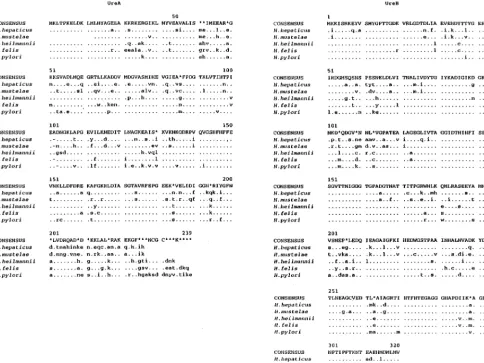
gene. The predicted amino acid sequence of the H. hepaticus
urease was compared to those of H. felis, H. mustelae, H.
heil-mannii, and H. pylori. The H. hepaticus urease was most closely
related to the urease of H. mustelae (71% amino acid sequence
identity with UreA and 83% identity with UreB) and to a
slightly lesser extent was related to the urease of H. felis (61%
amino acid sequence identity with UreA and 76% identity with
UreB) (Fig. 2).
The intergenic space between ureA and ureB was found to be
21-bp for H. hepaticus. This intergenic space is longer than the
14 bp for H. heilmannii, the 9 bp for H. felis, and the 3 bp for
H. pylori.
Use of PCR-amplified H. hepaticus urease structural genes
for differentiation of H. hepaticus strains.
Primers HHUF5 and
4324R (Table 1) successfully amplified a 1.6-kb PCR fragment
(from nucleotide 2668 of ureA to nucleotide 4323 of ureB
according to the H. pylori ure gene sequence) from 11 different
H. hepaticus strains isolated from mice from 11 different
sources. All isolates were confirmed as H. hepaticus by PCR
using 16S rRNA primers specific for H. hepaticus (data not
shown) (43). The PCR product digested with HhaI resulted in
three distinct patterns after agarose gel electrophoresis (Fig.
3). Pattern A yielded fragments of about 50, 120, 150, 470, and
830 bp. Two of the strains that produced this pattern were from
Europe, and the other six strains were from the United States.
Two strains isolated in the United States yielded pattern B,
with fragments of 50, 120, 620, and 830 bp. One strain isolated
from the United States yielded Pattern C, consisting of
ments of 50, 150, 470, and 940 bp. The restriction digest
frag-ment patterns were identical for all 11 strains when other
enzymes—AluI, BfaI, HinfI, HaeIII, and DpnI—were used for
digestion (data not shown).
Using the same method, we also examined sequential H.
he-paticus isolates cultured from mice during a long-term
coloni-zation study (20). Isolates of H. hepaticus from experimentally
inoculated germfree mice at 3, 6, 9, 12, 15, and 18 months after
inoculation were used for RFLP analysis. All of these isolates
had identical pattern-A RFLP profiles (Fig. 4A). H. hepaticus
isolates from different strains of mice originating from the
same commercial animal supplier also were subjected to RFLP
analysis. Among the isolates cultured from the seven different
strains of mice, pattern A and pattern B were recognized (Fig.
4B).
Homology of ure genes among H. hepaticus strains.
RFLP
[image:3.612.64.548.75.438.2]analysis with HhaI revealed that there was limited diversity in
the H. hepaticus urease genes among the 18 strains analyzed.
These genes appear to be highly conserved, because digestion
FIG. 2. Predicted amino acid sequences of UreA and UreB from H. hepaticus aligned with the corresponding predicted sequences from H. felis, H. pylori, H. heilmannii, and H. mustelae. ., sequence identity;p, sequence difference.
on May 15, 2020 by guest
http://jcm.asm.org/
with five other restriction enzymes—AluI, BfaI, HinfI, HaeIII,
and DpnI—produced identical RFLP profiles (data not shown).
To investigate the similarity of H. hepaticus urease genes
among strains, the partial urease genes of two other H.
hepati-cus strains were directly sequenced from their 1.6-kb PCR
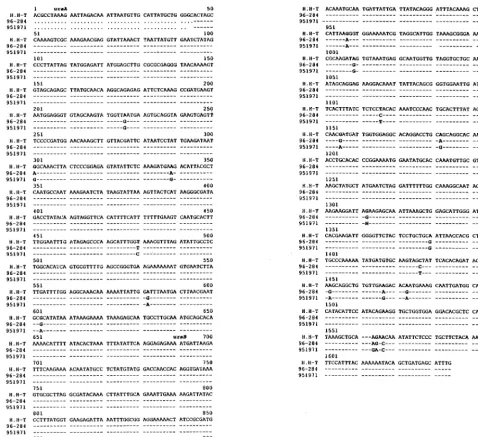
products. Strain 96284, isolated in Germany, had the same
RFLP pattern as the H. hepaticus type strain (pattern A) and
99% nucleotide sequence identity to the urease gene of the
H. hepaticus type strain. Strain 951971, isolated from mouse
obtained from another U.S. university had a different RFLP
pattern (pattern B) than the type strain. The urease genes of
this strain showed 98.8% nucleotide sequence identity to that
of the H. hepaticus type strain (Fig. 5).
Distinguishing H. hepaticus from other Helicobacter spp.
Primers HHUF5 and HHUR1 (Table 1) were used to amplify
a fragment from the ure structural genes. This set of primers
amplified a 914-bp fragment from all 11 H. hepaticus isolates
tested and did not cross-react with 8 of the other Helicobacter
spp. analyzed (Fig. 6).
DISCUSSION
The RFLP assay we developed using amplified urease genes
should provide a sensitive epidemiological tool for the typing
of H. hepaticus clinical isolates. The use of the urease gene
PCR product for restriction digest analysis readily produced
identifiable differences in restriction digest patterns. Also, this
assay does not require a high concentration of chromosomal
DNA, special equipment for PFGE, or further extraction of
the PCR product. However, because of the relatively small
number of H. hepaticus isolates analyzed in the present study
and the low degree of RFLP diversity observed, a larger
num-ber of isolates and, perhaps, additional restriction enzymes will
need to be employed before the full utility of this
epidemio-logical typing procedure can be established. Similarly, analyses
of more animals, both infected and uninfected with H.
hepati-cus, will need to be tested before the true sensitivity of this
assay can be determined.
We used primers to amplify a 1.6-kb urease gene fragment
from 11 isolates of H. hepaticus obtained from mice from
different sources, and three different patterns were observed.
Foxall et al. (24) reported that for 22 clinical isolates of H.
py-lori, there were 10 urease gene RFLP patterns. These
prelim-inary data suggest that the H. hepaticus urease genes are more
conserved than that of H. pylori. Interestingly, H. hepaticus
isolated from mice obtained from the same commercial source
but maintained in different rooms had different RFLP
pat-terns, indicating that different strains of mice from the same
commercial source can be infected with different H. hepaticus
strains. The different RFLP patterns detected in our study
were probably not due to base substitutions during PCR,
be-cause repeated PCR amplification of individual strains
pro-duced the same restriction patterns. The urease genes also
appeared to be very stable in vivo. During long-term
coloniza-tion in mice, the H. hepaticus strain used for experimental
inoculation maintained the same RFLP profile (20).
PCR amplification and analysis of restriction digest patterns
of the urease structural genes also have been used to
distin-guish different H. pylori strains (1, 2, 5, 11, 13, 24, 31, 37, 46),
to identify the presence of multiple strains in a single biopsy
specimen (26), to ascertain whether reinfection with the same
strain occurred following eradication therapy (39), and to
iden-tify similar or identical strains among family members (50).
Although the epidemiology of H. hepaticus infection is
un-known, widespread H. hepaticus infection in commercially
maintained mice, as well as in mice being used in biomedical
research, has been previously reported (43). H. hepaticus, like
H. pylori, also demonstrates genetic diversity at the genomic
DNA level. Saunders et al. (42) reported that H. hepaticus
strains isolated from mice in the United States and European
countries had different restriction enzyme digestion patterns of
chromosomal DNA when analyzed by pulsed-field gel
electro-phoresis (PFGE). In their study, the strains from European
countries had restriction enzyme digestion patterns of
chromo-somal DNA different from the pattern noted in the H.
hepati-FIG. 3. Restriction digest patterns of the amplified urease gene on a 1.6-kbPCR product from 11 H. hepaticus isolates. Amplified DNA was digested with
HhaI and separated by electrophoresis on a 6% Visigel. Shown are a 100-bp
DNA ladder (lane 1), pattern A (lanes 2 to 4, 6 to 9, and 11), pattern B (lanes 5 and 12), and pattern C (lane 10).
FIG. 4. (A) Restriction digest patterns of amplified urease genes of H.
paticus isolates cultured from mice during a long-term colonization study. H. he-paticus was isolated from the mouse cecum 3 (lane 1), 6 (lane 2), 9 (lane 3), 12
(lane 4), 15 (lane 5), and 18 months (lane 6) postinoculation. Lane 7, H. hepaticus strain used for dosing; lane 8, 100-bp DNA ladder. (B) Restriction digest pat-terns of amplified urease genes of H. hepaticus isolated from different strains of mice housed within the same facility. Lane 1, DBA/2J; lane 2, B6D2F1/D; lane 3,
BALB/J; lane 4, B6SJLF1; lane 5, BALB/cByj-nu; lane 6, BALB/cBj; lane 7,
C57BL/6c-nu; lane 8, 100-bp DNA ladder.
2450
SHEN ET AL.
J. C
LIN. M
ICROBIOL.
on May 15, 2020 by guest
http://jcm.asm.org/
[image:4.612.67.273.69.223.2]cus type strain. In our study, however, one of the European
strains had the same RFLP pattern of the ure gene as the type
strain. Restriction enzyme digestion of genomic DNA coupled
with PFGE may be a better method with which to discriminate
between individual strains of H. hepaticus than RFLP analysis.
But the relative ease and rapidity of the RFLP method may
make this a preferred method for initial analysis. Strains which
are not differentiated by ure gene RFLP can then be analyzed
for genetic polymorphism at other loci by PFGE.
It can be argued that the nucleotide sequence of such an
important virulence factor as urease should be conserved
among strains and that the nucleotide sequence variations
de-tected in the ureA and ureB genes of H. hepaticus strains are
base substitutions that nevertheless conserve amino acids or
allow amino acid substitutions that do not affect enzyme
activ-ity. The different H. hepaticus isolates tested showed high
ho-mology within the urease gene, about 99% identity at the DNA
level and 99% similarity at the amino acid level, among the
three strains analyzed from different locations. Single base
changes apparently are responsible for restriction site
differ-ences. Because the urease structural genes have high homology
among H. hepaticus strains, primers selected specifically for
H. hepaticus from the region exhibiting diversity among
Heli-cobacter spp. can be used for diagnostic purposes. For example,
the primers from the urease gene of H. pylori have been
com-monly used for the detection of H. pylori (5, 7, 32). Primers
HHUF5 and HHUR1 based on H. hepaticus urease gene
se-quence amplified a 914-bp product from all of the 11 H.
he-paticus strains but did not amplify the same size product from
DNAs of 8 other Helicobacter spp. which either have urease
activity or alternatively are urease-negative helicobacters that
colonize the intestine of rodents. It is noted, however, that
H. muridarum and H. bilis had nonspecific PCR products of a
different size.
The presence of two structural urease subunits in H.
hepati-cus is characteristic of the genus Helicobacter. Urease
struc-FIG. 5. Sequence comparison of the H. hepaticus urease genes of different strains. A dash indicates sequence identity; sequence differences are illustrated in boldface type. H.H-T, H. hepaticus type strain (ATCC 51449).
on May 15, 2020 by guest
http://jcm.asm.org/
[image:5.612.59.538.70.507.2]tural genes from H. hepaticus are highly homologous to ureA
and ureB from H. mustelae (44), H. felis (16, 25), H. heilmannii
(45), and H. pylori (36). The homology is greatest for ureB,
which is consistent with the fact that this subunit contains the
urease catalytic site, which is highly conserved among the known
Helicobacter spp. The conservation of ureA and ureB
polypep-tide sequences is consistent with an essential role for urease in
the colonization and presumably the pathogenesis of some
Helicobacter spp. (36).
The availability of urease gene DNA sequences from
differ-ent species of Helicobacter, which differ in host range
specific-ity, tissue specificspecific-ity, and ability to produce disease, will allow
further delineation of the role of urease. We have recently
constructed and are currently characterizing an isogenic
ure-ase-negative mutant of H. hepaticus, to allow a more precise
evaluation of the role of H. hepaticus urease in the colonization
and pathogenesis of hepatobiliary and inflammatory bowel
dis-ease (6, 20). Recent evidence also suggests that immunization
of mice with urease from Helicobacter spp. confers protection
against challenge with H. felis and H. pylori (8, 9, 12, 28, 41).
Studies to ascertain whether H. hepaticus urease can induce
protective immunity and prevent H. hepaticus colonization in
vivo may also be an important strategy in the development of
an H. hepaticus vaccine.
In summary, we used PCR to amplify a portion of the urease
structural genes from H. hepaticus genomic DNA. The urease
genes from this nongastric Helicobacter sp. show a high degree
of homology with other Helicobacter spp., and the urease genes
of H. hepaticus were less diverse than those of H. pylori. A
PCR-based RFLP assay using the nucleotide sequence of the
H. hepaticus urease structural genes ureAB was developed to
identify and differentiate clinical isolates. This assay, with
fur-ther development, should prove to be useful for studying the
epidemiology and pathogenesis of this murine pathogen.
ACKNOWLEDGMENTS
This work was supported by grants R01CA67529, P01CA26731, and
R01AI23328 from the National Institutes of Health.
We thank Paul Foxall for sharing preliminary nucleotide sequence
data.
REFERENCES
1. Akashi, H., T. Hayashi, H. Koizuka, T. Shimoyama, and T. Tamura. 1996. Strain differentiation and phylogenic relationships, in terms of base sequence of the ure B gene, of Helicobacter pylori. J. Gastroenterol. 31:16–23. 2. Akopyanz, N., N. O. Bukanov, T. U. Westblom, and D. E. Berg. 1992.
PCR-based RFLP analysis of DNA sequence diversity in the gastric patho-gen Helicobacter pylori. Nucleic Acids Res. 20:6221–6225.
3. Andrutis, K. A., J. G. Fox, D. B. Schauer, R. P. Marini, J. C. Murphy, L. Yan, and J. V. Solnick.1995. Inability of an isogenic urease-negative mutant strain of Helicobacter mustelae to colonize the ferret stomach. Infect. Immun. 63: 3722–3725.
4. Bayerdorffer, E., A. Neubauer, B. Rudolph, C. Thiede, N. Lehn, S. Eidt, and M. Stolte.1995. Regression of primary gastric lymphoma of mucosa-associ-ated lymphoid tissue type after cure of Helicobacter pylori infection. Lancet 345:1591–1594.
5. Bickley, J., R. J. Owen, A. G. Fraser, and R. E. Pounder. 1993. Evaluation of the polymerase chain reaction for detecting the urease C gene of
Helicobac-ter pylori in gastric biopsy samples and dental plaque. J. Med. Microbiol. 39:
338–344.
6. Cahill, R. J., C. J. Foltz, J. G. Fox, C. A. Dangler, F. Powrie, and D. B. Schauer.1997. Inflammatory bowel disease: an immune-mediated condition triggered by bacterial infection with Helicobacter hepaticus. Infect. Immun. 65:3126–3131.
7. Clayton, C., H. Kleanthous, P. Coates, D. Morgan, and S. Tabaqchali. 1992. Sensitive detection of Helicobacter pylori by using polymerase chain reaction. J. Clin. Microbiol. 30:192–200.
8. Corthesy-Theulaz, I., N. Porta, M. Glauser, E. Saraga, A. Vaney, R. Haas, J. Kraehenbuhl, A. Blum, and P. Michetti.1993. Helicobacter pylori urease elicits protection against Helicobacter felis infection in mice. Acta Gastro-Enterol. Belg. 56:64.
9. Corthesy-Theulaz, I., N. Porta, M. Glauser, E. Saraga, A. C. Vaney, R. Haas, J. P. Kraehenbuhl, A. L. Blum, and P. Michetti.1995. Oral immunization with Helicobacter pylori urease B subunit as a treatment against Helicobacter infection in mice. Gastroenterology 109:115–121.
10. Dekigal, H., M. Murakami, and T. Kita. 1995. Mechanism of Helicobacter
pylori associated gastric mucosa injury. Dig. Dis. Sci. 40:1332–1339.
11. Desai, M., D. Linton, R. Owen, and J. Stanley. 1994. Molecular typing of
Helicobacter pylori isolates from asymptomatic, ulcer and gastritis patients by
urease gene polymorphism. Epidemiol. Infect. 112:151–160.
12. Dore-Davin, C., P. Michetti, E. Saraga, A. Blum, and I. Corthesy-Theulaz. 1996. A 37 kDa fragment of ureB is sufficient to confer protection against
Helicobacter felis infection in mice. Gastroenterology 110:A97.
13. Dzierzanowska, D., A. Gzyl, E. Rozynek, E. Augustynowicz, U. Wojda, D. Celink-Cedro, M. Sankwoska, and T. Wadstrom.1996. PCR for identifica-tion and typing of Helicobacter pylori isolated from children. J. Physiol. Pharmacol. 47:101–104.
14. Eaton, K., and S. Krakowka. 1995. A virulent, urease-deficient Helicobacter
pylori colonises gastric epithelial explants ex vivo. Scand. J. Gastroenterol.
30:434–437.
15. Eaton, K. A., and S. Krakowka. 1994. Effect of gastric pH on urease-depen-dent colonization of gnotobiotic piglets by Helicobacter pylori. Infect. Immun. 62:3604–3607.
16. Ferrero, R. L., and A. Labigne. 1993. Cloning expression and sequencing of
Helicobacter felis urease genes. Mol. Microbiol. 9:323–333.
17. Fox, J. G., F. E. Dewhirst, J. G. Tully, B. J. Paster, L. Yan, N. S. Taylor, M. J. Collins, P. L. Gorelick, and J. M. Ward.1994. Helicobacter hepaticus sp. nov, a microaerophilic bacterium isolated from livers and intestinal mucosal scrapings from mice. J. Clin. Microbiol. 32:1238–1245.
18. Fox, J. G., and A. Lee. 1997. The role of Helicobacter species in newly recognized gastrointestinal tract diseases of animals. Lab. Anim. Sci. 47:222– 255.
19. Fox, J. G., A. Lee, G. Otto, N. S. Taylor, and J. C. Murphy. 1991. Helicobacter
felis gastritis in gnotobiotic rats: an animal model of Helicobacter pylori
gastritis. Infect. Immun. 59:785–791.
20. Fox, J. G., X. Li, L. Yan, R. J. Cahill, R. Hurley, R. Lewis, and J. C. Murphy. 1996. Chronic proliferative hepatitis in A/JCr mice associated with persistent
Helicobacter hepaticus infection: a model of helicobacter-induced
carcino-genesis. Infect. Immun. 64:1548–1558.
21. Fox, J. G., G. Otto, N. S. Taylor, W. Rosenblad, and J. C. Murphy. 1991.
Helicobacter mustelae-induced gastritis and elevated gastric pH in the ferret
(Mustela putorius furo). Infect. Immun. 59:1875–1880.
22. Fox, J. G., J. S. Wishnok, J. C. Murphy, S. R. Tannenbaum, and P. Correa. 1993. MNNG-induced gastric carcinoma in ferrets infected with Helicobacter
mustelae. Carcinogenesis 14:1957–1961.
[image:6.612.81.257.67.316.2]23. Fox, J. G., L. Yan, B. Shames, J. Campbell, J. C. Murphy, and X. Li. 1996. FIG. 6. Results of PCR with urease gene primers specific for H. hepaticus.
(A) Lanes 1 to 11, 11 strains of H. hepaticus from 11 sources; lane 12, 1-kb DNA ladder. (B) Lane 1, H. pylori; lane 2, H. bilis; lane 3, H. felis; lane 4, H. muridarum; lane 5, Flexispira rappini; lane 6, H. trogontum; lane 7, H. rodentium; lane 8,
H. mustelae; lane 9, H. hepaticus; lane 10, reagent control; lane 11, 1-kb DNA
ladder.
2452
SHEN ET AL.
J. C
LIN. M
ICROBIOL.
on May 15, 2020 by guest
http://jcm.asm.org/
Persistent hepatitis and enterocolitis in germfree mice infected with
Helico-bacter hepaticus. Infect. Immun. 64:3673–3681.
24. Foxall, P., L. Hu, and H. Mobley. 1992. Use of polymerase chain reaction-amplified Helicobacter pylori urease structural genes for differentiation of isolates. J. Clin. Microbiol. 30:739–741.
25. Gootz, T., G. Perez-Perez, J. Clancy, B. Martin, A. Tait-Kamradt, and M. Blaser.1994. Immunological and molecular characterization of Helicobacter
felis urease. Infect. Immun. 62:793–798.
26. Hurtado, A., and R. Owen. 1994. Identification of mixed genotypes in
Heli-cobacter pylori from gastric biopsy tissue by analysis of urease gene
polymor-phisms. FEMS. Immunol. Med. Microbiol. 8:307–313.
27. Karita, M., M. Tsuda, and T. Nakazawa. 1995. Essential role of urease in vitro and in vivo Helicobacter pylori colonization study using a wild-type and isogenic urease mutant strain. J. Clin. Gastroenterol. 21:S160–S163. 28. Kreiss, C., T. Kuclin, M. Cosma, I. Corthesy-Theulaz, and P. Michetti. 1996.
Safety of oral immunization with recombinant urease in patients with
Heli-cobacter pylori infection. Lancet 347:1630–1631.
29. Labigne, A., V. Cussac, and P. Courcoux. 1992. Shuttle cloning and nucle-otide sequences of Helicobacter pylori genes responsible for urease activity. J. Bacteriol. 173:1920–1931.
30. Lee, A., M. W. Phillips, J. L. O’Rourke, B. J. Paster, F. E. Dewhirst, G. J. Fraser, J. G. Fox, L. I. Sly, P. J. Romaniuk, T. J. Trust, and S. Kouprach. 1992. Helicobacter muridarum sp. nov., a microaerophilic helical bacterium with a novel ultrastructure isolated from the intestinal mucosa of rodents. Int. J. Syst. Bacteriol. 42:27–36.
31. Lopez, C., R. Owen, and M. Desai. 1993. Differentiation between isolates of
Helicobacter pylori by PCR-RFLP analysis of urease A and B genes and
comparison with ribosomal RNA gene patterns. FEMS Microbiol. Lett. 110: 37–43.
32. Lopez, C. R., R. Owen, N. Banatvala, Y. Abdi, J. Hardie, G. Davies, and R. Feldman.1993. Comparison of urease gene primer sequences for PCR-based amplification assays in identifying the gastric pathogen Helicobacter
pylori. Mol. Cell Probes 7:439–446.
33. Marshall, B., L. Barree, C. Prakash, R. McCallum, and R. Guervant. 1990. Urea protects Helicobacter pylori from the bactericidal effects of acid. Gas-troenterology 99:697–702.
34. Matsui, T., Y. Matsukawa, T. Sakai, K. Nakamura, A. Aoike, and K. Kawai. 1995. Effects of ammonia on cell cycle progression of human gastric cancer cells. Eur. J. Gastroenterol. Hepatol. 7(Suppl. 1):S79–S81.
35. Mobley, H. 1996. The role of Helicobacter pylori urease in the pathogenesis of gastritis and peptic ulceration. Aliment. Pharmacol. Ther. 10:57–64. 36. Mobley, H., M. Island, and R. Hausinger. 1995. Molecular biology of
mi-crobial ureases. Microbiol. Rev. 59:451–480.
37. Moore, R. A., A. Kureishi, S. Wong, and L. E. Bryan. 1993. Categorization of clinical isolates of Helicobacter pylori on the basis of restriction digest anal-yses of polymerase chain reaction-amplified ureC genes. J. Clin. Microbiol. 31:1334–1335.
38. Nomura, A., G. N. Stemmerman, P. H. Chyou, I. Kato, G. I. Perez-Perez, and M. J. Blaser.1991. Helicobacter pylori infection and gastric carcinoma among Japanese Americans in Hawaii. N. Engl. J. Med. 325:1132–1136.
39. Owen, R. J., J. Bickley, A. Hurtado, A. Fraser, and R. E. Pounder. 1994. Comparison of PCR-based restriction length polymorphism analysis of ure-ase genes with rRNA gene profiling for monitoring Helicobacter pylori infec-tions in patients on triple therapy. J. Clin. Microbiol. 32:1203–1210. 40. Parsonnet, J., G. D. Friedman, D. P. Vandersteen, Y. Chang, J. H. Vogelman,
N. Orentreich, and R. K. Sibley.1991. Helicobacter pylori infection and the risk of gastric carcinoma. N. Engl. J. Med. 325:1127–1131.
41. Rappuoli, R., A. Covacci, P. Ghiara, and J. Telford. 1994. Pathogenesis of
Helicobacter pylori and perspectives of vaccine development against an
emerging pathogen. Behring Inst. Mitt. 95:42–48.
42. Saunders, K. E., K. J. McGovern, and J. G. Fox. 1997. The use of pulsed-field gel electrophoresis to determine genomic diversity in strains of
Helico-bacter hepaticus from geographically distant locations. J. Clin. Microbiol. 35:
2859–2863.
43. Shames, B., J. G. Fox, F. E. Dewhirst, L. Yan, Z. Shen, and N. S. Taylor. 1995. Identification of widespread Helicobacter hepaticus infection in feces in commercial mouse colonies by culture and PCR assay. J. Clin. Microbiol. 33: 2968–2972.
44. Solnick, J. V., C. Josenhans, S. Suerbaum, L. S. Tomkins, and A. Labigne. 1995. Construction and characterization of an isogenic urease-negative mu-tant of Helicobacter mustelae. Infect. Immun. 63:3718–3723.
45. Solnick, J. V., J. O’Rourke, A. Lee, and L. S. Tompkins. 1994. Molecular analysis of urease genes from a newly identified uncultured species of
Hel-icobacter. Infect. Immun. 62:1631–1638.
46. Tonokatsu, Y., T. Hayashi, T. Mizuta, I. Yamamoto, Y. Fukuda, K. Tamura, and T. Tamura.1991. Restriction fragment length polymorphism of
Helico-bacter pylori using the urease gene probe. Gastroenterol. Jpn. 26:788.
47. Traumann, M., M. Moldrzyk, K. Vogt, J. Korber, T. Held, and R. Marre. 1994. Use of a receiver operating characteristic in the evaluation of two commercial enzyme immunoassays for detection of Helicobacter pylori infec-tion. Eur. J. Clin. Microbiol. Infect. Dis. 13:812–819.
48. Tsuda, M., T. Karata, T. Mizota, M. Morshed, K. Okita, and T. Nakazawa. 1994. Essential role of Helicobacter pylori urease in gastric colonization: definite proof using a urease-negative mutant constructed by gene replace-ment. Eur. J. Gastroenterol. Hepatol. 6:S49–S52.
49. Tsuda, M., M. Karita, M. Morshed, K. Okira, and T. Nakazawa. 1994. A urease-negative mutant of Helicobacter pylori constructed by allelic exchange mutagenesis lacks the ability to colonize the nude mouse stomach. Infect. Immun. 62:3586–3589.
50. Wang, J., J. Shew, J. Lin, T. Wang, and M. Wu. 1993. Direct DNA ampli-fication and restriction pattern analysis of Helicobacter pylori in patients with duodenal ulcer and their families. J. Infect. Dis. 168:1544–1548.
51. Ward, J. M., M. R. Anver, D. C. Haines, J. M. Melhorn, P. Gorelick, L. Yan, and J. G. Fox.1996. Inflammatory large bowel disease in immunodeficient mice naturally infected with Helicobacter hepaticus. Lab. Anim. Sci. 46:15–20. 52. Whary, M. T., T. Morgan, C. Dangler, K. Gaudes, N. Taylor, and J. G. Fox. 1998. Chronic active hepatitis induced by Helicobacter hepaticus in the A/JCr mouse is associated with a Th1 cell-mediated immune response. Infect. Immun. 66:3142–3148.