Finding schizophrenia genes
George Kirov, … , Michael C. O’Donovan, Michael J. Owen
J Clin Invest.
2005;
115(6)
:1440-1448.
https://doi.org/10.1172/JCI24759
.
Genetic epidemiological studies suggest that individual variation in susceptibility to
schizophrenia is largely genetic, reflecting alleles of moderate to small effect in multiple
genes. Molecular genetic studies have identified a number of potential regions of linkage
and 2 associated chromosomal abnormalities, and accumulating evidence favors several
positional candidate genes. These findings are grounds for optimism that insight into
genetic factors associated with schizophrenia will help further our understanding of this
disease and contribute to the development of new ways to treat it.
Review Series
Find the latest version:
Finding schizophrenia genes
George Kirov, Michael C. O’Donovan, and Michael J. Owen
Department of Psychological Medicine, Wales College of Medicine, Cardiff University, Cardiff, United Kingdom.
Genetic epidemiological studies suggest that individual variation in susceptibility to schizophrenia is largely
genetic, reflecting alleles of moderate to small effect in multiple genes. Molecular genetic studies have identified a
number of potential regions of linkage and 2 associated chromosomal abnormalities, and accumulating evidence
favors several positional candidate genes. These findings are grounds for optimism that insight into genetic
fac-tors associated with schizophrenia will help further our understanding of this disease and contribute to the
devel-opment of new ways to treat it.
Schizophrenia is a disorder characterized by delusions, hallucina-tions, reduced interest and drive, altered emotional reactivity, and dis-organized behavior. Often, cognitive and behavioral signs are present from early childhood, but the characteristic features generally start in the late teens and early twenties. Although outcomes are variable, even with treatment, the typical course is one of relapses followed by only partial remission as well as a marked reduction in social and occupational function such that sufferers are often the most vulner-able, isolated, and disadvantaged individuals in society. In a recent metaanalysis the median incidence rate was 15.2 per 100,000, with the 10% to 90% quantiles between 7.7 and 43.0 per 100,000 (1).
Genetic epidemiology
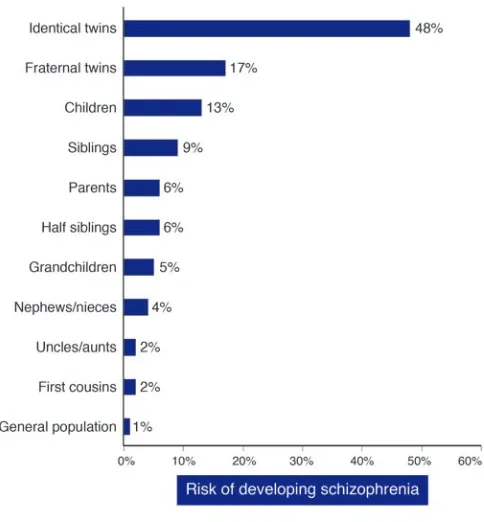
The results of numerous family, twin, and adoption studies show conclusively that risk of schizophrenia is increased among the rela-tives of affected individuals and that it is the result largely of genes rather than shared environment (2–4). In the children and siblings of individuals with schizophrenia, the increase in risk is approxi-mately 10-fold; it is somewhat less than this in parents (Figure 1). The latter finding is probably explained by a reduction in the repro-ductive opportunities, drive, and possibly the fertility of affected indi-viduals. Five recent systematically ascertained studies report mono-zygotic concordance estimated at 41–65% compared with dimono-zygotic concordance of 0–28% and an estimate of broad heritability of 85% (5). Among complex genetic disorders, schizophrenia has one of the highest heritabilities. To place this in perspective, the heritability of schizophrenia is similar to that of type I diabetes (72%–88%; refs. 6, 7), but greater than that of breast cancer (30%; ref. 8), coronary heart disease in males (57%; ref. 9), and type II diabetes (26%; ref. 10).
While the twin and adoption literature leave little doubt that genes are important, they also point to the importance of envi-ronmental factors, since the concordance for schizophrenia in monozygotic twins is typically around 50% and heritability esti-mates are less than 100%. Moreover, we should also note that
risks resulting from some gene-environment interactions tend to be attributed to genes in most genetic epidemiological studies.
It is clear from genetic epidemiology that the mode of transmis-sion is complex (11, 12). However, the number of susceptibility loci, the disease risk conferred by each locus, the extent of genetic heterogeneity, and the degree of interaction among loci all remain unknown. Risch (13) has calculated that the data are incompati-ble with the existence of a single locus conferring a sibling relative risk (λS) of more than 3 and, unless extreme epistasis exists,
mod-els with 2 or 3 loci of λS less than or equal to 2 are more plausible.
It should be emphasized that these calculations are based upon the assumption of homogeneity and refer to population-wide
λS. It is quite possible that alleles of larger effect are operating in
some groups of patients, for example, families with a high density of illness. However, high density families are expected to occur by chance even under polygenic inheritance, and their existence does not prove the existence of disease alleles of large effect (12).
The phenotype of schizophrenia
Different combinations of symptoms exist in different individu-als, and there is considerable heterogeneity of disease course and outcome. However, it is not known whether schizophrenia is a single disorder with variable clinical manifestations or a group of syndromes, each with a unique or overlapping pathophysiology. In spite of this, structured and semistructured interviews together with explicit operational diagnostic criteria permit high diagnos-tic reliability. Given that clinically diagnosed schizophrenia has a high heritability, it should, in principle, be possible to subject it to molecular genetic analysis. However, schizophrenia, as defined by current diagnostic criteria, may well include a number of hetero-geneous disease processes, in which case attempts at identifying genes and other etiological factors would be greatly facilitated if it were possible to distinguish reliably amongthem (14).
The situation is further complicated by the fact that we are unable to define the limits of the clinical phenotype to which genetic liability can lead. It clearly extends beyond the core diagno-sis of schizophrenia to encompass a spectrum of disorders, includ-ing schizoaffective disorder and schizotypal personality disorder (15, 16). However, the limits of this spectrum and its relationship to other psychoses, affective and nonaffective, and nonpsychotic affective disorders remain uncertain (17, 18).
One of the earliest benefits of the identification of susceptibility genes is that the validity of current nosological categories can be further explored. Knowing the genes involved should illuminate heterogeneity within the current concept of schizophrenia and help us to understand its relationship to other diagnostic groups.
Nonstandard abbreviations used: ARVCF, armadillo repeat deleted in velocardiofa-cial syndrome gene; COMT, gene encoding catecholamine O-methyl transferase; DAO, gene encoding D–amino acid oxidase; DAOA, gene encoding D–amino acid oxidase activator; DTNBP1, dystrobrevin-binding protein 1; ErbB, v-erb-b2 erythroblastic leukemia viral oncogene homologue; GRM3,gene encoding metabotropic glutamate receptor type 3; LD, linkage disequilibrium; NMDA, N-methly-D-aspartate; NRG1, gene encoding neuregulin 1; PRODH, gene encoding proline dehydrogenase; RGS4, gene encoding regulator of G protein signaling 4; λS, sibling relative risk; SNP, single
nucleotide polymorphism; TRAR4, gene encoding trace amine receptor 4; ZDHHC8, gene encoding zinc finger– and DHHC domain–containing protein 8.
Conflict of interest: The authors have declared that no conflict of interest exists. Citation for this article: J. Clin. Invest. 115:1440–1448 (2005).
review series
Epidemiology, pathophysiology, and neurobiology
Epidemiological studies have identified a number of environmental factors associated with schizophrenia: pregnancy and delivery com-plications, delayed development, winter and spring birth, low IQ, urban birth and domicile, immigration, and the use of illegal drugs (especially cannabis; ref. 19). However, the effect sizesare small, and in most cases the direction of causation is uncertain.
For many years, ideas about the pathophysiology of schizophre-nia were based on pharmacological studies. The classic “dopamine hypothesis,” in which schizophrenia was attributed to a hyperdo-paminergic state, derived from the realization that the potency of the first generation of antipsychotic drugs was proportional to their ability to block dopamine receptors (20). Modern refine-ments suggest a more complex picture, with increased dopami-nergic transmission in the basal ganglia associated with acute psy-chosis (21) and a prefrontal cortical dopamine deficit responsible for chronic cognitive impairments (22). Psychopharmacological studies have also implicated altered serotonergic, and, more com-pellingly, glutamatergic transmission (23, 24). However, as these systems interact, the hypotheses are not mutually exclusive, and at least some of the dopaminergic changes may be secondary to altered cortical glutamatergic transmission (25).
The fundamental causes, whatever they are, appear to act dur-ing neurodevelopment rather than simply at the onset of the dis-order (26, 27). This is supported by many of the epidemiological findings summarized above, by observations that children who subsequently develop schizophrenia have higher rates of neuro-psychological and motor deficits, and by neuroimaging studies showing ventricular enlargement and reductions in cortical vol-ume at illness onset (28) and in those at high risk of the disorder by virtue of increased genetic loading (29). The reduction in size of some brain structures shown by neuroimaging could in
princi-ple be due to neurodevelopmental or neurodegenerative processes or a combination of the 2. The existence of a neurodevelopmen-tal mechanism is supported by the failure of neuropathological studies to detect markers of neurodegeneration (30). Neuro-pathological studies have also failed to establish a clear diagnos-tic neuropathology, and findings have often been conflicting. However, fairly consistent evidence has emerged for widespread nonuniform reductions in the neuropil and neuronal size, with the temporal lobe, prefrontal cortex, and dorsal thalamus par-ticularly affected (30). These changes, together with reductions seen in synaptic and dendritic markers and abnormalities in white matter (31), suggest deficits in synaptic structure, function, and connectivity between neurons (30).
Epidemiological, pharmacological, and neurobiological stud-ies have certainly brought about progress in our general under-standing of schizophrenia. However, it is impossible confidently to implicate specific pathophysiological processes from the rather vague concepts of altered neurodevelopment, synaptic dysfunc-tion, or neuronal connectivity. The more specific neurotransmit-ter-based hypotheses are very likely to be relevant to some of the overt clinical manifestations of schizophrenia, but with few excep-tions, molecular genetic studies predicated on these hypotheses have met with disappointing results. This, together with the evi-dence for high heritability, has encouraged a number of groups to apply positional genetic approaches as these do not depend upon knowledge of disease pathophysiology.
Three main approaches have been used to seek genes for schizophrenia: positional genetics based on genome-wide link-age analysis, identification of chromosomal abnormalities asso-ciated with schizophrenia, and studies of functional candidate genes. In the following sections, we review the main findings that have emerged from each.
Molecular genetic studies
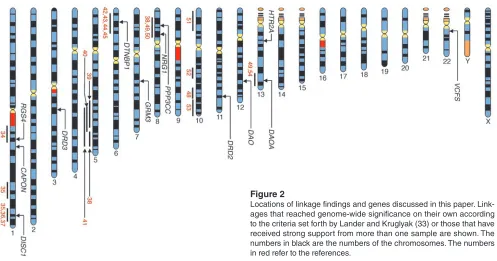
Linkage analysis. In contrast with several other complex disorders, such as breast cancer, Alzheimer disease, Parkinson disease, and epilepsy, no forms of schizophrenia following Mendelian inheri-tance patterns have yet been discovered. Indeed the results of link-age studies in schizophrenia have been disappointing, with positive studies often falling short of stringent genome-wide levels of signif-icance and abundant failures to replicate. This is probably attribut-able to a combination of small genetic effects and inadequate sam-ple sizes (32). However, as more than 20 genome-wide studies have been reported and sample sizes increased, some consistent patterns have emerged. Linkages that reached genome-wide significance on their own according to the criteria set forth by Lander and Kruglyak (33) and those that have received strong support from more than one sample are illustrated in Figure 2 (34–54).
Recently, 2 metaanalyses of schizophrenia linkage have been reported. Each used different methods and obtained overlap-ping but somewhat different results. The study of Badner and Gershon (55) supported the existence of susceptibility genes on chromosomes 8p, 13q, and 22q, while that of Lewis et al. (56) most strongly favored 2q but also found that the number of loci meet-ing the aggregate criteria for significance was much greater than the number of loci expected by chance (P < 0.001). Evidence was also obtained for susceptibility gene regions on chromosomes 5q, 3p, 11q, 6p, 1q, 22q, 8p, 20q, and 14p. The 8p and 22q regions were supported by both metaanalyses, but 8 other regions were supported by only one. Furthermore the region most strongly
sup-Figure 1
[image:3.585.44.286.81.342.2]ported by the Lewis et al. (56) analysis, that on chromosome 2q, is not one that had received strong support previously; now it is clearly worthy of further investigation.
The linkage data therefore support the predictions made by Risch (13) on the basis of genetic epidemiological findings: it is highly unlikely that there exists a locus of effect size λS greater
than 3. However, there is evidence that implicates a number of regions, which is consistent with the existence of susceptibility alleles of moderate effect (λS 1.2–3) and possibly uncommon loci
of larger effect that can be identified in specific samples of large multiply affected families. Of course, the proof that a positive link-age is correct comes when the disease gene, or genes, is identified, and a number of the linked regions are currently being subjected to detailed analysis with, as we shall see, encouraging results.
Positional candidate genetics. Previously, the economics and practicalities of hunting a susceptibility gene within a linked chromosomal region dictated that one should have virtually definitive evidence that the linkage was a true positive before beginning. With recent improvements in our knowledge of genome anatomy and in genome analysis technology, the task of positional cloning has been transformed and now favors bolder endeavors. These considerations, together with the con-vergence of some positive linkage findings, have led to a number of detailed mapping studies of linked regions which have in turn implicated specific genes. However, the quality of the data has been variable, and a number of putative susceptibility genes have yet to be clearly replicated. Here we focus on the genes for which, at the time of this writing, there are published follow-up stud-ies or for which we are aware of data that allow judgment about whether the gene is likely to be a true positive. In making these judgments, we have primarily been influenced by the strength of the genetic evidence for association to the clinical phenotype. We have given no weight to claims that a single nucleotide poly-morphism (SNP)is functional or that the gene has plausibility by virtue of patterns of expression or participation in relevant
pathophysiological pathways. These are key properties of true susceptibility variants, but the number of genes that meet the above criteria is so vast that such evidence cannot be used signif-icantly to increase the prior probability that a gene is implicated in schizophrenia and to prop up weak genetic findings. We have also given little weight to associations with endophenotypes, be they based on electrophysiology, pharmacology, psychology, or neuroimaging or performed in humans or modeled in animals. Such studies are likely to be essential for understanding how variation in a proven susceptibility gene leads to the clinical phe-notype. However, the use of endophenotypes for the identifica-tion of disease genes requires that the measures in quesidentifica-tion are trait, rather than state, variables as well as compelling evidence from genetic epidemiology that they reflect genetic vulnerabil-ity to that disease rather than environmental factors. Promising data are accumulating for some potential endophenotypes for schizophrenia (57), but, in most cases, uncertainties remain.
[image:4.585.48.545.77.338.2]Dystrobrevin-binding protein 1. Evidence that the gene encod-ing dystrobrevin-bindencod-ing protein 1 (DTNBP1) or dysbindin has a role in schizophrenia was first reported by Straub et al. (58), who undertook association mapping across the linkage region on chromosome 6p22.3. Significant associations were found between schizophrenia and several SNPs and multimarker hap-lotypes spanning DTNBP1. A second study based on 203 fami-lies, most of which came from Germany (59), provided further evidence for association between DTNBP1 and schizophrenia as did 2 large studies from our own group, which included approxi-mately 900 schizophrenic patientsfrom the United Kingdom and Ireland (60) and 488 parent-proband trios from Bulgaria (61). Although there have also been some studies in which no associa-tion was found (62, 63), significant associaassocia-tions in a total of 10 samples have now been published (64, 65). Moreover, significant association was found in the initially negative sample of Mor-ris and colleagues (63), when 1 additional marker that defined the risk haplotype in our own UK sample was genotyped (60).
Figure 2
review series
Thus, the evidence in favor of DTNBP1 as a susceptibility gene for schizophrenia is strong. However, there are inconsistencies between the specific risk alleles and haplotypes among studies, which suggests the presence of multiple susceptibility and pro-tective alleles (60) or the possibility that a single susceptibility allele is carried on a remarkable diversity of haplotypes even in closely related populations.
As yet, no causative variant has been identified, and the absence of associated nonsynonymous alleles after systematic mutation detection of the exons (60) suggests that disease sus-ceptibility depends upon variation affecting mRNA expression or processing. The latter possibility is indirectly supported by evidence for as yet unknown cis-acting polymorphisms affecting
DTNBP1 expression in the human brain (66) and more directly supported by 2 recent studies showing reduced levels of expres-sion of the mRNA (67) and protein (68) in postmortem brain samples from patients with schizophrenia.
Dysbindin 1 binds both α- and β-dystrobrevin, which are com-ponents of the dystrophin glycoprotein complex. The dystrophin complex is found in the sarcolemma of muscle but is also located in postsynaptic densities in a number of brain areas, particularly mossy fiber synaptic terminals in the cerebellum and hippocam-pus. Although its functions are largely unknown, its location ini-tially suggested that variation in DTNBP1 might confer risk of schizophrenia by mediating effects on postsynaptic structure and function (58). However, Talbot and colleagues (68) have recently shown that the presynaptic dystrobrevin-independent fraction of dysbindin is reduced in the schizophrenic brain within certain intrinsic glutamatergic neurones of the hippocampus and that this is associated with increased expression of vesicular glutamate transporter type 1. Moreover, a reduction in glutamate release has been demonstrated in cultured neurons with reduced DTNBP1
expression (64). These data suggest that variation in DTNBP1
might confer risk by altering presynaptic glutamate function.
Neuregulin 1. Neuregulin 1 (NRG1) was implicated in schizo-phrenia by a study in an Icelandic sample (50). Association analy-sis across 8p21–22 revealed highly significant evidence for asso-ciation between schizophrenia and a multimarker haplotype at the 5′ end of NRG1.Strong evidence for association with the same haplotype was subsequently found in a large sample from Scot-land (69) and weakly replicated in a United Kingdom sample (70). Further positive findings have emerged from Irish (71), Chinese (72–75), and South African (76) samples. However, some negative findings have also been reported (76–79). Only the 3 studies of Icelandic, Scottish, and UK samples (50, 69, 70) have implicated the specific Icelandic haplotype, perhaps reflecting differences in the linkage disequilibrium (LD) structure across NRG1 in Euro-pean and Asian samples (74).
Despite detailed resequencing (50), it has not yet proven pos-sible to identify specific susceptibility variants, but the Icelandic haplotype points to the 5′ end of the gene, once again suggest-ing that altered expression or perhaps mRNA splicsuggest-ing might be involved. It is even possible at this stage that NRG1 is not itself the susceptibility gene, as intron 1 contains another expressed sequence (71) whose function is unknown. However, insofar as it is possible to model schizophrenia in animals, behavioral analyses of NRG1 hypomorphic mice support the view that the association is related to altered NRG1 function or expression (80). More direct evidence suggesting that altered expression might be involved is also beginning to accumulate (81). Just as
for DTNBP1, the mechanisms by which altered NRG1 function might lead to schizophrenia are unclear. NRG1 hypomorphic mice have reduced expression of N-methyl-D-aspartate (NMDA) receptors, suggesting that the effects might be mediated through glutamatergic mechanisms (50). However, NRG1 encodes many mRNA species and proteins;it is thought to encode approxi-mately 15 proteins with a diverse range of functions in the brain, including cell signaling, v-erb-b2 erythroblastic leukemia viral oncogene homologue (ErbB) receptor interactions, axon guid-ance, synaptogenesis, glial differentiation, myelination, and neurotransmission (82). Any of these could potentially influ-ence susceptibility to schizophrenia.
D–amino acid oxidase and D–amino acid oxidase activator. Chuma-kov and colleagues (83) undertook association mapping in the linkage region on chromosome 13q22–34. They found associa-tions in French Canadian and Russian populaassocia-tions in markers around 2 novel genes, G72 and G30, which are overlapping but transcribed in opposite directions. G72 is a primate-specific gene expressed in the caudateand amygdala. With the use of yeast 2-hybrid analysis, evidence for physical interaction was found between G72 and D–amino acid oxidase (DAO). DAO is expressed in the human brain, where it oxidizes D-serine, a potent activator of NMDA glutamate receptor. Coincubation of G72 and DAO in vitrorevealed a functional interaction between the 2, with G72 enhancing the activity of DAO. Consequently, G72 has now been named D–amino acid oxidase activator (DAOA). In the same study, DAO polymorphisms were shown to be associated with schizophrenia in one of the samples, and analysis of DAOA and
DAO variants revealed modest evidence for a statisticalinteraction between the loci and disease risk. Given the 3 levels of interaction, the authors concluded that both genes influence risk of schizo-phrenia through a similar pathway and that this effect is likely to be mediated through altered NMDA-receptor function.
Associations between DAOA and schizophrenia have subse-quently been reported in samples from Germany (84), China (85), and both the US and South Africa (76) as well as in a small sample of very early onset psychosis subjects from the US (86). As before, and conceivably for similar reasons, there is no consensus concerning the specific risk alleles or haplotypes across studies. The German group also reported association between DAO and schizophrenia, although with no evidence for a statistical interac-tion between the loci and risk of schizophrenia. At present, the published genetic evidence in support of this gene is weaker than that for DTNBP1 and NRG1.
by dopaminergic neurotransmission is of relevance to its possible role in schizophrenia (93). Moreover, RGS4 interacts with ErbB3 (94), which may be of relevance as ErbB3 is a NRG1 receptor whose expression is downregulated in schizophrenic brains (82).
Other positional candidate genes. Association analysis in single studies of CAPON (C terminal PDZ domain ligand of neuronal nitric oxide synthase) (95), PPP3CC(protein phosphatase 3, cat-alytic subunit) (96), and trace amine receptor 4 (TRAR4) (97), which map to the 1q22, 8p21.3, and 6q23.2 linkage regions, respectively, has suggested these as possible susceptibility genes. As discussed in the original articles, each of these genes can be plausibly related to candidate pathophysiologies of schizophre-nia, but at this writing, we are not aware of any replication data to support these hypotheses.
Chromosomal abnormalities
There have been numerous reports of associations between schizo-phrenia and chromosomal abnormalities (98), but with 2 excep-tions, none provides convincing evidence for the location of a sus-ceptibility gene. Several studies have shown that adults with 22q11 deletions have a high risk of schizophrenia (99–101), with the largest study of adult patients to date (n = 50) estimating this at 24% (101). The deletion cannot account for a high proportion of schizophrenia cases (102), but reports of linkage to 22q11 (55, 56) suggest that vari-ants in genes mapping to this region might contribute to cases of schizophrenia that do not have 22q11 deletions. Current candidates include catecholamine O-methyl transferase (COMT), proline dehy-drogenase (PRODH), and zinc finger– and DHHC domain–contain-ing protein 8 (ZDHHC8). The positions of the deletions on 22q11 and their frequencies (103) are shown in Figure 3.
COMT has been intensively studied because of its key role in dopamine catabolism. Most studies have focused upon a valine-to-methionine changeat codon 158 of the brain-predominant membrane-bound form of COMT (MB-COMT) and codon 108 of the soluble form (S-COMT). The valine allele confers higher activ-ity and thermal stabilactiv-ity to COMT (104) and has been fairly con-sistently associated with reduced performance in tests of frontal lobe function (105, 106). The results for schizophrenia have been mixed, with a recent metaanalysis (107) reporting no overall evi-dence for association with the valine allele.
Since the preparation of the metaanalysis, an Israeli study of over 700 cases reported strong evidence for association between haplotypes, including the val158 allele and 2 flanking, noncoding SNPs (108). As in an earlier study (109), the evidence from haplo-types was stronger than for the valine allele alone, which suggests that COMT may well be a susceptibility gene for schizophrenia, but that the effect is not attributable to the valine/methionine variant. We have been unable to replicate association with any of the SNPs or halotypes, including the valine/methionine poly-morphism, in a study of more than 2800 individuals including almost 1200 schizophrenics (Williams, et al. in press; ref. 110), but 2 other groups (104, 111) have recently reported rather different haplotype associations at COMT in Irish and US samples. As for the Israeli study, haplotypes carrying the val158 allele exhibited stronger evidence for association than did that allele alone while in the second study, the strongest findings included markers span-ning the 3′ end of the armadillo repeat deleted in velocardiofacial syndrome gene (ARVCF). The latter has also been implicated in an earlier study (109), and its transcribed genomic sequenceoverlaps with that of COMT (112). While the picture is confused, we believe that the evidence does not support a role for valine/methionine 158 in susceptibility to schizophrenia, although a small effect can-not be excluded nor can a role in phecan-notype modification. Howev-er, it remains a strong possibility that variation elsewhere in COMT
or in ARVCF confers susceptibility.
PRODH is another functional candidate gene, given that a loss-of-function mutant mouse exhibits behavioral abnormalities in sensorimotor gating that are analogous to those observed in patients with schizophrenia (113) and that PRODH influences the availability of glutamate. In addition, a heterozygous dele-tion of the entire PRODH gene was found in a family that includ-ed 2 subjects with schizophrenia, and 2 heterozygous PRODH
missense variants were detected in 3 of 63 patients with schizo-phrenia studied by Jacquet et al. (114). Evidence in favor of asso-ciation between PRODH and schizophrenia has been reported by Liu and colleagues (115) and by Li and colleagues (116). We have been unable to replicate either of these findings in large case-con-trol and family-based association samples (117). Moreover, we have also observed a range of missense mutations that are equally common in patients with schizophrenia and controls (117); and in a very large sample of Japanese subjects, PRODH deletions were not associated with schizophrenia (118).
Finally, there is evidence that a SNP in ZDHHC8, a gene which encodes a putative transmembrane palmitoyl transfer-ase, directly confers susceptibility to schizophrenia in females (119). The genetic evidence is not strong but has gained circum-stantial support from data suggesting that this SNP may affect the splicing of an mRNA expressed in brain regions relevant to schizophrenia (119). Unfortunately, the only published attempt at replication so far found the opposite allele to be associated and no evidence for a gender effect (120).
[image:6.585.45.287.82.228.2]The other major finding based upon a chromosomal abnor-mality comes from an extended pedigree in which a balanced chromosomal translocation (1, 11) (q42;q14.3) showed strong evidence for linkage to a fairly broad phenotype consisting of schizophrenia, bipolar disorder, and recurrent depression (36). The translocation was found to disrupt 2 genes on chromo-some 1: DISC1 and DISC2(36, 121). DISC2 contains no open reading frame and may regulate DISC1 expression via antisense RNA (121). Interestingly, DISC1 and DISC2 are located close
Figure 3
review series
to the chromosome 1 markers implicated in 2 Finnish linkage studies (35, 37) (Figure 1). It has been suggested that trunca-tion of DISC1 in the translocatrunca-tion family might contribute to schizophrenia by affecting neuronal functions dependent upon intact cytoskeletal regulation, such as neuronal migration, neu-rite architecture, and intracellular transport (122, 123). While these are interesting hypotheses, it is important to remember that translocations can exert effects on genes other than those directly disrupted. For example, there are several mechanisms by which a translocation can influence the expression of neighbor-ing genes. Thus, in order to unequivocally implicate DISC1 and/ or DISC2 in the pathogenesis of schizophrenia, it is necessary to identify in another population mutations or polymorphisms that are associated with schizophrenia that are not in linkage disequilibrium with neighboring genes. Four published studies have attempted to do this; negative findings were reported by the Edinburgh group that originally identified DISC1 and DISC2
(124) and by a group that focused on the 5′ end of the gene in a large Japanese sample (125). However, positive findings have been reported in a large Finnish sample (see supplemental ref. S1; supplemental references available online with this article; doi:10.1172/JCI24759DS1) and in US samples with schizophre-nia, schizoaffective disorder, or bipolar disorder (S2) At present, therefore, the genetic evidence in favor of DISC1 as a suscepti-bility gene for schizophrenia is gaining weight but, in our view, is not yet compelling. In addition, there are suggestions that
DISC1 variants might confer susceptibility to a range of pheno-types, including schizoaffective disorder, bipolar disorder, and recurrent major depressive disorder as well as schizophrenia.
Functional candidate genes
There is a huge schizophrenia candidate-gene literature consisting of negative findings or positive findings that have either not been replicated or have seemed so unconvincing that there have been no attempts to replicate them. While most of the reported positives are unlikely to stand the test of time, neither can we conclude that any gene has been effectively excluded, given that most have not been studied exhaustively in large samples through a combination of detailed sequencing of exons, introns, and large regions of 5′ and 3′ flanking sequences combined with exhaustive genotyping. How-ever, metaanalyses do at least suggest that the dopamine receptors
DRD3 (S3) and DRD2 (S4) and the serotonergic receptor HTR2A
(S5) might confer risk. The effect sizes, if any, are extremely small with odds ratios (ORs) less than 1.2 and difficult to confirm, but if the associations exist, the findings provide some support for the view that altered dopaminergic and serotonergic function might be a primary event in susceptibility to schizophrenia. If the puta-tive associations are the result of linkage disequilibrium between the assayed markers and the true susceptibility variant, it is pos-sible that the latter might contribute somewhat more, depending upon the degree of LD between the 2.
There is accumulating evidence for abnormalities of gluta-matergic neurotransmission in schizophrenia. By and large, analysis of glutamatergic genes as functional candidates for schizophrenia has failed to produce consistent positive findings. However, recently claims have been made that variation in GRM3
(the gene encoding metabotropic glutamate receptor–type 3) might confer risk of schizophrenia. GRM3 was first implicated in a case-control study of German patients in which one SNP was significantly associated with schizophrenia (P = 0.0022)
in 1 out of the 3 groups of patients studied (S6). Fujii and col-leagues (S7) genotyped 6 SNPs in a small case-control sample from Japan. They found significant association with one SNP (P = 0.011, uncorrected) and a 3-marker haplotype containing this SNP (P = 8.30 × 10⁻⁴). Egan et al. (S8) genotyped 7 SNPs,
including the 2 implicated in the previous reports, in a family-based association study. Weak evidence for overtransmission to cases was observed for one SNP (P = 0.02, uncorrected). However this was not one of the SNPs implicated previously, and the result failed to replicate in a second sample. A haplotype including this SNP was overtransmitted to cases(global P = 0.01, allele specific
P = 0.0001), but again, this did not replicate in a second sample. The authors also presented data relating the single putatively associated GRM3 SNP to cognitive, fMRI, magnetic resonance spectroscopy, and neurochemical variables. They argued that these data all support the conclusion that GRM3 affects prefron-tal and hippocampal physiology, cognition, and risk for schizo-phrenia by altering glutamate neurotransmission. However, the genetic data implicating GRM3 as a susceptibility gene for schizophrenia remain weak, although the findings of Egan and colleagues (S8) clearly suggest that further study is warranted.
Functional implications of susceptibility genes. In our view, the evi-dence most strongly implicates DTNBP1 and NRG1 as suscep-tibility genes for schizophrenia, while the data for DAO, DAOA,
DISC1,and RGS4 are promising but not yet compelling. Even in the most convincing cases, the risk haplotypes appear to be associated with small effect sizes (OR < 2.5) and, although this is difficult to determine, do not appear to fully explain the linkage findings that prompted each study. This could suggest that the associated polymorphisms/haplotypes are only in weak LD with the true pathogenic variants, that the linkages reflect variation at more than one susceptibility site in the same gene (or in multiple genes in the area of linkage), or that in some cases, despite the statistical evidence, the associations are spurious. Detailed follow-up studies, including de novo mutation detection and detailed genotyping in large samples drawn from different populations, with the aim of answering these questions are now required.
a heterogeneous disorder with more that 1 core pathophysiology may well be correct. The desire, then, to fit the data into a unified theory is attractive and parsimonious, in which case it will not be possible to fit the data into a unified theory. It is therefore vital that there be no letup in the hunt for novel schizophrenia genes, the finding of which will allow us to test existing and to generate novel hypotheses of schizophrenia pathogenesis.
Conclusions
Molecular genetic studies of schizophrenia are built upon the firm foundations of reliable diagnostic methodology and a wealth of genetic epidemiological data. The fact that most, if not all, dis-ease genes apparently have only moderate or small effect sizes has proven challenging, as with other common diseases. However, the
resources and reagents generated by the human genome project have begun to make adequately powered studies feasible. A num-ber of potential regions of linkage and 2 associated chromosomal abnormalities have been identified, and accumulating evidence favors several positional candidate genes, although in no case has the causative variant(s) been unequivocally identified. These find-ings are grounds for optimism and suggest that, while we still have far to travel, we are at least moving in the right direction.
Address correspondence to: Michael Owen, Department of Psy-chological Medicine, Wales College of Medicine, Cardiff Univer-sity, Henry Wellcome Building, Heath Park, Cardiff CF14 4XN, United Kingdom. Phone: 44-2920-743248; Fax: 44-2920-746554; E-mail: [email protected].
1. McGrath, J., et al. 2004. A systematic review of the incidence of schizophrenia: the distribution of rates and the influence of sex, urbanicity, migrant status and methodology. BMC Med. 2:13. 2. McGuffin, P., Owen, M.J., O’Donovan, M.C.,
Thapar, A., and Gottesman, I.I. 1994. Schizophre-nia. In Seminars in psychiatric genetics, Royal College of Psychiatrists. London, United Kingdom. 87–109. 3. Gottesman, I.I. 1991. Schizophrenia genesis: the origins
of madness. Henry Holt & Company Inc. New York, New York, USA. 296 pp.
4. Riley, B.C., and Kendler, K.S. 2004. Schizophrenia: genetics. In Kaplan and Sadock’s comprehensive text-book psychiatry. 8th edition. B.J. Sadock and V.A. Sadock, editors. Lippincott Williams and Wilkins. Philadelphia, Pennsylvania, USA. 1354–1371. 5. Cardno, A.G., and Gottesman, I.I. 2000. Twin
stud-ies of schizophrenia: from bow-and-arrow concor-dances to star war Mx and functional genomics.
Am. J. Med. Genet. 97:12–17.
6. Kyvik, K.O., Green, A., and Beck-Nielsen, H. 1995. Concordance rates of insulin dependent diabetes mellitus: a population based study of young Dan-ish twins. BMJ. 311:913–917.
7. Hyttinen, V., Kaprio, J., Kinnunen, L., Koskenvuo, M., and Tuomilehto, J. 2003. Genetic liability of type 1 diabetes and the onset age among 22,650 young Finnish twin pairs: a nationwide follow-up study. Diabetes. 52:1052–1055.
8. Locatelli, I., Lichtenstein, P., and Yashin, A.I. 2004. The heritability of breast cancer: a bayesian corre-lated frailty model applied to Swedish twins data.
Twin Res. 7:182–191.
9. Zdravkovic, S., et al. 2002. Heritability of death from coronary heart disease: a 36-year follow-up of 20 966 Swedish twins. J. Intern. Med. 252:247–254. 10. Poulsen, P., Kyvik, K.O., Vaag, A., and Beck-Nielsen,
H. 1999. Heritability of type II (non-insulin-depen-dent) diabetes mellitus and abnormal glucose tol-erance–a population-based twin study. Diabetologia. 42:139–145.
11. Gottesman, I.I., and Shields, J. 1967. A polygenic theory of schizophrenia. Proc. Natl. Acad. Sci. U. S. A. 58:199–205.
12. McGue, M., and Gottesman, I.I. 1989. A single dominant gene still cannot account for the trans-mission of schizophrenia. Arch. Gen. Psychiatry. 46:478–480.
13. Risch, N. 1990. Genetic linkage and complex dis-eases, with special reference to psychiatric disor-ders [review]. Genet. Epidemiol. 7:3–16; discussion 17–45.
14. Gottesman, I.I., and Shields, J. 1982. Schizophrenia: the epigenetic puzzle. Cambridge University Press. Cambridge, United Kingdom. 258 pp.
15. Farmer, A.E., McGuffin, P., and Gottesman I.I. 1987. Twin concordance for DSM-III schizophre-nia. Scrutinizing the validity of the definition.
Arch. Gen. Psychiatry. 44:634–641.
16. Kendler, K.S., Neale, M.C., and Walsh, D. 1995. Evaluating the spectrum concept of schizophrenia in the Roscommon Family Study. Am. J. Psychiatry. 152:749–754.
17. Kendler, K.S., Karkowski, L.M., and Walsh, D. 1998. The structure of psychosis: latent class analysis of probands from the Roscommon Family Study.
Arch. Gen. Psychiatry. 55:492–499.
18. Tienari, P. et al. 2000. Finnish adoptive family study: sample selection and adoptee DSM-III-R diagnoses. Acta Psychiatr. Scand. 101:433–443. 19. Murray, R.M., Jones, P.B., Susser, E., van Os, J., and
Cannon, M. 2002. The epidemiology of schizophrenia. Cambridge University Press. Cambridge, United Kingdom. 454 pp.
20. Seeman, P., and Lee, T. 1975. Antipsychotic drugs: direct correlation between clinical potency and presynaptic action on dopamine neurons. Science. 188:1217–1219.
21. Abi-Dargham, A., et al. 2000. Increased baseline occupancy of D2 receptors by dopamine in schizo-phrenia. Proc. Natl. Acad. Sci. U. S. A. 97:8104–8109. 22. Weinberger, D.R., et al. 2001. Prefrontal neurons
and the genetics of schizophrenia. Biol. Psychiatry. 50:825–844.
23. Meltzer, H.Y., Matsubara, S., and Lee, J.C. 1989. Classification of typical and atypical antipsy-chotic drugs on the basis of dopamine D-1, D-2 and serotonin2 pKi values. J. Pharmacol. Exp. Ther. 251:238–246.
24. Javitt, D.C., and Zukin, S.R. 1991. Recent advances in the phencyclidine model of schizophrenia. Am. J. Psychiatry. 148:1301–1308.
25. Laruelle, M., Kegeles, L.S., and Abi-Dargham, A. 2003. Glutamate, dopamine, and schizophrenia: from pathophysiology to treatment. Ann. N. Y. Acad. Sci. 1003:138–158.
26. Weinberger, D.R. 1995. From neuropathology to neurodevelopment. Lancet. 346:552–557. 27. Murray, R.M., and Lewis, S.W. 1987. Is
schizophre-nia a neurodevelopmental disorder? Br. Med. J.
295:681–682.
28. Pantelis, C., et al. 2003. Neuroanatomical abnor-malities before and after onset of psychosis: a cross-sectional and longitudinal MRI comparison.
Lancet. 361:281–288.
29. Lawrie, S.M., et al. 1999. Magnetic resonance imag-ing of brain in people at high risk of developimag-ing schizophrenia. Lancet. 353:30–33.
30. Harrison, P.J. 1999. The neuropathology of schizo-phrenia. A critical review of the data and their interpretation. Brain. 122:593–624.
31. Davis, K.L., et al. 2003. White matter changes in schizophrenia: evidence for myelin-related dys-function. Arch. Gen. Psychiatry. 60:443–456. 32. Suarez, B.K., Hampe, C.L., and Van Eerdewegh, P.
1994. Problems of replicating linkage claims in psy-chiatry. In Genetic approaches to mental disorders. E.S. Gershon and C.R. Cloninger, editors. American
Psychiatric Press. Washington, DC, USA. 23–46. 33. Lander, E., and Kruglyak, L. 1995. Genetic
dis-section of complex traits: guidelines for inter-preting and reporting linkage results. Nat. Genet. 11:241–247.
34. Brzustowicz, L.M., Hodgkinson, K.A., Chow, E.W., Honer, W.G., and Bassett, A.S. 2000. Loca-tion of a major susceptibility locus for familial schizophrenia on chromosome 1q21-q22. Science. 288:678–682.
35. Ekelund, J., et al. 2001. Chromosome 1 loci in Finnish schizophrenia families. Hum. Mol. Genet. 10:1611–1617.
36. Blackwood, D.H., et al. 2001. Schizophrenia and affective disorders-cosegregation with a transloca-tion at chromosome 1q42 that directly disrupts brain-expressed genes: clinical and P300 findings in a family. Am. J. Hum. Genet. 69:428–433. 37. Ekelund, J., et al. 2004. Replication of 1q42 linkage
in Finnish schizophrenia pedigrees. Mol. Psychiatry. 9:1037–1041.
38. Gurling, H.M., et al. 2001. Genomewide genetic linkage analysis confirms the presence of suscep-tibility loci for schizophrenia, on chromosomes 1q32.2, 5q33.2, and 8p21-22 and provides support for linkage to schizophrenia, on chromosomes 11q23.3-24 and 20q12.1-11.23. Am. J. Hum. Genet.
68:661–673.
39. Straub, R.E., MacLean, C.J., O’Neil, F.A., Walsh, D., and Kendler, K.S. 1997. Support for a possible schizophrenia vulnerability locus in region 5q22-31 in Irish families. Mol. Psychiatry.2:148–155. 40. Devlin, B., et al. 2002. Genome-wide multipoint
linkage analyses of multiplex schizophrenia pedi-grees from the oceanic nation of Palau. Mol. Psychia-try. 7:689–694.
41. Paunio, T., et al. 2001. Genome-wide scan in a nationwide study sample of schizophrenia families in Finland reveals susceptibility loci on chromo-somes 2q and 5q. Hum. Mol. Genet. 10:3037–3048. 42. Straub, R.E., et al. 1995. A potential vulnerability
locus for schizophrenia on chromosome 6p24-22: evidence for genetic heterogeneity. Nat. Genet.
11:287–293.
43. Schizophrenia Linkage Collaborative Group for Chromosomes 3, 6, and 8. 1996. Additional sup-port for schizophrenia linkage on chromosomes 6 and 8: a multicenter study. Am. J. Med. Genet.
67:580–594.
44. Maziade, M., Bissonnette, L., Rouillard, E., Roy, M.A., and Merette, C. 1997. Further evidence of a susceptibility gene for schizophrenia in 6p22-p24: a contribution from the eastern Quebec popula-tion. Am. J. Med. Genet. 74:666–667.
45. Schwab, S.G., et al. 2000. A genome-wide autoso-mal screen for schizophrenia susceptibility loci in 71 families with affected siblings: support for loci on chromosome 10p and 6. Mol. Psychiatry.
review series
46. Martinez, M., et al. 1999. Follow-up study on a sus-ceptibility locus for schizophrenia on chromosome 6q. Am. J. Med. Genet. 88:337–343.
47. Lindholm, E. et al. 2001. A schizophrenia-suscep-tibility locus at 6q25, in one of the world’s largest reported pedigrees. Am. J. Hum. Genet. 69:96–105. 48. Lerer, B., et al. 2003. Genome scan of Arab Israeli
families maps a schizophrenia susceptibility gene to chromosome 6q23 and supports a locus at chro-mosome 10q24. Mol. Psychiatry. 8:488–498. 49. Blouin, J.L., et al. 1998. Schizophrenia
suscepti-bility loci on chromosomes 13q32 and 8p21. Nat. Genet. 20:70–73.
50. Stefansson, H., et al. 2002. Neuregulin 1 and sus-ceptibility to schizophrenia. Am. J. Hum. Genet. 71:877–892.
51. DeLisi, L.E., et al. 2002. A genome-wide scan for linkage to chromosomal regions in 382 sibling pairs with schizophrenia or schizoaffective disor-der. Am. J. Psychiatry. 159:803–812.
52. Fallin, M.D., et al. 2003. Genomewide linkage scan for schizophrenia susceptibility loci among Ashkenazi Jewish families shows evidence of
link-age on chromosome 10q22. Am. J. Hum. Genet.
73:601–611.
53. Williams, N., et al. 2003. A systematic genomewide linkage study in 353 sib pairs with schizophrenia.
Am. J. Hum. Genet. 73:1355–1367.
54. Brzustowicz, L.M., et al. 1999. Linkage of familial schizophrenia to chromosome 13q32. Am. J. Hum. Genet. 65:1096–1103.
55. Badner, J.A., and Gershon, E.S. 2002. Meta-analysis of whole-genome linkage scans of bipolar disorder and schizophrenia. Mol. Psychiatry. 7:405–411. 56. Lewis, C.M., et al. 2003. Genome scan
meta-analy-sis of schizophrenia and bipolar disorder, part II: Schizophrenia. Am. J. Hum. Genet. 73:34–48. 57. Gottesman, I.I., and Gould, T.D. 2003. The
endo-phenotype concept in psychiatry: etymology and strategic intentions. Am. J. Psychiatry. 160:636–645. 58. Straub, R.E., et al. 2002. Genetic variation in the
6p22.3 gene DTNBP1, the human ortholog of the mouse dysbindin gene, is associated with schizo-phrenia. Am. J. Hum. Genet. 71:337–348.
59. Schwab, S.G., et al. 2003. Support for association of schizophrenia with genetic variation in the 6p22.3 gene, dysbindin, in sib-pair families with linkage and in an additional sample of triad families. Am. J. Hum. Genet. 72:185–190.
60. Williams, N.M., et al. 2004. Identification in 2 independent samples of a novel schizophrenia risk haplotype of the dystrobrevin binding protein gene (DTNBP1). Arch. Gen. Psychiatry. 61:336–344. 61. Kirov, G., et al. 2004. Strong evidence for
associa-tion between the dystrobrevin binding protein 1 (DTNBP1) gene and schizophrenia in 488 par-ent-offspring trios from Bulgaria. Biol. Psychiatry.
55:971–975.
62. Van Den Bogaert, A., et al. 2003. The DTNBP1 (dysbindin) gene contributes to schizophrenia, depending on family history of the disease. Am. J. Hum. Genet. 73:1438–1443.
63. Morris, D.W., et al. 2003. No evidence for asso-ciation of the dysbindin gene [DTNBP1] with schizophrenia in an Irish population-based study.
Schizophr. Res. 60:167–172.
64. Numakawa, T., et al. 2004. Evidence of novel neuronal functions of dysbindin, a suscepti-bility gene for schizophrenia. Hum. Mol. Genet. 13:2699–2708.
65. Funke, B., et al. 2004. Association of the DTNBP1 locus with schizophrenia in a U.S. Population.
Am. J. Hum. Genet. 75:891–898.
66. Bray, N.J., Buckland, P.R., Owen, M.J., and O’Donovan, M.C. 2003. Cis-acting variation in the expression of a high proportion of genes in human brain. Hum. Genet. 113:149–153.
67. Weickert, C.S., et al. 2004. Human dysbindin
(DTNBP1) gene expression in normal brain and in schizophrenic prefrontal cortex and midbrain.
Arch. Gen. Psychiatry. 61:544–555.
68. Talbot, K., et al. 2004. Dysbindin-1 is reduced in intrinsic, glutamatergic terminals of the hippocampal formation in schizophrenia. J. Clin. Invest. 113:1353–1363. doi:10.1172/JCI200420425. 69. Stefansson, H., et al. 2003. Association of neuregu-lin 1 with schizophrenia confirmed in a Scottish population. Am. J. Hum. Genet. 72:83–87. 70. Williams, N.M., et al. 2003. Support for genetic
variation in neuregulin 1 and susceptibility to schizophrenia. Mol. Psychiatry. 8:485–487. 71. Corvin, A.P., et al. 2004. Confirmation and
refine-ment of an ‘at-risk’ haplotype for schizophrenia suggests the EST cluster, Hs.97362, as a potential susceptibility gene at the neuregulin-1 locus. Mol. Psychiatry. 9:208–213.
72. Yang, J.Z., et al. 2003. Association study of neu-regulin 1 gene with schizophrenia. Mol. Psychiatry.
8:706–709.
73. Tang, J.X., et al. 2004. Polymorphisms within 5′ end of the neuregulin 1 gene are genetically associated with schizophrenia in the Chinese population. Mol. Psychiatry. 9:11–12.
74. Zhao, X., et al. 2004. A case control and family based association study of the neuregulin1 gene and schizophrenia. J. Med. Genet. 41:31–34. 75. Li, T., et al. 2004. Identification of a novel
neu-regulin 1 at-risk haplotype in Han schizophrenia Chinese patients, but no association with the Icelandic/Scottish risk haplotype. Mol. Psychiatry. 9:698–704.
76. Hall, D., Gogos, J.A., and Karayiorgou, M. 2004. The contribution of three strong candidate schizo-phrenia susceptibility genes in demographically distinct populations. Genes Brain Behav. 3:240–248. 77. Iwata, N., et al. 2004. No association with the neu-regulin 1 haplotype to Japanese schizophrenia. Mol. Psychiatry. 9:126–127.
78. Thiselton, D.L., et al. 2004. No evidence for linkage or association of neuregulin-1 (NRG1) with disease in the Irish study of high-density schizophrenia families (ISHDSF). Mol. Psychiatry. 9:777–783. 79. Hong, C.J., et al. 2004. Case-control and
family-based association studies between the neuregulin 1 (Arg38Gln) polymorphism and schizophrenia.
Neurosci. Lett. 366:158–161.
80. Stefansson, H., Steinthorsdottir, V., Thorgeirsson, T.E., Gulcher, J.R., and Stefansson, K. 2004. Neu-regulin 1 and schizophrenia. Ann. Med. 36:62–71. 81. Hashimoto, R., et al. 2004. Expression analysis of
neuregulin-1 in the dorsolateral prefrontal cortex in schizophrenia. Mol. Psychiatry. 9:299–307. 82. Corfas, G., Roy, K., and Buxbaum, J.D. 2004.
Neu-regulin 1-erbB signaling and the molecular/cellular basis of schizophrenia. Nat. Neurosci. 7:575–580. 83. Chumakov, I., et al. 2002. Genetic and
physiologi-cal data implicating the new human gene G72 and the gene for D-amino acid oxidase in schizophre-nia. Proc. Natl. Acad. Sci. U. S. A. 99:13675–13680. 84. Schumacher, J., et al. 2004. Examination of G72
and D-amino-acid oxidase as genetic risk factors for schizophrenia and bipolar affective disorder.
Mol. Psychiatry. 9:203–207.
85. Wang, X., et al. 2004. Association of G72/G30 with schizophrenia in the Chinese population. Biochem. Biophys. Res. Commun. 319:1281–1286.
86. Addington, A.M., et al. 2004. Polymorphisms in the 13q33.2 gene G72/G30 are associated with child-hood-onset schizophrenia and psychosis not oth-erwise specified. Biol. Psychiatry. 55:976–980. 87. Chowdari, K.V., et al. 2002. Association and linkage
analyses of RGS4 polymorphisms in schizophrenia.
Hum. Mol. Genet. 11:1373–1380.
88. Williams, N.M., et al. 2004. Support for RGS4 as a susceptibility gene for schizophrenia. Biol. Psychiatry. 55:192–195.
89. Chen, X., et al. 2004. Regulator of G-protein signal-ing 4 (RGS4) gene is associated with schizophrenia in Irish high density families. Am. J. Med. Genet. B Neuropsychiatr. Genet. 129B:23–26.
90. Morris, D.W., et al. 2004. Confirming RGS4 as a susceptibility gene for schizophrenia. Am. J. Med. Genet. B Neuropsychiatr. Genet. 125B:50–53. 91. Beyer, C.E., et al. 2004. Regulators of G-protein
signaling 4: modulation of 5-HT(1A)-medi-ated neurotransmitter release in vivo. Brain Res. 1022:214–220.
92. De Blasi, A., Conn, P.J., Pin, J., and Nicoletti, F. 2001. Molecular determinants of metabotropic glutamate receptor signaling. Trends Pharmacol. Sci. 22:114–120.
93. Taymans, J.M., et al. 2004. Dopamine receptor-mediated regulation of RGS2 and RGS4 mRNA differentially depends on ascending dopamine pro-jections and time. Eur. J. Neurosci. 19:2249–2260. 94. Thaminy, S., Auerbach, D., Arnoldo, A., and
Stagljar, I. 2003. Identification of novel ErbB3-interacting factors using the split-ubiquitin
membrane yeast two-hybrid system. Genome Res.
13:1744–1753.
95. Brzustowicz, L.M., et al. 2004. Linkage disequilibri-um mapping of schizophrenia susceptibility to the
CAPON region of chromosome 1q22. Am. J. Hum.
Genet. 74:1057–1063.
96. Gerber, D.J., et al. 2003. Evidence for association of schizophrenia with genetic variation in the 8p21.3 gene, PPP3CC, encoding the calcineu-rin gamma subunit. Proc. Natl. Acad. Sci. U. S. A. 100:8993–8998.
97. Duan, J., et al. 2004. Polymorphisms in the trace amine receptor 4 (TRAR4) gene on chromosome 6q23.2 are associated with susceptibility to schizo-phrenia. Am. J. Hum. Genet. 75:624–638.
98. MacIntyre, D.J., Blackwood, D.H., Porteous, D.J., Pickard, B.S., and Muir, W.J. 2003. Chromosomal abnormalities and mental illness. Mol. Psychiatry. 8:275–287.
99. Pulver, A.E., et al. 1994. Psychotic illness in patients diagnosed with velo-cardio-facial syndrome and their relatives. J. Nerv. Ment. Dis. 182:476–478. 100. Bassett, A.S., et al. 1998. 22q11 deletion syndrome
in adults with schizophrenia. Am. J. Med. Genet. 81:328–337.
101. Murphy, K.C., Jones, L.A., and Owen, M.J. 1999. High rates of schizophrenia in adults with velo-cardio-facial syndrome. Arch. Gen. Psychiatry. 56:940–945.
102. Ivanov, D., et al. 2003. A molecular genetic study of the vcfs region in patients with early onset psycho-sis. Br. J. Psychiatry. 183:409–413.
103. Shaikh, T.H., et al. 2000. Chromosome 22-specific low copy repeats and the 22q11.2 deletion syn-drome: genomic organisation and deletion end-point analysis. Hum. Mol. Genet. 9:489–501. 104. Chen, X., Wang, X., O’Neill, A.F., Walsh, D., and
Kendler, K.S. 2004. Variants in the catechol-o-methyltransferase (COMT) gene are associated with schizophrenia in Irish high-density families.
Mol. Psychiatry. 9:962–967.
105. Egan, M.F., et al. 2001. Effect of COMT Val108/158 Met genotype on frontal lobe function and risk for schizophrenia. Proc. Natl. Acad. Sci. U. S. A. 98:6917–6922.
106. Malhotra, A.K., et al. 2002. A functional polymor-phism in the COMT gene and performance on a test of prefrontal cognition. Am. J. Psychiatry. 159:652–654.
107. Glatt, S.J., Faraone, S.V., and Tsuang, M.T. 2003. Association between a functional catechol O-meth-yltransferase gene polymorphism and schizophre-nia: meta-analysis of case-control and family-based studies. Am. J. Psychiatry. 160:469–476.
Am. J. Hum. Genet. 71:1296–1302.
109. Li, T., et al. 2000. Family-based linkage disequi-librium mapping using SNP marker haplotypes: application to a potential locus for schizophrenia at chromosome 22q11. Mol. Psychiatry. 5:77–84. 110. Williams, H., et al. 2005. No association between
polymorphisms in COMT and schizophrenia in two large samples. Am. J. Psychiatry. In press. 111. Sanders, A.R., et al. 2005. Haplotypic association
spanning the 22q11.21 genes COMT and ARVCF with schizophrenia. Mol. Psychiatry. 10:353–365. 112. Bray, N.J., et al. 2003. A haplotype implicated in
schizophrenia susceptibility is associated with
reduced COMT expression in human brain. Am. J.
Hum. Genet. 73:152–161.
113. Gogos, J.A., et al. 1999. The gene encoding proline dehydrogenase modulates sensorimotor gating in mice. Nat. Genet. 21:434–439.
114. Jacquet, H., et al. 2002. PRODH mutations and hyperprolinemia in a subset of schizophrenic patients. Hum. Mol. Genet. 11:2243–2249.
115. Liu, H., et al. 2002. Genetic variation at the 22q11 PRODH/DGCR6 locus presents an unusual pat-tern and increases susceptibility to schizophrenia.
Proc. Natl. Acad. Sci. U. S. A. 99:3717–3722. 116. Li, T., et al. 2004. Evidence for association between
novel polymorphisms in the PRODH gene and schizophrenia in a Chinese population. Am. J. Med. Genet. B Neuropsychiatr. Genet. 129B:13–15. 117. Williams, H.J., et al. 2003. Association between
PRODH and schizophrenia is not confirmed. Mol. Psychiatry. 8:644–645.
118. Ohtsuki, T., et al. 2004. Failure to find associa-tion between PRODH deleassocia-tion and schizophrenia.
Schizophr. Res. 67:111–113.
119. Mukai, J., et al. 2004. Evidence that the gene encoding ZDHHC8 contributes to the risk of schizophrenia.
Nat. Genet. 36:725–731.
120. Chen, W.Y., et al. 2004. Case-control study and transmission disequilibrium test provide con-sistent evidence for association between schizo-phrenia and genetic variation in the 22q11 gene
ZDHHC8. Hum. Mol. Genet. 13:2991–2995. 121. Millar, J.K., et al. 2000. Disruption of two novel
genes by a translocation co-segregating with schizophrenia. Hum. Mol. Genet. 9:1415–1423. 122. Miyoshi, K., et al. 2003.
Disrupted-In-Schizo-phrenia 1, a candidate gene for schizoDisrupted-In-Schizo-phrenia, participates in neurite outgrowth. Mol. Psychiatry. 8:685–694.
123. Ozeki, Y, et al. 2003. Disrupted-in-schizophrenia-1 (DISC-1): mutant truncation prevents binding to NudE-like (NUDEL) and inhibits neurite out-growth. Proc. Natl. Acad. Sci. U. S. A. 100:289–294. 124. Devon, R.S., et al. 2001. Identification of
polymor-phisms within Disrupted in Schizophrenia 1 and Disrupted in Schizophrenia 2, and an investigation of their association with schizophrenia and bipolar disorder. Psychiatr. Genet. 11:71–78.
125. Kockelkorn, T.T., et al. 2004. Association study
of polymorphisms in the 5′ upstream region of