S T U D Y P R O T O C O L
Open Access
Healthy Campus Trial: a multiphase
optimization strategy (MOST) fully factorial
trial to optimize the smartphone cognitive
behavioral therapy (CBT) app for mental
health promotion among university
students: study protocol for a randomized
controlled trial
Teruhisa Uwatoko
1, Yan Luo
2, Masatsugu Sakata
2, Daisuke Kobayashi
1, Yu Sakagami
1, Kazumi Takemoto
1,
Linda M. Collins
3, Ed Watkins
4, Steven D. Hollon
5, James Wason
6, Hisashi Noma
7, Masaru Horikoshi
8,
Takashi Kawamura
1, Taku Iwami
1and Toshi A. Furukawa
2*Abstract
Background:Youth in general and college life in particular are characterized by new educational, vocational, and interpersonal challenges, opportunities, and substantial stress. It is estimated that 30–50% of university students meet criteria for some mental disorder, especially depression, in any given year. The university has traditionally provided many channels to promote students’mental health, but until now only a minority have sought such help, possibly owing to lack of time and/or to stigma related to mental illness. Smartphone-delivered cognitive behavioral therapy (CBT) shows promise for its accessibility and effectiveness. However, its most effective components and for whom it is more (or less) effective are not known.
Methods/design:Based on the multiphase optimization strategy framework, this study is a parallel-group, multicenter, open, fully factorial trial examining five smartphone-delivered CBT components (self-monitoring, cognitive restructuring, behavioral activation, assertion training, and problem solving) among university students with elevated distress, defined as scoring 5 or more on the Patient Health Questionnaire-9 (PHQ-9). The primary outcome is change in PHQ-9 scores from baseline to week 8. We will estimate specific efficacy of the five components and their interactions through the mixed-effects repeated-measures analysis and propose the most effective and efficacious combinations of components. Effect modification by selected baseline characteristics will be examined in exploratory analyses.
(Continued on next page)
* Correspondence:[email protected]
2Deparment of Health Promotion and Human Behavior, Kyoto University
Graduate School of Medicine / School of Public Health, Yoshida Konoe-cho, Sakyo-ku, Kyoto, Japan
Full list of author information is available at the end of the article
(Continued from previous page)
Discussion:The highly efficient experimental design will allow identification of the most effective components and the most efficient combinations thereof among the five components of smartphone CBT for university students.
Pragmatically, the findings will help make the most efficacious CBT package accessible to a large number of distressed university students at reduced cost; theoretically, they will shed light on the underlying mechanisms of CBT and help further advance CBT for depression.
Trial registration:UMIN,CTR-000031307. Registered on February 14, 2018.
Keywords:Cognitive behavioral therapy, Smartphone, Depression, MOST, Factorial, University students
Background
It is estimated that between 30% and 50% of university students meet criteria for at least one mental disorder in
any given year [1, 2]. Mental disorders, when untreated,
can have significant consequences: they have been shown to lead to lowered academic performance [3], increased
dropout from university before completion [4,5], and
im-pairment in social relationships [6]. They are also often as-sociated with various comorbidities, including suicidality [7], substance use [8], and subsequent development of a range of mental disorders. Most lifetime mental disorders have their first onset before age 24 [9]; they account for nearly half of disease burden for young adults globally [10]. For many, young adulthood is a period of greater educational opportunities, prospects for employment, and development of personal relationships. Given the breadth of new experiences, opportunities, and chal-lenges faced by university students, it is not surprising that college life is characterized by substantial stress. College campuses have accordingly been providing many channels through which they can have a positive effect on the mental health of their youth. Unfortunately, however, surveys repeatedly show that only a minority of distressed university students seek professional help, possibly due in part to lack of time and also to stigma
related to mental health [1,11].
Clearly, we need new approaches and strategies [12]. Medications are not effective and are possibly harmful for
depression in youth [13,14], especially when depression is
mild and subthreshold [15]. By contrast, there is growing evidence that computer-delivered and internet-based psy-chological interventions, in particular cognitive behavioral therapy (CBT), may alleviate depression and anxiety in youth [16] and in university students [17]. Digital inter-ventions increase accessibility and decrease cost and thus can meet high-scale demands and ensure quality in deliv-ery [18]. The young generation may find them particularly attractive and easy to access, thereby surmounting their many barriers to help-seeking.
Psychological interventions, however, are complex and consist of multiple components in variable combinations [19]. For example, CBT may typically include components such as psychoeducation (PE), self-monitoring (SM),
cognitive restructuring (CR), behavioral activation (BA), assertion training (AT), problem solving (PS), relaxation, and mindfulness, among others. But traditional random-ized controlled trials (RCTs) have only examined the effectiveness of various combinations of these as a pack-age. It is then no wonder that some studies of such broadly conceived CBT programs consisting of different components have produced conflicting results in terms of
their effectiveness [16,17]. It remains to be seen which of
the various cognitive and behavioral skills are effective in alleviating depression and anxiety among university stu-dents, and for whom they may be particularly fit or unfit.
The multiphase optimization strategy (MOST) is an in-novative approach rooted in engineering and behavioral science that provides a principled and comprehensive framework for selecting individual intervention
compo-nents out of multicomponent interventions [20, 21]. It
consists of three stages: (1) preparation to conduct an optimization trial, (2) optimization to reveal what constitutes an optimized intervention, and (3) evaluation of the optimized intervention relative to an established intervention in an RCT.
In this study, we use the three cognitive behavioral components for SM, CR, and BA that were included in an internet CBT program with demonstrated effective-ness [18] and two similarly constructed components for AT and PS. This study represents the optimization phase according to MOST and uses the fully factorial design that allows estimation of main effects of individual components and their interaction effects. In this design, the effect of a component is estimated by comparing the mean of all combinations including that component against the mean of all other combinations not including that component. Because both the former and the latter sets of combinations have equal credibility and nonspe-cific supportive elements, this design allows estimation of effects specific to that component and can uniquely overcome the issue of specificity in psychotherapy re-search [22], which has been unable to find a nonspecific
control equal to pill placebo in drug research [23, 24]
multicomponent interventions is matching particular
components with individual characteristics: Some
components may be particularly fit or unfit for certain subgroups of participants. There have been several at-tempts to tailor or personalize psychotherapies to match
individual characteristics [25, 26]. Smartphone CBT
offers a unique opportunity to examine effect modifica-tion by individual characteristics because it enables re-cruitment of the large sample of participants that would be required to examine the issue.
The purpose of the Healthy Campus Trial is therefore to examine specific efficacy of CBT components, thereby determining the most effective and efficient combination for university students and exploring the matching of the selected components with individual characteristics. Given the long-lasting and potentially serious conse-quences of psychological distress, the study will have two analytical phases: analysis 1 (stress reduction study) and analysis 2 (prevention study).
This protocol has been written in accordance with the Standard Protocol Items: Recommendations for Inter-ventional Trials (SPIRIT) guideline [27] and with the Japanese Ethical Guidelines for Medical and Health Research Involving Human Subjects (December 22, 2014) and its guidance (revised May 29, 2017). This report is based on protocol version 1.0.1, approved on February 24, 2018, by Kyoto University Graduate School of Medicine Ethics Committee.
Methods/design Objectives
The primary objectives of analysis 1 are twofold:
1. To find if each component has specific efficacy in terms of short-term (2 months) alleviation of psycho-logical distress, including depression and anxiety. The biggest strength of the factorial design is that the examination of each component as a main effect can reveal the specific efficacy of that component in com-parison with not receiving that component.
2. To find the most efficacious components and the most efficient combinations thereof out of the five typical CBT skills for the university students. The identified combinations should be efficient in terms of the time and effort required of the students and the costs incurred by the university.
The trial is also designed to answer the following ancillary questions:
3. To conduct exploratory analyses to find the best matches between students’baseline characteristics and the CBT components so that we can offer personalized and improved services in the future.
4. To examine the ordering effect of BA and CR, the two most basic components of CBT.
5. To explore the process variables in the efficacy of the smartphone CBT.
6. To test for enduring effects of the 2-month stress reduction at 12 months.
The target population of analysis 1 is those students with elevated distress at baseline, defined as scoring 5 or more on the Patient Health Questionnaire-9 (PHQ-9) [28].
The primary objectives of analysis 2 are as follows:
1. To examine the long-term effect (12 months) of the most efficacious and efficient combination(s) in pre-venting future occurrences of new depressive episodes.
2. To examine the ordering effect of BA and CR and to explore the process variables in the efficacy of the smartphone CBT in preventing future occurrences of new depressive episodes.
The target population of analysis 2 is those without a major depressive episode (MDE) as ascertained by Composite International Diagnostic Interview (CIDI) at baseline.
Trial design
This trial is a parallel-group, multicenter, open, stratified block randomized, fully factorial trial of five experimen-tal components of SM, CR, BA, AT, and PS. Each component will be coded at two levels (+ 1 for presence
and−1 for absence).
Participants
Study setting
This trial will take place at Kyoto University and several other universities in Japan. The collaborating universities will be recruited at the later stage of the study.
Eligibility criteria for study centers
Collaborating universities will be recruited from 4-year universities in Japan, taking into consideration their willingness to participate, their size, and other characteris-tics so that there will be more variability in the back-grounds of the participants.
Eligibility criteria for participants
Each participant must satisfy all of the following inclu-sion criteria and none of the excluinclu-sion criteria.
Inclusion criteria
a. Aged between 18 and 39 at time of enrollment. The upper age limit of 39 was adopted in order to secure homogeneity of the participants within adolescence to young adulthood.
b. Of either sex
2. They must have their own smartphone, either an Apple iPhone or Android device.
3. They must provide written informed consent to participate in this study after full disclosure of the contents and procedures of the study.
4. They must have completed the PE component within 2 weeks after providing their consent.
Exclusion criteria
1. Being unable to understand written Japanese 2. Currently receiving professional treatment for
mental health problems
3. Scoring 10 or more on PHQ-9 at screening
Eligibility criteria for study personnel Encouragement emails will be handled by personnel qualified in health care, such as physicians, nurses, and clinical psychologists.
Interventions
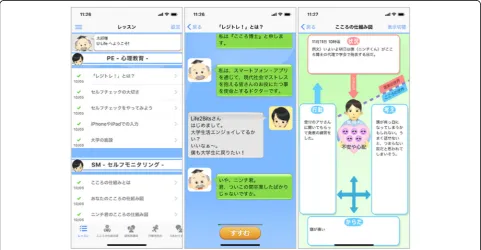
Figure 1 shows the screenshots from the smartphone
app. The components of the smartphone CBT are as follows:
PE(psychoeducation) consists of didactic materials about psychological stress, emphasizes importance
of self-checks of one’s own emotional states, and provides information about campus resources for psychological help.
SM(self-monitoring) consists of PE of the CBT model in the form of a mind map. The participants learn how to monitor their reactions to situations in terms of feelings, thoughts, body reactions, and behaviors and describe them in mind maps. They will be asked to fill in at least one mind map from their daily life before they can proceed to the next lesson. They are then free to complete as many mind maps as they can during the intervention.
CR(cognitive restructuring) consists of PE of skills of cognitive restructuring and a worksheet of finding alternative thoughts for a recent stressful situation. In order to help the participants broaden their thoughts, CR provides four tools, each of which guides them to alternative thoughts through interaction with the characters.
BA(behavioral activation) consists of PE of the importance of pleasurable activities according to the principle“When your body moves, so does your mind.” It provides a worksheet of a personal experiment to test a new activity and also a gamified“action marathon”to promote such personal experiments.
AT(assertion training) consists of PE of assertive communication in contrast to aggressive or passive communication. The participants learn how to express their true feelings and wishes without hurting others or sacrificing themselves.
[image:4.595.57.539.464.714.2]PS(structured problem solving) teaches the
participants how to break down the issue at hand, to specify a concrete and achievable objective for it, to brainstorm possible solutions, to compare their advantages and disadvantages, and finally to choose the most desirable action and act on it. A worksheet to guide the participants through this process is provided.
Each component will consist of a lesson that is sup-posed to take 1 week to complete. The participants can move to the next lesson only after 1 week has passed and after they have completed one worksheet. We have demonstrated the efficacy of a smartphone CBT package containing the SM, BA, and CR components among pa-tients with antidepressant-resistant depression in an RCT [18]. This study found that it took the participants, on average, 10.8 (SD, 4.2) days to complete one lesson; because the maximum number of components or les-sons that participants undertake after PE is five, we set the length of the intervention phase of the trial to 8 weeks.
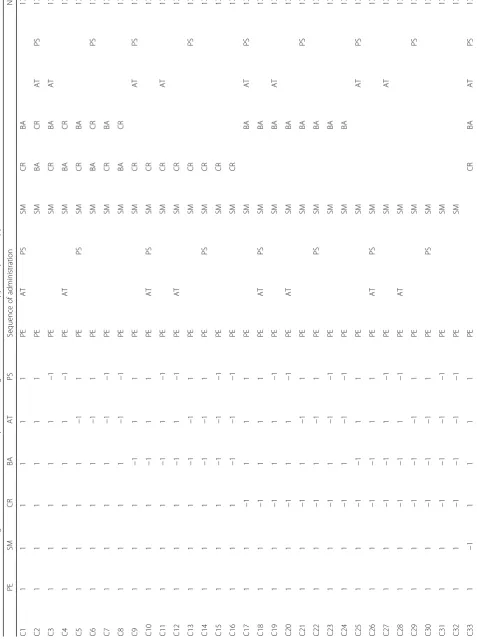
PE constitutes the core of the intervention, and all participants will receive this component. After com-pleting PE, the participants will be randomly allocated to one of the combinations on the basis of presence/
absence of the remaining five components (Table 1).
In order to enable examination of the ordering effects between CR and BA, we doubled the number of
com-binations to 25× 2 = 64. AT and PS are placed before
or after SM or CR or BA in equal proportions among these 64 combinations in order to counterbalance the anticipated likelihood that fewer participants will complete later parts of the intervention. All partici-pants have full access to treatment as usual, inside and outside the campus.
Strategies to improve adherence to interventions and procedures for monitoring adherence
The participants will receive a semiautomated email to congratulate them for their progress in the program every week. The message is based on a template focusing on adherence and motivation but can be modified by a physician or a clinical psych-ologist on the study team. It can contain technical advice for the program, but the participant will be referred to the student health center for any psycho-logical advice.
The adherence of the participants to the allocated intervention will be uploaded and recorded by the online server program. The study personnel will have access to the server and perform ongoing monitoring of adher-ence of the participants.
Concomitant care and interventions that are permitted or prohibited during the trial
All the participants are allowed to receive their usual treatments, including services at the student health cen-ter and other professional psychiatric care. Any receipt of psychological or pharmacological care for a mental health problem will be recorded.
Criteria for discontinuing or modifying the allocated interventions
The allocated intervention will be discontinued if any of the following criteria are met. The date and reason will be recorded. The follow-up assessments will be contin-ued if the participant does not withdraw his or her con-sent to be assessed.
1. The participant withdraws from the intervention 2. The participant cannot continue the intervention
owing to an adverse event 3. The study itself is discontinued
4. The steering committee judges that it is appropriate to discontinue the intervention.
Anticipated risks and benefits for the participants
The interventions will consist of various amounts of PE and exercises in cognitive and behavioral skills for stress reduction to be conducted as self-help by the participants on their smartphones. The interventions will therefore be
considered as “intervention with minimal invasiveness,”
and no serious health risks are expected, except for pos-sible psychological and time burden in going through the program and responding to the questionnaires. On the
contrary, a meta-analysis of internet-based guided
self-help programs show that participants have lower risk of deterioration in symptoms of depression during such interventions than control groups [29].
The possible psychological and time burdens will be fully disclosed and explained to the potential partici-pants at the orientation meeting, and only those who have provided written informed consent will be recruited into the study. No insurance scheme is therefore planned.
Preventing contaminations
Because the intervention takes place at the same univer-sity, there is some concern regarding contamination among the friends, each of whom is randomized to a different combination of components but who may dis-cuss the components of their peers. We assume that such a possibility is minimal, however, because the
inter-vention takes place on each participant’s own
smart-phone, which makes it hard to share the actual contents shown on the app. We will take extra precaution to pre-vent the contamination by explicitly instructing the participants not to discuss or exchange the apps to which each is assigned. Each participant will be inquired as to the degree of possible contamination at week 8, and these results will be reported to and monitored by data safety and monitoring committee.
Measurements
Primary outcomes
The primary outcome of analysis 1 is self-administered PHQ-9 at week 8. The primary outcome of analysis 2 is incidence of a MDE as assessed by the MDE section of the computerized CIDI at week 52.
Secondary outcomes
The secondary outcomes are as follows:
1. PHQ-9 at weeks 1, 2, 3, 4, 5, 6, 7, 12, 16, 20, 24, 28, 32, 36, 40, 44, 48, and 52
2. Generalized Anxiety Disorder-7 (GAD-7) at weeks 4, 8, and 52
3. Cognitive and behavioral skills [30–35] at weeks 8 and 52
4. Presenteeism scale from the Health and Work Performance Questionnaire (HPQ) [36] at weeks 8 and 52
5. Use statistics of the smartphone app through the trial
6. Cointerventions (visits to a mental health professional, psychotropics, counseling/ psychotherapy)
Background characteristics
The following background characteristics will be mea-sured at baseline:
1. Demographics a. Age b. Sex
c. Course (doctoral/master/undergraduate) and class (1/2/3/4: if repeated or not)
d. Major e. Marital status
f. Domicile (home/lodging)
g. Part-time employment (no/less than 2 h per week/2–10 h/more than 10 h)
h. Involvement in club activities (no/less than 2 h per week/2–10 h/more than 10 h)
i. History of psychological/psychiatric treatment j. Smoking (none/10 cigarettes/20 cigarettes/30 or
more cigarettes per day)
k. Drinking (none/less than 2 units per day/2 or more units per day/problem drinking) l. Exercise (rarely/sometimes/daily) m. Breakfast (rarely/sometimes/every day) 2. Personality
a. Short form of the Big Five scale (29 items) [37,38] b. Short form of the Autism Spectrum Quotient
(ten items) [39] 3. Social support
a. Social Support Questionnaire (12 items) [40,41] 4. Cognitive and behavioral skills
a. Self-monitoring (five items) [30] b. Cognitive restructuring (six items) [31] c. Behavioral activation: Behavioral Activation
for Depression Scale-Short Form (eight items) [32, 33]
d. Assertiveness (seven items) [34] e. Problem solving (six items) [35] 5. Clinical characteristics
a. PHQ-9 [28] b. GAD-7 [42]
c. Major depression section of the computerized World Health Organization (WHO) CIDI [43,44] 6. Function
a. Presenteeism scale from the HPQ [36]
Measures
Personal Health Questionnaire-9 (PHQ-9)
PHQ-9 consists of the nine diagnostic criteria items
for a MDE in the Diagnostic and Statistical Manual
of Mental Disorders, Fourth Edition (DSM-IV), and
the DSM-5 [28]. Each item is rated from 0 =Not at
all through 3 =Nearly every day, with the total score
ranging therefore between 0 and 27. The reliability and the validity of the original PHQ-9 and its
Japanese version are well established [45, 46]. We
used this scale successfully in our previous trial of the smartphone CBT [18].
Generalized Anxiety Disorder-7
GAD-7 was developed to measure the severity of gener-alized anxiety and consists of seven items representing nervousness, tension, and worrying [42]. Each item is
rated from 0 =Not at all through 3 =Nearly every day,
part of a standardized battery to measure health out-comes for depression and anxiety [47].
Big Five Scale of Personality Trait Adjectives
There are several validated scales to measure personality traits according to the five-factor model. We will use the short form of the Big Five Scale of Personality Trait Adjectives [37], commonly used in Japan. The reliability and validity of the short version have been ascertained [38]. Each of the five personality traits of neuroticism, extraversion, openness, agreeableness, and conscien-tiousness is measured with five to seven corresponding
adjectives on a 5-point Likert scale from 0 =Untrue of
meand 4 =True of me.
Autism Spectrum Quotient
The autistic trait of the participants will be measured with the short version of the Autism Spectrum Quotient, originally developed by Baron-Cohen et al. [48]. The reliability and validity of the Japanese version and its short from have been established [39].
Social Support Questionnaire
We will measure the size and quality of the students’
social support with the short form of the Social Sup-port Questionnaire [40]. It measures the number of persons providing support and the satisfaction with such support in six domains. The reliability and valid-ity of the original scale and its Japanese version have
been satisfactory [40, 41].
Cognitive and behavioral skills
In order to measure each of the cognitive or behavioral skills for the five components to be examined in this trial in an efficient and valid manner, we have adopted the short versions based on the following established questionnaires. In order to measure the SM skill, we will use the five items that constitute the SM subscale of the original 17-item cognitive-behavioral self-monitoring scale developed by Tsuchida et al. [30]. The study con-firmed the internal consistency reliability, factorial valid-ity, and construct validity of the subscale. Each item is
rated on a 4-point Likert scale from 0 =Very untrue of
me through 3 =Very true of me, and the total score
therefore ranges between 0 and 15.
The skills for CR will be measured with the six highest-loading items from the Competencies of Cogni-tive Therapy Scale, recently developed and validated by
Strunk et al. [31]. Each item is rated from 0 =Very
un-true of me through 3 =Very true of me, and the total score therefore ranges between 0 and 18. We ascertained the semantic equivalence between the Japanese version and its original English version through translation and back translation.
We will use the BA subscale of the Japanese
Behav-ioral Activation for Depression Scale – Short Form,
translated from the original English version [32] and validated in the Japanese population [33]. The Japanese
version consists of five items, each rated from 0 =Very
untrue of methrough 3 =Very true of me.
AT will be measured by the self-assertion subscale of the Adult Social Skills Scale, developed by Aikawa et al. [34]. Its reliability, factorial validity, and construct valid-ity have been established [34]. It consists of seven items,
each rated between 0 =Very untrue of me through 3 =
Very true of me.
The PS skill will be measured with the six
highest-loading items of the approach avoidance style subscale of the Problem-Solving Inventory [35]. We developed its Japanese version through translation and back translation. The original study demonstrated the reliability, factorial validity, and construct validity for the original 32-item version. The reliability and validity of the abbreviated Japanese version need to be examined in
this study. Each item is rated from 0 =Very untrue of me
through 3 =Very true of me, and the total score ranges
between 9 and 18.
CIDI
We will use the self-administered version of the Japanese
WHO-CIDI 3.0 depression section [49, 50] to ascertain
the diagnosis of a major depressive disorder according to DSM-IV in the past 12 months. The self-administered version has been shown to have good concordance with the clinical diagnosis of MDE [51] and to be reliable in a
1-year test–retest survey [44].
HPQ
We will use the three questions from the presenteeism subscale of the HPQ. The original study demonstrated
its reliability and validity [36, 52]. The Japanese version
of the HPQ has been used in the World Mental Health Survey in Japan [50].
Participant timeline
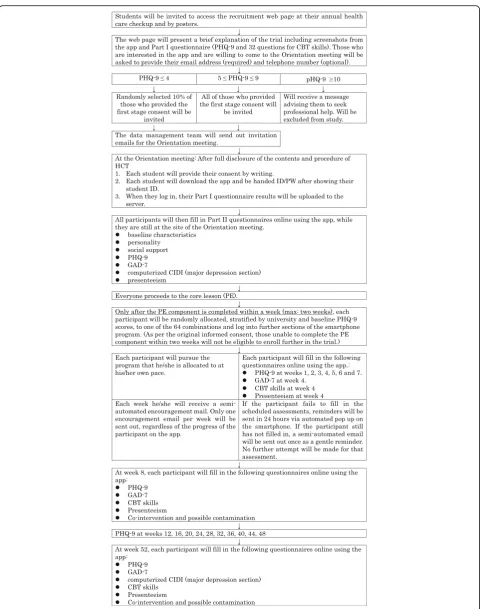
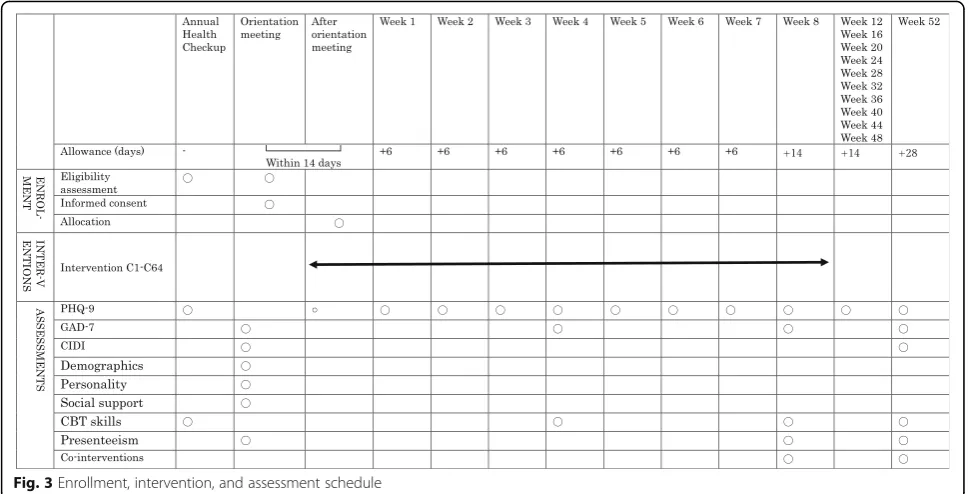
Figure 2 shows the participant timeline, and Fig. 3
shows the enrollment, intervention, and assessment schedule.
Sample size
The study will be powered for analysis 1 (i.e., those scor-ing 5 or more on baseline PHQ-9). The followscor-ing sample size is therefore for this stratum. The sample size will be reviewed after the pilot run in the first year, which will inform us of the possible participation rate among uni-versity students. All the power calculations have been conducted with FactorialPowerPlan SAS Macro
In order to detect an effect size (standardized mean difference) of 0.20 for an efficacious component and their interaction at alpha = 0.05 and beta = 0.10 in ana-lysis of covariance (ANCOVA), we need a total sample size of 1051. To reach this total sample size, the sample size for each of 64 combinations needs to be 17 and the total sample size is therefore 17 × 64 = 1088.
The mixed-effects repeated-measures analysis with more than 5 measurement points, planned for this trial,
is known to require 30–50% fewer participants for the
same power than a pre-to-post-only assessment [53]. Because we expect less than 30% dropouts, we conserva-tively set the final target sample size of our study as that calculated by usual ANCOVA-type power calculation without repeated measures and without dropouts as above.
Recruitment
In the first year of the study, we will conduct a pilot
run aiming at enrolling 100–200 students at Kyoto
University. This will inform us of the possible partici-pation rate among the university students along with possible inadequacies and barriers in the protocol. In the second year of the study, depending on the find-ings from the pilot run, we will extend recruitment to other classes of undergraduate and graduate students at Kyoto University. In the third year of the study, de-pending on the recruitment so far, we will seek collaboration from several other universities in Japan. Recruitment from other universities may already be started in the second year.
Assignment of interventions
Randomization and allocation concealment
The allocation will be stratified by university and by the baseline PHQ-9 score (4 or less vs 5 or more). We will use permuted block randomization in order to ensure balance in the number of subjects allocated to each combination, because in the fully factorial design, the imbalance in the allocated numbers among factors will reduce the statistical power of the study. The size of the block will be hidden to the study personnel, except for the statistician (HN) and the principal investigator (TAF), both of whom will have no role in the partici-pant enrollment.
The statistician (HN) will generate the random alloca-tion sequence using the SAS PROC PLAN (SAS Institute, Cary, NC, USA), which will be built into the
server application. Each participant will then be
automatically allocated to one of the combinations after he/she completes the PE component of the app within 2 weeks.
Blinding
Neither the participant nor the study personnel will be blinded to the intervention that each participant is receiving through the conduct of the trial. The assess-ment of all the primary and secondary outcomes is
self-report by the participant and therefore not
[image:11.595.56.541.88.335.2]without knowledge of the identification of the compo-nents, which will be revealed only after the writing committee signs off the agreed-on statement of interpretation.
Data collection, management, and analysis
Data collection methods
All the data will be collected via the smartphone app platform.
Plans to promote participant retention and complete follow-up
The outcome data will be collected even when the par-ticipant has not completed the allocated intervention, unless he/she has expressed a wish to completely with-draw from the study. When the participant fails to fill in the scheduled assessments, reminders will be sent in 24 hours and 48 hours via automated popup on the smartphone. If the participant still has not filled in the assessment, a semiautomated email will be sent once as a gentle reminder. No further attempt will be made for that assessment. The participants will receive modest compensation for the time it requires to fill in the ques-tionnaires: 1000 yen when they complete week 4 assess-ment, 2000 yen when they complete week 8 assessassess-ment, and 2000 yen when they complete week 52 assessment.
Data management
A secure, web-based, password-protected database will be used to manage recruitment, eligibility assessment, randomization, scheduling and tracking, baseline and follow-up assessments, and delivery of the allocated in-terventions. All the assessment data will be checked automatically for integrity by this platform. The security of the data transfer between the app and the server will be guaranteed through the Secure Socket Layer (SSL).
Statistical methods
All analyses will be performed on the intention-to-treat sample.
Analysis 1 main analyses at week 8
We will use the mixed-effects repeated-measures ana-lysis to estimate the mean difference in change scores on the PHQ-9 for each component. The model will include random effects for subjects (as intercepts) and fixed effects of treatment (main effects and second-order interaction effects of the five components), visit (as categorical), and treatment-by-visit interaction, adjusted for university, age, sex, and baseline PHQ-9 scores. Each of the experimental factors will be coded at two levels
(presence coded as + 1 and absence as −1) using effect
coding. The primary outcome is change in PHQ-9 scores from baseline to week 8. The estimated mean differences
will be converted into standardized mean differences by using the root of the variance taken from the covariance matrix. No adjustment for multiple testing will be applied in estimation of statistical significance of the main and interaction effects in this model, and the
con-ventional threshold for statistical significance (p< 0.05,
two-sided) will be used, because in the optimization phase of the MOST framework, the emphasis is on making a decision about what components will make up the optimized intervention [20], and factorial designs usually evaluate multiple completely different interven-tions that could have been assessed in separate trials and, conventionally, the multiple hypotheses have been
tested independently in these trial designs [54, 55]. We
will use a similar model for GAD-7 and cognitive and behavioral skills at week 8. As sensitivity analyses, we will repeat the above-mentioned analyses for the whole sample, including both strata scoring 4 or less and 5 or more on baseline PHQ-9. The most effica-cious and efficient combination(s) of smartphone CBT for university students will be proposed on the basis of all the above findings.
Analysis 1 secondary analyses
Exploratory analyses will be conducted to elucidate pos-sible effect modification by the baseline variables on the efficacy of each component and of the proposed optimum combination(s) of components. The psycho-metric characteristics of the baseline questionnaires
(in-ternal consistency reliability, factor validity, and
construct validity) will be ascertained. The ordering ef-fect between BA and CR will be examined through com-parison of the eight combinations in which CR comes before BA and the eight combinations in which BA comes before CR. The expected total sample size for this comparison is 272 (17 × 8 × 2). The comparison will have 70% power to detect an effect size of 0.3 at alpha = 0.05. Further exploratory analyses will be conducted on the mediator variables and use statistics of the smartphone CBT to examine the process of the therapy. Where repeated-measures analysis is not possible (e.g., cognitive behavioral skills), we will use multiple imputation for missing observations, where appropriate. The enduring effects of the 2-month intervention among those with el-evated distress at baseline will be examined at week 52.
Analysis 2 main analyses at week 52
subjects (as intercepts) and fixed effects of treatment (main effects and second-order interaction effects of
the five components), visit (as categorical) and
treatment-by-visit interaction, university, age, sex, and baseline PHQ-9 scores.
An exploratory analysis will be conducted to compare the incidence of MDE between the proposed optimum combination(s) with the other combinations, which do
not contain such components, through the
time-to-event analysis (Kaplan-Meier survival analysis) among those who did not have an MDE at baseline. The influence of baseline characteristics on the time to event will be explored by use of Cox proportional hazards ana-lysis if the proportional hazards assumption is met. This analysis is only exploratory, rather than confirmatory, because the efficacy of the proposed optimum combina-tion(s) will be confounded by the correlations of depres-sion scores and status between the 9-week outcomes, from which the proposed combination(s) are derived, and the 52-week outcomes, which are correlated with the outcome of this analysis.
Even when we include all participants with all baseline PHQ-9 scores, the power for analysis 2 may be low owing to the low event rates among the participants. The post hoc power calculation will be conducted for the expected 50% reduction in terms of OR or HR.
Interim analysis
No interim analysis is planned.
Monitoring
Data monitoring
Data integrity will be monitored centrally, first through the built-in data check system on the server program and second by the data management team on a daily basis. The data management team will prepare the annual summary (number of participants entering the study, number of participants completing the study, and serious adverse events) to be presented to the data and
safety monitoring board (DSMB) at 12 months,
24 months, and 36 months after the enrollment of the first participant. The DSMB will advise the steering committee as to the appropriateness of the study progress.
Harms
If elevated suicidal score is noted (total PHQ-9 score of
10 or more and “half or more of the time” or “almost
daily” on item 9 of PHQ-9), the encouragement email
will contain advice to seek help at the student health center and see a psychiatrist from the clinical manage-ment team who will judge whether any emergency intervention is necessary and whether the participation in the trial can be continued (participation itself can be
continued after emergency intervention). All serious adverse events (defined as all deaths, life-threatening
events, hospitalizations, enduring or conspicuous
disabilities), whether they are related to the trial partici-pation or not, will be handled according to the proce-dures set out by Kyoto University Hospital.
Auditing
Because the intervention can be classified as“minimally
invasive intervention,” no formal auditing will be
conducted.
Ethics and dissemination
Research ethics approval
The study protocol was approved by the ethics commit-tee of Kyoto University Graduate School of Medicine (C1357) and will be approved by the ethics committees of other collaborating universities.
Protocol amendments
Any amendments to the protocol will be submitted to the ethics committee of Kyoto University Graduate School of Medicine for approval. Once approved, they will be reported to all the study investigators and, where necessary, to the study participants. Further approval of the ethics committees of participating universities will also be sought.
Consent or assent
We will employ a two-stage consent procedure. At the time of the annual health checkup, participants will have access to the recruitment web page explaining the smartphone app and the trial, fill in part I of the questionnaire, and provide their contact details to re-ceive an invitation to the orientation meeting. At the orientation meeting, the researchers from the student health center will obtain the fully informed written consent to participate in the trial on the smartphone app. Because all participants will be at least 18 years of age and the intervention is minimally invasive, no assent or consent from authorized surrogates is assumed for this study.
Confidentiality
will be kept in the locked drawer in the student health center for 10 years after the publication of the primary findings. The de-identified, anonymized dataset will be uploaded to the UMIN-ICDR website (http://www.umi-n.ac.jp/icdr/index-j.html), and researchers approved by the steering committee will be able to have access to the dataset.
Access to data
All members of the steering committee will have full access to the final trial dataset.
Ancillary and posttrial care
All the participants receive the standard care as provided by the student health center of Kyoto University and by corresponding facilities in each participating university, both throughout the study and afterward.
Dissemination policy
The full protocol will be published in an academic journal in English. Its Japanese synopsis will be posted on the website of the student health center and the Department of Health Promotion and Human Behavior, Kyoto University Graduate School of Medicine/School of Public Health.
The study results will be disseminated to health care professionals and the public through presentations in
academic meetings and publications in academic
journals. The synopses of these reports will be posted on the home page mentioned above for their dissemination to trial participants.
Authorship of the planned primary and secondary publications will include all the members of the steering committee and others judged as appropriate by the steering committee. The order of the authors will be de-termined by the steering committee in consideration of the contributions of each member. After the publication of the primary findings, the de-identified and completely anonymized individual participant-level dataset will be posted on the UMIN-ICDR website (http://www.umin.ac.jp/ icdr/index-j.html) for access by qualified researchers.
Discussion
We have described the protocol for a MOST fully fac-torial trial aimed at optimizing the smartphone CBT for university students. The primary objective of this study is to estimate the specific efficacy of each of the five cognitive or behavioral components to reduce psychological distress within 2 months and thereby to propose the most efficacious and efficient combin-ation of components for university students. The study has several secondary objectives, including the exploration of matching between treatments and indi-vidual characteristics and the examination of the
prophylactic effect of smartphone CBT to prevent an MDE over the course of 12 months.
There will be many challenges in the conduct of this large-scale trial, including the recruitment of partici-pants and their retention in the smartphone CBT and in the assessment. We have taken measures to meet these challenges as follows. First, Kyoto University, the pri-mary study site, has over 22,000 undergraduate and graduate students, and we are anticipating participation of several similarly sized universities. Second, we have incorporated several trial design features to increase retention [56]: a run-in period before randomization so that only those who have shown preliminary ad-herence to the program are randomized; measuring the primary outcome at a relatively early time point (2 months); measuring all the outcomes online with several prompts built into the smartphone app; and offering appropriate monetary incentives, as approved by the ethics committee, for the completeness of data collection. Finally, the research team has a good track record in enrolling and following participants in
pre-vious trials [18, 57–59].
The theoretical strength of the proposed trial is its ability to estimate the specific main effect of a cogni-tive or behavioral component by comparing combina-tions including that component against those not including that component, all of which are equivalent in terms of treatment credibility, delivered attention, or therapist allegiance that may contribute to nonspe-cific effects. These findings can be expected to uniquely contribute to the theories of psychotherapy and of CBT [60].
The pragmatic advantage of the proposed trial comes from the MOST framework, which involves optimization trials using highly efficient experimental designs. This framework enables the investigator to identify the most efficacious and efficient package for a complex interven-tion. The resultant package of smartphone CBT can be efficiently delivered to a large number of students and attain the largest efficacy benefit for them. We also ex-pect to move on to the evaluation phase of the MOST design in the future, in which we can not only evaluate this optimized intervention against treatment as usual but also collect further information to personalize the
treatment to match the individual student’s
characteris-tics and needs.
We will start the recruitment in 2018 and aim at completing the trial by 2021, and we expect to start pub-lishing the results soon afterward.
Trial status
Abbreviations
ANCOVA:Analysis of covariance; AT: Assertion training; BA: Behavioral activation; CBT: Cognitive behavioral therapy; CIDI: Composite International Diagnostic Interview; CR: Cognitive restructuring; DSM:Diagnostic and Statistical Manual of Mental Disorders; DSMB: Data and Safety Monitoring Board; GAD-7: Generalized Anxiety Disorder-7; HPQ: Heath and Work Performance Questionnaire; MDE: Major depressive episode; MOST: Multiphase optimization strategy; PE: Psychoeducation; PHQ-9: Patient Health Questionnaire-9; PS: Problem solving; RCT: Randomized controlled trial; SM: Self-monitoring; SSL: Secure Socket Layer; WHO: World Health Organization
Funding
Initial funding for this trial will be provided by intramural support from Kyoto University to Kyoto University Health Service and by intramural support from the Department of Health Promotion and Human Behavior, Kyoto University Graduate School of Medicine/School of Public Health. None of the study funders shall have any role in study design; collection, management, analysis, and interpretation of data; writing of the report; or the decision to submit the report for publication.
Availability of data and materials
After the publication of the primary findings, the de-identified and com-pletely anonymized individual participant-level dataset will be posted on the UMIN-ICDR website (http://www.umin.ac.jp/icdr/index-j.html) so that it can be accessed by qualified researchers.
Authors’contributions
TU, TI, and TAF conceived of the study. TU, YL, MS, DK, YS, KT, MH, TK, TI, and TAF designed the study. LMC, EW, DSH, JW, and HN critically contributed to the study design. YL and TAF wrote the first draft of the manuscript. All authors contributed to, read, and approved the final manuscript.
Ethics approval and consent to participate
The study protocol was reviewed and approved by the ethics committee of Kyoto University Graduate School of Medicine (reference number C1357). All participants will provide written informed consent prior to participation.
Competing interests
TAF has received lecture fees from Janssen, Meiji, Mitsubishi-Tanabe, MSD, and Pfizer. TAF has received research support from Mitsubishi-Tanabe and Mochida. TAF and MH are developers of the app. All of the other authors declare that they have no competing interests.
Publisher’s Note
Springer Nature remains neutral with regard to jurisdictional claims in published maps and institutional affiliations.
Author details
1
Kyoto University Health Service, Yoshida-Honmachi, Sakyo-ku, Kyoto 606-8501, Japan.2Deparment of Health Promotion and Human Behavior,
Kyoto University Graduate School of Medicine / School of Public Health, Yoshida Konoe-cho, Sakyo-ku, Kyoto, Japan.3The Methodology Center and
Department of Human Development & Family Studies, The Pennsylvania State University, University Park, PA, USA.4School of Psychology, University of
Exeter, Exeter, UK.5Department of Psychology, Vanderbilt University, Nashville, TN, USA.6MRC Biostatistics Unit, University of Cambridge,
Cambridge, UK.7Institute of Statistical Mathematics, Tokyo, Japan.8Center for Cognitive Behavior Therapy and Research, National Center of Neurology and Psychiatry, Kodaira, Japan.
Received: 18 March 2018 Accepted: 1 June 2018
References
1. Blanco C, Okuda M, Wright C, Hasin DS, Grant BF, Liu SM, Olfson M. Mental health of college students and their non-college-attending peers: results from the National Epidemiologic Study on Alcohol and Related Conditions. Arch Gen Psychiatry. 2008;65(12):1429–37.
2. Auerbach RP, Alonso J, Axinn WG, Cuijpers P, Ebert DD, Green JG, Hwang I, Kessler RC, Liu H, Mortier P, et al. Mental disorders among college students
in the World Health Organization World Mental Health Surveys. Psychol Med. 2016;46(14):2955–70.
3. Bruffaerts R, Mortier P, Kiekens G, Auerbach RP, Cuijpers P, Demyttenaere K, Green JG, Nock MK, Kessler RC. Mental health problems in college freshmen: prevalence and academic functioning. J Affect Disord. 2018;225:97–103. 4. Kessler RC, Foster CL, Saunders WB, Stang PE. Social consequences of
psychiatric disorders, I: educational attainment. Am J Psychiatry. 1995;152(7): 1026–32.
5. Breslau J, Lane M, Sampson N, Kessler RC. Mental disorders and subsequent educational attainment in a US national sample. J Psychiatr Res. 2008;42(9): 708–16.
6. Kessler RC, Walters EE, Forthofer MS. The social consequences of psychiatric disorders, III: probability of marital stability. Am J Psychiatry. 1998;155(8):1092–6. 7. Sihvola E, Keski-Rahkonen A, Dick DM, Pulkkinen L, Rose RJ, Marttunen M,
Kaprio J. Minor depression in adolescence: phenomenology and clinical correlates. J Affect Disord. 2007;97(1–3):211–8.
8. Weitzman ER. Poor mental health, depression, and associations with alcohol consumption, harm, and abuse in a national sample of young adults in college. J Nerv Ment Dis. 2004;192(4):269–77.
9. Kessler RC, Berglund P, Demler O, Jin R, Walters EE. Lifetime prevalence and age-of-onset distributions of DSM-IV disorders in the National Comorbidity Survey Replication. Arch Gen Psychiatry. 2005;62(6):593–602.
10. Global Burden of Disease [http://www.healthdata.org/].
11. Eisenberg D, Downs MF, Golberstein E, Zivin K. Stigma and help seeking for mental health among college students. Med Care Res Rev. 2009;66(5):522–41. 12. Eisenberg D, Hunt J, Speer N. Help seeking for mental health on college
campuses: review of evidence and next steps for research and practice. Harv Rev Psychiatry. 2012;20(4):222–32.
13. Stone M, Laughren T, Jones ML, Levenson M, Holland PC, Hughes A, Hammad TA, Temple R, Rochester G. Risk of suicidality in clinical trials of antidepressants in adults: analysis of proprietary data submitted to US Food and Drug Administration. BMJ. 2009;339:b2880.
14. Cipriani A, Zhou X, Del Giovane C, Hetrick SE, Qin B, Whittington C, Coghill D, Zhang Y, Hazell P, Leucht S, et al. Comparative efficacy and tolerability of antidepressants for major depressive disorder in children and adolescents: a network meta-analysis. Lancet. 2016;388(10047):881–90.
15. Barbui C, Cipriani A, Patel V, Ayuso-Mateos JL, van Ommeren M. Efficacy of antidepressants and benzodiazepines in minor depression: systematic review and meta-analysis. Br J Psychiatry. 2011;198(1):11–6.
16. Ebert DD, Zarski AC, Christensen H, Stikkelbroek Y, Cuijpers P, Berking M, Riper H. Internet and computer-based cognitive behavioral therapy for anxiety and depression in youth: a meta-analysis of randomized controlled outcome trials. PLoS One. 2015;10(3):e0119895.
17. Davies EB, Morriss R, Glazebrook C. Computer-delivered and web-based interventions to improve depression, anxiety, and psychological well-being of university students: a systematic review and meta-analysis. J Med Internet Res. 2014;16(5):e130.
18. Mantani A, Kato T, Furukawa TA, Horikoshi M, Imai H, Hiroe T, Chino B, Funayama T, Yonemoto N, Zhou Q, et al. Smartphone cognitive behavioral therapy as an adjunct to pharmacotherapy for refractory depression: randomized controlled trial. J Med Internet Res. 2017;19(11):e373. 19. Guise JM, Chang C, Butler M, Viswanathan M, Tugwell P. AHRQ series on
complex intervention systematic reviews—paper 1: an introduction to a series of articles that provide guidance and tools for reviews of complex interventions. J Clin Epidemiol. 2017;90:6–10.
20. Collins LM. Optimization of behavioral, biobehavioral, and biomedical interventions: the multiphase optimization strategy (MOST). New York: Springer; 2018.
21. Collins LM, Kugler KC, Gwadz MV. Optimization of multicomponent behavioral and biobehavioral interventions for the prevention and treatment of HIV/AIDS. AIDS Behav. 2016;20(Suppl 1):S197–214. 22. Watkins E, Newbold A, Tester-Jones M, Javaid M, Cadman J, Collins LM,
Graham J, Mostazir M. Implementing multifactorial psychotherapy research in online virtual environments (IMPROVE-2): study protocol for a phase III trial of the MOST randomized component selection method for internet cognitive-behavioural therapy for depression. BMC Psychiatry. 2016;16(1):345. 23. Bjornsson AS. Beyond the“psychological placebo”: specifying the nonspecific in psychotherapy. Clin Psychol Sci Pract. 2011;18:113–8. 24. Borkovec TD, Sibrava NJ. Problems with the use of placebo conditions in
25. DeRubeis RJ, Cohen ZD, Forand NR, Fournier JC, Gelfand LA, Lorenzo-Luaces L. The Personalized Advantage Index: translating research on prediction into individualized treatment recommendations: a demonstration. PLoS One. 2014;9(1):e83875.
26. Driessen E, Smits N, Dekker JJ, Peen J, Don FJ, Kool S, Westra D, Hendriksen M, Cuijpers P, Van HL. Differential efficacy of cognitive behavioral therapy and psychodynamic therapy for major depression: a study of prescriptive factors. Psychol Med. 2016;46(4):731–44.
27. Chan AW, Tetzlaff JM, Altman DG, Laupacis A, Gotzsche PC, Krleza-Jeric K, Hrobjartsson A, Mann H, Dickersin K, Berlin JA, et al. SPIRIT 2013 statement: defining standard protocol items for clinical trials. Ann Intern Med. 2013;158(3):200–7.
28. Kroenke K, Spitzer RL, Williams JB. The PHQ-9: validity of a brief depression severity measure. J Gen Intern Med. 2001;16(9):606–13.
29. Ebert DD, Donkin L, Andersson G, Andrews G, Berger T, Carlbring P, Rozenthal A, Choi I, Laferton JA, Johansson R, et al. Does internet-based guided-self-help for depression cause harm? An individual participant data meta-analysis on deterioration rates and its moderators in randomized controlled trials. Psychol Med. 2016;46(13):2679–93.
30. Tsuchida T, Fukushima O. The development of the cognitive behavioral self-monitoring scale. Mejiro J Psychol. 2007;3(1):85–93.
31. Strunk DR, Hollars SN, Adler AD, Goldstein LA, Braun JD. Assessing patients’cognitive therapy skills: initial evaluation of the Competencies of Cognitive Therapy Scale. Cognit Ther Res. 2014;38(5):559–69. 32. Manos RC, Kanter JW, Luo W. The behavioral activation for depression
scale-short form: development and validation. Behav Ther. 2011;42(4):726–39. 33. Yamamoto T, Shudo Y, Sakai M. Development of the Japanese version of
Behavioral Activation for Depression Scale-Short Form (BADS-SF) and examination of its reliability and validity. Jpn J Cogn Ther. 2015;8(1):96–105. 34. Aikawa A, Fujita M. An attempt to construct a social skills self-rating scale
for adults. Bulletin of Tokyo Gakugei University Part I. 2005;56(1):87–93. 35. Heppner PP, Petersen CH. The development and implications of a personal
problem-solving inventory. J Couns Psychol. 1982;29(1):66–75.
36. Kessler RC, Barber C, Beck A, Berglund P, Cleary PD, McKenas D, Pronk N, Simon G, Stang P, Ustun TB, et al. The World Health Organization Health and Work Performance Questionnaire (HPQ). J Occup Environ Med. 2003;45(2):156–74. 37. Wada S. Construction of the Big Five Scales of personality trait terms and concurrent validity with NPI [in Japanese]. Jpn J Psychol. 1996;67(1):61–7. 38. Namikawa T, Tani I, Wakita T, Kuamagai R, Nakane A, Noguchi H.
Development of a short form of the Japanese Big-Five Scale, and a test of its reliability and validity. Jpn J Psychol. 2012;83(2):91–9.
39. Kurita H, Koyama T, Osada H. Autism-Spectrum Quotient-Japanese version and its short forms for screening normally intelligent persons with pervasive development disorders. Psychiatry Clin Neurosci. 2005;59:490–6.
40. Sarason IG, Sarason BR, Shearin EN, Pierce GR. A brief measure of social support: practical and theoretical implications. J Soc Pers Relat. 1987;4:497–510. 41. Furukawa TA, Harai H, Hirai T, Kitamura T, Takahashi K. Social Support
Questionnaire among psychiatric patients with various diagnoses and normal controls. Soc Psychiatry Psychiatr Epidemiol. 1999;34(4):216–22. 42. Spitzer RL, Kroenke K, Williams JB, Lowe B. A brief measure for assessing
generalized anxiety disorder: the GAD-7. Arch Intern Med. 2006;166(10):1092–7. 43. Peters L, Andrews G. Procedural validity of the computerized version of the
Composite International Diagnostic Interview (CIDI-Auto) in the anxiety disorders. Psychol Med. 1995;25(6):1269–80.
44. Shimoda H, Inoue A, Tsuno K, Kawakami N. One-year test-retest reliability of a Japanese web-based version of the WHO Composite International Diagnostic Interview (CIDI) for major depression in a working population. Int J Methods Psychiatr Res. 2015;24(3):204–12.
45. Furukawa TA. Assessment of mood: guides for clinicians. J Psychosom Res. 2010;68(6):581–9.
46. Muramatsu K, Miyaoka H, Kamijima K, Muramatsu Y, Tanaka Y, Hosaka M, Miwa Y, Fuse K, Yoshimine F, Mashima I, et al. Performance of the Japanese version of the Patient Health Questionnaire (J-PHQ-9) for depression in primary care. Gen Hosp Psychiatry. 2018;52:64–9.
47. Obbarius A, van Maasakkers L, Baer L, Clark DM, Crocker AG, de Beurs E, Emmelkamp PMG, Furukawa TA, Hedman-Lagerlof E, Kangas M, et al. Standardization of health outcomes assessment for depression and anxiety: recommendations from the ICHOM Depression and Anxiety Working Group. Qual Life Res. 2017;26(12):3211–25.
48. Baron-Cohen S, Wheelwright S, Skinner R, Martin J, Clubley E. The Autism-Spectrum Quotient (AQ): evidence from Asperger
syndrome/high-functioning autism, males and females, scientists and mathematicians. J Autism Dev Disord. 2001;31(1):5–17.
49. Kessler RC, Ustun TB. The World Mental Health (WMH) Survey Initiative version of the World Health Organization (WHO) Composite International Diagnostic Interview (CIDI). Int J Methods Psychiatr Res. 2004;13(2):93–121. 50. Kawakami N, Takeshima T, Ono Y, Uda H, Hata Y, Nakane Y, Nakane H, Iwata
N, Furukawa TA, Kikkawa T. Twelve-month prevalence, severity, and treatment of common mental disorders in communities in Japan: preliminary finding from the World Mental Health Japan Survey 2002-2003. Psychiatry Clin Neurosci. 2005;59(4):441–52.
51. Inoue A, Kawakami N, Tsuno K, Tomioka K, Nakanishi M. Organizational justice and major depressive episodes in Japanese employees: a cross-sectional study. J Occup Health. 2013;55(2):47–55.
52. Kessler RC, Ames M, Hymel PA, Loeppke R, McKenas DK, Richling DE, Stang PE, Ustun TB. Using the World Health Organization Health and Work Performance Questionnaire (HPQ) to evaluate the indirect workplace costs of illness. J Occup Environ Med. 2004;46(6 Suppl):S23–37.
53. Muthen BO, Curran PJ. General longitudinal modeling of individual differences in experimental designs: a latent variable framework for analysis and power calculation. Psychol Methods. 1997;2(4):371–402. 54. Fleiss JL. Design and analysis of clinical experiments. New York: John Wiley
& Sons; 1999.
55. Balakrishnan N, editor. Methods and applications of statistics in clinical trials, vol. Vols. 1 and 2. Hoboken: Wiley; 2014.
56. Little RJ, D’Agostino R, Cohen ML, Dickersin K, Emerson SS, Farrar JT, Frangakis C, Hogan JW, Molenberghs G, Murphy SA, et al. The prevention and treatment of missing data in clinical trials. N Engl J Med. 2012;367(14): 1355–60.
57. Furukawa TA, Horikoshi M, Kawakami N, Kadota M, Sasaki M, Sekiya Y, Hosogoshi H, Kashimura M, Asano K, Terashima H, et al. Telephone cognitive-behavioral therapy for subthreshold depression and presenteeism in workplace: a randomized controlled trial. PLoS One. 2012;7(4):e35330. 58. Kitamura T, Kiyohara K, Sakai T, Matsuyama T, Hatakeyama T, Shimamoto T,
Izawa J, Fujii T, Nishiyama C, Kawamura T, et al. Public-access defibrillation and out-of-hospital cardiac arrest in Japan. N Engl J Med. 2016;375(17): 1649–59.
59. Satomura K, Kitamura T, Kawamura T, Shimbo T, Watanabe M, Kamei M, Takano Y, Tamakoshi A, Great Cold Investigators-I. Prevention of upper respiratory tract infections by gargling: a randomized trial. Am J Prev Med. 2005;29(4):302–7.