S-MSE: ASEMANTIC META SEARCH ENGINE USING
SEMANTIC SIMILARITY AND REPUTATION MEASURE
P. VIJAYA1, G. RAJU2, SANTOSH KUMAR RAY3
1Research Scholar, Karpagam University, Coimbatore, TamilNadu, India
2Department of Information Technology, Kannur University, Kerala, India
3Department of Information Technology, Al Khawarizmi International College, Al Alin, UAE
E-mail: [email protected]
ABSTRACT
In order to increase web search effectiveness, Meta search engines are invented to combine results of multiple search engines as a result of larger coverage of indexed web. Meta search engine is a kind of system which is useful for internet users to take advantage of multiple search engines in searching information. Recently several approaches were developed using ontology and ranking measures. Accordingly, Meta search engine is developed here using ontology and semantic similarity measure. In order to bring semantic in keyword matching, a semantic similarity measure (SSM) is developed. Here, every concept sets are matched with the title sets using SSM that consider the hyponyms and hyponyms of the keywords presented in the title sets. Along with three different ranking measures relevant to contents, title sets and raking value given by the standard search engines are effectively combined to improve the effectiveness. Finally, the experimentation is carried out using different set of queries and the performance of the meta-search engine is evaluated using TREC-style average precision (TSAP) measure. The proposed semantic meta-search engine provides 80% TSAP which is high compared with existing search engine and meta-search engine.
Keywords: S-MSE, Search Engine, Semantic Similarity, Reputation Measure, TREC, TSAP
1.INTRODUCTION
With fluctuating capabilities, the ubiquity of the Internet and Web has directed to the emergence of numerous Web search engines. These search engines guide Web sites, images, Usenet news groups, content-based directories, and news sources with the objective of producing search effects that are most related to user queries. On the other hand, just a small number of web users really make out how to employ the true power of Web search engines. Search engines have started offering access to their services through different interfaces in order to address this problem [1]. For any specified query, search engine as a device to explore the Web must get the desired effects. Achievement of a search engine is directly reliant on the satisfaction level of the user. Within a short time of interval, users longing the data to be offered to them. They in addition anticipate that the most related and latest information are existing [2, 3] to them by the search engines. A large amount of the search engines can never totally please user's necessities and the search
effects are frequently very imprecise and unrelated [4].
A lot of researchers who have accounted previously about different features of search engines are there in [5-17]. Search devices for the web can be categorized as Search Engines, Directory Services, Meta-Search Engines, and Hybrid Search Services. Google, Inktomi, etc., are distinctive search engines. Yahoo is a well-known
directory service. Meta-Crawler, ProFusion,
ISSN: 1992-8645 www.jatit.org E-ISSN: 1817-3195
Amongst the researchers, semantic search engine have obtained a considerable attention very lately. The processes of semantic search engine normally may comprise: 1) Extracting the relevant concepts from the sentence, from where the user question can be interpreted; 2) The meaningful concepts relevant to the query, is removed by means of Ontology. By employing semantically richer
ontologies in semantic search engine, the
subsequent advantages can be acquired. Initially, to explain the terminology of the application and the domain knowledge in more detail, ontologies can be applied, as example we can regard as, relations among categories in dissimilar sights can be termed. Secondly, for making semantically more precise annotations in terms of the domain knowledge, ontologies can be applied. Thirdly, with the assist of ontologies, the user can convey the queries more accurately and unambiguously which leads to improved precision and recall rates.
Fourthly, class definitions and inference
mechanisms, such as instance-level metadata, property inheritance, can be developed semantically through ontological [26].
In this research effort, to develop web documents retrieval we have offered a semantic meta search engine. Here, a new semantic similarity measure is designed to find the similarity between two keywords. This semantic resemblance measure makes use of mathematical set operation based on hyponyms and hyponyms. The main steps of the suggested meta search engine encloses, i) ranking based on web contents, ii) ranking based on title keywords, and iii) ranking based on reputation among different search engines. A hybrid measure is improved to re-rank the web document that is regained through dissimilar search engine by joining these three measures. At this point, the weighted average calculation formulae are applied with the dissimilar weights prearranged for three
dissimilar ranking measures. Lastly, the
presentation is assessed with the assist of TSAP measure. Remaining of the paper is arranged as follows: Section 2 offers the assessment of associated works and section 3 offers the semantic similarity measure designed for the semantic meta search engine. Section 4 offers the hybrid ranking measure for the suggested meta search engine. Section 5 converses the effects and section 6 ends the paper.
2. REVIEW OF RELATED WORKS
Using web search engines as corpus or physically gathered corpus, quite a lot of researches compute
semantic similarity between two words. Paik. I et al. [24] have suggested a technique to find the word Ri between two words P and Q and removed a relation of the words with PLSI (Probabilistic Latent Semantic Indexing). The effects of the experiments demonstrated that by means of the PLSI with smaller latent class such was efficient in getting Ri which was more associated to P and Q, and by the PLSI with over 5 latent class was efficient in getting implied relation between P and Q. An information customization system that unites meta-search and unsupervised learning has been suggested by Mohamed Salah Hamdiet al. [23]. At the same time a meta-search engine searches for multiple search engines and comes back a single record of results. As the results, was regularly clutching the initial items from the relevancy-ranked list of hits returned by the individual search engines, the effects regained by this engine were highly related. Using the Kohonen Feature Map, a self-organizing semantic map such that the documents of related substances are situated close to one another, is erected.
A lightweight strategy for service discovery has been suggested by Giantsiou, Let al. [25]. Their strategy includes three main phases. Initially, the semantic service explanations were regained and accumulated locally during the crawling phase. After that the semantics of every explanation were plotted to a service meta-model and the effecting triples were accumulated in a RDF repository, in the homogenization phase. Lastly, the users were facilitated to query the fundamental repository and discover online services, at the search phase. Guang-ming and Wen-juan [18] have suggested the proficient meta search engine system, employed the CC4 neural network algorithm to compute web page relation degree, and attained the high degree of professional web pages. They worked out the problem of the breadth the people’s access to information, suggested a superior solution to explore in the ocean of information. It completely examined the web page information, used CC4 neural network algorithm to reviewer the related web pages and optimal rank and then joined the professional dictionary to strain the sort effects. Lastly, the experimental results demonstrated that the technique enhanced the search quality to the particular specialty.
Google functions that are available from EGG through the Google. The suggested method attained
through uncomplicated manipulation and
automation of the presented Google functions. The suggested meta-search engine sustained search based on “Combinatorial Keywords” and “Normal Search”. A detailed assessment expressed how one can exploit the competence of Google cluster architecture through its programmable Web services by making advanced search features at a third party user application level. Meow, a semantic meta search engine has been offered by Keongand Anthony [20] that was capable to change a query from a non-semantic search result into a semantic search result. DBpedia was employed as a knowledge base since it encloses a huge dataset that was capable to explain general ideas for different domains. Meow was able to enhance the search result from Google by using DBpedia. On the other hand, the information that was queried from DBpedia for definite topic may be huge and may contain ideas that are not related.
3. NEW SEMANTIC SIMILARITY MEASURE
Finding the similarity between two keywords is important for any information retrieval application. Generally, the string matching distance and vector space modelling-based approaches are widely used to find the similarity between keywords. Here, we have given new semantic similarity measure for finding the similarity between two keywords. In order to find the similarity between two keywords, the following mathematical model will be used. This semantic similarity measure is then used to find the ranking measure based on title keywords.
At first, two keywords such as,
t
1andc
1are givento Wordnetontology(wordnet.princeton.edu) to
extract the hypernyms and hyponyms of those two keywords. Once we extract them, three different sets are individually formed for those keywords.
For example, first set of keyword
t
1 contains a setof keywords that are related to the
hypernyms(Hypr)t1and the second set contains the
hyponyms (Hypo)t1and third set contains whole
keywords presented in hypernyms and
hypernyms(Uw)t1.Then, the semantic similarity
measure will be found out using the following formulae. ) ( )] [( ) ( ) , ( 1 2
T n γ Hy β H α T n k k
Sim = − w+ w + Uw
Where, n(T) is the number terms chosen for
weighted summation. Here, the value for n(T)is
three. Hwcontributes to similarity based on the
similarity in hypernyms of two keywords taken for
similarity finding.Hyw is used to bring the
similarity of two keywords based on hyponyms set
and Uwbring the similarity value based on
similarity of universal set. α,,β,γare the weightage
constants that are computed based on the following formulae.
w
H is computed by taking the intersection and
union operation of hypernyms sets formed from
two different keyword. Similarly, Hyw is
computed by taking the difference in between the
union and intersection similarity. Uwis found out
using similarity of universal set.
|) ) ( ) ( (| |) ) ( ) (
(| t1 c1 t1 c1
w Hypr Hypr Hypr hyper
H = U − I
Where, |(Hypr)t1U(Hypr)c1| provides number
of keywords presented after finding the union in
between (Hypr)t1and (Hypr)c1.
1
1 ( )
)
(Hyprt I hyper c provides number of keywords
presented after finding the intersection in between
1
)
(Hypr t and (Hypr)c1.
) ) ( ) ( ) ) ( ) (
( Hypo t1 Hypo c1 Hypo t1 Hypo c1
Hyw= U − I
Where, (Hypo)t1U(Hypo)c1) provides number
of keywords presented after finding the union in
between (Hypo)t1and (Hypo)c1.
I
( ) ) )(Hypo t1 Hypo c1 provides number of
keywords presented after finding the union in between (Hypo)t1 and (Hypo)c1.
) ) ( ) ( ( ) ) ( ) (
( w t1 w c1 w t w c1
w U U U U I U
U = −
Where, (Uw)t1U(Uw)c1 is found by taking
modulus operation after taking the union operation in between (Uw)t1and (Uw)c1. (Uw)t1
I
(Uw)c1 isfound by taking modulus operation after taking the
intersection operation in between (Uw)t1 and
1
) (Uw c .
The weightage constants are computed based on the following formulae. Here, the total number of keywords presented after taking the union operation is used as the weighatge parameters of the three terms presented in the proposed semantic similarity formulae. ) ) ( ) (( 1 1
1 hypr c
ISSN: 1992-8645 www.jatit.org E-ISSN: 1817-3195
) ) ( ) (( 1 1
1 hypr c
t hypr n β U = ) ( 1 1 1 c t n γ U U U =
Where,n((hypr) t1U(hypr)c1)is number of
keywords in union set of hypernyms.
) ) ( )
((hyprt1 hyprc1
n U is number of keywords in
union set of hyponyms. n(Ut1 U Uc1) are total
keywords in the union set of universal set.
4. HYBRID RANKING AND SEMANTIC SIMILARITY MEASURE FOR ONTOLOGY BASED META-SEARCH ENGINE
This section presents and discusses the proposed hybrid ranking measure. The hybrid ranking measure combines three ranking measure obtained through concept, title and reputation matrix. Here, the finding of similarity between two keywords in title matrix computation is done through the semantic similarity measure designed newly. The overall steps of the proposed hybrid meta search engines is explained through three different steps:
1. Pre-processing
2. Finding of ranking measure
3. Hybrid ranking measure
4.1 Pre-processing
At first, the query keywords are given to various search engines namely, Google, Bing and Yahoo. Then, top ‘n’ results from each of the three search engines are selected for rearranging the order of the results retrieved from the search engines. For the entire documents, the keywords are extracted from web document and stop words are removed from
the extracted content of web document.
Subsequently, sequential keywords are extracted based on the mutual relation between two consecutive keywords given in the document. The sequential keyword is extracted based on a mutual association value, which is defined by,
) ( ) ( ) , ( log ) . ( j i j i j i k P k P k k P k k MA =
Where, MA(ki,kj) is the mutual association
between the keywords ki and kj . P (ki,kj) is the joint probability that both keywords to be present in the
text window and the P (ki) is the probability that a
keyword ki to appear in the text window. Once we
find the mutual values for the entire combination of consecutive words, the final set of sequential
keyword set is identified if the mutual association values are high. Then, the sequential keywords are stored to a set SW.
] ,..., ,
[sw1 sw2 swn SW =
Similar the process is repeated for all the documents and it is constructed as matrix where, row indicates sequential keywords and column indicates set of documents. Every value in the matrix is in mutual association that is obtained from the previous step.
4.2 Computation of ranking measure
This step is useful to find three ranking measure made for meta-search engine. Three different measures focus on different aspect like content, title and the reputation among three search engines.
i) Generating ranking measure for web documents based on concept (R1)
For the input query, we form the concept sets that are generated after matching the query word with the ontology. Then, the combination is generated for all the extracted keywords from the ontology with the query keyword. For all the combinations (concepts), we find the score value after matching the concepts with the sequential word matrix. It produces a concept matrix that contains set of concepts as rows and documents as columns. The concept matrix is represented as follows:
] ,..., ,
[c1 c2 cn
C =
Where,
i
c is the concept vector that contains the mutual
association value related to all the documents for the specific conceptci.
Then, the trusting measure of concepts are computed for every value located in the concept matrix. The formulae for computing the trusting measure of concepts is given as,
n c Trci = i
Where,
n
is the total documents considered.After computing the trusting measure for all the values, we put the trusting measure values in the corresponding location so that we obtain new matrix, called trusting matrix of concept.
] ,..., ,
[Trc1 Trc2 Trcn
TRMC =
Then, the trusting matrix is used to provide the
ranking measure of concept matrixR1 j( ) based on
n j 1 Trc Trc j R m i j i
j + ≤ ≤
=
∑
= ; 2 1 ) ( 1 2 1ii) Generating ranking measure for web documents based on title (R2)
To find the ranking measure based on title, we extracts the title keywords from the title tags of all the web pages returned by search engines and constructs the matrix regarding the titles. The title matrix is matrix that contains total title keywords as column and the concepts in the concepts matrix as rows. Then, the values are filled up by finding the semantic similarity score of the concept and title word. For finding the semantic similarity score, the new formulae designed in the previous section is used. The title matrix of the proposed approach is indicated as follows:
] ,..., , [t1 t2 tn
TM =
Where, ti is the title vector that contains the semantic similarity value related to all the documents. Then, the trusting measure of title matrix is computed for every value located in the title matrix. The formulae for computing the trusting measure is given as,
n t Trti = i
Where,
n
is the total documents considered.After computing the trusting measure for all the values, we put the trusting measure values in the corresponding location so that we obtain new matrix, called trusting matrix of title.
] ,..., ,
[Trt1 Trt2 Trtn
TRMT =
Then, the trusting matrix of title is used to
provide the ranking measure of title matrixR2 j( )
based on the following formulae.
n j 1 Trt Trt j R m i j i
j + ≤ ≤
=
∑
= ; 2 1 ) ( 2 2 1iii) Generating ranking measure for web documents based on reputation matrix (R3)
Here, the ranking measure is designed based on the reputation of web pages among different search engines. The ranking given by three different search engine like, Google, Yahoo and Bing is added to obtain the reputation value of the web documents extracted. ) ( ) ( ) ( )
(j G j Y j B j
k = r + r + r
Where, G (j)
r is ranking of web document ‘j’
obtained from Google.Yr(j) is ranking of web
document ‘j’ obtained from yahoo and Br( j) is
ranking of web document ‘j’ obtained from Bing. Then, ranking measure for web documents based on reputation matrix (R3) is computed based on the following formulae, in which ‘n’ is the total number of document considered.
n j k j
R3( )=1− ( )
4.3 Hybrid Ranking Measure
After finding three ranking measures, the hybrid measure for every web document is computed based on hybrid ranking measure. Here, the weighted average formula is used here to find the hybrid measure by putting appropriate weights for concept, title and reputation matrices.
n j 1 w w w j v w j v w j v w j
R ≤ ≤
+ + + + = ( ) ( ) ( ); ) ( 3 2 1 3 3 2 2 1 1
Here, w1=0.5, w2=0.25, w3=0.25. Once the hybrid ranking vector is calculated, the values are arranged in the descending order. The web documents are shown to the users based on the values of the sorted hybrid ranking vector vector.
5. RESULTS AND DISCUSSION
This section presents the experimental analysis of the proposed semantic meta-search engine and its discussion. The proposed system is implemented in Java under JDK 1.7 and all the experiments are conducted on a system with intel core i5 processor and 3 GB RAM. The proposed system is evaluated with 50 queries and only the sample evaluation of three queries is given in section.
5.1 Evaluation Factor
ISSN: 1992-8645 www.jatit.org E-ISSN: 1817-3195
N r TSAP
N
i i)/ (
1
∑
=
=
Where
r
i=
1
/
i
if the ith ranked result is relevantand
r
i=
0
if the ith result is not relevant. It is easyto see that TSAP takes into consideration both the number of relevant documents in the top N results and the ranks of the relevant documents. TSAP tends to yield a larger value when more relevant documents appear in the top N results and when the relevant documents are ranked higher.
5.2 Performance analysis of S-MSE based on ranking order
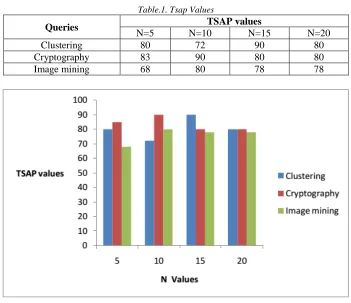
[image:6.612.130.481.278.581.2]The performance of the S-MSE is evaluated with three different queries such as, clustering, cryptography and image mining. After obtaining the results from the hybrid search engine, the obtained results and given to the users to find the relevant pages of them. Based on the relevancy, TSAP measure is computed and it is plotted in a graph shown in figure 1. From the figure, we can identify that the highest TSAP value of 83% is achieved for “cryptography” when N=5. For the query keyword “clustering, the highest value is 90% that is obtained for N=15.
Table.1. Tsap Values
Queries TSAP values
N=5 N=10 N=15 N=20
Clustering 80 72 90 80
Cryptography 83 90 80 80
Image mining 68 80 78 78
Fig.1. TSAP Values Against N Variations
5.3 Comparative analysis with existing search engine and Meta search engine
i) Analysis with existing search engine
Figure 2 shows the comparative evaluation of the proposed meta-search engine with the standard
Table.2. TSAP Comparison
Queries TSAP values
S-MSE Google yahoo Bing
Clustering 80 70 78 60
Cryptography 85 75 83 65
Image mining 68 62 65 55
Fig.2. A Comparison Of TSAP Values With Traditional Search Engines
ii) Comparative analysis with existing meta search engine
Analysis with 2002 web track data
In this section, we plot a comparative study of the proposed approach with some other search engines. We use the TREC 2002 web track and 2002 TREC Web Track has 50 topics indexed from 551 to 600. In this paper, for each topic, only the title part is used as a query to send to the search engines, because the titles are short, similar to most Internet queries submitted by real users. The average length of the titles of these 50 topics is 3.06. The description and the narrative describe what documents should be considered relevant to the corresponding topic. This information is served as the standard criteria for us to judge the relevancy of the collected result documents. Each query is
submitted to every component search engine. For each query and each search engine, the top 10 results on the first result page are collected. The results are plotted based on the precision as evaluation criteria.
N
documents relevant
of Number ecision =
Pr
Here, we consider N as total number of top results and the relevant document from the top result are compared manually. The relevancy of each document is manually checked, based on the criteria specified in the description and the narrative part of the corresponding TREC query. The collected data and the documents, together with the relevancy assessment result, form our test-bed. The test-bed is stored locally so it will not be affected by any subsequent changes from any component search engine.
Table.3. Precision Analysis
index Title S-MSE Google Yahoo Bing
551 intellectual property 0.92 0.88 0.87 0.79
552 Foods for cancer patients 0.91 0.84 0.81 0.82
553 federal funding mental illness 0.93 0.81 0.81 0.81
554 Home buying 0.95 0.89 0.83 0.84
ISSN: 1992-8645 www.jatit.org E-ISSN: 1817-3195
The table 3 represents the precision based analysis of the proposed approach with three major search engines Google, yahoo and Bing. The analysis showed that the S-MSE algorithm has better precision over the other search engines on data 2002 TREC web track. We processed all the 50 indices from 551 to 600, the same result obtained for all indices as above. In this section, we also made a comparison of the semantic meta-search engine, which has been done with an existing search algorithm. The existing meta-search is used for evaluation of result merging
strategies for meta-search engines [22]. The above stated approach implemented three algorithms for the evaluating the meta-search process and the algorithms are derived based on the similarity of the documents and the similarity measures used are SRRsim, SRRrank and SRRsimMF[22]. The comparative evaluation is given in figure 3. From the figure, the proposed meta-search engine obtained the maximum TSAP value for all the ranking order. For N=10, the proposed meta-search engine obtained 80% TSAP while the existing measure achieved about 25%.
Table.4. TSAP Comparison Against Meta Search Engines
Queries TSAP values
N=5 N=10 N=15 N=20
SRRsim 0.381 0.236 0.139 0.099
SRRrank 0.370 0.230 0.130 0.099
SRRsimMF 0.381 0.237 0.139 0.099
S-MSE 0.770 0.810 0.790 0.760
Fig.3.Comparison Analysis
6. CONCLUSION
We have presented a semantic meta-search engine to improve web documents retrieval. Here, a new semantic similarity measure is designed by the use of mathematical set operation based on hyponyms and hyponyms. This measure is used to find the similarity between two keywords. Along with, three different ranking measures relevant to contents, title sets and raking value given by the standard search engines are effectively combined using weighted average formulae. Finally, the evaluation of the proposed meta-search engine is carried out using different set of queries and the comparative analysis is performed using TSAP measure. The hybrid semantic meta-search engine
provides 80% TSAP which is high compared with existing search engine and meta search engine.
REFERENCES
[1] Abawajy, J.H., Hu, M.J.,"A new Internet meta-search engine and implementation,” The 3rd ACS/IEEE International Conference on Computer Systems and Applications, 2005. [2] Juan Tang, Ya-Jun Du, Ke-Liang Wang, “Design
[3] K.SatyaSai Prakash, S. V. Raghavan, "DLAPANGSE: Distributed Intelligent Agent based Parallel Architecture for Next Generation Search Engines", Department of Computer Science & Engineering, Indian Institute of Technology Madras, India, 2001.
[4] Z. Li, Y. Wang.V. Oria, "A New Architecture for Web Meta-Search Engines," Seventh Americas Conference on Information Systems, CIS Department, New Jercy Institute of Technology, 2001.
[5] A. Araus, et. al., "Searching the Web", ACM Transactions on Internet Technology, Vol. 1, August 2001, pp: 243.
[6] J. W. Green, "Hyper Dog: Up to Date Web Monitoring tirough Meta Computers", MS Report, Baltimore, Maryland, October 2000. [7] S. Lawrence, L. Giles, "Searching the World
Wide Web", Science, VOL. 280, No. 5360, April 1998, pp: 98-100.
[8] W. May, G. Lausen, "Information Extraction from the Web", TR. No. 136, Institute for
Informatic, Albert-Ludwings University,
Germany, March 2000.
[9] M. Kobayashi, K. Takeda, "Information Retrieval on the Web", ACM Computing Surveys, Vol. 32, Issue 2, June 2000, pp: 144-173.
[10] 5. Br, L. Page, "The Anatomy of large Scale HyperTextual Web Search Engine", URL: "www7.scu.edu.au/programme/fullpapers/192 1/comlO21.htm". Visited at 2004.
[11] Talim et al, ”Controlling the Robots of Web
Search Engines", Proceedings of ACM
SIGMETRICS 2001, pp: 236-244.
[12] V. Gupta, RI Campbell, "'Internet Search Engine Freshness by Web Server Help",
TR-UIUCDCS-R-2000-2153, Digital Computer
Library.
[13] J. Barker, "Meta-Search Engines", Teaching Library Intemet Workshops University of California, Berkeley, April 2000.
[14] B. Grossan, "Search Engines: What they are, How they work, and Practical Suggestions for Getting the most out of them", February, 1997, “http:llwww.webreference.com/content/search". [15] M. Henzinger, "Web Information Retrieval",
16"' International Conference on Data
Engineering, IEEE Computer Society, San Diego, CA, USA, Februay 29-March 3, 2000.
[16] A. Kingoff, "Comparing Intemet Search Engines", Computer (30:4), April 1997, pp.1 17-118.
[17] G.S.Goldsmidt, "Distributed Management by
Delegation," Ph.D. Thesis, Columbia
University, 1996.
[18] LI Guang-ming,GENG Wen-juan, “Research
and Design of Meta-search Engine Oriented
Specialty,” International Symposium on
Intelligence Information Processing and Trusted Computing, 2010.
[19] VishwasRaval and Padam Kumar, “EGG (Enhanced Guided Google) - A Meta Search Engine for Combinatorial Keyword Search,” Institute of Technology, Nirma University, Ahmedabad –382 481, 08-10 December, 2011. [20] Boo VooiKeong, Patricia Anthony, “Meta
Search Engine Powered by DBpedia,”
International Conference on Semantic Technology and Information Retrieval, 2011. [21] Mohammad Ali Ghaderi, Nasser Yazdani,
BehzadMoshiri, “A Social Network-based Meta Search Engine,”5th International Symposium on Telecommunications (IST'2010), 2010.
[22] Yiyao Lu, WeiyiMeng, LiangcaiShu, Clement Yu, King-Lup Liu, "Evaluation of Result Merging Strategies for Metasearch Engines", in Proceedings of the 6th international conference on Web Information Systems Engineering, pp. 53-66 , 2005.
[23] Mohamed Salah Hamdi, "SOMSE: A semantic map based meta-search engine for the purpose of web information customization", Applied Soft Computing, Vol. 11, no. 1, pp. 1310–1321, January 2011.
[24] Incheon Paik, Mori, S. ;Wuhui Chen, "Semantic words similarity in triple relation using intermediate concept by PLSI", Systems Man and Cybernetics (SMC), 2010 IEEE International Conference on, pp. 912-917, 2010. [25] Lemonia Giantsiou, Nikolaos Loutas, Vassilios
Peristeras and Konstantinos Tarabanis,
"Semantic Service Search Engine (S3E): An Approach for Finding Services on the Web", Lecture Notes in Computer Science, Vol. 5736, pp. 316-325, 2009.