A HVS MODEL FOR REPRESENTATION OF
DOMAIN-ORIENTED WEB PAGE TOPIC FEATURES
XIANGHUA WU, QIAO GUO, LEI LA, QIMIN CAO
School of Automation, Beijing Institute of Technology, Beijing 100081, China
ABSTRACT
Domain-oriented web page extraction is a new and practical direction in the field of information extraction. The paper focuses on the representation of domain-oriented web page topic features, and hierarchical vector space (HVS) model is put forward. Considering the hierarchical characteristics of the web page itself, topic features of the web page are expressed more effectively by HVS model from the facets of the page structure and the content. Then the topic-related page identification problem is discussed by the similarity calculation. Experimental results show good accuracy and applicability for our system to domain-oriented web extraction.
Keywords:Domain-Oriented, Hierarchical Vector Space Model, Information Extraction
1. INTRODUCTION
With the rapid development of Internet, web has become the largest and most widely known repository of information in the world. Some types of web-based information extraction(IE) technology are emerged, which have a very wide range of applications, such as natural language processing[1,
2], knowledge discovery[3] and data mining[4]. Nowadays, according to the theoretical basis of IE technology, the methods of web information extraction are generally divided into four categories: IE based on natural language processing, statistical learning-based IE, IE based on ontology, IE based on html structure tree.
However, with the requirements of various information services gradually increased, the universal web extraction methods have been unable to meet the personalized needs. Web pages can be collected as much as possible but collection accuracy is relatively not high. Experimental results have shown that even for large-scale web extraction system, the coverage of web is only 30 percent to 40 percent. Moreover, conventional web system refreshes one time will take several weeks to a month[5,6]. In contrast, web information extraction methods for a specified domain can automatically search the pages related to the field and have no need to traverse the entire network, which significantly improved the effectiveness of information extraction and effectively shortened the update cycle.
This paper mainly researches the representation of domain-oriented web page features. Based on conventional vector space model, we propose a novel feature representation method called hierarchical vector space(HVS) model. Considering the hierarchical characteristics of the web page itself, the topic features of the web pages are expressed with a multi-dimensional vector from the facets of the page structure and the content. Then the topics of the domain can be established if we select the sample web pages in a specified field. Next we search the web pages related to the topic, which features have higher similarity with the topics. Based on the above analysis, the topic related web pages can be efficiently searched. Therefore, the representation of characteristics for the web pages in a specified field is a critical issue, which is also the focus of this paper.
2. FEATURE OF WEB PAGES
Figure 1: System Architecture Diagram
2.1 Web Extraction Principle
Domain-oriented web extraction method works normally around an explicit topic. Therefore, when we want to extract web pages in a field, firstly we should select some pages as sample pages from the authoritative websites related to the field. Researches have shown that the authoritative web sites related to one topic are easy to be found and URL of the pages on the same topic in one site tend to have a high level of similarity. So the design of the search strategy based on the following two assumptions: (1) manually selected initial websites and the search scope is limited in the same site once the sample pages are specified. (2) the web pages structure can be classified by the similarity of the URL.
2.2 Feature Of Web Page Stru-
Cture
If we aim at extracting the topic-oriented web pages, it is critical to calculate the feature similarity of the test page and sample page. So how to define meaningful topic and how to express the practical theme of the system should be solved as the basic problem.
A web page contains different types of information areas. Normally, it is composed of five functional areas: the website header, text area, advertising area, navigation area and copyright area. Generally, text area is the part we are most concerned about.
Each website has unique design style, and location of each functional area in a page may not be exactly the same. Therefore, we cannot judge the area function only by its location. The vision tree is introduced by means of Vision-Based Page Segmentation (VIPS)[7]. Then we establish a vision tree modeling and the page might is divided into
some blocks. Furthermore, we represent the feature of web page through the characteristics of the blocks and their weights.
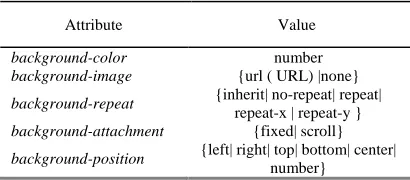
By means of web Cascading Style Sheets (CSS) [8], part attributes of web page structure are shown in TableⅠto Table Ⅲ. They are CSS font properties , text properties and background attribute. The feature attributes of the respective blocks can be obtained by training them, which reflect the characteristics of each functional block. e.g., background for website header is more complicated than the text area, and the font styles are relatively complex. In different blocks, weight of the same attribute is not the same. Accordingly, the weight of background in website header is higher than in the text area.
Table Ⅰ: Attribute Features Of Font
Table Ⅱ: Attribute Features Of Text
Table Ⅲ : Attribute Features Of Background
2.3 FEATURE OF WEB PAGE TEXT
The content feature of different functional blocks is not the same, with which we can identify the functional block. For instance, the number of pictures is not the same in different blocks, as well
Attribute Value
font-type {“1pt”,”2pt”,”3pt”,...}
font-size
[image:2.612.96.302.76.239.2] [image:2.612.318.523.311.421.2] [image:2.612.318.523.567.657.2]{number|inherit|medium|large|lar ger|x-large|xx-large|small|smaller
|x-small|xx-small}
font-weight { normal|bold|bolder|
lighter | normal }
font-style { inherit| italic| normal|
oblique}
font-variant {normal| small-caps}
Attribute Value
text-decoration overline | line-through | blink} {inherit| none| underline|
text-transform {capitalize| uppercase|
lowercase| none}
text-align { left| right| center| justify }
white-space { normal| pre| nowrap }
Attribute Value
background-color number
background-image {url ( URL) |none}
background-repeat {inherit| no-repeat| repeat|
repeat-x | repeat-y }
background-attachment {fixed| scroll}
background-position {left| right| top| bottom| center|
number} feature
extractor
feature
domain oriented page database
other Page database
to
p
ic
c
la
ss
if
ie
r
w
eb
p
ag
e p
ar
ser
sample web pages
Internet
crawling thread 1
crawling thread 2
...
as the size of the picture. There are more pictures in the advertising area than in other areas. Moreover, the hyperlink number of the different blocks will also not the same. Number of hyperlink in navigation area is more than in the text area. Therefore feature representation of functional blocks are performed further by using these semantic features. In Table Ⅳ to Table Ⅷ, the specific features of contents are given.
Table Ⅳ: Content Features Of Images
Feature Meaning
image-number number
image-size Img-size
Table Ⅴ: Content Features Of Hyperlink
Feature Meaning
hyperlink-number number
hypertext-size Hypertext-size
Table Ⅵ: Content Features Of Text
Feature Meaning
text-length Inner Text-length
text-keywords Inner Text keywords
{”copyright”}
Table Ⅶ: Content Features Of Interaction
Feature Meaning
interaction-number interaction-Num
interaction-size interaction-Size
Table Ⅷ: Content Features Of Form
Feature Meaning
form-number form-Num
form-size form-Size
3. REPRESENTATION OF FEATU- RE VECTOR
We represent the feature vector by means of Vector Space Model. By means of VSM, documentd
is mapped to vector V d( ),which is defined below:
1 1 2 2
( ) ( , ( ); , ( );...; , ( ))n n
V d = t ωt t ω t t ωt (1)
where t ii( =1, 2,..., )n is a list of different items.ω( )ti is the weight of tiind, and generally
defined the frequency function of tiin d.
3.1 Hierarchical Vector Space Model
Taking into account that the web page is a semi-structured document, based on VIPS, the features of a web page can be expressed with a multi-dimensional vector from the facets of the page structure and the content.We propose a novel feature vector representation called hierarchical vector space (HVS) model, which improves the conventional vector space model in the level structure. Considering the web page features of hierarchical relationships, the feature of the page is expressed more accurately with HVS model.
We represent topic feature of web pagePwith a multi-dimensional vectorFpthat is composed of
structural vector s p
F and content vector c p
F . As follows:
1 2 3 4
1 2 3 4 5 6
( , );
( , , , , ); ( , , , , , ,....);
s c
p p p
s s s s s
p
c c c c c c c
p
F F F
F f f f f
F f f f f f f
=
= ⋅⋅⋅
=
1 1 2 2
( , ( ); , ( ); ; , ( ); ),
s s s s s s s
i i i i i im im
f = f ω f f ω f ⋅⋅⋅ f ω f ⋅⋅⋅ (2) (i=1, 2, 3, 4,⋅⋅⋅);
1 1 2 2
( , ( ); , ( ); ; , ( ); )
c c c c c c c
i i i i i im im
f = f ω f f ω f ⋅⋅⋅ f ω f ⋅⋅⋅
(i=1, 2, 3, 4,⋅⋅⋅); In(2), s( 1, 2, 3 )
im
f m= ⋅⋅⋅ and c( 1, 2, 3, )
im
f m= ⋅⋅⋅
respectively reflect structure feature vector and content feature vector, which corresponds the CSS attribute in TableⅠto Table Ⅲ and content feature in Table Ⅳ to Table Ⅷ. Correspondingly,
(fims)
ω and ω(fimc) respectively represent the weights of fims and
c im
f . Then we describe the feature vector by means of Term Frequency-Inverse Document Frequency(TF_IDF).
Take f3c
for example, it can be expressed as follows:
{ | , }
c i i
T = t ∀ ∈t d ∀ ∈d D (3)
In above equation, t represents the word of block di in document D. If a word belongs to
one block or the most blocks, it is described to have little impact or little weight. In contrast, the word is the topic key word we need. twc describes weight
of the key word according to the frequency of the word in a block and can be defined as below:
( , ) ( , ) log , ( )
c c c c
c
n tw d t tf d t
df t
= ⋅ (4)
To deal with the web functional blocks with variant lengths, we standardize each vector. Then the mode of the vector equals 1. 3
c
f
3c
f
can be described as below:
31 32
31 32
2 2
3 3
1 3 1 3
3 3 2 3 1 3 log log , ...,
( log ) ( log )
log
( log )
c c
c c
m m
c c
i c i c
i i i i
c m c m m c i c i i n n tf tf df df n n f f df df n tf df n f df = = = ⋅ ⋅ ⋅ ⋅ ⋅ ⋅
∑
∑
∑
(5)If || 3c|| 1
f = , c p
f
cp
F
can be expressed as(6):
1 2 1 2 3 3 1 2 1 2
1 2 1 2
1 2
1 1 1 2
3 3 1 2 3 1 3 log log , ,
( log ) ( log )
log
,...
( log )
c c
i i
m c m c
i i
m m
i c i c
i c i c
i i i i
c i m c i m i c i c i i n n tf tf df df n n tf tf df df n tf df n tf df = = = = = = ⋅ ⋅ ⋅ ⋅ ⋅ ⋅
∑
∑
∑
(6)3.2 Similarity Of Web Pages
We calculate the similarity of two pages after the topic features of pages have been represented in formula(2). We take two pages Pi and Pj for example, with the Cosine theorem, similarity ofPi andPj can be described as following :
( , ) i j
i j
p p
i j
p p
F F
sim P P
F F
∗ =
⋅ , (7)
Assuming Pi is a sample page, and we have expressed feature ofPi. If we will search the same
topic page with the pagePi in the internet, the similarity ofPiand the test page calledPjshould be
computed. If sim P P( ,i j) reaches to a specified thresholdθ,Piis considered the topic-related page
we are searching for.
3.3 Algorithm Description
We build domain-oriented web page database and other web page database. Both initialization are empty.
Step1. We calculate the feature value based on the need of domain-oriented information extraction. (1) Manually specify the initial sample web sites and pages;
(2) Based on the Vision-Based Page Segmentation, the web page will be divided into some blocks, in which the structure feature and content features are different. We assign weight to every block.
(3) Calculate the feature by means of TF-IDF. Step2. We collect the web pages by the web searching strategy.
Step3. The similarity of the test page and the sample page will be computed, then we can identify the web pages we need. If the similarity reaches to a thresholdθ , the page can be stored in the domain-oriented web page databases.
The algorithm is described as follows in detail:
4. EXPERIMENTAL ANALYSIS
In order to test validity of the method above, we take academic domain oriented web extraction for example. We select the journal paper web pages of part academicians in Chinese Academy of Sciences and Chinese Academy of Engineering, which were indexed since 2002 by SCI (Science Citation Index) database, EI (Engineering Index) database and IEL
Input : web pages( include sample pages
( 1, 2, 3, , )
i
P i= ⋅⋅⋅m and test pages
( 1, 2, 3, , )
j
T j= ⋅⋅⋅n )
Output: domain-oriented webpage database group
1 begin
2 database group={}; 3 for (i=1; i≤m; i++)
4 represent feature of Pi: ( , )
i i i
s c
P p p
F = F F
5 calculate the weight of
i s p F and i c p F 6 represent the topic feature of the domain Fp
7 for ( j=1; j≤n; j++)
8 represent feature of Tj: ( , )
i i i
s c
T T T
F = F F
9 calculate ( , )
i
p T
sim F F
10 if ( , )
i
p T
sim F F >θ
11 group=group {Ti};
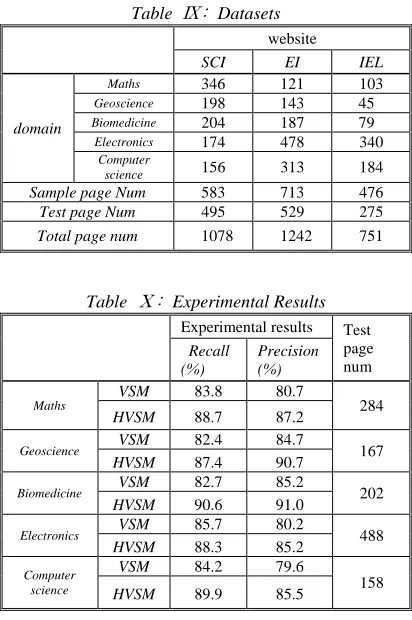
(IEEE/IEE, Electronic Library) database. Some will be taken as the sample pages, others as the test pages. According to the disciplines, the pages are divided into five domains: Maths, Geoscience, Biomedicine, Electronics and Computer science. First we train the sample page to obtain the features of each field, then we will search the web pages related to a field in test datasets. The test datasets and experimental results are shown in Table Ⅸ and Table Ⅹ.
Table Ⅸ: Datasets
website
SCI EI IEL
domain
Maths 346 121 103
Geoscience 198 143 45
Biomedicine 204 187 79
Electronics 174 478 340
Computer
science 156 313 184 Sample page Num 583 713 476
Test page Num 495 529 275
Total page num 1078 1242 751
Table Ⅹ: Experimental Results
Experimental results Test page num
Recall (%)
Precision (%)
Maths VSM 83.8 80.7 284
HVSM 88.7 87.2
Geoscience VSM 82.4 84.7 167
HVSM 87.4 90.7
Biomedicine VSM 82.7 85.2 202
HVSM 90.6 91.0
Electronics VSM 85.7 80.2 488
HVSM 88.3 85.2
Computer science
VSM 84.2 79.6
158
HVSM 89.9 85.5
From table X, we can see that comparing with web extraction method by means of conventional VSM, our method with HVS model(HVSM in the table) achieves a better performance. Moreover, the recall ratio and precision of all category domains are more than 80 percent, even in several domains they are more than 90 percent. Experimental results show that with HVS model, more features of web structure and the content are explored, so extraction efficiency can improve remarkably. In addition, we found the precisions of domain about Electronics and Computer are relatively low, which is consistent with the actual situation. The two fields have relatively high similarity, therefore identification of web page becomes harder and
precision correspondingly be lower than in other domains.
5.
CONCLUSION
In this paper, we focus on the representation of web page topic features. Hierarchical vector space model is proposed. According to the hierarchical characteristics of the web page itself , the topic features of the web page are expressed accurately with a multi-dimensional vector from the page structure and the content. Then the topics of the domain can be expressed. Next we can search the suitable web pages in the domain. Experimental results about academic domain oriented area show that search method with HVS model has high efficiency and strong page adaptability. As a follow-up study, we should improve the maintenance work of the search method fault tolerance and object properties, making the search have more domain adaptability and the transplantation have more convenience and flexibility .
ACKNOWLEDGEMENTS
The paper is supported by China Association of Science and Technology.
REFERENCES:
[1] H. Cui, M. Kan, T. Chua, “Soft pattern matching models for definitional question answering”, ACM Transactions on Information Systems, Vol. 25 , No. 2, pp. 1-30, 2007.
[2] E.Nyberg, T.Mitamura, J.Callan, et al, “The JAVELIN question-answering system at TREC 2003: a multi-strategy approach with dynamic planning”, Proceedings of TREC 12, pp. 93-108, November, 2003.
[3] R J.Mooney, R.Bunescu, “Mining knowledge from text using information extraction”, ACM SIGKDD Explorations Newsletter-Natural Language Processing and Text Mining, Vol. 7, No. 1, pp. 3-10, 2005.
[image:5.612.95.301.217.527.2][5] CC.Aggarwal, F.AL-Garawi, Ps.Yu,“Intellig- ent crawling on the world wide web with arbitrary predicates”, Proceedings of the 10th International Conference on World Wide Web, pp. 96 -105, 2001.
[6] S.Brin, L.Page, “The anatomy of a large-scale hypertextual web search engine”, Proceedings of the Seventh International World Wide Web Conference, Computer Networks and ISDN Systems, Vol.30, No 1-7, pp.107-117, 1998.
[7] D.Cai, S.Yu, J.Wen, et al, “VIPS: a vision based page segmentation algorithm”, Technical Report,MSR-TR-2003-79, Microsoft Research, 2003.