APPLICATION OF CONTOURLET TRANSFORM AND
MAXIMUM ENTROPY ON DIGITAL IMAGE
WATERMARKING
1NADIA IDRISSI, 2AHMED ROUKHE 1,2
Faculty of Sciences Moulay Ismail Univerity Meknes, LAMPE Laboratory, Department of physics E-mail: [email protected], [email protected]
ABSTRACT
During the last few years, the copyright in multimedia world is becoming a real concern especially with the increase in transfer files, documents over networks. These data are actually very easy to hack: information becomes vulnerable to interception, copying, tampering or corruption. To meet this need, digital watermarking is a method of signal processing which inserted into a digital document an invisible watermark, containing a code robust against any attack that can affect the watermarked data. In this paper we presented a method of digital image watermarking based on contourlet transform and maximum entropy.
Keywords: Contourlet Transform; Entropy; PSNR; NC
1. INTRODUCTION
The network growth and increased transmission of digital data on Internet has evolved the risk of computer hacking. The data are transferred without a protection that make them secure. This sometimes prevents users to limit their data transfer. To solve this problem, we must use techniques and methods that enable users to protect and mark their data. Watermarking is a method to insert a secret message in data such as files, images and videos. This protects the intellectual properties of these data [1]. The insertion method should be imperceptible to not detect the existence of a message; it should be robust against all conventional or geometrical attacks, as it must have a maximum amount of information that is inserted [2]. Watermarking methods can be applied in various domain of digital image processing as the spatial domain, frequency domain, and multi-directional domain. For this we will propose a method of watermarking that present a scheme in multi-directional domain to ensure a very strong robustness against several attacks.
For that this paper will be organized as follows. Section 2 illustrates the decomposition techniques of images processing. Section 3 presents the proposed approach for watermarking scheme in detail. Section 4 clarifies experiment results as well as some discussions. Conclusions are given in section 5.
2. DECOMPOSITION TECHNIQUES OF
IMAGES PROCESSING
2.1 Discrete Contourlet Transform
The Contourlet Transform (CT) is a geometrical image- based transform [3]. It’s a multi resolution and multidirectional transformation technique that is used in image analysis for capturing contours and fine details in images [4]. Contourlet transform offers multi- scale decomposition of the image; this is obtained by using Laplacian Pyramid (LP). LP is first used to capture point discontinuities (Figure1) It is then followed by a directional filter bank (DFB) to link point discontinuities into linear structures [5] and to capture the high-frequency content like smooth contours and directional edges.
ISSN: 1992-8645 www.jatit.org E-ISSN: 1817-3195
The LP decomposition at each level generates a down sampled lowpass version of the original and the difference between the original and the prediction, resulting in a bandpass image. Figure 2 shows this process, where H and G are called analysis and synthesis filters respectively and M is the sampling matrix [6].
Figure2. Laplacian Pyramid Scheme (A) Analysis And (B) Reconstruction.
The bandpass image obtained in the LP decomposition is further processed by a DFB. A DFB is designed to capture the high-frequency content like smooth contours and directional edges [7, 8]. The DFB is efficiently implemented via a K-level binary tree decomposition that leads to 2K subbands with wedge-shaped frequency partitioning as shown in Figure 3. The contourlet decomposition is illustrated by using the Lena test image of size 512×512 and its decomposition into four levels, in Figure 4. At each successive level, the number of directional subbands is 2, 4, 8, and 16 [8].
Figure3. Laplacian Pyramid Scheme (A) Analysis And (B) Reconstruction.
Figure4. Contourlet decomposition of Lena.
2.2 ENTROPY
Entropy is a statistical measure of randomness that can be used to characterize the texture of the input image. Entropy is defined as:
E=-sum(p.*log2(p))
Where p contains the histogram counts returned from imhist. By default, entropy uses two bins for logical arrays and 256 bins for uint8, uint16, or double arrays. [9-11].
3. PROPOSED METHOD
In this paper, contourlet and SVD based transform technique is proposed for watermarking of gray scale image along with binary watermark logo. The robustness and imperceptibility of watermarked image is increased by selecting specifics blocks which have the maximum entropy value. And is tested for two quantifiers such as PSNR.
3.1 Watermark embedding process
The embedding process is divided into following steps and is briefly described as bellow:
Step 1: Apply contourlet transform on the original image; Apply contourlet transform on the watermark.
Step 2: extration of coefficients with different orientations.
Step 3: division of each orientation in blocks of same sizes,
Step 4: modify the original image with watermark such that:
Step 5: Apply inverse Contourlet Transform
Step 7: obtain the watermarked image.
Sθ = Iθ + αWθ
This scheme resumed the steps of embedding process
4. EXPERIMENTAL RESULTS
The robustness is tested under 9 types of attacks: Salt and pepper, Gaussian noise, median filtering, resizing, contrast adjustment, JPEG compression, cropping, and rotation, Histogram equalization.
The original image considered for the experimentation is Lena. The watermark image is a logo as shown in Figure 6. Figure7 indicates that visual appearance of the watermarked image is good with a PSNR of 60.5446 Db.
Figure6. (a) Original watermark, (b) extracted watermark
Figure7. (a) Original image, (b) watermarked image
To improve the performance of our proposed method we have used other different standard images test.
Figure8. Images of test
The metric used to assess the performance of the proposed algorithm is PSNR.
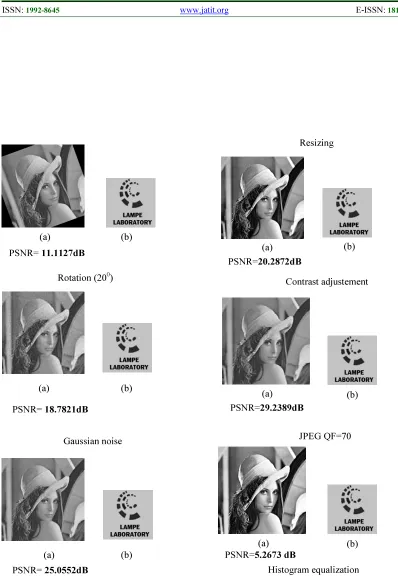
The results of different attacks of lena image are presented in figures as bellow:
(a)
(b)
(a)
(b)
Camerama Jetplane
Original
image I
Watermark
W
S
θ= I
θ+ αW
θθ
=
0, π/2, π/4 and 3π/4
Apply inverse Contourlet
Watermarked
Image
Figure5. Watermark Embedding Process
Step 1
Step 2
Step 5
W1
W2
W3 W4
Step 3
I
1I
2I
3I
4Step 4
ISSN: 1992-8645 www.jatit.org E-ISSN: 1817-3195
Figure 9(a).Attacked watermarked image with PSNR. (b).Extracted watermark from LH matrix.
These results are resumed in table and graphs as PSNR= 11.1127dB
Rotation (200) (a) (b)
PSNR= 18.7821dB
Gaussian noise (a) (b)
PSNR= 25.0552dB
Median filtering (3x3) kernel (a) (b)
PSNR=20.2872dB
Contrast adjustement (a) (b)
PSNR=29.2389dB
JPEG QF=70 (a) (b)
Resizing
PSNR=5.2673 dB
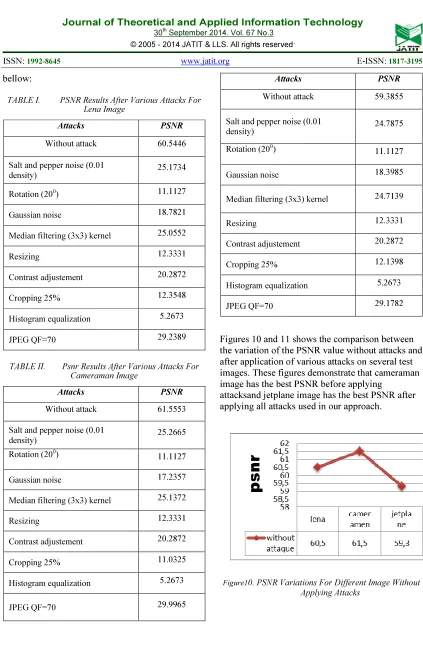
[image:4.595.86.484.105.686.2]bellow:
TABLE I. PSNR Results After Various Attacks For
Lena Image
Attacks PSNR
Without attack 60.5446
Salt and pepper noise (0.01
density) 25.1734
Rotation (200
) 11.1127
Gaussian noise 18.7821
Median filtering (3x3) kernel 25.0552
Resizing 12.3331
Contrast adjustement 20.2872
Cropping 25% 12.3548
Histogram equalization 5.2673
JPEG QF=70 29.2389
TABLE II. Psnr Results After Various Attacks For
Cameraman Image
Attacks PSNR
Without attack 61.5553
Salt and pepper noise (0.01
density) 25.2665
Rotation (200
) 11.1127
Gaussian noise 17.2357
Median filtering (3x3) kernel 25.1372
Resizing 12.3331
Contrast adjustement 20.2872
Cropping 25% 11.0325
Histogram equalization 5.2673
JPEG QF=70 29.9965
TABLE III. PSNR Results After Various Attacks For
Jetplane Image
Attacks PSNR
Without attack 59.3855
Salt and pepper noise (0.01
density) 24.7875
Rotation (200) 11.1127
Gaussian noise 18.3985
Median filtering (3x3) kernel 24.7139
Resizing 12.3331
Contrast adjustement 20.2872
Cropping 25% 12.1398
Histogram equalization 5.2673
JPEG QF=70 29.1782
Figures 10 and 11 shows the comparison between the variation of the PSNR value without attacks and after application of various attacks on several test images. These figures demonstrate that cameraman image has the best PSNR before applying
attacksand jetplane image has the best PSNR after applying all attacks used in our approach.
ISSN: 1992-8645 www.jatit.org E-ISSN: 1817-3195
5. CONCLUSION
In this paper, we proposed a new approach for watermarking of still images based on both contourlet transform and singular value decomposition concepts. The experimental results show that this method is robust against most attacks. Thereby we can conclude that intellectual property of images is protected by our approach. Future work will focus on a more robust method that combines its characteristics with those of contourlet transform for the best results. This approach can also be extended to video and audio watermarking.
REFRENCES:
[1] Natarajan Meghanathan, Lopamudra Nayak, “Steganalysis algorithms for detecting the hidden information in image, audio and video cover media”, International Journal of Network Security & Its Application (IJNSA), Vol.2, No.1, January 2010.
[2] Mr.Manjunatha Prasad.R, Dr.Shivaprakash Koliwad, “A Comprehensive Survey of Contemporary Researches in Watermarking for Copyright Protection of Digital Images”, IJCSNS International Journal of Computer Science and Network Security, VOL.9 No.4, April 2009.
[3] M. N. Do and M. Vetterli, “The contourlet transform: An efficient directional multiresolution image representation,” IEEE Transactions on Image Processing, vol. 14, no. 12, pp.2091–2106, 2005.
[4] C.Venkata Narasimhulu & K.Satya Prasad, “A hybrid watermarking scheme using contourlet transform and singular value decomposition ”, IJCSNS International Journal of Computer Science and Network Security, VOL.10 No.9, September 2010.
[5] Minh N. Do, Member, IEEE, and Martin Vetterli,Fellow, IEEE, “The Contourlet Transform: An Efficient Directional Multiresolution Image Representation”, IEEE TRANSACTIONS ON IMAGE PROCESSING, Volume: 14 , Issue: 12 2005. [6] Nagham S. AL-lella, Khalil I. Alsaif, “Data
hiding in contourlet coefficients based on their energy ”, J. of university of anbar for pure science : Vol.6:NO.2 : 2012.
[7] Ibrahim A. El rube, Mohamad Abou El Nasr , Mostafa M. Naim, Mahmoud Farouk, “Contourlet versus wavelet transform for a robust digital image watermarking technique”, World academy of science, Engeneering and technology Vol:36 2009-12-21.
[8] Sirvan Khalighi, Parisa Tirdad and HamidR Rabiee, “A Contourlet –Based Image Watermarking Scheme With High Resistance to Removal and Geometrical Attacks”, EURASIP Journal on Advances in Signal Processing 2010, 2010:540723.
[9] Mohamed RADOUANE, Tarik BOUJIHA, Rochdi MESSOUSSI, Nadia IDRISSI, Ahmed ROUKH, “A Method of LSB substitution based on image blocks and maximum entropy”, IJCSI International Journal of Computer Science Issues, Vol. 10, Issue 1, No 1, January 2013.
[10]Nadia IDRISSI, Ahmed ROUKH, Lhoussaine MASMOUDI, Mohamed RADOUANE, Rochdi MESSOUSSI, “A Robust Digital Watermarking Technique using DWT-DCT and Statics blocks”, IJCSI International Journal of Computer Science Issues, Vol. 10, Issue 2, No 1, March 2013.