S T U D Y P R O T O C O L
Open Access
Study protocol: developing, disseminating,
and implementing a core outcome set for
selective fetal growth restriction in
monochorionic twin pregnancies
Asma Khalil
1,2*, James M. N. Duffy
3,4, Helen Perry
1,2, Wessel Ganzevoort
5, Keith Reed
6, Ahmet A. Baschat
7,
Jan Deprest
8, Eduardo Gratacos
9, Kurt Hecher
10, Liesbeth Lewi
8, Enrico Lopriore
11, Dick Oepkes
11,
Aris Papageorghiou
2, Sanne J. Gordijn
12and On behalf of the International Collaboration to Harmonise Outcomes
for Selective Fetal Growth Restriction (CHOOSE-FGR)
Abstract
Background:Selective fetal growth restriction in monochorionic twin pregnancies is associated with an increased risk of perinatal mortality and morbidity and represents a clinical dilemma. Interventions include expectant management with early preterm delivery if there are signs of fetal compromise, selective termination of the compromised twin, fetoscopic laser coagulation of the communicating placental vessels or termination of the whole pregnancy. Previous studies evaluating interventions have reported many different outcomes and outcome measures. Such variation makes comparing, contrasting, and combining results challenging, limiting ongoing research on this uncommon condition to inform clinical practice. We aim to produce, disseminate, and implement a core outcome set for selective fetal growth restriction research in monochorionic twin pregnancies.
Methods:An international steering group, including professionals, researchers, and lay experts, has been established to oversee the development of this core outcome set. The methods have been guided by the Core Outcome Measures in Effectiveness Trials Initiative Handbook.
Potential core outcomes will be developed by undertaking a systematic review of studies evaluating interventions for selective fetal growth restriction in monochorionic twin pregnancies. Potential core outcomes will be entered into a three-round Delphi survey and key stakeholders including clinical professionals, researchers, and lay experts will be invited to participate. Repeated reflection and rescoring of individual outcomes should encourage group and
individual stakeholder convergence towards consensus outcomes which will be entered into a modified Nominal Group Technique to finalize the core outcome set. Once core outcomes have been agreed, we will establish standardized definitions and recommend high-quality measurement instruments for each outcome.
(Continued on next page)
* Correspondence:[email protected]
1Vascular Biology Research Centre, Molecular and Clinical Sciences Research
Institute, St George’s University of London, Cranmer Terrace, London SW17 0RE, UK
2Fetal Medicine Unit, Department of Obstetrics and Gynaecology, St.
George’s University Hospitals NHS Foundation Trust, Blackshaw Road, London SW17 0QT, UK
Full list of author information is available at the end of the article
(Continued from previous page)
Discussion: The development, dissemination, and implementation of a core outcome set for selective fetal
growth restriction should ensure that future research protocols select, collect, and report outcomes and outcome measures in a standardized manner. Data synthesis will be possible on a broad level and rigorous implementation should advance the quality of research studies and their effective use in order to guide clinical practice, improve patient care, maternal, short-term perinatal outcomes, and long-term neurodevelopmental outcomes.
Trial registration:Core Outcome Measures in Effectiveness Trials (COMET) registration number: 998.
International Prospective Register of Systematic Reviews (PROSPERO) registration number:CRD42018092697. 18th April 2018.
Keywords:Selective fetal growth restriction, Selective intrauterine growth restriction, Core outcome set, Modified Delphi method, Modified Nominal Group Technique, Consensus development study
Background
Twin pregnancies complicated by selective fetal growth restriction (sFGR) are associated with increased perinatal mortality and morbidity [1]. This pathology affects 10– 15% of monochorionic (MC) twin pregnancies and rep-resents a management challenge due to the interdepend-ence of twins connected via the placental vasculature [2–5]. One particular challenge in MC twin pregnancies complicated by sFGR is the risk of acute feto-fetal trans-fusion in the event of demise or hypoxia and vascular imbalance with profound hypotension in one twin caus-ing death or neurological injury in the co-twin [6].
A classification according to the umbilical artery Doppler findings in the smaller twin was proposed in 2007, where three types with variable prognosis were identified [7]. Furthermore, we have recently published a consensus agreement on the diagnostic criteria of sFGR in twin pregnancies [8]. Although the overall perinatal survival in pregnancies affected by type 1 sFGR (with positive end-diastolic flow in the umbilical artery Doppler) is as high as 97%, the survival in sFGR with absent or reversed end-diastolic flow in the umbil-ical artery Doppler (types 2 and 3) is around 60 and 85%, respectively [3–5], with a high risk of intrauterine demise that may be particularly unpredictable in type 3 sFGR [1, 7]. Possible interventions include expectant management with early preterm delivery if there are signs of fetal compromise and active fetal intervention, which includes selective termination of the compro-mised twin, fetoscopic laser coagulation of the commu-nicating placental vessels or termination of the whole pregnancy. Selective termination favors the outcome of the larger twin, while fetoscopic laser coagulation of the placental vessels can achieve survival of both twins in select cases at the cost of a higher risk of mortality and neurological complications in the larger co-twin [4,
5, 9, 10]. Clinicians and researchers face clinical uncer-tainty regarding the optimal management of sFGR [3– 5]. Given the variation in outcome by classification, the optimal management is likely to vary according to the
type and severity of sFGR, the distribution of placental tissue and the timing of onset.
Given the high potential for morbidity and mortality in these pregnancies, there is a need for robust guidance on the safest and most effective course of management. However, the large variation among the studies in the re-ported outcomes, makes it difficult to compare results, or combine the data from individual studies, limiting the potential of research to guide clinical practice. Core out-come sets are agreed, clearly defined minimum sets of outcomes that can be measured in a standardized man-ner and reported consistently [11]. Acknowledging that inconsistencies in outcome reporting can be disruptive to progress in our specialty, 78 editors of journals on women’s health came together to form a consortium to support the development, dissemination, and implemen-tation of core outcome sets [12].
Our objective is to produce, disseminate, and implement a core outcome set for sFGR in MC twin pregnancies.
Methods
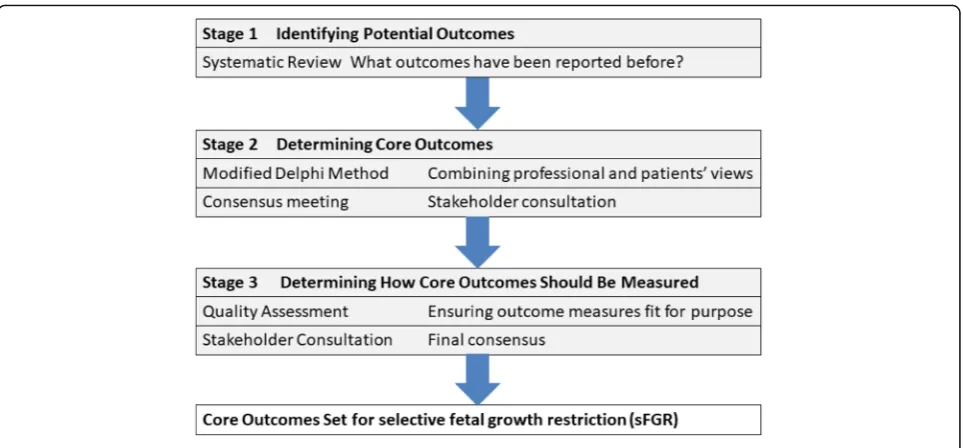
The methods have been informed by the Core Outcome Measures in Effectiveness Trials (COMET) Initiative Handbook and other core outcome set development studies relevant to women’s and newborn health, includ-ing twin-to-twin transfusion syndrome, pre-eclampsia, endometriosis, termination of pregnancy, and neonatal medicine [11, 13–17]. This study protocol is reported in accordance with Standard Protocol Items: Recommenda-tions for Interventional Trials (SPIRIT) Guidelines (Add-itional file1). The stages of the development of the core outcome set are shown in Fig.1.
Prospective registration
Steering Group
An international steering group, including professionals, researchers, and women with lived experience of sFGR, has been formed to guide the development of this core outcome set. The Steering Group members were approached and invited based on their expertise as clini-cians and researchers in sFGR. Patient representatives were approached as interested individuals who had pre-viously contacted The Twin and Multiple Births
Associ-ation (TAMBA). The Steering Group has been
established to make decisions regarding the study’s methods; for example, determining the scope of the core outcome set, selecting appropriate consensus methods, and developing the recruitment strategy. While the Steering Group will oversee the process, further partici-pants will be involved in the consensus-forming process and anyone, anywhere is welcome to participate.
Scope of the core outcome set
This core outcome set will apply to all therapeutic inter-ventions for sFGR. This will not be limited by the type of intervention, the setting in which administered, or the gestation at which provided. Selective fetal growth re-striction will be defined according to the recently pub-lished consensus agreement on the diagnostic criteria of sFGR in twin pregnancies; the solitary finding of an esti-mated fetal weight below the third centile in one of the twins or at least two out of four of the following: (1) an estimated fetal weight below the 10th centile in one of the twins, (2) an abdominal circumference below the 10th centile in one of the twins, (3) an estimated fetal weight discordance≥25%, and (4) umbilical artery Dop-pler pulsatility index > 95th centile in the smaller twin
[8]. However, as this consensus was only recently pub-lished, studies that use other definitions, the commonest is one twin with an estimated fetal weight less than the 10th centile, will be included. We are not seeking to reach consensus on the standardization of other aspects of study design or the definition or staging of sFGR.
Identifying potential core outcomes
We will conduct a systematic review to identify potential core outcomes. The systematic review methods will be informed by published systematic reviews identifying po-tential core outcomes [18–23]. We will search the Cochrane Central Register of Controlled Trials (CEN-TRAL), EMBASE, and MEDLINE from inception to January 2018 to identify all trials and observational stud-ies reporting outcomes evaluating interventions for sFGR using defined Medical Subject Headings (MeSH) descriptor terms including sFGR and selective intrauter-ine growth restriction. We will search unpublished gray literature and ongoing trials and observational studies using the same terms. The conduct of the systematic re-view will adhere to standard systematic rere-view methods [24]. The population includes MC twin pregnancies complicated by sFGR. The interventions include any intervention used for the treatment of sFGR. The com-parator will include any comcom-parator treatment used for the interventions of sFGR. Possible interventions include alternative treatment, standard care, a placebo treatment or no treatment. The outcomes will include all outcomes reported in the included sFGR studies. We will include all randomized controlled trials, quasi-randomized trials, controlled before and after studies, interrupted time series, and observational studies that report an outcome
[image:3.595.58.540.86.310.2]following any intervention for sFGR. We will exclude case reports, small case series, editorials, and review arti-cles. No data or language limits will be applied.
All studies identified in the search will be screened using the title and abstract. The full-text article will be reviewed of all studies meeting the inclusion criteria and those where this cannot be determined from the abstract alone. Identified studies will be reviewed by two re-viewers and any discrepancies resolved by discussion with a third reviewer. The studies will be assessed using a purposively developed Data Extraction Form to collect the following information: year of publication, study de-sign, sample size, intervention undertaken, outcomes, and outcome measures.
We will report the systematic review with reference to the Preferred Reporting Items for Systematic Reviews and Meta-analyses (PRISMA) Statement for reporting systematic reviews and meta-analyses of studies that evaluate health care interventions [25]. All identified outcomes will be entered into an outcome inventory and organized into the following categories: survival out-comes, fetal outout-comes, short-term neonatal outout-comes, long-term neurodevelopmental outcomes (including be-havioral outcomes and quality of life), obstetric out-comes and surgical/operator outout-comes. These outout-comes will be reviewed and discussed by the Steering Group with particular emphasis on reducing duplication of out-comes caused by varying terminologies and grouping very similar outcomes together in order to make the final outcome inventory clear and succinct. Following agreement, the inventory will be entered into the modi-fied Delphi method. The wording of the outcomes will be decided in collaboration with the patient representa-tives (TAMBA).
Determining core outcomes
The core outcomes will be determined by using a modi-fied Delphi method. The Delphi method is an estab-lished tool for achieving a convergence of opinion on a particular subject by gathering data from respondents with expert knowledge of that particular subject. It al-lows consensus building by using a series of question-naires to extract opinion from participants. Web-based Delphi tools facilitate international data collection and are largely considered acceptable to the user [26,27]. All categories of stakeholder, including health professionals, researchers and people with lived experience of or ex-pertise in sFGR will be invited to take part. By asking participants to specify the stakeholder group that they most identify with, we will be able to interpret the re-sults of the survey both as a whole and by participant background, and to identify any differences between the groups. The recruitment strategy has been designed to ensure that people with assorted experiences of sFGR
from diverse demographic backgrounds and geograph-ical locations can be recruited. We will ask members of an expert panel who have participated in the core out-come set on twin-to-twin transfusion syndrome and those who participated in the development of a consen-sus on the diagnostic criteria of sFGR. Recruitment will be facilitated by national and international patient orga-nizations, including TAMBA, and national and inter-national professional organizations, including the Royal College of Obstetricians and Gynaecologists (RCOG), the International Society of Ultrasound in Obstetrics and Gynaecology (ISUOG), and the International Society for Twin Studies (ISTS), advertising the study within their newsletters, online forums, and social media feeds. Potential participants will be able to register their inter-est online and will be sent Delphi survey instructions written in plain language. When participants register to complete the survey, they will complete a questionnaire recording demographic details; for example, age, ethnic group, and country, and information pertaining to their experiences or expertise of sFGR. We aim to recruit 18 participants for each stakeholder group. Participants who fail to complete the Delphi survey will be asked about their reasons for withdrawal. Only core members of the Steering Group will have access to the study dataset.
Round 1
All participants will be invited to register with the online survey and will be allocated a unique identifier to enable anonymization of their responses. They will be asked to score individual outcomes on a 9-point Likert scale an-chored between one (labeled “of limited importance for making a decision”) and 9 (labeled“critical for making a decision”). This scale was devised by the Grading of Rec-ommendations Assessment, Development and Evalu-ation (GRADE) Working Group to facilitate the ranking of outcomes according to their importance and has been adopted widely by core outcome set developers [28]. There will be an opportunity for participants to suggest new outcomes and these will be considered by the Steer-ing Group for inclusion in the second-round survey.
Round 2
All outcomes will be carried forward into the second round and any additional outcomes suggested by partici-pants will be included. Participartici-pants will receive their own scores and stakeholder group feedback for each round-1 outcome. Participants will be invited to reflect and rescore individual outcomes.
Round 3
stakeholder group feedback for each round-2 outcome. Participants will be invited to reflect and rescore individ-ual outcomes. A standardized definition will be applied to this round’s results enabling consensus outcomes to be identified. Consensus outcomes will be defined as outcomes achieving a median score of 8 across all three stakeholder groups.
Stakeholder meeting: modified Nominal Group Technique
The results of the Delphi survey will be discussed in a consensus development meeting including professionals, researchers and people with lived experience of sFGR. The round-3 results will be reviewed and all consensus outcomes will be considered. Participants will be able to discuss any other outcomes upon request. The objective of the consensus development meeting will be to de-velop a final core outcome set for sFGR.
Determining core outcome measures
Once the core outcome set has been agreed and estab-lished it will be necessary to determine how it should be defined or measured. Potential definitions and measure-ment instrumeasure-ments will be inventoried across formal defin-ition development initiatives, national and international guidelines, Cochrane systematic reviews and published studies. Potential definitions will be entered into a consen-sus development workshop including professionals, re-searchers and people with lived experience of sFGR. The objective of the consensus workshop will be to identify definitions for individual core outcomes. Potential meas-urement instruments will be quality assessed using the Core Outcome Measures in Effectiveness Trials (COMET) and the Consensus-Based Standards for the Selection of Health Measurement Instruments (COSMIN) Initiative quality assessment framework [29].
Dissemination and implementation
The Steering Group will aim to disseminate the core outcome set as widely and effectively as possible. We will aim to describe the core outcome set through publi-cation in a relevant journal as well as presenting to our peers at meetings. The Core Outcomes in Women’s and Newborn’s Health (CROWN) Initiative is endorsed by the International Federation of Gynecology and Obstet-rics (FIGO), the Royal College of Obstetricians and Gynaecologists (RCOG), and the Royal Australian and New Zealand College of Obstetricians and Gynaecolo-gists (RANZCOG). TAMBA will use its publicity chan-nels to further share the core outcome set to both health care professionals and patients. With the CROWN Ini-tiative now supported by over 80 journals, researchers will have more obligation to engage with the core out-come set when it out-comes to planning their studies. We will also engage with the relevant Cochrane Review
Groups, clinical guideline developers, research funders, trial registries and regulators such as research ethics committees. We plan to use a theoretically informed framework when implementing dissemination [30]. The methods of dissemination we are planning to use are peer-reviewed publications in open-access jour-nals, presentations at scientific meetings, posters, events, newsletters, press release, and podcasts. We will report the core outcome set in line with the COS-STAR Statement [31].
Discussion
The development and implementation of core outcome sets is likely to be very beneficial to the design and reporting of clinical studies, systematic reviews, and clin-ical guideline. This should ultimately improve clinclin-ical care and patients’ experience. The importance of such an initiative has been acknowledged by a number of key national and international organizations.
Improving the selection of the outcome of clinical studies
The Standard Protocol Items: Recommendations for Interventional Trials (SPIRIT) Statement, supported by funders of health research, such as the National Institute of Health Research (NIHR), recommends the use of core outcome sets. The use of standard core outcome sets would enhance comparability of clinical trials and facili-tate the conduct of prospective meta-analyses using indi-vidual patient data.
Facilitating the evidence synthesis and reporting of clinical studies
The Core Outcomes in Women’s and Newborn’s Health (CROWN) Initiative, supported by 78 specialty journals, including the Cochrane Pregnancy and Childbirth Group, has resolved to implement core outcome sets. These journals would expect authors to report the study results for the core outcomes and draw their conclusions based on these outcomes rather than non-core or surro-gate outcomes.
Enhancing the ability to develop robust clinical guidelines
Developing a network which can support an international collaboration
The team of involved key stakeholders has the potential to set up an international network, which could be a po-tent vehicle for the development of international guide-lines and registries and setting research priorities for sFGR. In the context of sFGR, this could potentially have a profound impact on morbidity and mortality rates in the long term.
Trial status
At the time of manuscript submission, the systematic re-view process has commenced and strategic planning for the Delphi method consensus-building exercise is under-way. This is the first version of the protocol (18th April 2018).
Additional files
Additional file 1:Populated Standard Protocol Items: Recommendations for Interventional Trials (SPIRIT) Checklist. (DOC 120 kb)
Additional file 2:The National Research Ethics Service (NRES) has advised that ethical approval is not required. (PDF 164kb)
Abbreviations
CENTRAL:Cochrane Central Register of Controlled Trials; COMET: Core Outcome Measures in Effectiveness Trials Initiative; COMIS: Core Outcome Measurement Instrument Selection project; COS-STAR: Core Outcome Set Standards for Reporting; CROWN: Core Outcomes in Women’s and Newborn’s Health Initiative; GRADE: Grading of Recommendations Assessment, Development and Evaluation Working Group;
ISUOG: International Society of Ultrasound in Obstetrics and Gynaecology; MC: Monochorionic; MeSH: Medical Subject Headings; NICE: National Institute for Health and Care Excellence; NRES: National Research and Ethics Service; PRISMA: Preferred Reporting Items for Systematic Reviews and Meta-analyses; PROSPERO: International Prospective Register of Systematic Reviews; RANZCOG: The Royal Australian and New Zealand College of Obstetricians and Gynaecologists; RCOG: Royal College of Obstetricians and
Gynaecologists; sFGR: Selective fetal growth restriction; SPIRIT: Standard Protocol Items: Recommendations for Interventional Trials Statement
Acknowledgements Not applicable.
Funding Not applicable.
Availability of data and materials Not applicable.
Authors’contributions
AK, SJG, and JMND initiated the idea and postulated the hypothesis. AK, JMND, HP, WG, KR, AAB, JD, EG, KH, LL, EL, DO, AP, and SJG contributed to writing the manuscript. All authors read and approved the final manuscript.
Ethics approval and consent to participate
Not required as assessed by the Medical Research Council Health Research Authority (MRC HRA) tool (Additional file2).
Consent for publication Not applicable.
Competing interests
The authors declare that they have no competing interests.
Publisher’s Note
Springer Nature remains neutral with regard to jurisdictional claims in published maps and institutional affiliations.
Author details
1Vascular Biology Research Centre, Molecular and Clinical Sciences Research
Institute, St George’s University of London, Cranmer Terrace, London SW17 0RE, UK.2Fetal Medicine Unit, Department of Obstetrics and Gynaecology, St. George’s University Hospitals NHS Foundation Trust, Blackshaw Road, London SW17 0QT, UK.3Balliol College, University of Oxford, Broad Street,
Oxford OX1 3BJ, UK.4Nuffield Department of Primary Care Health Sciences,
University of Oxford, Radcliffe Primary Care Building, Radcliffe Observatory Quarter, Woodstock Road, Oxford OX2 6GG, UK.5Department of Obstetrics
and Gynecology, Academic Medical Center Amsterdam, University of Amsterdam, Amsterdam, The Netherlands.6Twin and Multiple Births
Association (TAMBA), The Manor House Manor Park, Church Hill, Aldershot GU12 4JU, UK.7The Johns Hopkins Center for Fetal Therapy, 600 North
Wolfe, Nelson 228, Baltimore, MD 21287, USA.8Department of Obstetrics and
Gynecology, University Hospitals of KU Leuven, Herestraat, 49 3000 Leuven, Belgium.9Barcelona Center for Maternal-Fetal and Neonatal Medicine, Hospital Clínic and Hospital Sant Joan de Deu, Universitat de Barcelona; Institut d’Investigacions Biomèdiques August Pi i Sunyer (IDIBAPS), and Centre for Biomedical Research on Rare Diseases (CIBER-ER), Barcelona, Spain.
10
Department of Obstetrics and Fetal Medicine, University Medical Center Hamburg-Eppendorf, Neues Klinikum, Gebäude O10 Martinistr. 52, 20246 Hamburg, Germany.11Division of Fetal Medicine, Department of Obstetrics,
Leiden University Medical Center, K-06-35, P.O. Box 9600, 2300RC Leiden, The Netherlands.12Department of Obstetrics and Gynecology, University Medical Center Groningen, University of Groningen, Groningen, The Netherlands.
Received: 19 July 2018 Accepted: 18 December 2018
References
1. Buca D, Pagani G, Rizzo G, Familiari A, Flacco ME, Manzoli L, et al. Outcome of monochorionic twin pregnancy with selective intrauterine growth restriction according to umbilical artery Doppler flow pattern of smaller twin: systematic review and meta-analysis. Ultrasound Obstet Gynecol. 2017; 50:559–68.https://doi.org/10.1002/uog.17362.
2. Lewi L, Gucciardo L, Van Mieghem T, de Koninck P, Beck V, Medek H, et al. Monochorionic diamniotic twin pregnancies: natural history and risk stratification. Fetal Diagn Ther. 2010;27:121–33.https://doi.org/10.1159/ 000313300.
3. Bennasar M, Eixarch E, Martinez JM, Gratacós E. Selective intrauterine growth restriction in monochorionic diamniotic twin pregnancies. Semin Fetal Neonatal Med. 2017;22:376–82.https://doi.org/10.1016/j.siny.2017.05.001. 4. Townsend R, Khalil A. Twin pregnancy complicated by selective growth
restriction. Curr Opin Obstet Gynecol. 2016;28:485–91.https://doi.org/10. 1097/GCO.0000000000000326.
5. Townsend R, Khalil A. Fetal growth restriction in twins. Best Pract Res Clin Obstet Gynaecol. 2018;49:79–88.https://doi.org/10.1016/j.bpobgyn. 2018.02.004.
6. Bejar R, Vigliocco G, Gramajo H, Solana C, Benirschke K, Berry C, et al. Antenatal origin of neurologic damage in newborn infants. II. Multiple gestations. Am J Obstet Gynecol. 1990;162:1230–6http://www.ncbi.nlm.nih. gov/pubmed/2187353. Accessed 18 Jun 2018.
7. Gratacós E, Lewi L, Muñoz B, Acosta-Rojas R, Hernandez-Andrade E, Martinez JM, et al. A classification system for selective intrauterine growth restriction in monochorionic pregnancies according to umbilical artery Doppler flow in the smaller twin. Ultrasound Obstet Gynecol. 2007;30:28–34.https://doi. org/10.1002/uog.4046.
8. Khalil A, Beune I, Hecher K, Wynia K, Ganzevoort W, Reed K, et al. Consensus definition and essential reporting parameters of selective fetal growth restriction in twin pregnancy: a Delphi procedure. Ultrasound Obstet Gynecol. 2018.https://doi.org/10.1002/uog.19013.
10. Parra-Cordero M, Bennasar M, Martínez JM, Eixarch E, Torres X, Gratacós E. Cord occlusion in monochorionic twins with early selective intrauterine growth restriction and abnormal umbilical artery Doppler: a consecutive series of 90 cases. Fetal Diagn Ther. 2016;39:186–91.https://doi.org/10.1159/ 000439023.
11. Williamson PR, Altman DG, Bagley H, Barnes KL, Blazeby JM, Brookes ST, et al. The COMET Handbook: version 1.0. Trials. 2017;18 Suppl 3:280.https:// doi.org/10.1186/s13063-017-1978-4.
12. Duffy J, Rolph R, Gale C, Hirsch M, Khan K, Ziebland S, et al. Core outcome sets in women’s and newborn health: a systematic review. BJOG An Int J Obstet Gynaecol. 2017;124:1481–9.https://doi.org/10.1111/1471-0528.14694. 13. Whitehouse KC, Kim CR, Ganatra B, Duffy JMN, Blum J, Brahmi D, et al.
Standardizing abortion research outcomes (STAR): a protocol for developing, disseminating and implementing a core outcome set for medical and surgical abortion. Contraception. 2017;95:437–41.https://doi. org/10.1016/j.contraception.2016.12.009.
14. Hirsch M, Duffy JMN, Barker C, Hummelshoj L, Johnson NP, Mol B, et al. Protocol for developing, disseminating and implementing a core outcome set for endometriosis. BMJ Open. 2016;6:e013998.https://doi.org/10.1136/ bmjopen-2016-013998.
15. Duffy JMN, van’t Hooft J, Gale C, Brown M, Grobman W, Fitzpatrick R, et al. A protocol for developing, disseminating, and implementing a core outcome set for pre-eclampsia. Pregnancy Hypertens. 2016;6:274–8.https:// doi.org/10.1016/j.preghy.2016.04.008.
16. Khalil A, Perry H, Duffy J, Reed K, Baschat A, Deprest J, et al. Twin-twin transfusion syndrome: study protocol for developing, disseminating, and implementing a core outcome set. Trials. 2017;18:325.https://doi.org/10. 1186/s13063-017-2042-0.
17. Webbe J, Brunton G, Ali S, Duffy JM, Modi N, Gale C. Developing, implementing and disseminating a core outcome set for neonatal medicine. BMJ Paediatr Open. 2017;1:e000048.https://doi.org/10.1136/ bmjpo-2017-000048.
18. Duffy J, McManus RJ. Influence of methodology upon the identification of potential core outcomes: recommendations for core outcome set developers are needed. BJOG. 2016;123:1599. https://doi.org/10.1111/1471-0528.14219.
19. Hirsch M, Duffy JMN, Kusznir JO, Davis CJ, Plana MN, Khan KS, et al. Variation in outcome reporting in endometriosis trials: a systematic review. Am J Obstet Gynecol. 2016;214:452–64.https://doi.org/10.1016/j.ajog.2015.12.039. 20. Duffy J, Hirsch M, Kawsar A, Gale C, Pealing L, Plana MN, et al. Outcome
reporting across randomised controlled trials evaluating therapeutic interventions for pre-eclampsia. BJOG. 2017;124:1829–39.https://doi.org/10. 1111/1471-0528.14702.
21. Duffy J, Hirsch M, Pealing L, Showell M, Khan KS, Ziebland S, et al. Inadequate safety reporting in pre-eclampsia trials: a systematic evaluation. BJOG. 2018;125:795–803.https://doi.org/10.1111/1471-0528.14969. 22. Perry H, Duffy JMN, Umadia O, Khalil A, International Collaboration to
Harmonise Outcomes for Twin-Twin Transfusion Syndrome (CHOOSE). Outcome reporting across randomised trials and observational studies evaluating treatments for twin-twin rransfusion syndrome: a systematic review. Ultrasound Obstet Gynecol. 2018.https://doi.org/10.1002/uog.19068. 23. Duffy JMN, Hirsch M, Gale C, Pealing L, Kawsar A, Showell M, et al. A
systematic review of primary outcomes and outcome measure reporting in randomized trials evaluating treatments for pre-eclampsia. Int J Gynaecol Obstet. 2017;139:262–7.https://doi.org/10.1002/ijgo.12298.
24. Higgins J, Green S. Cochrane handbook for systematic reviews of interventions. Version 5.1.0. 2011.http://handbook-5-1.cochrane.org/. Accessed 2 Apr 2018.
25. Liberati A, Altman DG, Tetzlaff J, Mulrow C, Gotzsche PC, Ioannidis JPA, et al. The PRISMA Statement for reporting systematic reviews and meta-analyses of studies that evaluate healthcare interventions: explanation and elaboration. BMJ. 2009;339 jul21 1:b2700.https://doi.org/10.1136/bmj.b2700. 26. Sinha IP, Smyth RL, Williamson PR. Using the Delphi technique to determine
which outcomes to measure in clinical trials: recommendations for the future based on a systematic review of existing studies. PLoS Med. 2011;8: e1000393.https://doi.org/10.1371/journal.pmed.1000393.
27. Hsu C-C, Sandford BA. The Delphi technique: making sense of
consensus—Practical assessment, research & evaluation. Pract Assessment, Res Eval. 2007;12http://pareonline.net/getvn.asp?v=12&n=10. Accessed 18 Jun 2018.
28. Guyatt GH, Oxman AD, Kunz R, Atkins D, Brozek J, Vist G, et al. GRADE guidelines: 2. Framing the question and deciding on important outcomes. J Clin Epidemiol. 2011;64:395–400.https://doi.org/10.1016/j. jclinepi.2010.09.012.
29. Prinsen CAC, Vohra S, Rose MR, King-Jones S, Ishaque S, Bhaloo Z, et al. Core Outcome Measures in Effectiveness Trials (COMET) Initiative: protocol for an international Delphi study to achieve consensus on how to select outcome measurement instruments for outcomes included in a“core outcome set”. Trials. 2014;15:247.https://doi.org/10.1186/1745-6215-15-247. 30. Wilson PM, Petticrew M, Calnan MW, Nazareth I. Disseminating research
findings: what should researchers do? A systematic scoping review of conceptual frameworks. Implement Sci. 2010;5:91.https://doi.org/10.1186/ 1748-5908-5-91.
31. Kirkham JJ, Gorst S, Altman DG, Blazeby JM, Clarke M, Devane D, et al. Core Outcome Set-STAndards for Reporting: The COS-STAR Statement. PLoS Med. 2016;13:e1002148.https://doi.org/10.1371/journal.pmed.1002148.
32. Khan K. The CROWN Initiative: journal editors invite researchers to develop core outcomes in women’s health. BJOG An Int J Obstet Gynaecol. 2014; 121:1181–2.https://doi.org/10.1111/1471-0528.12929.