R E S E A R C H A R T I C L E
Open Access
Sub-classification based specific movement
control exercises are superior to general
exercise in sub-acute low back pain when
both are combined with manual therapy:
A randomized controlled trial
Vesa Lehtola
1,7*, Hannu Luomajoki
2, Ville Leinonen
3,4, Sean Gibbons
5and Olavi Airaksinen
1,6Abstract
Background:Clinical guidelines recommend research on sub-groups of patients with low back pain (LBP) but, to date, only few studies have been published. One sub-group of LBP is movement control impairment (MCI) and clinical tests to identify this sub-group have been developed. Also, exercises appear to be beneficial for the management of chronic LBP (CLBP), but very little is known about the management of sub-acute LBP.
Methods:A randomized controlled trial (RCT) was conducted to compare the effects of general exercise versus specific movement control exercise (SMCE) on disability and function in patients with MCI within the recurrent sub-acute LBP group. Participants having a MCI attended five treatment sessions of either specific or general exercises. In both groups a short application of manual therapy was applied. The primary outcome was disability, assessed by the Roland-Morris Disability Questionnaire (RMDQ). The measurements were taken at baseline, immediately after the three months intervention and at twelve-month follow-up.
Results:Seventy patients met the inclusion criteria and were eligible for the trial. Measurements of 61 patients (SMCEn= 30 and general exercisen= 31) were completed at twelve months. (Drop-out rate 12.9 %). Patients in both groups reported significantly less disability (RMDQ) at twelve months follow-up. However, the mean change on the RMDQ between baseline and the twelve-month measurement showed statistically significantly superior improvement for the SMCE group -1.9 points (-3.9 to -0.5) 95 % (CI). The result did not reach the clinically significant three point difference. There was no statistical difference between the groups measured with Oswestry Disability Index (ODI).
Conclusion:For subjects with non-specific recurrent sub-acute LBP and MCI an intervention consisting of SMCE and manual therapy combined may be superior to general exercise combined with manual therapy.
Trial registration:The study protocol registration number is ISRCTN48684087. It was registered retrospectively 18th Jan 2012.
* Correspondence:[email protected]
1Department of Physical and Rehabilitation Medicine, Institute of Clinical
Medicine, University of Eastern Finland, Kuopio, Finland 7Allintie 8, 48100 Kotka, Finland
Full list of author information is available at the end of the article
Background
Exercise is a common intervention for sub-acute LBP al-though it’s effect size seems to be modest. This is sup-ported by systematic reviews [1, 2] and meta-analysis [3] which has lead to exercise being recommended in guide-lines [4–7]. Little is known about the relative effectiveness of general versus specific exercise on sub-acute LBP [8].
LBP has been viewed as a multi-factorial biopsychoso-cial pain syndrome [9]. In spite of the large number of potentially pain generating structures and pathological conditions that can give rise to LBP in most cases ap-proximately eighty-five [10] to ninety percent [11] have no identifiable cause. The heterogeneity of patients with non-specific low back pain (NSLBP) has been a challen-ging issue. Two systematic reviews support treatment targeted at sub-groups of patients with NSLBP to im-prove patient outcomes [12, 13]. Three randomized con-trolled trials show positive outcome for patients with chronic LBP when movement patterns are cognitively altered or controlled [14–16]. The application of re-habilitation concepts from chronic LBP to recurrent sub-acute NSLBP pain has face validity since altered movement control may occur at any stage of rehabilita-tion [17]. Altered movement patterns within a mixed group of acute, sub-acute and chronic LBP subjects was not related to their symptom duration [18]. In another mixed population the improvement of the movement pattern could improve the majority of subjects’ symp-toms [19]. Recent research has demonstrated that spinal manipulative therapy is effective for subgroups of patients and as a component of a comprehensive treatment plan rather than in isolation. The benefits of manual therapy include pain relief and function improvement [7].
In this trial we used the sub-classification model presented by O’Sullivan in which sub-groups are based on the mechanism underlying the disorder and which are considered critical in ensuring appropriate management [20]. In this model, patients with MCI provoke the pain through maladaptive physical and also cognitive compensation for their disorders, which then cause ongoing pain. These subjects present with a deficit in movement control which underlies their pain disorder [21]. Because these patients cannot con-trol their movement properly they might themselves unknowingly be increasing their pain [20]. The sub-grouping system of O’Sullivan shows high reliability [22]. For the movement control subgroup a test bat-tery has been proposed which demonstrates adequate discriminative validity [23].
The purpose of this study, following sub-classification for MCI of patients with recurrent sub-acute non-spe-cific LBP, was to compare the effect of individually tailored SMCE combined with manual therapy to combined
general exercise and manual therapy on disability reduction.
Methods
The study protocol registration number is ISRCTN 48684087 and it was approved by the Ethics Committee of Carea (Kymenlaakso Hospital District, Finland) in 17thMay 2010. The protocol of the study design has been published retrospectively in BMC Musculoskeletal Disorders [24]. The study was performed according to Helsinki declaration.
Inclusion criteria was non-specific LBP for at least 6 weeks, age between 16 and 65 years, a written in-formed consent, at least one episode of LBP prior to the study, physically suitable for active exercise, score greater than 4 on the RMDQ [25], less than 12 points on the Finnish validated depression scale (DEPS), less than 38 on the Tampa Scale for Kinesio-phobia (TSK) and less than 80 on the Motor Control Abilities Questionnaire (MCAQ). A DEPS score above the cut off implies that the patient has at least mild depression. A TSK score above 38 is associated with poor outcome [26]. The MCAQ is a self- report tool which was developed to screen people for their ability to learn specific motor control stability exercise and specific movement control exercise. A score above 80 accurately predicts patients who cannot learn the SMCEs. The MCAQ was used to exclude those sub-jects who are unable to learn the exercises and thus not likely benefit from the treatment [27].
The further inclusion regimen aimed to sub-classify patients with MCI. Within the physical examination the participant should have≥2/6 positive MCI test described by Luomajoki [23]. Three of the tests are for flexion con-trol (waiter’s bow, rocking backwards and sitting knee extension), three for extension control (posterior pelvic tilt, rocking forwards and prone knee flexion) and one for rotation and side flexion control (one leg standing). Reliability of the movement control test battery has been shown to be at least k > 0.6 [28] for all the six tests and the battery discriminates patients with LBP from healthy controls very well [28].
patients with mechanical movement impairment of the lumbar spine.
Randomization
Each participant was randomized to general exercise group or to SMCE group by the Randomizer 17.0 pro-gram and an independent investigator. This independent investigator was not involved in recruiting or treating the patients, was concealed from patients and the other investigators, and used consecutively numbered, sealed, opaque envelopes. The envelopes were held in a locked box during the trial.
Interventions
Participants attended five treatment sessions over a three-month period. The number of treatment sessions was chosen to mimic clinical physiotherapy practice. The treatment was carried out by two different physical therapists in one private physiotherapy clinic in Finland. Each therapist was designated to implement one of the two interventions (i.e. therapist #1: intervention #1; ther-apist #2: intervention #2). Physical therther-apists preferences in relation to the interventions were neutral. Both phys-ical therapists were specifphys-ically trained and enthusiastic about both intervention methods. As well, both thera-pists were experienced manual therathera-pists and instructors and had over 25 years experience in clinical physio-therapy practice. The treatments were implemented as follows.
Initial assessment
A physical therapist carried out an initial assessment of each patient to determine how physically active the par-ticipant was, how troublesome the back problem, and his or her ability to perform the exercises. The method was to interview the subject with five questions regard-ing their physical activity. The questions were part of Finnish translation of SF-36 [29]. The assessor was blinded to the allocation of subjects.
General exercise
Participants were taught the exercises and advised on the intensity of performance. The exercises were per-formed under supervision of a physical therapist. The intensity of the exercises was progressed over the 5 treatments sessions, with participants being encouraged to improve their own performance. Each session lasted 45 min and included a short session of manual therapy (10–15 min). Manual therapy was based on individual findings (segmental hypomobility or restricted motion) and consisted of any spinal, myofascial or neurodynamic technique the physical therapist found necessary. Home exercises were taught and the ability to perform them was controlled at each treatment session. The participant
performed the previously taught exercises and the physical therapist corrected the performance when necessary. The typical individual exercise program comprised three sets of 15 repetitions. At the last session of the intervention the participant had an exercise program of 10 to 12 differ-ent exercises and the complete program lasted 30 to 40 min. Home exercises were to be performed three times a week during the intervention and follow-up period.
The main aims of the program were to improve phys-ical function and self-confidence in using the spine. The program targeted abdominal and paraspinal muscles without the involvement of specific deep muscle activa-tion [30] (Addiactiva-tional file 1).
Specific movement control exercise
Participants were taught the SMCEs and advised on the intensity at which they should exercise. The exercises were performed under supervision of a physical therap-ist. The participant performed the previously taught exercises and the physical therapist corrected the per-formance when necessary. The intensity of the exercises was similar to general exercise (i.e. the typical individual exercise program was three sets of 15 repetitions). In addition, movement pattern control was taught in the positions of sitting, four-point kneeling and standing, according to the decision of the physical therapist. The intensity of the exercises was progressed over the 5 treatments with participants being encouraged to im-prove their own performance. Each session lasted 45 min and included a short session of manual therapy (10–15 min) as described above. At the last session of the intervention the participant had an exercise program of 10 to 12 different exercises and the complete program lasted 30 to 40 min. Home exercises were to be per-formed three times a week and, additionally, the sitting, four-point kneeling and standing exercises once or twice daily.
The main aims of the program were to improve the in-dividual direction-specific movement control of the lum-bar spine, physical function and confidence in using the spine (Additional file 2).
Contrast between the exercise methods
not accurate enough sensorimotor function can be complimented by tactility (e.g. placing a hand on the spine). These exercises require a high degree of skill and expertise on the part of the treating therapist [31]. Two key points make this exercise fundamen-tally different from the other intervention: the level of sensorimotor function and neurocognitive func-tion required to continuously monitor the precision of the lumbar spine position for constant control to maintain accuracy throughout the movement; and the exercise approach specifically targets a direction of trunk movement in which the lack of control is believed to be the underlying mechanism contribut-ing to the patient’s LBP.
In both groups the exercises were integrated into par-ticipants’other physical exercises, according to the UKK Institute’s Weekly Physical Activity Pie (http://www. ukkinstituutti.fi/en/products/physical_activity_pie). These written instructions were given to participants during the last intervention session. Participants were instructed and taught how to record a practice diary.
The main outcome measure was the RMDQ [25]. Secondary outcome measures were: the Patient-Specific Functional Scale (PSFS) [32], the Oswestry Disability Index (ODI) [33], and movement control tests [23]. Base-line measures were taken of these prior to randomization, three months after the intervention, and follow-up at twelve months after the randomization. The quantity of absence from work, need for other treatment modalities, pain medication, and patient satisfaction were recorded using a 1–5 scale.
Statistical analysis
A sample size of 70 participants, determined a priori, provides 80 % power with anαof 0.05 to detect a clinic-ally meaningful difference in disability with the RMDQ. This was based on a minimally important difference of three points between the groups for this outcome meas-ure. The comparability of the groups on outcome variables at baseline were analyzed using the two-sample t-tests for parametric, the Wilcoxon test for non-parametric distribution, as well as Chi-Square test for nominal data. Differences between the groups over time were measured with Students t-test (absolute change scores) for parametric and the Mann Whitney Utest for non-parametric distribution. The Number Needed to Treat (NNT) was calculated based on the absolute risk re-duction for a change in disability. The rere-duction of 50% in RMDQ was chosen because of the sub-acute stage and it’s possible spontaneous recovery [1]. An Intention-to-Treat Analyses was used for the missing data. Here, the missing data were replaced by the each group’s mean value. Statis-tical significance was set asαof <0.05. Statistical analyses were performed with SPSS for Windows version 19.0.
Results
Recruitment
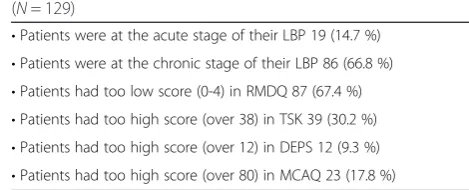
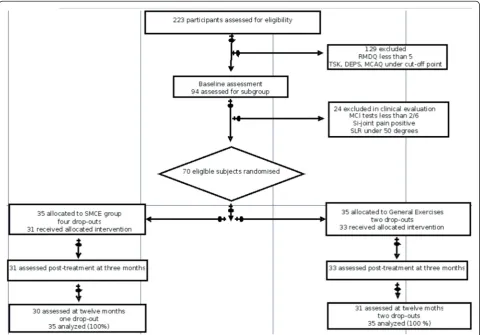
Initially 223 subjects seeking treatment for sub-acute NSLBP at a physical therapy clinic in Kotka, Finland, were assessed for eligibility between October 2010 and November 2012. Participants were recruited from local general practitioners, occupational health clinics and three advertisements published in the local newspaper. Seventy patients met the inclusion criteria and were found eligible for the trial while 129 patients were ex-cluded at the first examination stage (Table 1). Twenty-four patients were excluded at the physical examination: they either did not have two or more positive MCI tests, had a SLR under 50°, or had positive sacroiliac joint provocation tests.
After randomization, 35 patients were assigned to the SMCE group and 35 patients to the general exercise group. Sixty-four subjects (SMCEn= 31 and general ex-ercises n= 33) concluded their three-month interven-tions, resulting in a drop-out rate of 8.6 %. Drop-outs were caused by a prolapsed disc during the intervention period (2 subjects), a lack of motivation (2 subjects), a serious acute illness of a subject’s child (1 subject), and radical change in work duties (1 subject). In the baseline characteristics the two groups were comparable (Table 2). Sixty-one subjects (SMCE n= 30 and general exercises
n= 31) attended the twelve-month follow-up measure-ment resulting in a final drop-out rate of 12.9 % (Fig. 1).
Main outcome measure
The data were normally distributed and, therefore, para-metric tests were used.
Three-month results:
In the between-group comparison the mean change in the RMDQ from baseline to the three-month measure-ment showed a significantly superior improvemeasure-ment for the SMCE group; (p< 0.01) -2.4 (95 % CI -4.5 to -1.1) (Tables 3, 4 and Fig. 2). Categorical data analysis showed that 87.1 % (27 out of 31) of the SMCE group and 54.5 % (18 out of 33) of the general exercise group re-duced their disability (measured with RMDQ) by more than 50 %. The NNT was 3 for the SMCE.
[image:4.595.299.534.636.731.2]At the twelve-month follow-up the between-group dif-ference measured by the mean change in the RMDQ
Table 1The reasons for exclusion in the first examination stage (N= 129)
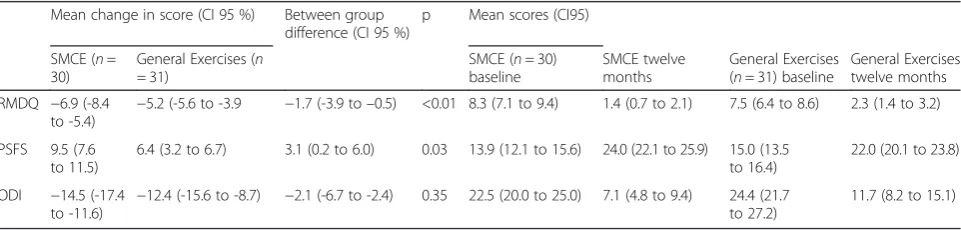
from baseline to the twelve-month measurement showed a significantly superior improvement for the SMCE group; (p< 0.01) -1.7 (95 % CI -3.9 to -0.5) (Tables 3 and 4). Categorical data analysis showed that 93.3 % (28 out of 30) of the SMCE group and 77.4 % (24 out of 31) of the general exercise group reduced their disability
(measured with RMDQ) more than 50 %. The NNT was 6 for SMCE.
Secondary outcome measures
[image:5.595.56.291.100.233.2]The secondary outcome measures PSFS and ODI dem-onstrated that both groups significantly improved but that there was no statistical difference between the groups in the measurements at three months. At the twelve-month follow-up SMCE showed a significantly better result in the self-reported function (measured with PSFS) (Tables 3 and 4). The average (standard devi-ation, sd) amount of positive movement control tests at baseline were 3.0 (0.6) in the SMCE group and 2.8 (0.8) in the general exercise group. At the three-month meas-urement the number of positive tests were 0.8 (sd 0.8) and 1.8 (sd 1.2), respectively. The scores 0 and 1 are considered as normal values. Within the inclusion cri-teria of this trial subjects had to have at least two (2 out of 6) positive tests. At the three-month measurement 83.9 % of subjects in the SMCE group had a normal re-sult (0 or 1) compared to 45.5 % of subjects in the Table 2Comparability of the treatment groups at baseline
Movement Control Groupn= 35
General Exercises Groupn= 35
Sex female 20 (57.1 %) 22 (62.9 %)
Height 172 (12) 172 (8)
Weight 78 (18) 80 (18)
Age 51 (11) 48 (11)
rmdq baseline 8,3 (3,2) 7,5 (3,2)
psfs baseline 13,9 (5,0) 15,0 (4,2)
odi baseline 22,5 (7,3) 24,4 (8,1)
mc tests baseline 3,0 (0,6) 2,9 (0,7)
(rmdq is roland-morris score, odi is oswestry disability index and mc is movement control. Data is presented with mean score and with standard deviation)
[image:5.595.58.541.358.693.2]general exercise group. The NNT was 3 (2.6) in favor of the SMCE group.
The need for pain medication at the twelve-month measurement was statistically significantly lower in favor of the SMCE group. There was no statistically significant difference between the groups in need for other treat-ment modalities, the quantity of absence from work or patient satisfaction.
Discussion
The aim of this study was to compare the effect of indi-vidually tailored SMCE combined with manual therapy to combined general exercise and manual therapy on disability reduction. This was following sub-classification for MCI of patients with recurrent sub-acute NSLBP. The findings suggest that both interventions reduce dis-ability and improve function. However, patients under-going a combination of specific exercises and manual therapy had a significantly greater reduction in disability (as measured by the RMDQ) at both the three-month and twelve-month measurements. The effect size of SMCE in our study was 0.77, which is favorable com-pared to studies with heterogeneous patients [1, 2]. There was a significant change in self-reported function between the groups in favor of SMCE at the twelve-month follow-up, but not at three twelve-months after intervention.
This was a level 1 clinical trial. The RMDQ and the ODI significantly improved in both groups but there were no statistical difference between the groups as measured with the ODI. This may be because the RMDQ has been shown to be more sensitive for patients with mild to moderate disability while the ODI is more effective for persistent, severe disability [34]. The disabil-ity was less than moderate in this trial, hence the statisti-cally different results. The effect on the RMDQ did not reach the threshold of clinical importance of three points difference but was still statistically significant. It has to be acknowledged that the difference found in this study may not be clinical important.
[image:6.595.57.541.99.212.2]Patients in both groups improved significantly. At twelve months 93 % of patients in the SMCE group and 77 % in the general exercise group improved more than 50 % on the RMDQ. This finding underlines and strengthens the earlier findings on LBP that exercises are an effective intervention. Whether there is a specific sub-group within these patients with MCI who benefit more from specific treatment needs to be further investi-gated. We did not calculate cost-effectiveness of the study intervention, but it should be noted that the pa-tients had only five sessions of therapy and showed these promising effects within a year. 66.7% of the SMCE group and 60.0% of the general exercises group had con-ducted their exercises less than planned. Thus, one year after randomisation, approximately one third of the Table 3Mean Change (SD) in disability and function at three month for treatment groups
Mean change in score (CI 95 %)
Between group difference (CI 95 %)
p Mean scores SD
SMCE (n= 31)
General Exercises (n= 33)
SMCE (n= 31) baseline
SMCE three months
General Exercises (n= 33) baseline
General Exercises three months
RMDQ −6.5 (-7.9 to -5.0)
−4.6 (-4.7 to -2.6) −1.9 (-4.5 to -1.1) <0.01 8.3 (7.1 to 9.4) 1.8 (1.2 to 2.5) 7.5 (6.4 to 8.6) 2.9 (2.4 to 4.4)
PSFS 8.0 (5.1 to 9.3)
5.3 (3.2 to 6.7) 2.7 (0.4 to 5.9) 0.13 13.9 (12.1 to 15.6) 21.9 (20.3 to 23.4)
15.0 (13.5 to 16.4)
20.3 (18.9 to 21.7)
ODI −13.2 (-15.2 to -9.3)
−10.5 (-13.6 to -7.0)
−2.7 (-6.3 to -2.3) 0.35 22.5 (20.0 to 25.0) 9.3 (6.9 to 11.6) 24.4 (21.7 to 27.2)
13.9 (10.3 to 17.5)
RMDQRoland-Morris Disablity Questionnaire,PSFSPatient-Specific Functional Scale,ODIOswestry Disability Index
Table 4Mean Change (SD) in disability and function at twelve month follow-up for treatment groups
Mean change in score (CI 95 %) Between group difference (CI 95 %)
p Mean scores (CI95)
SMCE (n= 30)
General Exercises (n = 31)
SMCE (n= 30) baseline
SMCE twelve months
General Exercises (n= 31) baseline
General Exercises twelve months
RMDQ −6.9 (-8.4 to -5.4)
−5.2 (-5.6 to -3.9 −1.7 (-3.9 to–0.5) <0.01 8.3 (7.1 to 9.4) 1.4 (0.7 to 2.1) 7.5 (6.4 to 8.6) 2.3 (1.4 to 3.2)
PSFS 9.5 (7.6 to 11.5)
6.4 (3.2 to 6.7) 3.1 (0.2 to 6.0) 0.03 13.9 (12.1 to 15.6) 24.0 (22.1 to 25.9) 15.0 (13.5 to 16.4)
22.0 (20.1 to 23.8)
ODI −14.5 (-17.4 to -11.6)
−12.4 (-15.6 to -8.7) −2.1 (-6.7 to -2.4) 0.35 22.5 (20.0 to 25.0) 7.1 (4.8 to 9.4) 24.4 (21.7 to 27.2)
11.7 (8.2 to 15.1)
[image:6.595.58.539.609.724.2]patients in both groups reported that they still did their exercises in accordance with the recommended three times per week or daily. This result has to be interpreted with caution because at the last session of intervention the treating PT gave the subjects UKK Institute’s Weekly Physical Activity Pie. In practice, participants were instructed to undertake two cardiovascular exercises in a week in addition to the intervention-based exercises. Some of the subjects may have answered this question according to total amount of weekly exercises and the others from the perspective of intervention-based exer-cises only. The question should have had a more specific wording (e.g.“Have you done the exercises your physical therapist taught you during treatment session?”).
A similar sub-classification study compared cognitive functional therapy with combined traditional manual therapy and general exercise in chronic NSLBP [15] and produced superior outcomes for the specific therapy. While a direct comparison to this study is difficult both control groups included different types of motor control exercises, and the specific intervention of cognitively al-tering movement patterns was shown to be superior. An almost identical study on sub-acute and chronic LBP but conducted in a multicenter setting, found no additional benefit of specific exercises targeting MCI compared with general exercises [35]. Key differences to the current study were that they did not use the MCAQ [27] to exclude patients with motor learning difficulties and they excluded patients with high psychosocial risk
factors (measured with Örebro questionnaire). These factors could explain the difference in the results be-tween these two studies. This study is one of the first studies to show that one specific type of exercise may be more beneficial than general exercise in patients with sub-acute NSLBP. In patients with chronic low back pain a similar intervention was superior compared to a strengthening program for function [16]. Exercise ther-apy is recommended in various guidelines [4–7] but it is not clear if one exercise type is superior.
[image:7.595.58.544.89.347.2]depression, poor ability to learn the exercises, and those patients predominantly with MCI. According to a sys-tematic review, there is cautious evidence to support the notion that treatment targeted at sub-groups of patients with NSLBP may improve patient outcomes [12]. A re-cent overview review recommended SMCE for LBP pa-tients with moderate pain and disability status [43].
This study has several limitations. The study was regis-tered retrospectively. The subjects and clinicians could not be blinded to the intervention. However, there is no accepted standard therapy for any type of NSLBP or it was unknown which therapy would be better. This may help to reduce the performance bias. In addition, the sit-ting, four-point kneeling and standing exercises were to be performed by patients in the SMCE group once or twice daily. This frequency is higher than that for the home exercise program of the general exercise group and could potentially be an alternative explanation for the reported effect. The general exercise group included a group of core stability exercises (core stiffness exer-cises), which involved an element of spinal control. This means that both groups received interventions that were attempting to cognitively control the position of the spine, although they also had fundamental differences in their application and potential benefits. This was a level 1 clinical trial. With a sub-acute study group it is pos-sible some of the patients may have spontaneously re-covered. Therefore the results have to be interpreted cautiously with the small sample size used. The ITT method used in this trial was to replace the missing values with the mean values of each group. When drop-out rates are less than 20 % (which is the case in our study) this method keeps statistical power at higher levels compared to the last-observation-carried-forward method [44]. The mean changes of control group may have been a more valid method. Additionally, longer follow-up is needed to evaluate the sustainability of the treatment effect. Another limitation of this study is that no information on pain intensity levels in the groups was measured. It has to be acknowledged that there is no data available that shows MCI is a treatment effect modifier. More research of the causality of control im-pairment and disability is needed.
As discussed in the protocol [24] there are several as-pects of the study which influence the external validity. These include: the skills of the treating physical therap-ist, the number of sessions used (five), and the time spent with each patient (forty-five minutes). As well, since there are many other exercises that could be con-sidered as general exercise, it is unknown whether SMCE would show the same benefit when compared to other types of general exercise. Further, the data should not be used to make inferences about the effectiveness of other types of interventions compared to SMCE.
Ideally, to be able to recommend a specific intervention for one sub-group of patients we would also need to know the effectiveness of the same intervention on those who do not belong to this sub-group. Further research of this kind of study design is recommended.
Conclusion
Although the result did not reach the clinically signifi-cant three points difference this study suggests that a combination of SMCE and manual therapy may be more effective in reducing disability and improving function than combined general exercise and manual therapy in subjects with non-specific recurrent sub-acute LBP and MCI.
Additional files
Additional file 1:General exercise program. The subject has provided consent for his image to appear in the images. (PDF 54648 kb)
Additional file 2:Specific Movement Control Exercises for a patient, who has Flexion and Sideflexion-rotation control dysfunction. The subjects have provided consent for his/her image to appear in the images. (PDF 116352 kb)
Competing interests
The authors declare that they have no competing interest.
Authors’contributions
VL and HL are responsible for the design of the study and this article will be one part of Lehtola’s PhD work. ViL and OA helped with the methodological considerations and SG helped with the study design, methodological considerations and text editing. All authors have read and approved the final manuscript.
Acknowledgements
The authors want to acknowledge Tuula Kesseli, Tero Somervuori, Anita Toikka, Paula Lindqvist and Ilkka Korhonen for their contributions.
Author details
1Department of Physical and Rehabilitation Medicine, Institute of Clinical
Medicine, University of Eastern Finland, Kuopio, Finland.2Zürich University of Applied Sciences ZHAW, Institut for Physiotherapy, Winterthur, Switzerland. 3Neurosurgery of NeuroCenter, Kuopio University Hospital, Kuopio, Finland. 4Institute of Clinical Medicine, University of Eastern Finland, Kuopio, Finland. 5Faculty of Medicine, Department of Clinical Epidemiology, Memorial
University of Newfoundland, Newfoundland, Canada.6Kuopio University Hospital, Kuopio, Finland.7Allintie 8, 48100 Kotka, Finland.
Received: 5 October 2015 Accepted: 15 March 2016
References
1. Pengel HM, Maher CG, Refshauge KM. Systematic review of conservative interventions for subacute low back pain. Clin Rehabil. 2002;16(8):811–20. 2. Hayden JA, van Tulder MW, Tomlinson G. Systematic review: strategies for
using exercise therapy to improve outcomes in chronic low back pain. Ann Intern Med. 2005;142(9):776–85.
3. Hayden JA, van Tulder MW, Malmivaara A, Koes BW. Exercise therapy for treatment of non-specific low back pain. Cochrane Database Syst Rev. 2005; (3):CD000.
4. Bekkering GE, Hendriks HJM, Koes BW, Oostendorp RAB, Ostelo RWJG, Thomassen JMC, van Tulder MW. Dutch Physiotherapy Guidelines for Low Back Pain. Physiotherapy. 2003;89(2):82–96.
guidelines for the management of chronic nonspecific low back pain. Eur Spine. 2004;15 Suppl 2:S192–300.
6. Chou R, Qaseem A, Snow V, Casey D, Cross JT, Shekelle P, Owens DK. Diagnosis and Treatment of Low Back Pain: A Joint Clinical Practice Guideline from the American College of Physicians and the American Pain Society. Ann Intern Med. 2007;147(7):478–91. doi:10.7326/0003-4819-147-7-200710020-00006.
7. Delitto A, Georgr SZ, Van Dillen L, Whitman JM, Sowa G, Shekelle P, Denninger TR, Godges JJ. Low Back Pain. Clinical Practice Guidelines Linked to the International Classification of Functioning, Disability, and Health from the Orthopaedic Section of the American Physical Therapy Association. JOSPT. 2012;42(4):A1–A57. doi:10.2519/jospt.2012.0301.
8. Henchoz Y, Kai-Lik A. Exercise and nonspecific low back pain: A literature review. Joint Bone Spine. 2008;25:533–9.
9. Borkan J, Van Tulder M, Reis S, Schoene ML, Croft P, Hermoni D. Advances in the field of low back pain in primary care: a report from the fourth international forum. Spine. 2002;27(5):128–32.
10. Waddell G. The back pain revolution. UK. Churchill Livingstone. 2nd ed. UK: Churchill Livingstone; 2004.
11. Manek NJ, MacGregor AJ. Epidemiology of back disorders: prevalence, risk factors, and prognosis. Curr Opin Rheumatol. 2005;17:134–40.
12. Fersum KV, Dankaerts W, O’Sullivan PB, Maes J, Skouen JS, Bjordal JM, Kvåle A. Integration of subclassification strategies in randomised controlled clinical trials evaluating manual therapy treatment and exercise therapy for non-specific chronic low back pain: a systematic review. Br J Sports Med. 2010; 44(14):1054–62. Epub 2009 Dec 8.
13. Kent P, Mjøsund HL, Petersen DH. Does targeting manual therapy and/or exercise improve patient outcomes in nonspecific low back pain? A systematic review. BMC Med. 2010;8:22.
14. Suni J, Rinne M, Natri A, Statistisian MP, Parkkari J, Alaranta H. Control of the lumbar neutral zone decreases low back pain and improves self-evaluated work ability: a 12-month randomized controlled study. Spine. 2006;31(18):E611–20. 15. Vibe Fersum K, O’Sullivan P, Skouen JS, Smith A, Kvåle A. Efficacy of
classification-based cognitive functional therapy in patients with non-specific chronic low back pain: a randomized controlled trial. Eur J Pain. 2013;17(6):916–28.
16. Aasa B, Berglund L, Michaelson P, Aasa U. Individualized low-load motor control exercises and education versus a high-load lifting exercise and education to improve activity, pain intensity, and physical performance in patients with low back pain: a randomized controlled trial. JOSPT. 2015; 45(2):77–85. doi:10.2519/jospt.2015.5021. B1-4.
17. Sahrmann SA. The human movement system: our professional identity. Phys Ther. 2014;94(7):1034–42.
18. Van Dillen LR, Sahrmann SA, Norton BJ, Caldwell CA, Fleming D, McDonnell MK, Bloom NJ. Effect of active limb movements on symptoms in patients with low back pain. JOSPT. 2001;31(8):402–13.
19. Van Dillen LR, Maluf KS, Sahrmann SA. Further examination of modifying patient-preferred movement and alignment strategies in patients with low back pain during symptomatic tests. Man Ther. 2009;14(1):52–60. 20. O’Sullivan P. Diagnosis and classification of chronic low back pain disorders:
maladaptive movement and motor control impairments as underlying mechanism. Man Ther. 2005;104:242–55.
21. Dankaerts W, O’Sullivan PB, Straker LM, Burnett AF, Skouen JS. The inter-examiner reliability of a classification method for nonspecific chronic low back pain patients with motor control impairment. Man Ther. 2006;11(1):28–39. 22. Dankaerts W, O’Sullivan P. The validity of O’Sullivan’s classification system
(CS) for a sub-group of NS-CLBP with motor control impairment (MCI): overview of a series of studies and review of the literature. Man Ther. 2011; 16(1):9–14. doi:10.1016/j.math.2010.10.006. Epub 2010 Nov 20.
23. Luomajoki H, Kool J, De Bruin ED, Airaksinen O. Reliability of movement control tests in the lumbar spine. BMC MusculoskeletDisord. 2007;8(1):90. 24. Lehtola V, Luomajoki H, Leinonen V, Gibbons S, Airaksinen O. Efficacy of
movement control exercises versus general exercises on recurrent sub-acute nonspecific low back pain in a sub-group of patients with movement control dysfunction. protocol of a randomized controlled trial. BMC Musculoskelet Disord. 2012;13:55. doi:10.1186/1471-2474-13-55. 25. Roland M, Morris R. A study of natural history of back pain, part 1:
Development of a reliable and sensitive measure of disability in low back pain. Spine. 1983;8:141–4.
26. Vlayen JWS, Kole-Snijders AMJ, Boeren RGB, van Eek H. Fear of movement-(re) injury in chronic low back pain and its relation in behavioral performance. Pain. 1995;62:363–72.
27. Gibbons SGT. The development, initial reliability and construct validity of the motor control abilities questionnaire. Man Ther. 2009;14(S1):S22. 28. Luomajoki H, Kool J, de Bruin ED, Airaksinen O. Movement control tests of
the low back; evaluation of the difference between patients with low back pain and healthy controls. BMC Musculoskelet Disord. 2008;9:170. doi:10. 1186/1471-2474-9-170.
29. Brazier JE, Harper R, Jones NM, O’Cathain A, Thomas KJ, Usherwood T, Westlake L. Validating the SF-36 health survey questionnaire: new outcome measure for primary care. BMJ. 1992;305(6846):160–4.
30. Koumantakis GA, Oldham JA, Watson PJ. Trunk muscle stabilization training plus general exercise versus general exercise only: randomized controlled trial of patients with recurrent low back pain. Phys Ther. 2005;85(3):209. 31. O’Sullivan PB.‘Clinical instability’of the lumbar spine: Its pathological basis,
diagnosis and conservative management. In: Boying JD, Jull GA, editors. Grieve’s Modern Manual Therapy. 3rd ed. Edinburgh: Churchill Livingstone; 2004. 32. Lehtola V, Kaksonen A, Luomajoki H, Leinonen V, Gibbons S, Airaksinen O.
Content validity and responsiveness of a Finnish version of the Patient-Specific Functional Scale. Eur J Physiother. 2013;15:134–8.
33. Fairbank JC, Couper J, Davies JB, O’Brien JP. The Oswestry low back pain disability questionnaire. Physiotherapy. 1980;66:271–3.
34. Davies CC, Nitz AJ. Psychometric properties of the Roland-Morris Disability Questionnaire compared to the Oswestry Disability Index: a systematic review. Phys Ther Rev. 2009; (6): 399-408.
35. Saner J, Kool J, Sieben JM, Luomajoki H, Bastiaenen CHG, deBie RA: A tailored exercise program versus general exercise for a subgroup of patients with low back pain and movement control impairment: A randomised controlled trial with one-year follow-up. Man Ther. 2015. Publication stage: In Press Corrected Proof. DOI: http://dx.doi.org/10.1016/j.math.2015.02.005 36. Van Dillen LR, Sahrmann SA, Wagner JM. Classification, intervention, and
outcomes for a person with lumbar rotation with flexion syndrome. Phys Ther. 2005;85(4):336–51.
37. Dankaerts W, O’Sullivan P, Burnett A, Straker L. Altered patterns of superficial trunk muscle activation during sitting in nonspecific chronic low back pain patients: importance of subclassification. Spine. 2006;31(17):2017–23. 38. Dankaerts W, O’Sullivan P, Burnett A, Straker L. Differences in sitting
postures are associated with nonspecific chronic low back pain disorders when patients are subclassified. Spine. 2006;31(6):698–704.
39. Dankaerts W, O’Sullivan PB, Burnett AF, Straker LM. The use of a
mechanism-based classification system to evaluate and direct management of a patient with non-specific chronic low back pain and motor control impairment–A case report. Man Ther. 2007;12(2):181–91.
40. Astfalck RG, O’Sullivan PB, Straker LM, Smith AJ, Burnett A, Caneiro JP, Dankaerts W. Sitting postures and trunk muscle activity in adolescents with and without nonspecific chronic low back pain: an analysis based on subclassification. Spine. 2010;35(14):1387–95.
41. Trudelle-Jackson E, Sarvaiya-Shah S, Wang S. Interrater reliability of a movement impairment-based classification system for lumbar spine syndromes in patients with chronic low back pain. JOSPT. 2008;38(6):371–6. 42. Harris-Hayes M, van Dillen LM. The inter-tester reliability of physical
therapists classifying low back pain problems based on the movement system impairment classification system. PM R. 2009;1(2):117–26. 43. Alrwaily M, Timko M, Schneider M, Stevans J, Bise C, Hariharan K, Delitto A. The
Treatment-Based Classification System for Low Back Pain: Revision and Update. Phys Ther. 2015. doi:10.2522/ptj.20150345. Published online December 4. 44. Armijo-Olivo S, Warren S, Magee DJ. Intention to treat analysis, compliance,