The Stewardship Gap: A Challenge in Long-Term Access to Data
Myron P. Gutmann1*, Jeremy York2, Francine Berman3
1 Institute of Behavioral Science and Department of History, University of Colorado Boulder, Boulder, Colorado, United States of America
2 School of Information, University of Michigan, Ann Arbor, Michigan, United States of America
3 Department of Computer Science, Rensselaer Polytechnic Institute, Troy, New York, United States of America
* Corresponding Author
Abstract
Despite broad consensus among many in the scientific research, data, and policy
communities about the importance of preserving and sharing research data, there are significant concerns about the adequacy of measures being taken today to enable these activities. The difference between current activities and best or ideal policies and practices constitutes a gap that this article describes: the stewardship gap—a gap that will require innovative strategies by
researchers, research organizations, and research sponsors to address. The authors interviewed 46 active researchers, drawn from a variety of scientific domains, to understand their perspectives on the value of their research data, the length of time their data would remain valuable, and the kind and extent of commitments in place to ensure ongoing preservation of valuable data. In all, the researchers provided descriptions, valuations, and prospective plans for 120 datasets
produced in 46 projects. Four concepts are valuable for understanding our findings: the kinds of commitment researchers receive from data stewards; who takes responsibility for stewardship; the value of the data as perceived by the researcher and others; and the length of time over which data are valuable and commitments exist. Based on this study as a representation of the larger cohort of data created with federal and foundation R&D support, research data are "at risk." This is especially so when data are valuable and the length of time for which there is a preservation commitment is less than the length of time that the data will have value. Closing gaps in
Introduction
There is broad consensus among many in the scientific research, data, and policy communities that effectively preserving and sharing research data is critical for advancing scientific progress. At the same time, there are significant concerns that adequate provisions are not in place to ensure the long-term availability of data that are valuable for future research. The difference between the current situation and best or ideal policies and practices constitutes a gap in stewardship practice for many research environments and is particularly critical when data are deemed valuable by the community. In the following, we refer to this as the stewardship gap.
Understanding the stewardship gap requires that we learn more about which data are most critical now and in the long term, and what stewardship practice is necessary and desirable in different contexts. This involves an assessment of value, commitment, and resources in the stewardship ecosystem: what gives the data value, how individuals and institutions make commitments about those data, which resources are employed, and how resources are
distributed. Moreover, identifying gaps is not enough; addressing the gaps will require using what we learn about the gaps to develop targeted strategies and policies that help researchers, research-oriented institutions, and policy makers to effectively allocate resources that will ensure adequate stewardship.
In this paper we report on research designed to enhance our knowledge of the stewardship gap, identify vitally important aspects of the gap, and recommend some
The research we report here builds on a literature about data sharing and data
preservation that has emerged over the last two decades, which has shed light on a growing body of knowledge about the context in which data sharing takes place and the attitudes of researchers about sharing their data. The literature on research data sharing that is most relevant for our work involved three distinct research modalities: examination of policies that mandate sharing
established by research organizations and publications (1-7); examination of publications and research grants to see whether they produced or cited data and whether those data could
reasonably by reused (2, 4, 8-14); and surveys of researchers, either in a single domain or across a wider span of the scientific world (6, 8, 15-20). In addition, there are a substantial number of studies that focused on a single research institution, and examined policies, practices, and attitudes of researchers working in that institution towards data sharing and preservation, in both the U.S. (20-28) and elsewhere.
that there are differences between fields, with researchers who study human subjects the least likely to share their data (18, 19).
Our research was designed to draw on the conclusions of others we have noted, but to go further and in new directions. We are especially interested in getting more detailed knowledge about the gaps in data stewardship, and in the relationships between those gaps and the value researchers perceive in their data, the kinds of stewardship commitments they have received, and in how long researchers perceive that their data will have value and the stewardship
commitments they receive will last. Our research has allowed us to do just that. Moreover, our research builds on earlier work on our part, in particular on two
publications as well as regular and in-depth deliberations with an expert Stewardship Gap Project Advisory Group, named in the Acknowledgements. In the first of our earlier publications (29) we summarized the considerable literature about data stewardship in an effort to identify
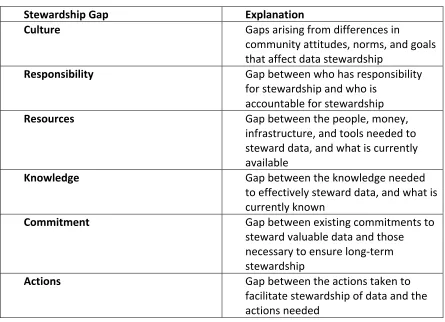
important areas of research consensus as well as areas where future research would be valuable. That publication has an extensive bibliography of literature related to data stewardship, and points to an even larger on-line bibliography (https://doi.org/10.7302/Z2ZW1J47). We have not attempted to duplicate that discussion or the bibliography here. The most important conclusions of that article fall into four areas.
Table 1: Main Stewardship Gaps Identified
Stewardship Gap Explanation
Culture Gaps arising from differences in
community attitudes, norms, and goals that affect data stewardship
Responsibility Gap between who has responsibility
for stewardship and who is accountable for stewardship
Resources Gap between the people, money,
infrastructure, and tools needed to steward data, and what is currently available
Knowledge Gap between the knowledge needed
to effectively steward data, and what is currently known
Commitment Gap between existing commitments to
steward valuable data and those necessary to ensure long-term stewardship
Actions Gap between the actions taken to
facilitate stewardship of data and the actions needed
Second, the literature pays different levels of attention to different gap areas, with noticeable “holes”, calling for more research in some areas, including those related to dynamic and adaptable infrastructure, discoverability, collaboration, and levels of funding and staff support.
Third (and related to our second point), research has approached stewardship gaps with unequal depth, leaving us a shallower knowledge of the stewardship process than we might like. In particular, more in-depth research is needed for studies about fragmentation of data
Fourth, while the stewardship literature encompasses studies about metrics (strategies for measurement) and measures (specific efforts to measure stewardship), the overwhelming focus is on specific measures of stewardship gaps. The relative shortage of metrics studies, which
provide measurement strategies, calls for significant work on this large and generally unstudied area.
In a second publication (30), we presented results from an earlier version of the research reported here, based on a pilot of seventeen interviews with researchers in sixteen areas of
research, representing thirteen U.S. research institutions. The in-depth interviews were conducted during November and December, 2015.
The main conclusions of that phase of our research demonstrated that the kind of in-depth interviews we conducted produce valuable information about the stewardship gap. Importantly, our findings showed that there were a diversity of stewardship arrangements, not easily
correlated with size or type of data, or with scientific domain. A relatively small proportion of the data we heard about was well stewarded at the time of the interview, and long-term
commitments were often lacking, something that confirms work done by others, and generates concern among researchers (12, 13, 31). We learned that more knowledge was needed to understand what factors gave researchers confidence in sustainable stewardship, and more analysis was needed in order to make confident recommendations about policy activities that would enhance stewardship in the future.
In this paper we turn our attention to a larger body of interviews (now 46), drawn from a broader range of scientific domains and encompassing the complete study. We drill down into specific questions that emerged as especially important from our research. First, we are interested in understanding how researchers assess the value of their data, initially for
how they perceive the relationship between the value of their data and the stewardship
responsibility that falls to them and others. From our perspective, value isn't just something that gets a "score" from one to ten, but rather a multidimensional indicator of the importance of the research activity to the community at large, with the capacity to give us an understanding of why specific data are meaningful (for use by others or because of the difficulty of replacement, for example, or how long the data will be important or useful). In Table 2 we list the reasons for data value provided by our respondents. Data could have more or less value for any one of these reasons (a high value for research inside the community, for example), while simultaneously having a lot of -- or little or no -- value for another of these reasons (for example as a
longitudinal data series). In addition to different types of value, data collections can also retain value for different lengths of time.
Table 2: Characteristics of value researchers were asked to choose (controlled vocabulary) Value for researcher's own research
Value because data would be difficult to recreate Value due to characteristics of data organization Value because of current or potential research impact Value because of inclusion in reference collection Value for reuse in immediate community
Value due to existence of longitudinal data series Value because data are timeless (will never lose value) Value for reuse outside immediate community
have value: do data that are expected to have value for a long time have stewardship commitments that will last equally long? This often inadequate intersection of value and commitment provokes a significant finding of our research, one that is noteworthy but not
entirely surprising, given the results of other research (12, 13). Even in the case of data for which the value is high, commitments are often not strong and may not last as long as the data have value.
Materials and Methods
Sampling
We gathered the data analyzed in this study from 46 interviews with principle investigators (PIs) of federally- or non-profit-funded research projects. We conducted 29 interviews during the spring and summer of 2016, in addition to the 17 that we reported on in York, Gutmann (30). The additional 29 interviews were conducted with PIs selected from a representative sample of research projects funded by U.S. federal agencies in 2010. We selected projects funded in 2010 to ensure that PIs would have generated at least some data that could be discussed in the interview. This approach differed from the opportunistic sample of researchers we used in our first phase of research (30), where we explored potential questions and evaluated the possibilities for this line of research. We recognize the challenges created by mixing
interviews from two different sampling strategies with slightly different questions, specifically that they might have generated incompatible responses from our interview subjects. We
nonetheless believe that the commonality of approach harmonizes the differences, enabling the combined results to have significant value.
Table 3. Distribution of interview subjects based on funding obligations by federal agency and discipline. Percent of Fed. Obliga-tions by S&E Area Desired # of Cases Dept. of Agri-culture Dept. of Com-merce Dept. of Defense Dept. of Edu-cation
HHS Dept. of
Interior Dept. of Trans.
Veter-an's Admin.
NASA NSF
% Federal Obligations by
agency 3% 2% 10% 12% 50% 1% 1% 1% 9% 8%
Funder distribution (N=50)
2 1 5 6 25 1 1 1 5 5
Environmental
Sciences 6% 3 1 1 1 1
Life Sciences 50% 25 1 1 21 1 1
Computer Sciences
and Mathematics 6% 3 1 1 1 1
Physical Sciences 11% 5 1 2 1 1
Psychology 3% 2 2
Social Sciences 3% 2 1 1
Other Sciences nec 3% 2 1 1
Engineering 18% 9 2 2 1 1 2 1
We calculated the distribution based on an initial desire to conduct 50 interviews. For instance, because 84% of funding in Life
Sciences is obligated from Health and Human services, we determined that 21 of 25 interviews in Life Sciences should be conducted
Once we established our sampling frame, we obtained data about projects funded by each
federal agency in 2010 from the US Government’s grant web site, https://grants.gov. Using the
grants.gov web site’s advanced search feature, we randomly selected grants from what the site
calls “new assistance project grants” (so that we were sure to find grants in their first year)
received by a “private” or “state controlled” institution of higher education. We then contacted
the Principal Investigator (PI) of the selected grants by email. If the PI did not respond to our
email, or declined our request for an interview, we randomly selected another project from the
same sponsor and discipline, and contacted the PI of that project.
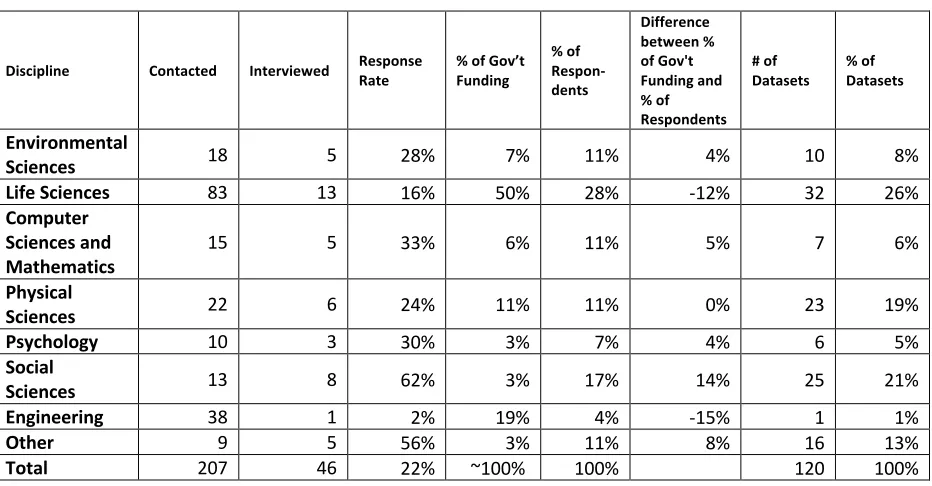
Table 4 shows a breakdown of the disciplines of the PIs we contacted and interviewed,
the disciplinary response rate, our targeted percentage of interviews per discipline based on
funding levels (% of Gov’t Funding), and actual overall percentage of respondents. The
important column here is the one labeled "Difference between % of Government Funding and %
of Respondents." Cells with a negative value indicate disciplines where we interviewed fewer
respondents than desired; cells with a positive value indicate disciplines with a greater number of
respondents. Despite contacting a larger number of PIs in Life Sciences and Engineering than the
other disciplines, these were the only areas where we interviewed fewer PIs than targeted. We
determined the distribution of interview subjects (shown in Table 3) initially based on a desire to
conduct 50 interviews. In the end, we conducted 26 interviews after contacting 207 researchers, a
sign of the challenges that we and other researchers face in attempting to learn about the
Table 4. Distribution of subjects interviewed, by Scientific Domain
Discipline Contacted Interviewed Response Rate % of Gov’t Funding % of Respon-dents
Difference between % of Gov't Funding and % of Respondents
# of
Datasets % of Datasets
Environmental
Sciences 18 5 28% 7% 11% 4% 10 8%
Life Sciences 83 13 16% 50% 28% -12% 32 26%
Computer Sciences and
Mathematics 15 5 33% 6% 11% 5% 7 6%
Physical
Sciences 22 6 24% 11% 11% 0% 23 19%
Psychology 10 3 30% 3% 7% 4% 6 5%
Social
Sciences 13 8 62% 3% 17% 14% 25 21%
Engineering 38 1 2% 19% 4% -15% 1 1%
Other 9 5 56% 3% 11% 8% 16 13%
Total 207 46 22% ~100% 100% 120 100%
Project Questions
The questions used for the initial sample of 17 and subsequent sample of 29 researchers were
nearly identical, and those used in the later interviews are included in the supporting materials
(S1 Appendix). The questions covered the following areas:
• Project Context: Purpose, domains of science, collaborators, funders, size and
characteristics of data
• Commitment: The amount of data for which there is a) a commitment to preserve; b) an
intention to preserve; c) no intention to preserve (though no intention to delete); or d) an
intention or obligation to delete the data
• Stewardship: Who is stewarding data; what is being done to take care of them; concerns
• Value: Why are the data valuable and for how long; how does the valuation affect
stewardship decisions; the utility of reassessing the value of the data in the future
The main changes we made to the interview protocol between the first and second sets of
interviews were the addition of questions to 1) distinguish the purpose of the project (i.e.,
primarily to test a hypothesis or to collect data in order to share them), 2) identify whether data
collected by others were used in the research, 3) obtain more specific information about the
degree of confidence PIs had in the current stewardship of project data and future stewardship
plans, and 4) ask explicitly about reasons data have value as articulated in the course of the first
set of interviews. We also added a working definition of “data.” We removed a question about
whether the data were being preserved “for yourself or someone else”, because we found this
question was confusing and did not add to our results given the other questions asked.
In both sets of interviews, we allowed respondents to select a project of their choice to
discuss as long as they were the principle investigator and the project had generated digital data
for which they were responsible at the time of the interview or previously. We also provided
definitions for two terms: We used “steward” to refer to the responsible management of data
(including the wide variety of activities that might be involved in managing them); and we used
“preserve” to refer to the execution of a set of activities with an explicit goal of maintaining the
integrity of data over time. In the second set of interviews, we defined “data” as digital outputs
of research that did not exist beforehand and had not already been deleted. Further details about
the rationale behind the interview questions and protocol are discussed in our earlier work (30).
Results
While our research sample was relatively small, our detailed interviews reveal a
opinions about the value of their data, and the processes by which those data will be preserved
and shared (or not). Including our earlier pilot sample, we interviewed a total of 46 respondents
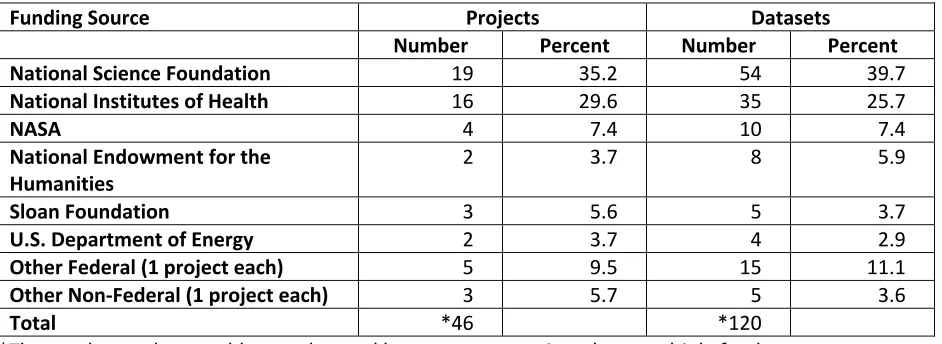
in 38 disciplines from 36 institutions. They had support from a variety of organizations (see
Table 5), with the largest number from the National Science Foundation and the National
Institutes of Health, and smaller numbers from NASA, the Alfred P. Sloan Foundation, the
National Endowment for the Humanities, and the Department of Energy. The interviews also
allowed us to see the extent to which U.S. researchers are engaging in work that crosses
traditional disciplinary boundaries. In particular, the 46 respondents from 36 disciplines told their
interviewer that their work covered a total of 79 domains of research. We list the research fields
in which the respondents work and the domains of research they described in the supplemental
[image:15.612.73.544.419.591.2]materials (S2 Table).
Table 5: Funding Sources reported by Interview Respondents
Funding Source Projects Datasets Number Percent Number Percent National Science Foundation 19 35.2 54 39.7
National Institutes of Health 16 29.6 35 25.7
NASA 4 7.4 10 7.4
National Endowment for the
Humanities 2 3.7 8 5.9
Sloan Foundation 3 5.6 5 3.7
U.S. Department of Energy 2 3.7 4 2.9
Other Federal (1 project each) 5 9.5 15 11.1
Other Non-Federal (1 project each) 3 5.7 5 3.6
Total *46 *120
*These columns do not add up to the total because some projects have multiple funders.
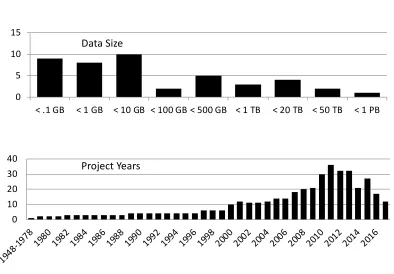
In examining the data (fig 1), it is valuable to remember that we asked each respondent to
describe a single project, and that each project involved a varying number of datasets. The
projects the respondents described took place over a long period of time, but our focus in the
us a heavy concentration in the early 2010s, with the peak in the years from 2010 to 2013. The
data also ranged broadly in size, from modest (less than 100 megabytes) to quite large (hundreds
of terabytes). The diversity of time frame and size gives us confidence that despite the limited
number of interviews, our work captures the diversity of data stewardship that our informants
have experienced.
We see key questions about various stewardship gaps as operating across three
dimensions, in which one dimension informs us about the value of data, a second dimension
explores the risks to data, and a third dimension considers the first two dimensions across time.
We begin with the reasons that researchers believe that their data have value. We asked
researchers to agree or disagree with a series of statements about the reasons that their data have
0 5 10 15
< .1 GB < 1 GB < 10 GB < 100 GB < 500 GB < 1 TB < 20 TB < 50 TB < 1 PB Data Size
0 10 20 30 40
19
[image:16.612.104.498.248.522.2]48-1978 1980 198219841986 1988 19901992 1994 1996 19982000 2002 2004 20062008 2010 201220142016 Project Years
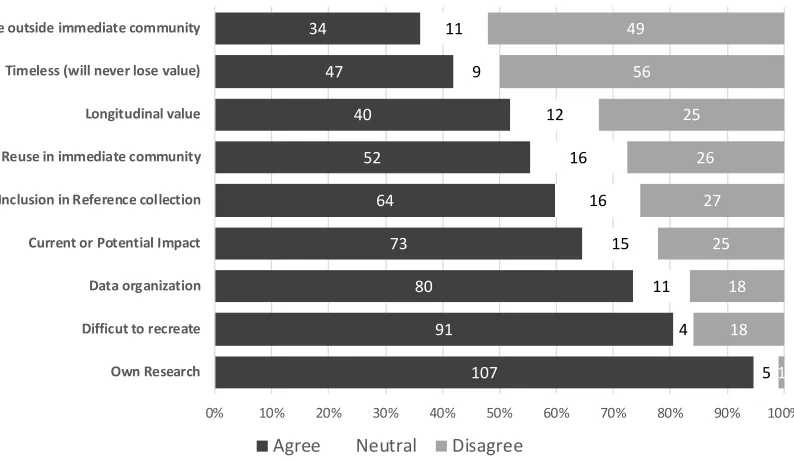
value, dividing their responses into agreement, neutral response, and disagreement (fig 2). One
of the significant conclusions that we draw from these data is that researchers do not feel that all
of their data have value, and they feel strongly that their data do not have value for some
purposes. It is not surprising that a large proportion of researchers believe that their data have
value for their own research, or because they would be difficult to recreate, but it may be
surprising -- especially to the data preservation community -- that only half of researchers
believe that their data will be useful to their community, and only roughly a third believe that
their data will be useful outside their immediate research community.
When we add the reasons for value that researchers tell us drive preservation decisions
about their data, a different but related story emerges. Here we asked researchers to rank the first, 107 91 80 73 64 52 40 47 34 5 4 11 15 16 16 12 9 11 1 18 18 25 27 26 25 56 49
0% 10% 20% 30% 40% 50% 60% 70% 80% 90% 100%
Own Research Difficut to recreate Data organization Current or Potential Impact Inclusion in Reference collection Reuse in immediate community Longitudinal value Timeless (will never lose value) Reuse outside immediate community
[image:17.612.107.504.341.572.2]Agree Neutral Disagree
second, and third most important types of value that influenced the decision to preserve data
from their project (fig 3). Overall (prioritized by users as first, second, or third) "reuse by others"
was the most common, expected use for their “own research” second, “potential reuse” for the
researchers themselves, historic purposes, or reproducing results third, and “difficult to recreate”
data was fourth. If we limit our analysis to their first order priority, then “reuse by others”, their
“own research”, and “longitudinal value” are most important, with “uniqueness” having an
interesting place as a strong first order priority, but not as a second or third priority.
The length of time that researchers believe their data have value adds another dimension
to the results. Table 6 shows the kinds of commitment that researchers have for preserving their
data, and the length of time that they expect their data to have value. The most interesting
0 10 20 30 40 50 60 70 Reus e by o
thers
Own r esea
rch
Poten tial re
use
Diffic ult to
Re-cr eate
Long itudin
al Val ue
Acco untab
ility
Curre nt or
poten tial Im
pact Uniqu enes s Missi on
[image:18.612.109.513.335.563.2]First Choice Second Choice Third Choice
characteristic of this table is the fact that even several years after their project began, researchers
had an intention to preserve 79% of the data sets they described (95 of 120 datasets), but still no
solid commitment from a stewardship organization for sustainable preservation. This, despite the
fact that researchers expected more than half of the data to have value either indefinitely or for
more than ten years, and intended to preserve the data for that length of time. Note that we
defined commitment in our interviews as having a written agreement about preservation with a
stewardship organization. This definition sets a high bar, but one that we feel is important
[image:19.612.77.540.342.478.2]because it indicates more than an informal intent to commit.
Table 6: Number of Datasets by Type of Commitment and Term of Value
Type of
Commitment Term of Value
Indefinite years > 10 <= 10 years years <= 5 Undetermined *Total
Commitment 4 2 1 7
Intention 33 20 13 22 7 95
No Intention 10 4 1 15
Temporary 1 2 3
Unsure 1 1
*This column adds up to 120 because one interview subject indicated that a single dataset had a
temporary commitment but also an intention to preserve the data.
It is difficult to over-emphasize the consequences of the finding just articulated.
Researchers value their data and intend for those data to be preserved, but long after their
projects have begun, few of them have solid commitments to steward those data. Put in concrete
terms, for only 11 of 120 datasets did researchers have definite plans for stewardship—with
some commitments having been confirmed and others not—all involving deposit in a third-party
commitment that an expert in data preservation would find sustainable: 13 of the 29 datasets
involved backing up their data on a hard drive, while another 9 assumed that their institution
would take responsibility for stewarding the data. These are not strong commitments, especially
as many institutions are still developing their strategies for institutional repositories.
Our findings of low levels of stewardship planning and preservation commitment are
consistent across all durations of time for which researchers believe that their data have value, as
the two panels of Table 7 show. Panel A shows the number of datasets tabulated by the length of
time that researchers believe they will have value (columns) and the length of time that they
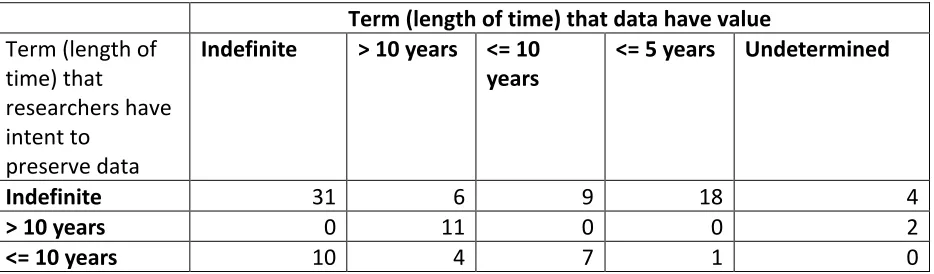
intend to preserve those data. The picture in Panel A appears optimistic at first, because, for the
majority of datasets (95 out of 120, excluding the dataset with an undetermined term of
intention), the duration of intention to preserve is equal to or greater than the duration that
researchers believe the data will have value (along and above the diagonal). Panel B shows the
sharp contrast, however, in the number of datasets of any duration of perceived value that have a
formal preservation commitment. When we single out written commitments, the picture is much
[image:20.612.75.542.584.721.2]less optimistic, something in keeping with the work of others (12, 13).
Table 7. Length of time that data have value compared with intention and commitment.
A. Length of time that data have value compared to length of time researchers intend for data
to be preserved
Term (length of time) that data have value Term (length of
time) that
researchers have intent to
preserve data
Indefinite > 10 years <= 10
years <= 5 years Undetermined
Indefinite 31 6 9 18 4
> 10 years 0 11 0 0 2
<= 5 years 3 1 1 7 0
B. Length of time that data have value compared to length of time researchers have a
commitment for data to be preserved
Term (length of time) that data have value Term (length of
time) that
researchers have a commitment to preserve data
Indefinite > 10 years <= 10
years <= 5 years Undetermined
Indefinite 2 0 0 1 0
> 10 years 0 1 0 0 0
<= 10 years 0 0 0 1 0
<= 5 years 2 1 0 0 0
Undetermined 0 0 0 Unsure 0
Panel A displays the length of time that researchers intend for their data to be preserved. Panel
B displays the length of time that researchers have a commitment for data to be preserved.
Cells below the diagonal indicate datasets where the term of the commitment or intention to
preserve is longer than the time the researcher believes the data will have value; cells above
the diagonal indicate datasets where the term of the commitment or intention is equal to the
perceived duration of value; cells on the diagonal indicate datasets where the term of the
commitment or intention to preserve is less than the perceived duration of value.
As parties concerned with data stewardship and reuse, we see the lack of commitment to
stewardship reported by many of our respondents as dangerous to the long-term sustainability of
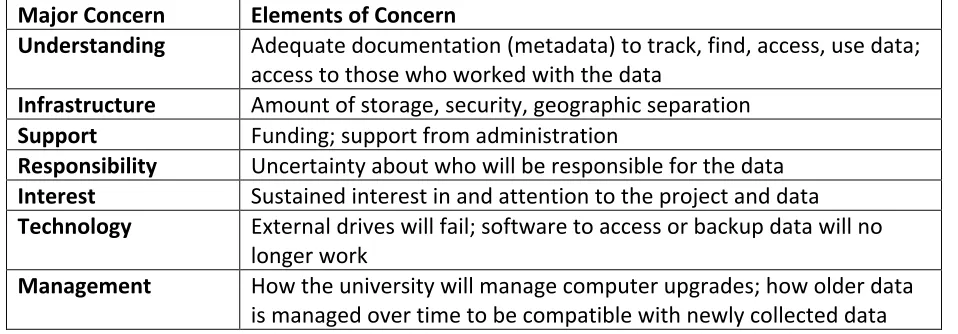
the research enterprise. On their side, our respondents have their own concerns about their data,
which we summarize in Table 8. Researchers expressed concerns about roughly half of the
datasets they described (63), with no concern for 18 datasets. They provided less information to
Table 8: Major Areas of Concern about stewardship sustainability for Interview subjects
Major Concern Elements of Concern
Understanding Adequate documentation (metadata) to track, find, access, use data; access to those who worked with the data
Infrastructure Amount of storage, security, geographic separation Support Funding; support from administration
Responsibility Uncertainty about who will be responsible for the data Interest Sustained interest in and attention to the project and data Technology External drives will fail; software to access or backup data will no
longer work
Management How the university will manage computer upgrades; how older data is managed over time to be compatible with newly collected data
As we might expect given the topic and the depth of our interviews, there is a complex
interaction between the attitudes and knowledge of researchers about stewardship, their concerns
for the future of their data, and the value that they see their data holding, now and in the future.
One way to look at this is to think about the temporal perspective that researchers hold: where
researchers are very confident in the stewardship of their data in the short-term, their concerns
have to do with the ability to understand data over time (e.g., adequate documentation), and
financial and administrative support for stewardship and preservationover time. Where
researchers are less confident in the short-term, their concerns have to do with continuity of
responsibility, technology and infrastructure (e.g., hardware and software failures and the
amount and security of available storage), and the ability to understand data over time. These
concerns show the interest researchers have in ensuring the stewardship of research, but also the
challenges that they face in ensuring that their data can be used in the future. We can also
generalize in other ways. Where durations of commitments or intentions match or are greater
than durations of value, concerns about understanding data and infrastructure predominate;
where durations of commitments or intentions are less than durations of value, concerns about
Table 9: Number of Studies with each Major Concern by type of value and relationship
between term of value and term of commitment.
Major Concern
Term of
Commitment or intention Equals Term of Value
Term of
Commitment or intention Greater than Term of Value
Term of
Commitment or intention Less than Term of Value
Understanding 7 14 1
Infrastructure 7 6 4
Support 4 6 3
Responsibility 0 2 10
Interest 0 6 0
Technology 5 0 0
Management 0 0 5
No concern 8 10 0
No information 25 7 7
Researchers’ types of concerns vary according to the durations of commitment or
intention and value data have, but what about according to types of value? Table 10 shows the
reasons shaping preservation decisions for each term of commitment/intention and term of value
Table 10: Type of Value with Greatest Impact on Preservation Decisions (rank).
Type of Value Term of
Commitment or Intention Equals Term of Value
Term of Commitment or
Intention Greater than Term of
Value
Term of Commitment or
Intention Less than Term of
Value
Reuse x x x
Difficult to re-create 1 4
Longitudinal 2 x 1
Own research 3 3 2
Uniqueness 4
Potential reuse x 2 3
Accountability x x 4
Good scholarly
practice x 1 x
Impact x x x
Mission x x x
An "x" in a cell indicates that respondents said that the factor in the left column had an impact
on preservation decisions for studies with the terms of commitment/intention and value in
each column. The numbers in each column indicate the order of importance for the four most
important factors for each set of terms of commitment/intention and value.
We see that decisions driving the preservation of data where the term of commitment or
intention is longer than the term of value most frequently have to do with good scholarly practice
or the likelihood of continued use by the researcher or others. No researchers expressed the
opinion that data in this category were preserved due to the data’s uniqueness. Where the term of
commitment or intention is equal to the term of value, data are most frequently preserved
because they are difficult to re-create or because they are longitudinal in nature. Where the term
of commitment or intention is less than the term of value, data are most frequently preserved
because they are longitudinal in nature and for the researcher’s own use. No data in this last
These findings reveal not only systemic risks to data—as evidenced in the relative
weakness of preservation commitments and plans, as well as researchers’ concerns about data
stewardship—but also patterns of risks associated with different types of data value, and
different types of data value over different durations of time. The systemic and patterned nature
of the relationships between risk and value suggest that systematic policy and procedural
interventions could effectively mitigate concerns and ensure adequate commitments to valued
data over time. The findings also strongly suggest that success in this area will not be achieved
without an accurate assessment and understanding of the reasons data have value and of how
long they have value.
An additional finding underscores this point. Table 7 shows a number of datasets that
might be characterized as being preserved “too long” (those above the diagonal) and those where
the intent to preserve is “not long enough” (those below the diagonal). When we asked
researchers about the appropriate length of time after which the ongoing value of their data
should be appraised, in nearly all cases where appraisal was deemed worthwhile (more than half
of those where a response was recorded), the appraisal term was “just right.” That is, if data were
appraised at the recommended time, they would be reviewed and either definitively preserved
before they were lost, or de-accessioned before they were preserved past their useful life.
Discussion and Conclusions
We have identified aspects of value, aspects of risk, and aspects of value and risk over
time that can be identified, measured, and evaluated. Our data and analysis show that
stakeholders, stewards, and researchers may have different perspectives about value (e.g., value
of data to themselves and reasons for value that drive preservation decisions) and risks (the
different stewardship situations). These groups may also perceive time differently. For example,
many researchers do not believe that it is important to think about stewardship until the end of a
project or until their retirement despite the long period of time that they may believe the data to
have value for reuse (by themselves or others).
Our research leads us to believe that none of these perspectives (of stakeholders,
stewards, or researchers) is “right” or “wrong.” Rather, developing effective strategies for
stewarding valuable data involves combining information and knowledge from these different
sources—researchers’ understanding of value and ability to appraise their own data; stewards’
understanding of infrastructure and data management; stakeholders’ ability to form partnerships
and collaborations, allocate resources, and in general foster environments that promote good data
management, sharing, and disposition practices.
The conclusions we draw suggest that a large fraction of research data created with
federal and foundation R&D support is "at risk." We can go further in describing these at risk
data, and divide them into high risk data (intent but no commitment), medium risk data (intent
but a term of commitment that is less than the term of value) and low risk data (where the
commitment term is equal to or greater than the term of value). We believe that the implications
of data being at risk are particularly high when the length of the preservation commitment or
intention is less than the amount of time that the data will have value.
These conclusions lead us to focus on the four categories of stewardship gaps identified
during this research. Two of these categories are among the stewardship gaps discussed in this
paper: commitment and responsibility. The third is the notion of the value of data. The last is the
role of time, more specifically the amount of time that data have value and the amount of time
for which there are preservation intentions and commitments. Put simply, for any given level of
research sponsors and research-conducting institutions appear to be generally insufficiently
committed to stewarding data, at least from the perspective of researchers generating those data.
(Note that these researchers and their institutions are often required by “open data” policies to
ensure its access, and therefore stewardship). Coupled with an insufficient commitment, we also
find a shortage of responsibility.
Closing the commitment and responsibility gaps should be the first order of business for
those who are obligated to think about the long-term value of data, starting with research
sponsors and research-supporting institutions, but also including research data repositories and
researchers themselves. The starting point must be a clear set of policy directives from
government agencies and other research sponsors, in partnership with the institutions that they
fund, designed to close the gaps that we find between intention and commitment. This will
require a transformation of policy, and an acceptance of responsibility, with financial and human
resource consequences. Given the way that we asked our questions, it is difficult to assess how
much more we can ask of researchers. Virtually all researchers voiced an intention to have their
data preserved.
Our emphasis on two of the gaps we identified should not leave the other gaps
unaccounted for. They, too, are important, and demand a response from responsible parties. We
especially want to emphasize the importance of the gaps we call culture, knowledge, and action,
because these are the areas where the research community needs to stand up, consider their roles,
and work to improve our sustainable access to data. In all of these cases we call on researchers,
their professional organizations, and the institutions at which they work to build a program of
education and activity that will narrow and ultimately close these gaps. Education sounds easy,
Acknowledgements
This project was supported by a grant from the Alfred P. Sloan Foundation, as well as financial
support from the University of Colorado Boulder and the Rensselaer Polytechnic Institute. We
are grateful to the members of the Stewardship Gap project advisory board for critical driving
discussions and comments on drafts of this paper. Members include George Alter, Christine
Borgman, Philip Bourne, Vint Cerf, Sayeed Choudhury, Elizabeth Cohen, Patricia Cruse, Peter
Fox, John Gantz, Margaret Hedstrom, Brian Lavoie, Cliff Lynch, Andy Maltz, Guha
Ramanathan. Any errors are the responsibility of the authors alone. We also appreciate the
support and contributions of Daniel L. Goroff of the Alfred P. Sloan Foundation, who has been
much more than a program officer as we undertook this project. Any errors are the responsibility
References
1. McCain KW. Mandating Sharing Journal Policies in the Natural Sciences.
Science Communication. 1995;16(4):403-31.
2. Noor MAF, Zimmerman KJ, Teeter KC. Data Sharing: How Much Doesn't Get
Submitted to GenBank? PLoS Biology. 2006;4(7):e228.
3. Piwowar HA, Chapman WW, editors. A review of journal policies for sharing
research data. Conference on Electronic Publishing; 2008 2008/06//. Toronto, Canada.
4. Piwowar HA, Chapman WW. Public sharing of research datasets: a pilot study of
associations. J Informetr. 2010;4(2):148-56.
5. Waller M, Sharpe R. Mind the gap: Assessing digital preservation needs in the
UK. York, United Kingdom: Digital Preservation Coalition; 2006 2006.
6. Thaesis, van der Hoeven J. Insight Report: PARSE.Insight: INSIGHT into issues
of Permanent Access to the Records of Science in Europe. 2010 2010/04//.
7. Addis M. Estimating Research Data Volumes in UK HEI. 2015 2015.
8. Wicherts JM, Bakker M, Molenaar D. Willingness to Share Research Data Is
Related to the Strength of the Evidence and the Quality of Reporting of Statistical Results. PLOS
ONE. 2011;6(11):e26828.
9. Vines Timothy H, Albert Arianne YK, Andrew Rose L, Débarre F, Bock Dan G,
Franklin Michelle T, et al. The Availability of Research Data Declines Rapidly with Article Age.
Current Biology. 2014;24(1):94-7.
10. Vines TH, Andrew RL, Bock DG, Franklin MT, Gilbert KJ, Kane NC, et al.
Mandated data archiving greatly improves access to research data. The FASEB Journal.
11. Pepe A, Goodman A, Muench A, Crosas M, Erdmann C. How Do Astronomers
Share Data? Reliability and Persistence of Datasets Linked in AAS Publications and a
Qualitative Study of Data Practices among US Astronomers. PLoS ONE. 2014;9(8):e104798.
12. Read KB, Sheehan JR, Huerta MF, Knecht LS, Mork JG, Humphreys BL, et al.
Sizing the Problem of Improving Discovery and Access to NIH-Funded Data: A Preliminary
Study. PLOS ONE. 2015;10(7):e0132735.
13. Pienta AM, Alter GC, Lyle JA. The Enduring Value of Social Science Research:
The Use and Reuse of Primary Research Data. The Organisation, Economics and Policy of
Scientific Research; Turin, Italy 2010.
14. Roche DG, Kruuk LEB, Lanfear R, Binning SA. Public Data Archiving in
Ecology and Evolution: How Well Are We Doing? PLOS Biol. 2015;13(11):e1002295.
15. Federer L, Lu Y-L, Joubert D, Welsh J, Brandys B. Biomedical Data Sharing and
Reuse: Attitudes and Practices of Clinical and Scientific Research Staff. PLoS ONE. 2015;10(6).
16. Perry C. Archiving of publicly funded research data: A survey of Canadian
researchers. Government Information Quarterly. 2008;25(1):133-48.
17. Tenopir C, Allard S, Douglass K, Aydinoglu A, Wu L, Read E, et al. Data
Sharing by Scientists: Practices and Perceptions. PLoS ONE. 2011;6(6):e21101.
18. Tenopir C, Dalton ED, Allard S, Frame M, Pjesivac I, Birch B, et al. Changes in
Data Sharing and Data Reuse Practices and Perceptions among Scientists Worldwide. PLoS
ONE. 2015;10(8):e0134826.
19. Akers K, Doty J. Disciplinary differences in faculty research data management
20. Cragin M, Palmer C, Carlson J, Witt M. Data sharing, small science and
institutional repositories. Philosophical Transactions of the Royal Society A-Mathematical
Physical and Engineering Sciences. 2010;368(1926).
21. Averkamp S, Gu X, Rogers B. Data Management at the University of Iowa: A
University Libraries Report on Campus Research Data Needs.
22. Guindon A. Research Data Management at Concordia University: A Survey of
Current Practices. Feliciter. 2014;60(2):15-7.
23. Scaramozzino J, Ramírez M, McGaughey K. A Study of Faculty Data Curation
Behaviors and Attitudes at a Teaching-Centered University. College & Research Libraries.
2012;73(4):349-65.
24. University of North Carolina Chapel H. Research Data Stewardship at UNC:
Recommendations for Scholarly Practice and Leadership. Chapel Hill, North Carolina:
University of North Carolina Chapel Hill; 2012.
25. Westra B. Data Services for the Sciences: A Needs Assessment. Ariadne.
2010(64).
26. Marcus C, Ball S, Deslserone L, Hribar A, Loftus W. Understanding Research
Behaviors, Information Resources, and Service Needs of Scientists and Graduate Students: A
Study by the University of Minnesota Libraries. Minneapolis: University of Minnesota Libraries;
2007.
27. Vice Chancellor for Research’s Data Management Task Force. Research Data
Management at the University of Colorado Boulder: Recommendatins in Support of Fostering
21st Century Research Excellence. Boulder: University of Colorado Boulder; 2012.
28. Johnston LR, editor User-needs assessment of the research cyberinfrastructure for
31st Annual Conference; 2010; West Lafayette, Indiana: International Association of Scientific
and Technological University Libraries.
29. York JJ, Gutmann MP, Berman F. What Do We Know about the Stewardship
Gap. Data Science Journal. 2018;17.
30. York JJ, Gutmann MP, Berman F. Will Today’s Data Be Here Tomorrow?
Measuring the Stewardship Gap. iPres 2016 13th international conference on digital
preservation; Bern, Switzerland2016. p. 102-11.
31. Fecher B, Friesike S, Hebing M. What Drives Academic Data Sharing? PLOS
ONE. 2015;10(2):e0118053.
32. National Science Board. Science & Engineering Indicators 2016. Arlington, VA:
National Science Foundation; 2016.
Supporting Information
S1 File. Appendix. Stewardship Gap Project Questions.