2018 International Conference on Applied Mechanics, Mathematics, Modeling and Simulation (AMMMS 2018) ISBN: 978-1-60595-589-6
An Optimized Method of DG Allocation in Active Distribution Network
Considering Risk of Failure
Mei-e SHEN
1, Min-fang PENG
2, Xiao-dan XU
2,*and Si-jia LI
21Beijing University of Information Science and Technology, Beijing, China
2Hunan University, Changsha, China
*Corresponding author
Keywords: Failure risk factor, Distributed generator, Reliability.
Abstract. Based on the Particle Swarm Optimization algorithm (PSO) with inertia weight, this paper proposed a distributed generator (DG) optimization method in active distribution considering fault risk with the goal of minimizing economic loss. According to the number of users and the loss of user load caused by power failure of the active distribution network, the fault risk impact factor is proposed and defined and then used to correct the objective function. The effectiveness of the proposed method is verified by a 24-node 6kV network. The results show that, after accessing the DG, the user's loss risk value, load loss risk value and total risk value are greatly improved. And the effectiveness of the DG optimization method considering the risk of failure is confirmed.
Introduction
Distribution network accidents may lead to partial or even integral degradation of regional infrastructure systems, resulting in huge losses in social production. It is very urgent to reveal and evaluate the potential danger and its consequences. Thus, finding the planning and design method for the least loss and the optimal safety investment benefit is important. Domestic and foreign scholars have done a lot of research on the location and capacity of DG [1~3]. The literature [4] applies the voltage stability limit surface normal vector to the location of the DG. Literature [5] proposed a DEMOPSO algorithm based on entropy and distance and FWM technology to determine the DG planning scheme. Literature [6] contains a critical review of the work in this field and described some key challenges ahead which remain to be tackled. In summary, the existing literature has achieved a lot for the planning of DG, but few documents quantify the risk factors of failure when designing the planning scheme. This paper proposes an evaluation method for the risk factors of fault in active distribution network. It is included in the objective function of the planning scheme in the form of a penalty factor, and the DG planning model considering the safety constraints is established to obtain a more realistic planning scheme.
Failure Risk Assessment
First, we need to do the following treatments on the distribution network.
(1) For the same pole and parallel line to be combined. The branch of the shunt capacitor, the high-voltage transmission line, the main wiring of the power plant, and the main wiring of the substation are ignored. (2) Nodes in the network are divided into two types: equivalent power nodes and equivalent load nodes. (3)Distribution lines and transformer branches as edges. The impedance modulus is set to the edge weigh. (4) The distance between the equivalent power node and the equivalent load node is the length corresponding to the shortest path of two points.
Then, the distribution network can be abstracted into a complex network model G. We can define the importance indicator of its node i as follows:
( ) si i
l
In the formula, si is the edge weight of nodei. That is, the reciprocal of the weights of all edges directly connected to nodei. li is the average of the shortest path weights from node i to each other node. The loss caused by the failure is mainly including the loss of the number of users and the load of users. Its model is as follows,
1
1 1
N N
i i i i i
i i
R PL P
(2) 2 1 1 N Ni i i i i
i i
R n L n
(3)
where, R1 and R2are the consequences of user loss and load loss, respectively. N is the total
number of users.Pi is the load. ni is the number of users of node i. i is the importance factor
of node i. Li represents the power supply state of node i. 1 if not powered, otherwise 0. The
integrated model is as follows:
1 1
1 2
1 1
( )
N N
i i i i i i
i i
N N
i i i i
i i
PL n L
R P n
(4) where, is the probability of failure for a root node. 1and 2 are respectively the weight forload risk and number risk of user that is affected by power failure. And, 1 2 1. Therefore, we can adopt the penalty function to define the fault risk impact factor:
2 min min min ( ) , ( ) 0, R
K R R R R
K R
R R
(5)
where, KR is the consequence penalty factor of power fault.
DG Allocation Model
In order to achieve the most preferred location of the DG, the objective function is performed from the aspects of security and economy. Security mainly considers related constraints, including node voltage constraints, line current constraints, and DG operation constraints. The economic aspect mainly considers the network loss caused by DG after accessing to the network.
Constraints by DG Network Access
(1) Node voltage constraints
2 min min 2 max max min max ( ) , ( ) ( ) , 0,
U i i
U i U i i
i i
K U U U U K U K U U U U
U U U
(6)
In the formula,Ui, Uimaxand Uimin are respectively the voltage of node i, and its upper and lower limits. KU is the node voltage penalty factor, which is a penalty for deviation from the operating limit, and generally takes a larger value.
2
max max
max
( ) ,
0,
I j j j j
I
j j
K I I I I
K
I I
(7)
In the formula. Ii, Iimaxand Iimin are the current of nodei , its upper and lower limits
respectively. KI is node current penalty factor.
(3)DG operation constraint
2
( ) ,
( )
0,
L DG L
DG
DG DG
DG L
K S S S S K S S S
(8)
In the formula, SDG is the total capacity for DG to the grid. SL is 10% of the total grid load.
DG
K is the penalty factor for the amount of DG injection, and the value method is the same as
U K .
The Objective Function of DG to the Grid
The objective function is as follows:
cos
minZ t CDGCLCen
(9) Where, 1 ( ) DG n
DG i DGi pu DGi DGi i
C C C E W
is the investment and operating expenses of DGconverted to each year. nDG is the number of DGs to grid.i is the fixed annual investment cost factor for the i-th DG. CDGiis the fixed investment cost for the i-th DG. Cpu is the electricity
price.EDGiis the total annual power loss for the i-th DG. WDGi is the maintenance cost of the i
-th DG.
The formula en max ( ) pu
new DG
C T P P C is the cost of electricity purchase. Where,
1 DG n i DGi DG i
P S
; Tmax is the maximum hours of annual load. Pnewis the newly increased load.DG
P is the total active power. i is the power factor of the i-th DG.SDGi is the capacity of thei
-th DG.
After the DG, the power distribution company can choose to purchase additional power from the regular power supply, or choose to supply the load DG. But their cost are different. Based on this, it is necessary to add the cost of purchasing electricity from the conventional power source as a variable to the objective function. The constraint is normalized to the objective function in the form of a penalty factor, and the new objective function is obtained as follows:
cost
1 1
min ( ) ( ) ( ) ( )
n L
DG L en U i I j DG DG
i i
Z C C C K U K I K S K R
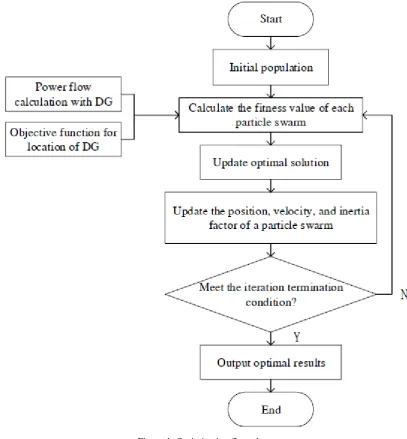
(10) The above related calculations is based on the calculation of the power flow of the distribution network after the DG is connected to the network. We adopt layered forward and backward substitution method for power flow calculation. The algorithm classifies the network branches according to the characteristics of the branch power forward and the voltage return between the same level of the radiated network. It can calculate the power loss and voltage loss in branch of each level in parallel, thus greatly improving the calculation speed of the distribution network power flow.
and local search. Its optimization result does not depend on the selection of the initial point, and it provides a solution possibility for solving nonlinear combination optimization problems of location and capacity of DG. The program flow of DG location selection based on PSO algorithm with inertia weight is shown inFig1
Figure 1. Optimization flow chart.
Analysis of Examples
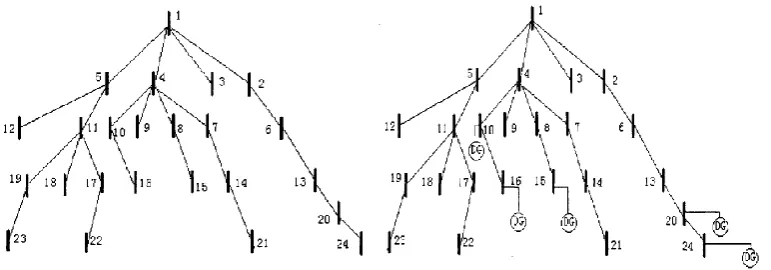
Figure 2. Grid structure of the example. Figure 3. Location results of DG.
In the model, the penalty factor KU KI KDG 100, and KR 10000. The average annual
cost factor i for fixed investment of DG is 0.35. In the case where the number of DGs, location and single power supply capacity are all uncertain, the PSO algorithm with inertia weight is adopted to select and size the DG supply. Finally, the optimal solution is shown in Fig 3.
As can be seen from the figure, due to the influence of DG on load capacity of line and power flow in distribution network, distributed power supply is mainly located at the end of line in radial distribution network. Table 1 shows the comparison results of the risk values before and after DG accessing to grid. The result is the value after applying the penalty function.
Table 1. Comparison of risk values before and after DG accessing to grid.
Risk With DG [ten thousand yuan] Without DG[ten thousand yuan]
Loss risk of
users
20.453 28.491
Loss risk of load 13.475 24.551
Total risk 33.928 53.042
From the perspective of risk, the loss risk value of users can measure the number of users lost in the distribution network before and after accessing the DGs. The loss risk value of load can measure the load loss of the distribution network before and after the DG access. So the total risk value obtained by the combination of the two can measure the reliability of the entire distribution network. The total risk before and after accessing the DGs is 53.042, 33.928 respectively. The risk of user loss and load loss is also greatly improved compared with that before access. This is mainly because the island power supply can be realized after the DGs are connected, and the reliability of the power supply can be significantly improved. In addition, the location scheme of DGs considers the user's loss risk value and the load loss risk value, and also considers various economic factors and various constraints of DG access. In summary, the method proposed in this paper finds a better location scheme for distributed power supply.
Summary
Acknowledgement
This research was financially supported by the following foundation items: National Natural Science Foundation of China (NO.61472128); Natural Science Foundation of Hunan Province (NO.14JJ1025).
References
[1] Uniyal A, Kumar A. Comparison of optimal DG allocation based on sensitivity based and optimization based approach[C]//IEEE International Conference on Power Electronics, Intelligent Control and Energy Systems. IEEE, 2017:1-6.
[2] Abbasi F, Hosseini S M. Optimal DG allocation and sizing in presence of storage systems considering network configuration effects in distribution systems [J]. Iet Generation Transmission & Distribution, 2016, 10(3):617-624.
[3] Phonrattanasak P. Optimal placement of DG using multiobjective particle swarm optimization[C]//International Conference on Mechanical and Electrical Technology. IEEE, 2010:342-346.
[4] Deng Dashang, Fang Xinyan. Application of normal vector of voltage stability limit surface in distributed generation allocation[J]. Power System Protection and Control, 2015, 43(5): 57-62.
[5] Li Ran, Ma Huizhuo, Zhu Jinyao, et al. Multi-objective optimization for DG integration into distributed system [J]. Electric Power Automation Equipment, 2014, 34(1): 6-13.