2018 3rd International Conference on Computational Modeling, Simulation and Applied Mathematics (CMSAM 2018) ISBN: 978-1-60595-035-8
Dual Digital Fingerprint Authentication Algorithm of DOC Document
Based on SM3 Algorithm
Ya-jie ZHENG and Zi-chen LI
Beijing Institute of Graphic Communication, Beijing, China
Keywords: Doc-document, SM3-algorithm, Dual-digital-fingerprints, Integrity verification, Anti-copy.
Abstract.Electronic document copyright protection technology based on digital fingerprint has made great progress in recent years, and also got some practical application, such as the digital fingerprint based on the feature vector of text content, based on the information of user's purchase transaction and based on word frequency statistic, but these digital fingerprints also have some problems that need to be solved. The digital fingerprint generated based on the above methods is complex and cannot verify the integrity of the document correctly, nor does it completely prevent copying. Collusion attack is the most important and difficult problem that digital fingerprint facing now. Based on the problems existing in the previous digital fingerprints, this paper mainly conducts some experimental operations on the time attribute of doc document, and found that doc documents only been added, deleted, modified and saved, and copy to other computers and mobile storage devices, or cut to other locations of the computer, the modification time of the document will change. Based on this time attribute of document, a dual digital fingerprint authentication algorithm based on time attribute is proposed by using SM3 hashing algorithm. First, get the content of document A, the acquired content is hashed using the SM3 hash algorithm to get the hash value 1. Second, acquiring the time property of the document and the SM3 algorithm is used to hash the acquired time attribute, get the hash value 2. Using the two hash values as a double digit fingerprint of a file. It is verified that this dual digital fingerprint can effectively verify the integrity of the document, which is used as the key to control the access to the document, and can prevent the document from being used in the copy circulation between different devices, which is called anti-copy.
Introduction
With the popularity of the Internet more and more widely, text files in the online dissemination of more and more widespread, companies, public utilities, government departments and other public institutions of the confidential electronic documents and academic research results are random access to steal tampering copy increasingly become the highlighted issues, Therefore, it caused a lot of loss and trouble to companies and individuals.
manipulated and copied, this paper introduces a dual digital fingerprint authentication algorithm, which is different from the digital fingerprint based on the text feature, the word frequency and the user purchase transaction information. This algorithm consists of a digital fingerprint of 1 based on the doc time attribute and a digital fingerprint of 2 based on the full text of the original document, avoiding a digital fingerprint with the same time-based attributes that coincide with the creation of different two documents, the modification time and the access time. In addition to using the document time attribute to generate a digital fingerprint, but also the whole document using the SM3 algorithm hash, the hash value as the second digital fingerprint of the document. It is verified that this dual digital fingerprint can effectively verify the integrity of the document, which is used as the key to control the access to the document, and can prevent the document from being used in the copy circulation between different devices, and has a strong ability to resist collusion attack.
Algorithm Design
SM3 Algorithm
[4]The SM3 hash algorithm was released in December 2012 by China National Password Administration. The algorithm is suitable for the digital signature and verification in commercial cryptographic applications and the generation of random numbers, which can meet the security requirements of multiple cryptographic applications.
The SM3 algorithm can calculate the data of any length less than 264bit, and output a hash value of 256bit length[4]
Algorithm Description
The SM3 algorithm which can be used to clutter message m with length L (l) bit. The SM3 algorithm process can be divided into 4 steps, as shown in Figure 1.
(1) Suppose the length of message m is l bits. First, add bit "1" to the end of the message, and then add k "0". K is the smallest non-negative integer that satisfies l + 1 + k congruence with 448mod512. Then add a 64-bit strings, which is a binary representation of length l. The length of the filled message m' is a multiple of 512 bits.
(2) The filled message m ' is grouped by 512 bits: m' = B (0) B (1) ... B (n-1), of which n= (L+K+65)/512. 512bit per team leader, the B (i) is divided into 16 32bit words, W0, W1,···,W15.
The group information is then expanded into 132 bit characters, W0, W1,···,W67, W0′, W1′, ···,W63′.
(3) After all B (i) data is processed, the final packet output V (n) is the final hash value, that is, the digital fingerprint.
Generation of the Digital Fingerprints
Message fill Message extention Compression function Output hash value Document Get the document content Document
content SM3 algorithm
Based on the contents of the document
Figure 1. SM3 algorithm flow chart. Figure 2. The fingerprint of document content.
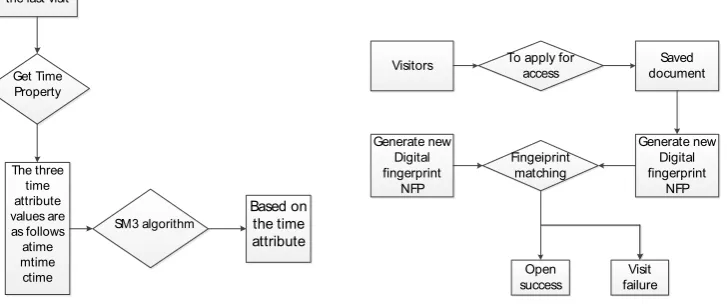
A Digital Fingerprint Based on the Time Attribute. In the Python language, the last access modified after the creation of the saved article A to obtain the time attribute, the obtained creation time, access time, modified time of the three time attribute values as the SM3 algorithm of the input value of the hash, The hash value that is output after filling the iteration expansion compression is the second digit fingerprint of document A. The specific process is shown in Figure 3.
Digital Fingerprint Authentication
After the system is created the last time to access or modify the saved some important DOC documents, using the system to generate each document of their own dual digital fingerprint LFP (last fingerprint), these fingerprints are not maliciously manipulated with the document to open the security private key, when the second visit, The system will regenerate the document's dual digital fingerprint NFP (New fingerprint), input the double digit fingerprint LFP that was generated on the last save, and match the double digit fingerprint NFP that was regenerated in the system when it was accessed again, if the match was successful, the document could be opened successfully. If the match is unsuccessful and the document fails to open, it means the document has been manipulated .The certification process Model diagram is shown in Figure 4.
Document a saved after the last visit
Get Time Property The three time attribute values are as follows atime mtime ctime SM3 algorithm Based on the time attribute
Visitors To apply for access documentSaved
[image:3.595.144.451.69.228.2]Generate new Digital fingerprint NFP Generate new Digital fingerprint NFP Fingeiprint matching Open success Visit failure
Figure 3. The fingerprint based on time attribute.
Figure 4. Certification System flow.
Experimental
The Generation of Double Digit Fingerprint of Original Document
[image:3.595.121.485.488.640.2]Figure 5. The contents of document A.
First Digital Fingerprint. The contents of document A in Fig.5 with the SM3 algorithm, and the result is shown in Fig. 6 and Fig. 7.
Figure 6. Getting the contents of the original document.
Figure 7. The hash value of the original document’s contents.
The results of the operation as shown in Fig.7 is the original document A's first digital fingerprint.
Second Digital Fingerprint. Getting the time attribute after the last save of the original document and hashes the acquired property with the SM3 algorithm, as shown in Fig. 8 and Fig. 9:
Figure 8. The time property values obtained.
Figure 9. Time property hash value.
The result shown in Figure five is the second digit fingerprint of the original document A.
A Document to the Following Operations, and Then the Operation of the Document Generated Double Digital Fingerprint
The Modified Document to Produce a Double Digit Fingerprints.
Modify Operation
Modifying the content of document A to change "DOC" in the text content to "txt", as shown in Fig. 10.
Figure 10. The content of document A which has been modified.
First Digital Fingerprint
The modified file A is hashed with the SM3 algorithm, and the first digital fingerprint of the modified document is obtained, as shown in Fig. 11 and Fig. 12.
Figure 11. Getting the contents of the modified document.
Second Digital Fingerprint
Gets the time attribute that modifies the saved document, hashes the acquired time property value with the SM3 algorithm, as shown in Fig. 13 and Fig. 14.
Figure 13. Time attribute value of the modified document.
Figure 14. The hash value of the document time attribute.
Using Fingerprint Contrast System to Verify
Inputting the first fingerprint, the display interface as shown in Fig. 15.
Figure 15. Input the first fingerprint comparison system display interface.
Generates a Dual Digital Fingerprint for a Document Copied from C to Disk D.
Copy Operation.
Copy a document from C to disk D.
First Digital Fingerprint
A document copied to D disk is hashed with the SM3 algorithm, and the first digit fingerprint of the copied a document is obtained, as shown in Fig. 16.
Figure 16. Property values for document an original document after replication.
Second Digital Fingerprint
Gets the time attribute of the copied document, hashes the acquired time property value with the SM3 algorithm, as shown in Fig. 17 and Fig. 18.
Figure 17. Property values for document a after replication.
Figure 18. Hash value of time attribute value.
Use Fingerprint Contrast System to Verify.
Inputting the second fingerprint, the display interface as shown in Fig. 19.
Compare the duplicate digital fingerprint of the copied document with the tamper-saved document in the above experiment, find that the first digit fingerprint verification is successful, the second is error and eject the window "second fingerprint error, document was copied".
Experimental Results Analysis
From the above two groups of experiments concluded that after the modified operation and the preservation of the document dual digital fingerprint has changed, after the copy of the document after the double digital fingerprint only a duplicate of the fingerprint changed.
Conclusion
Double Digital Fingerprint authentication algorithm experiment summary
From the above experiment can conclude that, text document as long as after adding a series of tamper behavior such as deletion and save, and copy to other computer or U disk and other storage devices, or cut to the other location of the computer, its access, modify time will change, So as long as one or more of the above types of operations, the second digital fingerprint of the document will change, and then access the document will be access to failure.
Therefore, the dual digital fingerprint authentication algorithm proposed in this paper can successfully verify the integrity of Doc document, and can successfully detect whether the document has been manipulated with and prevent the document from being copied and cut. Double digital fingerprint authentication algorithm compared to the traditional digital fingerprint has a great improvement, the traditional digital fingerprint is embedded in the document, only when the copyright disputes, the digital fingerprint extraction, can verify the copyright owner's information and thus defend rights.
The dual digital fingerprint authentication algorithm can block the infringing copy documents from the source, and find out whether the confidential documents have been manipulated with or not.
References
[1] Deng Jiaqing, Lin Pei, Research Progress of Digital Fingerprint Technology [M]. Computer & Telecommunication 2016 (8), 42-44 (in Chinese).
[2] Dong Yijun, The Copyright Protection of Library Digital Resources Based on The Digital Fingerprint [M]. Hangzhou University of electronic science and technology Press 2017 (in Chinese).
[3] Jose Juan Garcia-Hernandez, Miguel Morales-Sandoval A Collusion-Resistant Fingerprinting System for Restricted Distribution of Digital Documents, Article in PLoS ONE December 2013.
[4] State Cryptography Administration, SM3 Cryptographic Hash Algorithm last accessed 2010/12.