2018 2nd International Conference on Applied Mathematics, Modeling and Simulation (AMMS 2018) ISBN: 978-1-60595-580-3
Research on Assemblability Evaluation Method of Aero-engine
Based on Assembly Data Model
Chao LIU, Wei ZHANG, Zhen-dong LIU and Hong-feng ZHAO
Aecc Shenyang Engine Research Institute, Shenyang, China
Keywords: Aero-engine; Assemblability Evaluation, Assembly Data Model, Fuzzy Set.
Abstract. In order to improve the assemblability of aero-engine products, this paper combined with the assembly process design features of the engine, and divided the assemblability into five directions, assembly performance, assembly structure, assembly connection, equipment capability and other requirements. The engine assembly data model was used as the carrier of product assembly process information integration; the fuzzy set and expert system were introduced to organically combine the product assembly process and the assembly parameters. Evaluation levels in all aspects of the engine structure assemblability are determined by the analysis and evaluation of a single factor and comprehensive impact. High-level assemblability analysis was achieved by means of that. The algorithm proposed in the paper had been applied to engine assembly process design practice and had achieved good practical results.
Introduction
Assembleability is a measure of the ease with which a product can be assembled relative to an assembly capacity and resource. It is closely related to product structure, assembly methods, and assembly resources [1]. For aero-engines, the product structure is complex and diverse, and it has the characteristics of wide professional scale, compact space, huge number of parts and strict requirements on the shape [2], and the assembly process design is very complicated. At the same time, the cost impact of upstream design issues of aerospace products will propagate downstream in an increasingly enlarged form, making its assemblability more important to actual assembly. Therefore, the evaluation and feedback of the assemblability of engine products has become an important factor in improving the assembly quality of engine products and ensuring product performance.
The assemblability evaluation of engine products is an effective means of collaborative research and development for design and process. It emphasizes the constraints of the assembly process in the early stages of design, systematically evaluates the assemblability of the entire product, proposes improved design solutions, eliminates design flaws, avoids large rework, and improves assembly efficiency and assembly quality.
Existing research results, including commercial CAD software such as Pro/Engineer, CATIA, UG, etc., only verify whether the product can be assembled, by scattered assembly process simulation, in the form of motion simulation, animation display, etc. It can’t really, systematically reproduce the assembly process of the product, lacking a quantitative analysis system for assemblability. Aiming at the above problems, this paper proposed an assembly-level evaluation technology based on assembly data model. The data model was used as the carrier of product assembly process information integration, and a fuzzy set of evaluation factors is introduced to integrate product assembly characteristics and assembly process organically. By which high-level assemblability analysis and evaluation were achieved.
Construction of Assemblability Analysis Process
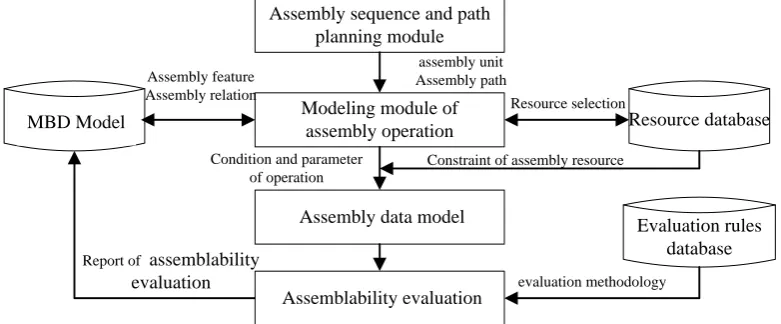
resources are selected, the assembly process of the product is simulated, the assembly data model is generated, and the assemblability of the design model is verified according to the corresponding evaluation rules. Thus, hazard assessments and recommendations of the structural design change are given. Its overall structure is shown as Figure 1.
Assembly sequence and path planning module
Modeling module of assembly operation
MBD Model Resource database
assembly unit Assembly path
Resource selection
Constraint of assembly resource Condition and parameter
of operation
Report of assemblability evaluation
Assembly feature Assembly relation
Assembly data model
Assemblability evaluation
Evaluation rules database
[image:2.595.102.493.137.299.2]evaluation methodology
Figure 1. Assembleability analysis system structure.
Assembly Data Model
Aero-engine design is a system engineering that requires constant verification and iterations to achieve final use and assembly requirements. If the spatial positional relationship between the assembly objects in the product is unreasonable, it not only affects the accessibility and operability of the assembly, but increases the difficulty and time of assembly. In the evaluation of assemblability, it is first necessary to determine the factors that affect the assemblability and the characteristics of the design of complex structural products. Based on the actual situation of manual assembly operations, the influence of these factors on the assembly of complex structural products is analyzed.
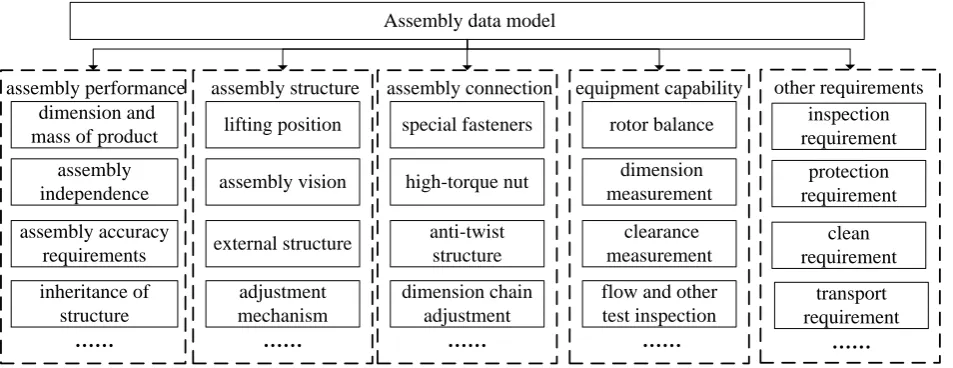
Considering the characteristics of the engine product structure and its assembly process design, in order to achieve accurate analysis and judgment of its assemblability, it is necessary to classify the structure and performance data that affect the assemblability, and combine the assembly unit planning results and assembly process. During the operation process, the equipment and tooling at the assembly site is considered, the assembly parameters and assembly environment is summarized, and an assembly data model to provide a data foundation for subsequent evaluation of the assemblability of engine products is established.
Assembly data model
assembly structure assembly connection equipment capability other requirements lifting position
assembly vision
external structure
……
protection requirement
adjustment mechanism
rotor balance special fasteners
high-torque nut
anti-twist structure
……
dimension measurement
clearance measurement flow and other test inspection dimension chain
adjustment
inspection requirement
clean requirement assembly performance
dimension and mass of product
assembly independence
assembly accuracy requirements inheritance of
structure ……
transport requirement
[image:3.595.61.538.71.255.2]…… ……
Figure 2. Engine assembly data model.
Assembly performance data is aimed at primarily the assembly properties of the engine. Including the dimensions and other parameters of the assembled parts; whether the different assembly units are independent; whether the structural similarity between the machine and the existing model or the original model allows the use of existing process conditions; whether the assembly accuracy requirements exceed the conventional Assembly precision control range and other aspects.
Assembly structure data is aimed mainly at the structural properties of the engine. Including whether the suspending position of the whole machine and components is sufficient and reasonable; whether the assembly vision is sufficient; whether the external structure level is obvious; whether the installed and the inspection requirements of geometric adjustment mechanism are reasonable.
Assembly connection data is defined mainly for the connection structure of the engine parts. Including whether there are special fasteners; whether the high-torque nut structure is easy to assemble, whether there is any anti-twist structure available; whether there are special forms of fasteners and connectors in the structure, whether the dimension chain adjustment requirements for the connection are reasonable and implementable.
Equipment capability data mean whether equipment capabilities at the assembly site can meet assembly requirements. Including whether the balancing machine on-site meets the engine rotor balance requirements; whether the product dimension measurement is reasonable and implementable; whether the clearance measurement requirements are reasonable and implementable; whether the sealing, flow and other test inspection requirements are clear and implementable.
Other requirements data, which is defined mainly for other requirements of engine assembly, such as the inspection of the products, whether the protection has special requirements, whether it is reasonable; whether the products have requirements of cleaned, transported, etc., whether special equipment is required.
Single Factor for Assemblability Evaluation
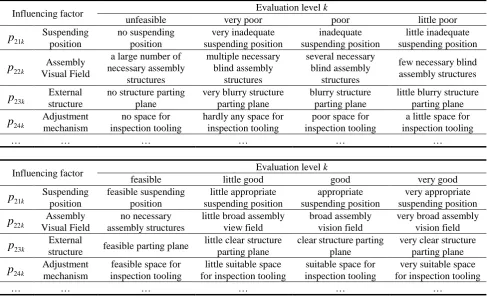
Referring to J V Carnhan fuzzy clustering method [3], the evaluation level of assembly data is divided into 8 fuzzy levels, namely, “unfeasible”, “very poor”, “poor”, “little poor”, “feasible”, “little good”, “good” and “very good”, which are indicated by “P”.
1 2
( ij , ij , , ijk)
P p p p ,(i1, 2, ,5;j1, 2, , ;n k 1, 2, ,8)
Table 1. Single factor classification.
Influencing factor Evaluation level k
unfeasible very poor poor little poor
21k p Suspending position no suspending position very inadequate suspending position inadequate suspending position little inadequate suspending position 22k p Assembly Visual Field
a large number of necessary assembly structures multiple necessary blind assembly structures several necessary blind assembly structures
few necessary blind assembly structures
23k
p External structure
no structure parting plane
very blurry structure parting plane
blurry structure parting plane
little blurry structure parting plane
24k
p Adjustment mechanism
no space for inspection tooling
hardly any space for inspection tooling
poor space for inspection tooling
a little space for inspection tooling
… … … …
Influencing factor Evaluation level k
feasible little good good very good
21k p Suspending position feasible suspending position little appropriate suspending position appropriate suspending position very appropriate suspending position 22k p Assembly Visual Field no necessary assembly structures
little broad assembly view field
broad assembly vision field
very broad assembly vision field
23k
p External
structure feasible parting plane
little clear structure parting plane
clear structure parting plane
very clear structure parting plane
24k
p Adjustment mechanism
feasible space for inspection tooling
little suitable space for inspection tooling
suitable space for inspection tooling
very suitable space for inspection tooling
… … … …
According to the difficulty level in the assembly process, the design results of various influencing factors can be given different evaluation. Due to the strong empirical of the aero-engine design and the high requirements of the products, the evaluation of the design results of various factors can be depended on the method of expert evaluation. The expert group consists mainly of experts from the design department, assembly process department and manufacturing process department. According to the results of expert evaluation, the eight levels are defined, for “unfeasible”, “very poor”, “poor”, “little poor”, “feasible”, “little good”, “good” and “very good”. The corresponding scores are 1, 2, 3, 4, 5, 6, 7, 8, which is indicated with matrix “SF”:
1 2 8 1 2 8
SF sf sf sf
(2) In order to ensure the reliability of the evaluation results, and to exclude the extremes of individual expert evaluation, we can use “ns”, the number of experts, who select different evaluation scores, to
multiply by the level points, and get the value, which can reflect the evaluation result of the single factor [4].The evaluation results of assembly data sub-model can be indicated by matrix “FEi”.
1, 2, ,8
ijk k
fe cf ns k,
(3)
11 12 18
12 22 28
1 2 8
i i i
i i i
i
ij ij ij
fe fe fe
fe fe fe
FE
fe fe fe
averaged and rounded, which can determine the final evaluation result of the single factor, as equation (5) shown, where “m” is the number of participating experts.
8
k=1
1
( ) , 1, 2, ,5; 1, 2, ,
ij ijk
AFE fe i j n
m
(5)Comprehensive Assemblability Evaluation Based on Assembly Data Model
Among all the factors in the same data model, the influence degree of each influencing factor on the evaluation results is different. In order to accurately reflect the assemblability of an engine structure, it is necessary to assign various factors weight values according to the degree of influence of them.
First, weight value “ai(i=1,2,…,n)” is defined for different factors “ui(i=1,2,…,n)” of each sub-model, and a weight set “A” is composed by each weight, A=(a1,a2,…,an). Each weight value satisfies the normalized and non-negative conditions, as in equation (6). According to the design characteristics of the engine and the design experience of the assembly process, the weight value of each factor on the evaluation results are determined.
1
1, 0, 1, 2, ,
n
i i
i
a a i n
(6) According to the single factor evaluation result and the weight of each factor, the factor weight is applied to the single factor evaluation result, which can reasonably reflect the comprehensive influence of all factors in the data sub-model. Therefore, the fuzzy comprehensive evaluation model can be expressed as equation (7).
11 12 18
12 22 28
1 2
1 2 8
, , , , 1, 2, 3, 4, 5
i i i
i i i
i i n
ij ij ij
fe fe fe
fe fe fe
NE A FE a a a i
fe fe fe
(7) The assemblability of different engine structures needs to be judged in five directions: assembly performance, assembly structure, assembly connection, equipment capability, and other requirements. Each direction has different effects on the assembly of the engine. Therefore, it is necessary to correlate the evaluation matrices of the five sub-models, as in equation (8).
1 2 3 4 5
( , , , , )T SNE NE NE NE NE NE
(8) According to the design characteristics of the engine and the assembly process design experience, the sub-models of the assembly data model are again weighted, and the weight value “b” is defined,
and the weight values are composed of the weight set “B”. B=(b1,b2,…,b5) Each weight value satisfies the normalized and non-negative conditions, as in equation (9).
5
1
1, 0, 1, 2, ,5
i i
i
b b i
(9) Thus, a comprehensive evaluation value “E” for the evaluation of the assemblability of the engine
structure can be obtained. The comprehensive evaluation is an overall evaluation of the engine product. By rounding “E”, a comprehensive evaluation of the assemblability of the engine structure
E B SNE (10)
Evaluation Example
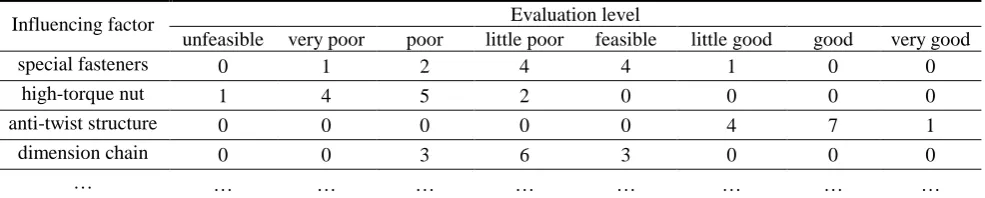
[image:6.595.53.546.208.307.2]Take the assemblability evaluation of an engine rotor for example. The assemblability evaluation process based on the assembly data is a brief description in following. The judge experts totaled 12 people, and Table 2 shows the number of experts selecting different assemblability evaluation for part of a sub-model.
Table 2. Number of experts for engine rotor (part).
Influencing factor Evaluation level
unfeasible very poor poor little poor feasible little good good very good
special fasteners 0 1 2 4 4 1 0 0
high-torque nut 1 4 5 2 0 0 0 0
anti-twist structure 0 0 0 0 0 4 7 1
dimension chain 0 0 3 6 3 0 0 0
… … … …
Thereby, an evaluation result matrix for the assembly connection data sub-model can be obtained, as in equation (11).
3
0 2 6 16 20 6 0 0
1 8 15 8 0 0 0 0
0 0 0 0 0 24 49 8
0 0 9 24 15 0 0 0 FE
(11) Average and round the assembly connection evaluation according to equation (4), as in equation (12).
3 4,3, 7, 4
AFE ,
(12) So, the assembly performance evaluation results of the special fasteners, the high torque nut, the tightness assembly, and the axial dimension chain in the rotor structure are as follows, “feasible”, “little poor”, “good” and “feasible”. The matrix NEi can be obtained by evaluating other assembly data sub-models with above method and assigning weight set A. Associating five sub-models, defining the weight set B, can obtain the comprehensive evaluation value E. Correspondingly, a comprehensive evaluation of the assemblability of the rotor can be obtained by rounding E.
The above evaluation process has been evaluated at two levels: Single factor evaluation and comprehensive evaluation, which are conducive to giving feedback on product design. If the comprehensive evaluation result is not good, the single factor evaluation result can be further analyzed, and then the specific product structure improvement design proposal is proposed. At the same time, in order to avoid the negative impact on other design aspects due to some aspects of design improvement, the assemblability evaluation of the improved product structure is required.
Conclusion
preliminarily applied in the actual work, which proved that the method has good engineering guidance value.
References
[1] Kashiyama Kazuo, Takada Tomosato, Miyachi Hideo, Large Scale Finite Element Modeling Simulation and Visualization for Wind Flows in Urban Area Using Virtual Reality, J. Tsinghua Science and Technology. S1(2008) 84-89.
[2] S Jonathan, Litt, Autonomous Propulsion System Technology Being Developed to Optimize Engine Performance Throughout the Lifecycle. NASA Glenn's Research & Technology reports, 2004, 216-433-3748.
[3] J.V. Carnhan, DL. Thurston, T. Liu, Fuzzing ratings for multi-attribute design decision-making, J. Journal of Mechanical Design. 11(1994) 511~521