Open Access
Research article
Lower back pain in physically demanding college academic
programs: a questionnaire based study
Graham Brennan, Amir Shafat*, Ciarán Mac Donncha and Carmel Vekins
Address: Department of Physical Education and Sports Sciences, University of Limerick, Limerick, Ireland
Email: Graham Brennan - [email protected]; Amir Shafat* - [email protected]; Ciarán Mac Donncha - [email protected]; Carmel Vekins - [email protected]
* Corresponding author
Abstract
Background: Lower back pain (LBP) is ranked first as a cause of disability and inability to work, and is expected to affect up to 90% of the worlds population at some point in their lifetime. The annual first time incidence of LBP is 5%, and the annual prevalence (i.e. those suffering at time of questioning) is between 15 and 63%. Prospective studies demonstrate that low back problems do not display a six-week spontaneous recovery pattern, as was once believed. The condition is regularly seen to worsen over time, becoming a chronic disorder, influenced by both physical and psychosocial factors.
Methods: The current study assessed the level of LBP amongst students engaged in educational programs that were physically demanding, and its influence on lower back problems. A 1-year retrospective questionnaire consisting of 37 closed, open and multi-choice questions was designed to ascertain self-reported information on the occurrence, cause and type of LBP. Treatment, care seeking and general knowledge regarding LBP were also recorded. Students were enrolled in BSc Equine Science, BSc Physical Education and BSc Sports & Exercise Science degree programs and a total number of 188 valid questionnaires were collected.
Results: The self reported, anthropometrical data for participants in this study are: age 20.9 ± 2.7 yrs; height 171.8 ± 9.3 cm; weight 66.7 ± 10.4 kg; female 64% (n = 120), male 36% (n = 68). The overall self reported prevalence of LBP was 32% (n = 61). Within the LBP population, 77% reported their problem as recurring. Two factors showed significance as having an influence on LBP. They were age (21.6 ± 3.5 yrs, p = 0.005) and hours of personal training physical activity (14.0 ± 8.2 hrs per week, p = 0.02). LBP sufferers also displayed poor management of their condition and an interest in education and treatment of their problem.
Conclusion: The current study revealed high prevalence of LBP consistent with that of the literature, and unveiled a recurrence rate and behavioral habits of sufferers, which are warning signs of a more chronic state to come. Novel data presented here offers strong support for the need for prospective injury tracking, plus educational intervention and treatment aimed at prevention of LBP.
Published: 13 July 2007
BMC Musculoskeletal Disorders 2007, 8:67 doi:10.1186/1471-2474-8-67
Received: 18 December 2006 Accepted: 13 July 2007
This article is available from: http://www.biomedcentral.com/1471-2474/8/67
© 2007 Brennan et al; licensee BioMed Central Ltd.
Background
Lower back pain is ranked first as a cause of disability and inability to work, and expected to affect up to 90% of the worlds population at some point in their lives [1]. Lower back pain is a complex condition, influenced by a number of factors and often a challenge when trying to identify any singular cause or even a single major factor [2]. The annual first time incidence of lower back pain is 5% [1], and the annual prevalence between 15 and 63% (i.e. those suffering at time of questioning) [3,4]. Prospective studies demonstrate that low back problems do not display a six-week spontaneous recovery pattern [5], as was once believed. The condition is regularly seen to worsen over time, becoming a chronic disorder, influenced by both physical and psychosocial factors [6,7].
Cross-sectional data demonstrate that initial onset of lower back pain is expected to occur around the mean age of 30 [8], and peaking in occurrence between the ages of 45 and 60 years [1,8]. However, lower back pain is com-mon in both older and younger adults. Nyland and Grim-mer (2003) stated that an early eGrim-mergence of lower back pain and the increase duration of suffering may go so far as to decrease performance of duties in any physically active vocation, in their case, physiotherapy. Early onset of lower back pain may be even more important in voca-tional training where physical activity is part of the curric-ulum and profession such as physical education teaching [9].
The influence of physical activity in relation to lower back pain has been observed as associative [4,10], non-associa-tive [11] and even protecnon-associa-tive [8,12]. Jacob and colleagues [11] identified the specific factors of high occupational activity (lifting and loading) and low perception of gen-eral health as contributory in a gengen-eral population. Hest-baek et al. noted how the so-called protective effect of a sedentary occupation was lost once physical activity is undertaken [13]. But still no firm associations between physical activity and lower back pain have been made. It is proposed by Adams (2002) [14], that a 'U shaped' curve best describes the correlation between lower back pain and physical activity. Sedentary lifestyles, as well as extremely active lifestyles are associated with increased prevalence while moderate activity seems protective [15]. It is not implied that inactivity causes lower back pain, nor that high activity is a result of lower back pain, but studies have indicated that engaging in higher intensities of phys-ical activity, particularly with a history of lower back pain is associated with lower back pain [9,13,16], or extremity of flexion and/or load in the lumbar region [17,18]. In contrast, once lower back pain has occurred, low activity levels have been associated with prolonging suffering and lengthening time to recovery [8,11,12,19].
Rehabilitation and care seeking habits of the sufferer can be poor and often affected by psychosocial factors [20], financial compensation [3,21] and even a simple lack of knowledge. Educational intervention and reducing wait-ing time before primary examination has resulted in a reduction in financial compensation claims both in Aus-tralia [20] and Ireland [21,22]. This indicates a possible light at the end of the tunnel and that lower back pain can be controlled and the burden lightened physically and financially.
Lower back pain is a heterogeneous condition, which may contribute to variation in reported prevalence. In the absence of 'a gold standard to evaluate low back pain' [23] questionnaires are considered reliable measurement tools [24] for the assessment of this condition.
The current study assessed the level of lower back pain amongst students engaged in educational programs that included a physical activity component, which consti-tuted a quarter of their academic program. The primary objective of the study was to examine the impact of phys-ically demanding academic programs on the occurrence of lower back pain. Additional objectives were to gather baseline statistical data on the current prevalence, state of recovery from the condition (and any other injuries reported), possible causes and type of lower back pain and educational awareness in regards to lower back pain.
Methods
Definition of lower back pain
Lower back pain was defined in this study as an episode of pain or discomfort that interrupted normal daily activities and/or required treatment or consultation in the lower back. Lower back was defined as the region between the twelfth rib and the gluteal folds on the posterior aspect of the trunk [7].
Apparatus
pain. Two open questions were asked: 'What type of activ-ity were you doing?' and 'For your most recent back prob-lem, what did you feel was the actual movement or mechanism that caused the problem?' Finally, the present and desired level of knowledge regarding lower back pain was examined with the questions; 'Do you feel enough back education is received in your program of study?' and 'Would you be interested in attending a back care pro-gram?'
Participant recruitment
After approval by the University of Limerick Research Eth-ics Committee, questionnaires were administered during class time, thus ensuring high questionnaire return.
A random sample of students participated in this study; students were enrolled in BSc Equine Science, BSc Physical Education and BSc Sports & Exercise Science degree grams at the University of Limerick. These academic pro-grams were chosen because a physical activity element represents approximately a quarter of their program of study, and a major interest of this study was the influence of physically demanding college academic programs on lower back pain. Due to the large number of students involved, a fraction of each year was surveyed. This study collected data from at least thirty percent of the students from each academic program, and where total class size was small more students were included (see Table 1). Forty-three questionnaires were collected from a total of 67 students in BSc Equine Science, 70 from a total of 236 BSc Physical Education, and 75 from a total of 159 BSc Sports and Exercise Science students. A total of one hun-dred and ninety questionnaires were administered between November 2003 and January 2004. One hun-dred and eighty eight valid questionnaires were returned representing a response rate of 99%. The questionnaire investigated physical activity habits and injury status over the previous 12-month period.
Analysis
All data were analyzed using SPSS version 12.0 (Chicago, Illinois, USA). Statistical significance was set at p ≤ 0.05. Skewness of the data was used and as indication of nor-mality. The skewness of the quantitative data (height,
weight, age, hours of activity and number of sports partic-ipated in) was calculated by dividing the raw skewness value by the standard error for skewness. The resultant value was interpreted as a Z score, (i.e., values ± 1.96 exceed p ≤ 0.05, and values ± 2.58 exceed p ≤ 0.01). Data were considered normally distributed if the Z value did not exceed ± 2.0 [25]. In the case of normal data non-parametric analysis was used. All data, with the exception of height were found to be non-normal. In the case of nor-mally distributed data, independent sample t-tests were used to examine differences between individuals report-ing with and without low back pain. Mann-Whitney U rank tests were used to examine differences between indi-viduals with and without low back pain on the following variables: age, weight, body mass index, hours of aca-demic program physical activity, hours of personal train-ing physical activity, number of sports participated in within academic program and the number of sports par-ticipated in within personal training. A Pearson's chi-square test was used to examine the association of back pain occurrence with gender and academic program taken. The assumptions for chi-square were met for this comparison. All data are presented as Mean ± SD. The fol-lowing equation ES = (M1 - M2·s-1) was used to determine
effect size; where for example M1 = the mean age of partic-ipants without lower back pain and M2 = the mean age of non-lower back pain participants and s-1 = the pooled
standard deviation [26].
Results
Participant characteristics
The self reported and anthropometrical data for partici-pants in this study are: age 20.9 ± 2.7 yrs; height 171.8 ± 9.3 cm; weight 66.7 ± 10.4 kg; body mass index 22.6 ± 2.7 kgm-2; female 64% (n = 120), male 36% (n = 68).
Prevalence
[image:3.612.59.556.640.734.2]The overall self reported 12-month prevalence of lower back pain was 32% (n = 61). Within the lower back pain population, 77% reported their problem as recurring. Sur-prisingly, 14% of questionnaires contained an unsolicited comment describing their lower back pain problem as constant or ongoing. When compared to all other injuries
Table 1: Total class sizes per year, per academic program at time of investigation and percentage of students participating in the study.
Course Students participating in the study per year of study (% of total) Total
First Second Third Fourth
by type and site, lower back pain was more frequent than sprain at 24% and ankle injuries at 15% respectively.
The factors associated with low back pain
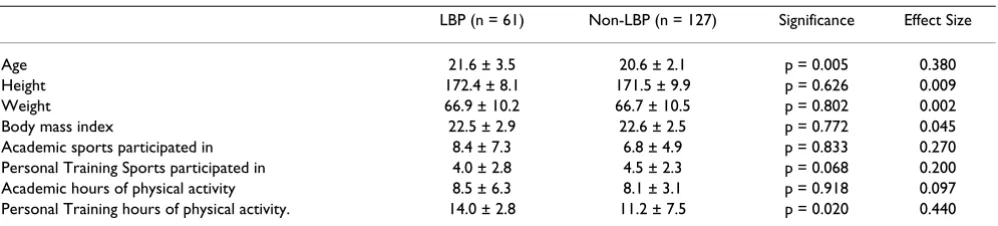
Two factors showed significance as having an association with lower back pain. They were age and hours of per-sonal training physical activity. All other factors investi-gated (height, weight, body mass index, gender, academic program, year of study, hours of academic program phys-ical activity, number of sports participated in within aca-demic program and the number of sports participated in within personal training) were not found to be significant (see Table 2). The mean age of those reporting lower back pain was 21.6 ± 3.5 yrs vs. 20.6 ± 2.1 yrs for non-lower back pain (p = 0.005, see Table 2). The hours of personal training physical activity was 14.0 ± 8.2 hrs per week for lower back pain and 11.2 ± 7.5 hrs per week for non-lower back pain (p = 0.02, see Table 2). Also, students reported hours of academic program physical activity ranging between 8.0 ± 3.1 to 8.4 ± 6.3 hours per week. In answer to the question "how many different sports do you take part in?" responses ranged from 6.8 ± 4.9 to 8.4 ± 7.3 sep-arate sports as part of their academic curriculum and 4.0 ± 2.7 to 4.4 ± 2.3 separate sports as part of their personal training. These factors were similar in lower back pain and non-lower back pain groups.
Activity at time of occurrence and mechanism responsible
Self reported responses to questions regarding the cause of their lower back pain, 25% named a team sport as the activity undertaken when the problem occurred, while 24% named lifting as the contributory action. Other activ-ities included; individual sports (20%), horse riding (14%) and lifting (10%). Other activities reported included contact within sports (16%), strength and fitness training (15%) and falls (10%).
Location and type
With use of the diagram, 39% reported lower back pain in L4–L5, 18% in L1–L3, and 11% reported 'low back/non-specific'. All other regions (sacro-iliac joint, sacrum, coc-cyx, lumbo-sacral joint, posterior superior iliac spine)
ranged between 3 and 9% each. When asked to report what type of back condition they suffered from, either diagnosed or self-assessed, participants gave less definitive answers. Twenty three percent replied 'general back pain', while 'back strain' and 'slipped disc' were equally frequent at 10% each. Other conditions included sharp radiating pain, compressed vertebrae, sciatica, osteoarthritis, back strain, muscle spasm, bruising and fracture of the coccyx, and were reported between 1 and 8% each. Non-respond-ers accounted for the remaining percentage.
Impact and care seeking habits
When asked, "Which health care practitioner did you con-sult?" physiotherapists were the most frequently attended professionals (26%), general practitioner (13%), chiro-practor (8%) and 'other' (10%). Interestingly, 43% reported attending no medical professional for their con-dition. Thirty-six percent of lower back pain sufferers lost between 1 and 31 days due to their condition, while 5% reported more than 6 months absence from physical activity (work, sport, education). 31% lost less than a day due to lower back pain. Non-responders accounted for the remaining percentage.
Only 36% reported the use of coping strategies. The most commonly reported were lower back and core exercises (10%), stretching (5%), whilst 3% reported 'avoidance' as a coping strategy. Ranging between 1% and 5 %, other strategies included correct warm-up, postural corrections, warm baths, massage and rest. A further, seven percent reported taking prescription medication.
[image:4.612.58.557.604.717.2]Of those with lower back pain, 48% reported the condi-tion to be healed but recurrent, 32% were receiving treat-ment but still active in sport, 8% were healed and non-recurrent, 3% were temporarily withdrawn from physical activity and the remainder did not respond to the ques-tion. Looking more specifically at the restrictions imposed by lower back pain, 38% reported a reduction in mobility, 36% reported discomfort from sitting or standing for pro-longed periods and 15% reported difficulty lifting. The remainder did not respond to the question.
Table 2: Measured characteristics of participants with and without lower back pain.
LBP (n = 61) Non-LBP (n = 127) Significance Effect Size
Age 21.6 ± 3.5 20.6 ± 2.1 p = 0.005 0.380
Height 172.4 ± 8.1 171.5 ± 9.9 p = 0.626 0.009 Weight 66.9 ± 10.2 66.7 ± 10.5 p = 0.802 0.002 Body mass index 22.5 ± 2.9 22.6 ± 2.5 p = 0.772 0.045 Academic sports participated in 8.4 ± 7.3 6.8 ± 4.9 p = 0.833 0.270 Personal Training Sports participated in 4.0 ± 2.8 4.5 ± 2.3 p = 0.068 0.200 Academic hours of physical activity 8.5 ± 6.3 8.1 ± 3.1 p = 0.918 0.097 Personal Training hours of physical activity. 14.0 ± 2.8 11.2 ± 7.5 p = 0.020 0.440
Education assessment
When asked if enough information was provided within their program regarding lower back pain, 65% of those suffering from lower back pain answered no. Further, 64% were interested in attending a back clinic.
Discussion
The current study found a 12-month prevalence of 32% and is in general agreement with prevalence rates reported in the literature, which vary from 15% to 63% [3,4]. Nyland and Grimmer (2003)[4] assessed undergraduate physiotherapy students using the Nordic back care ques-tionnaire, and their thorough assessment of lower back pain retrospectively, allowed the investigators to display separately 12 month, one month, one week prevalence. Retrospective studies can produce detailed results, but the prospective approach can further assess change over time and enhance investigations. Palmer et al. [27] prospec-tively revealed 36% prevalence in the general population, which increased to 49% over ten years. The deterioration of lower back pain into a chronic state condition can be examined using a prospective approach, particularly when investigating healing times and impact on the sufferer. This calls into play the usefulness of 'recurrence rates' as a beneficial measurement of the overall impact of lower back pain.
Students in the current study engaged in physical activity, reported a 77% recurrence rate, in agreement with recent literature, which ranges between 60% to 76% [19,28,29]. Recurrence and healing are controversial topics as it has been stated that 90% of lower back pain will resolve itself within one month [1]. However, Croft and colleagues' (1998)[5] prospective work on healing and care seeking showed that although 59% of sufferers did not consult again within six months of injury, only 25% had fully recovered within 12 months. In summary, lower back pain does not spontaneously heal or subside within one month, but persists over a twelve-month period, and the only decline may be in return visits to medical practition-ers.
When asked when the low back pain first occurred, some students made a surprising and unsolicited comment. That was, their lower back pain was 'constant' or 'contin-uous'. This conservatively represented 14% of sufferers and may indicate a chronic state of lower back pain. Chronic lower back pain, seen as a stage in the progressive development from acute to sub-acute and finally chronic, as a result of recurrence [14] has reported rates of 20–30% across a broad range of populations [7,30]. Data pre-sented in the current study may under-represent the actual rate. The mechanisms of change and deterioration to chronic state may be as difficult to assess retrospectively as the initial cause of lower back pain [2]. However,
physi-cally active students in the current study did display behaviors that may be of concern in relation to the devel-opment of chronic lower back pain. These include: 39% never attended a medical practitioner; few reported using a coping strategy ('core body exercises' highest at only 10%), a small but important 6% reported using pre-scribed medication and 3% stated 'avoidance' as a coping strategy. Together, these observations indicate a tendency towards passive coping. Passive coping is strongly associ-ated with disabling neck and back pain [31] and thor-oughly contrary to findings that active rehabilitation (physical or cognitive) is superior to passive coping [32]. In light of these findings the sufferers in the current pop-ulation are likely to be following the path of lower back pain sufferers observed by Croft et al. [5] and Mercado et al. [31]. They may find themselves suffering longer peri-ods of absenteeism and reduced daily functionality. The high prevalence (32%) and high recurrence (77%) suggest that lower back pain in this population is a serious health concern.
Increasing this concern may be the fact that, similar to Nyland and Grimmer [4], the population sampled are undergraduate students, with an average age approxi-mately a decade younger than those observed in the majority of studies on lower back pain.
The literature typically reports the onset of lower back pain at approximately 30 years of age [12] and peaking in prevalence within middle age [8]. Lower back pain suffer-ers in this study, however, were younger at 21.6 years. But lower back pain is not uncommon in younger popula-tions, and has been observed from early teens and onwards [33]. Rates vary throughout adolescence as Prendeville and Dockrell [34] found a high lifetime prev-alence of 42%, in 13 to 17 year olds, while Nyland and Grimmer's [4] reported ages 20 and 21 years. Further, their risk of lower back pain increased after year one of physiotherapy training. These were final year students, indicating an effect of long-term (3 to 4 year college career) exposure to stress and strain on the lower back. No association to year of study was observed in the current population, but the average age of 21.6 years for lower back pain sufferers, does coincide with Nyland and Grim-mer's [4] final year students (21.4 yrs). The onset of lower back pain at this low age brings forward the expected emergence of lower back pain by approximately 9 years. This increase in time exposed to risk factors may also increase wear and tear on the lower back and therefore the risk of injury.
stu-dents following a similarly active academic program. Ster-gioulas et al. [9] reported 63% prevalence amongst physical education teachers, attributing 'no personal training' and occupational factors such as 'lifting gym instruments' and 'helping students into flexing posture' as significant risk factors. The high prevalence of lower back pain in a young and active population is a worrying trend, especially in light of similarities in age to other lower back pain studies on active populations. The physical activity type associated with lower back pain warrants further investigation and the logical progression for the current study is an examination of physical activity in a number of different forms, to establish links between lower back pain and activity.
Findings in the literature vary regarding the impact of activity and exercise, but studies on elite athletes and sports involving hyper-flexion and extension have reported higher prevalence of lower back pain [10]. Links have also been found between occupational activities (lifting and loading) and lower back pain [11,13]. Adams
et al. [14] proposed a U-shaped association with lower back pain. A simple association between low activity lev-els and lower back pain may be an inappropriate claim, as lower back pain may be more an effect than a cause of sed-entary lifestyle. Athletes, however, have suffered lower back pain due to long duration of training [9,13,16], or extremity of flexion and/or load in the lumbar region [17]. In the current study, 'hours of physical activity in personal training' was the only factor significantly associ-ated with lower back pain, and those reporting lower back pain carried out an average of 14.0 ± 8.2 hrs per week, while non-sufferers completed 11.2 ± 7.5 hrs per week of personal training.
Key significance is the fact that personal training is one of a number of activity types participated in by the students. Initially considerations included investigating if a thresh-old for lower back pain exists somewhere between 11 and 14 hours of personal training. But lower back pain is a multi-factorial condition [35], and can be initiated by combined influence of genetics, environment and expo-sure to risk factors. The conclusion therefore is that we may simply be observing a culmination of factors with perhaps several factors combining to cause lower back pain. Details regarding other physical activity in the cur-rent study are as follows: students reported hours of aca-demic program physical activity ranging between 8.0 ± 3.1 to 8.4 ± 6.3 hours per week, in answer to the question "how many different sports do you take part in?" responses ranged from 6.8 ± 4.9 to 8.4 ± 7.3 separate sports as part of their academic curriculum and 4.0 ± 2.7 to 4.4 ± 2.3 separate sports as part of their personal train-ing. This may be contributing to an excessive strain on the lower back. We are reluctant to accept a reduction in
per-sonal training hours as a way to alleviate lower back health, because of other health implications of such inter-pretation, the self reported nature of current data, and the need for further clarification of the physical activity in this population.
As stated, the current study was retrospective, but Verni et al.'s [16] prospective work with fin swimmers, enabled the authors to identify the peak occurrences for lower back pain through injury tracking. This established the time of year most associated with lower back pain and concluded that poor fitness and technique early in the season, and exhaustion late in the season were contributory factors. This further supports both a prospective approach and a U-shaped association with activity, and indicates a multi-factorial assessment of cause in lower back pain.
A number of recent studies have investigated physiother-apy versus education intervention, and shown that educa-tion, even alone, may aid the sufferer as much as physiotherapy. Alston and O'Sullivan [21], Frost et al. [36] and Uderman et al. [37] all showed education interven-tion was as, and even more effective than physiotherapy alone in improving pain management and pain resolu-tion. When undergraduates in the current study were asked if they 'received enough information regarding lower back pain on their academic program of study', a majority expressed the opinion that not enough lower back pain information was provided. Equally, interest in a back education program was strongly expressed as 'yes' when asked if they would attend a back clinic. The infor-mation requested included 'proper lifting techniques' and 'background information on prevention of lower back pain'.
Conclusion
The current study revealed high prevalence of lower back pain consistent with that of the literature, and unveiled a recurrence rate and behavioral habits of sufferers, which are warning signs of a more chronic state to come. In this study, the condition was more prevalent than all other injuries, and had two main factors associated with it, age and hours of personal training physical activity. Associa-tive factors vary across studies. Age as a significant factor is of great concern in this young population entering the workforce and en route to a greater exposure to risk fac-tors. Personal training may only be the tip of the iceberg as regards the accumulation of stress and strain on the lower back. Without quantifiable and structured assess-ment, tracking and educational intervention, this condi-tion may not resolve itself, but become more prevalent and indeed more chronic amongst sufferers. Novel data presented here offers strong support for the need for pro-spective injury tracking, plus educational intervention and treatment aimed at prevention of lower back pain.
Limitations
Limitations in this study restrict our data to self-reported information. Also, the study is not prospective in nature. The study population does not reflect a more 'general' population due to the limited mean age and narrow age range, and the study population is a group of university students rather than a 'normal' population.
Competing interests
The author(s) declare that they have no competing inter-ests.
Authors' contributions
CV and GB designed the study. AS, CMD and GB analyzed and interpreted the data. All authors read and approved the final manuscript.
References
1. Ehrlich GE: Low back pain. Bull World Health Organ 2003,
81:671-676.
2. Deyo RA: Diagnostic evaluation of LBP: reaching a specific diagnosis is often impossible. Arch Intern Med 2002,
162:1444-1447. discussion 1447–1448
3. Andersson G: Epidemiological features of chronic low-back pain. The Lancet 1999, 354:581-585.
4. Nyland LJ, Grimmer KA: Is undergraduate physiotherapy study a risk factor for low back pain? A prevalence study of LBP in physiotherapy students. BMC Musculoskelet Disord 2003, 4:22. 5. Croft PR, Macfarlane GJ, Papageorgiou AC, Thomas E, Silman AJ:
Outcome of low back pain in general practice: a prospective study. BMJ 1998, 316:1356-1359.
6. Koleck M, Mazaux JM, Rascle N, Bruchon-Schweitzer M: Psycho-social factors and coping strategies as predictors of chronic evolution and quality of life in patients with low back pain: a prospective study. Eur J Pain 2006, 10:1-11.
7. Thomas E, Silman AJ, Croft PR, Papageorgiou AC, Jayson MI, Macfar-lane GJ: Predicting who develops chronic low back pain in pri-mary care: a prospective study. BMJ 1999, 318:1662-1667. 8. Bratton RL: Assessment and management of acute low back
pain. Am Fam Physician 1999, 60:2299-2308.
9. Stergioulas A, Filippou DK, Triga A, Grigoriadis E, Shipkov CD: Low back pain in physical education teachers. Folia Med (Plovdiv)
2004, 46:51-55.
10. Novy DM, Simmonds MJ, Olson SL, Lee CE, Jones SC: Physical per-formance: differences in men and women with and without low back pain. Arch Phys Med Rehabil 1999, 80:195-198.
11. Jacob T, Baras M, Zeev A, Epstein L: Physical activities and low back pain: a community-based study. Med Sci Sports Exerc 2004,
36:9-15.
12. Lei L, Dempsey P, Xu J, Ge L, Liang Y: Risk factors for the preva-lence of musculoskeletal disorders among Chinese foundry workers. Indust journ of indusl ergonom 2004, 35:197-204. 13. Hestbaek L, Larsen K, Weidick F, Leboeuf-Yde C: Low back pain in
military recruits in relation to social background and previ-ous low back pain. A cross-sectional and prospective obser-vational survey. BMC Musculoskelet Disord 2005, 6:25.
14. Adams M, Bogduk N, Burton K, Dolan P: The Biomechanics Of Back Pain London: Churchill Livingstone; 2002:82-88.
15. Rainville J, Hartigan C, Martinez E, Limke J, Jouve C, Finno M: Exer-cise as a treatment for chronic low back pain. Spine J 2004,
4:106-115.
16. Verni E, Prosperi L, Lucaccini C, Fedele L, Beluzzi R, Lubich T: Lum-bar pain and fin swimming. J Sports Med Phys Fitness 1999,
39:61-65.
17. Hutchinson MR: Low back pain in elite rhythmic gymnasts.
Med Sci Sports Exerc 1999, 31:1686-1688.
18. Gagnon M: Box tilt and knee motions in manual lifting: two differential factors in expert and novice workers. Clin Biomech
1997, 12:419-428.
19. Verbunt JA, Sieben JM, Seelen HA, Vlaeyen JW, Bousema EJ, van der Heijden GJ, Knottnerus JA: Decline in physical activity, disability and pain-related fear in sub-acute low back pain. Eur J Pain
2005, 9:417-425.
20. Walker B, Muller R, Grant W: Low back pain in Australian adults. Health provider utilization and care seeking. Journ of manip and physio therapeu 2004, 27:327-335.
21. Alston S, O'Sullivan T: Patient education in physiotherapy of low back pain: acute outcomes of group instruction. Irish journ med sci 2005, 174(3):64-69.
22. Wall M: Back pain initiative reduced numbers . 2004:29 September. 23. Calmels P, Bethoux F, Condemine A, Fayolle-Minon : Low back pain
disability assessment tools. Annales de readaptation et de medecine physique 2005, 48:288-297.
24. Jacob T, Baras M, Zeev A, Epstein L: Low back pain: reliability of a set of pain measurement tools. Arch Phys Med Rehabil 2001,
82:735-742.
25. Vincent WJ: Statistics in Kinesiology Champaign: Human Kinetics; 2005:83.
26. Thomas JR, Nelson JK: Research methods in physical activity 4th edition. Champaign: Human Kinetics; 2001.
27. Palmer KT, Walsh K, Bendall H, Cooper C, Coggon D: Back pain in Britain: comparison of two prevalence surveys at an interval of 10 years. BMJ 2000, 320:1577-1578.
28. Kent PM, Keating JL: The epidemiology of low back pain in pri-mary care. Chiropr Osteopat 2005, 13:13.
29. Pengel LH, Herbert RD, Maher CG, Refshauge KM: Acute low back pain: systematic review of its prognosis. BMJ 2003, 327:323. 30. Susan H, Picavet HS, Schouten JS: Physical load in daily life and
low back problems in the general population-The MORGEN study. Prev Med 2000, 31:506-512.
31. Mercado AC, Carroll LJ, Cassidy JD, Cote P: Passive coping is a risk factor for disabling neck or low back pain. Pain 2005,
117:51-57.
32. Smeets RJ, Vlaeyen JW, Hidding A, Kester AD, van der Heijden GJ, van Geel AC, Knottnerus JA: Active rehabilitation for chronic low back pain: Cognitive-behavioral, physical, or both? First direct post-treatment results from a randomized controlled trial [ISRCTN22714229]. BMC Musculoskelet Disord 2006, 7:5. 33. Hakala P, Rimpela A, Salminen JJ, Virtanen SM, Rimpela M: Back,
neck, and shoulder pain in Finnish adolescents: national cross sectional surveys. BMJ 2002, 325:743.
34. Prendeville K, Dockrell S: A pilot study to investigate the inci-dence of low back pain in school children. Physiotherapy Ireland
1998, 19:3-7.
Publish with BioMed Central and every scientist can read your work free of charge "BioMed Central will be the most significant development for disseminating the results of biomedical researc h in our lifetime."
Sir Paul Nurse, Cancer Research UK
Your research papers will be:
available free of charge to the entire biomedical community
peer reviewed and published immediately upon acceptance
cited in PubMed and archived on PubMed Central
yours — you keep the copyright
Submit your manuscript here:
http://www.biomedcentral.com/info/publishing_adv.asp
BioMedcentral 36. Frost H, Lamb SE, Doll HA, Carver PT, Stewart-Brown S:
Ran-domised controlled trial of physiotherapy compared with advice for low back pain. BMJ 2004, 329:708-714.
37. Udermann BE, Spratt KF, Donelson RG, Mayer J, Graves JE, Tillotson J: Can a patient educational book change behavior and reduce pain in chronic low back pain patients? Spine J 2004,
4:425-435.
38. Buchbinder R, Jolley D, Wyatt M: Population based intervention to change back pain beliefs and disability: three part evalua-tion. BMJ 2001, 322:1516-1520.
39. Clairborne N, Vandenburgh H, Millard-Kraus T, Leung P: Measuring quality of life changes in individuals with chronic low back conditions: a back education program evaluation. Eval and prog plan 2001, 25:61-70.
Pre-publication history
The pre-publication history for this paper can be accessed here: