2018 International Conference on Communication, Network and Artificial Intelligence (CNAI 2018) ISBN: 978-1-60595-065-5
A Finite Set Recognition Algorithm of LDPC Coding by
Using Soft Decision Sequence
Lu-wei LUO
*, Ying-ke LEI, Ding-li CHU and Xi-chang LIAO
School of Electronic Countermeasure, National University of Defense Technology, Hefei Anhui of China
*Corresponding author
Keywords: LDPC code, Finite Set Recognition, Check log-likelihood ratio.
Abstract. Aiming at Finite set identification problem of the channel encoding of LDPC code identification system, a novel coding identification algorithm for LDPC Codes using Soft decision sequence is proposed in this paper. The algorithm will introduce the relation of encoding check log-likelihood ratio(CLLR) to receive soft decision sequence. By analyzing statistical characteristics of CLLR, an identification algorithm using the MMSR decision will be proposed and then LDPC closed set identification will be completed. The algorithm comprehensively uses the statistical characteristics of the mean and variance of the data, and effectively avoids the defects of the traditional algorithm, when the identification effect is not ideal ,under the low signal to noise ratio(SNR). From the simulation results, the algorithm is significantly better than the existing algorithm under the closed set application mode of a priori coded set, and the identification gain can reach 2 dB to 5dB in low SNR environment. Moreover, for the identification of high bit rate LDPC code, the identification effect of this algorithm is obviously better than the existing algorithm.
Introduction
In recent years, channel coding and identification analysis has become a new research direction in the field of non-cooperative signal processing. It has been widely applied in intelligent communication, information interception and information countermeasure field. In the future intelligent mobile communication and multipoint broadcast communication, adaptive modulation and coding technology will be widely used. With the change of channel quality, the channel coding mode will be changed at any time, so as to achieve the best communication efficiency and service quality. But in reality, due to the time delay and transmission in the process of interruption, the relevant control information may not be on time or properly transmitted to the receiver, resulting that communication can't be established ,which requires the receiver only according to the received data to identify the unknown system parameters, channel encoding, to achieve intelligent communication especially with the development of cognitive radio to cognitive and communication, identification and analysis of channel encoding will become one of the main functions of intelligent communication system in the future. In all kinds of channel coding methods, LDPC codes have become the preferred channel for many next generation communication systems with their excellent performance, which urgently demands for the research of LDPC code identification algorithm.
performance of the algorithm is simulated. The simulation results show that the closed set application mode, the algorithm can effectively identify the LDPC code, and in low SNR environment can still get a good identification effect. Especially, in the problem of high bit rate LDPC code identification performance, the performance of this algorithm is obviously superior to the algorithm in[6]
LDPC Code Coding Identification Model
Aiming at the identification problem of LDPC coding in this paper, it is assumed that the modulation mode is fixed as BPSK. The set of M LDPC code patterns in closed space set is { x| 1, 2, , }
x M
, in
which each pattern and the check matrix form a one-to-one mapping relation, and the check matrix corresponding to the x type LDPC code is x
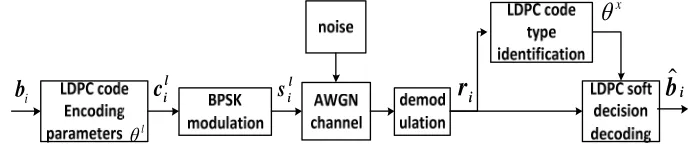
H and the size is mxnx. The basic communication model for identifying problems can be represented by Figure 1:
l
i
b
c
ill i
s
r
ix
i
b
[image:2.612.131.479.241.316.2]
Figure 1. Identification model of the basic communication.
At the sending end, the sender encodes the sending information sequence
T
,0 , , 1
( , , , , )
i i i j i k
b b b b with length k by using l type LDPC code encoding, where
, GF(2) i j
b , we denote Galois Field of 2 power and i denotes the i times information sequence. Coded code sequence = ( ,0, , , , l )T
l l l l
i ci ci, j ci,n -1
c , its code sequence code length l
n . After cil is mapped
according to BPSK, the baseband sequence ( ,1, , , , l1)T
l l l l
i i, j i,n
-s s s
s , l { 1,1}
i, j
s is obtained. Finally, the signal is sent to the AWGN channel with noise power of 2 for transmission.
At the receiving end, the receiver first demodulates the signal and then performs a sampling process to obtain a soft decision sequence, Denoted as, T
,1 1
( , , , , l )
l
i i, j i,n
-r r r
r , where ri, jR, R represents the real number field. Finally, the receiver performs LDPC decoding on the soft-decision sequence. The problem to be studied in this paper is that we identify the coding type l of LDPC
codes in set by analyzing the characteristics of soft decision sequences ri under different
parameters, which provides the conditions for the following LDPC decoding.
An LDPC Code Encoding Identification Algorithm
Note that the vector = ( , , , , x 1)
x x x x
v v,0 v, j v,n
h h h h is the vector of line v in x
H and mxs is the number of lines in x
H ,x. If and only if xl, that is, the correct choice of parameters, for any b, is the correct choice of parameters, for any x
v
h , there is always the following relationship between the codewords l
i
c and hvx:
,
,
: 1
0
x v t
x l l
v i i t
t h
h
c c (1)
For the problem model in this paper, the receiver gets a sequence of real numbers. Therefore, we first define the posterior log-likelihood ratio for the value of k:
, ,
, ,
, ,
Pr( 0 | ) ( | ) ln
Pr( 1| )
l
i j i j
l
i j i j l
i j i j
r L r r c c
c (2)
By Bayes theory, Eq. (2) can be made as follows:
, , , , ,
( l | ) ( | l ) ( l )
i j i j i j i j i j
L c r L r c L c (3) For the prior log-likelihood ratio in Eq.(2), the probabilities of 0 and 1 in codeword l
i
c are usually
equal for any channel coding. and so:
, ,
,
Pr( 0)
( ) ln 0
Pr( 1)
l i j l
i j l
i j
L
c c
c (4)
Therefore, equation (3) is equivalent to ( , | , ) ( , | , )
l l
i j i j i j i j
L c r L r c .In the AWGN channel model shown in Figure 1, the likelihood LLR corresponding to BPSK modulation holds as follows:
2 2
, , ,
2 2 2
, , , , , ,
( 1
( | ) ln Pr( | 0) ln Pr( | 0)
l 1 exp ) 1 exp ( 1) 2
2 2
2 2
n ln
l l l
i j i j i j i j i j i
i j
j
i j i j
L r r
r r r
r
c c c
(5)
Next define the log-likelihood ratio (Check LLR, denoted as CLLR). Under the condition of receiving the soft decision sequence ri, the CLLR of the check relationship
x l v i
h c is denoted as , x i v , , , : 1 ( | ) | x v t
x x l l
i v v i i i t i,t
t h
L h r L r
c c (6)
N indicates the number of check vectors in parity check matrix x
H . The two parameters 1 x
and2 x
that define x v
are as follows:
1 , 1 1 N x x i v v N
, 2
, 1
21
1 N
x x x
i v v
N
Where 1 x denotes the mean of elements in , x i v
, and 2 x
denotes the degree of deviation of elements in , x i v
from 1 x
. Define the mean square ratio x:
, , 1 1 1 2 2 2, 1 , 1
1 1
1
1
N N
x x
x i v i v
x v v
N N
x
x x x x
i v i v
v v N N
(7)According to Eqs.(1) and (7), it can be found that whenxl, since cil and the check vectors Hx
satisfy the checking relation, x l 0
v i
h c always holds and hence1x 0. According to Eqs. (9), x 1
be established.
When xl there is no constraint between the codewords cil and x v
h , and the value of , x i v
is positive and negative. Therefore, in the x
i
elements in the mean, the x i
positive and negative elements offset each other, there should be x 1.
Define the MMSR decision-maker as:
arg max x x i
In order to improve the efficiency of the identification algorithm, we can use the partial verification vector in x
H to define the mean square. The x( )p of the definition of the first p(1 p N) rows of check vectors in the check matrix Hx is defined as:
, 1 1
2 2
, 1
1
( ) ( )
( ) ( )
N x
x i v
x v
N x
x x
i v v
p p
p
p
(9)Among them 1 , 1
( ) 1
p
x x
i v v
p p
It can be seen that formula pN is established when thespecial circumstances. From Eq. (12), we can see that the performance improvement of the maximum mean square ratio estimator is at the cost of partial computational complexity compared to the maximum mean value arbiter. However, this computational complexity is acceptable. Considering both identification performance and computational complexity, the MMSER estimator finds a good balance between the two.
Simulation Analysis
Through the above analysis and discussion, the Matlab software is used in this section to simulate the experiment. Through 1000 Monte Carlo experiments, this paper analyzes the feasibility of the algorithm, the identification performance of the RMS algorithm and the comparative experimental analysis of the algorithm, which verify the performance of the algorithm. When simulating, we use the LDPC code in IEEE802.11n protocol and the coding algorithm in reference [7] to encode the channel information sequence. In the IEEE802.11n protocol, the coding parameters used for the LDPC code are: code length n = 648, 1296 and 1944, code rate R = 1/2,2/3,3/4 and 5/6.
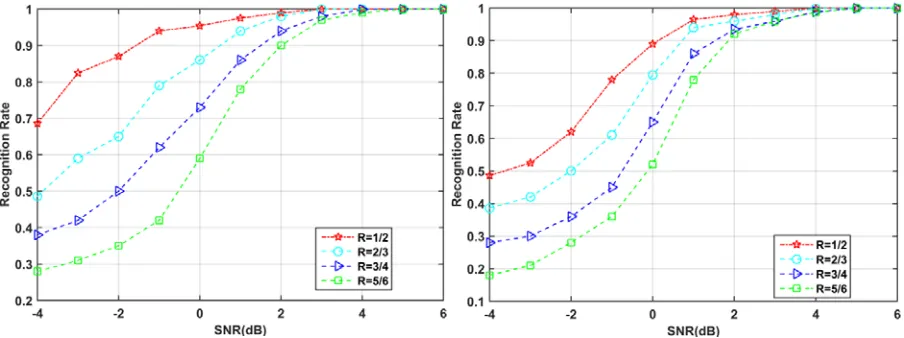
[image:4.612.81.533.476.645.2]On the Mean Square ratio judger identification performance, the coding scheme set is an LDPC code with a code length of 648 and 1944 respectively at four code rates. It is show the changes of the identification accuracy of maximum MSR estimator with SNR when the LDPC codes with SNR range of -4dB to 6dB and code length of 648 and 1944 respectively in Figure 2 and Figure 3.
Figure 2. When code length is 648, the identification
rate of four kinds of code rates changes curve. Figure 3. When code length is 1944, identification rate of the four kinds of code rates changes curve.
identification accuracy of the algorithm. As can be seen from the comparison of FIG. (2)and FIG. (3), when using the MSR decision device for identification, it has better identification performance both for a LDPC code with a lower code length and a LDPC code with a higher code length.
Acknowledgement
This research was financially supported by the National Science Foundation.
References
[1] Bao X., Zhou L.K., He K. Reconstruction of LDPC code sparse parity check matrix [J]. Journal of the University of Electronic Science and technology, 2016, 45 (2): 191-196.
[2] Sala F., Schoeny C., Kabir S., et al. On Nonuniform Noisy Decoding for LDPC Codes with Application to Radiation-Induced Errors [J]. IEEE Transactions on Communications, 2017, PP(99): 1-1.
[3] Liu J., Li J., Yu P.D. An iterative Turbo in code interleaver estimation method [J]. Journal of China Institute of communications, 2015, 36 (6): 201-206.
[4] Kuo Y.H., Ceng W.T., Chen J. A blind identification method based on the probability approximation of the original BCH code coding parameters [J]. Journal of electronic and information, 2014, second: 332-339.
[5] Jung J., Park I.C. Multi-Bit Flipping Decoding of LDPC Codes for NAND Storage Systems [J]. IEEE Communications Letters, 2017, PP(99):.1-1.
[6] Jie H. ,Wang F.H., Huang Z.T. Fast blind identification algorithm of convolutional codes based on improved Euclidean algorithm [J]. Journal of National University of Defense Technology, 2012, 06 (6): 158-162.
[7] Xia T., Wu H.C. Blind Identification of Nonbinary LDPC Codes Using Average LLR of Syndrome a Posteriori Probability [J]. IEEE Communications Society, 2016(7): 1301-1304.