Journal of Inequalities and Applications Volume 2011, Article ID 839679,24pages doi:10.1155/2011/839679
Research Article
Tightly Proper Efficiency in Vector Optimization
with Nearly Cone-Subconvexlike Set-Valued Maps
Y. D. Xu and S. J. Li
College of Mathematics and Statistics, Chongqing University, Chongqing 401331, China
Correspondence should be addressed to Y. D. Xu,[email protected]
Received 26 September 2010; Revised 17 December 2010; Accepted 7 January 2011
Academic Editor: Kok Teo
Copyrightq2011 Y. D. Xu and S. J. Li. This is an open access article distributed under the Creative Commons Attribution License, which permits unrestricted use, distribution, and reproduction in any medium, provided the original work is properly cited.
A scalarization theorem and two Lagrange multiplier theorems are established for tightly proper efficiency in vector optimization involving nearly cone-subconvexlike set-valued maps. A dual is proposed, and some duality results are obtained in terms of tightly properly efficient solutions. A new type of saddle point, which is called tightly proper saddle point of an appropriate set-valued Lagrange map, is introduced and is used to characterize tightly proper efficiency.
1. Introduction
One important problem in vector optimization is to find efficient points of a set. As observed by Kuhn, Tucker and later by Geoffrion, some efficient points exhibit certain abnormal properties. To eliminate such abnormal efficient points, there are many papers to introduce various concepts of proper efficiency; see 1–8. Particularly, Zaffaroni 9 introduced the concept of tightly proper efficiency and used a special scalar function to characterize the tightly proper efficiency, and obtained some properties of tightly proper efficiency. Zheng10
extended the concept of superefficiency from normed spaces to locally convex topological vector spaces. Guerraggio et al.11 and Liu and Song 12 made a survey on a number of definitions of proper efficiency and discussed the relationships among these efficiencies, respectively.
Recently, several authors have turned their interests to vector optimization of set-valued maps, for instance, see13–18. Gong 19discussed set-valued constrained vector optimization problems under the constraint ordering cone with empty interior. Sach 20
and Lagrange mulitplier theorems for set-valued vector optimization problem under cone-subconvexlikeness. Mehra 22, Xia and Qiu 23 discussed the superefficiency in vector optimization problem involving nearly convexlike set-valued maps, nearly cone-subconvexlike set-valued maps, respectively. For other results for proper efficiencies in optimization problems with generalized convexity and generalized constraints, we refer to
24–26and the references therein.
In this paper, inspired by10,21–23, we extend the concept of tight properness from normed linear spaces to locally convex topological vector spaces, and study tightly proper efficiency for vector optimization problem involving nearly cone-subconvexlike set-valued maps and with nonempty interior of constraint cone in the framework of locally convex topological vector spaces.
The paper is organized as follows. Some concepts about tightly proper efficiency, superefficiency and strict efficiency are introduced and a lemma is given in Section 2. In
Section 3, the relationships among the concepts of tightly proper efficiency, strict efficiency and superefficiency in local convex topological vector spaces are clarified. InSection 4, the concept of tightly proper efficiency for set-valued vector optimization problem is introduced and a scalarization theorem for tightly proper efficiency in vector optimization problems involving nearly cone-subconvexlike set-valued maps is obtained. InSection 5, we establish two Lagrange multiplier theorems which show that tightly properly efficient solution of the constrained vector optimization problem is equivalent to tightly properly efficient solution of an appropriate unconstrained vector optimization problem. InSection 6, some results on tightly proper duality are given. Finally, a new concept of tightly proper saddle point for set-valued Lagrangian map is introduced and is then utilized to characterize tightly proper efficiency inSection 7.Section 8contains some remarks and conclusions.
2. Preliminaries
Throughout this paper, letXbe a linear space,Y andZbe two real locally convex topological spacesin brief, LCTS, with topological dual spacesY∗andZ∗, respectively. For a setA⊂Y, clA, intA,∂A, andAcdenote the closure, the interior, the boundary, and the complement of
A, respectively. Moreover, byBwe denote the closed unit ball ofY. A setC⊂Yis said to be a cone ifλc∈Cfor anyc∈Candλ≥0. A coneCis said to be convex ifCC⊂C, and it is said to be pointed ifC∩−C {0}. The generated cone ofCis defined by
coneC: {λc|λ≥0, c∈C}. 2.1
The dual cone ofCis defined as
C: ϕ∈Y∗|ϕc≥0, ∀c∈C 2.2
and the quasi-interior ofCis the set
Ci: ϕ∈Y∗|ϕc>0, ∀c∈C\ {0Y}
Recall that a base of a coneCis a convex subset ofCsuch that
0Y ∈/clB, C coneB. 2.4
Of course,Cis pointed wheneverChas a base. Furthermore, ifCis a nonempty closed convex pointed cone inY, thenCi/∅if and only ifChas a base.
Also, in this paper, we assume that, unless indicated otherwise,C⊂YandD⊂Zare pointed closed convex cones with intC /∅and intD /∅, respectively.
Definition 2.1see27. LetΘbe a base ofC. Define
Θst: ϕ∈Y∗:∃t >0 such thatϕθ≥t, ∀θ∈Θ. 2.5
Cheng and Fu in27discussed the propositions ofΘst, and the following remark also gives some propositions ofΘst.
Remark 2.2 see 27. i Let ϕ ∈ Y∗ \ {0Y∗}. Then ϕ ∈ Θst if and only if there exists a
neighborhoodUof 0Y such thatϕU−Θ<≤0. iiIfΘis a bounded base ofC, thenΘst Ci.
Definition 2.3. A pointy∈S⊂Yis said to be efficient with respect toCdenotedy∈ES, C
if
S−y∩ −C {0Y}. 2.6
Remark 2.4see28. IfCis a closed convex pointed cone and 0Y ∈ H ⊂C, thenES, C
ESH, C.
In 10, Zheng generalized two kinds of proper efficiency, namely, Henig proper efficiency and superefficiency, from normed linear spaces to LCTS. And Fu8generalized a kind of proper efficiency, namely strict efficiency, from normed linear spaces to LCTS. LetC
be an ordering cone with a baseΘ. Then 0Y ∈/clΘ, by the Hahn Banach separation theorem, there are afΘ∈Y∗and anα >0 such that
α inffΘθ|θ∈Θ. 2.7
LetUΘ {y∈Y :|fΘy|< α/2}. ThenUΘis a neighborhood of 0Y and
inffΘy:y∈Θ UΘ≥ α
2. 2.8
Definition 2.5see8. Suppose thatSis a subset ofYandBCdenotes the family of all bases ofC.yis said to be a strictly efficient point with respect toΘ∈BC, written asy∈STES,Θ, if there is a convex neighborhoodUof 0Y such that
cl coneS−y∩U−Θ ∅. 2.9
yis said to be a strictly efficient point with respect toC, written as,y∈STES, Cif
y∈
Θ∈BC
STES,Θ. 2.10
Remark 2.6. Since U−Θ is open in Y, thus cl coneS−y∩U−Θ ∅ is equivalent to coneS−y∩U−Θ ∅.
Definition 2.7. The pointy∈S⊂Yis called tightly properly efficient with respect toΘ∈BC denotedy∈TPES,Θif there exists a convex coneK⊂Y withC\ {0Y} ⊂intKsatisfying S−y∩ −K {0Y}and there exists a neighborhoodUof 0Y such that
−Kc∩U−Θ ∅. 2.11
yis said to be a tightly properly efficient point with respect toC, written as,y∈TPES, Cif
y∈
Θ∈BC
TPES,Θ. 2.12
Now, we give the following example to illustrateDefinition 2.7.
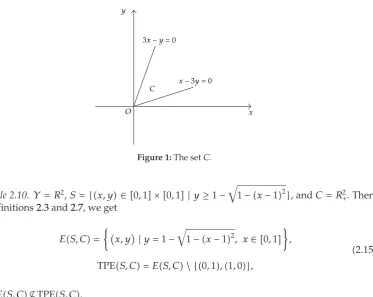
Example 2.8. LetY R2,S {x, y ∈ Y | −x≤ y ≤ 1 andx ≤ 1}. GivenCseeFigure 1.
Thus, it follows from the direct computation andDefinition 2.7that
TPES, C x, y|y −x, −1≤x≤1. 2.13
Remark 2.9. By Definitions2.7and2.3, it is easy to verify that
TPES, C⊆ES, C, 2.14
y
x O
C 3x−y=0
[image:5.600.125.499.92.389.2]x−3y=0
Figure 1:The setC.
Example 2.10. Y R2,S {x, y∈0,1×0,1|y ≥1−
1−x−12}, andC R2. Then, by Definitions2.3and2.7, we get
ES, C x, y|y 1−
1−x−12, x∈0,1 ,
TPES, C ES, C\ {0,1,1,0},
2.15
thus,ES, C/⊆TPES, C.
Definition 2.11see10. y∈Sis called a superefficient point of a subsetSofY with respect to ordering cone C, written asy ∈ SES, C, if, for each neighborhood V of 0Y, there is neighborhoodUof 0Y such that
cl coneS−y∩U−C⊂V. 2.16
Definition 2.12 see 29, 30. A set-valued map F : X → 2Y is said to be nearly C -subconvexlike onXif cl coneFX Cis convex.
Given the two set-valued mapsF:X → 2Y,G:X → 2Z, let
Hx Fx, Gx, x∈X. 2.17
The product F × G is called nearly C × D-subconvexlike on X if H is nearly C × D -subconvexlike onX. Let LZ, Ybe the space of continuous linear operators from Z toY, and let
LZ, Y {T∈LZ, Y:TD⊂C}. 2.18
Denote byF, Gthe set-valued map fromXtoY×Zdefined by
Ifϕ∈Y∗,T ∈LZ, Y, we also defineϕF:X → 2RandFTG:X → 2Y by
ϕFx ϕFx, FTGx Fx TGx, 2.20
respectively.
Lemma 2.13see23. IfF, Gis nearlyC×D-subconvexlike onX, then:
ifor eachϕ∈C\ {0Y∗},ϕF, Gis nearlyR×D-subconvexlike onX; iifor eachT ∈LZ, Y,FTGis nearlyC-subconvexlike onX.
3. Tightly Proper Efficiency, Strict Efficiency, and Superefficiency
In 11, 12, the authors introduced many concepts of proper efficiency tightly proper efficiency exceptfor normed spaces and for topological vector spaces, respectively. Further-more, they discussed the relationships between superefficiency and other proper efficiencies. If we can get the relationship between tightly proper efficiency and superefficiency, then we can get the relationships between tightly proper efficiency and other proper efficiencies. So, in this section, the aim is to get the equivalent relationships between tightly proper efficiency and superefficiency under suitable assumption by virtue of strict efficiency.
Lemma 3.1. IfChas a bounded baseΘ, then
TPES,Θ TPES, C. 3.1
Proof. From the definition of TPES, Cand TPES,Θ, we only need prove that TPES,Θ⊂
TPES,Θfor anyΘ ∈ BC. Indeed, for eachΘ ∈BC, by the separation theorem, there existsf ∈Y∗such that
α inffθ|θ∈Θ>0. 3.2
Hence,f∈Ci. SinceΘis bounded, there existsλ >0 such that
λΘ⊂y∈Y |0< fy< α. 3.3
It is clear thatλΘ∈BCand TPES,Θ TPES, λΘ. If there existsy∈TPES,Θsuch that
y /∈TPES,Θ, then for any convex coneKwithC\ {0Y} ⊂intKsatisfyingS−y∩−K {0Y}and for any neighborhoodUof 0Y such that
−Kc∩U−Θ/∅. 3.4
It implies that there existsy∈Ysuch that
Then there isu ∈ Uandθ ∈ Θsuch thaty u−θ, sinceθ ∈ Θ ∈ C coneλΘ, then there exists μ > 0 and θ ∈ λΘ such thatθ μθ. By 3.2 and 3.3, we see that μ ≥ 1. Therefore,u/μ∈Uandy/μ∈−KC∩U−λΘ, it is a contradiction. Therefore, TPES,Θ
TPES, λΘ TPES,Θfor eachΘ∈BC.
Proposition 3.2. IfChas a bounded baseΘ, then
SES, C⊆TPES, C. 3.6
Proof. ByDefinition 2.11, for anyy∈SES, C, there exists a convex neighborhoodUof{0Y} withU⊂UΘsuch that
cl coneS−y∩ −SUΘ {0Y}. 3.7
It is easy to verify that
−SUΘc∩U−Θ ∅. 3.8
Now, letK SUΘand byLemma 3.1, we have
y∈TPES,Θ TPES, C. 3.9
which implies that SES, C⊂TPES, C.
Proposition 3.3. LetΘ∈BC. Then
TPES,Θ⊆STES,Θ. 3.10
Proof. For each y ∈ TPES,Θ, there exists a convex cone K ⊂ Y with C\ {0Y} ⊂ intK satisfying
S−y∩ −K {0Y}, 3.11
and there exists a neighborhoodUof 0Y such that
−Kc∩U−Θ ∅. 3.12
Since expression3.11can be equivalently expressed as
coneS−y∩ −K {0Y}, 3.13
coneS−y⊂−Kc∪ {0Y}, and by3.12, we have
y
x O
S
1 1
[image:8.600.223.378.96.242.2]2 2
Figure 2:The setS.
SinceU−Θis open inY, we get
cl coneS−y∩U−Θ ∅. 3.15
It implies thaty∈STES,Θ. Therefore this proof is completed.
Remark 3.4. IfCdoes not have a bounded base, then the converse ofProposition 3.3may not hold. The following example illustrates this case.
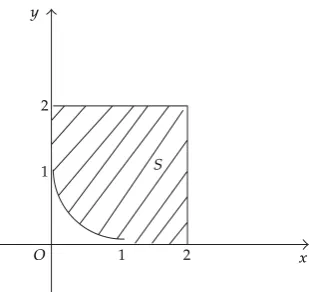
Example 3.5. LetY R2,S {x, y∈0,2×0,2|y≥1−
1−x−12 for x∈0,1}see
Figure 2andC {x, y∪ {0,0} |x >0, y∈R}.
Then, letΘ {x, y|x 1, y∈R}, we haveΘ∈BC. It follows from the definitions of STES,Θand TPES,Θthat
STES,Θ
x,1−
1−x−12
|x∈0,1 ∪0, y|y∈1,2∪ {x,0|x∈1,2},
TPES,Θ
x,1−
1−x−12
|x∈0,1 ,
3.16
respectively. Thus, the converse ofProposition 3.3is not valid.
Proposition 3.6see8. IfChas a bounded baseΘ, then
SES,Θ SES, C STES, C STES,Θ. 3.17
Corollary 3.7. IfChas a bounded baseΘ, then
SES, C TPES, C STES, C. 3.18
Example 3.8. LetY R2,Sbe given inExample 3.5andC R2
. Then
TPES, C SES, C STES, C
x,1−
1−x−12
|x∈0,1 . 3.19
Lemma 3.9see23. LetC⊂Ybe a closed convex pointed cone with a bounded baseΘandS⊂Y. Then,SES, C SESC, C.
FromCorollary 3.7andLemma 3.9, we can get the following proposition.
Proposition 3.10. IfChas a bounded baseΘandSis a nonempty subset ofY, thenTPES, C
TPESC, C.
4. Tightly Proper Efficiency and Scalarization
LetD ⊂ Zbe a closed convex pointed cone. We consider the following vector optimization problem with set-valued maps
C-min Fx,
s.t. Gx∩−D/∅, x∈X, VP
whereF:X → 2Y,G:X → 2Zare set-valued maps with nonempty values. LetA {x∈X:
Gx∩−D/∅}be the set of all feasible solutions ofVP.
Definition 4.1. x ∈Ais said to be a tightly properly efficient solution ofVP, if there exists
y∈Fxsuch thaty∈TPEFA, C.
We callx, yis a tightly properly efficient minimizer ofVP. The set of all tightly properly efficient solutions ofVPis denoted by TPEVP.
In association with the vector optimization problem VP of set-valued maps, we consider the following scalar optimization problem with set-valued mapF:
min ϕFx,
s.t. x∈A, SPϕ
whereϕ∈Y∗\ {0Y∗}. The set of all optimal solutions ofSPϕis denoted byMSPϕ, that is,
MSPϕ
x∈A:∃y∈Fxsuch thatϕy≤ϕy, ∀y∈FA. 4.1
Theorem 4.2. Let the coneChave a bounded baseΘ. Letx∈A,y∈Fx, andF−ybe nearlyC -subconvexlike onA. Theny∈TPEFA, Cif and only if there existsϕ∈Cisuch thatϕFA− y≥0.
Proof. Necessity. Let y ∈ TPEFA, C. Then, by Lemma 3.1and Proposition 3.10, we have
y∈TPEFA C,Θ. Hence, there exists a convex coneKwithC\ {0Y} ⊂intKsatisfying FA C−y∩−K {0Y}and there exists a convex neighborhoodUof 0Y such that
−Kc∩U−Θ ∅. 4.2
From the above expression andFA C−y∩−K {0Y}, we have
coneFA C−y∩U−Θ ∅. 4.3
SinceU−Θis open inY, we have
cl coneFA C−y∩U−Θ ∅. 4.4
By the assumption thatF−yis nearlyC-subconvexlike onA, thus cl coneFA C−yis convex set. By the Hahn-Banach separation theorem, there existsϕ∈Y∗\ {0Y∗}such that
ϕcl coneFA C−y> ϕU−Θ. 4.5
It is easy to see that
ϕconeFA C−y≥0, ϕU−Θ<0. 4.6
Hence, we obtain
ϕFA−y≥0. 4.7
Furthermore, according toRemark 2.2, we haveϕ∈Ci.
Sufficiency. Suppose that there existsϕ ∈Ci such thatϕFA−y ≥ 0. SinceChas a bounded baseΘ, thus byRemark 2.2ii, we know thatϕ∈Θst. And byRemark 2.2i, we
can take a convex neighborhoodUof 0Y such that
ϕU−Θ<0. 4.8
ByϕFA−y≥0, we have
ϕcl coneFA−y≥0. 4.9
From the above expression and4.8, we get
y
x O
F(A)
[image:11.600.223.377.99.238.2]y=−x
Figure 3:The setFA.
Therefore,y∈ STES,Θ. Noting thatChas a bounded baseΘand byLemma 3.1, we have
y∈TPES, C.
Now, we give the following example to illustrateTheorem 4.2.
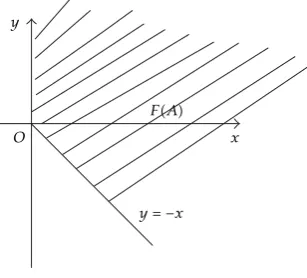
Example 4.3. LetX R,Y R2andZ R. GivenC R2
,D R. Let
Fx x, y|y≥ −x for any x∈X,
Gx −x,−x1 for anyx∈X.
4.11
Thus, feasible set ofVP
A {x∈X|Gx∩−R/∅} 0,∞. 4.12
ByDefinition 4.1, we get
TPEFA, C x, y|y −x, x >0. 4.13
For any pointx, y∈TPEFA, C, there existsϕ∈Cisuch that
ϕFA−x, y≥0. 4.14
Indeed, for anyx, y∈FA−x, y, we consider the following three cases.
Case 1. Ifx, yis in the first quadrant, then for anyϕ∈Cisuch thatϕx, y≥0.
Case 2. If x, y is in the second quadrant, then there exists k ≤ 0 such that y kx. Let
ϕ t1, t2such that
Then, we have
t1xt2y t1xt2kx t1kt2x≥0. 4.16
Case 3. Ifx, yin the fourth quadrant, then there existsk≤0 such thaty kx. Letϕ t1, t2
such that
t1 >0, t2 >0, t1≥ −kt2. 4.17
Then, we have
t1xt2y t1xt2kx t1kt2x≥0. 4.18
Therefore, if follows from Cases 1, 2, and 3 that there exists ϕ ∈ Ci such that
ϕFA−x, y≥0.
FromTheorem 4.2, we can get immediately the following corollary.
Corollary 4.4. Let the coneChave a bounded base Θ. For anyy0 ∈ FAifF−y0 is nearlyC
-subconvexlike onA. Then
TPEVP ϕ∈Ci
MSPϕ
. 4.19
5. Tightly Proper Efficiency and the Lagrange Multipliers
In this section, we establish two Lagrange multiplier theorems which show that tightly properly efficient solution of the constrained vector optimization problemVP, is equivalent to tightly properly efficient solution of an appropriate unconstrained vector optimization problem.
Definition 5.1see17. LetD ⊂ Zbe a closed convex pointed cone with intD /∅. We say thatVPsatisfies the generalized Slater constraint qualification, if there existsx ∈ X such that
Gx∩−intD/∅. 5.1
Theorem 5.2. LetChave a bounded baseΘandintD /∅. Letx ∈A,y ∈FxandF−y, Gis nearlyC×D-subconvexlike onX. Furthermore, let VPsatisfies the generalized Slater constraint qualification. Ifx∈TPEVPandy∈TPEFA, C, then there existsT ∈LZ, Ysuch that
0Y ∈TGx∩−D,
Proof. SinceChas bounded baseΘ, byLemma 2.13, we havey∈TPEFA,Θ. Thus, there is a convex coneKwithC\ {0Y} ⊂intKsatisfying
FA−y∩−K {0Y}, 5.3
and there exists an absolutely convex open neighborhoodUof 0Y such that
−Kc∩U−Θ ∅. 5.4
Since5.3is equivalent to coneFA C−y∩−K {0Y}, and from5.4we see that
coneFA C−y∩U−Θ ∅. 5.5
Moreover, for anyx∈X\A, we haveGx∩−D ∅. Therefore,
coneF−y, GX C, D∩U−Θ,−intD ∅. 5.6
SinceU−Θ,−intDis open inY×Z, thus, we get
cl coneF−y, GX C, D∩U−Θ,−intD ∅. 5.7
By the assumption thatF−y, Gis nearlyC×D-subconvexlike onX, we have
cl coneF−y, GX C, D 5.8
is convex. Hence, it follows from the Hahn-Banach separation theorem that there exists
ϕ, ψ∈Y∗, Z∗\ {0Y∗,0Z∗}such that
ϕconeFx−yCψconeGx D> ϕU−Θ ψ−intD, ∀x∈X. 5.9
Thus, we obtain
ϕFx−yψGx≥0, ∀x∈X, 5.10
ϕU Θ ψintD>0. 5.11
SinceDis a cone, we get
ϕU Θ≥0, 5.12
Sincex∈A,Gx∩−D/∅. Choosez∈Gx∩−D. By5.13, we know thatψ∈D, thus
ψz≤0. 5.14
Lettingx xand noting thaty∈Fx,z∈Gxin5.10, we get
ψz≥0. 5.15
Thus,ψz 0, which implies
0∈ψGx∩−D. 5.16
Now, we claim thatϕ /0Y∗. If this is not the case, then
ψ∈D\ {0Z∗}. 5.17
By the generalized Slater constraint qualification, then there existsx∈Xsuch that
Gx∩−intD/∅, 5.18
and so there existsz∈Gxsuch thatz∈ −intD. Hence,ψz<0. But substitutingϕ 0Y∗ into5.10, and by takingx x, andz∈Gxin5.10, we have
ψz≥0. 5.19
This contradiction shows thatϕ /0Y∗. Thereforeϕ∈Y∗\ {0Y∗}. From5.12andRemark 2.2, we haveϕ ∈ Θst. And sinceΘis a bounded base ofC, so ϕ ∈ Ci. Hence, we can choose
c∈C\ {0Y}such thatϕc 1 and define the operatorT :Z → Y by
Tz ψzc, ∀z∈Z. 5.20
Clearly,T ∈LZ, Yand by5.16, we see that
0Y ∈TGx∩−D. 5.21
Therefore,
y∈Fx⊂Fx TGx. 5.22
From5.10and5.20, we obtain
ϕFx TGx−y ϕFx−yψGxϕc
SinceF−y, Gis nearlyC×D-subconvexlike onX, byLemma 2.13, we haveFTG−y
is nearlyC-subconvexlike onX. From5.22,Theorem 4.2and the above expression, we have
y∈TPEFTGX, C. 5.24
Therefore, the proof is completed.
Theorem 5.3. Let C ⊂ Y be a closed convex pointed cone with a bounded base Θ, x ∈ A and
y∈Fx. If there existsT ∈LZ, Ysuch that0Y ∈TGx∩−Dandy∈TPEFTGX, C, thenx∈TPEVPandy∈TPEFA, C.
Proof. SinceChas a bounded base, andy ∈ TPEF TGX, C, we havey ∈ TPEF TGX C, C. Thus, there exists a convex coneKwithC\ {0Y} ⊂intKsatisfying
FTGX C−y∩−K {0Y}, 5.25
and there exits a convex neighborhoodUof 0Y such that
−Kc∩U−Θ ∅. 5.26
By 0Y ∈TGx∩−D, we have
FA TGA C⊃FA. 5.27
Thus,
FA−y∩−K {0Y},
−Kc∩U−Θ ∅. 5.28
Therefore, by the definition of TPEFA, C and TPEVP, we getx ∈ TPEVPand y ∈
TPEFA, C, respectively.
6. Tightly Proper Efficiency and Duality
Definition 6.1. The set-valued Lagrangian mapL : X×LZ, Y → 2Y for problemVPis defined by
Lx, T Fx TGx, ∀x∈X, ∀T∈LZ, Y. 6.1
Definition 6.2. The set-valued mapΦ:LZ, Y → 2Y, defined by
is called a tightly properly dual map forVP. We now associate the following Lagrange dual problem withVP:
C-max
T∈LZ,Y
ΦT. VD
Definition 6.3. A pointy0∈
T∈LZ,YΦTis said to be an efficient point ofVDif
y−y0∈/C\ {0Y}, ∀y∈
T∈LZ,Y
ΦT. 6.3
We now can establish the following dual theorems.
Theorem 6.4weak duality. Ifx∈Aandy0∈T∈LZ,YΦT. Then
y0−Fx
∩C\ {0Y} ∅. 6.4
Proof. One has
y0∈
T∈LZ,Y
ΦT. 6.5
Then, there existsT ∈LZ, Ysuch that
y0∈Φ
T
TPE
x∈X
Fx TGx, C
⊆min
x∈X
Fx TGx, C
.
6.6
Hence,
y0−Fx−TGx
∩C\ {0Y} ∅. 6.7
Particularly,
Noting that
x∈A
⇒Gx∩−D/∅
⇒ ∃z∈Gx s.t. −z∈D
⇒ −Tz∈C,
6.9
and takingz zin6.8, we have
y0−y−Tz∈/C\ {0Y}, ∀y∈Fx. 6.10
Hence, from−Tz∈CandCC\ {0Y} ⊂C\ {0Y}, we get
y0−y /∈C\ {0Y}, ∀y∈Fx. 6.11
This completes the proof.
Theorem 6.5strong duality. LetCbe a closed convex pointed cone with a bounded base Θin
Y and D be a closed convex pointed cone withintD /∅ in Z. Let x ∈ A,y ∈ Fx, F−y, G
be nearlyC×D-subconvexlike onX. Furthermore, letVPsatisfy the generalized Slater constraint qualification. Then,x ∈ TPEVPand y ∈ TPEFA, Cif and only ify is an efficient point of VD.
Proof. Letx ∈ TPEVPandy ∈ TPEFA, C, then according toTheorem 5.2, there exists
T ∈LZ, Ysuch that 0Y ∈TGx∩ −Dandy∈TPETFGX, C. Hence
y∈TPE
x∈X
Fx TGx, C
ΦT⊂
T∈LZ,Y
ΦT. 6.12
ByTheorem 6.4, we know thatyis an efficient point ofVD.
Conversely, Sinceyis an efficient point ofVD, theny∈T∈LZ,YΦT. Hence, there existsT ∈LZ, Ysuch that
y∈ΦT TPEFTGX, C. 6.13
SinceChas a bounded baseΘ, byLemma 3.1andProposition 3.10, we have
y∈TPEFTGX, C
TPEFTGX C, C
TPEFTGX C,Θ.
Hence, there exists a convex coneKwithC\{0Y} ⊂intKsatisfyingFTGXC−y∩−K and there exists an absolutely open convex neighborhoodUof 0Y such that
−Kc∩U−Θ ∅. 6.15
Hence, we have
coneFTGX C−y∩U−Θ ∅. 6.16
Since,U−Θis open subset ofY, we have
cl coneFTGX C−y∩U−Θ ∅. 6.17
SinceF−y, Gis nearlyC×D-subconvexlike onX, byLemma 2.13, we haveFTG−yis nearlyC-subconvexlike onX, which implies that
cl coneFTGX C−y 6.18
is convex. From6.17and by the Hahn-Banach separation theorem, there existsϕ∈Y∗\{0Y∗} such that
ϕcl coneFA C−y> ϕU−Θ. 6.19
From this, we have
ϕconeFA C−y≥0, 6.20
ϕU−Θ<0. 6.21
From6.21, we know thatϕ∈ Θst. And byΘis bounded base ofC, it implies thatCi. For anyx∈A, there existszx∈Gx∩−D. SinceT ∈LZ, Y, we have−Tzx∈Cand hence
ϕTzx≤0. From this and6.20, we have
ϕy−y≥ϕyTzx−y
≥0, ∀x∈A, y∈Fx, 6.22
that isϕFA−y≥0. ByTheorem 4.2, we havex∈TPEVPandy∈TPEFA, C.
7. Tightly Proper Efficiency and Tightly Proper Saddle Point
Definition 7.1. Let y ∈ S ⊂ Y,Cis a closed convex pointed cone of Y andΘ ∈ BC. y ∈
TPMS,Θif there exists a convex coneKwithC\ {0Y} ⊂intKsatisfyingS−y∩K {0Y} and there is a convex neighborhoodUof 0Y such that
Kc∩U Θ ∅. 7.1
y is said to be a tightly properly efficient point with respect to C, written as,y ∈
TPMS, Cif
y∈
Θ∈BC
TPMS,Θ. 7.2
It is easy to find thaty∈TPMS, Cif and only if−y∈TPE−S, C, and ifCis bounded, then we also have TPMS, C TPMS,Θ.
Definition 7.2. A pair x, T ∈ X ×LZ, Y is said to be a tightly proper saddle point of Lagrangian mapLif
Lx, T∩TPE
x∈X
Lx, T, C
∩TPM
⎡
⎣
T∈LZ,Y
Lx, T, C ⎤
⎦/∅. 7.3
We first present an important equivalent characterization for a tightly proper saddle point of the Lagrange mapL.
Lemma 7.3. x, T∈X×LZ, Yis said to be a tight proper saddle point of Lagrange mapLif only if there existy∈Fxandz∈Gxsuch that
iy∈TPEx∈XLx, T, C∩TPMT∈LZ,YLx, T, C, iiTz 0Y.
Proof. Necessity. Sincex, Tis a tightly proper saddle point ofL, byDefinition 7.2there exist
y∈Fxandz∈Gxsuch that
yTz∈TPE
x∈X
Lx, T, C
, 7.4
yTz∈TPM
⎡
⎣
T∈LZ,Y
Lx, T, C ⎤
⎦. 7.5
From7.5and the definition of TPMS, C, then there exists a convex coneKwithC\ {0Y} ⊂ intKsatisfying
⎛
⎝
T∈LZ,Y
Lx, T−C−yTz ⎞
and there is a convex neighborhoodUof 0Y such that
Kc∩U Θ ∅. 7.7
Since, for everyT∈LZ, Y,
Tz−Tz yTz−yTz∈Fx TGx−yTz
Lx, T−yTz.
7.8
We have
{Tz:T ∈LZ, Y} −C−Tz⊆
T∈LZ,Y
Lx, T−C−yTz. 7.9
Thus, from7.6, we have
K∩
⎡
⎣
T∈LZ,Y
{Tz} −C−Tz ⎤
⎦ {0Y}. 7.10
Letf:LZ, Y → Y be defined by
fT −Tz. 7.11
Then,7.10can be written as
−K∩fLZ, Y C−f
T {0Y} 7.12
By7.7and the above expression show thatT ∈LZ, Yis a tightly properly efficient point of the vector optimization problem
C-min fT
s.t. T ∈LZ, Y
7.13
Since f is a linear map, of course, −f is nearly C-subconvexlike on LZ, Y. Hence, by
Theorem 4.2, there existsϕ∈Cisuch that
ϕ−Tz ϕfT≤ϕfT ϕ−Tz, ∀T ∈LZ, Y. 7.14
Now, we claim that
If this is not true, then sinceDis a closed convex cone set, by the strong separation theorem in topological vector space, there existsμ∈Z∗\ {0Z∗}such that
μ−z< μλd, ∀d∈D, ∀λ >0. 7.16
In the above expression, takingd 0z∈Dgets
μz>0, 7.17
while lettingλ → ∞leads to
μd≥0, ∀d∈D. 7.18
Hence,
μ∈D\ {0Z∗}. 7.19
Letc∗∈intCbe fixed, and defineT∗:Z → Yas
T∗z
μz μz
c∗Tz. 7.20
It is evident thatT∗∈LZ, Yand that
T∗d
μd μz
c∗Td∈CC⊂C, ∀d∈D. 7.21
Hence,T∗∈LZ, Y. And takingz zin7.20, we obtain
T∗z−Tz c∗. 7.22
Hence,
ϕT∗z−ϕTz ϕc∗>0, 7.23
which contradicts7.14. Therefore,
−z∈D. 7.24
Thus,−Tz∈C, and sinceT ∈LZ, Y. IfTz/0Y, then
henceϕTz<0, byϕ∈Ci. But, takingT 0∈LZ, Yin7.14leads to
ϕTz≥0. 7.26
This contradiction shows thatTz 0Y, that is, conditioniiholds. Therefore, by7.4and7.5, we know
y∈TPE
x∈X
L x, T , C ∩TPM ⎡ ⎣
T∈LZ,Y
Lx, T, C ⎤
⎦, 7.27
that is conditioniholds.
Sufficiency. Fromy∈Fx,z∈Gx, and conditionii, we get
y yTz∈Fx TGx Lx, T. 7.28
And by conditioni, we obtain
y∈Lx, T∩TPE
x∈X
Lx, T, C
∩TPM
⎡
⎣
T∈LZ,Y
Lx, T, C ⎤
⎦. 7.29
Therefore,x, Tis a tightly proper saddle point ofL, and the proof is completed.
The following saddle-point theorem allows us to express a tightly properly efficient solution ofVPas a tightly proper saddle of the set-valued Lagrange mapL.
Theorem 7.4. LetFbe nearlyC-convexlike onA. If for any pointy0 ∈Y such thatF−y0, Gis
nearlyC×D-convexlike onX, andVPsatisfy generalized Slater constraint qualification. iIfx, Tis a tightly proper saddle point ofL, thenxis a tightly properly efficient solution
of VP.
iiIfx, ybe a tightly properly efficient minimizer ofVP,y∈TPMT∈LZ,YLx, T, C. Then there existsT ∈LZ, Ysuch thatx, Tis a tightly proper saddle point of Lagrange mapL.
Proof. iBy the necessity ofLemma 7.3, we have
0Y ∈TGx, 7.30
and there exists y ∈ Fx such thatx, yis a tightly properly efficient minimizer of the problem
C-min Fx TGx
s.t. x∈X.
According to Theorem 5.3, x, y is a tightly properly efficient minimizer of VP. Therefore,xis a tightly properly efficient solution ofVP.
iiFrom the assumption, and byTheorem 5.2, there existsT ∈LZ, Ysuch that
y∈TPE
x∈X
Lx, T, C
,
0Y ∈TGx∩−D.
7.31
Therefore there existsz∈ Gxsuch thatTz 0Y. Hence, fromLemma 7.3, it follows that x, Tis a tightly proper saddle point of Lagrange mapL.
8. Conclusions
In this paper, we have extended the concept of tightly proper efficiency from normed linear spaces to locally convex topological vector spaces and got the equivalent relations among tightly proper efficiency, strict efficiency and superefficiency. We have also obtained a scalarization theorem and two Lagrange multiplier theorems for tightly proper efficiency in vector optimization involving nearly cone-subconvexlike set-valued maps. Then, we have introduced a Lagrange dual problem and got some duality results in terms of tightly properly efficient solutions. To characterize tightly proper efficiency, we have also introduced a new type of saddle point, which is called the tightly proper saddle point of an appropriate set-valued Lagrange map, and obtained its necessary and sufficient optimality conditions. Simultaneously, we have also given some examples to illustrate these concepts and results. On the other hand, by using the results of theSection 3in this paper, we know that the above results hold for superefficiency and strict efficiency in vector optimization involving nearly cone-convexlike set-valued maps and, by virtue of12, Theorem 3.11, all the above results also hold for positive proper efficiency, Hurwicz proper efficiency, global Henig proper efficiency and global Borwein proper efficiency in vector optimization with set-valued maps under the conditions that the set-valuedF and G is closed convex and the ordering cone
C⊂Y has a weakly compact base.
Acknowledgments
The authors would like to thank the anonymous referees for their valuable comments and suggestions, which helped to improve the paper. This research was partially supported by the National Natural Science Foundation of ChinaGrant no. 10871216and the Fundamental Research Funds for the Central Universitiesproject no. CDJXS11102212.
References
1 H. W. Kuhn and A. W. Tucker, “Nonlinear programming,” inProceedings of the 2nd Berkeley Symposium on Mathematical Statistics and Probability, pp. 481–492, University of California Press, Berkeley, Calif, USA, 1951.
3 J. Borwein, “Proper efficient points for maximizations with respect to cones,”SIAM Journal on Control and Optimization, vol. 15, no. 1, pp. 57–63, 1977.
4 R. Hartley, “On cone-efficiency, cone-convexity and cone-compactness,” SIAM Journal on Applied Mathematics, vol. 34, no. 2, pp. 211–222, 1978.
5 H. P. Benson, “An improved definition of proper efficiency for vector maximization with respect to cones,”Journal of Mathematical Analysis and Applications, vol. 71, no. 1, pp. 232–241, 1979.
6 M. I. Henig, “Proper efficiency with respect to cones,”Journal of Optimization Theory and Applications, vol. 36, no. 3, pp. 387–407, 1982.
7 J. M. Borwein and D. Zhuang, “Super efficiency in vector optimization,”Transactions of the American Mathematical Society, vol. 338, no. 1, pp. 105–122, 1993.
8 W. T. Fu, “The strictly efficient points of a set in a normed linear space,”Journal of Systems Science and Mathematical Sciences, vol. 17, no. 4, pp. 324–329, 1997.
9 A. Zaffaroni, “Degrees of efficiency and degrees of minimality,” SIAM Journal on Control and Optimization, vol. 42, no. 3, pp. 1071–1086, 2003.
10 X. Y. Zheng, “Proper efficiency in locally convex topological vector spaces,”Journal of Optimization Theory and Applications, vol. 94, no. 2, pp. 469–486, 1997.
11 A. Guerraggio, E. Molho, and A. Zaffaroni, “On the notion of proper efficiency in vector optimization,”Journal of Optimization Theory and Applications, vol. 82, no. 1, pp. 1–21, 1994.
12 J. Liu and W. Song, “On proper efficiencies in locally convex spaces—a survey,”Acta Mathematica Vietnamica, vol. 26, no. 3, pp. 301–312, 2001.
13 H. W. Corley, “Existence and Lagrangian duality for maximizations of set-valued functions,”Journal of Optimization Theory and Applications, vol. 54, no. 3, pp. 489–501, 1987.
14 Z.-F. Li and G.-Y. Chen, “Lagrangian multipliers, saddle points, and duality in vector optimization of set-valued maps,”Journal of Mathematical Analysis and Applications, vol. 215, no. 2, pp. 297–316, 1997.
15 W. Song, “Lagrangian duality for minimization of nonconvex multifunctions,”Journal of Optimization Theory and Applications, vol. 93, no. 1, pp. 167–182, 1997.
16 G. Y. Chen and J. Jahn, “Optimality conditions for set-valued optimization problems,”Mathematical Methods of Operations Research, vol. 48, no. 2, pp. 187–200, 1998.
17 W. D. Rong and Y. N. Wu, “Characterizations of super efficiency in cone-convexlike vector optimization with set-valued maps,”Mathematical Methods of Operations Research, vol. 48, no. 2, pp. 247–258, 1998.
18 S. J. Li, X. Q. Yang, and G. Y. Chen, “Nonconvex vector optimization of set-valued mappings,”Journal of Mathematical Analysis and Applications, vol. 283, no. 2, pp. 337–350, 2003.
19 X.-H. Gong, “Optimality conditions for Henig and globally proper efficient solutions with ordering cone has empty interior,”Journal of Mathematical Analysis and Applications, vol. 307, no. 1, pp. 12–31, 2005.
20 P. H. Sach, “New generalized convexity notion for set-valued maps and application to vector optimization,”Journal of Optimization Theory and Applications, vol. 125, no. 1, pp. 157–179, 2005.
21 Z. F. Li, “Benson proper efficiency in the vector optimization of set-valued maps,” Journal of Optimization Theory and Applications, vol. 98, no. 3, pp. 623–649, 1998.
22 A. Mehra, “Super efficiency in vector optimization with nearly convexlike set-valued maps,”Journal of Mathematical Analysis and Applications, vol. 276, no. 2, pp. 815–832, 2002.
23 L. Y. Xia and J. H. Qiu, “Superefficiency in vector optimization with nearly subconvexlike set-valued maps,”Journal of Optimization Theory and Applications, vol. 136, no. 1, pp. 125–137, 2008.
24 D. S. Kim, G. M. Lee, and P. H. Sach, “Hartley proper efficiency in multifunction optimization,”Journal of Optimization Theory and Applications, vol. 120, no. 1, pp. 129–145, 2004.
25 P. H. Sach, “Hartley proper efficiency in multiobjective optimization problems with locally Lipschitz set-valued objectives and constraints,”Journal of Global Optimization, vol. 35, no. 1, pp. 1–25, 2006.
26 X. X. Huang and X. Q. Yang, “On characterizations of proper efficiency for nonconvex multiobjective optimization,”Journal of Global Optimization, vol. 23, no. 3-4, pp. 213–231, 2002.
27 Y. H. Cheng and W. T. Fu, “Strong efficiency in a locally convex space,”Mathematical Methods of Operations Research, vol. 50, no. 3, pp. 373–384, 1999.
28 D. Zhuang, “Density results for proper efficiencies,”SIAM Journal on Control and Optimization, vol. 32, no. 1, pp. 51–58, 1994.
29 X. M. Yang, D. Li, and S. Y. Wang, “Near-subconvexlikeness in vector optimization with set-valued functions,”Journal of Optimization Theory and Applications, vol. 110, no. 2, pp. 413–427, 2001.