R E S E A R C H
Open Access
An accelerated proximal augmented
Lagrangian method and its application in
compressive sensing
Min Sun
1,2*and Jing Liu
3*Correspondence:
[email protected] 1School of Management, Qufu
Normal University, Shandong, 276826, P.R. China
2School of Mathematics and
Statistics, Zaozhuang University, Shandong, 277160, P.R. China Full list of author information is available at the end of the article
Abstract
As a first-order method, the augmented Lagrangian method (ALM) is a benchmark solver for linearly constrained convex programming, and in practice some
semi-definite proximal terms are often added to its primal variable’s subproblem to make it more implementable. In this paper, we propose an accelerated PALM with indefinite proximal regularization (PALM-IPR) for convex programming with linear constraints, which generalizes the proximal terms from semi-definite to indefinite. Under mild assumptions, we establish the worst-caseO(1/t2) convergence rate of
PALM-IPR in a non-ergodic sense. Finally, numerical results show that our new method is feasible and efficient for solving compressive sensing.
MSC: 90C25; 90C30
Keywords: proximal augmented Lagrangian multiplier method; convex
programming; global convergence; compressive sensing
1 Introduction
LetRdenote the set of all real numbers,Rnthe Euclidean space of all real vectors withn
coordinates. In this paper, we are going to solve the following linearly constrained convex programming:
minf(x)|Ax=b,x∈Rn, ()
wheref(x) :Rn→Ris a closed proper convex function,A∈Rm×n,b∈Rm. Throughout,
we assume that the solution set of Problem () is nonempty. By choosing different objec-tive functionf(x), a variety of problems encountered in compressive processing, machine learning and statistics can be cast into Problem () (see [–] and the references therein). The following are two concrete examples of Problem ():
•The compressive sensing (CS):
min
x f(x) =x+
μx
,
s.t.Ax=b,
()
where μ> ,A∈Rm×n(mn) is the sensing matrix; b∈Rm is the observed signal,
and the-norm and-norm of the vectorxare defined byx=ni=|xi|andx= (ni=xi)/, respectively.
•The wavelet-based image processing problem:
min
x f(x) =x,
s.t.BWx=b,
()
where B∈Rm×l is a diagonal matrix whose elements are either (missing pixels) or (known pixels), andW∈Rl×nis a wavelet dictionary.
Problem () can be converted into the following strongly convex programming:
min
f(x) +β
Ax–b
|Ax=b,x∈Rn
, ()
where the constant β > is a penalty parameter. Introducing the Lagrange multiplier
λ∈Rm to the linear constraintsAx=b, we get the Lagrangian function associated with Problem ():
L(x,λ) =f(x) +λ(Ax–b) +β
Ax–b ,
which is also the augmented Lagrangian function associated with Problem (). Then the dual function is denoted by
G(λ) =inf
x L(x,λ),
and the dual problem of () is
max
λ∈RmG(λ).
Due to the strong convexity of the objective function of Problem (),G(λ) is continuously differentiable at anyλ∈Rm, and∇G(λ) = –(Ax(λ) –b), wherex(λ) = argmin
xL(x,λ) (see,
e.g., Theorem of []). Solving the above dual problem by the gradient ascent method, we get a benchmark solver for Problem (): the augmented Lagrangian method (ALM) [, ], which first minimizes the Lagrangian function of Problem () with respect toxby fixingλ=λkto getx(λk), and setxk+=x(λk); then it updates the Lagrange multiplierλ.
Specifically, for givenλk, thekth iteration of PALM for Problem () reads ⎧
⎨ ⎩
xk+=arg min
x∈Rn{L(x,λk)},
λk+=λk+γ β(Axk+–b),
()
whereγ ∈(, ) is a relaxation factor. Though ALM plays a fundamental role in the algo-rithmic development of Problem (), the cost of solving its first subproblem is often high for generalf(·) andA. To address this issue, many proximal ALMs [, –] are developed by adding the proximal termx–xk
semi-definite matrix. By settingG=τIn–βAAwithτ>βAA, thex-related
subprob-lem reduces to the following form:
xk+=arg min
x∈Rn
f(x) +τ
x–u
k
,
whereuk=
τ(Gxk–Aλk+βAb). The above subproblem is often simple enough to have a closed-form solution or can be easily solved up to a high precision. The proximal ALM is so instructive, and along this philosophy, a lot of efficient proximal ALM-type methods [, –] have been proposed. However, a new difficult problem has arisen for the prox-imal ALM-type methods, which is how to determine the optprox-imal value of the proxprox-imal parameterτ. Numerical results indicate that smaller values ofτ can often speed up the corresponding proximal ALM-type method [].
In [], Fazel et al. pointed out that the proximal matrixGshould be as small as possible, while the subproblem related to the primal variablexis still relatively easy to tackle. Fur-thermore, though anyτ>βAAcan ensure the global convergence of proximal ALM-type methods, the computation of the normAAis often high for some problems in practice, especially for largen. Therefore, it is meaningful to relax the feasible region of the proximal parameterτ. Quite recently some efficient methods with relaxed proximal matrix [–] have been developed for Problem (). Specifically, He et al. [] proposed a positive-indefinite proximal augmented Lagrangian method, in which the proximal ma-trix isG=G– ( –α)βAA, whereGis an arbitrarily positive definite matrix inRn, and
α∈(+γ, ). If we setG=τIn–αβAAwithτ>αβAA, thenG=τIn–βAA, which
maybe indefinite.
Many research results on the convergence speed of the ALM-type methods have been presented recently. For the classical ALM, He et al. [] firstly established the worst-case O(/t) convergence rate in the non-ergodic sense, and further developed a new ALM-type method, which hasO(/t) convergence rate. However, for inequality (.) in [], the authors only provedL(x∗,λ∗) –L(x˜k,λ˜k)≤C/(k+ )withC> , and we cannot ensure L(x∗,λ∗) –L(x˜k,λ˜k)≥. Similar problem occurs in Theorem . of []. In the following,
we shall prove that the inequalityL(x∗,λ∗) –L(x˜k,λ˜k)≥ holds for the method in [].
Quite recently, by introducing an ingeniously designed sequence{θk}, Lu et al. []
pro-posed a fast PALM-type method without proximal term, which hasO(/t) convergence rate.
In this paper, based on the study of [], we are going to further study the augmented Lagrangian method and develop a new fast proximal ALM-type method with indefinite proximal regularization, whose worst-case convergence rate isO(/t) in a non-ergodic sense. Furthermore, a relaxation factor γ ∈(, ) is attached to the updated formula of our new method, which is often beneficial to speed up convergence in practice.
2 Preliminaries
In this section, we give some notations used in the following analysis and present two criteria to measure the worst-caseO(/t) convergence rate of PALM type methods. At the end of this section, we prove that the inequalityL(x∗,λ∗) –L(x˜k,λ˜k)≥ holds for the
method in [].
Throughout, we use the following standard notations. For any two vectorsx,y∈Rn,
x,yorxydenote their inner products. The symbols · and · represent the -norm and-norm for vector variables, respectively.Indenotes then-dimensional identity
matrix. If the matrixG∈Rn×nis symmetric, we use the symbolx
Gto denotexGxeven
ifGis indefinite;G (resp.,G) denotes that the matrixGis positive definite (resp., semi-definite).
The following identity will be used in the following analysis:
x–y,x–z=
x–y+x–z–y–z, x,y,z∈Rn. ()
Definition . A point (x∗,λ∗) is a Karush-Kuhn-Tucker (KKT) point of Problem () if the following conditions are satisfied:
⎧ ⎨ ⎩
∈∂f(x∗) +Aλ∗,
Ax∗=b. ()
Note that the two conditions of () correspond to the dual feasibility and the primal feasibility of Problem (), respectively. The solution set of KKT system (), denoted by W∗, is nonempty under the nonempty solution set of (). By () and the property of the convex functionf(·), for any (x∗,λ∗)∈W∗, we have
f(x) –fx∗+x–x∗Aλ∗≥, ∀x∈Rn. ()
Based on () andAx∗=b, we have the following proposition.
Proposition .([]) Vectorx˜∈Rnis an optimal solution to Problem()if and only if
there exists r> such that
f(x˜) –fx∗+x˜–x∗Aλ∗+r
Ax˜–b
= , ()
where(x∗,λ∗)∈W∗.
Now let us review two different criteria to measure the worst-caseO(/t) convergence rate in [, ].
() In [], Xu presented the following criterion: ⎧
⎨ ⎩
|f(xt) –f(x∗)| ≤ C
(t+), Axt–b ≤λ∗(Ct+),
()
() In [], Lin et al. proposed the following criterion:
fxt–fx∗+xt–x∗Aλ∗+c Ax
t–b≤ C
(t+ ), ()
wherec,C> . Obviously, inequality () is motivated by equality (). Compared with (), the criterion () is more reasonable. Therefore, we shall use () to measure theO(/t) convergence rate of our new method.
Now, we prove that the inequalityL(x∗,λ∗) –L(x˜k,λ˜k)≥ holds for the iteration method proposed in [].
Theorem . For the KKT point(x∗,λ∗)of Problem(),the tuple(xk+,λ˜k+)generated by the method in[]satisfies
Lxk+,λ˜k+≤Lx∗,λ∗.
Proof Sincexk+is generated by the following subproblem:
xk+=arg min
x∈Rn
f(x) +β
Ax–b+λ
k
β
,
then it holds that
∈∂fxk++Aλk+βAxk+–b,
i.e.,
–Aλ˜k+∈∂fxk+.
This and the convexity of the functionf(·) yield
fx∗–fxk+≥–Aλ˜k+,x∗–xk+.
So, it holds that
Lx∗,λ∗=fx∗
≥fxk++–Aλ˜k+,x∗–xk+
≥fxk++–λ˜k+,Ax∗–Axk+
≥fxk++λ˜k+,Axk+–b
=Lxk+,λ˜k+.
3 PALM-IPR and its convergence rate
In this section, we first present the proximal ALM with indefinite proximal regularization (PALM-IPR) for Problem () and then prove its convergence rate step by step.
To present our new method, let us define a sequence{θk}which satisfiesθ= ,θk>
and
–θk+
θk+ =
θk. ()
Then the sequence{θk}has the following properties []:
t
k=
θk
=
θt, ()
and
θk≤
k+ , ∀k≥. ()
Algorithm .(PALM-IPR for Problem ())
Step .Input the parametersβ=θ= ,γ ∈(, ), the toleranceε> . Initializex∈ Rn,z∈Rn,λ∈RmandG
∈Rn×n. Setk:= . Step .Compute
zk+=arg min
x∈Rn
f(x) +βk
Ax–b+λ
k
βk
+βk
x–z
k
Gk
; ()
xk+= ( –θk)xk+θkzk+; ()
λk+=λk+γ βk
Azk+–b; ()
θk+= –θk+
θk+ θk
; ()
βk+=
θk+
. ()
Step .Ifxk–xk++λk–λk+ ≤ε, then stop; otherwise, chooseG
k+∈Rn×n, and setk:=k+ . Go to Step .
To prove the global convergence of PALM-IPR, we need to impose some restrictions on the proximal matrixGk, which is stated as follows.
Assumption . The proximal matrixGkis set asGk=θk(Dk– ( –α)AA), whereα∈
(+γ, ) and the matrixDk,∀k≥.
Remark . The proximal matrixGkmaybe indefinite. For example, if we setDk= , then
Gk= –( –α)θkAA, which is indefinite whenAis full-column rank.
Lemma . Let{(xk,yk,zk,λk)}
k≥be the sequence generated by PALM-IPR.For any x∈ Rn,it holds that
–θk+
θ
k+
fxk+–f(x)–
γ θk
λk++ (γ– )λk,Ax–Azk+
≤ –θk
θk
fxk–f(x)+ θkz
k–x
Gk–z
k+–x
Gk–z
k+–zk
Gk
. ()
Proof From the first-order optimality condition forz-related subproblem (), we have
∈∂fzk++βkA
Azk+–b+
βk
λk
+βkGk
zk+–zk
=∂fzk++Aλ˜k+βkGk
zk+–zk, ()
whereλ˜k=λk+β
k(Azk+–b). Then, from the convexity off(·) and (), we have
f(x) –fzk+≥–Aλ˜k+βkGk
zk+–zk,x–zk+. ()
From () and the convexity off(·) again, we thus get
fxk+≤( –θk)f
xk+θkf
zk+
≤( –θk)f
xk+θk
f(x) +Aλ˜k+βkGk
zk+–zk,x–zk+,
where the second inequality follows from (). Then, by rearranging terms of the above inequality, we arrive at
fxk+–f(x) –θk
Aλ˜k,x–zk+
≤( –θk)
fxk–f(x)+Gk
zk+–zk,x–zk+
≤( –θk)
fxk–f(x)+ z
k–x Gk–z
k+–x
Gk–z
k+–zk Gk
,
where the second inequality uses (), and the third inequality comes from identity (). Dividing both sides of the above inequality byθk, we get
θ
k
fxk+–f(x) –
θk
Aλ˜k,x–zk+
≤ –θk
θk
fxk–f(x)+ θkz
k–x Gk–z
k+–x
Gk–z
k+–zk Gk
.
From (), we have
˜
λk=λk+λ
k+–λk
γ =
λk++ (γ – )λk
γ .
Substituting this into the above inequality and using () lead to (). This completes the
Lemma . Let {(xk,yk,zk,λk)}
k≥ be the sequence generated by PALM-IPR. For any (x,λ)∈Rm+nwith Ax=b,it holds that
–θk+
θk+
fxk+–f(x)– –θk
θk
fxk–f(x)+
θk
λ,Azk+–b
≤
θ
k
zk–xG
k–z
k+–x
Gk–z
k+–zk
Gk
+ γ
γλk–λ–λk+–λ– ( –γ)λk+–λk. ()
Proof Adding the termθ
kλ,Az
k+–bto both sides of (), we get
–θk+
θk+
fxk+–f(x)– –θk
θk
fxk–f(x)+
θk
λ,Azk+–b
≤
θkz
k–x
Gk–z
k+–x
Gk–z
k+–zk
Gk
+
θk
λ–λ
k++ (γ – )λk
γ ,Az
k+–b
. ()
Now, let us deal with the termλ–λk++(γγ–)λk,Azk+–b. By (), we have
λ–λ
k++ (γ– )λk
γ ,Az
k+–b
=
γβ
k
γ λ–λk+– (γ – )λk,λk+–λk
=
γβ
k
γλ–λk,λk+–λk–λk+–λk
= γβ
k
γλk–λ–λk+–λ– ( –γ)λk+–λk.
Substituting the above equality into () and using (), we get () immediately. This
completes the proof.
Let us further deal with the termzk–x
Gk–z
k+–x
Gk–z
k+–zk
Gk on the
right-hand side of ().
Lemma . Let {(xk,yk,zk,λk)}
k≥ be the sequence generated by PALM-IPR. For any (x,λ)∈Rm+nwith Ax=b,it holds that
θkz
k–x Gk–z
k+–x
Gk–z
k+–zk Gk
≤zk–x Dk–
zk+–x
Dk–
zk+–zk Dk
+ ( –α)Azk–b–Azk+–b+ ( –α)Azk+–b. ()
Proof By Assumption ., we have
θkz
k–x Gk–z
k+–x
Gk–z
k+–zk Gk
=zk–xD
k–z
k+–x
Dk–z
k+–zk Dk
+ ( –α)–Azk–Ax+Azk+–Ax+Azk–Azk+
=zk–xD
k–z
k+–x
Dk–z
k+–zk
Dk
+ ( –α)–Azk–b+Azk+–b+Azk–b–Azk+–b.
Using the inequalityξ–η≤ξ+ ηwithξ=Azk–bandη=Azk+–b, we get
Azk–b–Azk+–b≤Azk–b+ Azk+–b.
Substituting this inequality into the right-hand side of the above equality, we obtain asser-tion () immediately. This completes the proof.
Then, from () and (), we have
–θk+
θk+
fxk+–f(x)– –θk
θk
fxk–f(x)+
θk
λ,Azk+–b
≤
z
k–x
Dk–z
k+–x
Dk–z
k+–zk
Dk+( –α)Az
k–b
–Azk+–b
+ ( –α)Azk+–b
+ γ
γλk–λ–λk+–λ– ( –γ)λk+–λk
≤
θkz
k–x
Dk–z
k+–x
Dk–z
k+–zk
Dk
+ ( –α)Azk–b–Azk+–b
+ γλ
k–λ
–λk+–λ+ +γ– α γ λ
k+–λk
, ()
where the second inequality comes from () and the factβk≥.
Based on (), we are going to prove the worst-caseO(/t) convergence rate of PALM-IPR in an ergodic sense.
Theorem . Let{(xk,yk,zk,λk)}k≥be the sequence generated by PALM-IPR.Then
fxt+–fx∗+Aλ∗,xt+–x∗+α– –γ
Ax
t+–b
≤
(t+ )z –x∗
D+ ( –α)Az
–b+
γ(t+ )λ
–λ∗.
Proof Settingx=x∗andλ=λ∗in (), we get
–θk+
θ
k+
fxk+–fx∗– –θk
θ
k
fxk–fx∗+
θk
λ∗,Azk+–b
≤
z
k–x∗ Dk–z
k+–x∗
Dk–z
k+–zk Dk
+ γλ
k–λ∗–λk+–λ∗+ +γ– α γ λ
k+–λk.
Summing the above inequality overk= , , . . . ,tand by (), we have
–θt+
θ
t+
fxt+–fx∗+
t k= θk
λ∗,Azk+–b
≤
z –x∗
D+ ( –α)Az
–b+ γλ
–λ∗
+ +γ– α θk
t
k=
Azk+–b
≤
z –x∗
D+ ( –α)Az
–b+ γλ
–λ∗
+ +γ– α θk
t
k=
Azk+–b, ()
where the second inequality follows fromθk≤ andα∈(+γ, ). By equations (), ()
of [], we have
t
k= zk+
θk
=
θtx
t+,
and t k= θk
Azk+–b≥
θtAx
t+–b.
Substituting the above two relationships into () and using (), we get
–θt+
θ
t+
fxt+–fx∗+
θ
t
λ∗,Axt+–b+α– –γ θ
t
Axt+–b
≤
z –x∗
D+ ( –α)Az
–b+ γλ
–λ∗ .
Then multiplying two sides of the above inequality byθ
t and using () lead to
fxt+–fx∗+λ∗,Axt+–b+α– –γ
Ax
t+–b
≤θt
z –x∗
D+ ( –α)Az
–b+ θt
γλ
–λ∗
≤
(t+ )z –x∗
D+ ( –α)Az
–b+
γ(t+ )λ
–λ∗,
4 Numerical results
In this section, we apply PALM-IPR to some practical applications and report the numer-ical results. All the codes were written by Matlab Ra and conducted on ThinkPad notebook with GB of memory.
Problem .(Quadratic programming) Firstly, let us test PALM-IPR on equality con-strained quadratic programming (ECQP) [] to validate its stability:
minF(x) = x
Qx+cx, s.t.Ax=b.
We set the problem size tom= ,n= and generateA∈Rm×n,b,candQ∈Rn×n ac-cording to the standard Gaussian distribution. We compare PALM-IPR with the classical ALM withβ= . For PALM-IPR, we setGk= for simplicity. We have tested the
experi-ment sixty times, and the numerical results are listed in Table , in which ‘NC’ means the number of convergence; ‘ND’ means the number of divergence and ‘Ratio’ means the ratio of succession. From Table , we can see that PALM-IPR performs much more stably than the classical ALM.
Problem .(Compressive sensing: the linearly constrained–minimization prob-lem ()) Now, let us test PALM-IPR on the compressive sensing to validate its accel-eration. For this problem, we firstly elaborate on how to solve subproblem () result-ing from PALM-IPR. Due to the existence of the augmented termAx–b, we cannot get the closed-form solution if we do not attach the proximal term x–zkGk. In this case, we have to solve the subproblem inexactly, which is often time-consuming. There-fore, we choose the proximal matrix Gk in () asGk=θk(Dk– ( –α)AA), in which
Dk=β
kθk
Pk+ ( –α)AA,Pk=τkIn–βkAAandτk>βkAA, and subproblem () can
be written as
zk+=arg min
x∈Rn
f(x) +βk
Ax–b+λ
k
βk
+
x–z
k
Pk
,
which is equivalent to
zk+=arg min
x∈Rn
x+ +μτk
μ
x– μ +μτk
Pkzk–Aλk+βkAb
,
and has a closed-form solution as follows:
zk+= shrink,
ak,μ/( +μτk)
.
=signak·max,ak–μ/( +μτk)
,
in whichak= μ +μτk(Pkz
k–Aλk+β
[image:11.595.245.350.695.731.2]kAb). Note that all computations are component-wise.
Table 1 Comparison of PALM-IPR with ALM
Method NC ND Ratio
PALM-IPR 59 1 98.33%
Table 2 Comparison of PALM-IPR with PALM-SDPR and PALM-PIPR
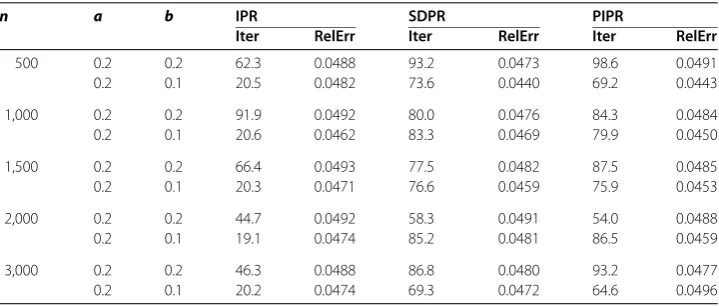
n a b IPR SDPR PIPR
Iter RelErr Iter RelErr Iter RelErr
500 0.2 0.2 62.3 0.0488 93.2 0.0473 98.6 0.0491
0.2 0.1 20.5 0.0482 73.6 0.0440 69.2 0.0443
1,000 0.2 0.2 91.9 0.0492 80.0 0.0476 84.3 0.0484
0.2 0.1 20.6 0.0462 83.3 0.0469 79.9 0.0450
1,500 0.2 0.2 66.4 0.0493 77.5 0.0482 87.5 0.0485
0.2 0.1 20.3 0.0471 76.6 0.0459 75.9 0.0453
2,000 0.2 0.2 44.7 0.0492 58.3 0.0491 54.0 0.0488
0.2 0.1 19.1 0.0474 85.2 0.0481 86.5 0.0459
3,000 0.2 0.2 46.3 0.0488 86.8 0.0480 93.2 0.0477
0.2 0.1 20.2 0.0474 69.3 0.0472 64.6 0.0496
In this experiment, we set m =floor(a× n) and k = floor(b × m) with n ∈
{, ,, ,, ,, ,}, where k is the number of random nonzero elements contained in the original signal. The sensing matrixAis generated by the following Mat-lab scripts:A¯ =randn(m,n), [Q,R] =qr(A¯, );A=Q, and the nonzero entries of the true signalx∗, whose values are sampled from the standard Gaussian:x∗=zeros(n, ); p=randperm(n);x∗(p( :k)) =randn(k, ), are selected at random. The observed signal bis generated byb=R\Ax∗. In addition, we setμ= ,γ = .. In this experiment, we set the proximal parameterτk= βkAA. Furthermore, the stopping criterion is
RelErr=x
k–x∗
x∗ ≤%,
or the number of iterations exceeds , wherexkis the iterate generated by PALM-IPR. Furthermore, all initial points are set asx=Ab,λ= . For comparison, we also give the numerical results of PALM-SDPR [] and the proximal PALM with positive-indefinite proximal regularization (PALM-PIPR) [], and the proximal matrix is set to beG=τIn–
βAAin PALM-SDPR andG= .τIn–βAAin PALM-PIPR, andτ= .βAA,β=
mean(abs(b)). Furthermore, we setγ= in PALM-PIPR. Since the computational load of all three methods are almost the same at each iteration, we only list the number of iterations (‘Iter’), the relative error (‘RelErr’) when three methods achieve the stopping criterion. The numerical results are listed in Table , and in the view of statistics, all the results are the average of runs for each pair (n,a,b).
Numerical results in Table indicate that: () All methods have succeeded in solving Problem () for all the scenarios; () The new method IPR outperforms PALM-SDPR and PALM-PIPR by taking a fewer number of iterations to converge except (n,a,b) = (,, ., .).
5 Conclusions
Similar to our proposed method, the methods in [, ] also have the worst-case O(/t) convergence rate in a non-ergodic sense, but they often have to solve a difficult subproblem at each iteration, and some inner iteration has to be executed. A prominent characteristic of the methods in [, ] is that the parameterβcan be any positive con-stant, but the parameterβin PALM-IPR changes with respect to the iteration counterk, and it can actually go to infinity ask→ ∞. In practice, we often observe that larger β
usually induces to slower convergence. Therefore, the method with proximal term, faster convergence rate and constant parameterβdeserves further research.
Acknowledgements
The authors gratefully acknowledge the valuable comments of the anonymous reviewers, and great thanks go to Prof. Yiju Wang of the School of Management, Qufu Normal University for the helpful discussions on this paper.
Funding
This work is supported by the National Natural Science Foundation of China (No. 11671228, 11601475), the First Class Discipline of Zhejiang-A (Zhejiang University of Finance and Economics-Statistics) and the Educational Reform Project of Zaozhuang University (No. 1021402).
Competing interests
The authors declare that they have no competing interests.
Authors’ contributions
All the authors conceived the study, participated in its design and read and approved the final manuscript.
Author details
1School of Management, Qufu Normal University, Shandong, 276826, P.R. China.2School of Mathematics and Statistics,
Zaozhuang University, Shandong, 277160, P.R. China.3School of Data Sciences, Zhejiang University of Finance and Economics, Zhejiang, 310018, P.R. China.
Publisher’s Note
Springer Nature remains neutral with regard to jurisdictional claims in published maps and institutional affiliations.
Received: 11 September 2017 Accepted: 12 October 2017 References
1. Boyd, S, Parikh, N, Chu, E, Peleato, B, Eckstein, J: Distributed optimization and statistical learning via the alternating direction method of multipliers. Found. Trends Mach. Learn.3, 1-122 (2011)
2. He, BS, Yuan, XM, Zhang, WX: A customized proximal point algorithm for convex minimization with linear constraints. Comput. Optim. Appl.56, 559-572 (2013)
3. Ma, F, Ni, MF: A class of customized proximal point algorithms for linearly constrained convex optimization. Comput. Appl. Math. (2016). doi:10.1007/s40314-016-0371-3
4. Sun, HC, Sun, M, Wang, YJ: Proximal ADMM with larger step size for two-block separable convex programming and its application to the correlation matrices calibrating problems. J. Nonlinear Sci. Appl.10(9), 5038-5051 (2017). doi:10.22436/jnsa.010.09.40
5. Liu, J, Duan, YR, Sun, M: A symmetric version of the generalized alternating direction method of multipliers for two-block separable convex programming. J. Inequal. Appl.2017, Article ID 129 (2017)
6. Sun, HC, Tian, MY, Sun, M: The symmetric ADMM with indefinite proximal regularization and its application. J. Inequal. Appl.2017, Article ID 172 (2017)
7. Sun, HC, Liu, J, Sun, M: A proximal fully parallel splitting method for stable principal component pursuit. Math. Probl. Eng. (2017, in press)
8. Sun, M, Sun, HC, Wang, YJ: Two proximal splitting methods for multi-block separable programming with applications to stable principal component pursuit. J. Appl. Math. Comput. (2017). doi:10.1007/s12190-017-1080-9
9. Nesterov, YE: Smooth minimization of non-smooth functions. Math. Program., Ser. A103(1), 127-152 (2005). doi:10.1007/s10107-004-0552-5
10. Hestenes, MR: Multiplier and gradient methods. J. Optim. Theory Appl.4, 303-320 (1969)
11. Powell, MJ: A method for non-linear constraints in minimization problems. In: Fletcher, R (ed.) Optimization, pp. 283-298. Academic Press, San Diego (1969)
12. He, BS, Liao, LZ, Han, DR, Yang, H: A new inexact alternating directions method for monotone variational inequalities. Math. Program.92(1), 103-118 (2002)
13. He, BS, Yuan, XM: On theO(1/n) convergence rate of the Douglas-Rachford alternating direction method. SIAM J. Numer. Anal.50(2), 700-709 (2012)
14. Yang, JF, Yuan, XM: Linearized augmented Lagrangian and alternating direction methods for nuclear norm minimization. Math. Comput.82(281), 301-329 (2013)
16. Qiu, HN, Chen, XM, Liu, WQ, Zhou, GL, Wang, YJ, Lai, JH: A fast1-solver and its applications to robust face recognition. J. Ind. Manag. Optim.8, 163-178 (2012)
17. Wang, YJ, Liu, WQ, Caccetta, L, Zhou, G: Parameter selection for nonnegative1matrix/tensor sparse decomposition. Oper. Res. Lett.43, 423-426 (2015)
18. Sun, M, Wang, YJ, Liu, J: Generalized Peaceman-Rachford splitting method for multiple-block separable convex programming with applications to robust PCA. Calcolo54(1), 77-94 (2017)
19. Li, M, Sun, DF, Toh, KC: A majorized ADMM with indefinite proximal terms for linearly constrained convex composite optimization. SIAM J. Optim.26(2), 922-950 (2016)
20. Fazel, M, Pong, TK, Sun, DF, Tseng, P: Hankel matrix rank minimization with applications to system identification and realization. SIAM J. Matrix Anal. Appl.34, 946-977 (2013)
21. He, BS, Ma, F, Yuan, XM: Linearized alternating direction method of multipliers via positive-indefinite proximal regularization for convex programming. Unpublished manuscript (2016)
22. He, BS, Yuan, XM: Improving an ADMM-like splitting method via positive-indefinite proximal regularization for three-block separable convex minimization. Unpublished manuscript (2016)
23. He, BS, Ma, F, Yuan, XM: Positive-indefinite proximal augmented Lagrangian method and its application to full Jacobian splitting for multi-block separable convex minimization problems. Unpublished manuscript (2016) 24. Sun, M, Liu, J: The convergence rate of the proximal alternating direction method of multipliers with indefinite
proximal regularization. J. Inequal. Appl.2017, Article ID 19 (2017)
25. He, BS, Yuan, XM: On the acceleration of augmented Lagrangian method for linearly constrained optimization. Unpublished manuscript (2010)
26. Ke, YF, Ma, CF: An accelerated augmented Lagrangian method for linearly constrained convex programming with the rate of convergenceO(1/k2). Appl. Math. J. Chin. Univ.32(1), 117-126 (2017). doi:10.1007/s11766-017-3381-z 27. Lu, CY, Li, H, Lin, ZC, Yan, SC: Fast proximal linearized alternating direction method of multiplier with parallel splitting.
In: Proceedings of the Thirtieth AAAI Conference on Artificial Intelligence (AAAI’16), pp. 739-745. AAAI Press, Menlo Park (2016)
28. Lin, ZC, Liu, RS, Li, H: Linearized alternating direction method with parallel splitting and adaptive penalty for separable convex programs in machine learning. Mach. Learn.99(2), 287-325 (2015)
29. Xu, YY: Accelerated first-order primal-dual proximal methods for linearly constrained composite convex programming. Unpublished manuscript (2016)