R E S E A R C H
Open Access
Robust optimization model for uncertain
multiobjective linear programs
Lei Wang
*and Min Fang
*Correspondence: [email protected] School of Economic Mathematics, Southwestern University of Finance and Economics, Chengdu, Sichuan 610074, P.R. China
Abstract
In this paper, we consider the multiobjective linear programs where coefficients in the objective function belong to uncertainty sets. We introduce the concept of robust efficient solutions to uncertain multiobjective linear programming problems. By using two scalarization methods, the weighted sum method and the
-constraint method, we obtain that the robust efficient solutions for uncertain multiobjective linear programs with ellipsoidal uncertainty sets and general norm uncertainty sets can be computed by some deterministic optimization problems.
MSC: 90A14; 47H04; 47S40
Keywords: multiobjective linear programs; robust efficient solutions; scalarization; uncertainty sets
1 Introduction
The parameter values of optimization problems in real world are usually uncertain due to prediction errors, estimation errors, or lack of information at the time of decision. There-fore, it is important to solve such uncertain optimization problems for decision maker. In 1973, Soyster [1] first introduced the robust linear programs where coefficients are uncer-tain. The main idea is to assume that the coefficients can be any scenario in the uncertainty set and to find a solution that is feasible for all possible scenarios from the uncertainty set. The interest of robust optimization was revived in the 1990s (see, e.g., [2–10]). In 2009, Ben-Tal, El-Ghaoui, and Nemirovski [11] introduced a number of important results in ro-bust linear optimization, roro-bust conic optimization, and roro-bust multistage optimization. Robust optimization has become a powerful approach to handle uncertain optimization problems.
On the other hand, the equilibrium problem provides a general mathematical model for a wide range of practical problems, such as optimization problems, Nash equilibria lems, fixed point problems, variational inequality problems, and complementarity prob-lems, and has been investigated intensively. For more details, we refer to [12–15]. As a particular case of the vector equilibrium problem, multiobjective optimization problems arise in a large number of applications such as transportation, finance, communication, etc. Naturally, the issue of uncertain data affects single objective optimization problems in the same way as it affects these multiobjective ones. The essential problem in multiob-jective optimization is to find thePareto efficient solutions, meaning the feasible solutions
such that no objective can be improved without sacrificing others; see, for example, Miet-tinen [16] and Ehrgott [17]. Therefore, in multiobjective optimization problems with data uncertainty, it is very important how to findrobust efficient solutionsthat are less sensitive to small perturbations in variables.
In 2006, Deb and Gupta [18] presented two different robust multiobjective optimization procedures. The first one replaces all objective functions by their mean functions, and ro-bust solution is defined as the efficient solution to the resulting deterministic optimiza-tion problem. The second one adds constraints to the predefined limit and optimizes the original objective functions. Recently, Kuroiwa and Lee [19] defined three kinds of robust efficient solutions, which are different from Deb and Gupta [18] for the uncertain multi-objective optimization problems. They also established necessary optimality theorems for robust efficient solutions and gave scalarization methods for robust efficient solutions of multiobjective optimization problems. Ehrgott, Ide, and Schobel [20] generalized the con-cept of minimax robustness introduced by Ben-Tal, El-Ghaoui, and Nemirovski [11] from single objective optimization problems to multiobjective optimization problems. They proposed robust Pareto efficiency and discussed how to find robust efficient solutions for uncertain multiobjective optimization problems. Goherna, Jeyakumar, Li, and Perez [21] introduced the definition of radius of robust feasibility and analyzed the robust weakly efficient solution of a multiobjective linear programming problems with data uncertainty both in the objective function and constraints. They also gave numerically tractable opti-mality conditions for highly robust weakly efficient solutions. Very recently, Bokrantz and Fredriksson [22] provided necessary and sufficient conditions for robust efficiency stud-ied by Ehrgott, Ide, and Schobel [20] to multiobjective optimization problems with data uncertainty. They also applied these results to the field of therapy for cancer treatment.
Motivated by the works mentioned, in this paper, we consider the multiobjective linear programs where the coefficientsaiandbiin the objective function belong to uncertain
but bounded setsUi. We introduce the concept of robust efficient solution to uncertain
multiobjective linear programs (UMLPs). Also, we show that two scalarization methods, the weighted sum method and the-constraint method, can be used to find robust effi-cient solutions of UMLP with ellipsoidal uncertainty sets and general norm uncertainty sets. The structure of the paper is as follows. In Section 2, we introduce the uncertain mul-tiobjective linear programming problems and the concept of robust efficient solution to UMLP. In Section 3, we give the ellipsoidal uncertainty sets and general norm uncertainty sets. Using the weighted sum method, we show that the robust efficient solution of UMLP can be found by some deterministic optimization problems. In Section 4, we use the -constraint method to compute the robust efficient solution of UMLP under ellipsoidal uncertainty sets and general norm uncertainty sets. Finally, we conclude in Section 5.
2 Introduction to uncertain multiobjective linear programs
2.1 Deterministic multiobjective linear programs
Consider the following multiobjective linear programming problem:
minf(x) =aT1x+b1,aT2x+b2, . . . ,aTmx+bm
s.t. x∈X,
(MLP)
wheref :Rn→Rm,X⊆Rn, and (a
In this paper, we use the order relation(see Ehrgott [17]): Fory1,y2∈Rm, we write y1y2ify1is greater than or equal toy2in every component and greater in at least one
component. Furthermore, we define the coneRm
={x∈Rm:x0}. The Pareto efficient solution to (MLP) is defined as follows:
Definition 1 A feasible solutionx∗∈Xto (MLP) is Pareto efficient if there is no feasible
solutionx∈Xsuch thatf(x)∈f(x∗) –Rm.
2.2 Robust multiobjective linear programs
Consider the following uncertain multi-objective linear programming problem
minf(x;a˜i,b˜i) =
˜
aT1x+b˜1,a˜T2x+b˜2, . . . ,a˜Tmx+b˜m
s.t. x∈X,
(UMLP)
where the coefficients (a˜i,b˜i),i= 1, . . . ,m, are uncertain and belong to the bounded
uncer-tainty setUi,i= 1, 2, . . . ,m, and setU=mi=1Ui.
Given an uncertain multiobjective linear programming problem (UMLP), there arises the same question of how to find feasible solutionsx∈Xas in a single objective optimiza-tion problem. We cannot take the worst case under all scenarios for evaluating soluoptimiza-tions because in multiobjective optimization problems, we obtain that the objective value for each scenario is a vector. Therefore, letfU(x) ={f(x;a˜i,b˜i) : (a˜i,b˜i)∈Ui,i= 1, 2, . . . ,m} ⊂ Rm. We can generalize the concept of efficiency as given in Definition 1 with this notion.
Definition 2 A feasible solutionx∗∈Xto problem (UMLP) is robust efficient if there is
no feasible solutionx∈X\ {x∗}such thatfU(x)⊆fU(x∗) –Rm.
Thus, all possible objective values of a solution x∗ are considered over all scenarios, namely the setfU(x∗).
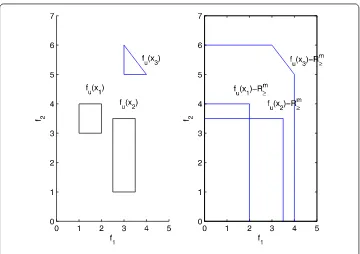
Example 1 Consider an uncertain multiobjective linear programming problem with two
objectivesf1=a˜T1x+b˜1andf2=a˜T2x+b˜2. The left picture in Figure 1 refers to (UMLP) with
feasible setX={x1,x2,x3}, and the three setsfU(x1),fU(x2),fU(x3) are polyhedrons. In the
right picture, we can see that none offU(x1) –Rm≥ andfU(x2) –Rm≥contains any other set
fU(xi), and thusx1andx2are both robust efficient. On the other hand,fU(x3) –Rm≥contains
fU(x1) andfU(x2), and thusx3is not robust efficient.
Having introduced the definition of robust efficient solutions for uncertain multiobjec-tive linear programs (UMLPs), in Sections 3 and 4, we use two scalarization methods, the weighted sum method and the-constraint method, to find the robust efficient solution for (UMLP).
3 Weighted sum scalarization
Figure 1 Illustration of robust efficient solution.
as follows:
min
m
i=1
λi
aTi x+bi
s.t.
m
i=1
λi= 1,
λi≥0,i= 1, 2, . . . ,m,
x∈X.
(WSP)
We now use the weighted sum scalarization method to reduce an uncertain multiob-jective linear programming problem to a single obmultiob-jective uncertain linear programming problem in order to compute robust efficient solutions by computing robust optimal solu-tions for the uncertain single objective linear programming problem. Next, we introduce the robust counterpart of the weighted sum scalarization problem of an uncertain multi-objective linear programs (RWSPs) as:
min max
(a˜i,˜bi)∈Ui
m
i=1
λi
˜
aTix+b˜i
s.t.
m
i=1
λi= 1,
λi≥0,i= 1, 2, . . . ,m,
x∈X.
Lemma 1 Given an uncertain multiobjective linear programming problem(UMLP),if x∗∈ X is the unique optimal solution to(RWSP),then x∗is robust efficient solution for(UMLP).
Proof Assum thatx∗is not robust efficient solution for (UMLP). Then there existsxˆsuch thatfU(xˆ)∈fU(x∗) –Rm. This implies that, for all (a˜i,b˜i)∈Ui, there exists (α˜i,β˜i)∈Uisuch
that
˜
aTixˆ+b˜i≤ ˜αiTx∗+β˜i, ∀i= 1, 2, . . . ,m.
Now choose arbitrary but fixedλi≥0,i= 1, 2, . . . ,m, such that
m
i=1λi= 1. We have
m i=1 λi ˜
aTi xˆ+b˜i
≤ m i=1 λi ˜ αiTx∗+β˜i
≤ max
(α˜i,β˜i)∈Ui
m i=1 λi ˜
αiTx∗+β˜i
for all (a˜i,b˜i)∈Ui. This implies that
max
(a˜i,b˜i)∈Ui
m i=1 λi ˜
aiTxˆ+b˜i≤ max
(α˜i,β˜i)∈Ui
m i=1 λi ˜
αiTx∗+β˜i,
which contradicts the fact thatx∗is the unique optimal solution to (RWSP).
We further show that robust efficient solutions for uncertain multiobjective linear pro-gramming problems with ellipsoidal uncertainty sets and general uncertainty sets can be found by solving deterministic optimization problems using weighted sum scalarization and thus can be computed by existing technology of deterministic optimization problems.
3.1 Ellipsoidal uncertainty sets
Consider the ellipsoidal uncertainty sets
Ui=
(a˜i,b˜i) =
a0i,b0i+
l
j=1
ujaji,bji|u2≤1
, (U1)
wherei= 1, 2, . . . ,m, (a0i,b0i) are nominal values of (RWSP), (aji,bji) are the given directions of perturbation, andujare the uncertain variables withu
2≤1.
Theorem 1 Consider the uncertain multiobjective linear programming problem(UMLP)
with ellipsoidal uncertainty sets Uigiven as in(U1).If x∗is the unique optimal solution to the deterministic second-order cone programming
min m i=1 λi
a0iTx+b0i+Aix+Bi2
s.t. m
i=1
λi= 1, ()
λi≥0,i= 1, 2, . . . ,m,
x∈X,
where Aix+Bi= (ai1Tx+b1i,ai2Tx+b2i, . . . ,alTi x+bli)T,then x∗is a robust efficient solution for(UMLP).
Proof First, we show that (RWSP) with ellipsoidal uncertainty sets (U1) is equivalent to (DP1). Forxfixed, the worst-case residual of objective function in (RWSP) with ellipsoidal uncertainty sets (U1) can be rewritten as
max
(a˜i,b˜i)∈Ui
m i=1 λi ˜
aTix+b˜i
= max u2≤1
m i=1 λi
a0T i x+b0i
+ l j=1 uj
ajTi x+bji = m i=1 λi
a0iTx+b0i+ max u2≤1
l
j=1
uj
ajTi x+bji
.
LetAix+Bi= (ai1Tx+b1i,ai2Tx+b2i, . . . ,ailTx+bli)T. Then we have
m i=1 λi
a0iTx+b0i+ max u2≤1
l
j=1
uj
ajTi x+bji = m i=1 λi
a0iTx+b0i+ max u2≤1
uT(Aix+Bi)2
= m i=1 λi
a0iTx+b0i+Aix+Bi2 .
This implies that (RWSP) with ellipsoidal uncertainty sets (U1) is equivalent to (DP1). By Lemma 1 we derive that ifx∗is the unique optimal solution to (DP1), thenx∗is a robust
efficient solution for (UMLP).
3.2 General norm uncertainty sets
Consider the general norm uncertainty sets
Ui=
(a˜i,b˜i) =
a0i,b0i+ (ai,bi)|M(ai,bi)T≤δ , (U2)
whereMis ann×1 invertible matrix,δis a given positive constant, and · is a general norm. Given a general normxfor a real vectorx, its dual norm is given by
z∗=max x≤1z
Tx.
Theorem 2 Consider the uncertain multiobjective linear programming problem(UMLP)
to the deterministic optimization problem
min
m
i=1
λi
a0iTx+b0i+δM–1(x, 1)T∗
s.t. m
i=1
λi= 1,
λi≥0,i= 1, 2, . . . ,m,
x∈X,
(DP2)
then x∗is a robust efficient solution for(UMLP).
Proof First, we show that (RWSP) with general norm uncertainty sets (U2) is equivalent to (DP2). Forxfixed, the worst-case residual of objective function in (RWSP) with general norm uncertainty sets (U2) can be rewritten as
max
(a˜i,b˜i)∈Ui
m
i=1
λi
˜
aTix+b˜i
= max
M(ai,bi)T≤δ
m
i=1
λi
a0iTx+b0i+aTix+bi
=
m
i=1
λi
a0iTx+b0i+ max M(ai,bi)T≤δ
(ai,bi)(x, 1)T
=
m
i=1
λi
a0iTx+b0i+max
y≤1 y
TδM–1(x, 1)T
=
m
i=1
λi
a0iTx+b0i+δM–1(x, 1)T∗ .
This implies that (RWSP) with general norm uncertainty sets (U2) is equivalent to (DP2). By Lemma 1 we derive that ifx∗is the unique optimal solution to (DP2), thenx∗is a robust
efficient solution for (UMLP).
Remark
1. If the general norm uncertainty set is given by the Euclidean norm · 2, then (DP2)
can be formulated as a second-order cone optimization problem because the Euclidean norm is self-dual.
2. If the general norm uncertainty set is described by either · 1or · ∞, then (DP2)
can be formulated as a linear programming problem.
3. We consider the uncertainty set described by the D-norm was studied by Bertsimas and Sim [4–6]. The D-norm ofy∈Rnis given as follows:
yp={ max S∪t|S⊆N,|S|≤p,t∈N\S}
j∈S
|yj|+
p–p|yt|
wherep∈[1,n] is the maximum number of variables, andpis not necessarily integer. In other words,pis a parameter used for controlling the degree of conservatism of the solu-tion for (RWSP). Speaking directly, it is unlike that all of theyj,j= 1, 2, . . . ,n, will change.
The dual norm of the norm · pis given by
y∗p=maxy∞,y1/p
.
By Theorem 2 we can obtain that if the general norm uncertainty set is given by the D-norm, then (DP2) can also be formulated as a linear programming problem.
4
-constraint scalarization
-constraint scalarization is another approach for evaluating efficient solutions for deter-ministic multiobjective optimization problems. For arbitraryt∈ {1, 2, . . . ,m}and a param-eter vector∈Rm, the-constraint linear programming problem is defined as
minaTtx+bt
s.t. aTkx+bk≤k, ∀k∈ {1, 2, . . . ,m}\{t},
x∈X.
(ECP)
Note that, the problem (ECP) does not depend on the parameterk. We now extend the
-constraint method by reducing an uncertain multiobjective linear programming problem to a single objective uncertain linear programming problem. Therefore, we define the ro-bust counterpart of the-constraint scalarization problem of an uncertain multiobjective linear programming problem as follows:
min max
(a˜t,b˜t)∈Ut ˜
aTtx+b˜t
s.t. max
(a˜k,b˜k)∈Uk ˜
aTkx+b˜k≤k, ∀k∈ {1, 2, . . . ,m}\{t},
x∈X.
(RECP)
Lemma 2 Given an uncertain multiobjective linear programming problem(UMLP),if x∗∈ X is the unique optimal solution to(RECP)for some∈Rmand some t∈ {1, 2, . . . ,m},then x∗is a robust efficient solution for(UMLP).
Proof Assume thatx∗is not a robust efficient solution for (UMLP). Then there existsxˆ
such thatfU(xˆ)∈fU(x∗) –Rm. This implies that, for all (a˜i,b˜i)∈Ui, there exists (α˜i,β˜i)∈Ui
such that
˜
aTixˆ+b˜i≤ ˜αiTx∗+β˜i, ∀i= 1, 2, . . . ,m.
Then, in the constraints of (RECP), we obtain
max
(a˜k,b˜k)∈Uk ˜
akTxˆ+b˜k≤ ˜αkTx∗+β˜k≤ max
(α˜k,β˜k)∈Uk ˜
On the other hand, in the objective function of (RECP), we have
max
(a˜t,b˜t)∈Ut ˜
atTxˆ+b˜t≤ ˜αtTx∗+β˜t≤ max
(α˜t,β˜t)∈Ut ˜
αtTx∗+β˜t.
But thenxˆis feasible for (RECP) and has an equal or better objective value thanx∗. This is a contradiction to the assumption thatx∗is the unique optimal solution to (RECP).
Next, we show that robust efficient solutions for uncertain multiobjective linear pro-gramming problems with ellipsoidal uncertainty sets and general uncertainty sets can be found by solving deterministic optimization problems using-constraint scalarization and so can be computed by existing technology of deterministic optimization problems.
Theorem 3 Consider the uncertain multiobjective linear programming problem(UMLP)
with ellipsoidal uncertainty sets Uigiven as in(U1).If x∗is the unique optimal solution to the deterministic second-order cone programming
mina0tTx+b0t +Atx+Bt2
s.t. a0kTx+b0k+Akx+Bk2≤k, ∀k∈ {1, 2, . . . ,m}\{t},
x∈X,
(DP3)
where Aix+Bi= (a1iTx+b1i,a2iTx+b2i, . . . ,alTi x+bil)T, i= 1, 2, . . . ,m,then x∗ is a robust efficient solution for(UMLP).
Proof First, we show that (RECP) with ellipsoidal uncertainty sets (U1) is equivalent to (DP3). For fixedx, the worst-case residual of objective function in (RECP) with ellipsoidal uncertainty sets (U1) can be rewritten as
max
(a˜t,b˜t)∈Ut ˜
aTtx+b˜t
= max u2≤1
a0tTx+b0t+
l
j=1
uj
ajTt x+b
j t
=a0tTx+b0t+ max u2≤1
l
j=1
uj
ajTt x+b
j t
.
LetAtx+Bt= (at1Tx+b1t,at2Tx+b2t, . . . ,atlTx+blt)T. Then we have
a0tTx+b0t + max u2≤1
l
j=1
uj
ajTt x+b
j t
=a0tTx+b0t+ max u2≤1
uT(Atx+Bt)2
Using a similar approach in the objective function, we can derive that the worst-case of constraints in (RECP) can be rewritten as
max
(a˜k,b˜k)∈Uk ˜
akTx+b˜k=ak0Tx+b0k+Akx+Bk2≤k, ∀k∈ {1, 2, . . . ,m}\{t}.
From the previous conclusions we have that (RECP) with ellipsoidal uncertainty sets is equivalent to (DP3). By Lemma 2 we derive that ifx∗ is the unique optimal solution to (DP3), thenx∗is a robust efficient solution for (UMLP).
Theorem 4 Consider the uncertain multiobjective linear programming problem(UMLP)
with general norm uncertainty sets Uigiven as in(U2).If x∗is the unique optimal solution to the deterministic optimization problem
mina0tTx+b0t +δM–1(x, 1)T∗
s.t. a0kTx+b0k+δM–1(x, 1)T∗≤k, ∀k∈ {1, 2, . . . ,m}\{t},
x∈X,
(DP4)
then x∗is a robust efficient solution for(UMLP).
Proof First, we show that (RECP) with general norm uncertainty sets (U2) is equivalent to (DP4). For fixedx, the worst-case residual of objective function in (RECP) with general norm uncertainty sets (U2) can be rewritten as
max
(a˜t,b˜t)∈Ui ˜
aTtx+b˜t
=a0tTx+b0t+ max M(at,bt)T≤δ
(at,bt)(x, 1)T
=a0tTx+b0t+max
y≤1 y
TδM–1(x, 1)T
=a0tTx+b0t+δM–1(x, 1)T∗.
Using a similar approach in the objective function, we can derive that the worst-case of constraints in (RECP) can be rewritten as
max
(a˜k,b˜k)∈Uk ˜
aTkx+b˜k=a0kTx+b0k+δM–1(x, 1)T
∗≤
k, ∀k∈ {1, 2, . . . ,m}\{t}.
From the previous conclusions we have that (RECP) with general norm uncertainty sets is equivalent to (DP4). By Lemma 2, we derive that ifx∗is the unique optimal solution to (DP4), thenx∗is a robust efficient solution for (UMLP).
Remark
1. If the general norm uncertainty set is given by the Euclidean norm · 2, then (DP4)
can be formulated as a second-order cone programming with second-order cone constraints.
2. If the general norm uncertainty set is given by either · 1or · ∞, then (DP4) can
3. If the general norm uncertainty set is described by the D-norm · p, then (DP4) can
also be formulated as a linear programming problem.
5 Conclusions
Multiobjective optimization and robust optimization have been well studied, but they are rarely considered in combination. In this paper, we consider the multiobjective linear pro-grams where coefficients in the objective function belong to uncertain-but-bounded sets. First, we introduce the concept of a robust efficient solution to uncertain multiobjective linear programs. We also introduce two common scalarization methods, the weighted sum scalarization and-constraint scalarization, to compute robust efficient solutions of uncertain multiobjective linear programs. Finally, we obtain that the robust efficient solu-tions of uncertain multiobjective linear programs can be computed by some deterministic optimization problems using both weighted sum method and-constraint method.
Funding
This work was supported by the National Natural Science Foundation of China (Grant No. 11401484).
Competing interests
The authors declare that they have no competing interests.
Authors’ contributions
Both authors contributed equally to this work. Both authors read and approved the final manuscript.
Publisher’s Note
Springer Nature remains neutral with regard to jurisdictional claims in published maps and institutional affiliations.
Received: 6 October 2017 Accepted: 3 January 2018
References
1. Soyster, A: Convex programming with set-inclusive constraints and applications to inexact linear programming. Oper. Res.21, 1154-1157 (1973)
2. Ben-Tal, A, Nemirovski, A: Robust convex optimization. Math. Oper. Res.23(4), 769-805 (1998)
3. Ben-Tal, A, Nemirovski, A: Robust solutions of uncertain linear programs. Oper. Res. Lett.25(1), 1-13 (1999) 4. Bertsimas, D, Sim, M: The price of robustness. Oper. Res.52(1), 1-34 (2003)
5. Bertsimas, D, Pachamanova, D, Sim, M: Robust linear optimization under general norms. Oper. Res. Lett.32, 1-12 (2004)
6. Bertsimas, D, Sim, M: Robust discrete optimization and network flows. Math. Program.98, 49-71 (2003) 7. El-Ghaoui, L, Lebret, H: Robust solutions to least squares problems with uncertain data. SIAM J. Matrix Anal. Appl.
18(4), 1035-1064 (1997)
8. El-Ghaoui, L, Oustry, F, Lebret, H: Robust solutions to uncertain semidefinite programs. SIAM J. Optim.9, 33-52 (1998) 9. Iyengar, G: Robust dynamic programming. Math. Oper. Res.30(2), 1-21 (2005)
10. Iyengar, G, Erdogan, E: Ambiguous chance constrained problems and robust optimization. Math. Program.107, 17-31 (2006)
11. Ben-Tal, A, El-Ghaoui, L, Nemirovski, A: Robust Optimization. Princeton Series in Applied Mathematics. Princeton University Press, New Jersey (2009)
12. Cho, SY: Strong convergence analysis of a hybrid algorithm for nonlinear operators in a Banach space. J. Appl. Anal. Comput.8, 19-31 (2018)
13. Chen, JW, Kobis, E, Kobis, MA, Yao, JC: Optimality conditions for solutions of constrained inverse vector variational inequalities by means of nonlinear scalarization. J. Nonlinear Var. Anal.1, 145-158 (2017)
14. Su, TV, Dinh, TV: On the existence of solutions of quasi-equilibrium problems (UPQEP), (LPQEP), (UWQEP) and (LWQEP) and related problems. Commun. Optim. Theory2016, Article ID 3 (2016)
15. Tung, LT: Strong Karush-Kuhn-Tucker optimality conditions and duality for nonsmooth multiobjective semi-infinite programming via Michel-Penot subdifferential. J. Nonlinear Funct. Anal.2017, Article ID 49 (2017).
16. Miettinen, K: Nonlinear Multiobjective Optimization. Kluwer Academic, Boston (1999)
17. Ehrgott, M: Multicriteria Optimization. Lectures Notes in Economics and Mathematical Systems. Springer, Berlin (2005)
18. Deb, K, Gupta, H: Introducing robustness in multi-objective optimization. Evol. Comput.14(4), 463-494 (2006) 19. Kuroiwa, D, Lee, G: On robust multiobjective optimization. Vietnam J. Math.40, 305-317 (2012)
20. Ehrgott, M, Ide, J, Schobel, A: Minimax robustness for multi-objective optimization problems. Eur. J. Oper. Res.239(1), 17-31 (2014)
21. Goberna, M, Jeyakumar, V, Li, G, Vicente-Perez, J: Robust solutions to multi-objective linear programs with uncertain data. Eur. J. Oper. Res.242(3), 730-743 (2015)