1367
DEVELOPING EFL LEARNERS’ COMMUNICATIVE
COMPETENCE THROUGH
MULTIMEDIA-ASSISTED LANGUAGE LEARNING
KYEONG-OUK JEONG
Hannam University, Department of English Education, Graduate School of Education, Korea E-mail: [email protected]
ABSTRACT
The purpose of this study is to explore ways how to develop English as a foreign language learners’ communicative competence through the use of multimedia-assisted language instruction. This paper tries to explore the impact of using authentic multimedia and effective instructional strategies in order to motivate university students’ English language learning. This study also tried to find out students’ perception and attitudes toward engaging in multimedia-assisted language learning materials and classroom activities for their English study. This paper investigates how the utilization of multimedia and technology-enhanced instructional strategies can foster learner motivation and autonomy in their EFL learning. This study first explains the notion of communicative competence which has been derived from the paradigm of communicative language teaching and then portrays how the integration of multimedia-enhanced language learning resources and instructional strategies can support university students to develop their communicative competence and integrated four English skills, especially presentation skills. In this study, EFL university students responded that they could develop their English communicative competence while they were engaging in the multimedia-assisted language learning. Participants of this study expressed that language learning materials using multimedia were very entertaining and informative for their English study. They evaluated their English learning experience through the use of multimedia as effective and motivating. The result of this study revealed that authentic multimodal English language learning materials and classroom activities using multimedia could be served as motivating factors to improve English as a foreign language learners’ communicative competence as well as to boost their English language learning motivation and autonomous learning experience.
Keywords: Multimedia-assisted language learning, Communicative competence, Learner motivation, EFL
1. INTRODUCTION
Over the past several decades, developing English
as a foreign language (EFL) learners’
communicative competence has gained much attention among researchers and educators around the globe as the paradigm of English education has shifted from form-focused theoretical orientation into the direction of meaning-focused pedagogy. This change has been the result of constructivist movement which emphasizes the importance of social interaction in language learning and the value of meaningful context and cooperative learning community [1]. In the constructivist perspectives, the conventional pedagogical emphasis has moved away from the focus on teaching to the focus on learning; from teacher-directed to learner-initiated. For constructivists, the goal of education is to help learners transform and grow as proactive agents of their own learning process. This standpoint makes it
possible for the learners to be transformed as the major agents in their learning. Accordingly, in the field of English as a foreign and second language education, the goals of classroom English language education based on constructivism are not just indoctrinating simple linguistic skills and English language pattern drills or emphasizing rote memorization. Instead, educators have tried to develop EFL learners’ communicative competence, helping them understand the importance of
meaningful social interaction, active
communication, discovery of meaning, shared learning communities, and collaboration with peer during their English language learning process [2].
1368 education [3]. MALL can be generally defined as any instructional practice that encourages English language learners to use authentic multimedia in order to enrich their English language learning experience. The accessibility and availability of well-resourced multimedia equipment and various multimodal English language learning and teaching materials in language classrooms have played a crucial role in developing the new trend for English as a foreign language learning and teaching [4]. The prevalent development of multimedia and new technology has made it possible that English language educators and curriculum developers should rethink the use of the traditional English language teaching resources and instructional techniques, which has become somewhat old-fashioned in the era of new digital technologies. The progresses in diverse educational technology have also led to a relentless search for more effective and reliable teaching methods and instructional strategies in the English language classrooms. By integrating new technology into English language classrooms, the pedagogical practices in which knowledge is transmitted have been dramatically transformed and enhanced. Because English language learners’ perspectives and learning experiences have been greatly enriched by implementing authentic multimodal language learning resources and innovative technologies, it has been possible for English language learners to develop their English communicative competence and four integrated English language skills simultaneously [5].
Consequently, the evolving paradigm of EFL pedagogy and instructional environment using multimedia-assisted language learning have brought a paradigm shift away from the conventional EFL instructional practice to technology-enhanced language education [6]. Under the constructivists’ perspectives, this paradigm shift has also transformed the role of teachers from a knowledge distributer to a facilitator or a guide who can help learners expand their capacity in solving problems, making educated decisions, and thinking critically. Under the premises of constructivism in EFL education field, the emphasis of the English language learning process has been transferred to learners, so English language learners can take the initiative in their own learning through the development of communicative competence, instead of depending on the teacher in conventional English language classrooms [7].
The purpose of this study is to develop EFL university learners’ communicative competence using multimedia-assisted language learning and
teaching. This study examines how the use of multimodal instructional English learning resources and effective classroom activities based on multimedia-assisted language teaching strategies can help develop English as a foreign language learners’ communicative competence and four integrated English language skills in university English language instruction. This study also investigates how the integration of multimedia and technology-enhanced instructional strategies can foster learner motivation and autonomy in university EFL learning. This study then examines how the use of MALL has influenced students’ English language learning experience and interactional classroom dynamics.
2. RELATED RESEARCH
2.1 Theoretical Background of
Multimedia-assisted Language Learning
Since the computer and new educational technology were incorporated into language teaching, many educators and EFL learners have engaged in utilizing multimodal learning materials and educational technology such as learning management system, discussion boards, weblog, social networks, and internet on a daily basis. Accordingly, multimedia-assisted English language learning and teaching has been introduced into the field of English education as the plausible alternative of the traditional pedagogical framework [8]. The prevalent use of technology in English language learning and teaching corresponds with the introduction of sociocultural theory of learning based on constructivist perspectives. With the benefit of multimedia and computer related English language learning and teaching environments, a lot of educators and researchers embrace the notion that more meaningful learning occurs through social interaction with others in authentic and interactive
communicative contexts [8].
1369 while learners engage in constructing their own learning and meaning making. Learners activate new information and abilities upon pre-existing knowledge in more collaborative and autonomous manner. Students develop new information and knowledge according to their own needs and interests, taking initiatives in their own learning activities and outcomes. By integrating multimedia applications into English language learning, learners can be engaged in learning activities that can
cultivate critical thinking skills. Various
multimedia-facilitated language learning and teaching environment can provide English language learners with the salient support and successful learning experiences in order to develop English language learners’ communicative competence. Interactive multimodal English language learning resources can offer authentic learning experiences for practicing all language skills, including speaking, listening, writing, and reading.
2.2 Authentic Multimedia and Innovative
Instructional Strategies in EFL Classrooms
Thanks to the development of information and communication technologies, schools around the world have attempted to implement various educational technology and state-of-the-art teaching techniques into EFL instruction both to boost digital-native learners’ learning motivation and to facilitate their language learning experience [11]. The use of authentic multimedia in language classrooms has some benefits because it can provide language learners with genuine and self-motivated learning environment. Using authentic multimedia in language learning can also cultivate learner motivation and autonomy as well as learning interests. Research results showed that by the use of multimedia-related classroom techniques students could develop better oral skills and this technique could be regarded as an important tool in foreign language learning and teaching [12]. Studies have also reported the benefits of a mixture of audio, picture, and video language learning in comparison to text only materials in offering new knowledge [13] [14]. In terms of the modality principle, audio or video language learning materials simultaneously require both the visual working memory and auditory working memory, while text only language learning materials contain only the visual working memory.
Multimedia language learning resources can be utilized as the supplement and improvement of traditional English language learning and teaching since they offer genuine aural and visual English learning resources that can be motivating and
engaging [13]. These appealing features can help language learners study with the multimodal
learning materials enthusiastically. Integrating
multimodal language learning contents such as text, images, audios, or videos can trigger language learners’ curiosity and increase participation in
classroom learning activities. Classroom
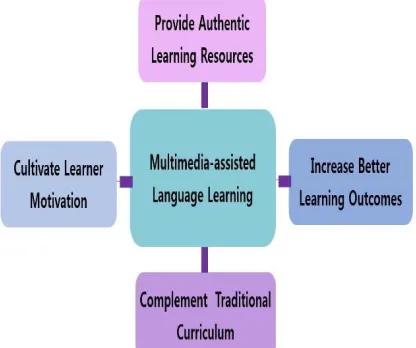
[image:3.612.314.522.327.501.2]instructional practice using multimedia can create genuine environment for language learning through simulations, role plays, or class discussion. Multimedia technology can be an outstanding channel for maximizing learners’ language output [15]. Learners can acquire auditory and visual stimulation, which can activate their language input into the level of long-term knowledge and can also provide learners with enhanced possibilities of accomplishing integrated English four language skills [16]. Figure 1 shows the benefits of multimedia-assisted language learning.
Figure 1: Benefits of Multimedia-assisted Language Learning
Since EFL settings may have environmental constraints such as students’ diversity in English proficiency levels, socioeconomic disparity between urban and rural schools, diverse class sizes, and time constraints, the availability and accessibility of English learning resources such as audiovisual materials and more recently digital learning resources in EFL language classroom become significant in improving learner motivation and achievement. Integrating technology into English language education allows addition of multisensory features that can offer meaningful contexts to promote learning comprehension so as to broaden the learning ground of language and linguistics beyond the classrooms [17].
1370 shadowing technique, which is integrated into multimedia-assisted language learning, has been regarded one of the most effective instructional techniques. This shadowing technique can be incorporated into language education in order to improve listening comprehension as well as speaking fluency [18]. This technique was originally created to train simultaneous language interpreters and then later it was pedagogically implemented in the realm of second or foreign language education. Shadowing is considered to be a dynamic and greatly cognitive practice in which language learners can track the aural form of the speech and articulate it as clearly as possible with the concurrent manner while they are listening to it [19]. Many language educators could see the benefits of the shadowing technique in cultivating communicative competence of language learners since shadowing was proved to play a crucial role in boosting language learners’ linguistic competence in both speaking and listening [20].
2.3 Developing Communicative Competence in
EFL Education
In the field of English as a second or foreign language learning and teaching, communicative language teaching(CLT) has gradually become a dominant paradigm around the world as a new or innovative way of learning and teaching English, replacing the conventional way of form-focused English language learning and teaching. This approach was emerged as the reaction against
grammar-based English language teaching
approaches like audiolingual approach. The foremost pedagogical notion of communicative language teaching is to foster English language learners’ communicative competence. The term communicative competence was coined by Hymes and referred to not only the implicit knowledge of a language and the ability to use it appropriately [21]. This concept was proposed as the disapproval at the concept of Chomsky’s idealized ideas of purely linguistic competence. Chomsky proposed linguistic competence was as the only theoretical foundation of methodology of English language learning, teaching, and assessment [22]. However, the term communicative competence was suggested to alter Chomsky’s notion of linguistic competence into a broader and more genuine concept of competence [23]. The newly proposed concept of communicative competence embraced language competence not only as an essential linguistic competence but also as the ability to utilize linguistic competence appropriately in various communicative contexts. Thus, the term communicative competence has
brought the sociolinguistic perspectives into Chomsky’s linguistic perspectives of language competence [24]. Having English communicative competence means that an English language user has sociocultural knowledge about when and how to speak the intended utterances properly beyond just having grammatical knowledge of English such as
syntactic, morphological, phonetical, and
phonological knowledge. The concept of
communicative competence can be characterized by means of manifestation, interpretation, and negotiation of meaning in communication.
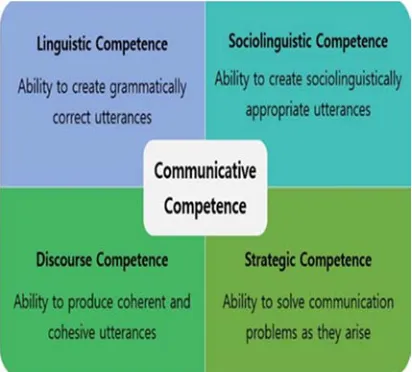
[image:4.612.315.521.335.521.2]Having communicative competence can be defined into several categories. According to the categorization, communicative competence has four sub-categories; grammatical competence, discourse competence, sociolinguistic competence, and strategic competence. Figure 2 shows four sub-categorizations of the communicative competence and their features according to the definition [25].
Figure 2: Sub-categories of Communicative Competence
1371 of listening, speaking, reading, and writing. To master this, English language learners should be able to understand rhetorical device for conversational organization, which includes cohesion and coherence in different genres of texts. Strategic competence has to do with compensatory strategies in conversational settings in case of linguistic, sociolinguistic, or discourse complications. This ability includes English language learners’ effective use of tactics in terms of verbal and non-verbal resources to repair their linguistic errors that can arise in communication due to different events that may limit the communicative process. These strategies include using avoidance tactics, reference resources, and paraphrase, as well as using requests for repetition, clarification, or slower speech [26].
Using a language appropriately in
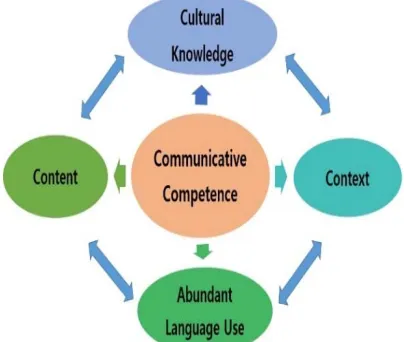
communication means to know the relationship between the utterances and their contexts of using them appropriately. To be communicatively competent, all these features of communicative competence should be meaningfully interweaved into intercultural understanding, communicative context, and abundant exposure to language use as well as the knowledge of conversational contents. Figure 3 represents all the interrelated relationship of
[image:5.612.93.295.422.593.2]these aspects of communicative competence.
Figure 3: Relationship in the Aspects of Communicative Competence
According to the perspective of constructivism, the English language learning and teaching filed meets the twenty-first century with the clear emphasis on meaningful social interaction. For communicative language teaching, it is crucial that English language learners should be engaged in doing authentic things with English and should make meaningful connection between the self and the
world through the medium of language, not merely knowing about the language [27].
3. RESEARCH CONTEXT AND METHOD
The participants of this study were freshmen in a university located in the central part of Korea. They enrolled in a general English course and this course was a mandatory course. The course was given twice per week for 90 minutes as a three credit course. To conduct this research, 69 students took part in the English language learning procedure using multimedia-assisted format in order to assist their English language learning. The English proficiency level of the participants was in the upper-intermediate or advanced level. The objective of the course was to develop English communicative competence and to improve integrated four English language skills, especially presentation skill. The course format of this study was based on a blended learning framework, which utilized authentic multimodal English learning resources and materials from various Internet websites. For instructional strategy, the shadow-speaking method was used as a language learning and teaching technique. Since students in this study were expected to be tech-savvy digital natives, various digital devices such as smartphones, laptops, or pads were utilized for the implementation of technology-enhanced English language learning and teaching.
For data collection and data analysis, five-Likert questionnaire survey and semi-structured interview were conducted. The data collecting tools for this study were designed to investigate the impact of using authentic multimedia in order to develop EFL university students’ communicative competence and motivate their English language learning process. The data were also collected in order to find out EFL university students’ perception and attitude of experiencing multimedia-assisted language learning and technology-enhanced classroom activities for their English study.
1372 the given news headlines. During the simulation activities, the participants were engaged in their speaking and presentation practice as a group and they helped to monitor their group members speaking performance through collaborating each other and providing peer-feedback. The instructor encouraged the students to raise their awareness on their intonation and rhythm of speech tone in order to improve their English language fluency as well as their accuracy of English speaking. Right after the group practice, the class time was given for the participants in order to develop their communicative competence by announcing news headlines as if they were news reporters.
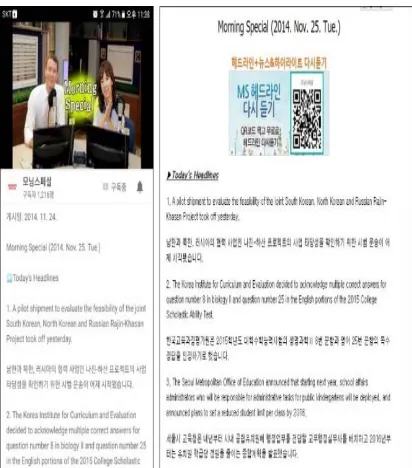
[image:6.612.317.524.191.470.2]After the classroom session, students were required to record their English news speaking as voice talk and post it on the social networking system, which was used as an interactive course platform for the class. The topic of the new headlines was selected among the themes that might be relevant and appealing to their needs and interests as EFL university students. Figure 4 shows one of the websites used for this study [28].
Figure 4: Multimedia Materials for the Course (EBS, 2014)
4. RESULT AND DISCUSSION
According to the data analysis of the research result, the participants of this study provided positive responses about their English learning experience using multimedia-assisted English language learning resources and shadow speaking as their classroom learning technique. They generally perceived
[image:6.612.318.523.195.470.2]multimedia-assisted English learning activities and course learning materials as motivating and entertaining as well as informative and engaging. Table 1 below shows the students’ responses related to the use of multimodal English learning materials and learning resources for the course.
Table 1: Students’ Responses Related to the Use of Multimedia-assisted Learning Materials
Question Items Mean
The topics for English speaking
practice using multimodal
learning resources were
informative and entertaining.
4.2
I can acquire a lot of genuine
vocabulary and English
expression using multimodal English learning resources.
4.0
I could develop my confidence in
English speaking using
multimodal English learning resources.
3.9
I could develop my confidence in
English listening using
multimodal English learning resources.
3.8
I was motivated in my English
study using multimodal English learning resources.
4.0
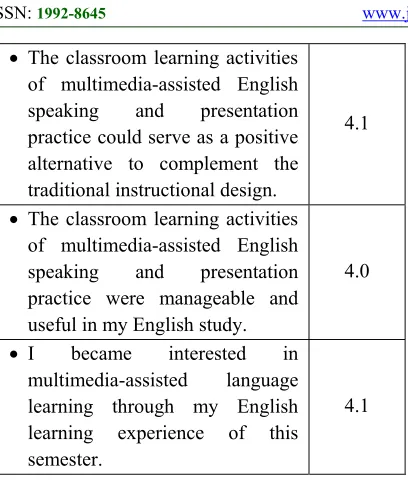
Table 2 below shows the students’ responses related to the perspectives about the multimedia-assisted classroom learning activities for their English study.
Table 2: Students’ Responses Related to the Multimedia-assisted Classroom Learning Activities
Question Items Mean
The classroom learning activities
of multimedia-assisted English
speaking and presentation
practice were helpful for the
improvement of my
pronunciation, intonation, and rhythm of English speech.
4.0
The classroom learning activities
of multimedia-assisted English
speaking and presentation
practice were stimulating and new.
[image:6.612.90.296.369.603.2]1373
The classroom learning activities
of multimedia-assisted English
speaking and presentation
practice could serve as a positive alternative to complement the traditional instructional design.
4.1
The classroom learning activities
of multimedia-assisted English
speaking and presentation
practice were manageable and useful in my English study.
4.0
I became interested in
multimedia-assisted language
learning through my English learning experience of this semester.
4.1
[image:7.612.96.300.72.312.2]According to the research result, among 69 participants, 54 students (78.3%) responded that English learning materials using multimedia and the topics of English speaking and presentation practice were entertaining and informative. This response was compatible to the previous study result in that multimedia-related language learning materials could offer genuine aural and visual English learning resources that can be motivating and engaging [13]. Students in this study considered studying English through the use of multimedia as effective and motivating learning experiences. Figure 5 shows students’ perception for the multimedia-assisted learning materials as entertaining and informative.
Figure 5: Students’ Response to the Entertaining Aspect of Using MALL Resources
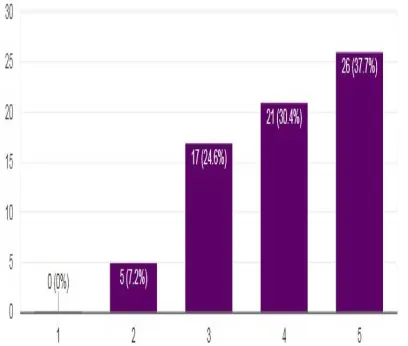
Among the participants, 55 students (79.7%) also responded that they could acquire a lot of vocabulary
and genuine English expression. As the previous research results already revealed, classroom instructional practice using multimedia can create genuine environment for language learning and multimedia technology can be an outstanding channel for maximizing learners’ language output [15]. According to the open-ended questionnaire survey response, the participants perceived that the integration of multimedia learning materials has made it possible to learn authentic English expression that they could not learn from the written textbook. From semi-structured interview, one of the participants stated,
Through multimedia-assisted language
learning experience, I could have chances to practice announcing news headline like a news reporter. It was a great experience because I hardly had chances to make a presentation in public. I think I could improve my communicative competence (Data from the semi-structured interview).
[image:7.612.316.519.412.586.2]Figure 6 shows students’ perception for the authentic feature of multimedia-assisted learning materials.
Figure 6: Students’ Response to the Authentic Aspect of Using MALL Resources
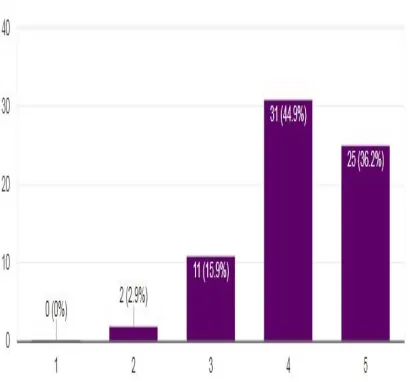
[image:7.612.93.296.507.669.2]1374 language learning experience [11]. From semi-structured interview, one of the participants said,
I could develop self-confidence in English speaking because the classroom activities using multimedia and smart devices were impressive enough to boost motivation in his English study (Data from the semi-structured interview).
Figure 7 shows students’ perception for the motivating factor of using multimedia-assisted learning materials.
Figure 7: Students’ Response to the Motivating Aspect of Using MALL Resources
[image:8.612.316.521.100.265.2]Among the participants, 51 students (73.9%) also responded that the classroom learning activities of multimedia-assisted English language speaking and presentation practice were helpful for the improvement of their pronunciation, intonation and rhythm of English speech. This response corresponded to research results showing that by the use of multimedia-related classroom techniques students could develop better oral skills and this technique could be regarded as an important tool in foreign language learning and teaching [12]. Figure 8 shows students’ perception for the informative aspect of experiencing multimedia-assisted learning activities.
Figure 8: Students’ Response to the Informative Aspect of Using MALL Activities
Among the participants, 56 students (81.1%) also responded that the classroom learning activities of multimedia-assisted English learning could serve as a positive alternative to complement traditional instructional design. This result was coherent to the previous study that multimedia-assisted English language learning and teaching had been introduced into the field of English education as the plausible alternative of the traditional pedagogical framework
[8]. Participants of this study could appreciate the
value of meaningful classroom interaction and peer cooperation. From semi-structured interview, one of the participants said,
Having a group as a cooperative and
supporting learning community could
motivate and challenge me to study more. It was like I could do more work-out when I went to the gym, compared to working out alone at home (Data from the semi-structured interview).
Figure 9 shows students’ perception for the innovative instructional aspect of using MALL activities.
[image:8.612.93.297.269.442.2]1375 Figure 9: Students’ Response to the Innovative Instructional Aspect of Using MALL Activities
5. CONCLUSION
This study examines the ways how to foster English as a foreign language learners’ communicative competence through the use of multimedia-assisted language instruction and also to scrutinize the effect of using genuine multimedia-assisted language learning resources and effective instructional strategies in order to motivate university students’ English language learning. Overall, the findings of this study suggest that integrating multimedia resources and technology-enhanced classroom activities into EFL university English instruction was beneficial for improving university students’ English study and motivating their learning experience. To foster motivating and engaging pedagogical learning environment for tech-savvy digital native EFL university students, EFL educators and researchers should never stop relentless efforts to incorporate the most effective channel to promote English as a foreign language learners’ communicative competence [29] [30]. The result of this study might provide insights about how to implement authentic multimedia and effective instructional strategies in order to motivate EFL university students’ English language learning.
REFRENCES:
[1] Vygotsky, L. S., Mind in Society, Cambridge:
Harvard University Press, 1978.
[2] Slavin, R., Educational Psychology: Theory and
Practice, Boston: Allyn and Bacon, 2003.
[3] Klassen, J., and Milton, P., “Enhancing English Language Skills using Multimedia: Tried and
Tested”, Computer Assisted Language Learning,
Vol. 12, No. 4, 1999, pp. 281-294.
[4] Rahini, M., and Hosseini, F., “The Impact of Computer-based Activities on Iranian High-School Students’ Attitudes towards
Computer-assisted Language Learning”, Procedia
Computer Science, Vol. 3, 2011, pp, 183-190.
[5] Hu, Z., Li, M., and Zou, H., “Internet-assisted
College English Teaching in China”, IERI
Procedia, Vol. 2, 2012, pp. 623-629.
[6] Marina, S. T., “Facing the Challenges, Getting the
Right Way Distance Learning”, Education at a
Distance, Vol. 15, 2001, pp. 1-8.
[7] Jeong, K. O., “A Study on the Integration of Google Docs as a Web-based Collaborative Learning Platform in EFL Writing Instruction”,
Indian Journal of Science and Technology, Vol.
9, No. 39, 2016, pp. 1-7.
[8] Wilhelm, J. D., and Friedemann, P. D.,
Hyperlearning: Where Project, Inquiry, and
Technology Meet. York, ME: Stenhouse
Publishers, 1998.
[9] O'Neil, J., “Our Schools as Learning Organizations: A Conversation with Peter
Senge”, Educational Leadership, Vol. 52, No. 7,
1995, pp. 20-23.
[10] Jonassen, D. H., Computers as Mindtools for
Schools, Upper Saddle River, NJ: Prentice-Hall,
2000.
[11] Jeong, K. O., “Integrating a Web-based Platform to Promote Creativity and Authenticity in
Language Classrooms”, International Journal
Knowledge and Learning, Vol. 11, Nos. 2/3,
2016, pp. 127-136.
[12] Razmia, M., Pouralib, S., and Nozad, S., “Digital
Storytelling in EFL Classroom (Oral
Presentation of the Story): A Pathway to Improve
Oral Production”, Procedia-Social and
Behavioral Sciences, Vol. 98, 2014, pp.
1541-1544.
[13] Marzban, A., “Investigating the Role of Multimedia Annotations in EFL Reading
Comprehension”, Procedia-Social and
Behavioral Sciences, Vol. 28, 2011, pp. 72-77.
[14] Mayer, R., and Moreno, R., “Information
Processing and Multimedia Usability”, Journal
of Educational Psychology, Vol. 91, 1998, pp.
358-368.
[15] Hwang, W. Y., Shadiev, R., Hsu, J. L., Huang, Y. M., Hsu, G. L., and Lin, Y. C., “Effects of Storytelling to Facilitate EFL Speaking Using
1376
Assisted Language Learning, Vol. 2, No. 2,
2016, pp. 215-241.
[16] Yi, L. X., “A Tentative Exploration on the Use of Multi-media in College English Education”,
AASRI Procedia, Vol. 1, 2012, pp. 282-286.
[17] Ramasubbu, S., “How Technology Can Help Language Learning”, retrieved from the website
https://www.huffingtonpost.com/suren-ramasubbu/how-technology-can-help- l_b_7489002.html
[18] Zakeri, E., “The Effect of Shadowing on EFL Leaners’ Oral Performance in Terms of
Fluency”, International Journal of English
Language Teaching, Vol. 2, No. 1, 2014, pp.
21-26.
[19] Nekoueizadeh, M., and Bahrani, T., “The Effect of Conversational Shadowing on Teaching and
Learning Conditional Sentences”, International
Journal of Language Learning and Applied
Linguistics World, Vol. 4, No. 1, 2013, pp.
253-267.
[20] Murphey, T., “Exploring Conversational
Shadowing”, Language Teaching Research, Vol.
5, 2001, pp. 128-155.
[21] Hymes, D., “Models of the Interaction of Language and Social Life”, in J. J. Gumperz and
D. Hymes (Eds.), Directions in Sociolinguistics:
The Ethnography of Communication, Austin, TX:
Holt, Rinehart and Winston, 1972, pp. 1-19.
[22] Chomsky, N., Aspects of the Theory of Syntax,
Cambridge, MA: The M.I.T. Press, 1965.
[23] Savignon, S. J., Communicative Competence:
Theory and Classroom Practice. Texts and
Contexts in Second Language Learning, Reading,
MA: Addison-Wesley Publishing Company, 1983.
[24] Vesna, B., “Defining Communicative
Competence”, Metodika, Vol. 8, No. 1, 2007, pp.
94-103.
[25] Canale, M., and Swain, M., “Theoretical Bases of Communicative Approaches to Second
Language Teaching and Testing”, Applied
Linguistics, Vol. 1, No. 1, 1980, pp. 1-47.
[26] Reinhold, P., What Is the Matter With
Communicative Competence?: An Analysis to Encourage Teachers of English to Assess the
Very Basis of Their Teaching, London, UK: LIT
Verlag, 2005.
[27] Savignon, S. J., Interpreting Communicative
Language Teaching, New Haven, CT: Yale
University Press, 2002.
[28] Morning Special, Korea Educational
Broadcasting System, Seoul, 2014.
[29] Jeong, K. O., “Preparing EFL Student Teachers with New Technologies in the Korean Context”,
Computer Assisted Language Learning, Vol. 30,
No. 6, 2017, pp. 489-509.
[30] Choi, M. H., “Multimedia Application and Ubiquitous English Education Environment”,
Journal of Digital Contents Society, Vol. 13, No.