ORIGINAL RESEARCH ARTICLE
USE OF THE PROTOCOL OF SAFE SURGERY BY NURSING PROFESSIONALS
Bruno Oliveira de Melo, *Ericka Holmes Amorim, Brígida Karla Fonseca Anízio, Jiovana de Souza Santos,
Rozileide Martins Simões Candeia, Angélica Barros Araújo and Leila de Cássia Tavares da Fonseca
Centro Universitário de João Pessoa, Paraíba – Brasil
ARTICLE INFO ABSTRACT
This study aims to analyze the use of the protocol of safe surgery by the nursing professionals of the Surgical Center of a hospital in the city of João Pessoa, PB. This is a descriptive, quantitative, exploratory, cross-sectional study that was carried out through the application of a structured questionnaire. The universe covered consisted of the nursing team working in the Surgical Center of the referred hospital, the sample consisted of 21 individuals, 4 nurses and 17 technicians. For that, all the ethical precepts of scientific research involving human beings were followed according to resolution 466/2012; this study was submitted to the Ethics Committee and approved with CAEE nº 93444218.0.0000.5176. Most professionals (20/ 95.2%) are familiar with PCS, more than half believe in its effectiveness (12 / 57.14%) and (16 / 76.19%) believe that it brings safety to the patient. Given this, it is noted that the professionals of the Surgical Center know the Protocol of Safe Surgery and consider it to be easy to understand. However, they still show a certain limitation in the moment of the use and filling of this material so important for all involved.
Copyright © 2019, Bruno Oliveira de Melo et al. This is an open access article distributed under the Creative Commons Attribution License, which permits unrestricted use, distribution, and reproduction in any medium, provided the original work is properly cited.
INTRODUCTION
According to the World Health Organization (WHO) (2009), in the world, every year, for every 25 people, surgery is performed, given that it has an importance with regard to patient safety, since half of the surgeries lead to complications and death, being factors that can be avoided in up to 50% of the cases. Based on this, WHO created in 2004 the World Alliance for Patient Safety, which aims to make professionals aware of the importance of safety in care. Thus, in 2007 and 2008, the aforementioned agency implemented the slogan Safe Surgery Safe Lives, which lists a list of procedures to be followed to reduce complications related to surgery and thus
ensure greater patient safety (WORLD HEALTH
ORGANIZATION, 2013). The primary purpose of surgical treatments is to save lives, but inaccuracies in safety and uncontrolled risks in surgical procedures can have disastrous consequences for patients. In this context, Moura and Diego (2014) report that, according to experts, wrong surgical procedures, in the wrong place, in the wrong patient are events that should never occur. Following this reasoning, some factors directly contribute to the occurrence of health care problems, which may involve both the structure and the professionals, namely: little experience of the surgeon, overwork, lack of material resources, deficiency in the supervision of trainees and deficits in communication among
professionals (GAWANDE, 2011). Thus, a system of validation of the safety of the surgeries, better known as a checklist, has been created in hospitals, in order to help the team to ensure greater safety. The use of this instrument is done in order to guarantee qualified assistance, through safety standards that can be inserted in all countries (FREITAS et al.,
2014). In this perspective, according to Pancieri et al. (2013), studies were performed and showed that the surgical checklist consisted of three stages, namely: Identification (prior to anesthetic induction or sign in), confirmation (prior to surgical incision or time out - surgical pause with presence of all team members in the operating room) and record (before the patient leaves the operating room or sign out). Moreover, with regard to the reduction of adverse events, this list is considered an essential element, since it guarantees safe measures for the surgical teams, seeing a greater safety of the surgical procedures and improvements in communication and teamwork (TANG; RANMUTHUGALA; CUNNINGHAM, 2014). Thus, in view of the above, the motivation and interest in the subject addressed appears, which could be observed through the stages of Nursing Care in Complex Units, performed at a Hospital Surgical Center (CC). Thus, there was a limitation in the application of the Safe Surgery Protocol through the hospital instrument and, to this end, the following question was raised: How does the surgical checklist apply to ensure its effectiveness? Therefore, the objective of this study
ISSN: 2230-9926
International Journal of Development Research
Vol. 09, Issue, 11, pp. 31139-31144, November, 2019
Article History: Received 16th August, 2019
Received in revised form 17th September, 2019
Accepted 02nd October, 2019
Published online 20th November, 2019
Available online at http://www.journalijdr.com
Key Words:
Surgery Center, Patient Safety, Nursing Professionals.
*Corresponding author: Ericka Holmes Amorim
Citation: Bruno Oliveira de Melo, Ericka Holmes Amorim, Brígida Karla Fonseca Anízio et al, 2019. “Use of the protocol of safe surgery by nursing
professionals”, International Journal of Development Research, 09, (10), 31139-31144.
is to analyze how the use of the Safe Surgery Protocol by nursing professionals in the CC of a hospital in the city of João Pessoa, PB and, as a specific objective, to investigate whether the tools used are effective for the application of the protocol.
METHODS
This is a field research of the descriptive type, quantitative-qualitative, exploratory, cross-sectional, and that was performed in the CC of a hospital in the city of João Pessoa, PB. The hospital has five surgical rooms, where about 12 surgeries per day are performed, totaling an average of 310 surgeries per month. For the calculation of the sample, the population of 35 members of the CC was considered, being 7 nurses and 28 nursing technicians. The sample was defined by the sample calculation for finite populations, assuming a significance level of 5% and a sampling error of 0.05 under a 95% confidence level. Thus, the sample of 27 participants was defined. However, of the nursing technicians, only 17 became available and correctly filled out the survey questionnaire. That is, five professionals were not found, four refused and two gave up participating in the survey, even after taking the questionnaire. A sample of 21 professionals, including 4 nurses and 17 nursing technicians, was completed. The inclusion criteria of the subjects in the sample involved nurses and nursing technicians belonging to the CC team of the referred hospital who had been working for at least six months in the sector and who accepted to participate in the study, signing the Informed Consent Form (TCLE) . On the other hand, the exclusion criteria involved the other professionals of the CC (Principal Surgeon, Auxiliary Surgeon, Anesthesiologist, Pharmacist, General Service Assistant and Maqueiro), besides those who refused to participate in the study, were on leave or away. The data collection instrument was composed of a structured questionnaire, composed of 26 questions, 23 of which were objective and three were subjective. This was divided as follows: 1) socio-demographic characterization of the sample (question 1 to question 10); 2) evaluation of the professionals' level of knowledge about the Safe Surgery Protocol (question 11 to question 26), besides containing the facilities, difficulties and suggestions of professionals on the subject. The data collection was done by means of a direct approach to each of the team members, after approval by the Scientific Committee and Research Ethics Committee (CEP) of the institution, under Protocol Platform Brasil number CAAE - 93444218.0.0000.5176, as well as after authorization from the CC managers. For the analysis of the data, the tabulation of the responses was performed and then the simple descriptive statistics, expressed through frequencies and percentages, expressed through tables, were performed. In order to certify the answers found, inferential statistics were performed through hypothesis tests.
RESULTS
The study sample consisted of 21 professionals who work in the hospital's CC, of which 4 (19%) are Nurses and 17 (81%) are Nursing Technicians. Regarding the gender, 19 (90.4%) professionals are female and only 2 (9.6%) are male. Professionals ranged from 1 to 26 years and the duration of the CC ranged from 6 months to 25 years, with a predominance in the 10-year career span (4/19%), which represents a large part of the sample has experience when considering professional training time. Regarding the question of patient safety, it was
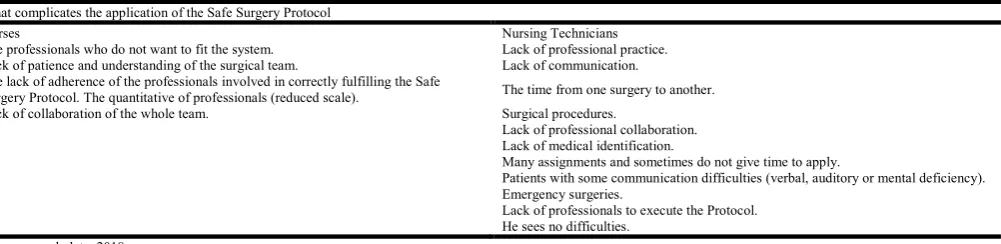
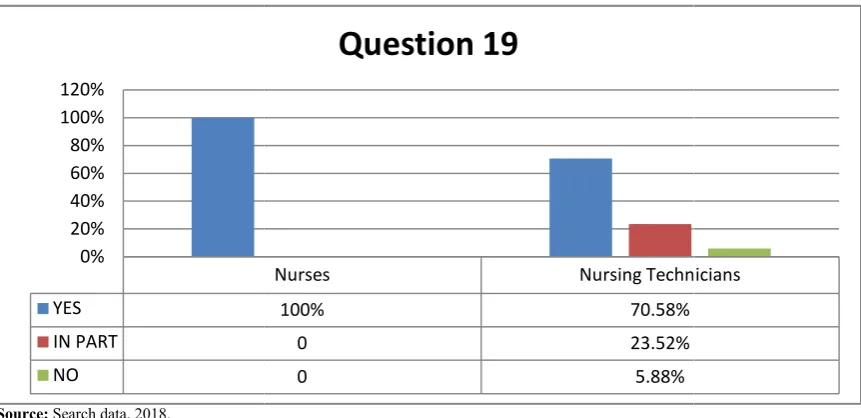
possible to observe the opinion of each professional about the level of knowledge of the Safe Surgery Protocol and, in order to facilitate the understanding and better visualization of the results, the data were worked according to each item approached, from questions 11 to 23. Question Number 18 asks if the timeout guarantees safety to the patient undergoing surgery. Of the total number of professionals, 16 (76.19%) respondents said "yes", while 04 (19.04%) professionals responded "in part" and only 01 (4.77%) answered negatively (Figure 1). The professional who opposed this statement is a Nursing Technician. In Question 19, the professionals were asked if the timeout guarantees safety to the surgical team. In response, taking into account only the Nurses, all (4 or 100%) answered "yes" to this question, stating that the timeout brings security to the team. Considering only the Technicians for this question, the answers were positive for 12 (70.58%) professionals, while 04 (23.52%) answered "in part" and 01 (5.88%) answered negatively (Figure 2). The last three questions in the questionnaire (Questions 24, 25 and 26) required a subjective and subjective response from the participants. The first asked what it facilitates in the application of the Safe Surgery Protocol, the second questioned what hinders the application of this Protocol and the last one referred to the suggestions that the professionals could give for its application. Not all professionals answered these questions. In view of the answers presented in the subjective questions, in order to further facilitate the knowledge on the subject, it was possible to make some tables that bring to light what participants believe facilitate or hinder the application of the Protocol. Two tables were made based on the Nurses and Nurses Technicians answers. The variety of answers about what facilitates the realization of this instrument stands out.
DISCUSSION
Table1. Responses presented on the level of knowledge of Nursing professionals about the Safe Surgery Protocol, with the exception of questions 18 and 19. n=21
Questioning Yes No In part
n % n % n %
11 -Do you know the Safe Surgery Protocol? 20 95,2% 0 0% 1 4,8%
12 –Do you consider the application of the Safe Surgery Protocol easy to understand? 19 90,4% 0 0% 2 9,6% 13 –There is a Safe Surgery Protocol instrument for filling printed on the patient's chart? 20 95,2% 0 0% 1 4,8%
14 –Do you consider this complete instrument? 13 61,9% 0 0% 7 33,33%
15 –Which part of the protocol instrument do you apply to the patient?* PRÉ 12 57,14% TRANS
6 28,57%
PÓS 2 9,52%
16 –In your institution, the timeout is used? 17 81% 0 0% 4 19%
17 –You consider that the use of timeout is performed effectively? 12 57,14% 2 9,53% 7 33,33%
20 –Timeout is frequently applied in the Surgical Center? 9 42,85% 3 14,30% 9 42,85%
21 –Timeout can be used in any anesthetic-surgical procedure? 20 95,2% 0 0% 1 4,8%
22-All surgical procedures in your institution perform the timeout? 6 28,57% 6 28,57% 9 42,85% 23 -Do you believe that timeout facilitates communication between professionals? 16 76,19% 1 4,77% 4 19,04%
[image:3.595.47.553.261.448.2]Source: Search data, 2018.
Table 2. What facilitates in the application of the Protocol of Safe Surgery, according to Nurses and Technicians in Nursing, João Pessoa – PB
This facilitates the application of the Safe Surgery Protocol
Nurses Nursing Technicians
Facilitates the identification and correction of preoperative, trans-operative and
postoperative errors. Knowledge directly with patients, information inherent and essential for professionals. The knowledge that all the team has about the importance of the Protocol for the patient and
for all involved. Easy to understand.
Correct identification of the patient, place of surgery, possible allergies to medications,
presence of comorbidities (basic diseases) and use of medications. It checks if it is the right patient and the procedure to which it will be submitted. Avoid errors in surgical procedures. Patient conditions and future discomfort situations.
Ensures safety to the surgical team.
Make sure that the patient is going to be operated correctly and safely. Communication with the patient and the questions asked ensure patient safety. Communication between all.
Necessary information of the patients in moments of urgency.
Ensures good organization of the service and safety to the patient and staff. It facilitates the procedure that will be done in the patient and all the team that assists him.
Know if the patient has comorbidities that may harm him or her in the surgical procedure.
The visualization of the patient's information without necessarily having to go to the medical record.
Good communication between professionals.
Source:search data, 2018.
Table 3. What complicates the application of the Safe Surgery Protocol, according to Nurses and Technicians in Nursing, João Pessoa – PB
What complicates the application of the Safe Surgery Protocol
Nurses Nursing Technicians
The professionals who do not want to fit the system. Lack of professional practice. Lack of patience and understanding of the surgical team. Lack of communication. The lack of adherence of the professionals involved in correctly fulfilling the Safe
Surgery Protocol. The quantitative of professionals (reduced scale). The time from one surgery to another. Lack of collaboration of the whole team. Surgical procedures.
Lack of professional collaboration. Lack of medical identification.
Many assignments and sometimes do not give time to apply.
Patients with some communication difficulties (verbal, auditory or mental deficiency). Emergency surgeries.
Lack of professionals to execute the Protocol. He sees no difficulties.
Source:search data, 2018.
Tabela 4. Suggestions presented for the application of the Safe Surgery Protocol, according to Nurses and Technicians in Nursing, João Pessoa – PB
Featured Suggestions Professional category
Show the importance of the Safe Surgery Protocol and do not perform incorrectly, just by doing. Work with all professionals. Nurse Qualification of professionals, statistical survey of the number of Protocols performed monthly, multiprofessional participation. Nurse
Greater participation of the team in the implementation of the Protocol. Nursing Technician
Enter the patient's weight. Nursing Technician
That all sectors should strive to improve the service. Nursing Technician
Let the doctors pass some important patient information to the team. Nursing Technician
More communication between the teams and the patient. Nursing Technician
That doctors should be more interested in implementing the Protocol. Nursing Technician
That the Safe Surgery Protocol be performed by the on-call nurse responsible for the surgical block. Nursing Technician
Only start the surgery after filling out the Protocol. Nursing Technician
That the Safe Surgery Protocol starts from the surgical clinic and is performed in all perioperative phases. Nursing Technician That the Safe Surgery Protocol be performed before the patient enters the operating room. Nursing Technician
Total 12
Source: Search data, 2018.
[image:3.595.49.550.499.621.2]professionals with more work time know better equipment and materials. However, it is questionable whether this professional would have addictions and some details could go unnoticed in the industry. In addition, the way the process is performed is still not defined, with the visual verification of the materials being executed by some professionals
that is also a reason for reflection -, taking into account that professionals are often faced with a and
them, which leads to more failures (LIMA, SOUSA; CUNHA, 2013). As much as the nursing team knows the checklist, it does not mean that it knows how to use it correctly. Thus, conducting training with all professionals working in the CC is essential to succeed in the Protocol. The use of the checklist is not limited to checking a form or list. That is, until professionals are informed about how to correctly use this instrument, the team will not show preparation and mastery to make use of it (PANCIERI; CARVALHO; BRAGA, 2014).
[image:4.595.82.514.57.332.2]Source: search data, 2018.
Figure 1. Safety of the timeout to the patient undergoing surgery, according to the professionals of the CC
Source: Search data, 2018.
Figure 2. Safety of the timeout to the surgical team, according to the profession
19,04%
YES
IN PART
NO 0% 20% 40% 60% 80% 100% 120%
professionals with more work time know better equipment and materials. However, it is questionable whether this professional would have addictions and some details could go the way the process is performed is still not defined, with the visual verification of the materials being executed by some professionals - a factor , taking into account that professionals are often faced with a and this may confuse them, which leads to more failures (LIMA, SOUSA; CUNHA, As much as the nursing team knows the checklist, it does not mean that it knows how to use it correctly. Thus, conducting training with all professionals working in the CC is ssential to succeed in the Protocol. The use of the checklist is not limited to checking a form or list. That is, until professionals are informed about how to correctly use this instrument, the team will not show preparation and mastery to
(PANCIERI; CARVALHO; BRAGA, 2014).
Following this thinking, it is not only necessary to impose this Protocol on the part of the institutions, but rather that professionals have access to information about the
in a presented way, that is, it only happens when they understand their need / importance and incorporate it to daily practice. The check should be done through the coordinator, along with the team and counting on the participation of the patient (PANCIERI et al., 2013).
showed the lack of communication and collaboration as factors that hinder the implementation of the Protocol. Therefore, Silva and Silva (p.27, 2017) recommend "training with the entire nursing team to explain the objectives of the Program and its importance for the safety of the surgical patient". results coincide with a study carried out in France, which demonstrated the lack of participation of the team as the most common problem (of the 16 centers surveyed, was identified in 10) and lack of communication as the most pointed
Safety of the timeout to the patient undergoing surgery, according to the professionals of the CC
2. Safety of the timeout to the surgical team, according to the professionals of the CC, João Pessoa
76,19%
4,77%
Question 18
Yes In part No
Nurses Nursing Technicians
100% 70.58%
0 23.52%
0 5.88%
Question 19
Following this thinking, it is not only necessary to impose this Protocol on the part of the institutions, but rather that professionals have access to information about the instrument in a presented way, that is, it only happens when they understand their need / importance and incorporate it to daily practice. The check should be done through the coordinator, along with the team and counting on the participation of the 2013). In the research, some results showed the lack of communication and collaboration as factors that hinder the implementation of the Protocol. Therefore, Silva and Silva (p.27, 2017) recommend "training with the to explain the objectives of the Program and its importance for the safety of the surgical patient". These results coincide with a study carried out in France, which demonstrated the lack of participation of the team as the most centers surveyed, was identified in 10) and lack of communication as the most pointed
Safety of the timeout to the patient undergoing surgery, according to the professionals of the CC
als of the CC, João Pessoa – PB
76,19%
[image:4.595.83.514.364.573.2]situation. From the 16 centers, 09 pointed to the time as a situation that disrupts the professionals, since they already had a long working day (FOURCADE et al., 2012). Some professionals reported the lack of time as another factor that hinders this protocol and, in the data collected, it was also observed that many of them have more than one job. On this, Ques, Montoro and Gonzalez (2010) affirm that time is an important factor for procedures aimed at patient safety. In addition, they affirm that the overload harms the detection of complications. Following the factors that hinder the Safe Surgery Protocol, according to professionals, emergency surgeries hamper the proper functioning of the timeout. Nevertheless, even with this hindrance, the team must act quickly and coordinated to ensure efficient service. Urgent and emergency situations require a stance based on self-control, speed and competence (Beneficient society israelita brasileira albert einstein, 2009). Regarding the timeout to ensure safety to the patient undergoing surgery, most professionals answered positively, agreeing with this statement. Thus, according to Salman (2011), adverse events and incidents undermine patient safety, posing a real challenge for the improvement of the health sector. In order to continuously improve care, mechanisms should be in place to ensure prevention and reduce errors. It is stated, therefore, that the timeout does not only prevent the performance of surgeries in places, procedures or wrong people, but above all it identifies and corrects risks before performing procedures, through the identification of what is called a near error, guaranteeing quality and safety to all involved. Thus, professionals must have attitudes that identify failures in a preventive way (SALMAN, 2011). To support these claims, epidemiological studies on adverse events have emerged, increasing awareness of patient safety and since then efforts have been made to ensure continuity. Some of these efforts have met the initiatives of several committed hospitals (LANDRIGAN, 2011). In this way, professionals are motivated to deepen their knowledge about the Protocol and guarantee security to those who need it most - in this case, the patient.
Conclusion
In the face of everything that was discussed during the course of the research, it can be inferred that CC professionals know the Safe Surgery Protocol and consider it to be easy to understand. However, they still show a certain limitation in the moment of the use and filling of this material so important for all involved. In addition, it can be stated that there is a gap in the presentation of this protocol to the surgical team, especially when it refers to the training of the professionals who work daily with it. To modify this reality, training and qualification are necessary, aiming at a better use of the instrument in question. The lack of time, urgent surgeries (for inpatients), the difficulty in communication and the low adherence of professionals were identified problems, based on the professionals of the sector. Given this, we note the importance of lifelong education. With it, all the collaborators exchange knowledge and improve the practice about the correct use of the Protocol of Safe Surgery. As the Protocol was recently implanted in the hospital's CC, it is noted that it is still in the process of being consolidated. For this to be guaranteed, professionals must submit to the changes already mentioned. Difficulties should not be seen as discouragement, but instead should serve as a deep reflection for the promotion of improvements. In summary, it is perceived the need for the institution to invest in actions aimed at a higher quality of care
and, consequently, patient safety. It is also advisable to have a periodic evaluation of the team regarding adherence to the Protocol and indicators that can measure the effectiveness of the checklist in reducing injuries. Only then will the level of excellence be achieved and who wins from it are all the people involved, especially the patients and the professionals.
REFERENCES
BRAZIL. Ministry of health. National Agency for Health Surveillance, World Health Organization. Second global challenge for patient safety. Safe surgeries save lives. Rio de Janeiro: Pan American Health Organization, 2009. REGIONAL COUNCIL OF NURSING - SÃO PAULO.
Life-saving details: How the Nursing team became a protagonist in the process of expanding patient safety in the operating room. São Paulo, Nursing Magazine [internet]. 2014; 8. Available at: <http://portal.coren-sp.gov.br/sites/default/ files/54_CAPA_cirurgia_segura.pdf> Accessed on: 04/05/2018.
CORONA, A.R.P.D; PENICHE, A.C.G. The safety culture of the patient in adherence to the protocol of safe surgery. Rev. Sobecc. São Paulo.; Vol. 3, No. 20, p .: 179-185. Jul./set. 2015
FERRAZ, M. Safe surgery: a requirement of the 21st century. RevColBras Cir. Vol.4, No. 36, p.:2-281, 2009. Available at: http: //dx.doi. org / 10.1590 / S0100-69912009000400001 Accessed on: 10/16/2018.
FREITAS, M.R. et al. Evaluation of adherence to the WHO safe surgery checklist in urological and gynecological surgeries in two teaching hospitals in Natal, Rio Grande do Norte, Brazil. Cad Public Health [internet]. Vol.1, No. 30, p.:137-48, 2014. DOI: <http://dx.doi.org/10.1590/0102-311X00184612> Accessed on: 04/05/2018.
FOURCADE, A. et al. Barriersto staff adoptionof a surgicalsafetychecklist. BMJ Qual Saf [internet]. Vol.3, N°21, p.:7-191, 2012. Availableat:http://qualitysafety.bmj. com.ez17.periodicos.capes.gov.br/content/qhc/21/3/191.ful l.pdfAcessed on: 16/10/2018.
GAWANDE, A. Checklist: How to do things well done. Rio de Janeiro: Sextante, 2011.
GERHARDT, T.E., SILVEIRA, D.T. Research Methods. 1st edition. Rio Grande do Sul: UFRGS Publishing House, 2009.
LANDRIGAN, C.P. Work conditions and well-being of health professionals: sharing of international lessons to improve patient safety. J Pediatr. Vol.6, No. 87, p.:5-463, Nov-Dec. 2011.
LIMA, A.M.; SOUSA, C.S.; CUNHA, A.L.S.M. Patient safety and operating room assembly: a reflection study. Rev. enferm UFPE online. Recife, Vol. 1, Nº 7, p.:289-94, jan., 2013. DOI: <10.5205 / reuol.3049-24704-1-LE.0701201337> Accessed on: 04/04/2018.
MARTINS, G.S.; CARVALHO, R. Realization of timeout by the surgical team: facilities and difficulties. Rev. SOBECC, São Paulo. Vol.1, No. 19, p.:18-25, jan./mar. 2014.
MOURA, M.L.; DIEGO, L.A. Safe surgery. In: SOUZA, P; MENDES, W.J. Patient safety: knowing the risks in health organizations. Rio de Janeiro: Fiocruz, 2014. p.:187. WORLD HEALTH ORGANIZATION. Safe surgeries save
lives. 2013. [cited 2014 Dec 20]. Available at: <http://www.who.int/patientsafety/ safesurgery / en / index.html> Accessed on: 04/04/2018.
WORLD HEALTH ORGANIZATION - WHO. Patient safety [Internet]. WHO, 2012 [cited 2011 Oct 20]. Available at:
<http://www.who.int/patientsafety/safesurgery/> Accessed on: 04/04/2018.
PANCIERI, A.P. et al. Safe surgery checklist: analysis of the safety and communication of the teams of a school hospital. Rev. Gaúcha Enferm. vol.34, No.1, Porto Alegre, Mar. 2013..
PANCIERI, A.P., CARVALHO, R; BRAGA, E.M.
Application of the safe surgery checklist: Experience report. Rev SOBECC [internet]. Vol.1, N ° 19, p.:26-33, 2014. Available at: https://revista.sobecc.org.br/sobecc/ article/view/50 Accessed on: 10/16/2018.
QUES, A.A.M.; MONTORO, C.H.; GONZALEZ, M.G. Strengths and threats around patient safety according to the opinion of nursing professionals. Rev Latino-Am Enfermagem [internet]. Vol.3, No. 18, p.:08, 2010. screens. DOI:http://dx.doi.org/10.1590/S0104-11692010000300007 Accessed on: 10/16/2018.
SALMAN, F.C. The importance of time-out for safety in the perioperative period. Safe Anesthesia, Medical Services of Anesthesia, São Paulo. 2011. Available at: http: // www. anestesiasegura.com/2011/01/importancia-da-realizacao-dotime-out.html. Accessed on: 09/22/2018.
SILVA, F.A.A.; SILVA, A.G.N. Nursing team in safe surgery: challenges for protocol adherence. RevEnferm UFPI. Vol.2, No. 6, p.:23-29, Apr-Jun. 2017.
BENEFICENT SOCIETY ISRAELI BRAZILIAN ALBERT EINSTEIN - SBIBAE. Identification of surgical site (laterality) and time out: prevention of surgery and invasive procedures at the wrong intervention site, wrong procedure or wrong patient [Internet]. Mar. 2009. [quoted 2012 Mar 12]. Available at: http: // medicalsuite.einstein.br/ perioperatorios_directories_timeout.pdf. Posted on: 10/16/2018.
TANG, R.; RANMUTHUGALA, G.; CUNNINGHAM, F. Surgical safety checklists: a review. ANZ J Surg; Vol. 3, No. 84, p.:148-54, 2014.
TORRES, B. et al. Patient safety at the surgical center and document quality related to surgical infection and hospitalization. Acta Paul Enferm. Vol. 4, No. 28, pp. 355-60, 2015.
VENDRAMINI, R.C.R.; SILVA, E.A.; FERREIRA, K.A.S.L. et al. Patient safety in cancer surgery: experience of the Cancer Institute of the State of São Paulo. RevEscEnferm USP [Internet] [cited 2011 Jun 20]; Vol. 3, No. 44, p: 32-827, Sep 2010. Available at: http://www.scielo.br/scielo. php?script=sci_arttext&pid=S0080-62342010000300039 Accessed on: 09/22/2018.