1637
TECHNOLOGY FACTORS INFLUENCING E-GOVERNMENT
READINESS
MUSTAFA OMAR M. BAEUO1, NOR ZAIRAH BINTI AB. RAHIM1, ASMA ALI MOSA ALARAIBI1
1
Advanced Informatics School, Universiti Teknologi Malaysia (UTM), Malaysia E-mail: [email protected], [email protected]
ABSTRACT
A rapidly growing number of countries are realizing that e-government has become a powerful tool for governments, as it can assist with measures such as making public administration significantly more efficient and effective. There is an urgent need for e-government to be able to enhance government administration performance and to provide efficient services to citizens. It can contribute to shortening time and effort as well as alleviating pressures on citizens. E-government projects need government support in order to create, apply, disseminate and continue the experience by providing all necessary resources. Various means of information transmission (such as the media) are vitally important by which to educate the stakeholders and increase their awareness to ensure the success and sustainability of such projects. Moreover, governments should assess their readiness for developing e-government procedures before embarking on the implementation of such a project to avoid any possible failures. Most of the failures of previous e-government measures can be attributed to technology factors. These factors include: infrastructure; security; technological/ technical issues; hard/soft gap; digital divide; internet use; and finally, skills. The successful implementation of e-government relies on assessing the readiness of technology aspects in order to realize the benefits of government and reduce potential failures of e-government implementation. Existing studies on e-e-government readiness lack agreement on the important technology aspects; thus, there remains a need to identify the relevant factors that shape the technology aspects of government readiness. The aim of this paper is to identify the said technology aspects of e-government readiness.
Keywords: Technology Factors, E-Government, E-Government Readiness, E-Government Ready
1. INTRODUCTION
According to Joseph (2014), Mkude and Wimmer (2013), and Almarabeh and Abuali (2010), the primary reason for e-government failure can be attributed to a lack of assessment on the readiness for e-government. This brings about challenges and does not guarantee successful implementation of e-government (Joseph, 2014; Mkude and Wimmer, 2013). According to (Abdelkader, 2015) the most barriers and challenges for e-government stem from technology issues. In addition, the majority of the failures can be ascribed to the technology perspective. Thus, the successful implementation of e-government relies on governmental assessments on their readiness for developing e-government before embarking on the implementation of such a project to avoid any possible failures (Joseph, 2014). We conclude that most governments still face challenges during the implementation of e-
government, especially in relation to the technology aspects, due to a lack of assessment of technology
aspect readiness having been carried out. This has the potential to jeopardize the successful implementation of e-government.
1638 on a high level of ICT infrastructure readiness and users’ technical skill readiness (Joseph, 2014). One of the issues that governments need to consider is the willingness of people to use technology. Parasuraman (2000) in his research used the term “technology readiness”. He defined technology readiness as “people’s propensity to embrace and use new technologies for accomplishing goals in home life and at work” (Parasuraman, 2000). From a different point of view, readiness of e-government can be defined as the preparedness of a country to develop and adopt e-government in terms of its technology infrastructure, development of human resources, telecommunication infrastructure and willingness of a government to use advanced technology to improve citizens’ lives (Mundy and Musa, 2010). Although there are existing studies on the significance of technology readiness in organizations, they lack robust foundations for empirical analysis (Choucri et al., 2003; Alghamdi et al., 2011b). Alghamdi et al. (2011b) indicated that there is a deficiency of research connecting technology readiness and implementation of e-government in several countries, and recommended that organizational strategy of ICT and national program of e-government ought to be considered as vital parts of the readiness assessment. As mentioned earlier, several researchers (Kurdi and Randles, 2011; Odat, 2012; Karunasena, 2011; Monyepao and Weeks, 2012; Ramli, 2012) believe that technology is one of the key components of e-government readiness.
According to our previous research, which was performed to explore gaps in existing knowledge concerning the technology aspects of e-government readiness through the conduct of a literature review (Baeuo et al. 2016), there is a lack of agreement relating to the factors that shape the technology aspects of e-government readiness. Hence, a clear gap can be identified in the knowledge pertaining to the technology aspects of e-government readiness. Thus, there is a need to identify the factors related to the technology aspects of e-government readiness. The aim of this paper is to investigate the factors that shape the technology aspects of e-government readiness.
The remainder of the paper is structured as follows: Section 2 describes the methodology of the study, Section 3 discusses the results, Section 4 presents limitations of this study, and Section 5 provides the conclusions and discusses future directions for our
work.
2. METHODOLOGY
Our literature research was performed via digital libraries. We collected papers relating to e-government readiness using Google Scholar, Wiley Online Library, Institute of Electrical and Electronics Engineers (IEEE), ACM, Springer Link and Science Direct. Search processes on papers were conducted by using the search strings ((“E-government” OR “Electronic Government”) AND
(“Readiness” OR “Willingness” OR
“Preparedness” OR “Ready”)). We obtained 30 papers relevant to e-government readiness, and then applied the inclusion/exclusion criteria on these 30 papers based on the following criteria:
- For inclusion criteria, we included all the papers from databases that were discussing either e-government readiness in general, e-e-government readiness in developing countries, or factors affecting e-government readiness. In addition, we included any papers that in English; and full text papers
- For exclusion criteria, the papers which were excluded from our dataset included either: papers which did not have any of the keywords relating to e-government readiness; and papers which were repeated in our data sources were excluded in the later stages. In addition, we excluded any papers that were not full text.
In the first step, we checked the papers based on keywords, title and abstract. Papers that did not have any of the abovementioned keywords or which were not related to our work (after perusal of the title and abstract) were excluded. In the second step, we read the full text papers and excluded some papers that were not related to our study in order to collect the final studies related to e-government readiness. The result was that, out of a total of 30 papers, 19 studies were excluded.
3. RESULTS
1639
Table 1: Technology Factors Of E-Government Readiness
Technology Factors Description Source
ICT Infrastructure ICT Infrastructure offers a range of
technologies to assist organizations with the efficient application of e-government services. It includes: hardware, software, networking, Internet access.
Hazlett &Hill (2003) Bakry (2004)
Ebrahim & Irani (2005) Zaid et all, (2007) Kurdi and Randles(2011) Karunasena (2011) AISuwaidi&Rajan(2013) Software The programs and other operating information
used by a technology or computer.
Hazlett &Hill (2003) Al-Omari&Al-Omari (2006) Alghamdi, et al, (2011) Hardware Physical equipment of computers such as
keys, locks, hinges.
Hazlett &Hill (2003) Al-Omari&Al-Omari (2006) Azab et al. (2009)
Alghamdi, et al, (2011) Operations Set of processes which provide the day-to-day
work needed to monitor and maintain a continuous ICT infrastructure and operating systems.
Alghamdi, et al, (2011)
Application A type of software that includes programmers who will do real work for users.
Al-Omari&Al-Omari (2006)
Communication A collection of terminal links that are
connected to enable communication between people. This supports foundations to improve citizens’ lives through the power of
communication.
Al-Omari&Al-Omari (2006) Kurdi and Randles, (2011) Karunasena (2011)
Technical Support Assistance for individuals having technical problems with electronic devices such as computers and software products.
Bakry (2004) Azab et al. (2009) AISuwaidi&Rajan(2013) Digital Divide Refers to the gap between people who have
access to the technology and those who do not.
Lau (2003)
Security Security is the degree of resistance to, or protection from, attack.
Lau (2003)
Ebrahim & Irani (2005) Karunasena (2011) Alghamdi, et al, (2011) Kurdi and Randles(2011) Internet A means of connecting a computer to any
other computer anywhere in the world via dedicated routers and servers.
Al-Omari&Al-Omari (2006)
Network Infrastructure Network infrastructure refers to the hardware and software resources of an entire network that enable network connectivity and communication.
Kurdi and Randles(2011) Karunasena (2011)
Al-Omari&Al-Omari (2006)
Information System Infrastructure
Information system infrastructure consists of hardware, software, networks, data, facilities, and services.
Kurdi and Randles(2011) Azab et al. (2009)
Skills Abilities to carry out a task based on computer and Internet functions.
Ebrahim & Irani (2005)
Connectivity The ability of computers and other electronic equipment to connect with other computers, programs or the Internet.
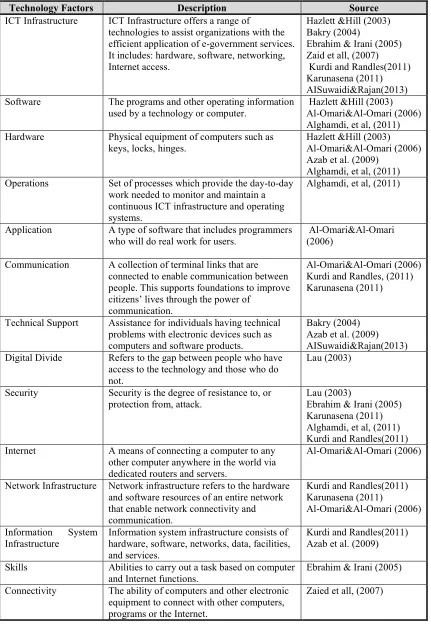
1640 In this literature review, a total of 14 factors related to technology components of e-government readiness were extracted. In order to propose the technology factors of e-government readiness framework, all 14 extracted factors from existing literature have been considered as independent variables. Since some of the factors were more relevant and close to each other, they have been classified into one category.
Based on the description in Table 1, there are some factors which have the same meaning, such as: ICT Infrastructure; Network Infrastructure; and Information System Infrastructure. Hence, they were modified into a single factor, namely, infrastructure (as infrastructure is a more commonly-used word). In addition, factors of software and application also have the same meaning. Accordingly, they have been combined as one factor, specifically, software; since the word “software” is more general in applications. Further, since the terms “Internet factor” and “Connectivity factor” essentially have the same meaning, they have also been combined as one factor, namely, Internet (since Internet is a more common word).
From Table 1, it can be seen that Infrastructure includes: hardware; software; internet; and communication. Thus, this factor includes most of the technology features. Therefore, ‘Infrastructure’ will be excluded since all of its elements have been reported.
In addition, the skills factors shown in Table 1 were mentioned in a study by Ebrahim & Irani (2005)as being factors related to the technology readiness for e-government while the other 10 studies mention this factor as the human resources readiness of e-government. From our point of view, this factor is more related to people having e-government readiness rather than the technology of e-government readiness. Accordingly, we have decided to exclude the skills factor.
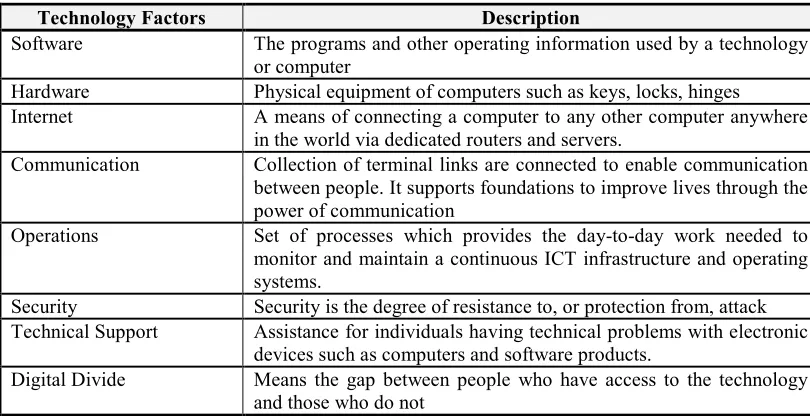
[image:4.612.102.507.412.620.2]After having combined factors having the same meaning, the technology factors of e-government readiness can be defined as: Software; Hardware; Internet; Communication; Operations; Security; and Technical Support and Digital Divide. Table 2 lists the identified technology factors of e-government readiness along with their descriptions.
Table 2: Technology Aspects Of E-Government Readiness
Technology Factors Description
Software The programs and other operating information used by a technology or computer
Hardware Physical equipment of computers such as keys, locks, hinges
Internet A means of connecting a computer to any other computer anywhere in the world via dedicated routers and servers.
Communication Collection of terminal links are connected to enable communication between people. It supports foundations to improve lives through the power of communication
Operations Set of processes which provides the day-to-day work needed to monitor and maintain a continuous ICT infrastructure and operating systems.
Security Security is the degree of resistance to, or protection from, attack Technical Support Assistance for individuals having technical problems with electronic
devices such as computers and software products.
Digital Divide Means the gap between people who have access to the technology and those who do not
Once the initial list of technology factors in its final form was created as in Table 2, it was then forwarded to three experts from academia to evaluate and advise which of them most influence e-government readiness. The experts were selected from academia on basis of their experience in the e-government field. With
1641
Table 3: Expert Background
Experts Position Experience in the E-government Field E1 University Associate Professor E1 is a researcher in the e-government field and is
working as an e-government program coordinator in the Prime Minister’s office, Libya.
E2 University Professor E2 is head of the IT department at the Academy of Graduate Studies–Benghazi. E2 is a researcher in the e-government field, and is working for a commutation company-Libya.
E3 University Professor E3 is a Faculty Member at the University of Al-Ain - United Arab Emirates. E3 is a researcher in the government field, and is also Director General of the e-government project in Libya.
The tasks provided to them were to either agree or disagree with the list of technology factors which have been identified in Table 2. The experts can perform the following functions: add new factors; delete any factors; rename existing factors; and identify any overlap existing between any two/more factors. In addition, the experts should provide the justification for their actions.
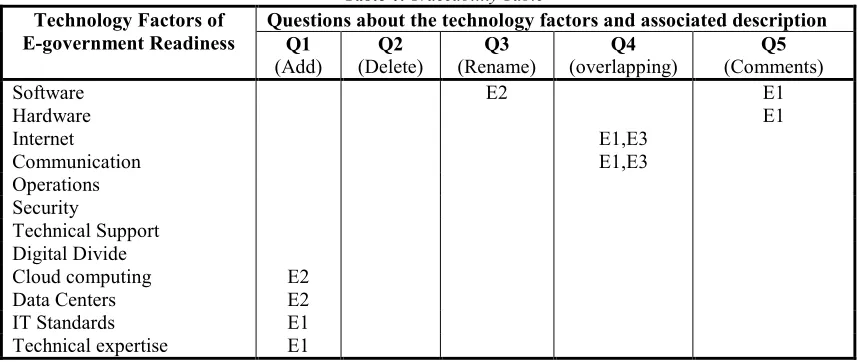
[image:5.612.84.513.393.574.2]All three experts Agreed withthe list of technology factors; the justification from the experts was that all of the factors have a significant impact upon the readiness of government. In addition, the experts recommended some modification in the initial list of technology factors which influence e-government readiness. The traceability of expert factors and questions is provided in Table 4. This traceability table also shows the questions answered by the experts, as well as associated factors.
Table 4: Traceability Table
Technology Factors of E-government Readiness
Questions about the technology factors and associated description Q1
(Add)
Q2
(Delete)
Q3
(Rename)
Q4
(overlapping)
Q5
(Comments)
Software E2 E1
Hardware E1
Internet E1,E3
Communication E1,E3
Operations Security
Technical Support Digital Divide
Cloud computing E2
Data Centers E2
IT Standards E1
Technical expertise E1
The details concerning the questions and feedback from experts are as follows:
Q1: Add New Factors:
E1 suggests the addition of two factors, namely: technical expertise and IT standards. E1 considers technical expertise to be one of the technical factors that should be included in the study. Although the researcher identified technical support as a factor, where human expertise is involved technical expertise usually goes beyond the scope of the supporting activities. Therefore, we will add the word “expertise” to the factor of “technical
support” to become “technical support and expertise” since the word “technical” appears in the two sentences. E1 defines IT standards as one of the technology factors which should be added. E1 further mentioned that in regard to IT standards, the varieties and the ongoing development of information technologies could lead to different organizations adopting different technology types. This eventually leads to a lack of inter-departmental data sharing and systems incompatibility.
1642 follows: “Cloud computing is a model for delivering information technology services in which resources are retrieved from the internet through web-based tools and applications, rather than a direct connection to a server. Data and software packages are stored in servers. However, the cloud computing structure allows access to information as long as an electronic device has access to the web. This type of system allows employees to work remotely”. Further, E2 defines a data center as, namely: “a data center (sometimes spelled datacenter) is a centralized repository, either physical or virtual, for the storage, management, and dissemination of data and information organized around a particular body of knowledge or pertaining to a particular business.” E3 does not add any new factors.
Q2: Delete any of Factors:
The three experts (E1, E2, and E3) stated that all factors in the list are important, and advised not to delete any of them.
Q3: Rename any of Factors:
E2 renamed “Software” as “Applications”; however, he did not mention the justification for this action. The term “Applications” refers to a program or group of programs that is designed for the end user. An application is basically a type of software, and since software is an all-encompassing term we decided not to rename the factors. No
suggestions to rename factors were provided by the other two experts, E1 and E3.
Q4: Overlapping between any of Factors:
E1 and E3 found that “Communications” and “Internet” are overlapping factors. This is very obvious based on the definitions given by the researcher. After we went through our description for these factors, we realized that these two factors are a means of connecting to enable communication between people. We agree with the two experts’ advice to resolve this overlap. Accordingly, we combined the “Communications” description with “Internet” description. We found the wording “connecting” and “connected” used in the original descriptions for “Communications” and “Internet” respectively and determined that they can be combined together as one word. E2 did not mention any overlapping factors.
Q5; Anything else to be added
E1 modified the description of “Software” to “The programs or any soft computing resources available through computers or any information and communication technologies”. In addition, he modified the description of “Hardware” to “Physical equipment of computers and related peripherals.” The other two experts, E2 and E3, provided no additional comments.
Based on the result, the tracked change for technology factors and description is as shown in
[image:6.612.86.515.481.724.2]Table 5.
Table 5: The Tracked Change For Technology Factors And Description
Technology Factors Description
Software The programs or any soft computing resources available through computers or any information and communication technologies.
The programs and other operating information used by a technology or computer
Hardware Physical equipment of computers and related peripherals.
Physical equipment of computers such as keys, locks, hinges
Internet A means of connecting a computer to any other computer anywhere in the world via dedicated routers and servers
Q5, E1: modify the description
1643
Technology Factors Description
Communication Collection of terminal links which are connected to enable communication between people. It supports foundations that seek to improve lives through the power of communication via dedicated routers and servers.
Q5, E1: Add the word “which”
Operations Set of processes which provide the day-to-day work needed to monitor and maintain a continuous ICT infrastructure and operating systems. Security Security is the degree of resistance to, or protection from, digital attack
Q5, E1: Add the word “Digital” Technical support and
expertise
Assistance for individuals having technical problems with electronic devices such as computers and software products, and technical expertise that covers anything from tips and advice to exploitation and optimization.
Q1, E1: Suggest to add technical expertise
Digital Divide Means the gap between people who have access to the technology and those who do not.
Cloud computing A model for delivering information technology services in which resources are retrieved from the internet through web-based tools and applications, rather than a direct connection to a server
Data Centers A centralized repository, either physical or virtual, for the storage, management, and dissemination of data and information organized around a particular body of knowledge or pertaining to a particular business.
IT Standards The varieties and the ongoing development of information technologies which can lead to different organizations potentially adopting different technology types
The improved list in Table 4 shows that two factors have been merged (“Communications” and “Internet”), and two factor descriptions have been modified after considering feedback from the experts (“Software” and “Hardware”). Three new factors have been added based on the feedback from the experts (“Cloud computing”, “Data Centers”, and “IT Standards”). We believe that the improved list of technology factors as suggested by experts makes the list more comprehensive and the description of each of the factors easier to understand.
4. LIMITATIONS
The aim of this paper is to identify the necessary factors that shape the technology aspects of e-government readiness. These factors were identified through a review of studies gathered via a search of six digital libraries (Google Scholar, Wiley Online Library, Institute of Electrical and Electronics Engineers (IEEE), ACM, Springer Link
and Science Direct). These six digital libraries are not exhaustive and, consequently, the research was necessarily limited. In addition, the traditional literature review included studies published in English only. Thus, there is a chance that work relevant to our research domain was missed as it may have been published in another language. In addition, the potential for misunderstanding when reviewing the literature cannot be ignored. We tried our best to overcome this by dealing carefully with the literature review, but the possibility of misunderstanding nevertheless exists. We also cannot ignore the risk of inaccuracy. In this work, we aimed to have a high rate of accuracy but still cannot entirely guarantee this.
5. CONCLUSION
e-1644 government implementation, but
t
here is a lack of agreement relating to the factors that shape the technology aspects of e-government readiness. Hence, a clear gap can be identified in the knowledge pertaining to the technology aspects of e-government readiness. Thus, this paper identified the factors that shape the technology aspects of e-government readiness. A traditional literature review method was used to investigate the relevant factors. We gathered 30 papers from online databases. Based on the exclusion and inclusion criteria, we excluded 19 studies and included 11 studies. From these 11 studies, we extracted 14 factors related to the technology aspects of e-government readiness. These factors were grouped into a total of eight factors, namely: Software; Hardware; Internet; Communication; Operations; Security; Technical Support and Digital Divide. The eight factors were then forwarded to three experts from academia to review. The result of the review of the technology factors is as follows: two factors have been merged (“Communications” and “Internet”); and two factor descriptions have been modified after considering feedback from the experts (“Software” and “Hardware”). Three new factors were added based on feedback from the experts (“Cloud computing”, “Data Centers”, and “IT Standards”). Finally, the technology factors of e-government readiness are: Software; Hardware; Communication; Operations; Security; Technical Support; Digital Divide; Cloud computing; Data Centers; and IT Standards. A future work will use the identified technology factors in order to conduct an e-government readiness assessment. It is envisaged that the identified technology factors will help governments to identify and understand the technology aspects that must be considered when assessing the situation regarding the implementation of an e-government initiative from a technology perspective. In addition, the list of technology readiness factors can be used by designers, developers and researchers as a guideline for identifying the necessary technology requirements for e-government implementation.REFERENCES
[1] Abdelkader, A. (2015). A Manifest of Barriers to Successful E-Government: Cases from the Egyptian Programme. International Journal of
Business and Social Science, 6(1).
[2] AISuwaidi, M., & Rajan, A. (2013). E-Government Failure and Success Factors Rank
Model an Extension of Heeks Factor Model.
Paper presented at the International Conference
on Current Trends in Information Technology (CTIT).
[3] Al-Omari, Ahmed, & Al-Omari, Hussein. (2006). E-government readiness assessment model. Journal of Computer Science, 2(11), 841-845.
[4] Alghamdi, Ibrahim A, Goodwin, Robert, & Rampersad, Giselle. (2011a). E-government readiness assessment for government organizations in developing countries.
Computer and Information Science, 4(3), p3.
[5] Alghamdi, Ibrahim A, Goodwin, Robert, & Rampersad, Giselle. (2011b). A suggested e-government framework for assessing organizational e-readiness in developing countries Informatics engineering and
information science (pp. 479-498): Springer.
[6] Almarabeh, Tamara, & AbuAli, Amer. (2010). A general framework for e-government: definition maturity challenges, opportunities, and success. European Journal of Scientific
Research, 39(1), 29-42.
[7] Azab, Nahed Amin, Kamel, Sherif, & Dafoulas, Georgios. (2009). A suggested framework for assessing electronic government readiness in Egypt. Electronic Journal of e-Government, 7(1), 11-28.
[8] Baeuo, M. O., Ab. Rahim, N. B., & Alaraibi, A. A. (2016). Technology Aspects of E-goverment Readiness in Developing Countries: A review of the Literature.
Computer and Information Science, 9(4).
[9] Bakry, Saad Haj. (2004). Development of e‐ government: a STOPE view. International
Journal of Network Management, 14(5),
339-350.
[10] Choucri, Nazli, Maugis, Vincent, Madnick, Stuart, Siegel, Michael, Gillet, S, O’Donnel, S, . . . Haghseta, F. (2003). Global e-READINESS–for What? Center for eBusiness
at MIT.
[11] Ebrahim, Zakareya, & Irani, Zahir. (2005). E-government Adoption: Architecture and Barriers. Business Process Management
Journal, 11(5), 589-611.
[12] Hazlett, Shirley-Ann, & Hill, Frances. (2003). E-government: the realities of using IT to transform the public sector. Managing Service
Quality: An International Journal, 13(6),
445-452.
[13] Joseph, S. . (2014). Development and validation of a framework for e-government
readiness measurement. Durban University of
1645 [14] Karunasena, Kanishka, Deng, Hepu, & Singh,
Mohini. (2011). Measuring the public value of e-government: a case study from Sri Lanka.
Transforming Government: People, Process
and Policy, 5(1), 81-99.
[15] Kitchenham, Barbara. (2004). Procedures for performing systematic reviews. Keele, UK,
Keele University, 33(2004), 1-26.
[16] Kitchenham, Barbara, Brereton, O Pearl, Budgen, David, Turner, Mark, Bailey, John, & Linkman, Stephen. (2009). Systematic literature reviews in software engineering–a systematic literature review. Information and
software technology, 51(1), 7-15.
[17] Kurdi, Rabea, & Randles, Martin. (2011). An Investigation Into E-government Information Systems: Analysis and Review of the Literature.
[18] Lau, Edwin. (2003). Challenges for
e-government development. Paper presented at
the 5th Global Forum on reinventing Government.
[19] Mkude, Catherine G, & Wimmer, Maria A. (2013). Strategic Framework for Designing E-Government in Developing Countries
Electronic Government (pp. 148-162):
Springer.
[20] Mollah, Muhammad Baqer, Islam, Kazi Reazul, & Islam, Sikder Sunbeam. (2012). E-police system for improved e-government
services of developing countries. Paper
presented at the Electrical & Computer Engineering (CCECE), 2012 25th IEEE Canadian Conference on.
[21] Monyepao, MD, & Weeks, RV. (2012). Case study: Assessing and evaluating the readiness of the ICT infrastructure to provide e-government services at a local e-government
level in South Africa. Paper presented at the
Technology Management for Emerging Technologies (PICMET), 2012 Proceedings of PICMET'12:.
[22] Mundy, Darren, & Musa, Bandi. (2010). Towards a framework for egovernment development in nigeria. Electronic Journal of
E-government, 8(2), 148-161.
[23] Odat, Ahmad Mousa. (2012). E-Government in
developing countries: Framework of
challenges and opportunities. Paper presented
at the Internet Technology And Secured Transactions, 2012 International Conference for.
[24] Othman, Bin, Hairul, Mohamed, & Razali, Rozilawati. (2013). Key contributing factors towards successful Electronic Government
systems interoperability. Paper presented at
the Research and Innovation in Information Systems (ICRIIS), 2013 International Conference on.
[25] Parasuraman, Arun. (2000). Technology Readiness Index (TRI) a multiple-item scale to measure readiness to embrace new technologies. Journal of service research, 2(4), 307-320.
[26] Peters, T. (2005). Ready for What? E-readiness in developing countries: current status and prospects toward the millennium development goals. infoDev, bridges. org. [27] Ramli, Razlini Mohd. (2012). Malaysian
e-government: issues and challenges in public administration. International Proceedings of
Economic Development and Research, 48(2),
19-23.
[28] Stapić, Zlatko, López, Eva García, Cabot, Antonio García, de Marcos Ortega, Luis, & Strahonja, Vjeran. (2012). Performing systematic literature review in software
engineering. Paper presented at the CECIIS
2012-23rd International Conference.
[29] Zaied, Abdel Nasser H, Khairalla, Faraj A, & Al-Rashid, W. (2007). Assessing e-readiness in the Arab countries: Perceptions towards ICT environment in public organisations in the State of Kuwait. Electronic Journal of