1754
FUZZY CLUSTERING DRIVEN FAST AND INTUITIVE
CLASSIFIER LEARNING WITH MAPREDUCE
FRAMEWORK
RAGHURAM BHUKYA, DR. JAYADEV GYANI
1
Assistant Professor, Department of Computer Science and Engineering Kakatiya Institute of Technology & Science, Warangal, India
2
Assistant Professor, Computer Science and Information Technology College Majmaah University, Majmaah, Kingdom of Saudi Arabia
1
[email protected], 2 [email protected]
ABSTRACT
Many business organizations exploring their big data resources using Hadoop distributed file system due to its capability in offering fast processing, easy scalability and higher extend reliability on low cost commodity hardware. The efficiency of Hadoop distributed file system is the result of using Mapreduce frame work, which is leading research communities to scale conventional data mining techniques to fit on Mapreduce framework. So far in the research we can found proposals of data mining on Mapreduce frame work concentrating only on scalability factor, but at the same time they are ignoring two important factors which can affect the efficiency, those are reducing number of scans to database and lacking of intuitiveness in obtained data mining results. In order to overcome such short comes and considering importance of classification learning techniques in real time environment, we propose an fuzzy associative classifier learning model using Mapreduce framework which take advantage of Tid-list representation to extract the total classifier with in single scan to database and provides intuitiveness using data driven fuzzy clusters. The experimental results show the proposed model successfully enhanced the fast and intuitive efficiencies of classification techniques for big data analytics without compromising the accuracy.
Key Words:Associative Classification, Mapreduce, Distributed File Systems, Fuzzy Clustering, Tid-List
Representation, Result Intutiveness.
1.INTRODUCTION
In the present era of data explosion, a massive amount of data accumulating from different sources like office automations, financial services, internet technologies, mobile users, social networks and sensors networks etc. According to literature studies, worldwide the volume of business data itself doubles every 1.2 years and this time range will come down in near feature. This massively accumulating data which is a result of human cognitive process is being referred as big data throwing a tough challenge to knowledge management community that is with respect to retrieving useful information within tolerable time
along with maintaining consistency with
commodity hardware. There is no formal definition to big data [1] but it referred by it 4V’s characteristics namely, huge Volume, huge Velocity, high Variety and low veracity. As the conventional hardware and data base management technologies can’t scale to handle big data, the
distributed file system is suitable for persistent and scalable storage.
In real time application in order store and mange ever scaling big data, most of the data service provider adopting The Hadoop distributed file system (HDFS) [2]. HDFS is a scalable distributed file system offered by Apache Hadoop open source project, which is adopted by more than 50 fortune companies for their data source management. The HDFS can scale and store extreme size of data just using commodity hardware connected in dedicated networks. The Hadoop provides greater extent reliability and fault tolerant because it maintains 3 replicated copies of the data by default. The other reason for popularity of HDFS is its efficiency in fast processing of big data which is a result of using Mapreduce framework for computation.
1756 fuzzy discretization of data is also computed on single system instead of parallel Mapreduce framework. As the size of data is very high and distributed it is not reliable to depend on human experts to cluster data into fuzzy set and single computing engaging on fuzzy discretization of such massive dataset will incur huge computation cost. In order to address this problem we adopt fuzzy c-means [9] based data clustering techniques, which decides the clusters of data based up on data values and perform fuzzy discretization of data on Mapreduce framework. At the same time considering fuzzy c-means can’t handle categorical as well binary data, our proposed pre processing model includes mechanism to handle intuitively these kinds of data. The other issue which could be overlooked in pre processing step is effect on time and space efficiency due to transforming whole data set into discretization representation. The proposed model reduces this effect by merging data transformation and processing operations under same module.
The other challenge to be address in exploring classical data mining techniques on Mapreduce framework is reducing number of scans to database. As the size of data base is massive in distributed file system even reduction in single scan will also show great impact on improving time efficiency. In conventional mining techniques it is already proved that Tid-list based vertical representation [10] can provide the frequent patterns even with single scan. The contributions of the work is we proposes scalable and intuitive fuzzy classification rule generation model with MapReduce framework using data driven fuzzy clusters and Tid-list based representation which can overcome difficulties in extending fuzzy associative classification method on MapReduce framework.
2. FUZZYASSOCIATIVECLASSIFICATION
NOTATIONS&DEFINITIONS
Let data set D with total T number of transactions provided to extract classifier and when it submitted to distributed file system it is horizontally fragmented among N number of distributed systems working under common distributed file management master. Where each distributed file system consist subset of D = {D1,
D2……DN | D = ⋃Di where i=1 to N} such that
transactions Ti T= {T1, T2……Tn | T = ⋃Ti
where i=1 to n} can present only in one subset of D. Let transaction set T consist of set of m number
of attributes A = {A1, A2……Am} and each
attribute Ac take k number of different unique
values x= {x1, x2……xk}. That is each value xi
taken by attribute Ac further generalized to any one
of fuzzy partition {L1, L2……Lk | Ac = ⋃Lj where c
= 1 to m and j=1 to k}.
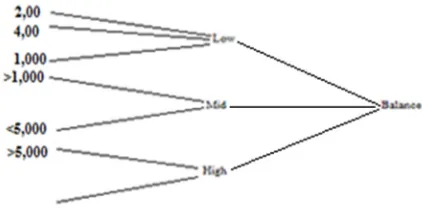
The hierarchical taxonomical tree for the balance attribute is shown in figure1. For example the attribute account_balance value < $ 1,000 generalized to its higher hierarchy Low_balance label and account_balance value >1,000 to 5,000
generalized to label Mid_balance and
[image:3.612.315.526.271.380.2]account_balance value >5,000 generalized to High_balance label.
Figure 2: Taxonomical Tree For Balance Attribute
If an attribute value xi Ac can partition into
fuzzy sets Lj = {L1… Lk} with a specific
membership value given by attributes fuzzy
membership function µc. where Lj(xi) = μ x
should satisfy equation (1).
0 ≦ μ x ≧ 1 & ∑ μ x 1
(1)
If an attribute Ac is categorical then the every
unique value xi Ac will be considered as a fuzzy
partition and µc (xi) = 0 or 1.
The fuzzy support for a fuzzy set Li with
respect to a distributed data sub set Dy with n
number transactions {t1…tn} is given by equation
(2).
FS L ! "
# !$%
&
(2)
The fuzzy support for a combination generated from fuzzy sets of different attributes with respect to a distributed data sub set Dy given by equation
(3).
FS L , L( ∑ ) * +% !,+, !
# !$%
&
Journal of Theoretical and Applied Information Technology 30th
April 2017. Vol.95. No 8 © 2005 – ongoing JATIT & LLS
ISSN: 1992-8645 www.jatit.org E-ISSN: 1817-3195
1757 The fuzzy associative classification rule extraction is special case of fuzzy association rule extraction. The class label based fuzzy generalized set support calculation process the equation (2) & (3) will be updated as equation (4) & (5).
FS L → . ∑#!$%&/!0123$2* ! "
(4)
FS L , L(→ 4
∑#!$%&/!0123$2) * +% !,+, !
*
(5)
In case of distributed environment where data set D fragmented horizontally among N number of systems then the global fuzzy support of a class
label based fuzzy generalized set 5 → C is
calculated with equation (6).
Global_FS (L→C) =∑:9$;789+→
< (6)
The fuzzy global confidence of the fuzzy generalized associative classification rule L→C is calculated by equation (7).
FC (L→C) = Global_FS L → CCGlobal_FS L
(7)
3. RELATEDWORK
In recent time several open source computing environments have been proposed based on Mapreduce computing paradigm in order to effectively handle big data which includes Apache Spark [11] for fast data processing, ApacheS4 [12] & CGL-Mapreduce [13] for stream data processing, Amazon EC2 [14] for cloud support and etc. Out of different computing environments Apache HADOOP is more popular because of scaling capacity on commodity hardware.
Considering impact on Mapreduce computing paradigm we can found several mining algorithms
which explores conventional data mining
algorithms on Mapreduce framework. The association rule finding algorithm are proposed in [15,16], k-means clustering for map reduce framework proposed in [17], the basic machine learning classification models on map reduce explored by CT-Chu [18] and further major classification work’s proposed like SVM[19,20],
KNN[21],boosting[22]. Even though these
proposals successfully explored their respective classification techniques on scalable Mapreduce architecture, they also suffer with problems due like their conventional methods for example moderate classification accuracy, harder in
interpreting the technique and assessing the results. These problems in conventional classification algorithms overcame by introducing associative
classification technique.
The first associative classification technique for single class label was proposed by Liu [23] which is further updated with multi class association rule by Li [24]. The other improvements includes Yang [25] model to classify with minimum number of rules Hu &Li [26] model proposed model to handle missing values, fadi’s [27] model extract associative classifier with single scan to database. The associative classifications also explored with respect to application on different fields like web mining [28], XML document classification [29], text analysis [30], image processing [31] and in [32,33,34] we can found associative classification models for distributed data mining environment. These conventional models suffer with a main problem that is lack of intuitiveness in classification result set. This lack of intuitiveness can overcome by fuzzy associative classification models proposed in [7, 35] and even fuzzy associative classification models also explored on distributed data mining environment in [36, 37, 38].
In literature we can found in Apriory algorithm [39] based associative classification model [40],
fp-groath model [41] based associative
classification model [42] with respect to Map-reduce architecture but the primary drawback of these models are they won’t consider intuitiveness of generated results. Even there exist even fuzzy sets [8] but this proposal has drawbacks like, the model won’t apply standard fuzzy clustering technique for fuzzy discretization of the data set which could affect its efficiency. The data discretization computation of the model is based on single system instead of distributed computing and even number of scans to data base is more than one which could affect time efficiency of model. Considering these drawbacks we propose fuzzy clustering driven fast and intuitive fuzzy
classification rule generation model with
1758
4.FUZZY ASSOCIATIVE CLASSIFIER
EXTRACTION MODEL FOR
[image:5.612.94.301.87.364.2]MAPREDUCEFRAMEWORK
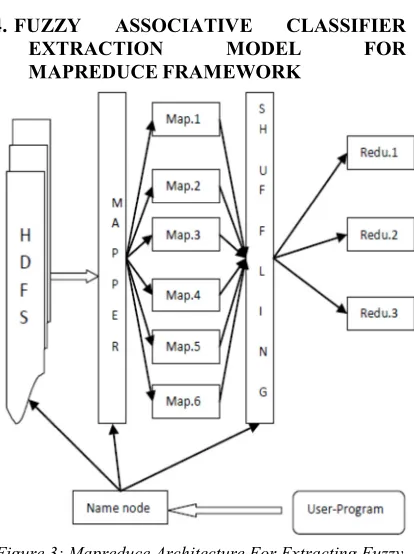
Figure 3: Mapreduce Architecture For Extracting Fuzzy Associative Classifier From Hdfs
The proposed Mapreduce model for
extracting fuzzy associative classifier from HDFS is shown in the figure.1. In the Mapreduce architecture the training data will be stored in HDFS and the name node is the master node where the user program will be submitted. Once if the user program is submitted to the name node then it initiates the Map nodes based up on data load of HDFS and assign a logical data block of HDFS for each Map node for further processing. The Map nodes process the corresponding HDFS data blocks in parallel. The intermediate results obtained from Map nodes will shuffled to different Reducer nodes to process for consolidated results. The number of Reducer nodes will decide manually based up on the number of class labels in training dataset. In order to extract fuzzy classification rules from given dataset the proposed Mapreduce computation
model perform following Mapreduce jobs.
MR_Job1. Data driven fuzzy quantifier
parameters generation using Fuzzy c-means
MR_Job2. Tid-list base Fuzzy associative
classification rules generation
MR_Job3. Classification rules pruning
MR_Job4. Classifying test instance and
efficiency calculation
The comprehensive explanation of Mapreduce jobs presented in following sections.
4.1 Data driven Fuzzy quantifier parameters generation using Fuzzy c-means clustering on Mapreduce framework:
Once if the task submitted to the name node it will initiate the Mapreduce job of data pre processing, which generates parameters to transform the crisp representative data records into the fuzzy representation. While in distributed file system as the huge data is distributed among multiple number of systems, depending on human experts to decide fuzzy quantification parameters is unreliable [43].In order to obtain data driven fuzzy quantification parameters the proposed model adopts fuzzy c-means algorithm. In this Mapreduce job experts only restricted to decide number of partitions and suitable semantic names, referred as fuzzy set labels for partitions with respect to
attributes where the fuzzy quantification
parameters driven by data stored in HDFS will be extracted by proposed fuzzy c-means approach for Mapreduce.
The Fuzzy c-Means(FCM) is a clustering method which allows a data element to be belongs to two or more clusters with specific membership value. The advantage of FCM is that it could categorize the data according to human semantic perspective. The objective of FCM for data points {x1,x2…xn} with expected clustered centers { v1,v2,…vc } is based on minimization of function (8) and membership value µ given by (9).
(
)
∑∑
(
)
= =≥
−
=
c i j i n i m j im
µ
x
v
J
µ
V
0 2 1 ,
1
m
,
,
(8) 1 1 2 1 , − − −
−
−
=
∑
m Ck i k j i j i
c
x
c
x
µ
(9)Journal of Theoretical and Applied Information Technology 30th
April 2017. Vol.95. No 8 © 2005 – ongoing JATIT & LLS
ISSN: 1992-8645 www.jatit.org E-ISSN: 1817-3195
1759 explore fuzzy c-means on map reduce framework to extract fuzzy quantifier parameters from distributed file system, our proposed approach at map nodes applies fuzzy c-means algorithm on all the data chunks in parallel to generate local centroids for all numeric attributes and local centroids of each attributes collected at a corresponding reducer node where again fuzzy c-mea ns algorithm will be applied on them to decide global centroids.
The proposed Mapreduce approach for Generating numeric attributes fuzzy partitioning parameters using fuzzy c-means presented in algorithm.1. According to proposed algorithm at first step the map node using assigned data node
generates fuzzy centroids matrix for all
corresponding numerical attributes by applying fuzzy c-means algorithm and stores them as intermediate result. The process will be carried out by all of the map nodes in parallel until completion of the all data chunks from Hadoop data bases. Once the fuzzy centroids matrix generation of all numerical attributes is been completed by map nodes they submit the status to name node, which will redistribute the centroids matrixes to reducer nodes. The re distribution will be done by attribute wise, that is all centroids matrices of an attribute will be directed to a reducer node where by combining these again fuzzy c-means algorithm will applied and final globally optimized fuzzy partitioning values will be obtained with respect to assigned attribute. The process will be continued for all attributes at other reduce nodes individually. The final combination of the reducer results are nothing but fuzzy partitioning parameters of the all numerical attributes of the data set.
Algorithm.1: Mapreduce Job 1: Generating Fuzzy Partitioning Parameters Of Numeric Attributes Using
Fuzzy C-Means
Input : Key: Training Data set, Value: Data
record values and initial Vectors Vi for attributes Ai
Output : <Key, Value> pair, Where Key = attribute Ai & Value = cluster centroids vector Vi of Ai
Map_Procedure:
1. For each quantitative attribute Ai initiate
the vector Vi={vi1,vi2,…vic} where c =
number of fuzzy sets satisfying
conditions ∑ µ 1.
a. For each transaction Tn read the
attribute value Ai and apply fuzzy
c-Means algorithm and update the local Vi vector
2. Using final set of Vi of all attributes form
the centroids matrix Mn for the data block
where n= number of map nodes.
Reduce_Procedure:
1. For each attribute Ai assigned
a. Read attribute Ai corresponding
centroids vector Vin from all centroids
matrix Mn
b. Calculate global fuzzy cluster
centroids vector Vi of Ai by applying
fuzzy c-Means on all Vin vectors.
Handling categorical attributes: In order to handle the categorical and binary attributes which can’t be generalized, the proposed model will considers every individual value taken by such attributes as a unique quantifier for corresponding attributes. For a transaction while calculating fuzzy membership of a categorical attribute, the membership for quantifier for exact match with attribute value will considered as 1 and for all reaming quantifier the fuzzy membership value will be considered as 0. In order to realize this approach on Mapreduce frame work there should be manual input indicating the categorical and binary attributes in total training dataset. In fuzzy quantifier generation the map node in a chunk if it encounters categorical attribute it just store all the unique value of corresponding attribute. At reducer phase for a categorical attribute all the corresponding values collected from processing the entire chunk will be unified and considered at global fuzzy quantifiers of attribute.
4.2 Tid-list base Fuzzy associative classification rule generation on Mapreduce framework:
Using the fuzzy partitioning values obtained in the previous step and corresponding fuzzy set labels expert , the fuzzy associative classification process on Mapreduce architecture will be initiated in this job. The proposed
Mapreduce approach for generating fuzzy
1760 corresponding data block with a single scan, which is used for frequent class label based item sets. In order to do so each map node at first creates the Tid-list vector by taking all attributes fuzzy partitioned set labels on row and for each transaction creates a new column. Then for each attribute item of transaction generate fuzzy membership values with respect to corresponding fuzzy partitions and store at corresponding label in the column. After generating fuzzy Tid-list all map nodes will generate all possible levels of local fuzzy item-sets along with their support count. The detail of fuzzy itemsets generation from fuzzy Tid-list is detailed in our previous publication [38].
Once the local fuzzy item-sets generation process is been over at map nodes then each level of item-sets will be directed to a corresponding reducer node. Then for each allotted level of item set, the reducer node will club the same local item-set and find their global support count of each. After this the reducer will apply global support cutoff, where the fuzzy itemsets with less than global threshold value will be dropdown. Then class label based association rule generated and corresponding confidence value will be calculated in conventional CBA [23] approach. Once the rule generation is been over then the rules not satisfying global cutoff threshold will be drop. The process will repeated for all level of item sets at every reducer node in parallel which results into the final set of globally valid associative classification rules.
Algorithm.2: Mapreduce Job 2: Globally Supported Fuzzy Associative Classification Rules Generation
Input : Key: Training Data set, Value: Data
record values and Centroids Vector Vi and fuzzy
set label vector Li of attributes Ai
Output : Fuzzy associative classification rules
Map_Procedure:
1. Create Tid-listn vector by taking all fuzzy
labels of Li on row
2. For each transaction ti
a. Create new column in Tid-listn do
b. For each attribute Ai of transaction ti
do
i. Generate membership values µi
using centroids vector Vi using
equation (1)
ii. Store each µi value at
corresponding label in the column
3. Generate local class label based fuzzy
itemsets using Tid-listn
4. Calculate support count using (5)
Reduce_Procedure:
1. For each level of allotted class label based
fuzzy itemsets do
a. Combine all same itemsets and
generate global itemsets
b. Calculate global support using (6)
c. Drop itemsets not satisfying global
support threshold
d. Generate fuzzy associative
classification rules using globally supported itemsets
e. Generate confidence of fuzzy
associative classification rules using (7)
f. Drop rules without satisfying
confidence threshold.
4.3 Rule pruning:
The Mapreduce job 3 is targeted to prune the redundant and less effective classification rules to get compact rule set. In order to prune the generated classification rules, at map node the rule set divided according to their targeted class label and each set will sort in ascending order according their rank. The rank of the rule decided based on confidence and support factor. That is a rule with high confidence will be given higher rank than rules with lower rank. If confidence of two rules are equal then their support will be compared and rule with high support value will be given higher rank and in case if two rules found same confidence and support then the rule whichever is generate first it will be given highest rank. At reduce procedure level each reducer directed to handle rule set of a single class at time where subset rules with less rank than its super set will be pruned.
4.4 Classifying test instances and efficiency
calculation:
Journal of Theoretical and Applied Information Technology 30th
April 2017. Vol.95. No 8 © 2005 – ongoing JATIT & LLS
ISSN: 1992-8645 www.jatit.org E-ISSN: 1817-3195
1761 classifying rule set will be applied on records and all the applicable rules along with their firing strength will be gathered. The class of the training record decided by the sum of firing strengths of rules with respect to each class label, that the applicable class label with highest firing strength will considered as class label of record. Before generating target class label the class label attribute of the transaction will be intentionally ignored and if once the class label of record is decided then the actual class label will be compare with obtained class label and correctness will be measured. The process will repeat for all the records in parallel at all map nodes in parallel. The consolidated accuracy and error rate will be calculated at reducer node using all the success and error scores of the all map nodes. Where the classification accuracy given by dividing correctly classified instance with total number of training instances and error rate given by dividing incorrectly classified instance by total number of training instances. The Mapreduce job 4 process is presented in algorithm.3.
Algorithm.3: Mapreduce Job 4: Fuzzy Classifier Accuracy Calculation
Input : Key: Testing data set, Value: Data record
Output : The accuracy and error rates of classifier
Map_Procedure:
1. For each test instance Ti do
a. Find all rules that applicable to Ti and
place in R
b. If all the rules in R indicating same
class then assign that class label to record
c. Else calculate sum of firing strengths
with respect to each class label
d. Assign class label to record with
highest firing strength
e. Update success and error count by
comparing actual class label with assigned class label.
Reduce_Procedure:
1. Calculate consolidated classification
efficiency and error rate by combining success and failure counts of all the map nodes.
5. IMPLEMENTATIONANDEVALUATION
The evaluation process considers accuracy and speed as factors to examine the performance of the proposed fuzzy associative classification algorithm implementation on map reduce architecture.
The Mapreduce framework established with maximum of 12 number of system in system where one system act as server node and other as computing nodes. Each of this system with Pentium-i5 2.67 GHz processors, 4GB RAM, 1Gbps Ethernet connection and hard disk with 500GB capacity. The MapReduce implemented with software version is Hadoop2.0.0-cdh4.4.0 and Mapreduce runtime (Classic) running on Ubuntu 14.4 operating system. .The maximum numbers of map task are dynamically decided by the master node where maximum number of reducers given is 4.
The first phase of experiment conducted to record classification accuracy of the proposed model, by taking 6 number of cores where one node considered as master node. The data set divided in training and testing data set in 10 cross 10 validation method. In order generate fuzzy associative classification rules all the nodes transferred into corresponding fuzzy representation
using proposed Mapreduce base fuzzy
preprocessing technique using which the globally optimized fuzzy classification rules and accuracy with respect training dataset was computed by applying subsequent algorithm on Mapreduce framework. The experiment repeatedly conducted for 3 different times and corresponding results are recorded, finally the average of recorded values used for evaluation.
1762 and Runner KDD[47] models our proposed MR-FAC model shown comparably well accuracy at same time it maintained highest intuitiveness with an average of 3-rules for each class. Along with these models we implemented distributed version of standard associative classification model CBA[23] on Mapreduce referred as MR_CBA with same interaction protocol and applied on KDD99 data set. In comparison with accuracy with respect MR_CBA also the proposed model proved its comparability. All to gether the accuracy levels with respect to Normal, Dos, and Probe classes are appreciable but in case of U2R and R2L classes it shown lower accuracy level. The reason to have lower accuracy in case of U2R andR2L may be due to lower number of training instances.
Table 1: The comparative test results on KDD-99 dataset
Model Name Normal Probe DoS U2R R2L
Winner-KDD
99.5 83.3 97.1 13.2 8.4
Runner-KDD 99.4 84.5 97.5 11.8 7.3
Dist_CBA 99.7 87.8 96.9 22.6 9.2
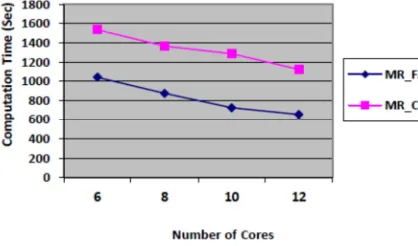
MR-FAC 98.2 81.3 96.7 11.3 7.1 The main objective of second phase of experiment is to evaluate time efficiency advantageous of adopting fuzzy model in comparison with non fuzzy model. In order to so we run MR_CBA and proposed model on 6, 8,10,12 number of nodes with Mapreduce frame work and which proves the time efficiency and scalability of our proposed approaches.
Figure 4: Computation Efficiency Of Methods With Respect To Number Of Nodes.
6.CONCLUSION
Considering the efficiency of Mapreduce framework and importance of fuzzy associative classification technique this paper proposes a fast and efficient fuzzy associative classification algorithm which can scale on Mapreduce
framework. In the proposed model the accuracy of classifier acquires by using data driven fuzzy clusters and time efficiency acquired using Tid-list based representation. The experimental results of proposed fuzzy associative classification model shows that it can successfully scale on Mapreduce architecture to handle data stored in HDFS and generate intuitive classification rules without compromising the efficiency. Extracting classifiers on multidimensional and dynamic datasets with Mapreduce framework can be worth full extension the proposed model.
REFERENCES:
[1]. C.L. Philip Chen ⇑, Chun-Yang Zhang,
.Data-intensive applications, challenges, techniques and technologies: A survey on Big Data Information Sciences 275 (2014) 314–347
[2]. Apache Hadoop Project,
http://hadoop.apache.org/
[3]. MapReduce: Simplified Data Processing on
LargeClusters, Jeffrey Dean and Sanjay Ghemawa, Google Labs, pp. 137–150, OSDI 2004
[4]. C.W.Tsai, C.F.Lai, M.C.Chiag, L.T. Yang “
Data mining for internet of the things” IEEE communications Survery & Tutorials, 2014, Vol.16.Issue.1, 77-97.
[5]. Neda Abdelhamid, “Associative
Classi¯cation Approaches: Review and Comparison”, Journal of Information & Knowledge Management, Vol. 13, No. 3 (2014) World Scienti¯c Publishing Co.
[6]. Zadeh, L. A.: Fuzzy sets. Inf. Control, 8,
338–358 (1965).
[7]. F.P.Pach, A.Gyenesei, J.Abonyi, Compact
fuzzy association rule-based classifier, Expert Systems with Applications, Vol.34, 2008, pp.2406–2416
[8]. Pietro Ducange, Fransceco Marcelloin,
Armado Segatori, “ A MapReduce-based Fuzzy Associative Classifier for Big Data “.
[9]. J.C.Bezdek, Pattern recognition with fuzzy
objective function algorithms, Plenum Press, New York, 1981
[10]. Savasere.A, Omiecinski.E, Navathe.S An
efficient algorithm for mining association rules in large databases, 1995, proceedings of the 21st conference on very large data bases 95 zurich, 432-444.
[11]. M.Zaharia,M.Chowdhury,M.J.Franklin,S.
Journal of Theoretical and Applied Information Technology 30th
April 2017. Vol.95. No 8 © 2005 – ongoing JATIT & LLS
ISSN: 1992-8645 www.jatit.org E-ISSN: 1817-3195
1763 ng,HotCloud’10,USENIXAssociation,Berke ley,CA,USA,2010.10–10
[12]. L.Neumeyer,B.Robbins,A.Nair,A.Kesari,
S4:distributedstreamcomputingplatform,in:P roceedingsof2010IEEEInternationalConfere nceonDataMiningWorkshops(ICDMW)„201 0,pp.170–
177,doi:10.1109/ICDMW.2010.172
[13]. J. Ekanayake, S. Pallickara, and G. Fox,
“Mapreduce for Data Intensive Scientific Analyses,” Proc. IEEE Fourth Int’l Conf eScience, pp. 277-284, 2008.
[14]. http://aws.amazon.com/ec2/.
[15].
M.-Y.Lin,P.-Y.Lee,S.-C.Hsueh,Apriori-based frequent itemset mining algorithms on MapReduce, in: Proceedings of the 6th International Conference on Ubiquitous
Information Management and
Communication, ICUIMC’12, ACM,
NewYork, NY, USA, 2012, pp.76:1–76:8.
[16]. H.Li,Y.Wang,D.Zhang,M.Zhang,E.Y.Cha
ng,PFP:parallelFP-Growthforqueryrecommendation,in:Proceed ingsofthe2008ACMConferenceonRecomme nder Systems, RecSys’08, ACM, NewYork, USA, 2008, pp.107–114.
[17]. W.Zhao,H.Ma,Q.He,ParallelKMeans
clustering based on MapReduce, in : Lecture Notes in Computer Science, 5931, Springer Berlin Heidelberg, 2009, pp.674–679.
[18].
C.-T.Chu,S.K.Kim,Y.-A.Lin,Y.Yu,G.R.Bradski,A.Y.Ng,K.Olukotu n,Map- Reduce for machine learning on multicore , in: B.Schölkopf, J.C.Platt, T.Hoffmanan(Eds.), Advances in Neural
Information Processing
Systems19,Proceedings of the Twentieth Annual Conference on Neural Information Processing Systems Vancouver, British
Columbia, Canada,
December4-7,2006,MITPress,2006,pp.281–288.
[19]. Q. He,C.Du,Q.Wang,F.Zhuang,Z.Shi,A
parallel incremental extreme svm
classifier,Neurocomputing74(16)(2011)2532 –2540.
[20]. G. Caruana,M.Li,Y.Liu, An ontology
enhanced parallel SVM for scalable spam
filter training,
Neurocomputing108(2013)45–57.
[21]. C.Zhang,F.Li,J.Jestes,EfficientparallelkN
NjoinsforlargedatainMapReduce,in:Proceedi ngsofthe15thInternationalConferenceonExte ndingDatabaseTechnology,EDBT’12,ACM, NewYork,NY,USA,2012,pp.38–
49,doi:10.1145/2247596.2247602.
[22]. I. Palit, C.Reddy, Scalable and parallel
boosting with mapreduce ,IEEETrans. Knowl.Data Eng.24(10)(2012)1904–1916.
[23]. B.Liu, W..Hsu& Y.Ma.” Integrating
classification and association rulemining” Jouranl of Knowledge discovery and data mining, KDD-98 , 1998.
[24]. W.Li, J. Han & J.Pei, “CMAR: Accurate
and efficient classification based on multiple class-association rules “, International conference on data mining, pp. 369–376, 2001.
[25]. J.Yang, “ Classification by association
rules: The importance of minimal rule sets”, The twentieth international conference on machine learning, 2003
[26]. H.Hu, J.Li. “Using association rules to
make rule-based classifiers robust”.
Proceedings of the sixteenth Australasian database conference pp. 47–54, 2005.
[27]. F.Thabtah, P.Cowling and S.Hammoud,
“MCAR: multi-class classification based on association rules”, Proceedings of the ACS/IEEE 2005 International Conference on Computer Systems and Applications, Washington, DC, USA, pp. 33–38, 2005.
[28]. Ajlouni, M. I. A., Hadi, W., & Alwedyan,
J. (2013). Detecting phishing websites using associative classification. European Journal of Business and Management, 5, 36–40.
[29]. Costa, G., Ortale, R., & Ritacco, E.
(2013). X-class: Associative classification of XML documents by structure. ACM Transactions on Information Systems, 31, 3.
[30]. Yoon, Y., & Lee, G. G. (2013). Two
scalable algorithms for associative text classification. Information Processing and Management, 49, 484–496.
[31]. Jabbar, M., Deekshatulu, B., & Chandra,
P. (2013). Knowledge discovery using associative classification for heart disease prediction. In Intelligent informatics (pp. 29–39). Springer.
[32]. G.Thakur, C.J. Ramesh.2008 A
Framework For Fast Classification
Algorithms, International Journal
Information Theories & Applications V.15, pp. 363-369.
[33]. D.Mokeddem, H Belbachir.2010.
Distributed classification using class
1764
[34]. Raghuram and Jayadev Gyani,
“incremental associative classification on distributed databases”, IEEE-Conf.
[35]. Xin Wang, Xiaodong Liu, Witold
Pedrycz, Xiaolei Zhu, Guangfei Hub, “ Mining axiomatic fuzzy set association rules for classification problems”, European Journal of Operational Research 218 (2012) 202–210.
[36]. B.RaghuRam and G.Aghila “ Mobile
agent based distributed fuzzy associative classification rules generation for OLAM”, IEEE conference on IAMA, Chennai, India, 2009.
[37]. Raghuram and Jayadev Gyani,
B.Hanumnthu, “Fuzzy associative classifier for distributed databases”, proceedings of ICWET-2012, Mumbai, India, IJCA, 2012.
[38]. Raghuram and Jayadev Gyani, “Fuzzy
generalised classifier for distributed
knowledge discovery”, International
Journal of Business Intelligence and Data Mining, Vol.8, No.3, pp.227 – 243, 2013
[39]. R.Agrawal,T.Imieli´nski,A.Swami,Mining
associationrulesbetweensetsofitemsinlargeda tabases,SIGMODRec.22(2)(1993)207– 216,doi:10.1145/170036.170072.
[40]. Fadi Thabtah, Suhel Hammoud, Hussein
Abdel-Jaber, “Parallel Associative
Classification Data Mining Frameworks Based MapReduce”, Journal of Parallel Processing Letters, Volume 25, Issue 02, June 2015.
[41]. J.Han, J.Pei, Y.Yin, R.Mao, Mining
frequent patterns without candidate
generation : a frequent-pattern tree
approach, DataMin.Knowl.Discov.8(1)
(2004) 53–87,
doi:10.1023/B:DAMI.0000005258.31418.83 .
[42]. Alessio Bechini, Francesco Marcelloni,
Armando Segatori, “ A mapreduce solution for associative classification on bigdata ”, Information Sciences 332 (2016) 33–55.
[43]. Ashish Mangalampalli, Vikram Pudi,
Fuzzy Association Rule Mining Algorithm for Fast and Efficient Performance on Very Large Datasets, Fuzz-IEEE, 2009, South korea.
[44]. Hore, P., Hall, L., Goldgof, D., Gu, Y.,
Maudsley, A.: A scalable framework for segmenting magentic resonance images. J. Signal Process. Syst. 54(1-3), 183–203 (2009).
[45]. Merz, c. and Murphy, P. ‘UCI machine
learning repository’ (1996) University of California, Irvine, CA, USA
[46]. B.Pfahringer, Winning the KDD99
classification cup: bagged boosting, ACM SIGKDD Explorations, Vol.1 (2), 2000, pp.65–66.
[47]. Levin, KDD-99 classifier learning contest