Characterization of Material Properties for Tunable
Reflectarray Antenna Design
M. Y. Ismail, M. Hashim Dahri and W. N. Zaihasra
Wireless and Radio Science Centre WARAS),
Universia Tun Hussein Onn Malaysia (UTHM, 86400 Parit Raja, Johor, Malaysia
Abstract. The emerging field of cornmications has increased the demand of electronically tunable reflectarray antennas. Substrate material nrooerties ulav an imoortant role in the desien of reflectarrav antennas. Variable nermittivitv
. .
.
,materials such as l~quid cvstals and ferroclectrics have received great deal of attention due to their non-linear material properties. A comparative analysis between the properties of liquid crystals and ferroelectrics for tunable reflectarray antenna design has been carried out by using Finite Integral Method (FIM). A thorough investigation based on reflectarray design analysis and tunable bias voltages of different non-linear materials is provided. It has been shown that due to higher dielectric permittivity values of non-linear materials, ferroelectrics require higher bias voltagcs for electronic tunability, as compared to liquid crystal materials. Barium strontium titanate (BST) with a dielectric
. .
-..
frequencyieflectarray operation due to materids' higher permittivity values. Furthermore a rectangular patch reflcctarriy antenna nrintcd on 1 mm thick different liauid crvstal materials has also been desiened based on FIM. It has been shown u that as the dielectric anisotropy of substrate matenal increases from 0.17 to 0.45, the frequency tunahlity and dynamic phase range of reflectmay antenna also increase from 372 MHz to 795 MHz and 90' to 160", respectively.
Keywords: Reflectanays, Nou-linear Materials, Dielectric Anisotropy, Dynamic Phasc Range, Frequency Tunability
PACS: 84.40:~
INTRODUCTION
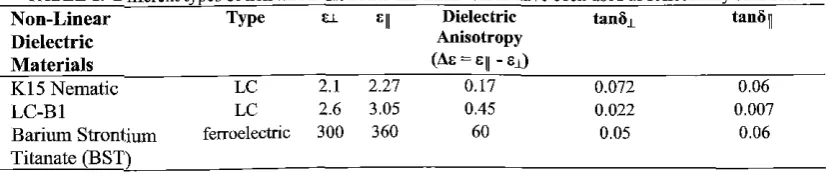
Mechanical movement of parabolic antenna especially in radar systems has increased the demand of an eleclronically tunable antenna [I]. Therefore a flat surface reflectarray antenna is gaining significant primary importance because of its lower cosl and miniaturized size. Reflectarray antenna consists of printed reflecting elements on a grounded flat dielectric surface, illuminated by a primary feed horn [2]. The properties of dielectric substrate play an important role in the designing of reflectmay antenna [3]. Non-linear dielectric properties of substrate materials are mostly exploited in phase shifter designs for electronic tunability [4, 51. The same technique can be employed to design an electronically tunable reflectarray antenna. In this work, different types of non-linear dielectric materials namely ferroelectrics and Liquid Crystals (LC) are used to design X-band rectangular patch reflectarray antenna. Table 1 summarizes some of lhe non-linear dielectric materials which have been used in reflectarray antenna design. Moreover, measurements of a passive reflectmay rectangular element printed on a linear material (Rogers 5880) were carried out by waveguide simulator approach. Measured reflection loss and static phase range values are compared wilh simulaled results in order to ensure the validity of simulations. Furthermore a comparative analysis based on required tunable bias voltage between ferroelectric and LC materials has been performed. The reflection loss performance is comparatively analyzed with kequency tunablilty and dynamic phase range of diffcrcnt nou-linear dieleclric materials based on FlM.
TABLE 1. Different types of non-linear dielectric materials which have been used as reflectarray substrate
Non-Linear Type
u
E I ~ Dielectric t a n 6 ~ tan611Dielectric Anisotropy
Materials (AE = €11
-
E ~ )K15 Nematic LC 2.1 2.27 0.17 0.072 0.06
LC-BI LC 2.6 3.05 0.45 0.022 0.007
Barium Strontium ferroelednc 300 360 60 0.05 0.06
[image:1.498.36.454.611.699.2]TABLE 4. Reflection loss, dynamic phase range and frequency tunability perfonnance of anisotropic LC materials
Non-Linear Dielectric Reflection Loss (dB) Dynamic Phase Frequency Tunability LC Materials Anisotropy at u Range Acp ( O ) Af (MHz)
at Ell
K15 Nematic 2 27 10.74 9.10 90 372
LC-B1 3.05 3.54 1.22 160 795
Table 4 also contains the values of dynamic phase ranges for reflectarray antenna printed on I mm thick dielectric anisotropic malerials. It has been observed from Table 4 that, as the dielectric anisotropy increases from
0.17 to 0.45 the dynamic phase range also increases from 90" to 160". This shows a relationship between dielectric anisotropy and dynamic phase range of non-linear LC materials.
A change in h e dielectric permittivity of &electric anisotropic materials can also cause a significant change in resonant frequency that is known as frequency tunability. Table 4 summarizes the frequency tunability values for reclangular reflectarray element printed above different anisotropic LC materials. I1 has been shown from Table 4
that, as the dielectric anisotropy increases from 0.17 to 0.45, the fiequency tunability also increases fiom 372-795 MHz Frequency tunability response of reflectarray antenna corresponds to the flexibilily in the value of dielectric anisotropy of anisotropic materials.
CONCLUSION
A delailed analysis based on rectangular patch reflectarray antenna printed on different linear and non-linear materials is presented in this work. The results obtained from t h s work demonstrate that different types of non-linear materials such as ferroelectrics and LC can enhance h e performance of reflectmay antenna in lenns of wider phase ranges and higher f i e q ~ ~ e n c y tunability. It has been observed that due lo lugher dielectric permittivity ferroelectrics require higher bias voltages as compared to LC materials. Furthermore it is observed that BST has a distorted phase response because of thinner substrate and reduced dimensions of the patch elemenl.
A
non-linear LC material offers rapid dynamic phase change behavior for designing XI electronically tunable reflectarray antenna. A rapid dynamic phase range wilh a high frequency tunability performance of differenl non-linear dielectric materials discussed in this work is required particularly for beam steering applicationsin
radar and satellite communication system.ACKNOWLEDGMENTS
This projecl is funded by the Best Fundamental Research Grant Scheme (FRGS VOT 0983), awarded by Minishy of Higher Education of Malaysia. We would like to thank the staff of Wireless and Radio Science Center (WAFUS) of University Tun Hussein Onn Malaysia (UTHM) for the technical support.
REFERENCES
1. M. I. Skoln~k, RadarHandbouk, 3'd edition,NewYork: Mc Craw Hill publications, 2008, pp. 1.1-1.23.
2. 1. Huang and J. Encinar, RejZectArryv Antennas, HabokenNew Jersey: John Wiley & Sons, Inc., 2007, pp. 1-6. 3. M. Y. Ismail, M. Inam and A. M. A. Zaidi, American J. of Engineerzng anduppliedSciences 3 (I), 180-185 (2010).
4. G. V6lu, K. Blaty and L. Burgnies, IEEE Tramactioiorrs on Microwave Theozy und Techniquer 55 (2), 438-444 (2007). 5. A. Moessinger, C. Fntzsch, S. Bildik and R. Jakoby, IEEEInternalional Microwave Symposium Digest (MTT-S), 1020-1023
(2014),
6. S. M. Kelly and M. O'Neill, 'Ziquid Crystals for Elcctro-Optic Applications" in Handbook of Advanced Electronic and Photonic Materials and Deviccs, edited by H.S. Nalwa, California: Academic Prcss, 2000, pp. 1-66.
7. M. Y. lsmail and R. Cahill, "Bern Steering Reflectarrays Using Liquid Crystal Substrate" in Tenrh IEEE High Frequency Postgraduate Siudent Colloquium, Conference Proceedings, University of Leeds, England, 2005, pp. 62-65.
8. T. R. Shrout and S. L. Swartz, "Processing of Ferroelecmc and Rekdted Materials; a review" in Eighth IEEE International
Symposium on Applications ofFerroelechics, ISAF Confercncc Proceedings 92, Greenville, USA, 1992, pp.80 -. 88.
9. 0. Tmshkevych, F. Golden, M. Pivnenko and H. Xu, Electronic Leners 46 (10). 693-695 (2010).
10. H. L. W Chan, "Smart Ferroclecwic Materials for Sensors and Mcchdtronic Device Applications" i~ 1EEE Conference
Publications, Proceedings of IEEE Electron Devices Meeting, Hong Kong, 1999, pp.68 - 71
l I. M. Inam and M. Y. Ismail, Microwave andOptica1 Technoloa Letters (MOTL) 53 (I), 77-80 (201 1).