A THREE-STAGE METHODOLOGY FOR DESIGN EVALUATION IN PRODUCT DEVELOPMENT
FAIZ BIN MOHD TURAN
A thesis submitted in
fulfilment of requirement for the award of the Doctor of Philosophy.
Faculty of Mechanical and Manufacturing Engineering Universiti Tun Hussein Onn Malaysia
v
ABSTRACT
vi
ABSTRAK
vii
CONTENTS
TITLE i
DECLARATION ii
DEDICATION iii
ACKNOWLEDGEMENT iv
ABSTRACT v
ABSTRAK vi
CONTENTS vii
LIST OF TABLES xi
LIST OF FIGURES xiv
LIST OF SYMBOLS AND ABBREVIATIONS xvii
LIST OF APPENDICES xix
CHAPTER 1 INTRODUCTION 1
1.1 Background 1
1.2 Problem statement 4
1.3 Objectives 6
1.4 Scope 8
1.5 Organisation of thesis 10
CHAPTER 2 LITERATURE REVIEW 13
2.1 Design model 13
viii
2.4 Classical AHP 18
2.5 Other existing tools 20
2.5.1 Fuzzy-TOPSIS 20
2.5.2 TRIZ 22
2.6 House of Quality (HoQ) 24
2.7 Fuzzy-AHP 28
2.7.1 Pair-wise comparison 28
2.7.2 Determination of weights 29
2.8 Rough-Grey Analysis 30
2.8.1 Rough sets and rough numbers 30 2.8.2 Grey relation analysis 31 2.9 Identified gaps in the literature 31
CHAPTER 3 METHODOLOGY 33
3.1 Introduction 33
3.2 Research framework 33
3.3 Research approach and design 35
3.3.1 Case study 35
3.3.2 Data collection 38
3.3.3 Reliability and validity 39
3.3.4 Ethical considerations 40
3.3.5 Data analysis 40
3.4 Summary 51
CHAPTER 4 IMPLEMENTATION 52
4.1 Introduction 52
ix
4.2.1 Conventional approach 57
4.2.2 Proposed approach 58
4.3 Flow of the events 59
4.3.1 Pilot case study 59
4.3.2 Case study 1 61
4.3.3 Case study 2 64
4.3.4 Case study 3 67
4.4 Summary 70
CHAPTER 5 RESULTS AND DISCUSSIONS 71
5.1 Pilot case study 71
5.1.1 Pahl & Beitz method 71
5.1.2 Conventional Fuzzy-AHP 74
5.1.3 Summary of pilot case study 77
5.2 Case study 1 78
5.2.1 Survey results 78
5.2.2 Pahl & Beitz method 80
5.2.3 Conventional Fuzzy-AHP 83
5.2.4 Fuzzy-TOPSIS 98
5.2.5 Proposed method 105
5.2.6 Summary of case study 1 121
5.3 Case study 2 122
5.3.1 Survey results 122
5.3.2 Applying TRIZ 124
5.3.3 Proposed method 140
x
5.4 Case study 3 156
5.4.1 Survey results 156
5.4.2 Proposed method 158
5.4.3 Summary of case study 3 171
5.5 Summary 171
CHAPTER 6 CONCLUSIONS AND FUTURE WORK 174
6.1 Review of the research objectives 174 6.2 The main research contribution 175
6.3 Suggestions for future work 176
REFERENCES 178
xi
LIST OF TABLES
2.1 The traditional form of AHP pair-wise comparison
scale 19
2.2 The comparison of characteristics between AHP and
TOPSIS 22
3.1 Proposed case study research 36 3.2 Scale of “Weighting criteria” 41
3.3 Dummy evaluation chart 43
3.4 Average consistencies indexes of random matrices 46 3.5 Dummy attribute ratings chart 47 3.6 The scale of attribute ratings ⊗v for benefit attributes 48 4.1 Initial criteria for case study 1 64 4.2 Initial criteria for case study 2 67 4.3 Initial criteria for case study 3 70 5.1 Evaluation of the principle solution variants for pilot
case study 73
5.2 Prioritisation weight of alternatives for pilot case study 77 5.3 Survey results of “Weighting criteria” for case study 1 79 5.4 Evaluation of the principle solution variants for case
study 1 84
5.5 Summary of prioritisation weight of alternatives for
case study 1 (conventional Fuzzy-AHP) 94 5.6 Prioritisation weight of alternatives for case study 1
after the criteria re-evaluation process
(conventional Fuzzy-AHP) 95
5.7 Prioritisation weight of alternatives for case study 1
(conventional Fuzzy-AHP) 96
xii
5.9 Decision matrix 100
5.10 Normalised decision matrix 100 5.11 Weighted normalised decision matrix 101
5.12 Positive ideal solution 102
5.13 Negative ideal solution 103
5.14 Computations 104
5.15 Survey results of “Weighting criteria” for case study 1
(proposed method) 106
5.16 HoQ summary for case study 1 108 5.17 Modified HoQ summary for case study 1 108 5.18 Dummy evaluation chart for case study 1 109 5.19 Summary of prioritisation weight of alternatives for
case study 1 (proposed method) 114 5.20 Prioritisation weight for alternatives for case study 1
(proposed method) 115
5.21 Dummy attribute ratings chart for case study 1 117 5.22 Attribute rating value for case study 1 119 5.23 Grey decision table for case study 1 120 5.24 Grey normalised for case study 1 120 5.25 Grey relational grade for case study 1 120 5.26 Survey results of “Weighting criteria” for case study 2 123
5.27 TRIZ contradiction 125
5.28 Weight calculation results for TRIZ 127
5.29 TRIZ summary 129
5.30 Modified TRIZ summary 130
5.31 Summary of prioritisation weight of alternatives for
case study 2 (TRIZ) 135
5.32 Prioritisation weight for alternatives for case study 2
(TRIZ) 136
xiii 5.38 Modified HoQ summary for case study 2 142
5.39 Dummy evaluation chart for case study 2 143 5.40 Summary of prioritisation weight of alternatives for
case study 2 (proposed method) 148 5.41 Prioritisation weight for alternatives for case study 2
(proposed method) 149
5.42 Dummy attribute ratings chart for case study 2 151 5.43 Attribute rating value for case study 2 (proposed method) 153 5.44 Grey decision table for case study 2 (proposed method) 154 5.45 Grey normalised for case study 2 (proposed method) 154 5.46 Grey relational grade for case study 2 (proposed method) 154 5.47 Survey results of “Weighting criteria” for case study 3 157 5.48 HoQ summary for case study 3 160 5.49 Modified HoQ summary for case study 3 161 5.50 Dummy evaluation chart for case study 3 161 5.51 Summary of prioritisation weight of alternatives for
case study 3 165
xiv
LIST OF FIGURES
1.1 The product design requirement 4 1.2 The relationship between number of design
Criteria and pair-wise comparisons of
Conventional Fuzzy-AHP 6
1.3 The overall aim of research 7
1.4 The aim of proposed approach 8
1.5 Simple set relationship of design evaluation 9
1.6 Thesis overview 12
2.1 A taxonomy of EDR research 13
2.2 Example of design models 14
2.3 Pahl & Beitz’s model of the design process 16 2.4 The difference between non-numerical and
numerical methods 17
2.5 The steps of the Fuzzy-TOPSIS method 21 2.6 The general case for abstracting a solution system 23 2.7 The first and second levels of abstraction 24 2.8 The four stages of QFD process 25
2.9 House of Quality matrix 26
2.10 Fuzzy set definition with triangular membership
function 29
3.1 General framework of proposed approach 34 3.2 Analytic hierarchy structure 44 4.1 Comparison of flow between conventional
Fuzzy-AHP and newly proposed approach 54 4.2 Problem analysis of conventional Fuzzy-AHP 55
4.3 Solution of proposed approach 56
xv
4.5 Implementation of proposed approach 59 4.6 Flow of events for pilot case study 60 4.7 Alternatives for pilot case study 61 4.8 Flow of events for case study 1 62 4.9 Design alternatives for case study 1 63 4.10 Flow of events for case study 2 65 4.11 Design alternatives for case study 2 66 4.12 Flow of events for case study 3 68 4.13 Design alternatives for case study 3 69 5.1 Selection chart for pilot case study 72 5.2 Objective tree for pilot case study 73 5.3 Analytic hierarchy structure for pilot case study 74 5.4 Fuzzy pair-wise comparison matrices for alternatives
for pilot case study 75
5.5 Relative importance of alternatives for pilot case study 76 5.6 Total completion period for pilot case study 78 5.7 Selection chart for case study 1 80 5.8 Objective tree for case study 1 81 5.9 Analytic hierarchy structure for case study 1
(conventional Fuzzy-AHP) 85
5.10 Fuzzy pair-wise comparison matrices for alternatives
for case study 1 (conventional Fuzzy-AHP) 86 5.11 Relative importance of alternatives for case study 1
(conventional Fuzzy-AHP) 89
5.12 HoQ matrix for case study 1 107 5.13 Analytic hierarchy structure for case study 1
(proposed method) 110
5.14 Fuzzy pair-wise comparison matrices for alternatives
for case study 1 (proposed method) 111 5.15 Prioritisation weight for alternatives for case study 1
(proposed method) 112
xvi
5.19 Analytic hierarchy structure for case study 2 (TRIZ) 131 5.20 Fuzzy pair-wise comparison matrices for alternatives
for case study 2 (TRIZ) 132
5.21 Prioritisation weight for alternatives for case study 2
(TRIZ) 133
5.22 Selection structure for case study 2 (TRIZ) 137 5.23 Analytic hierarchy structure for case study 2
(proposed method) 144
5.24 Fuzzy pair-wise comparison matrices for alternatives
for case study 2 (proposed method) 145 5.25 Prioritisation weight for alternatives for case study 2
(proposed method) 146
5.26 Selection structure for case study 2 (proposed method) 152 5.27 Total completion period for case study 2 155 5.28 HoQ matrix for case study 3 159 5.29 Analytic hierarchy structure for case study 3 162 5.30 Fuzzy pair-wise comparison matrices for alternatives
for case study 3 163
5.31 Prioritisation weight for alternatives for case study 3 164 5.32 Selection structure for case study 3 168 5.33 Total completion period for case study 3 171
xvii
LIST OF SYMBOLS AND ABBREVIATIONS
MCDM- Multi-Criteria Decision Making
AHP - Analytical Hierarchy Process
HoQ - House of Quality
⊗v - Attribute ratings value / Grey number value
EDR - Engineering Design Research
DM - Decision Maker
MADM- Multi-Attribute Decision Making
PIS- Positive Ideal Solution
NIS- Negative Ideal Solution
TOPSIS- Technique for Order Preference by Similarity to Ideal Solution
TRIZ - The Russian acronym for the “Theory of Inventive Problem Solving”
QFD - Quality Function Deployment
CA - Customer Attributes
TR - Technical Requirement
V - Correlation value
F - Fuzzy set
x - Values on the real time
U - Universe of discourse / General criterion
) (x
- Membership function
- Eigen value
A - nn fuzzy matrix
RM - Ringgit Malaysia
Wti - Relative weight value of HoQ
Vi - Rating value of evaluation criteria
WVi - Weighted value of evaluation criteria
DC - Difference Coefficient
xviii
PCM - Pair-wise Comparison Matrice
w - Prioritization weight (relative importance)
J - Index number of columns
I - Index number of rows
a - Value of pair-wise comparison
CI - Consistency Index
CR - Consistency Ratio
RI - Random consistency index
TW - Total prioritization weight
VP - Very Poor
P - Poor
MP - Medium Poor
F - Fair
MG - Medium Good
G - Good
VG - Very Good
K - Number of persons in a decision group
d - Decision value
S* - Suitable alternatives
*
S
R - Lower approximation of suitable alternatives
Smax - Ideal alternative
⊗x -
GRC - Grey Relational Coefficient
ρ - Distinguishing coefficient
GRG - Grey Relational Grade
- Degree of relation
ABS - Acrylonitrile Butadiene Styrene
PS - Polystytrene
PP - Polypropylene
PE - Polyethylene
OEM - Original Equipment Manufacturer
PCB - Printed Circuit Board
xix
LIST OF APPENDICES
APPENDIX TITLE PAGE
A Master schedule 189
B List of publications 190
C Awards received 191
CHAPTER 1
INTRODUCTION
1.1 Background
The product development process is one of transformation from customer requirements to a physical structure with consideration of the various design constraints (Li et al., 2010). For a long time, new product development has been considered an essential element for organisational competitiveness and success (Edwards et al., 2005). Product development also plays a critical role in the survival and success of manufacturing enterprises and many researchers have improved their understanding of the need for its strategic management (Brown & Eisenhardt, 1995; Griffin & Hauser, 1996; Krishnan & Ulrich, 2001; Chesbrough & Teece, 2002; Ayag & Odzemir, 2008). However, truly effective product development remains difficult (Lee & Santiago, 2008). A study by Minderhoud & Fraser (2005) indicates that product development practices have evolved over recent years as product cost; quality and time-to-market have each become progressively important. In parallel, the rapid pace of technological development has led to shorter product life cycles for many product categories, most notably in consumer electronics.
2
design process cannot be carried out efficiently if it is left entirely to chance...” (p.35). Furthermore, Finger & Dixon (1989b) mentioned that the mapping between the requirements of a design and the attributes of the artefact is not fully understood. Because the goal of design is to create artefacts that meet functional requirements, further fundamental research is needed on relating the attributes of designs to those functional requirements, that is, on prescribing the artefact. In addition, Chandrasegaran et al., (2013) stated that product design is a highly involved, often ill-defined, complex and iterative process and that the needs and specifications of the required artefact become more refined only as the design process moves towards its goal.
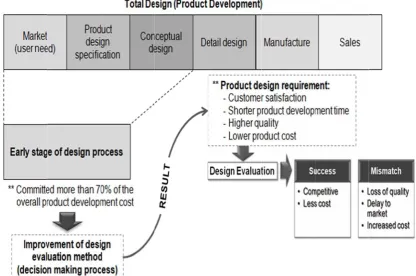
In today’s industries, product design has become the main focus in a highly competitive environment and fast-growing global market (Turan & Omar, 2012; 2013). The benchmarks used to determine the competitive advantage of a manufacturing company are customer satisfaction, shorter product development time, higher quality and lower product cost (Hsu & Woon, 1998; Subrahmanian et al., 2005; Shai et al., 2007). Today’s product designer is being asked to develop high-quality products at an ever increasing pace (Ye et al., 2008). To meet this challenge, new and novel design methodologies that facilitate the acquisition of design knowledge and creative ideas for later reuse are much sought after. In the same context, Liu & Boyle (2009) highlighted that the challenges currently faced by the engineering design industry are the need to attract and retain customers, the need to maintain and increase market share and profitability and the need to meet the requirements of diverse communities. Tools, techniques and methods are being developed that can support engineering design with an emphasis on the customer, the designer and the community (Chandrasegaran et al., 2013). Thus, a good design process should take into account the aforementioned criteria as early as possible in order to ensure the success of a product (Turan & Omar, 2012; 2013).
3
cost is committed during the early design phases. Furthermore, Ullman (2009) points out that 75% of the manufacturing cost is committed early in the design process. Under such circumstances, the design concept evaluation in the early phase of product development plays a critical role because it has a significant impact on downstream processes (Zhai et al., 2009). Similarly, Geng et al. (2010) point out that design concept evaluation, which is at the end of the conceptual design process, is one of the most critical decision points during product development. It relates to the ultimate success of product development, because a poor design concept can rarely be compensated in the latter stages.
Design concept evaluation is a complex multi-criteria decision-making (MCDM) process, which involves many factors ranging from initial customer needs to the resources and constraints of the manufacturing company. Concept design selection is the process of evaluation and selection from a range of competing design options with respect to customer needs and other criteria, comparing the relative strengths and weaknesses of the concept design and selecting one or more concept designs for further investigation, testing, or development (Green, 2000). However, how to evaluate effectively and objectively design concepts at the early stage of product development has not been well addressed, because the information available is usually incomplete, imprecise, and subjective or even inconsistent (Rosenman, 1993). As such, the quest for more effective and objective approaches to evaluate systematically design concepts in the early stage of the design process has invoked much research interest.
production concept d resources. manufactu 1.1 represe 1.2 Pr In prior to m Amongst t and the A attention o Turan & O one of the levels, wh which the n (Lovatt design alter To choos uring proce ents the afo
F
oblem state
order to he making a ju
the various Analytical H
owing to th Omar, 2013 e best metho hereas Fuzzy fuzziness o
& Sherclif native migh se a concep ss but also orementione Figure 1.1: ement elp designer udgement, tools devel ierarchy Pr heir abilities 3). Scott (20 ods for deci y-AHP is a of the decisi
ff, 1998). F ght lead to
pt design, consider th ed explanati
The produc
rs become b a systemat loped for de rocess (Fuzz s in handlin 002) and Ay iding amon a synthetic e
ion makers
Failing to reworking a company he criteria o ion of produ
ct design req
better-inform tic design e esign conce zy-AHP) m ng uncertai yag & Odze ng a comple
extension o is consider
choose the or redesig y should p of potential uct design re
quirement
med than co evaluation ept evaluatio methods have nty and MC emir (2007b
x criteria st f the classic ed. The nat
e most app gning and w pay attentio
l customers equirement
onventional method is on, fuzzy se e received t CDM (Scot b) state that tructure of d
cal AHP m ture of vagu
[image:20.595.114.531.199.475.2]5
design concept evaluation has made this method a topic of considerable interest to many researchers (Scott, 2002; Ayag & Odzemir, 2007b). In accordance with this, an ideal design evaluation method, as espoused by Ayag & Odzemir (2007b), Zhai et al. (2009) and Turan & Omar (2013), needs to use fewer numbers of design criteria, fewer numbers of pair-wise comparisons and have a support tool to verify and validate the ranking of the alternatives obtained.
The conventional Fuzzy-AHP method aims to use an optimum number of pair-wise comparisons. In AHP, pair-wise comparisons are often preferred by the decision makers, because they facilitate the weighting of criteria and scores of alternatives from comparison matrices, rather than quantifying the weights or scores directly (Javanbarg et al., 2012). In many practical situations, the human preference model is uncertain and decision makers might be reluctant or unable to assign exact numerical values to the comparison judgements. Although the use of the discrete scale for performing pair-wise comparative analysis has the advantage of simplicity, a decision maker might find it extremely difficult to express the strength of his preferences and to provide exact pair-wise comparison judgements in relation to the design criteria (Triantaphyllou & Lin, 1996; Duran & Aguilo, 2007). Consequently, the decision makers will need a process of reconsideration of design alternatives in relation to the design criteria, which might not help them reduce the number of design criteria. In addition, the final weight of design alternatives might not produce significant differences, which will affect the designers or decision makers when making a judgement. Thus, a sole conventional Fuzzy-AHP is insufficient when applied to ambiguous problems.
6
Figure 1.2: The relationship between number of design criteria and pair-wise comparisons of conventional Fuzzy-AHP
The proposed design evaluation method will integrate Fuzzy-AHP with another effective method in order to provide the designers with an alternative. A literature search indicates that no work has been done previously on the proposed methodology in design evaluation for new product development. The implementation of the proposed novel method will be divided into three stages: screening, evaluating and verifying, which use fewer numbers of design criteria, fewer numbers of pair-wise comparisons and have a support tool to verify and validate the ranking of the alternatives obtained. Thus, it can fulfil the aforementioned requirement of ideal design evaluation as well as contribute towards the body of knowledge.
1.3 Objective
The following defines in more detail what this work intends to achieve. Thus, it will be possible to evaluate later on, whether the steps chosen in the proposed methodology have led to successful results.
The overall aim of the research is formulated as follows:
To develop a novel methodology for design evaluation that enables designers to make better-informed decisions than conventional method when finalising their choice.
7
As the overall aim is broad, it has been divided into single objective in order to support its achievement. The objective of this research, as depicted in Figures 1.3 and 1.4 is to develop a method of interfacing Fuzzy-AHP with HoQ and Rough-Grey Analysis as the following steps:
(i) Introduce the scale of “Weighting criteria” for survey process prior to the first stage of design evaluation, which is a screening process using the HoQ method. HoQ will reduce the number of design criteria.
(ii) Introduce the method of computing the priority of element for constructing the pair-wise comparison matrix to execute the second stage of design evaluation, which is Fuzzy-AHP method with fewer numbers of pair-wise comparisons using the results from the first stage.
(iii) Introduce the method of quantifying the attribute ratings ⊗v to carry out the third stage of design evaluation, which is verification and validation stage using the Rough-Grey Analysis method. This stage will reduce the unnecessary iteration process.
The final target of the proposed approach is to help the design community become better-informed than conventional method before making final judgements and consequently, reduce development time and cost.
[image:23.595.117.522.460.727.2]
8
Figure 1.4: The aim of proposed approach
1.4 Scope
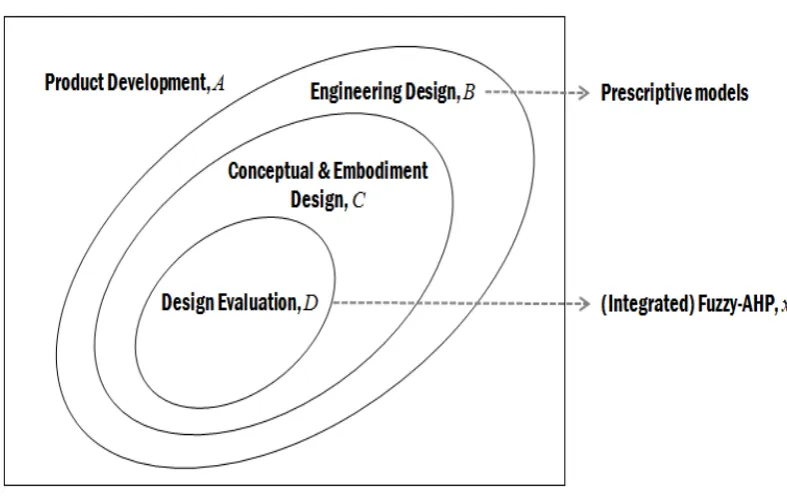
A Venn diagram or set of diagrams in Figure 1.5 shows all the hypothetically possible logical relations between product development and the proposed model of design evaluation. Mathematical equations of the aforementioned statement can be denoted by the following equation:
x
AB
C
D (1.1)where,
x: Proposed model of design evaluation A: Product development
9
[image:25.595.123.517.138.386.2]C: Conceptual and embodiment design D: Design evaluation
Figure 1.5: Simple set relationship of design evaluation (Turan & Omar, 2011, 2012)
As the scope of product development is too broad, this research will focus on prescriptive models of engineering design because this provides a systematic procedure for facilitating the design operations. Design operations will be limited to the conceptual design and embodiment design process and will focus entirely on the design evaluation, which is the integration of the Fuzzy-AHP method. Huang et al. (2006) mentioned that researchers had integrated fuzzy sets with other generic algorithms and neural networks to formulate an integrated approach for design concept generation and evaluation. In the same context, many researchers have successfully used fuzzy sets in engineering design evaluation (Carnahan et al., 1994; Khoo & Ho, 1996; Sun et al., 2000; Wang, 2001; Tsai & Hsiao, 2004). Furthermore, Fuzzy-AHP as one of the most commonly used MCDM techniques, has been adapted to evaluate alternatives of conceptual design (Zhai et al., 2009).
10
1.5 Organisation of thesis
The thesis structure, as indicated in Figure 1.6, is as follows. Chapter 1 presents the introduction of the research. The first part of Chapter 1 describes the background of the research, followed by a presentation of the specific problem to be addressed. The third and fourth parts describe the objectives and scope of the research, respectively and the final part describes the organisation of the thesis.
Chapter 2 comprises ten parts that discuss the design model, prescriptive design process model, design concept evaluation, classical Analytical Hierarchy Process (classical AHP), other existing tools, House of Quality, Fuzzy-AHP, Rough-Grey Analysis, overview on the prior art and finally, the identified gaps in the literature. The fifth part of this chapter discusses basic information of fuzzy set theory, the Technique for Order Preference by Similarity to Ideal Solution (Fuzzy-TOPSIS) and the Russian Theory of Inventive Problem Solving (TRIZ). The seventh part of this chapter, which is about Fuzzy-AHP, contains two short topics. It begins with the discussion of pair-wise comparison and is followed by the determination of weights. Similarly, the eighth part of this chapter, which is about Rough-Grey Analysis, discusses rough sets, rough numbers and grey relation analysis in detail. The ninth part of this chapter discusses the identified gap in the literature.
Chapter 3 covers the methodology of the research. This chapter discusses the proposed approach in detail. It discusses the general framework of this research and the research approach and design, which comprises an explanation of case study, data collection, reliability and validity, ethical considerations and data analysis. The final part of this chapter is a summary of the methodology.
Chapter 4 presents the implementation of the methodology proposed in the previous chapter. The implementation is divided into four parts: introduction, implementation strategy, flow of events and summary. The second part of this chapter discusses the implementation strategy of the conventional approach and the proposed approach. The third part of this chapter shows the flow of events for a pilot case study, case study 1, case study 2 and case study 3. The final part of this chapter is a summary of the implementation.
11
preliminary evaluation of the pilot case study using the Pahl & Beitz method and an evaluation using the conventional Fuzzy-AHP method. The end of this part presents a discussion of the pilot case study. Case study 1 presents the survey results, preliminary evaluation using the Pahl & Beitz method and an analysis of results using the conventional Fuzzy-AHP, Fuzzy-TOPSIS and the newly proposed method and a summary of case study 1. Similarly, case study 2 presents the survey results, an analysis of results by applying the TRIZ method and the newly proposed method and a summary of case study 2. Finally, case study 3 presents the survey results, the newly proposed method and a summary of case study 3. The final part of this chapter is a summary of results and discussions.
Figu
ure 1.6: Theesis overvieew
CHAPTER 2
LITERATURE REVIEW
2.1 Design model
[image:29.595.114.518.467.671.2]According to Cross (2000) and Darlington & Culley (2002), Engineering Design Research (EDR) has customarily been partitioned into prescriptive and descriptive work and design support tools will be allocated under the two main headings as seems appropriate to their provenance. An additional partition of ‘design automation’ has been added, because this appears to the present authors to be a quite separate research focus (Darlington & Culley, 2002). A taxonomy of the categorisations is shown in Figure 2.1.
Figure 2.1: A taxonomy of EDR research (Darlington & Culley, 2002)
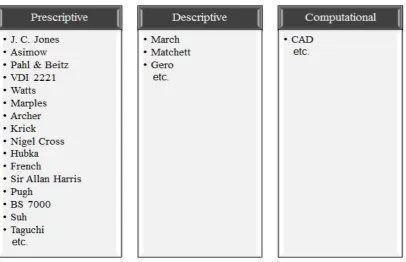
14 drawn as flow diagrams, showing the iterative nature of the design process via a feedback link. Generally, from various philosophical viewpoints, design models can be divided into two main classes: prescriptive and descriptive models. However, another class can be added, known here as computational models, which emphasise the use of quantitative and qualitative computational techniques and artificial intelligence techniques, combined with modern computing technologies (Ebuomwan et al., 1996; Cross, 2000).
[image:30.595.119.526.379.641.2]The prescriptive models tend to look at the design process from a global perspective, covering the procedural steps. They prescribe how the design process ought to proceed and sometimes suggest how best to carry it out. On the other hand, the descriptive models are concerned with designers’ actions and activities during the design process. This comes from both experience of individual designers and from studies carried out. Figure 2.2 presents examples of design models under each main class.
Figure 2.2: Example of design models
15
2.2 Prescriptive design process model
Prescriptive models of design process are concerned with trying to persuade or encourage designers to adopt improved ways of working. They usually offer a more algorithmic, systematic procedure to follow and they are often regarded as providing a particular design methodology. These models emphasise the need for further analytical work to develop the generation of solution concepts. The intention is to try to ensure that the design problem is fully understood, that no important elements of it are overlooked and that the real problem is identified.
The prescriptive models of both Taguchi and Suh are applied in practice and they have resulted in less expensive and more robust designs (Finger & Dixon, 1989a). In accordance with this, Pahl et al. (2007) introduced their model of the design process with the following stages:
(i) Clarification of the task:
Collect information about the requirements to be embodied in the solution and about the constraints.
(ii) Conceptual design:
Establish function structures; search for the suitable solution principles; combine into concept variants.
(iii) Embodiment design:
Starting from the concept, the designer determines the layout and forms and develops a technical product or system in accordance with technical and economic considerations.
(iv) Detail design:
Arrangement, form, dimensions and surface properties of all the individual parts; material specified; technical and economic feasibility re-checked; all drawings and other production documents produced. Figure 2.3 shows the design process of Pahl & Beitz’s model.
Figuree 2.3: Pahl && Beitz’s m Pahl et al
model of the l. (2007)
e design proocess
17
2.3 Design concept evaluation
Design concept evaluation is a complex MCDM process involving large amounts of data and expert knowledge, which are usually imprecise and subjective (Zhai et al., 2009).
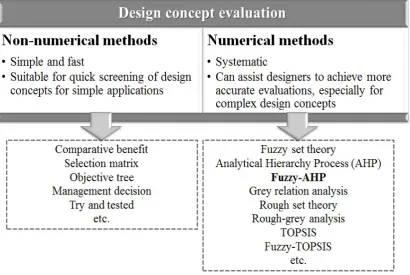
[image:33.595.119.530.447.722.2]Finger & Dixon (1989a) mentioned that in conceptual design, functional requirements are transformed into a physical embodiment or configuration. In the same manner, Ulrich & Seering (1987a, 1987b, 1987c) defined conceptual design as the transformation from functional and behavioural requirements to structural descriptions; that is, to configurations. Design concept evaluation can be classified into two categories: non-numerical methods and numerical methods (Ayag & Odzemir, 2007a). Generally, non-numerical methods are relatively simple, fast and are more suitable for quick screening of design concepts for simple applications. In contrast, numerical methods are more systematic and can assist designers in achieving evaluations that are more accurate, especially for complex design concepts. Figure 2.4 shows the difference between non-numerical and numerical methods as highlighted by Ayag & Odzemir (2007a).
18 A study by Zhang & Chu (2009) indicates that design concept evaluation is a complex MCDM problem, which involves many factors ranging from task-related factors (e.g., product complexity, initial customer requirements impreciseness and information scarcity) to decision related factors (e.g., the expertise and diversity of decision makers (DMs) and the method of aggregating judgements). Data and information involved in this problem come from design knowledge and experiences at earlier design stages and subjective judgements of DMs. At the earlier design stages, design information is deficient and imprecise. DMs’ judgements often lack precision and the confidence levels in them contribute to various degrees of uncertainty (Lo et al., 2006). Therefore, coping with uncertainty and the vague characteristics of information is critical to the effectiveness of the process of decision making. Furthermore, the aggregation method of individual judgements in group decision making and the alternatives ranking method in the evaluation model, are critical to the accuracy and effectiveness of design concept evaluation (Geng et al., 2010).
In short, design concept evaluation in the early phase of product development plays a critical role because it has a significant impact on downstream processes (Zhai et al., 2009). In addition, early design concept evaluation can save both cost and time in product development.
2.4 Classical AHP
In situations where DMs might have difficulties in determining accurately the various factor weights and evaluations, the Analytical Hierarchy Process (AHP) method can be used (Chatterjee & Mukherjee, 2010). In AHP, the DM starts by laying out the overall hierarchy of the decision. This hierarchy reveals the factors to be considered as well as the various alternatives in the decision. Here, both qualitative and quantitative criteria can be compared using a number of pair-wise comparisons, which result in the determination of factor weights. Finally, the alternative with the highest total weighted score is selected as the best option (Saaty, 1980).
19 subjective or qualitative judgements into numerical values. The pair-wise comparisons are applied to every element of a component, at a given level in the hierarchy, according to the elements of the next higher level (Nepal et al., 2010).
Table 2.1: The traditional form of AHP pair-wise comparison scale (Saaty, 1977)
Numerical
rating Verbal scale Description
1 Equal importance of both elements Two elements contribute equally 3 Moderate importance of one
element over another
Experience and judgement favour one over another 5 Strong importance of one element over another An element in strongly favoured 7 Very strong importance of one element over another An element is very strongly dominant 9 Extreme importance of one
element over another
An element is favoured by at least an order of magnitude 2,4,6,8 Intermediate values Used to compromise between two judgements
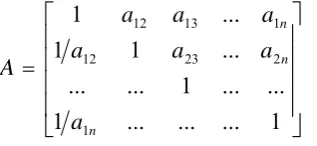
For computing the priorities of the elements, a judgemental matrix (also known as a pair-wise comparison matrix) is constructed, as shown below (Saaty, 1977). A 1 ... ... ... 1 ... ... 1 ... ... ... 1 1 ... 1 1 2 23 12 1 13 12 n n n a a a a a a a (2.1)
where aij represents a pair-wise comparison if element ei dominates ej (greater than or equal to one). On the other hand, 1 aij represents a similar comparison if element
j
20 elements dominates the other and ‘0’ means a judgement is not available. The entries
ij
a are governed by the following rules:
aij 0; aij 1 aji ; aii 1 i (2.2)
In short, the classical AHP method is incapable of handling the uncertainty and vagueness involved in the mapping of one’s preference to an exact number or ratio (Chatterjee & Mukherjee, 2010). The major difficulty with classical AHP is its inability to map human judgements. It has been observed that because of confusion in the DM’s mind, probable deviations should be integrated into the decision-making process (Askin & Guzin, 2007).
2.5 Other existing tools
2.5.1 Fuzzy-TOPSIS
The technique for order preference by similarity to ideal solution (TOPSIS) is a useful technique in dealing with multi-attribute or multi-criteria problems of decision making (MADM/MCDM) in the real world (Hwang & Yoon, 1981). The positive ideal solution (PIS) is a solution that maximises the benefit criteria/attributes and minimises the cost criteria/attributes. The negative ideal solution (NIS) maximises the cost criteria/attributes and minimises the benefit criteria/attributes (Chen, 2000). The best alternative is the one that is closest to the PIS and furthest from the NIS (Herrera et al., 1996; Herrera & Herrera-Viedma, 2000).
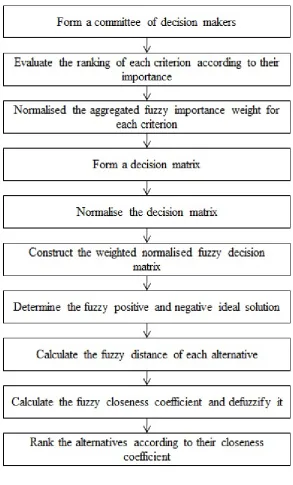
21
Figure 2.5: The steps of the Fuzzy-TOPSIS method
22 it would be suitable for cases with a large number of attributes and alternatives and especially handy for objective or quantitative data.
Table 2.2: The comparison of characteristics between AHP and TOPSIS (Saaty, 1990)
Characteristics AHP TOPSIS
1 Category
Cardinal information, information on attribute, MADM
Cardinal information, information on attribute, MADM
2 Core process Pair-wise comparison (cardinal ratio measurement)
The distances from PIS and NIS
(cardinal absolute measurement)
3 Attribute Given Given
4 Weight elicitation Pair-wise comparison Given
5 Consistency check Provided None
6 No. of attributes accommodated
7 ± 2 or hierarchical
decomposition Many more 7
No. of alternatives accommodated
7 ± 2 Many more
8 Others Compensatory operation Compensatory operation
In short, the disadvantages of the Fuzzy-TOPSIS method are not providing the weight elicitation and consistency checking, which are very useful for the DMs in making judgements.
2.5.2 TRIZ
23 The basic constituents of TRIZ are the contradictions, 40 inventive principles, the contradiction matrix (Domb, 1997; Zoyzen, 1997), the laws of evolution (Petrov, 2002), the substance-field analysis modelling (Terninko, 2000), the ideal final result (Domb, 1997), substance field resources and scientific effects (Frenklach, 1998). The core of TRIZ consists of 40 contradiction principles and the matrix; other tools are auxiliary in assisting design engineers to construct the problem model and analyse it.
[image:39.595.127.518.312.481.2]Altshuller’s early work on patents resulted in classifying inventive solutions into five levels, ranging from trivial to new scientific breakthroughs (Altshuller, 1999). Figure 2.6 illustrates this abstraction process, which classifies problems and solutions in seeking a correlation that enables a set of generic problem solving operators or principles to be identified.
Figure 2.6: The general case for abstracting a solution system (Lee & Huang, 2009)
24
Figure 2.7: The first and second levels of abstraction (Li & Huang, 2009)
In short, the contradiction matrix table of 40 innovative principles and 39 engineering parameters is used to ascertain the trade-off between design contradictions and engineering parameters. The design engineers can acquire more feasible solutions and inspiration through this method (Li & Huang, 2009). However, owing to vagueness and uncertainty in the DM’s judgement, a decision support tool that can represent adequately qualitative and subjective assessments under the multiple criteria decision-making environment is required.
2.6 House of Quality (HoQ)
Quality Function Deployment (QFD) was developed in Japan by Mitsubishi in 1972. This is a structured format used to integrate informational needs (Hauser & Clausing, 1988; Bounds et al., 1994). Applications begin with the HoQ, which is used to understand customer requirements and to translate these requirements into the voice of the engineer (Hauser, 1993). Posterior houses will deploy the requirements up to production requirements.
REFERENCES
Altshuller, G. (1999). The innovation algorithm. USA: Technical Innovation Centre Inc.
Askin, O., Guzin, O. (2007). Comparison of AHP and Fuzzy-AHP for multicriteria decision making process with linguistic evaluations Ýstanbul Ticaret Üniversitesi Fen Bilimleri Dergisi (Vol. 6, pp. 65-85).
Ayag, Z., Odzemir, R. G. (2007a). An Analytic Network Process-Based Approach to Concept Evaluation in a New Product Development Environment. Journal of Engineering Design, 18(3), 209-226.
Ayag, Z., Odzemir, R. G. (2007b). A combined fuzzy AHP-goal programming
approach to assembly-line selection. Journal of Intelligent and Fuzzy Systems, 18(4), 345-362.
Ayag, Z., Odzemir, R. G. (2008). A hybrid approach to concept selection through fuzzy analytic network process. Computers & Industrial Engineering, 56(1), 368-379.
Bai, C., Sarkis, J. (2010). Integrating sustainability into supplier selection with grey system and rough set methodologies. Int. J.ProductionEconomics, 124, 252-264.
Bai, C., Sarkis, J. (2011). Evaluating supplier development programs with a grey based rough set methodology. Expert Systems with Applications, 38, 13505-13517.
Bounds, G., Yorks, L., Adams, M., Rannsey, G. (1994). Beyond total quality management: Toward the emerging paradigm. New York: McGraw-Hill. Brown, P. G. (1991). QFD: Echoing the voice of the customer. AT&T Technical
Journal, March-April, 18-32.
179
Burns, N., Grove, S. K. (1993). The practice of nursing research: Conduct, critique & utilization 2nd edition. Philadelphia: Sanders.
Carnahan, J. V., Thurston, D. L., Liu, T. (1994). Fuzzing ratings for multi-attribute design decision-making. Journal of Mechanical Design, 116, 511-521. Chandrasegaran, S. K., Ramani, K., Sriram, R. D., Horváth, I., Bernard, A., Harik, R.
F., Gao, W. (2013). The evolution, challenges, and future of knowledge representation in product design systems. Computer-Aided Design, 45, 204-228.
Chatterjee, D., Mukherjee, B. (2010). Study of Fuzzy-AHP model to search the criterion in the evaluation of the best technical institutions: A case study. International Journal of Engineering Science and Technology, 2(7), 2499-2510.
Chen, C. T. (2000). Extensions of the TOPSIS for group decision making under fuzzy environment. Fuzzy Sets Systems, 114, 1-9.
Chen, L. C., Lin, L. (2002). Optimisation of product configuration design using functional requirements and constraints. Research in engineering design, 13, 167-182.
Chesbrough, H., Teece, D. (2002). Organizing for innovation: When is virtual virtuous? Harvard Business Review, 80(8), 127-134.
Childs, P. R. (2004). Mechanical design. Oxford: Elsevier Butterworth-Heinemann. Cook, T. D., Campbell, D. T. (1979). Quasi-experimentation: design & analysis
issues for field settings. Chicago: Rand McNally College Pub.
Cross, N. (2000). Engineering Design Methods: Strategies for Product Design (3rd ed.). Chichester, West Sussex, England: John Wiley & Sons Ltd.
Dang, Y. G., Liu, S. Y., Liu, B. (2005). On the multiple-attribute incidence decision model for interval numbers. Paper presented at the Proceedings on
Networking, Sensing and Control IEEE.
Darlington, M. J., Culley, S. J. (2002). Current Research in the Engineering Design Requirement. Proceedings of the Institution of Mechanical Engineers Part B - Journal of Engineering Manufacture, 216, 375-388.
Domb, E. (1997). 40 inventive principles with examples. TRIZ Journal of 1997(July). Duran, O., Aguilo, J. (2007). Computer-aided machine-tool selection based on a
180
Edwards, T., Battisti, G., W. P. McClendon Jr., Denyer, D., Neely, A. (2005). Pathways to Value How UK Firms Create More Value Using Innovation Strategically (1 ed.). London: Advanced Institure of Management Research (AIM).
Eisenhardt, K. M. (1989). Building the theories from case study research. Academy of Management Review, 14(4), 532-550.
Evans, J. R., Lindsay, W.M. (1996). The Management and Control of Quality. Saint Paul, MN: West Publishing.
F. O. Ebuomwan, N., Sivaloganathan, S., Jebb, A. (1996). A Survey of Design Philosophies, Models, Methods and Systems. Proceedings of the Institution of Mechanical Engineers Part B - Journal of Engineering Manufacture, 210, 301-320.
Finger, S., Dixon, J. R. (1989a). A Review of Research in Mechanical Engineering Design. Part I: Descriptive, Prescriptive, and Computer-Based Models of Design Process. Research in Engineering Design, 1, 51-67.
Finger, S., Dixon, J. R. (1989b). A Review of Research in Mechanical Engineering Design. Part II: Representations, Analysis, and Design for the Life Cycle. Research in Engineering Design, 1, 121-137.
Francis, E., Tay, H., Gu, J. (2002). Product Modeling for Conceptual Design Support. Computer in Industry, 48(2), 143-155.
Frenklach, G. (1998). Classifying the technical effects. TRIZ Journal of 1998(March). Geng, X., Chu, X., Zhang, Z. (2010). A new integrated design concept evaluation
approach based on vague sets. Expert Systems with Applications, 37, 6629-6638.
Green, G. (1997). Modeling concept design evaluation. Artificial intelligence for engineering design, analysis and manufacturing, 11, 211-217.
Green, G. (2000). Towards integrated evaluation: validation of models. Journal of engineering design, 11(2), 121-132.
Griffin, A., Hauser, J. (1992). The voice of the customer: Technical Report, Working paper 92-106, Marketing Science Institute, Cambridge, MA.
Griffin, A., Hauser, J. (1996). Integrating R&D and marketing: A review and
181
Hakim, C. (2000). Research Design: Succesful Designs for Social Economics Research 2nd edition. New York: Routledge.
Hartley, J. (2004). Case study research . In Catherine Cassell & Gillian Symon (Eds.) Essential guide to qualitative methods in organizational research (pp. 323-333). London: Sage Publications.
Hauser, J. R. (1993). How Puritan-Bennett used the house of quality. Sloan Management Review, 34(3), 61-70.
Hauser, J. R., Clausing, D. (1988). The house of quality. Harvard Business Review, 32(5), 63-73.
Hayes, J. (1996). A new framework for understanding cognition and effect in writing. In Levy, Michael; Ransdell, Sarah (eds.) The science of writing: Theories, methods, individual differences, and applications (pp. 1-27). Mahwah, NJ: Lawrence Erlbaum.
Hayes, J., Flower, L. (1980). Identifying the organization of writing processes. In Gregg, Lee; Steinberg, Erwin (eds.) Cognitive processes in writing: An interdisciplinary approach (pp. 3-30). Hillsdale, NJ: Lawrence Erlbaum. Herrera, F., Herrera-Viedma, E. (2000). Linguistic decision analysis: Steps for
solving decision problems under linguistic information. Fuzzy Sets and Systems,, 115, 67-82.
Herrera, F., Herrera-Viedma, E., Verdegay, J. L. (1996). A model of consensus in group decision making under linguistic assessments. Fuzzy Sets and Systems,, 78, 73-87.
Hongre, L. (2006). Identifying the Most Promising Business Model by using the Analytic Hierarchy Process Approach. Paper presented at the 23rd World Gas Conference, Amsterdam, Netherlands.
Hsu, W., M. Y. Woon, I. (1998). Current Research in the Conceptual Design of Mechanical Products. Computer-Aided Design, 30(No. 5), 377-389.
Huang, H. Z., Bo, R. F., Chen, W. (2006). An integrated computational intelligence approach to product concept generation and evaluation. Mechanism and Machine Theory, 41, 567-583.
182
Javanbarg, M. B., Scawthorn, C., Kiyono, J., Shahbodaghkhan, B. (2012). Fuzzy AHP-based multicriteria decision making systems using particle swarm optimization. Expert Systems with Applications, 39, 960–966.
Johnson, M. D., Herrmann, A., Bauer, H. H. (1999). The effects of price bundling on consumer evaluations of product offerings. International Journal of Research in Marketing, 16(2), 129-142.
Khoo, L. P., Ho, N. C. (1996). Framework of a fuzzy quality function deployment system. International Journal of Production Research, 34(2), 299-311. Khoo, L. P., Tor, S. B., Zhai, L. Y. (1999). A rough-set based approach for
classification and rule induction. International Journal of Advanced Manufacturing Technology, 15, 438-444.
Krishnan, V., Ulrich, K. (2001). Product development decisions: A review of the literature. Management Science, 1-21.
Krohling, R. A., Campanharo, V. C. (2011). Fuzzy TOPSIS for group decision making: A case study for accidents with oil spill in the sea. Expert Systems with Applications, 38, 4190-4197.
Lee, F., Santiago, M. (2008). Creativity in New Product Development : An Evolutionary Integration (1 ed.). USA: Butterworth-Heinemann.
Li, G. D., Yamaguchi, D., Nagai, M. (2008). A grey-based rough decision-making approach to supplier selection. International Journal of Advanced
Manufacturing Technology, 36, 1032-1040.
Li, T. S., Huang, H. H. (2009). Applying TRIZ and Fuzzy AHP to develop
innovative design for automated manufacturing systems. Expert Systems with Applications, 36, 8302-8312.
Li, W., Li, Y., Wang, J., Liu, X. (2010). The Process Model to Aid Innovation of Products Conceptual Design. Expert Systems with Applications, 37, 3574-3587.
Liu, S., Boyle, I. M. (2009). Engineering design: perspectives, challenges, and recent advances. Journal of Engineering Design, 20(1), 7-19.
Liu, Y. C., Bligh, T., Chakrabarti, A. (2003). Towards an ‘ideal’ approach for concept generation. Journal of design studies, 24, 341-355.
183
Lotter, B. (1986). Manufacturing Assembly Handbook. Boston, USA: Butterworth-Heinemann.
Lovatt, A. M., Shercliff, H.R. . (1998). Manufacturing process selection in engineering design. Part 2: an approach for creating task-based process selection procedures. Journal of material and design, 19, 217-230. Miles, M. B., Huberman, A. M. (1994). Qualitative data analysis 2nd edition.
California: Sage Publications.
Millson, M., Miles, B., Tennant. C. (2004). Effective new product introduction in SMEs. Paper presented at the Paper presented at the Proceeding of 2nd International Conference on Manufacturing Technology, Sheffield Hallam University, United Kingdom.
Minderhoud, S., Fraser, P. (2005). Shifting paradigms of product development in fast and dynamic markets. Reliability Engineering and System Safety, 88, 127-135. Mintzberg, H. (1979). The structuring of organizations: A systhesis of the research.
Englewood Cliffs, N.J.: Prentice-Hall.
Nepal, B., Yadav, O. P., Murat, A. (2010). A fuzzy-AHP approach to prioritization of CS attributes in target planning for automotive product development. Expert Systems with Applications, 37, 6775-6786.
Nevins, J. L., Whitney, D. (1989). Concurrent design of products and processes - A strategy for the next generation in manufacturing. New York: McGraw-Hill. Ordoobadi, S. M., Mulvaney, N. J. (2001). Development of a justification tool for
advanced manufacturing technologies: system-wide benefits value analysis. Journal of engineering and technology management, 18, 157-184.
Pahl, G., Beitz, W., Feldhuson, J., Grote, K. H. (2007). Engineering Design: A Systematic Approach (3rd ed.). London: Springer-Verlag London Ltd. Pawlak, Z. (1991). Rough sets: Theoretical aspects of reasoning about data.
Dordrecht: Kluwer Academic Publishing.
Petrov, V. (2002). The laws of system evolution. TRIZ Journal of 2002(March). Polit, D. F., Hungler, B. P. (1993). Essentials of nursing research. Philadelphia:
Lippincott.
Polit, D. F., Hungler, B. P. (1995). Nursing research: principles and methods 5th edition. Philadelphia: Lippincott.
Pugh, S. (1996). Total Design: Integrated Methods for Successful Product
184
Rosenman, M. A. (1993). Qualitative evaluation for topological specification in conceptual design. Applications and Techniques of Artificial Intelligence in Engineering, 2, 311-326.
Saaty, T. L. (1977). A Scaling Method for Priorities in Hierarchical Structures. Journal of Mathematical Psychology, 15, 234-281.
Saaty, T. L. (1980). The Analytic Hierarchy Process: Planning, Priority Setting and Resources Allocation. New York: McGraw-Hill.
Saaty, T. L. (1990). The Analytic Hierarchy Process (2nd ed.). Pittsburgh, PA: RWS Publication.
Saaty, T. L. (2000). Fundamentals of Decision Making and Priority Theory with the Analytic Hierarchy Process. Pittsburg: RWS Publications.
Saaty, T. L., Ozdemir, M. S. (2003). Why the magic number seven plus or minus two. Mathematical and Computer Modelling, 38, 233-244.
Scott, M. J. (2002). Quantifying Certainty in Design Decisions: Examining AHP. Paper presented at the ASME Design Engineering Technical Conferences (DETC2002).
Shai, O., Reich, Y., Rubin, D. (2007). Creative conceptual design: extending the scope by infused design. Computer-Aided Design, 41(3), 117-135. Shaw, A., Aitchison, D. R., Raine, J. K., Whybrew, K. (2001). Rapid product
development for world class manufacturing. Technical Report (Vol. 58). New Zealand: University of Canterbury.
Shih, H. S., Shyur, H. J., Lee, E. S. (2007). An Extension of TOPSIS for Group Decision Making. Mathematical and Computer Modeling, 45, 801-813. Stake, R. E. (2003). Case Studies in Denzin, N.K. &Lincoln, Y. (eds.) Strategies of
Qualitative Inquiry 2nd edition (pp. 134-164 ). London: Sage Publications. Streubert, H. J., Carpenter, D. R. (1999). Qualitative research in nursing: Advancing
the humanistic imperative 2nd edition. Philadelphia: Lippincott. Subrahmanian, E., Rachuri, S., Fenves, S. J., Foufou, S., Sriram, R. D. (2005).
Product lifecycle management support: A challenge in supporting product design and manufacturing in a networked economy. International Journal of Product Lifecycle Management, 1(1), 4-25.
185
Suskie, L. A. (2009). Assessing student learning: A common sense guide 2nd edition. San Francisco, CA: John Wiley & Sons.
Temponi, C., Yen, J., Tiao, W. J. (1999). House of quality: A fuzzy logic-based requirements analysis. European Journal of Operational Research, 117, 340-354.
Terninko, J. (2000). Su-field analysis. TRIZ Journal of 2000(February).
Triantaphyllou, E., Lin, C. T. (1996). Development and evaluation of five fuzzy multiattribute decision-making methods. International Journal of
Approximate Reasoning, 14, 281-310.
Tsai, H. C., Hsiao, S. W. (2004). Evaluation of alternatives for product customization using fuzzy logic. Information Sciences, 158(1), 233-262.
Turan, F. M., Omar, B. (2011). In situ design evaluation for product life cycle management. Paper presented at the 2nd International Conference on Mechanical and Manufacturing Engineering (ICME 2011), Putrajaya, Malaysia.
Turan, F. M., Omar, B. (2012). In situ design evaluation for product life cycle
management using Fuzzy-AHP approach. Paper presented at the International Conference on Applications and Design in Mechanical Engineering
(ICADME 2012), Penang, Malaysia.
Turan, F. M., Omar, B. (2013). The Integration of HOQ and Fuzzy-AHP for Design Concept Evaluation. Applied Mechanics and Materials, 315(2013), 25-29. Udo, G. G. (2000). Using Analytic Hierarchy Process to Analyze the Information
Technology Outsourcing Decision. Industrial Management & Data Systems, 100(9), 421-429.
Ullman, D. G. (2009). The Mechanical Design Process (4 ed.). New York: McGraw-Hill.
Ulrich, K., Eppinger, S. (2005). Product design and development, 5th edition. New York: McGraw-Hill Inc.
Ulrich, K., Seering, W. (1987a). A Computational Approach to Conceptual Design. Paper presented at the International Conference on Engineering Design, Cambridge, UK.
186
Ulrich, K., Seering, W. (1987c). Conceptual Design: Synthesis of Systems Components. Intelligent and Integrated Manufacturing Analysis and Synthesis, American Society of Mechanical Engineers, New York, 57-66. Vairaktarakis, G. L. (1999). Optimization tools for design and marketing of new /
improved products using the house of quality. Journal of Operations Management, 17, 645-663.
Wallace, K. M. (1989). Better by Design. Manufacturing Engineer, 35-36. Wang, J. (2001). Ranking engineering design concepts using a fuzzy outranking
preference model. Fuzzy Sets and Systems,, 119, 161-170.
Ye, X., Liu, H., Chen, L., Chen, Z., Pan, X., Zhang, S. (2008). Reverse innovative design - an integrated product design methodology. Computer-Aided Design, 40, 812-827.
Yin, R. K. (1984). Case study research. Beverly Hills, CA: Sage Publications. Yin, R. K. (2003). Applications of case study research 2nd edition (Vol. 34).
California: Sage Publications.
Zhai, L. Y., Khoo, L. P., Zhong, Z. W. (2007). A rough set enhanced fuzzy approach to quality function deployment. International Journal of Advanced
Manufacturing Technology, 37(5-6), 613-624.
Zhai, L. Y., Khoo, L. P., Zhong, Z. W. (2009). Design Concept Evaluation in Product Development using Rough Sets and Grey Relation Analysis. Expert Systems with Applications, 36, 7072-7079.
Zhang, Z., Chu, X. (2009). A new integrated decision-making approach for design alternative selection for supporting complex product development.
International Journal of Computer Integrated Manufacturing, 22(3), 179-198. Zoyzen, Z. (1997). Solving contradictions in development of new generation