Journal of Chemical and Pharmaceutical Research
__________________________________________________
ISSN No: 0975-7384 CODEN(USA): JCPRC5
J. Chem. Pharm. Res., 2011, 3(6):856-864
856
Design and Development of Hydrodynamically Balanced Tablet of
Itopride
Gupta Amit M.*, Belgamwar Aarti V. , Wake Prashant S. , Rathi Trivesh P, Mundhada D. R.
Agnihotri College of Pharmacy, Wardha, M.S., India
______________________________________________________________________________
ABSTRACT
Hydrodynamically Balanced Systems is an approach to increase the gastric residence time of drugs in stomach. This system is designed for site-specific oral drugs with low bulk density than gastric fluid so as to buoyant the dosage forms in stomach to increase the residence time of the drug. In the present investigation, an attempt has been made to design hydrodynamically
balanced drug delivery systems for itopride using HPMC K100M, HPMC K4M, and Xanhtan gum
polymers. Different batches of matrix tablets of itopride were prepared using various drugs to polymer ratio by direct compression method. The compressed tablets were evaluated for physical characteristics, drug content, floating time, floating lag time, in-vitro dissolution, stability study and FTIR spectroscopy. FTIR study showed that there is no chemical interaction between drug and excipients. All the formulation passes various physico-chemical tests. F4 formulation showed a buoyancy lag time of less than 75 Sec and floating time of more than 12hrs. From the in vitro drug release profile it was found that matrix tablet containing HPMC K 4M showed 95.88% drug release in 12 hrs .It can be concluded that itopride released from the tablet follows zero order kinetics with peppas model with non-Fickian diffusion.
Key words: Hydrodynamically Balanced Systems, Floating matrix tablet, Itopride and Xanthan
gum.
______________________________________________________________________________
INTRODUCTION
857
residual system is emptied from the stomach. This results in an increase in the GRT and a better control of fluctuations in the plasma drug concentrations. Itopride Hydrochloride is a prokinetic drug and its primary site of action is stomach and also in the pH range of 3.5 to 5.5 so it would be beneficial to formulate a floating drug delivery system of Itopride hydrochloride.5, 6, 7
Itopride hydrochloride is the drug of first choice in the therapy of upper dyspepsia at this time in Czech Republic. It is a prokinetic drug that activates the gastrointestinal motility through synergism of its dopamine D2 - receptor antagonistic action and its acetylcholine esterase inhibitory action8.
EXPERIMENTAL SECTION
Itopride hydrochloride was gifted by J.B Pharmaceutical & Chemical Ltd., Mumbai, HPMC K100M; HPMC K4M was gifted by Colorcon Asia Pvt. Ltd., Goa. Xanthan gum was gifted by Leben Pharma, Akola. Sodium Bicarbonate, Citric acid, Magnesium Stearate, Talc, was procured from. S.D. Fine Chem. Ltd.
Drug- Excipient Interaction
The physicochemical compatibilities of drug and excipient were tested by FTIR spectroscopy. FTIR spectras of the drug alone and drug-excipient physical mixtures (1:1) were derived from a FTIR. (Fig. I)
Development of Hydrodynamically Balanced Tablet of Itopride
Hydrodynamically balance tablets containing Itopride HCl were prepared by direct compression technique using varying concentrations of different grades of polymers with sodium bicarbonate and citric acid as a gas generating agent. All the ingredients were accurately weighed and sifted through different mesh sieves accordingly. Then, except magnesium stearate, all other ingredients were blended uniformly. After sufficient mixing of drug as well as other components, magnesium stearate was added, as post lubricant, and further mixed for additional 2-3 minutes. The tablets were compressed with 8 mm punch using rotary tablet machine. The composition of Itopride tablets are given in Table I.
Evaluation of Powder
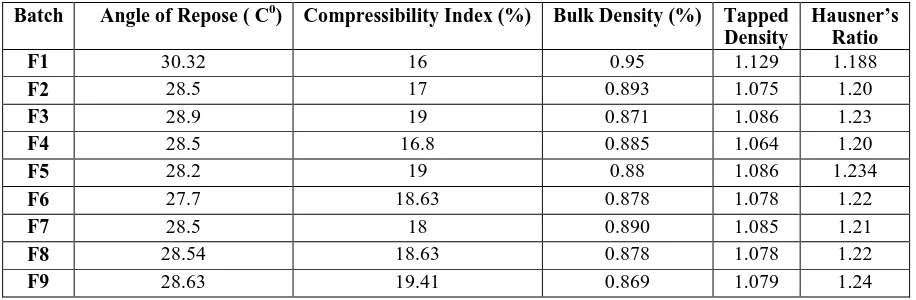
The powder blend was evaluated for angle of repose, bulk density, compressibility index and Hausner’s factor using USP tapped density tester. Result of evaluation is given in Table II.
Evaluation of Itopride Tablets Physical Evaluation
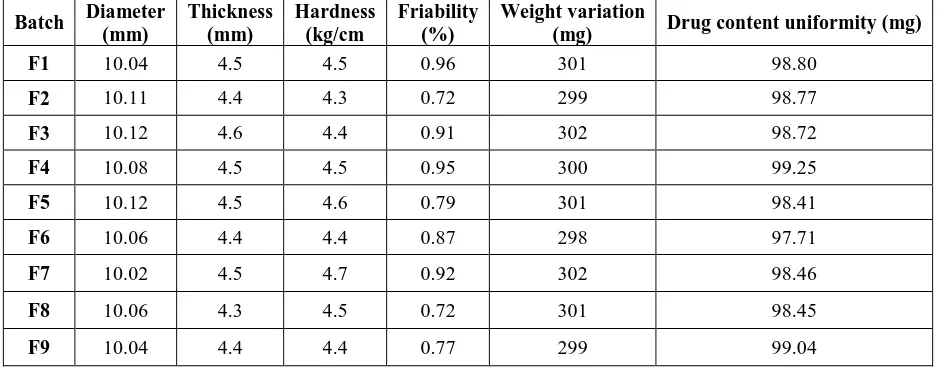
The thickness and diameter (Vernier caliper), hardness (Monsanto Hardness tester), weight variation, friability (Friability testing apparatus, Electrolab, Mumbai), drug content uniformity was evaluated. Result are shown in Table III
Drug Content
858
Buoyancy Lag Time and Total Floating Time
Tablets were evaluated for tablet density; Buoyancy lag time and total floating time, Table IV, Figure I. Time between introduction of dosage form and its buoyancy on the simulated gastric fluid and the time during which the dosage form remain buoyant were measured. The time taken for dosage form to emerge on the surface of medium is called floating lag time (FLT) or buoyancy lag time (BLT) and total duration of time by which dosage form remain buoyant is called total floating time (TFT) 9 .
Swelling Study10
The swelling behavior of a dosage form was measured by studying its weight gain or water uptake. Water uptake was measured in terms of percent weight gain, as given by equation
WU = (Wt- Wo)/ Wo X 100
Wt – Weight of dosage form at time t Wo – Initial weight of dosage form.
Result of swelling index are given in Table V
In Vitro Drug Release Study 11
The release rate of Itopride HCl from floating tablets was determined using USP Dissolution Testing Apparatus II (Paddle type). The dissolution test was performed using 900 ml of 0.1 N HCl, at 37 ± 0.5 °C and 50 rpm. Aliquot volume was withdrawn from the dissolution apparatus hourly for 12 h, and the samples were replaced with fresh dissolution medium. After filtration and suitable dilution the amount of drug release was determined from the calibration curve.
Stability Studies of Matrix Tablets
Stability studies of the selected formulated tablets were carried out by keeping the tablets at room temperature and at 40°C ± 2°C / 75 ± 5% RH (stability chamber) for 30days and evaluated for physical properties, drug release and drug content during the testing period. All the parameters were compared with initial formulation.
RESULTS AND DISCUSSION
Drug- Excipient Interaction
Drug- Excipient Interaction was determined using FTIR spectrophotometer. The IR spectrum of pure drug and physical mixture of drug and polymer of optimized formulation were studied. The characteristic absorption peaks of Itopride Hydrochloride were obtained at 1349.93 cm-11590.99 cm-1, 3415.31 cm-1, 3456.78 cm-1, 3502.12 cm-1.The peaks obtained in the spectrum of each formulation correlates with the peaks of drug spectrum. This indicates that the drug is compatible with the formulation components.
Evaluation of Powder
859
Evaluation of Itopride Tablets
Tablet thickness was almost uniform in all formulation and was found to be in the range of 4.03mm – 4.6mm. The diameter of tablet ranges between 10.02mm – 10.11. Hardness of tablets range between 4.4kg/cm2 -4.7kg/cm2 ensures good handling characteristics of all batches. Friability values were 0.72% - 0.96% was less than 1% insures mechanical stability of tablets. Percentage drug content was found to be between 97.71%- 99.25%, which was within acceptable limits.
Tablet density:
To provide good floating behavior in the stomach, the density of the device should be less than that of the gastric contents (1.004g/cm3). All the batches showed density below than that of gastric fluid (1.004). The values are shown in Table no. 4, when tablet comes in contact the test medium, tablet expanded because of swellable polymers and there of CO2 gas liberates due to
effervescent agent, sodium bicarbonate and citric acid. Citric acid acts a dual action of effervescent agent as well as it maintains the pH of the environment. The density decreases due to this expansion and upward force of CO2 gas generation. This plays an important role in
ensuring the floating capability of the dosage form.
Buoyancy Study:
On immersion in 0.1N HCl solution pH (1.2) at 370C, the tablets floated, and remained buoyant without disintegration. Table no. 4 shows the results of Buoyancy study and show Buoyancy character of prepared tablet (As shown in photograph).
Carbon dioxide is formed within the tablet containing effervescent agent when tablet is brought in contact with the acidic dissolution medium. The low density of HPMC assists in floating the Itopride tablet. The gelling capacity of the HPMC also helps to float the tablet by entrapping carbon dioxide gas in the gel network of HPMC. The gelling capacity of HPMC also prevents disintegration of the tablet during the dissolution study and thus sustained drug release occurs.
From the results it can be concluded that the batch containing only HPMC polymer showed good Buoyancy lag time (BLT) and Total floating time (TFT). Formulation F4 containing HPMC K4
showed good BLT while the formulation containing xanthan gum was rather slow, causing delayed gel formation and subsequent increase in BLT and TFT more than 12 hrs. A 10% concentration of sodium bicarbonate was found optimum to impart floating. It was observed that the concentration of sodium bicarbonate less than 10% led to slow reaction that prolonged the floating lag time up to 1.5h.
Swelling Study:
Swelling ratio describes the amount of water that is contained within the hydrogel at equilibrium and is a function of the network structure, hydrophilicity and ionization of the functional groups. Swelling study was performed on all formulations for 12 hours. The results of swelling index are given in Table no.5.
860
In the present study, the higher swelling index was found for tablets of batch F9 containing
Xanthan gum having viscosity. Thus, the viscosity of the polymer had major influence on swelling process, matrix integrity, as well as floating capability, hence from the above results it can be concluded that linear relationship exists between swelling process and viscosity of polymer
Drug Content Uniformity
The percentage of drug content was found to be between 97.71% and 99.25% of Itopride, which was within acceptable limits. Table no.3 showed the results of drug content uniformity in each batch.
In Vitro Drug Release
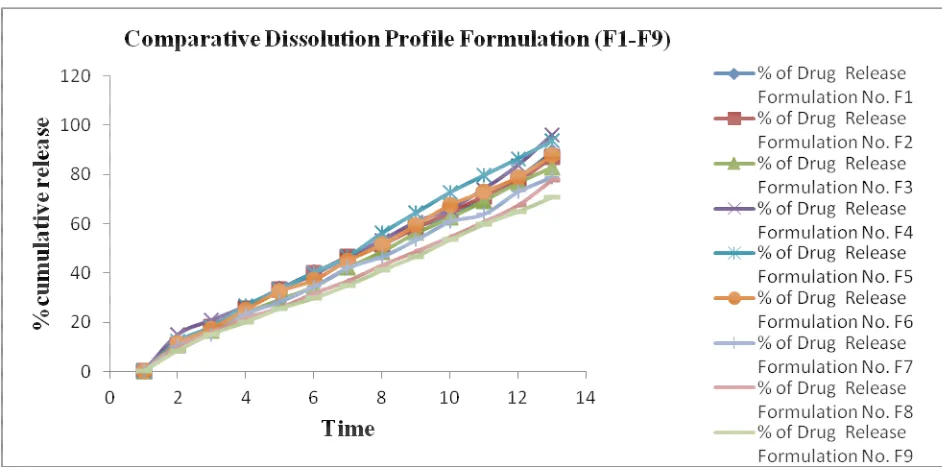
The in vitro drug release of hydrodynamic balanced tablets from each batch (F1 to F9) were also
carried in 0.1N HCl having pH 1.2 for 12 hrs and the values are shown in Table No. 6 The plot of Cumulative drug release vs. time (hr) was plotted and depicted as shown in Fig No.2. From the in vitro dissolution data, it was found that the drug release study from formulations containing HPMC K100M (F1to F3) was 89.12, 87.22, and 82.93% respectively. Formulations
containing HPMC K4M (F4-F6) showed 95.88, 93.64, and 88.05% respectively. The higher rate
and extent of drug release was observed from the formulation based on HPMC K100M and HPMC K4M than those based on Xanthan gum showed slower release of drug this is because of
higher degree of swelling due to water uptake and small amount of erosion due to polymer relaxation
Drug release profiles of formulations composed of Xanthan gum (F7toF9) showed 79.08, 77.9,
and 70.75% respectively, in 12 h. this variation was consider to be due to different polymer concentrations in formulations further, this three formulation failed to meet the required theoretical drug profile, In addition, these formulation showed very long floating lag times .
Among all the formulations, formulation F4 containing polymer HPMC K4M showed maximum
release retardation.
Curve Fitting Analysis
The results of dissolution data fitted to various drug release kinetic equations. Peppas model was found to be the best fitted in all dissolution profile having higher correlation coefficient (r-value) followed by Higuchi and Zero order release equation. The kinetic values obtained for different formulations are tabulated. Korsemeyer-Peppas model indicates that release mechanism is not well known or more than one type of release phenomena could be involved. The 'n' value could be used to characterize different release mechanisms as
N Mechanism
0.5 Fickian diffusion (Higuchi Matrix) 0.5 < n < 1 Non-Fickian diffusion
1 Case II transport
861
Table No 1: Composition of Hydrodynamically Balanced tablets of Itopride (Mgs)
Total weight of tablet: 300 mg
Table No 2: Angle of Repose,
[image:6.595.78.536.581.731.2]Compressibility Index, Tapped density, Bulk density
Table No 3: Physical properties of tablets of all formulations Ingredient F1 F2 F3 F4 F5 F6 F7 F8 F9
Itopride 100 100 100 100 100 100 100 100 100
HPMC K100M 60 75 90 __ __ __ __ __ __
HPMC K4M __ __ __ 60 75 90 __ __ __
Xanthan Gum __ __ __ __ __ __ 60 75 90
Sodium Bicarbonate 30 30 30 30 30 30 30 30 30
Citric Acid 15 15 15 15 15 15 15 15 15
Lactose 90 75 60 90 75 60 90 75 60
Talc 2 2 2 2 2 2 2 2 2
Magnesium state 3 3 3 3 3 3 3 3 3
Batch Tablet Density (g/cc) Buoyancy Lag Time (Sec) Total Floating Time (H)
F1 0.84 54sec. >12
F2 0.85 56sec. >12
F3 0.81 60sec. >12
F4 0.86 50sec. >12
F5 0.84 56sec. >12
F6 0.86 59sec. >12
F7 0.84 60sec. >12
F8 0.89 64sec. >12
F9 0.90 75sec. >12
Batch Angle of Repose ( C0) Compressibility Index (%) Bulk Density (%) Tapped Density
Hausner’s Ratio
F1 30.32 16 0.95 1.129 1.188
F2 28.5 17 0.893 1.075 1.20
F3 28.9 19 0.871 1.086 1.23
F4 28.5 16.8 0.885 1.064 1.20
F5 28.2 19 0.88 1.086 1.234
F6 27.7 18.63 0.878 1.078 1.22
F7 28.5 18 0.890 1.085 1.21
F8 28.54 18.63 0.878 1.078 1.22
862
[image:7.595.72.541.90.275.2]Table No 4: Tablet Density, Buoyancy Lag Time and Total Floating Time
Table No 5: Swelling index of tablets of all formulations
[image:7.595.123.492.580.770.2]
Table No. 6: In vitro drug released study of formulation F1-F9
Sr. No.
Time (hours)
% of Drug Release Formulation No.
F1 F2 F3 F4 F5 F6 F7 F8 F9 1 1 10.98 10.62 11.07 14.94 12.24 11.34 10.35 9.72 8.5 2 2 18.42 18.14 16.62 20.78 18.06 17.43 15.08 16.07 15.16 3 3 26.08 25.44 23.73 26.47 26.71 25.24 23.36 21.65 20.02 4 4 33.51 33.42 29.17 33.46 33.15 32.51 28.26 25.82 25.44 5 5 40.18 39.9 34.42 39.28 40.09 37.19 34.44 31.72 29.72 6 6 45.62 46.69 42.12 46.55 46.52 45.08 42.1 36.84 34.92 7 7 52.08 51.52 48.65 53.28 56.14 51.59 46.65 43.17 41.05 8 8 58.75 58.39 56.21 60.59 64.39 59.57 53.39 48.8 46.68 9 9 62.94 64.64 62.45 65.96 72.64 67.68 60.88 54.65 53.43 10 10 70.39 71.29 69.36 73.97 79.63 73.09 63.97 60.9 59.82 11 11 78.68 77.28 76.76 83.73 86.42 79.05 73 67.6 64.91 12 12 89.12 87.22 82.93 95.88 93.64 88.05 79.08 77.9 70.75 Batch Diameter
(mm)
Thickness (mm)
Hardness (kg/cm
Friability (%)
Weight variation
(mg) Drug content uniformity (mg)
F1 10.04 4.5 4.5 0.96 301 98.80
F2 10.11 4.4 4.3 0.72 299 98.77
F3 10.12 4.6 4.4 0.91 302 98.72
F4 10.08 4.5 4.5 0.95 300 99.25
F5 10.12 4.5 4.6 0.79 301 98.41
F6 10.06 4.4 4.4 0.87 298 97.71
F7 10.02 4.5 4.7 0.92 302 98.46
F8 10.06 4.3 4.5 0.72 301 98.45
F9 10.04 4.4 4.4 0.77 299 99.04
Sr. No F1 F2 F3 F4 F5 F6 F7 F8 F9
1 0.066 0.1 0.166 0.043 0.05 0.096 0.116 0.113 0.166
2 0.106 0.183 0.333 0.083 0.1 0.16 0.19 0.27 0.32
3 0.166 0.25 0.46 0.136 0.116 0.223 0.25 0.383 0.48
4 0.223 0.336 0.59 0.196 0.22 0.26 0.343 0.506 0.6
5 0.31 0.45 0.693 0.233 0.276 0.31 0.443 0.616 0.76
6 0.37 0.523 0.79 0.283 0.356 0.386 0.56 0.75 0.896
7 0.43 0.59 0.89 0.33 0.406 0.443 0.65 0.866 1.033
8 0.49 0.676 0.99 0.39 0.483 0.506 0.766 0.976 1.2
9 0.56 0.756 1.1 0.456 0.566 0.586 0.876 1.103 1.416
10 0.62 0.80 1.22 0.5 0.623 0.673 0.956 1.223 1.553
11 0.71 0.86 1.31 0.57 0.673 0.8 1.063 1.366 1.66
863
Fig No. 1: Hydrodynamic Balanced Tablets of Itopride
Fig. No. 2: In vitro comparative release graph of formulation F1-F9
CONCLUSION
[image:8.595.72.543.425.659.2]864
with effervescing agent sodium bicarbonate and citric acid. It was found that the formulation with maximum swelling indices showed slower release of drug. All the formulations were prepared by direct compression method. The prepared tablets of all the formulations were evaluated for physical characters, assay, swelling index, in-vitro drug release, floating lag time, total floating time, tablet density, hardness and friability. From all the formulations, F4 containing
HPMC K4 M, showed extended drug release and also possessed quick buoyancy lag time of 50
sec. and good total floating time more than 12 hrs. The results showed that the drug release rate was decreased as the viscosity of the polymer was increased. The kinetics of drug release and the release mechanism from matrix tablets were ascertained the mechanism of drug release followed zero-order for batch F3 and F6, Peppas model for other batches with non-fickian diffusion. The present work can be continued further to prove its stability during shelf life.
REFERENCES
[1] Friend D.R., Oral delivery a new approach to dosage form, Pharmaceutical News, 2002, 375-380.
[2] Robinson J.R, Lee VHL., Controlled Drug Delivery, Fundamentals and Applications, 2nd ed., New York, Marcel Dekker, 1978, 373-380
[3] Arora S, Ali J, Ahuja A, Khar R.K., Baboota S., AAPS Pharm. Sci. Tech., 06(03), 2005, 372-90.
[4] Tsubouchi T, Saito T, Mizutani F, Yamauchi T, Iwanga Y., J Pharmacol Exp. Ther., 306,
2003, 787-793.
[5] Gupta S, Kapoor V, Kapoor B, J. K. Sci., 6(2), 2004, 106-108.
[6] Samip S and Shridhar P., International Journal of Pharmaceutical Science and
Research(IJPSR), 2010, Vol. 1, Issue 6, 7-18
[7] Holtmann G, Talley JN, Liebregts T, Adam B, Parow C., N Engl J Med, 2006, 355(4), 429. [8] Rajeev G and G. Das, Chem. Pharm. Bull, 2009, 57, 545-549
[9] K. K Mali, R. J. Dias and V. D. Havaldar, Asian Pharmaceutical, 2009, 286-291.
[10]Liandong Hu and Li,XunYang, European Journal of Pharmaceutics and Science, 2010, 1-7. [11]Y.S. Tanwar and M.Jaimini, Current Drug Delivery, 2007, 51-55.
[12]S. T. Prajapati and L. P.,Gastric, Acta Pharm, 58, 2008, 221-229.
[13]M. Chavanpatil, J. Paras and P. Vavia, International Journal of Pharmaceutics, 304, 2005, 178-184.
[14]Ramesh B and K Veerabrahma, Acta Pharm., 59, 2009, 211-221.
[15]Inez J-Martinez and Leopoldo V, International Journal of Pharmaceutics, 362, 2008, 37-43. [16]Kavitha K and Puneeth K.P, International Journal of Pharmatech Research, Vol.2(3), 1662-1669.
[17]Santosh U.Z and Paresh K, International Journal of Drug Delivery, 2010, 340-343.
[18]Hu Yiqiao and Xu Xiaoqiang , International Journal of Pharmaceutical, 310, 2006, 139-145.
[19]Mina Ibrahim Tadros, European Journal of Pharmaceutics and Biopharmaceutics, 74,
2010, 332-339.
[20]S. D. Barhate, M. M. Patel and Yogesh R, International Journal of Pharma and
Biosciences, Vol.1 4, 2010, 613-621.
[21]Swati C.J and Bhanudas K, AAPS Pharma. Science. Tech., Vol.10(3), 2009, 1071-1079. [22]J. A. Raval and J. K. Patel, Asian Journal Pharmaceutical Science, 2007,2 (4), 130-142. [23]C. Sauzet, M. Claeys-Bruno and M. Nicolas, International Journal of Pharmaceutical, 378,
2009, 23-29.