EDUCATIONAL MULTIFUNCTIONAL
ELEDTRONIC ROBOTIC KIT
AHAMAD RIZAL MADAR
SITI NUR ATHIRAH MAZLAN
MOHAMAD RAFI RAHHIM
MOHAMAD ZAID MUSTAFA
SEMINAR KEBANGSAAN
PENDIDIKAN TEKNIK DAN VOKASIONAL
KALI KE
3
2009
9-10 DISEMBER 2009
DEWAN SENAT
EDUCATIONAL MULTIFUNCTIONAL ELECTRONIC ROBOTIC KIT (E.M.E.R.K)
1Ahmad Rizal Madar, 2Siti Nur Athirah Mazlan, 3Mohamad Rafi Rahhim, 4Mohamad
Zaid Mustafa & 5Yahya Buntat
i, 2 , 3 , 4F A K L U T I pendidikan Teknikal
Universiti Tun Hussein Onn Malaysia 86400 Parit Raja Batu Pahat Johor
Malaysia
[email protected], [email protected], [email protected] &
5Fakluti Pendidikan
Universiti Teknologi Malaysia 81300 Skudai Johor
Malaysia
ABSTRACT
1.0 Introduction
The Malaysia 'Vision 2020' to be fully developed country by the year 2020,
economically, politically, intellectually, socially, spiritually, psychologically and
culturally. The achievement of sustained and equitable development remains the greatest
challenge facing toward humanity today. As for today, education plays an important role
in fulfill the challenge towards reaching the Vision 2020 and therefore the Ministry of
Education (MOE) has formulated a five year action plan called the National Education
Blueprint (2006-2010) or better known as PIPP.
Technical and Vocational Education and Training (TVET) programs can play an
instrument role in developing a new generation of individuals who will face the challenge
of achieving sustainable socio-economic development (Majumdar, 2006). TVET as " the
acquisition of knowledge and skills for the world of work." As such, one of the key
objectives of TVET is to prepare and equip students for immediate work upon graduation
especially in technical (Kane et al, 2007).
With rapid transformation of societies in social, political, economic, technological
and education spheres, the Ministry of Education work hard in making the big changes to
Technical and Vocational Education and Training according to the plan and strategies
that have been made in PIPP (2006-2010) which has six strategic thrust areas that will
contribute directly towards the achievement Vision 2020 through educational
sustainability. Under the thrust of National Education Blueprint, 2006 -2010, Developing
Human Capital, the ministry will give attention to value systems, disciplinary aspect,
character, morals and resilience of students. This is to produce students who are
competent in Science and Technology, innovative and creative and marketable as
mention in the journal of Aris et al (2007).
Greater effort would be made to nurture creativity and innovativeness among
students such as enhance a lot of activities on literacy and hands on and developed new
curriculum along with competent towards 2010. Moreover, in developing the science and
technology culture through the development and integration of Information and
methods more to students-centered strategies. As for example, multiple the activities like
experimenting, discussion, simulation, problem solving, and outdoors activities (National
Education Blueprint, 2006-2010).
In the implementation of developing and strengthen the curriculum, it is provision
in enrichment programmes cater for all the students in a class, regardless whether they
bright, average or slow learners. An enrichment programmes consist of additional
activities to reciprocate the basic learning activities. Students often use different learning
styles in studying, operating either as an activist, a theorist, a pragmatist or a reflector
(Aris et al, 2006). Therefore, knowledge of their preferred learning methods that provide
for a variety of learning styles will help towards achieving the learning objectives, since
they will automatically cater for different types of learners.
Related to that, learning becomes effective when students are actively involved in
the process. To extent his different senses are related, his learning becomes successful to
that extent. For using various senses in the teaching and learning process, different
materials are utilized in the classrooms. The learning experiences are thus made quite
relevant, meaningful and effective (Bagulia, 2005). Teaching and learning materials
(teaching aids) are prepared to fulfill curriculum and teaching-learning requirements,
including critical and creative thinking, motivate learning, and active participation.
These teaching and learning materials are prepared to fulfill curriculum and
teaching and learning requirements, including critical and creative thinking, motivate
learning, and active participation and teaching and learning material also a
network-based, teacher-based and materials-network-based, which include both conventional and electronic
materials. (Mok, 2003). Refers to the journal of Khan et al, (2003), Nicholls (2000); Raw
(2003), stated that education has become wide spread and exclusively oral teaching
cannot be the key to successful pedagogy. To make the teaching learning interesting the
teacher has to use teaching aids. Learning process can be enhanced if aids are used.
The idea of design and building the Educational Multifunctional Electronic
Robotic Kits (E.M.E.R.K) as teaching aids is to enhanced the process of teaching and
learning easily and practically for each subtopic in the last topic of Electric and
Electronics Engineering Study Form 5 in Technical Secondary School. The produce of
teaching and learning. The use of kit can be used as a teaching mod that can help
teachers practically apply lab activities with the help of teaching aids that can help in the
construct of the teaching concept perfectly and more systematic.
2.0 Problem Statement
From the previous research and observations it is proved that teaching aids play an
important role in the process of teaching and learning. In the other case, not all teachers
in school use teaching aids especially the one that applied hands on activities.
According to an interview (refer to APPENDIX C) between the researcher with
Encik Abdul Rahim Bin Md Sab and Puan Norihan Binti Yusof which are both are
teachers of EEES subject in Johor Bahru Secondary High School found that many
students understand this topic with many exercises from handouts given by teachers and
memorize mostly of the facts that involve robots and Programmable Logic Controller
(PLC).
Encik Abdul Rahim Bin Md Sab explain that he needs to explain more than twice
to make the students see what PLC can do to robotic in the basic programming such as
ladder diagram and mnemonic code works. Puan Norihan Binti Yusof actually supports
this statement and further states that there are no specific teaching tools that can show
how the robot actually works with the program of PLC in the real situation. Puan Norihan
Binti Yusof even explained that even though the suggestion activities exist at the end of
each subtopic in the topic of Introduction to Robotic, teachers seldom carry out the
activities itself due to teachers facing problems such as lack of tools and instruments,
time constraint and problems in managing and sorting out the lab tools.
Cost for mostly lab instruments are expensive, fragile, and difficult to do
maintenances on it. Additionally, only 40 minutes of time in teaching and learning are
qualified for each session. While, students takes a lot of time moving around and handle
practical activities with separate and unattached instrument that available in laboratory. In
spite of that, students need times to makes robot and handle the PLC alone for practical
the PLC program in such a real situation. Therefore, teachers try to avoid carry out the
practical activities for the topic Introduction to Robotic.
According to the problems above, researcher initiatively want to carry out a
project title Educational Multifunctional Electronic Robotic Kit (E.M.E.R.K) in practical
activities for the Electric and Electronics Engineering Study (EEES) Form 5 subject in
Secondary Technical School to help students comprehend this topic in more practical and
effective way. The development of this kit takes count on the factors of organizing
material, instruments and time taken to handle the kit as what the teachers emphasize on
about during the interview session before this.
By constructing and building this kit, students can emphasize on their
psychomotor skills and create more literal and exact understanding concept and
simultaneously arouse the students interest and have more positive attitudes towards this
topic. Other than that, hopefully this kit can give the benefits and the pleasant to the
teachers for them to carry out the practical activities related and at the same time can run
the process of teaching and learning more efficient and in a better way.
3.0 Objective Research
To make the project clear and on the right track, researcher determined the objectives
below as a target to be achieve by the end of the project.
(i) To build an educational robotic kit as teaching aid that includes 5 lab sheets based
on robot PLC programming elements.
(ii) To evaluate the design of educational robotic kit that has been build.
(iii) To test the functionality of the educational robotic kit that has been build.
4.0 Research Question
According to the problems and objectives stated, researcher has identified the research
(i) What is the suitable design to be developed so it can be able to function as a
teaching aid for Introduction to Robotic in the EEES Form 5 subject at Technical
Secondary School?
(ii) What are the important aspects that need to be evaluate in the build of design the
product that are based on teaching aid?
(iii) Can the robotic kit that has been design be use as the teaching aid for Introduction
to Robotic in the EEES Form 5 subject.
5.0 Scope Project
The project mainly focus on the subtopic of manipulator, controller, power source,
gripper, sensor, D.C motor, and gear, and using the Programmable Logic Controller
(PLC) which can be divided under the subtopic of main part on PLC system, basic
programming, programming console, procedure to develop PLC programme, developing
a programme, and application of PLC system to control robot mechanism. This project
focus mostly in proving the input entered that can delivers the correct output for lab
activity. Additionally, this project is for the student to be familiar with the electronic
circuit on robot and how the robots actually work.
6.0 Methodology
The purpose of carry out this project is to design and to explore or study the various value
of the Education Multifunctional Electronic Robotic Kit (E.M.E.R.K) for the EEES Form
5 subject to assist or aid the process of teaching and learning towards teachers and
students especially in the chapter six for the EEES Form 5 subject in Technical
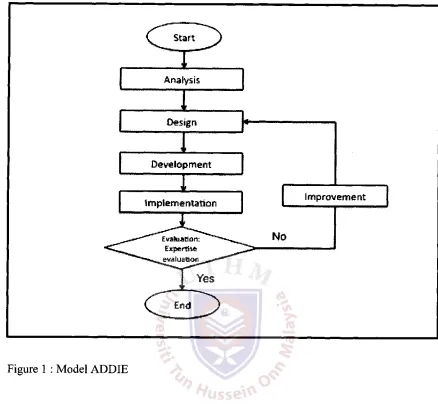
Secondary School. In the process of designing kit, researcher selected the ADDIE Model
Figure 1 : Model ADDIE
7.0 Engineering Analysis
Analysis has been carried out on E.M.E.R.K. to find out the functionality of each input
and output to make sure this teaching kit product work as it commanded. Simulation
process was carry out using Cx Programmer convenient to the analysis that is done to
simulate input voltage using contact and coil as terminal from Cx Programmer between
Push Button (contact) that is as input to the coil as output (hardware)
Additionally, this analysis is carried out to test the coding of contact if it match or
synchronize with the coding of the coil. Testing with multi meter kit on PLC(OMRON) is
to test whether there is close circuit between the contact and coil that had been
OMRON USB cable for the system to function when the output (hardware) such as
robotic arm, Light Emitting Diode (L.E.D), and conveyor belt connected to
PLC(OMRON) output (OC211) to work as it command in Cx programmer (ladder
diagram) or using console in form of mnemonic codes.
The analysis procedure for this teaching kit is started with the connection of wires
from Push Button 1 (PB 1) until Push Button 7 (PB 7) to the input (ID211) of PLC
(OMRON). Then proceed with the connection of wires from the output (hardware) to the
output (OC211) of PLC (OMRON). There is also a connection wires from input and
output devices to Command (COM) of PLC (OMRON) as for it to link to the Cx
Programmer. After that researcher created a programme coding that give command to
each contact to coil that has it own coding in Cx Programmer and linked to the PLC
(OMRON).
Then press every Push Button that had been linked to the PLC (OMRON) to see
the connection between Cx Programmer and the PLC (OMRON). The light will appear at
the number input (ID211) synchronize with number of the output (OC211) of PLC
(OMRON) if there is current flow between the contact and the coil. If it test with the
multi meter, the value of voltage read by the meter will be 0 V if the Push Button is
pressed. This means that the circuit is close and the system proven works as in theory.
Moreover, each of every circuits differ with its own coding as an input and output
that had been programmed by researcher in Cx Programmer. For analysis, only serial
circuit is appropriate to test the input and the output of the circuit developed. For
example, just by edit contact and edit coil researcher can have the next analysis in testing
every input for every output of this product circuit as shown in Figure 4.1. Then the push
button is pressed to see if there is a connection from Cx Programmer to PLC (OMRON)
and to test if the coding set for input can linked to the coding of the output. If there is a
connection, the line will turn green to show simulation of current flows in the Cx
8.0 Conclusion
As a conclusion, E.M.E.R.K that involve PLC and robotics successfully developed and
built as a teaching to help the process of teaching and learning for teachers and students
for the topic introduction to robotic in the Electrical and Electronic Engineering Studies
subject.
From the development of this product, concept of learning PLC and robotic is
easily to be deliver and explain towards students. As for that, along side with the design
concept that is being abroad up successfully can face the problems in time constraint and
lack of instrument before this that are the main causes for the teachers to carry out
practical activities in the process of teaching and learning in introduction to robotic topic.
Moreover the E.M.E.R.K. that has been built by the researcher also suitable and
appropriate with the objective of EEES subject as in the EEES syllabus that highlight for
student to identified, acknowledge and use the electrical and electronic component with
tools related. Other than that, E.M.E.R.K. also can develop student won positive
characteristic such as patient, responsibility and others. This is support from the Mick
Lalopa, 2006 that strategies in teaching and learning should be engaging and interactive
while incorporating sharing, trusting, teambuilding, reflecting, helping and coaching
(Pitas, 2000)
In the aspect of applying this kit, E.M.E.R.K. that is built are suitable in
constructivism learning method as supported by that constructivism is an environment
that allows for the learner-centered activities to take place where the teacher provides the
students with the experiences that allow them to develop problem solving, critical
thinking and creative thinking skills, and apply them in a meaningful manner. Neo &
Neo, 2009. Hopefully, E.M.E.R.K. that has been built can motivate students, and make
them become more creative and innovative in the area of electrical and electronic
9.0 Discussion
The kit product entitled Educational Multifunctional Electronic Robotic Kit (E.M.E.R.K)
for the subject of Electrical and Electronics Engineering Studies which is the
experimental type of research that focus on the three main matters :
(i) Kit development process
(ii) Kit design
(iii) Kit functionality
9.1 Kit Development Process
Basically, researcher used teachers experienced in the process of teaching and learning
based on the topic on introduction to robotic as an input to this research. Research input
attained from the interview process session on two teachers that are involved in the
process of teaching and learning in the subject of Electrical and Electronics Engineering
Studies in Secondary Technical School. Included in the information gained from the
interview session are on the information about the main problems faced by the teachers
during the process of teaching and learning in the introduction to robotic topic.
The outcomes of the interview are that teachers faces the difficulty in explaining
the concept of program developing in PLC that are causes from :
(i) There is no specific teaching kit to help teachers in the process of teaching and
learning.
(ii) There is lack of practical learning (hands on) in class because of:
(a) Problem in time constraint
(b) Problem in managing and sorting out the lab tools
(c) Lack of tools and instrument.
Therefore, researcher had made a conclusion that the need to emphasizes on the
the Minister Of Education in the National Education Blueprint (2006-2010) that
encouraged in using hands on and visual activities concept. Hands on method are
constructivist approach to science education, which emphasizes the importance of
concrete physical experiences in learning science concepts and principles (Brooks and
Brooks, 1993; Frensham, 1992) in the journal of Johnson(1997)
On the other hand, by developing teaching and learning kit for the introduction to
robotic topic is the best solution to solve the problem in teaching and learning process.
This is suitable from the journal of Yen, 1999 for the teaching and learning kit concept
that is practical activities provides a chance for students to practice future skills and
develop logical thought by trial and error.
Moreover, researcher has identified few important aspects in designing the teaching kit.
All the aspect are from the researcher analysis towards the outcomes of the interview
session and teachers suggestion that involve the process of the interview.
The aspects are :
(i) Can assist teacher in explaining how to develop PLC programming.
(ii) Easy to use by the students.
(iii) Does not involve complicated programming.
(iv) Parallel towards developing student cognitive in class.
(v) The use of tools and instrument that is easy to be handle.
(vi) Does not take a very long time using it.
ADDIE model was chosen as a kit development model for a greater systematic
work development. This is support the ADDIE model for this research that said ADDIE
model is a systematic which the steps are carefully prescribed and follow a logical order
and it is also empirical where the data gathering is built into the process and decisions are
made on the basic of data (Aris et al, 2006).
There are five main parts involve in the ADDIE model that are analysis phase,
design phase, development phase, implementation phase, and evaluation phase.
Researcher had included the new phase that can help the flow of developing this kit
properly and need to include more interactive output as it is proven of why improvement
phase is important to this research. An improvement to this teaching kit are that more
interactive output is better and can apply lots more activities after referring this teaching
kit product to the peculiar expertise. Hence, researcher made a decision that improvement
phase is convenient to make a room of improvement in developing better teaching and
learning kit and can contribute great benefits to teachers and students.
9.2 Kit Design
The teaching kit that developed by researcher refers to exceptional design instrument and
it is place in a mobile casing that can be easily use in the process of teaching and learning
by teachers and students specifically in carry out many activities that involve practical
learning in introduction to robotic topic. Wherefore it is defined as a teaching and
learning kit where teaching and learning kit tool being developed and provide help in
many ways for the teaching process. (Alexandra Cristea et al, 1997).
Additionally, creating teaching kit is purposely to help teachers that facing
difficulty in explaining the concept of developing PLC programming in teaching and
learning process for the topic introduction to robotic as stated in the interview session
carry out by the researcher to the teachers themselves. Building concepts by making
connections of abstract symbols to concrete materials with the use of five senses that
involve kinesthetic activity in learning. Engaging as many of the five senses as possible
helps make the abstract more concrete for the learner. Yetkin, 2003-Jennifer R. Bradley
et al, 2008)-this statement also supported from the journal of Nader Nada et al, 2007
stated that with many student being visual and kinesthetic learners, this approach makes
the teaching more enjoyable and effective and the learning more successful and fun.
Generally, there are two main parts that involved in the process of developing
E.M.E.R.K that are at the part of circuit designing and part where the designing the
casing product development. In the circuit design part involved the process of developing
the electronic circuit on the PCB, on the other hand casing design part involved
The circuit designed required connection from within and outer of the casing.
Connection from within means that, it needed a connection from components leg to the
track that is developed on the PCB and from outer means that it needed the use of the kit
to make a complete circuit such as with push button and clip wires. Therefore, students
can use the kit depends on their knowledge on the topic introduction to robotic. Hence
this teaching and learning kit is very effective according to what it is Lee & Yeap, 2003
stated that it is generally recognized that good technology helps student to learn
effectively. Indeed the uses of appropriate educational technology tools will enable
teachers to implement a greater variety of strategies and new ways of doing teaching
learning.
There are about more than five PLC programming that student need to develop in
the Cx Programmer adapted from Daud et al (2006) to see the output of the programme
that students have develop. The use of PLC programming with the help of computer
technologies are suitable with the syllabus content from the subject of Electrical and
Electronic Engineering Studies for the introduction to robotic topic. As for that, this is
supported by Lee & Yeap,2003 that lecturer should know how to integrate the correct
sequence of activities with good technology into an effective part of the teaching and
learning process that not only leads to student motivation and engagement in the subject
but also to student understanding of the subject matter.
All of the circuit and output (hardware) are being integrated to one kit that is
solidified to fit in the mobile character kit. Mobility character is very suitable for the
teaching and learning properties that is effective as suggested by Aris et al , 2000 stated
that teaching tools need to have mobility characteristic that can be brings to different
places depends on the process of teaching and learning that had been process.
At the first stage of circuit combination, researcher needed to carry out simulation
using Proteus Software to prove the combination of the circuit function well. All of the
circuit that have been combine and test its functionality can be transferred to the Proteus
Software also to scheme in the schematic circuit and the PCB layout design for it to carry
on the next process to developed a printed circuit PCB to fit in the component that can
Casing product is built to fit in the electronic circuit that had been developed.
First of all, casing initial development need to be design in the software called SolidWork
to match the operation of the circuit with the product display interface. Rectangle shape
alike a suites case are used in this teaching kit design for it to be easy to carry around and
to make it into wider space for the student to explore. The size of this case are 510mm x
435mm for the student to easily carry out an experiments and interact among them in
groups. Colored acrylics is used in building the case to give a properties of attractive and
colorful display which the use of colorful properties, showing images of the various to
subject matters does look lively and conducive to student learning according to Lee &
Yeap, 2003.
9.3 Kit Functionality
E.M.E.R.K is built with the concept of PLC system that uses PLC OMRON with the help
of Cx Programmer to make this kit function with the theory that are related with theory
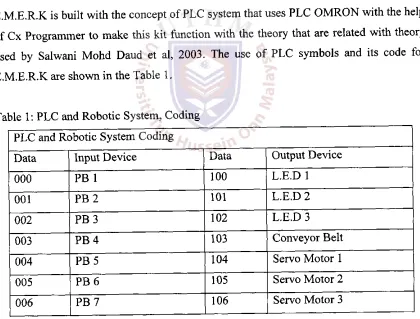
used by Salwani Mohd Daud et al, 2003. The use of PLC symbols and its code for
[image:15.594.92.512.328.647.2]E.M.E.R.K are shown in the Table 1.
Table 1: PLC and Robotic System, Coding
PLC and Robotic System Coding
Data Input Device Data Output Device
000 PB 1 100 L.E.D 1
001 PB 2 101 L.E.D 2
002 PB 3 102 L.E.D 3
003 PB 4 103 Conveyor Belt
004 PB 5 104 Servo Motor 1
005 PB 6 105 Servo Motor 2
The codes that are entered in the Cx Programmer are the manipulative for the
system to change according to what the ladder diagram looks like with its own command
made by the user. The maximum voltage that are used in this product is 24 V and it is
from the power supply set. The push button used required +24 V for it to function while
the rest of the components and instrument only need +5 V to function.
E.M.E.R.K. that is built was able to test the code that are entered in Cx Programmer for
every input given. Every input represent the PLC ladder diagram code from Cx
programmer or mnemonic code from the console such as basic code like normally open
contact and normally close contact symbol. Every output for E.M.E.R.K represent with
the L.E.D, conveyor belt and servo motors in robotic arm as it light up or move according
to the programme developed in Cx Programmer.
10.0 Researcher Recommendation
According to the analysis, discussion and the result achieved from the whole of the
research process in developing E.M.E.R.K, there are several recommendations that
needed to be brought up by the researcher to add more concepts from the original
concepts in the kit developing process, kit designing and kit functionality.
10.1 Kit Developing Process
Product specification that has been built referred to the source of interview with the
teacher along side with the process of teaching and learning in topic of introduction to
robotic. Based on the evaluation and the questionnaire in the APPENDIX D done by the
peculiar expertise shows that E.M.E.R.K that has been built fulfill the biggest part of
teaching kit needs in the topic of introduction to robotic. It is proven that in developing
design based on the teaching kit, it is appropriate to take opinion form the expertise
appointed that involve in the process if teaching and learning for the topic related because
10.2 Kit Designing
The research carried out proven that E.M.E.R.K are capable to be a teaching kit for the
introduction to robotic topic that was successfully design and developed. The kit that has
been built suitable for teachers and students to use especially in EEES subject in technical
secondary school because it is complete with learning the concept of PLC from the basic
to higher level as shown in the questionnaire answered by the peculiar expertise in the
APPENDIX D On the other hand, E.M.E.R.K. are suitable to be use as one of alternative
in the teaching and learning from teachers and students instead of technical secondary
school such as in ordinary school, polytechnic, and other institution that have others skills
that are involve in teaching and learning robotic and PLC.
10.2 Kit Functionality
The data achieve from the questionnaire from the Appendix ...that answered by the
peculiar expertise are appointed to prove that E.M.E.R.K that has been built can
excellently functions. The design that has been built also suitable for activity in group
and have the properties of easy to keep. This result shows that in building product, it is
very important that researcher identified the target client or user for the product that need
to be develop.
11.0 References
Aris B, Hura M, Kok B. S, Ali M.B, Harun J & Tasir Z(2006).Learning "Goal
Programming" Using an Interactive Multimedia Courseware Design Factors and
Students' Preferences" Skudai : Universiti Teknologi Malaysia.
Aris B, Yahaya N, Hj. Harun J & Tasir Z, (2000). Teknologi Pendidikan Dari yang
Tradisi Kepada Yang Terkini. Skudai: Universiti Teknologi Malaysia.
Arleguiz J, Nelio Fava, Emanuele Menegatti, Stefano Monfalcano, Michele Moro &
Alfredo Pinaz (2006). Robotics at Primary and Secondary Levels: Technology,
Methodology, Curriculum and Science. Padoya : University of Padoya.
Bagulia A.M (2005). " Modern Education Audio-Visual Aids." Anmol Publications
PVT. LTD.
Barraket J (2004). Teaching Research Method Using a Student-Centered Approach?
Journal of University Teaching and Learning Practice. Melbourne : University of
Melbourne
Bradley J.R (2008). Teaching Mathematics To Elementary School Students Using a
Variety of Tools (2008).
Castaldi B (1994). Educational Facilities: Planning, Modernization and Management,
Fourth Edition. Boston : Allyn and Bacon.
Chua Y.P (2006). Kaedah Penyelidikan. Serdang, Selangor. McGraw Hill.
Cristea A & Toshio O (2003). Aknowledge Based Education Tool for Classroom
Teaching: Goal, Functional Tests. Japan: University of Electro
Daud S.M, Fariza Bt Said Hassan, Liza Bt Abd Latiff, Morina Bt Abdullah, Kamaruddin
B. Tawi & Rasli B. Abd Ghani. (2006). Electrical and Electronics Engineering
Studies Form 5. Kuala Lumpur : Dewan Bahasa dan Pustaka
Dunkin M.J (2007). The International Encyclopedia of Teaching and teacher education.
Michigan : Pergamon Press.
Ellington H & Aris B (2000). A Practical Guide To Instructional Design. Published by
Penerbit UTM.
gauge.u-gakugei.ac.jp/apeid/apeid07/CoutryReport/MALAYSIA.pdf. Malaysia :
Educational for Sustainable Development (ESD) reach at 30 April 2009
Goh H & Aris B, (2007). Using Robotics in Education : Lessons Learned and Learning
Experiences. Skudai: Universiti Teknologi Malaysia.
Halim H (2004). Kebolehgunaan Pengajaran Berbentukan Model Interaktif Motor
Elektrik : ABBM Subjek PKE di SMT. Tesis Sarjana Pendidikan Teknik Dan
Vokasional KUITTHO : Tidak Diterbitkan.
Harley D (2004). Visual Materials as Tools for Teaching "Sociology of Culture".
Harry W. Fox (2007). " Using Robotics in the Engineering Technology Classroom."