SOME IMPLICATIONS OF RECENT PROPOSALS AND RECOMMENDATIONS
PARTICULARLY AFFECTING THE CSO
T P LINEHAN
Director, CSO(Read before the Society, 7th November, 1985)
I congratulate the Officers of the Statistical and Social Inquiry Society in responding so quickly to my suggestion to have this Symposium It is timely to have discussion in the Society on the statistical component of information needs in this country In particular, how these needs can best be identified and how structures and resources can best be developed to meet, efficiently, any needs not yet covered by the availability of existing statistics
In this context there are two documents "on the table" - one with recommendations from NESC, the second containing proposals by government I welcome them both and would like at the outset to express my appreciation of the considerable effort by the various authors in their preparation Naturally this does not mean that I accept all the points as put forward in either document
The very recent government publication "A New Institutional Structure for the Central Statistics Office" makes specific proposals about structures and certain procedures The publication (pi 3483), which for brevity I refer to subsequently as the Proposals, has really three separate parts, which in chronological order, rather than sequence of presentation, are
the Report to the Taoiseach of the Statistical Council set up last year (Appendix I ) ,
the CSO comments on that Report (Appendix II), abbreviated to fit an allotted space, hence not covering all points of agreement or difference, the actual Proposals, with background - these are my "point of departure"
These Proposals identify (par 23) four key features of the CSO's new structure I wish to concentrate on two of them - those relating to the scope of CSO activities as being particularly relevant to our subject tonight They are
-(a) A National Statistics Board with the essential function of guiding the strategic direction of the CSO The Board will be charged with establishing priorities in responding to the demand for official statistics
(b) New powers of co-ordination in respect of all official statistics
The two others relate more to internal CSO matters which are not as relevant
(c) Aspects of managerial as well as professional functions
(d) Greater freedom in allocation and deployment of resources
implementation What could be described as the culmination for the Statistical Council and this NESC activity is in effect a starting point for CSO
MULT I-ANNUAL PLANS
As I interpret the Proposals (par 29 and 40), the Board will at the outset, with the advice of senior management in CSO, undertake the preparation of a multi-annual plan covering priorities, time-tables for achieving them and a recommendation for government approval concerning the resources of staff, equipment and finance which should be made available to the CSO When the recommendation has been considered by government, a firm five-year expenditure programme will be set by government for the CSO - with no possibility of a volume increase beyond any originally covered by the programme The procedure would be repeated at regular five-year intervals Subject to certain modifications, this would be a most welcome innovation by contrast with the annual approach to which we have been constrained
The first immediate task, then, is the preparation of the first multi-year plan There will have to be detailed consideration of requirements for all purposes for which it is considered that official statistics should be provided The starting point will be the expressed wants of every sector whether described in terms of changes to existing statistical series or of new items
I use the word wants designedly The Board will have to translate these into needs and seem adequate justifications and explanations of intended use by proponents of changes or of additions They will need to obtain or provide answers to many questions, such as
What is required7
Who requires it9
Why9 When9 How often9
Who will provide it9 From what source9
What does it cost to obtain9 Is it worth it9
What is its priority rating9
To relate to the title of this symposium - there will have to be a conscious decision as to whether a narrow approach "Policy" or the wider one "Policy and Research" is to be taken In addition, what about commercial needs and those of the general public9 What are the relative
weightings to be given to these various user groups9 The CSO
has always tried to take full account of the broader approach and would certainly hope that this policy will not be changed fundamentally, although the question of charges for services rendered will have to be carefully considered
Another aspect of "official statistics" is meeting EEC requirements There is an EEC multi-year statistical programme which is very heavy and, to a substantial extent, statutory in nature The assessment of needs and priorities must encompass these requirements and wrestle with what may be conflict between different statistical requirements at the national and Commission levels
Input for the preparation of a multi-year plan will be needed on as comprehensive a basis as possible The CSO will resume next month a series of user seminars covering different subject matter areas These should provide one type of useful source of information for the comprehensive reassessment of statistical needs and priorities
There was a detailed assessment made over a decade ago and published in the 1974 Report of the Committee on Statistical Requirements and Priorities A summary of the final chapter of that report, which set out recommendations and overall priorities is given in Appendix 6 of the NESC report with a brief account of subsequent action In the context of user contacts the suggestion of the Statistical Council to have users groups/liaison groups is welcome In their developments it will be important to bring in the supplier dimension as well
The existence of these recommendations in such a
conveniently presented format in that well written report
may convey an impression of comprehensiveness and of an
authoritative status on content and priority which, I
believe, was not intended but which can be misleading They
are not the result of a detailed in-depth survey of all
sectors of the type which is necessary for the preparation
of a multi-year programme - nor is it anywhere claimed by
the author that they are
In saying this I do not wish to imply that he is not
justified in raising the topics for consideration - far from
it But there are many instances where his recommendations
need to be considered more fully before all the statistical
implications become clear and final recommendations made and
there are gaps in coverage too
For example - one recommendation is that, at the
earliest opportunity, the Census of Population should be
moved to a de jure (usually resident) basis from the
traditional de facto (where present on Census night) basis
but to maintain continuity the data on the latter basis
should be retained, at least for some time The relevant
paragraph (4 29) deals only with some of the advantages of
such a change but there are disadvantages too
There will be a Census next April - it will be on the
same basis as heretofore - why
7One use of the Census total,
perhaps the best known, is derivation of intercensal net
migration If we change we get an incorrect figure - so why
not collect data on both bases simultaneously - each
household and institution accounting both for all those
present on Census night (with usual address given) and for
all those usual residents absent on Census night
9We see
scope for untold confusion using both bases with conflicting
population figures circulating
However, without a reliable continuing system for
measuring migration flows we would be severely criticised,
justly, if we were to change from the existing method A
change in basis at any future time must be preceded by
adequate pilot studies held in census-type conditions
simple recommendation to illustrate the point concerning statistical implications
Similarly, concerning lack of comprehensiveness of subject matter areas in the report, I refer to just one example, agriculture, but there are many more Agriculture receives scant mention (paragraph 4 57) with no advertence to the hazardous state of the once flourishing small area data on livestock numbers and on cropping patterns, etc Any assessment of allocation of limited resources must face up to this deteriorating situation in the early part of any multi-year plan This will be an area where assessment of needs of macro-data and micro-data users and policy makers and research workers and EEC bodies will present an interesting exercise in priority setting
In the context of users' needs publications must be considered In both the Report of the Statistical Council and the NESC report, detailed suggestions have been made concerning publications As we are now reviewing our publication programme I take this opportunity to invite from every user suggestions and views concerning CSO publications and concerning the comments thereon included in the two reports Considered comments in writing will be particularly welcome in the CSO
CO-ORDINATION
The second implication of the Proposals I wish to refer to is co-ordination The idea of co-ordination comes up in all the documents which I have mentioned Clarification on what is envisaged and of what can be reasonably feasible in this regard is required and calls for discussion just as much as the first topic - the multi-year plan
As regards power - the Proposals in paragraphs 36 to 38 (reproduced in Appendix A ) , state that statutory authority will be given to the CSO to have access to administrative records in other government departments for the purpose just stated Legislation will also provide that the CSO shall be informed of any new collecting and processing of statistical data envisaged by any public body and that the CSO may require information on any such existing activity
One of the responsibilities of the Board given in paragraph 29 of the Proposals reads - "developing ways of ensuring and co-ordinating the needed flow of information from government departments, State bodies and firms, etc , in the private sector to CSO while minimising the burden of compliance to the extent possible" This brings in the additional aspect of response burden but seems to relate to co-ordination of flows to the CSO only
The NESC report goes into some detail on what co-ordination of statistics outside the CSO should cover Appendix B reproduces the relevant paragraphs 8 31 - 8 46
indicating a number of objectives which, as the consultant sees it, would be embraced in the main functions of the co-ordinating role They are quite extensive but are summarised in paragraph 9 24 as follows - "to maximise output from public resources, achieve quality control and compatibility between data sets, avoid unnecessary duplication, use the capability for data transmission via computers, and encourage public sector bodies to consider the statistical possibilities of administrative records and to consult on this with the CSO The functions of the CSO should be widened to include this co-ordination"
While I do not have time to dwell on the detailed paragraphs, I must highlight practical considerations which must also be recognised
-1 Resource implications exist not only for the CSO but also for public sector bodies with suitable but undeveloped administrative records
3 Special nature of client relationships, enjoyed by State agencies, inhibits pooling of statistics 4 For co-ordination, as elsewhere, priorities will
have to be settled within the multi-annual plan and five-year expenditure programme
5 Whatever role as co-ordinator the CSO takes on, it is essential that it continues to be a statistical agency only and that it does not become associated in the public mind with any department or agency or semi-State body which is concerned with administration of schemes or programmes affecting persons or business concerns in their individual capacity There cannot be any development which involves transfer of such individual data from the CSO or via the CSO to administrative agencies
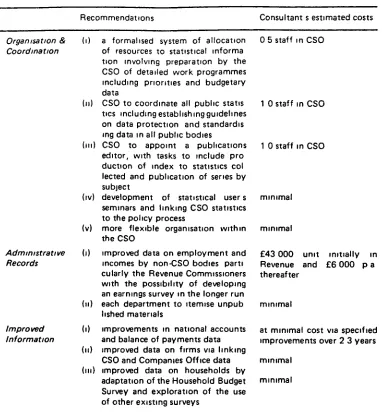
I am quite surprised that the summary in Table 1 of the NESC report (see Appendix C) includes at ( n ) the task of establishing guidelines on data protection " as part of co-ordination activities for the CSO This is a very wide field indeed in which the implications for statistical purposes, although relevant, are not the dominating consideration
Besides "co-ordination", the terms "official" and "statistics" will also need clarification for non-CSO statistics Is "statistics to include all ongoing management measurements per se related to administration of specific schemes or systems, be they general or sectoral, related to social or economic aspects, etc 9 Or does it cover only
those which can be adapted to reasonable conformity with measurable economic or social concepts to indicate levels or trends9
. Does "official" cover all local and regional authorities besides the types of bodies listed in NESC paragraph 8 43 (see Appendix B )9 Should it cover research
institutes funded by the State9
RESOURCES
Earlier on I referred to the NESC report's approach to resources - John Blackwell will, I know, not be surprised to hear me developing the point
The general impression is given in the relevant part of the consultant's report and more particularly in the Council's comment thereon, that a very substantial improvement can be achieved with little additional resources less than 1 per cent in relation to the CSO's Budget (£60,000) Table 1 (see Appendix C) highlights the position The frequent use of the word "minimal" creates, unjustifiably, the idea of negligible requirements One needs to be a careful and thorough reader to assess the difference between the Council's recommendations and those dealt with by the consultant Even in the detailed report, however, I am concerned that the resources implications are not fully appreciated
My main concern is to dispel the impression of substantial improvements for negligible resource inputs Of course, additional outputs in the form of extra cross-tabulations from, for example, the Labour Force Survey, would not call for sizeable resources The position is otherwise for projects such as the improvement of the National Accounts estimation on the expenditure side, basic overhaul of agricultural enumerations implicit in their computerisation, the wide powers of co-ordination to be given to the CSO, and many others
possible for a first year to have one senior person surveying the field, as it were, with a view to a plan of campaign However, the actual implementations on a continuing basis of co-ordination would need a permanent division of its own with a number of people working full-time I cannot at this stage say what the size of that should be This will depend on the precise terms of reference
The last entry in Table 1 speaks of "improved data on households by adaptation of the Household Budget Survey But at present there is no Household Budget Survey at all and such a Survey must be in existence before one speaks of adapting it In paragraph 8 80 of the report the consultant does refer to "an annual small scale Household Budget Survey (£200,000 a year)" The first requirement however is a full scale Household Budget Survey which will cost many times this sum This will have to be covered in the early part of the first plan
In the same table the word "minimal" is used to describe the estimated costs of each of a number of recommendations and the sum of all the "minimal" entries seems to be zero
It is not my objective to itemise all the reservations which relate to this cost aspect - and there are many - but to illustrate the grounds on which the CSO disagrees with the general impression given in several places of the possibilities of substantial increases in outputs with "minimal" additions to resource inputs
The government Proposals do not deal with resources, these will be a matter for the Board But in the context of preparing the resource recommendations for the first multi-year plan (which must provide for ongoing activities as well as developments) the Board is instructed to take into account the relevant Statistical Council and NESC reports and an unpublished DPS Management Services report on the CSO
In fairness to the NESC report it indicated that "it was not intended that the study should provide detailed costings which an 0 & M study might include, partly because of the prior existence of such a study of the CSO by the Department of the Public Service"
The Management Services Unit of the DPS did consider, and at great length too, the manpower resources needed for the ongoing activity of the CSO (they did not have the task of questioning the need for each of these activities) The result of their Survey which is not published showed in no uncertain terms that the CSO was appreciably understaffed for the activities it had in hands This study was completed in 1983 We got nothing from it Since then we have been subject to the same rules of embargoes, etc , as all other civil service offices In the Proposals, paragraph 40 indicates that the CSO will not be relieved from such measures
Some of you may feel that I am overstressing this matter of resources We in the CSO have reason to speak about it frequently We feel we have a just cause
We are not blind to the fact that there are general resource problems in the Public Service - we are not naive enough to think that the CSO should get priority over everybody else But are we really unreasonable9
Certainly, we cannot take on additional tasks until we have enough resources to deal with them adequately as well as supporting, maintaining and renewing existing ongoing activities - unless of course the in-depth assessment identified some substantial ones as no longer necessary -any candidates, please9
We have identified our priorities for more resources They are given in the very last paragraph of the government publication in our comments on the Statistical Council Report
CONCLUSION
setting out the CSO's views on the specific statistical needs for Policy and Research It is not because I am not aware of many needs but because I feel other aspects should be brought to the fore at this initial stage The objective is to get everyone involved or interested thinking about the realities of implementation
The discussion this evening will, I hope, bring to light views on "burning needs" both as regards data and co-ordination The preparation work for the multi-annual plan will give a further opportunity for doing so, either in conjunction with the seminars that I mentioned already or through other contacts
What are the CSO's views on the Government Proposals I have covered9 We welcome the proposal to have a multi-year
programme with project priorities settled, leading to a firm five-year expenditure programme to be set by government We would, however, be extremely disappointed, indeed finally disillusioned, if all the work which is about to be undertaken leads to a programme which in the event is not executed Need I say that we would much prefer to have a government budgetary commitment for a five-year period rather than the more uncertain expenditure programme
The associated factor of the Proposals that no volume increase can be envisaged after a five-year programme has been set by Government needs reconsideration in the context of accounting procedures These are such that even if a new project could be funded from outside (for example some EEC Survey) it would add to our total pay costs and to our gross expenditure even though our net expenditure would not be altered The restrictions should therefore be operated in terms of a net expenditure basis, to cater for the possibility of some external financing
The plan would also have to contain within it some flexibility, particularly in the context of ad hoc surveys, to enable the CSO to respond to unforeseen requirements emerging during the period and considered by the Board as urgent in nature
APPENDIX A
EXTRACT FROM "A NEW INSTITUTIONAL STRUCTURE FOR THE
CENTRAL STATISTICS OFFICE"(P1 3483)
CO-ORDINATION OF STATISTICS
36 Already there are important links between the Central Statistics Office and other Government departments generating a flow of statistical material to the Office In order to allow a strengthening of these links, statutory authority will be given to the Office to give it access (subject to considerations of national security) to administrative records available in other Government departments for the purposes of assessing the potential of these records as a source of needed statistical information and, where appropriate, developing these sources in conjunction with the department concerned with, in all cases, adequate safeguards ot confidentiality The Office will have the central role for co-ordination of official statistics
37 To give the Central Statistics Office clear powers to co-ordinate statistics, legislation will provide that
(a) if any public body contemplates, either directly or indirectly, collecting and processing statistical data or introducing a data base the Central Statistics Office shall be informed with a view to co-ordination,
(b) from the public bodies which collect arid process statistical data or use data bases at the time when the Act enters into force, the Central Statistics Office may require information on their statistical activities with a view to co-ordination It is envisaged that this programme would be completed within three years,
authority of the Taoiseach, be the arbiter in any conflicts which may arise between public bodies in matters of statistical co-ordination
38 Each public body will nominate a Statistical Liaison Officer at senior level who will be responsible for co-ordination with CSO as far as that body is concerned
APPENDIX B
EXTRACT FROM "INFORMATION FOR POLICY"
- NESC REPORT
Co-ordination of Statistics Outside the Central Statistics Office
8 31 Although Ireland has a centralised statistics office, statistics are now being collected and distributed by a wide variety of public bodies No explicit co-ordination of this output of statistics occurs Nor is there any indication of the amount of resources which go into this activity To some extent, the growth in non-CSO sources has been in response to perceived deficiencies in the existing body of information In part, it has occurred as a by-product of filling internal planning needs and the need for co-ordination In part also, it has occurred as a by-product of implementing administrative schemes the building cost
index would be an example here
8 34 Second, there is need to avoid unnecessary
duplication In particular, the potential for
rationalisation of the data-gathering activities of State
agencies should be examined This would lead to enhanced
possibilities for data analysis, as it might be possible to
cross-tabulate data across the headings contained in
individual surveys There are two ways in which this might
occur through the institution of an "umbrella" or omnibus
survey, or through the linking of records The latter would
be much more difficult to achieve To move towards an
"umbrella" survey would be the most fruitful route This
would occur in relation to household data, and here is
linked to the need for a general household survey (Chapter
4) An "umbrella" survey could also occur in relation to
industrial data from firms Here, there would be the need to
overcome a resistance on the part of firms reluctant to deal
with any central data-gatherer or unwilling to permit
sharing of data
8 35 Third, it is important to ensure that statistics which
are of importance to policy-makers but which are of little
or no importance to the collecting agency are produced This
may at times require that such a subordinate objective be
given explicitly to the agency concerned
8 36 Fourth, to consider the use of statistics collected by
State agencies, other than the CSO, as means of
verification, as sampling frames or as registers for the
purposes of coding
8 37 Fifth, to fulfil some "gatekeepmg" functions in
respect of the increasing volume of surveys of Irish firms
being carried out by agencies in the public sector
8 38 Sixth, to use the enhanced capability for data
transmission via computers within the public sector This
reflects the increasing computerisation of public sector
records There is need to ensure mutual compatibility in
such matters as the use of codes Also in
computer-to-computer operations, certain standards would
have to be set and maintained
to consult on this with bodies such as the CSO This would
be especially important at a time when new computer
facilities were being installed
8 40 There are many examples of the valuable work which
could be done through the co-ordinator There is the
achievement of standardisation of information in reports and
accounts of State-sponsored bodies and a common reporting
standard for certain public bodies (Chapter 4)
8 41 Another example is in the area of balance of payments
and thf- activities of transnational companies Currently,
four bodies collect information which would be of interest
from the viewpoint of a policy analyst the IDA on the
disbursement of industrial grants, the CSO on industrial
production, the Revenue Commissioners on the taxation of
corporate income and the Central Bank through exchange
control regulations (O'Leary, 1984) There is a pnma facie
case for some co-ordination of this information collection
The co-ordinator could seek rationalisation and the greatest
efficiency in the evolution of data banks - which is needed
as can be seen from Chapter 7 The co-ordinator should
encourage the most effective use of administrative records
The potential for this is evident from Chapter 6
8 42 Minimum standards should be set in relation to data
which are collected as a by-product of Government contracts,
including their deposit at a central location
8 43 In summary, as far as the relations between CSO and
other bodies are concerned, the key organisational issues
relate to co-ordination of activities and compatibility of
data sets This is in the light of the increasing
fragmentation of outlets which has been occurring The
principal bodies which are involved, outside the CSO, are
- AnCO,
- Central Bank of Ireland,
- Departments of Education, Energy, the Environment,
Finance, Health, Industry, Trade, Commerce and
Tourism, Labour, the Public Service and Social
Welfare.
- Higher Education Authority,
Institute for Industrial Research and Standards, - National Board for Science and Technology,
- National Manpower Seryice, Revenue Commissioners
8 44 It is recommended that in order to achieve some degree of coherence, responsibility for encouraging co-ordination among non-CSO producers within the public sector should be assigned There are a number of ways in which this desired co-ordination could occur One would be a central office with responsibility for all public statistics Another would be a co-ordinator of non-CSO statistics, together with effective liaison between that co-ordinator and CSO The co-ordinator could be in a Government department, outside the departmental system, or could work through an interdepartmental committee
8 45 In order to avoid a proliferation of both bodies, of controls and to achieve cost-effectiveness, it is recommended that the functions of the CSO should be widened to include the co-ordination of all public statistics which are gathered outside CSO This should be written into the functions of CSO, in order to give the Office the desired degree of leverage in its dealings with Departments and agencies
APPENDIX C
[image:19.479.43.425.173.587.2]EXTRACT FROM "INFORMATION FOR POLICY'
- NESC REPORT
Table 1
1 The Council s recommendations and estimated costs (the full list of the consultant s recommendations is provided)
Recommendations Consultant s estimated costs
A Organisation &
Coordination
A dm in istra ti ve Records
C Improved
Information
(i) a formalised system of allocation of resources to statistical informa tion involving preparation by the CSO of detailed work programmes including priorities and budgetary data
(n) CSO to coordinate all public statis tics including establishing guidelines on data protection and standardis ing data in all public bodies
(in) CSO to appoint a publications editor, with tasks to include pro duction of index to statistics col lected and publication of series by subject
(iv) development of statistical user s seminars and linking CSO statistics to the policy process
(v) more flexible organisation within the CSO
(i) improved data on employment and incomes by non-CSO bodies parti cularly the Revenue Commissioners with the possibility of developing an earnings survey in the longer run (n) each department to itemise unpub
hshed materials
(i) improvements in national accounts and balance of payments data (11) improved data on firms via linking
CSO and Companies Office data (in) improved data on households by
adaptation of the Household Budget Survey and exploration of the use of other existing surveys
0 5 staff in CSO
1 0 staff in CSO
1 0 staff in CSO
minimal
minimal
£43 000 unit initially in Revenue and £6 000 p a thereafter
minimal
at minimal cost via specified improvements over 2 3 years
minimal
DISCUSSION
S Cromien I enjoyed these papers very much There are so
many interesting points in them that it is difficult to know
which to comment upon As an official of the Department of
Finance I suppose I can be expected to comment first on the
question of resources In the course of my official duties I
spend much of my time advising Ministers that public
expenditure must be cut back sharply because both taxation
and borrowing are too high I find myself then turning to
the specific areas in which I am personally interested such
as the provision of adequate economic statistics on which
policy decisions have to be based - including the decision
to cut back expenditure - and discovering that everything
that I would like to see done would cost extra money
1My personal dilemma is an illustration at micro-level
of the dilemma of the Government when priorities have to be
resolved Giving something priority means preferring it over
something else It is difficult to persuade the community
that where many vital services have to be cut back the
improvement of statistics needs increased resources Having
said this, it is heartening that the Government White Paper
recognised the importance of statistics to the extent of
providing that a five-year expenditure programme will be
set Because of the constraints it is unfortunately not
possible to go as far as Mr Linehan would like in providing
a five-year Government budgetary commitment I would not
like to have a guarantee that any service (other, of course,
than debt service) will be assured of a particular amount of
resources over the next five years, given the difficulties
of the Exchequer
1provided, has its apologists and defenders but in a reallocation of resources something has to give For example, while I appreciate that there are statutory requirements for much of the information that is prepared for the EEC, are all the other statistics required by the EEC and provided by the CSO really worth the cost in our circumstances9
I was rather struck by some of the quotations from the Rayner Committee report which Professor Conniffe includes in his paper as an example of a much less sympathetic line which might have been taken here to a reorganisation of the CSO One of these makes the brusque statement that "there is no more reason for government to act as universal provider in the statistical field than in any other" This approach would not be acceptable here but it does raise an interesting question of principle about the extent to which the State can be expected to provide services of this nature without charging a commercial price for them Rayner goes on to recommend that information of value to business should be charged for commercially I hope the new Statistics Board will look into the feasibility of this
Mr Blackwell makes some valuable comments about using economists along with mathematicians in the CSO and Professor Conniffe seems to favour them in some cases instead of mathematicians This question will presumably be considered by the new Board I would personally favour the use of more economists I note that the British CSO "publications often contain analyses by staff members
Mr Blackwell also suggests mobility between the CSO and other Government offices and I would certainly support this too Professor Conniffe was concerned that the CSO was being retained within the Civil Service rather than being set up as a State-sponsored body, as the Statistical Council has recommended I must say that I can see advantages in keeping the office within the Civil Service framework, not least because of the access which this provides to Government departments which will be the providers of important
information which it will require
John FitzGerald This symposium must be welcomed as a
timely opportunity to review the many studies which have been undertaken in this area So often in the past such studies have just been shelved but in this case, before the ink is dry on them, there are signs that things are improving Anyone using CSO statistics must be aware of the developments that are taking place in a number of different areas In the field of industrial statistics the improvements are obvious In other areas such as the National Accounts, while improvements are less obvious to outsiders, as a major user I must record my increasing confidence in the data now being produced Generally, I feel that the CSO are showing a sense of purpose which may have been lacking in the late 1970s There still remain some areas which have been touched on by other speakers where one must express certain unhappiness However, in the area of Statistics for Policy and Research the major problems in the future lie outside the CSO in the wider Public Service, especially in the Revenue Commissioners and the Department of Social Welfare A common thread running through many of the problems of collection and dissemination of data for Policy and Research is the failure to exploit the opportunities provided by computerisation I want to consider this question in so far as it affects the CSO, accounting in the wider Government sector, and the Revenue and Social Welfare systems
Computerisation - CSO
In the case of the CSO the potential of computerisation has implications for three areas collection, processing and dissemination of data
(a) Collection The method and range of data to be
and future data requirements This software could then be
sold to users A further option would be for the CSO to set
out software standards to be adopted by all developers of
software in Ireland which would cover the provision of the
data the CSO requires
While some firms, whether in the industrial or services
sector, might oppose such a strategy it is likely that many
would be quite happy to adopt such a practice involving, as
it would, considerable labour cost savings in the
preparation of data for the CSO
In designing such software, or software standards,
consideration should also be given to the likelihood that,
within the next few years, the most efficient method of
collecting the data, from the point of view of the CSO and
the firm, would be to transmit it from the reporting body on
a magnetic tape or disk or, preferably, directly to the
CSO's computer over the telephone This, together with the
integration of the data preparation into the normal
computerised accounting system of the firm or reporting
unit, could result in delays in reporting being cut from
months to milliseconds Any danger to the security of the
firm's data could be guarded by suitable programming and/or
safeguards in the machinery actually used The
implementation of such a comprehensive system of data
preparation and collection, if done directly by the CSO
rather than merely by the establishment of software
standards, would obviously require a field force who could
help tailor existing software to the firm s (reporting
body's) own requirements and to those of the CSO However,
some of the cost could possibly be recovered by charging for
a service which would, obviously, have some value to the
firms themselves
(b) Processing The CSO should move more rapidly to a
particularly the case where terminals or microcomputers are
not easily available to users Experience in the Department
of Finance with a range of staff of different grades, with
no data processing backgrounds, indicates that it is only
when a terminal is placed on the individual's desk that the
sense of fright which computers engender is overcome
However, this experience indicates that once the equipment
is made available all problems are overcome in days Thus,
while it may seem wasteful to an outsider to allocate a
terminal or micro per desk, in practice it is the most
efficient way to bring about change If the cost of a micro
or terminal, which amounts to a once off payment of between
£2,000 and £4,000 per head, is compared to the ongoing cost
of even a junior head of staff, the cost of such an approach
is seen in its proper perspective Given the very
considerable increase in productivity which computerisation
allows, I feel that the payback period for such an approach
would be short An intermediate approach based on limited
access to micros or terminals would, in my view, give the
worst of all worlds If my opinions evoke a sense of
disbelief in my audience, I suggest that pilot schemes be
tried using both approaches To my knowledge, no such
experiments have yet been carried out
(c) Dissemination The question of the implications of
computerisation for the dissemination of data have already
been dealt with Suffice it to say that I welcome the
establishment of the CSO's computerised databank
Computerisation - Government Accounts
(a) Introduction Over the past decade major
developments have taken place in the use of computers in the
public service They are used to regulate the payment of
wages, salaries and social welfare benefits and to run the
collection of tax and social insurance contributions In
carrying out these tasks a vast range of information is
collected and stored in computer files in different parts of
the Public Service
adequate or satisfactory or whether the introduction of computers could allow new developments or improvements In fact, because of the specific design of the computer system actually introduced, the new accounting and management systems are frequently less flexible than the old ones and it is more rather than less difficult to implement administrative changes This decreased flexibility is not inherent in the introduction of computers Rather it is a function of the kind of computer programs developed for use in the public sector If sufficiently flexible programs are introduced initially, it should facilitate administrative changes and alterations in accounting practices in the future
The advent of computers and the promise that they hold out for increased flexibility in accounting should have long ago led to a major review of Government accounting practices It is certainly urgent that something be done at this late stage to carry out such a review
(b) Computerisation and Government Expenditure In
The development of such an integrated system would mean that for individual departments or public bodies they would only have to work with one set of accounts made up of the basic building blocks of the system A computer program can then be used to aggregate the building blocks and produce a comprehensive set of accounts on any basis at any level of aggregation Providing that the basic building blocks are kept on computer files, the cost of producing these accounts will be tiny and their preparation on a quarterly, monthly, or even weekly basis will be extremely easy To some extent this approach has been adopted in the Civil Service but major problems remain with the rest of the public sector
By introducing such a system throughout the public sector it will make the accounts produced by the different bodies much more intelligible and useful and will help in providing integrated accounts for the public sector At present, because of a mismatch between the accounting practices of semi-State bodies, local authorities and the central Government, it is extremely difficult, if not impossible, to produce accurate accounts for the public sector as a whole
One problem which is faced by both economists outside the Civil Service and officials working in Public Expenditure Division in the Department of Finance is that of divining what is happening on an intra-year basis in the area of public expenditure With a properly computerised system of accounts it should be possible to produce accurate monthly returns of employment and expenditure, classified under any system In contrast, the present system merely provides information on disbursements by the central Exchequer to departments or outside bodies
today It is ironic that such transfer of data from one
computer to another already exists in the Civil Service
Wages and salary payments are transferred on tape from the
CCS computer to the commercial banks Data on tax payments
are transferred in this form to the Revenue Commissioners
Yet this medium is not yet used to provide up-to-date data
for management information or accounting control purposes to
either the Department of Finance or the CSO
Computerisation - Social Welfare and Revenue Commissioners
The single biggest area of computerisation in the
Public Service is the Revenue and Social Welfare system
However, it is the area where the potential of
computerisation has been least exploited Even today the
Revenue and Social Welfare systems are treated as two
separate systems in spite of the fact that they both deal
with many of the same members of the public and are both
intimately related to the State's activity in redistributing
income Present policy in the Revenue Commissioners and the
Department of Social Welfare involves setting up different
taxes and benefits on different computers using different
computer systems This makes any integration of the
tax/social welfare system all the more difficult This poses
a major problem for Governments Implementation of
Government decisions to tax social welfare payments has
foundered on this rock in the past Major obstacles to other
such changes, for example, the proposed child benefit
scheme, must be posed by this failure to integrate systems
All the discussion among economists today points to the need
to treat the two systems as a whole whereas the
computerisation of the two as separate entities is making
such a policy more and more difficult to implement It seems
absurd that computerisation should be used to make policy
reform more rather than less difficult
computer file itself should facilitate rapid access subsets of these data required for different purposes
to
There would be numerous advantages to such an integrated system
(a) It would allow the introduction of an integrated tax and social welfare system Social Welfare benefits could, if desired, be taxed in a similar manner to all other forms of income The integrated system would allow the introduction of a negative income tax system or some other method of dealing with those who are on low pay
(b) It would allow the decentralisation of the administration For example, one operator with a computer terminal linked by telephone to the central computer could be sited in every post office in the country With suitably designed computer programs, which prompted the operator with relevant questions, the system would enable one person to handle immediately most queries on the Social Welfare and tax codes This should simultaneously reduce the volume of administration drastically and produce a much better service to the public
(c) Different computer programs could be applied to the same files to produce details of the distribution of income cross-classified by family structure, region, occupation and age This information would be of very considerable value to economists and administrators in understanding the effects of the current tax and Social Welfare codes on the distribution of income, in designing changes in the system and in forecasting tax revenue and expenditure in future years
details )
(e) By extending the integrated system to include other taxes and activities of the State, additional information could be gleaned of considerable value to economists and administrators In addition, it would help reduce avoidance and evasion of tax In this regard it is very worrying to read that the Revenue Commissioners have not got a monitoring system to distinguish payment made by vocational groups as they felt that this was merely statistical analysis (The Irish Times, 6-11-1985) I can think of a wide range of checks which could be made using properly formatted files of data on the tax and welfare systems which could throw up extremely useful data on areas or individuals where evasion is rife or where potential revenue is being lost These checks could only be carried out using computerised data, they would be cheap to implement once such data are available, and they would constitute a lot more than "mere" statistical analysis A good example of what can be done in this regard is the paper by Buckley (1985) on the Disability Benefit Scheme
Computerisation - Conclusion
their life easier There will be a natural tendency to
implement as many of these "frills" as possible, especially
if it can be done at little extra cost to them Once
started, this process will result in a gradual
implementation of the new standards as existing systems are
replaced or altered over time for other administrative
reasons
If it is desired to proceed more rapidly along these
lines, it is best done by means of pilot schemes Horror
stories abound of cases where welfare schemes broke down as
new computerised payments mechanisms were implemented Pilot
schemes allow systems to be fully tested in circumstances
where existing schemes continue in parallel, ensuring no
discontinuity of service It might well be useful to
transfer a few hundred taxpayers/welfare recipients to a
special scheme where a computerised integrated system is
developed to cover all State payments or receipts While
such a system was being developed and tested, the existing
systems, continuing in parallel, would ensure that the
individuals involved did not suffer on account of teething
problems
References
BLACKWELL,
July
1985 Information for Policy, Dublin NESC,
BUCKLEY, MICHAEL, 1985 "The Evaluation of Social Welfare
Expenditure" Paper presented to the Eighth Annual
Economic Policy Conference organised by the Dublin
Economics Workshop, Kenmare, Co Kerry, October 18th to
20th
D C Murphy I wish to comment briefly on the relatively
misrepresented the situation to some degree and has, even by virtue of the space he has devoted to this topic, exaggerated any possible concerns that there may be about the mathematical background of the majority of serving statisticians
The first point to scotch is the false impression that Denis Conniffe conveys that "economists" and "social scientists" are precluded from being appointed as statisticians in the CSO This is simply not true From the outset the regulations governing the appointment of statisticians have specified that candidates can be either
(1) honours graduates in mathematics, mathematical physics and statistics, or
(2) honours graduates in economics who have shown in their educational careers an aptitude for mathematics, or
(3) honours graduates in any discipline who have
shown in their educational career a particular aptitude for mathematics, and also
have adequate experience in practical statistical work
Honours graduates in economics, social science and other disciplines can, therefore, be appointed so long as they have a quantitative bent It is also relevant to mention here that there is always an economist on the interview board No social scientist has, to my knowledge, ever been appointed to the grade but economists, admittedly few in number, have and there are a number serving at present Indeed, I am an economics graduate myself although mathematics and statistics were my main disciplines The fact of the matter is that economists simply do not appear to be attracted to the post of statistician There are probably many reasons for this, but in my view this situation will not change very significantly unless the number of statisticians in the CSO is increased sufficiently to give scope for career subject-matter posts and for a wider analytical and interpretative role for the office In
was struck by the fact that in other countries the proportion of graduate staff was far higher than in Ireland, even in countries where the expenditure on the statistical service was not much above the Irish level
There is obviously great scope to employ economists, social scientists and other subject-matter specialists in the statistical services of large countries such as France, Italy, Germany, UK, etc The UK, for example, employs over 400 professional statistical personnel scattered throughout all government ministries The situation is completely different here in Ireland where there are currently only 23 statistician posts in the CSO Because of this there is no scope for career specialisation in the CSO Both management and staff favour systematic 30b rotation for training, experience, career development purposes, etc At present, statisticians serve about 3-4 years in a particular area and are then transferred (generally to something quite different) This means that people appointed as statisticians must have the technical competence and ability to serve in any statistical area - from National Accounts (where economics would certainly be very advantageous) to, for example, index compilation, survey work, etc , necessitating technical statistical expertise This is the only practical approach in the Office with such a small quota of professional staff
Denis Conniffe quotes liberally from Sir Claus Moser's very interesting presidential address to the Royal Statistical Society in 1979 on "Statistics and Public Policy" However, the relevance of his comments to the Irish situation, particularly in relation to the type of statistician required, must be interpreted with caution because the UK statistical service has been specially organised on a decentralised basis to ensure that statisticians are close to their main users in policy departments and because he was commenting expressly in the context of his concern that, and I quote from the same address, ''they do not reap all the advantages of this closeness7' There is no doubt in my mind that Claus Moser
I must make the point that CSO statisticians, and no doubt mathematicians here tonight, do not take too kindly to the inferences that they are deficient in their "knowledge of society or the economy" and are "not sufficiently sensitive to the environment" There is no evidence for such facile generalisations May I, for example, remind Professor Conniffe that 2 of the 4 directors of his Institute came from the CSO, that 2 of its current 5 professors travelled the same road and that, for example, CSO personnel contribute approximately 20 per cent of the papers presented to this Society There is no point dwelling on this Most people here tonight can judge for themselves from their dealings with CSO professional staff In this connection, people often tend to forget that Government services and the EEC are the CSO s two main customers and I can assure you that there is no danger at all of the CSO being out of touch with their changing requirements and priorities There is daily direct contact with the relevant Government departments and on the EEC front the EUROSTAT work programme for 1986, for example, distinguishes over 50 separate statistical working groups necessitating CSO attendance at over 80 meetings1 The "interface" with other users may not
be as good Rather than blaming the CSO completely for this, may I suggest that there is also an onus on them to articulate their requirements more effectively The CSO always maintains an open door policy to user representations and in general I think it can be said that we are always accommodating
do Even some slight amelioration in this situation would significantly improve the performance capacity of the Office We also see the advantages of staff exchanges and secondments However, in the light of the disruption already resulting from the high rate of statistician departures, the short-term temporary nature (1-2 years at the most presumably) of any exchanges or secondments and the time that will inevitably be lost (from the CSO's perspective) with outsiders familiarising themselves with the details of a particular statistical area (1 e , work practices, manuals, computer systems, etc ), such assignments must, in my view, be additional to serving statistician posts As John Blackwell says in the relevant section of his NESC report (paragraph 8 26, page 115) "both parties must gain
from the exchange", not least the CSO1
Finally, may I endorse another statement that Sir Claus Moser made in the paper referred to by Professor Conniffe, namely that
-University departments should be encouraged to strengthen the applied side of their statistics courses as well as the statistical side of other applled special isms
In this connection I must mention that on the basis of interview board experience in recent years I am concerned about the apparent lack of knowledge shown by current economic graduates of economic statistics produced by the CSO I have always considered that there is scope for greater contact between the CSO and local universities in this connection The Office would be very favourably disposed to having some of its staff participate in any courses or seminars on economic statistics, but this of course is a matter for the universities themselves to assess and pursue
John P Flood In his contribution Mr Blackwell has stated
duties in its care, but it would be wrong to imply that in pursuing its main objective the Revenue has scant regard for the provision of statistical data For example, on the inland revenue side of the Office of the Revenue Commissioners there is a statistics section which, among other things, analyses statistical material for the annual reports of the Revenue Commissioners, arranges for the provision of additional statistical material for these reports, estimates the impact on the revenue of budgetary and other proposals, and forecasts and monitors tax yields The same section also services meetings of Working Party No 2 of the OECD Committee on Fiscal Affairs This Working Party (and its sub-group on estimating methodology) deals with tax analysis and tax statistics on the international plane
As an indication of the Revenue's desire to provide statistics of general interest I would point to the income distribution statistics in the annual reports of the Revenue Commissioners In recent reports these statistics have been expanded to include income distribution material relating specifically to trades and professions A further recent addition to the annual reports is a table of the cost in terms of revenue forgone of certain allowances and reliefs which are given under the income tax and corporation tax systems
The Revenue Commissioners are at all times prepared to consider suggestions for improving or expanding the statistics they provide However, a lack of resources in Revenue imposes constraints on what can be provided An illustration of these constraints is the fact that 852 unfillable vacancies have arisen in Revenue since the first staff embargo was imposed in July 1981
I do not propose to comment in any detail on the background or reasoning behind either the Government proposals or the Report of the Statistical Council, as this ground has been adequately covered by other speakers I do wish, however, to refer to a number of specific but relevant issues which may not have been fully emphasised in either document
Professor Conniffe has already referred to some areas where the Government proposals diverge from, or do not fully accommodate, particular suggestions made by the Statistical Council As Professor Conniffe has said, the principal difference here relates to the position or status of the CSO in the overall public sphere The Council expressed the view that the CSO should be reconstituted as a semi-State body, albeit a special one It is important to emphasise the ''special" attribute here, as what the Council had in mind was not necessarily a semi-St'ate agency as perceived in the normal sense but a special entity obviously requiring legislation which would1 ensure its independence,
objectivity, flexibility of operation, adequacy of links with the Government and, above all, continued access to statistical information from Government and other public sources
Even though the current proposals envisage the CSO remaining inside the Civil Service, I accept that many of the above-mentioned objectives will be achieved A number of them, for example, flexibility of operation and the ability to independently redeploy resources, are embodied in the Government White Paper on Civil Service Reform and therefore their implementation will depend on the vigour with which the Government pursues these wider objectives
numerical aptitude This issue is referred to in the Government proposals in the form of a statement that "procedures will be established, in conjunction with the Civil Service Commissioners, to ensure that the CSO obtains staff with relevant abilities' Quite frankly, I doubt if much, if anything, will be achieved here Once a body is part of the Civil Service it is virtually lmoossible to make exceptions of this kind If such a proposal were seriously considered (and basically what we are considering here is the CSO creaming off the better applicants from Civil Service boards), it would meet with strenuous objections from other departments On the basis of my past experience, these departments would have little difficulty in convincing the powers that be that their requirements are more important than the compilation of statistics
I would now like to turn to the question of official statisticians operating in a broader environment where they may take greater account of, or be more attuned to, the subject matter with which they are dealing I am of the view that there has been a real problem here but the position should be improved both by the introduction of the National Statistical Board itself and, more particularly, through the proposed user and supplier liaison groups which will provide a forum within which statisticians and commercial and research users and suppliers of data can exchange views In my view, these groups, which should form part of the permanent CSO structures, should be set up without delay
if some of these had some years' experience so that they would be able to apply their skills to better advantage
Indeed, I see advantages in having a two-way process here whereby statisticians could spend some time outside of the Government statistical service working in the admini-strative, policy or research areas In my opinion what is important here is not only the background disciplines of the professional staff concerned but the structures within which they operate Up to now these have left statisticians too isolated from developments in the economic and social fields The new consultative arrangements, if fully implemented, should therefore be the important factor in achieving a situation where the available statistics take adequate account of ongoing social and economic developments
We should not underestimate the importance of a sound mathematical background in selecting statisticians It is true that the everyday work of a Government statistician does not involve the use of advanced mathematical techniques (except of course where the work is in the research and development areas) However, I contend that the basic training acquired in learning these techniques is vital, since it conveys a range of attributes which embrace confidence in dealing with data, the ability to conceptualise and a more logical and precise approach to the particular problems which the statistician has to face I am not implying that such attributes can only be acquired through full-time degree courses in mathematical science many disciplines which now entail the teaching of mathematics to a fairly high level, will obviously fulfil this requirement
and integrity there has to be a dividing line here since, even though the statistician is primarily serving the government of the day, he also has a very definite responsibility to the community at large Furthermore, given the extent to which institutions and issues tend to become politicised in this country, if such a relationship were to become too close, then the end result would not be statistics influencing policy but policy influencing statistics
A Punch At the outset, Mr Chairman, I should like to say how relieved I am to find myself on this side of the house, having been succeeded as one of the Honorary Secretaries of the Society by Pat Cox This, however, should not be taken to imply that I did not enjoy my three-year tenure as Honorary Secretary On the contrary, I found it both challenging and stimulating to serve the Society under your Presidency and that of your predecessor, Professor Bob O'Connor
As regards the subject matter of tonight's Symposium, I would like, as a statistician serving in the CSO, to make a few observations on the papers presented by the three speakers Specifically, I will confine my attention to the possibility of research and development being carried out in the CSO as well as the five-year plan envisaged in the Government proposals
the strength and weaknesses of the data are confined almost exclusively to carrying out the basic compilation work
John Blackwell, in his paper, exDresses the wish to bring "statisticians out from the back room which they have occupied for too long" I think I can safely reassure him that there are few amongst us who would willingly care to be cast in the mould of "closet statisticians" His claim that "data-providers have occupied a relatively humble low-key role in public administration, if it be true, is one that has not come about through choice I am sure that on a personal level he is aware of many data-providers who are neither humble nor see their role as being in any sense low-key
His suggestion for teamwork in the analysis of large data sets is, I believe, very meritorious and I can envisage an active role for statisticians in such teams - something akin to a scrum-half in a rugby team This recipe has already been tried and tested by the French and has been seen to work quite well In the INSEE's monthly publication, Ecnnomie et Statistic/up, statisticians and outside research workers have combined well in producing research articles of a high quality I can see no reason why this could not succeed equally well in Ireland