Natural killer cells as a therapeutic tool for infectious diseases –
current status and future perspectives
Stanislaw Schmidt
1, Lars Tramsen
1, Bushra Rais
2,3, Evelyn Ullrich
2,3and Thomas
Lehrnbecher
1,31Division for Pediatric Hematology and Oncology, Johann Wolfgang Goethe University, Frankfurt, Germany
2Division of Stem Cell Transplantation and Immunology, Laboratory for Cellular Immunology, Hospital for Children and Adolescents, Johann Wolfgang Goethe University, Frankfurt, Germany
3LOEWE Center for Cell and Gene Therapy, Cellular Immunology, Johann Wolfgang Goethe University, Frankfurt, Germany
Correspondence to: Thomas Lehrnbecher, email: [email protected] Keywords: natural killer cell; adoptive immunotherapy; virus; bacterium; fungus
Received: January 16, 2018 Accepted: March 21, 2018 Published: April 17, 2018
Copyright: Schmidt et al. This is an open-access article distributed under the terms of the Creative Commons Attribution License 3.0 (CC BY 3.0), which permits unrestricted use, distribution, and reproduction in any medium, provided the original author and source are credited.
ABSTRACT
Natural Killer (NK) cells are involved in the host immune response against infections due to viral, bacterial and fungal pathogens, all of which are a significant cause of morbidity and mortality in immunocompromised patients. Since the recovery of the immune system has a major impact on the outcome of an infectious complication, there is major interest in strengthening the host response in immunocompromised patients, either by using cytokines or growth factors or by adoptive cellular therapies transfusing immune cells such as granulocytes or pathogen-specific T-cells. To date, relatively little is known about the potential of adoptively transferring NK cells in immunocompromised patients with infectious complications, although the anti-cancer property of NK cells is already being investigated in the clinical setting. This review will focus on the antimicrobial properties of NK cells and the current standing and future perspectives of generating and using NK cells as immunotherapy in patients with infectious complications, an approach which is promising and might have an important clinical impact in the future.
www.oncotarget.com
Oncotarget, 2018, Vol. 9, (No. 29), pp: 20891-20907
INTRODUCTION
Immunocompromised patients, such as patients
suffering from cancer or hematopoietic stem cell transplant
(HSCT) recipients, are at a significantly increased risk for
an infectious complication due to viral, bacterial or fungal
pathogens [1–4]. In addition, in this patient population,
infections often have a more severe clinical course and
are an important cause of mortality [4]. Depending on
the pathogen, different components of the host immune
system play a role in the response to an infection.
Lymphocytes are important in the combat against viruses,
whereas granulocytes play a key role in bacterial and
fungal infections, and proliferation and activation of these
immune cells is regulated by cytokines and interferons.
Over the last decades it became clear that also Natural
Killer (NK) cells are involved in the host response against
all of these pathogens.
In the immunocompromised patient, the recovery of
the immune system has a major impact on the outcome
of an infectious complication [4, 5]. Therefore, there
is major interest in strengthening the host response in
immunocompromised patients, either by using cytokines
or growth factors or by adoptive cellular therapies
transfusing immune cells such as granulocytes or
pathogen-specific T-cells [6–8]. To date, relatively little
is known about the potential of adoptively transferred NK
cells in patients with infectious complications, although
the anti-cancer property of NK cells is intensively being
investigated in the clinical setting. Notably, in addition to
strengthen the host response against a pathogen, potential
adverse effects have to be considered, such as excessive
inflammation by pro-inflammatory cytokines resulting
in tissue damage [9–11]. This review will focus on the
antimicrobial properties of NK cells and the current
standing and future perspectives of generating and using
NK cells as immunotherapy in patients with infectious
complications, an approach which is promising and might
have an important clinical impact in the future.
NK cell biology
Human NK cells are cytolytic innate immune cells
that are defined by the expression of CD56 and by the
absence of the T cell marker CD3. NK cells originate from
the bone marrow, home to secondary lymphoid tissues,
and represent up to 15% of peripheral blood mononuclear
cells. In respect to the surface expression density of CD56
and CD16, two main subpopulations of NK cells can be
distinguished, namely the cytotoxic CD56
dimCD16
brightand
the immune regulatory CD56
brightCD16
dimsubsets [12]. The
activity of NK cells depends on the surface expression of
several activating and inhibitory receptors that recognize
MHC class-1 molecules [13–17]. Activating receptors
include the natural cytotoxicity receptors NKp46, NKp44,
or NKp30 and NKG2D which recognize ligands and
are upregulated during cellular stress such as tumor
transformation and viral infections [16, 18]. Among
the inhibitory receptors, the
killer-immunoglobulin-like receptors (KIRs) play an important role in NK cell
alloreactivity [19]. NK cells are able to kill their target
directly by cytotoxic molecules such as perforin or
granzyme B, and by death receptor mediated apoptosis
[20, 21]. In addition to their cytotoxic function, NK cells
are able to modify the immune response of the host by
secreting different chemokines, like
tumor-necrosis-factor alpha (TNF-α), granulocyte-macrophage
colony-stimulating factor (GM-CSF) or CCL5 (RANTES) and
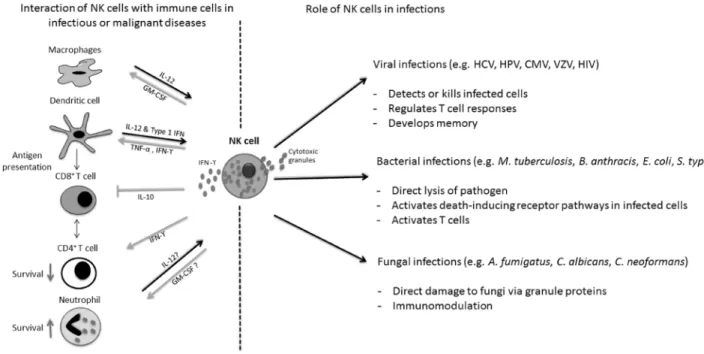
interferon (IFN)-γ [22–24] (Figure 1). NK cells have
recently been classified closely to group 1 innate lymphoid
cells (ILCs), which are characterized by the ability to
produce IFN-γ, but not type 2 cytokines [25].
Current research has shown that NK cell education
and differentiation plays an important role in both the
direct and antibody-dependent functionality of NK
cells [26, 27]. In this respect, various models have been
developed to explain the process of NK cell “education”
[23, 28]. In general, the expression of self-recognizing
inhibitory receptors (SRIR) guides NK cell development
towards fully functional mature NK cells and has been
termed “licensing” process [29]. The “disarming” model
describes NK cells lacking SRIR that become anergic due
to chronic activation [30], and the more dynamic “rheostat
model” has been introduced to describe that stronger
inhibitory signaling through more SRIR interactions
leads to greater functional responsiveness of NK cells
[31, 32]. It has been reported that SRIR deficient NK
cells can be primed to a functional state upon cytokine
stimulation [29]. Of note, also uneducated NK cells
may play important roles in the combat against viral
infections, since SRIR-deficient NK cells strongly respond
toward murine CMV [33]. In conclusion, all these results
underline the value of a highly diverse NK cell repertoire
with unlicensed and licensed cell subsets that interact in
the defense of infectious diseases [34]. Importantly, NK
cells also have the ability to shape adaptive immunity such
Figure 1: Antimicrobial activities of Natural Killer (NK) cells.
NK cells not only detect and damage various viral, bacterial and fungal pathogens (right side), but also modulate proliferation and activation of a variety of cells of the innate and adaptive immune system (left side). IL interleukin; IFN interferon; TNF tumor-necrosis factor; GM-CSF granulocyte-macrophage colony-stimulating factor; HCV hepatitis C virus; HPV human papilloma virus; CMV cytomegalovirus; VZV Varicella-Zoster virus; HIV human immunodeficiency virus.as immunological memory [35–37], as both animal models
and human studies indicate that NK cells can develop
long-lasting antigen-specific memory cells [38]. These
aspects of NK cell regulation are highly interesting as it
demonstrates the high potential of NK cells for
immuno-prophylactic and/or immunotherapeutic strategies, which
may be important not only in the field of cancer therapy
but also for infectious diseases [23, 39].
Anti-cancer activity of NK cells
It is well known that NK cells play a crucial role in
the defense against cancer, and that low NK cell activity
is associated with an increased risk for malignancy
[40, 41]. The direct cytotoxicity of human expanded NK
cells against several tumor cell lines could be demonstrated
in various experimental settings, for example against
human U87 glioblastoma cells [42], the neuroblastoma
cell line UKF-NB-3 [43], and various Ewing sarcoma and
rhabdomyosarcoma cell lines [44]. While cytotoxic NK
cells directly eliminate tumor cells, regulatory NK cells
also play an important role in the antitumor activity by
orchestrating the complex interaction of other immune cells
through secreted cytokines and chemokines [20, 45, 46].
Anti-cancer immunotherapy with NK cells –
clinical aspects
A number of clinical trials investigated the
immunotherapeutic anti-cancer property of NK cells
in various patient populations. For example, regional
arterial administration of autologous cytokine-stimulated
NK cells (lymphokine-activated killer cells; LAK) in
combination with daily administration of low IL-2 doses
to patients with metastatic renal cell carcinoma resulted
in the regression of five out of 15 treated metastases
and pain relief in six out of ten patients [47]. A similar
approach was used in patients with recurrent glioblastoma
[48]. Although the response rate of immunotherapy was
33%, the survival of 18 months from diagnosis could
not be improved. A phase I clinical trial using expanded
autologous NK cells (approximately 4720-fold expansion)
in patients with advanced digestive cancer demonstrated
that the cells were well tolerated [49]. Despite the fact
that the cells were highly lytic and a strong expression
of functional markers such as NKG2D and CD16 was
found, no clinical response could be observed. Safety and
efficacy of multiple infusions of autologous activated and
expanded NK cells in combination with anti-myeloma
drugs were evaluated in a recent single-arm
open-label phase I clinical trial which included five patients
with relapsed or refractory multiple myeloma who had
received two to seven prior lines of therapy [50]. Four
of the five patients showed disease stabilization prior to
the end of treatment, and two showed a 50% reduction
in bone marrow infiltration and a long-term response of
more than one year. The use of allogeneic NK cells for
immunotherapy is currently being evaluated in different
settings, such as acute lymphoblastic or myeloid leukemia
(ALL and AML, respectively), but also in high-risk solid
tumors (reviewed in [19]). Most of the patients receive a
combined treatment which includes haploidentical HSCT
and the adoptive transfer of NK cells from the same
haploidentical donor followed by IL-2 application, and
the overall results suggest a decrease of the relapse rate.
For example, in one trial, the adoptive transfer of human
haploidentical NK cells in AML patients induced complete
hematologic remission in five out of 19 poor-prognosis
patients [39]. In contrast to the haploidentical transplant
setting, the use of allogeneic NK cells in unrelated HSCT
is less clear and a matter of controversy [19]. In a phase
I clinical study which evaluated allogeneic NK cells from
random healthy donors in 17 patients with malignant
lymphoma or advanced or recurrent solid tumors, no
serious adverse event occurred [51]. This corroborates the
data of other studies that immunotherapy with NK cells is
usually safe and well tolerated, and only temporary side
effects such as fever, weight gain, or neurotoxicity are
observed [52]. Notably, in a phase II study which enrolled
20 patients with recurrent ovarian and breast cancer, one
ovarian cancer patient developed tumor lysis syndrome
within 6 h of the initial NK cell infusion. The timing of
the event, together with the detection of NK cells in the
necrotic liver specimen on autopsy, suggests that NK cells
could have contributed to the tumor lysis [53].
To this end, the use of NK cells as immunotherapy
against cancer is promising, but further studies are
warranted in order to identify patient populations which
will significantly benefit from this strategy, and to tailor
pharmacological and immunological therapies to the
individual patients´ characteristics.
NK cells in the host response against infectious
pathogens
There is a growing body of evidence that NK cells
play a major role in the host response against various
pathogens. For example, a number of studies have
demonstrated that genetic mutations may lead to reduced
NK cell numbers or functional NK cell impairment
such as mutations affecting genes IL2RG, JAK3, and
ADA which cause severe combined immunodeficiency
syndromes [54, 55] or a mutation in the ITGB2 gene
associated with leukocyte adhesion deficiency [56].
These immunocompromised patients have an increased
susceptibility to viral infections, such as infections with
herpes simplex virus (HSV), Varicella Zoster virus
(VZV), Cytomegalovirus (CMV), and with human
papilloma virus [22, 41, 57]. However, as these patients
display multiple defects of the immune system, the exact
role of NK cells in the increases risk of viral infection
remains unclear. An early report described a young girl
who experienced a series of recurrent and severe viral
infections during childhood and adolescence, including
infections by multiple herpes viruses, which was thought
to be the result of non-functional NK cells [58]. Other
studies reported on children with altered forms of the
Fc receptor for IgG type IIIA (CD16) on their NK cells,
who suffered from recurrent viral infections such as
infections due to HSV, Epstein-Barr virus (EBV) and
VZV, respectively [59, 60]. The clinical condition of
these children significantly improved with acyclovir
prophylaxis. Recently, it has been shown that decidua
NK cells inhibit human immunodeficiency virus (HIV)-1
infection in pregnancy [61]. Similar to the fight against
cancer cells, NK cells limit viral burden not only by
killing of infected cells [38], but also by modulating the
cytokine milieu, which in turn influences other immune
cells such as T cells. For example, NK cell derived
IFN-γ is not only important for the direct non-cytopathic
inhibition of the replication of the hepatitis C virus [62],
but also regulates the immune responses of CD4
+and
CD8
+T cells [63–65]. Importantly, recent data of animal
and human studies indicate that NK can develop
long-lasting antigen specific memory cells [38]. Much work
has been performed on the evaluation of the importance
of NK cells in the host response against influenza virus. It
has become clear that the severity of influenza disease is
not uniform, with a severe clinical course being associated
with transient T and NK cell deficiency [66] and with
specific haplotypes of killer-immunoglobulin-like
receptors (KIRs) [67]. In a mouse model, infection with
a high dose of influenza virus led to the impairment of
cytotoxicity and IFN-γ production by spleen NK cells and
to decreased virus-specific killing mediated by cytotoxic
T lymphocytes. Importantly, the latter could be reversed
by the adoptive transfer of spleen NK cells harvested from
low-dose-infected mice [68]. During influenza infection,
NK cells are activated by different mechanisms, such
as by influenza nucleoprotein (NP) and matrix 1 (M1)
antibodies [69], and CD16 seems to play an important
role in the early activation of NK cells after vaccination
against influenza [70]. A recent study demonstrated that
shortly after infection with influenza virus, licensed
(“functional”) NK cells serve as early innate effectors
as they produce IFN-γ in inflamed parenchymal tissues
and further mediate direct antiviral responses [34].
In contrast, NK cells which lack self-specific MHC-I
receptors (“unlicensed” NK cells) are localized in the
draining lymph nodes and help to promote activation and
expansion of dendritic cells, which ultimately results in
a sustained antigen-specific CD8
+response. In addition
to the killing of virus-infected cells, NK cells provide
vital cytokines for tissue regeneration, such as IL-22 [71].
However, it is important to note that in mouse models,
NK cells might mediate pathology as the depletion of NK
cells in vivo reduced mortality from influenza infection,
whereas the adoptive transfer of NK cells from
influenza-infected lung, but not from uninfluenza-infected lung resulted in
increased mortality in influenza-infected mice, probably
due to a deleterious NK cell-dependent alteration of T cell
responses [72].
Compared to the antiviral activity of NK cells,
considerably less data are available for the interaction of
NK cells with bacteria and fungi. NK cells exhibit direct
activity against a variety of positive and
Gram-negative bacteria such as Mycobacterium tuberculosis,
Bacillus anthracis, Escherichia coli or Salmonella
typhi by the secretion of the soluble molecules perforin
and granulysin [73–76]. In addition, NK cells have an
antibacterial effect against intracellular bacterial pathogens
by using death inducing receptor pathways such as
Fas-FasL and TNF-related apoptosis-inducing ligand (TRAIL)
pathways [77, 78], which ultimately induce
caspase-dependent apoptosis of the target cell [21, 77, 79]. The
important role of the antibacterial activity of NK cells in
vivo is demonstrated by animal models which showed
higher survival rates and lower bacterial titers during
infection with Shigella flexneri in mice lacking B and T
cells but having NK cells as compared to mice which lack
all three cell types [80].
Similar to the antibacterial activity, NK cells
exhibit in vitro antifungal activity against a number of
pathogenic fungi such as Aspergillus fumigatus, Candida
albicans, Cryptococcus neoformans, or different species
of mucormycetes [81–86]. Cytotoxic molecules including
NK cell derived perforin seem to be important in the
antifungal activity. In addition, upon stimulation by fungi,
NK cells release a number of cytokines, which modulate
both innate and adaptive immune responses [87]. The
in vitro data of the antifungal activity of NK cells are
supported by observations made in animal studies. For
example, it has been shown that NK cells proliferate in
mice experimentally infected with Aspergillus niger,
and this proliferation was associated with an inhibition
of the fungal growth [88]. Antibody mediated depletion
of NK cells in mice inoculated with C. neoformans [89]
resulted in a significant higher fungal burden in the lungs
as compared to untreated controls, corroborating studies
in NK-depleted mice which revealed the pivotal role of
NK cells in the host response against A. fumigatus, C.
albicans, and Histoplasma capsulatum [90–95].
Although these data clearly demonstrate that NK
cells exhibit important activities in the host immune
response to different viral, bacterial and fungal pathogens,
many questions have to be resolved. For example,
further studies have to evaluate how and to which extent
a pathogen may exert an immunosuppressive effect on
NK cells as well as on other cells of the immune system,
which has been shown for bacteria such as Pseudomonas
aeruginosa and for fungi such as A. fumigatus. This
knowledge may be important in the clinical setting for
specifically strengthening the host response during
infection.
The strategy of adoptive immunotherapy in
infectious complications
Both severity and duration of a defect in the
immune system are associated with risk and outcome
of an infectious complication [4]. Therefore, since the
1970s, there was great interest to improve the prognosis
of persistently neutropenic patients suffering from severe
infections with the administration of granulocytes, and
the availability of recombinant hematopoietic growth
factors such as granulocyte-colony stimulating factor
(G-CSF) extended the use of this strategy even into the
prophylactic setting (“adoptive immunotherapy”) [96].
A prospective, non-randomized study evaluated
transfusions of granulocytes in order to control acute
life-threatening infections or to prevent recurrence
of severe fungal infections during HSCT or intensive
chemotherapy [6]. Granulocyte transfusions achieved
control in 82% of acute life-threatening infections, and
no single reactivation of a previous infection occurred
with prophylactically administered granulocytes,
whereas a recent randomized study failed to demonstrate
a significant benefit of this strategy [97]. In patients
suffering from invasive fungal infections, a recent review
of available data did not find strong evidence of a benefit
of granulocyte transfusions, but it is to hope that ongoing
randomized controlled studies such as the GRANITE
study (German Clinical Trials Register number
DRKS00000218) will provide helpful results [98].
Notably, granulocyte transfusions are often associated
with febrile transfusion reactions and pulmonary
complications, including transfusion-related acute lung
injury (TRALI), and a monocenter retrospective analysis
of 128 patients with a hematological malignancy,
prolonged neutropenia and invasive aspergillosis
suggested that patients receiving granulocyte transfusions
had a worse outcome [99]. Another approach which aims
to reconstitute the long-lasting impairment of cellular
immunity of allogeneic HSCT recipients became possible
with the development of techniques to isolate and to
generate pathogen-specific T cells. Infusion of
CMV-specific T cell clones largely prevented CMV reactivation
and reduced CMV mortality [7, 100], and studies reported
on a clinical benefit for adoptively transferred T cells
specific against adenovirus [101] and Epstein-Barr-virus
(EBV) [102], respectively. Similarly, a proof-of principle
study showed that the adoptive transfer of
pathogen-specific Aspergillus CD4
+T cells resulted in a rapid
decline of Aspergillus antigen in the blood, and more
importantly, 9 of 10 patients cleared invasive aspergillosis
[7]. In contrast to most studies which use donor-derived
pathogen specific T cells, a recent trial reported on the
successful use of “off the shelf” T cells generated from
eligible third-party donors against a variety of viruses
such as BK virus, human herpesvirus 6, adenovirus or
EBV [103].
Although immunotherapy with adoptively
transferred pathogen specific T cells seems to be a
promising strategy, the use of T cells may be associated
with the risk of graft-versus-host disease (GvHD) [104].
NK cells as potential immunotherapeutic agent
in infectious complications
As compared to studies investigating NK cells as
immunotherapeutic tool in patients with an underlying
malignancy, relatively little is known regarding the
in vivo effect of adoptively transferred NK cells into
a host suffering from an infectious complication. In
Aspergillus infected mice, the depletion of NK cells
resulted in a higher fungal load and lower survival,
whereas the transfer of activated NK cells to these mice
led to greater pathogen clearance from the lungs [93].
Similarly, cyclophosphamide pretreated mice suffering
from cryptococcosis showed an enhanced clearance of
the fungus when they had received an NK cell-enriched
graft as compared to mice which had received an NK
cell-depleted graft [105, 106]. Although these results
suggest that adoptively transferred NK cells may
be a potential tool in patients suffering from fungal
infections, no study to date has proven this concept in
the clinical setting. Importantly, there may be a major
difference of the adoptive transfer of NK cells between
immunocompromised and immunocompetent patients.
Whereas safety data in immunocompromised patients
with cancer are promising [107, 108], results on the
adoptive transfer of NK cells into immunocompetent
human individuals are lacking. However, it has been
demonstrated that NK cells infused in mice with
polymicrobial intra-abdominal bacterial infection
contributed to an excessive induction of
pro-inflammatory cytokines which ultimately resulted in
a lethal septic shock [10, 11, 109–111]. Another study
in the murine model demonstrated that infection by
Listeria monocytogenes resulted in excessive IFN-γ
production by CD27
+NK cells, which in turn, impaired
innate anti-bacterial host defenses by inducing
down-regulation of CXCR2 on granulocytes and thus
inhibiting the recruitment of granulocytes at the site of
infection [112]. However, the mice could be rescued
by antibodies blocking CD27 signaling or by depleting
IFN-γ. Therefore, further studies have to better define
the preconditions in which the adoptive transfer of NK
cells may be beneficial or harmful, such as the degree of
the host´s immune impairment or the pathogen(s) causing
an infection, as well as the optimal schedule and dosage
of adoptively transferred NK cells in each setting. On
the other hand, as compared to pathogen-specific T cells
which have already been evaluated in the clinical setting,
NK cells may be of advantage since they are active
against a broad range of pathogens including viruses,
bacteria, or fungi.
Generation of high numbers of functionally
active NK cells for adoptive immunotherapy
When employing NK cells to fight against a
malignancy or to combat infectious complications, only
functional active NK cells administered at a sufficient
effector-to-target (E:T) ratio might result in a beneficial
effect. Studies addressing both mouse and human NK cell
immunity have shown that NK cells are a heterogeneous
population consisting of not only phenotypically but also
functionally distinct subsets, and cytokine-stimulation
induces significant changes not only in proliferation,
maturation status and finally in the subset composition
of the ex vivo expanded NK cell product [45, 113].
Therefore, knowledge on mouse NK cells cannot directly
be transferred to the human system, and expansion and
activation studies are mainly performed on human NK cell
preparations from peripheral blood or umbilical cord blood
leading to first preclinical data evaluating the cytotoxic
capacity of the final NK cell product in vitro and in vivo in
xenograft NSG (NOD scid gamma) mouse models against
various human tumors [114].
Most clinical trials with NK cells in the autologous
or allogeneic setting administer ex vivo expanded NK
cells [115, 116]. Of note, the expansion of NK cells
usually needs several days to weeks, depending on the
protocols used [114, 117]. In order to improve the rapid
expansion of isolated NK cells, cytokines like IL-2 have
been investigated, which can be added either alone or
in combination with an anti-CD3 antibody or additional
cytokines such as IL-15 and IL-21 [117–120]. Although
the exact role of anti-CD3 antibodies is unclear, it has
been suggested that OKT-3 leads to a profound outgrowth
of NK cells, which is probably due to the activation of T
cells [114]. Other studies suggest that co-culture of NK
cells with stimulatory cells such as EBV-transformed
lymphoblastoid cells or a Wilms tumor-derived cell line
also enhances the proliferation of NK cells [121, 122].
In an elegant approach, HLA-negative K562 cells were
genetically modified to express membrane-bound IL-15
and 4-1 BB Ligand (4-1BBL), which specifically activate
NK cells and promote their proliferation and survival, and
this strategy resulted in a dramatic enhancement of NK
cell expansion and activation [123, 124]. After further
improvement, this method has been adapted to
large-scale Good Manufacturing Practices (GMP) conditions
[121, 125]. In addition to autologous or allogeneic NK
cells, it may be possible to differentiate NK cells in vitro
from umbilical cord blood CD34
+cells, which is currently
being tested in two clinical trials (NCT01619761 and
NCT01729091) [126].
In addition to proliferation, cytokine stimulation
may also improve the functional activity of NK cells. For
example, when NK cells are resting, lytic granules are
distributed randomly or diffuse, whereas after exposure to
IL-2, granules congregate to the microtubule-organizing
center [127]. Thus, IL-2 stimulation not only activates
NK cells, but also accelerates their transition into NK
cells which are ready to exhibit their cytotoxic function.
Another study demonstrated that exposure of murine NK
cells to IL-12, IL-15 and IL-18 resulted in a sustained
effector function of NK cells in vivo [128]. Only
IL-12/15/18-preactivated NK cells, but not naïve, IL-15- nor
IL-2-pretreated NK cells, respectively, reduced the growth
of tumors when mice were concomitantly irradiated.
Similarly, prestimulation with a cytokine cocktail
including IL-12, IL-15, and IL-18 resulted in enhanced
IFN-γ production of human NK cells after restimulation
with K562 leukemia cells or with these cytokines [129].
Even if there are known differences in the biology of
murine and human NK cells, this observation suggests
that both murine and human NK cells receive functional
memory-like properties after cytokine activation, which
may provide a novel rationale for integrating cytokine
preactivation into NK cell immunotherapeutic strategies.
However, at the same time, the use of cytokines may alter
the phenotype of the NK cell and result in a potential
loss of responsiveness to some stimuli [130, 131]. For
example, IL-2 stimulation of NK cells decreased CD16
[132], and NK cell activation by intramuscular influenza
vaccination and HIV-positive plasma induced a matrix
metalloproteinase-mediated cleavage of cell surface
CD16, whereas inhibition of CD16 shedding potentiated
NK cell cytotoxic function [70, 133].
In addition to the exposure to various cytokines,
improvement of NK cell activity can be achieved by
the manipulation of NK cell receptors. For example,
NK cell cytotoxicity against tumor targets could be
improved by a retroviral transduction of a receptor
termed NKG2D-DAP10-CD3ζ that is composed of
NKG2D plus two signaling molecules, DAP10 and
CD3ζ [134]. These modified NK cells exhibit higher
killing activity against a number of ALL cell lines such
as CEM-C7 or MOLT-4, and against solid tumor-derived
cell lines such as the human prostate adenocarcinoma
cell line LNCaP or the hepatocellular carcinoma cell
line HepG2 [134]. Importantly, the increased activity
of the modified cells could also be demonstrated in
vivo, since in immunodeficient mice,
NKG2D-DAP10-CD3ζ-transduced NK cells killed osteosarcoma or
hepatocellular carcinoma cells more effectively compared
to mock-transduced NK cells [134, 135]. However,
soluble NKG2D ligands (sNKG2DL) such as sMICA/B
or sULBP2 are able to impair NK cell activity as it has
been demonstrated in the setting of various tumors and
of HIV [43, 136]. Naïve HIV-positive patients display
increased plasma levels of sMICA and reduced NKD2D
expression on NK cells, and sNKG2DLs impair
NKG2D-mediated cytotoxicity of NK cells [136]. Interestingly,
highly active antiretroviral therapy (HAART) resulted
in the drop of sNKD2DL and recovery of NKD2D
expression.
Another interesting approach is the transduction
of chimeric antigen receptors (CARs) into immune cells
in order to improve their activity. CARs are engineered
receptors with the ability to bind to specific antigens
which are expressed on the surface of tumor cells or
on the surface of a pathogen. The strategy of CARs in
patients’ T cells has recently been reported, which resulted
in impressive regression of B cell malignancies, and the
promising results of first clinical studies on CAR-T cells
have recently been reported [137–140]. Of note, CAR
constructs expressed in the NK cell line NK92 [141],
primary NK cells [137, 142] or cord blood derived
NK cells [143] have demonstrated efficient killing in
preclinical settings [144]. Two clinical trials testing
haploidentical donor-derived CAR NK cells for targeting
of refractory CD19
+ALL with a second-generation
anti-CD19 CAR that incorporates the 4-1BB costimulatory
domain are currently recruiting patients (NCT00995137
from St. Jude and NCT01974479 from The National
University Health System, Singapore) (for review see
[145]).
In contrast, studies on NK cells with modified
receptors or CAR-NK cells against infections are lacking,
and challenges of this strategy include the relatively long
time to generate these cells and the complex antigenic
properties of many pathogens, which is seen in particular
in fungi [146].
The functional activity of NK cells can also be
enhanced by the forced expression of the high-affinity
CD16-158V (HA-CD16) Fc receptor, for which the
minority of patients is homozygous [147, 148]. Several
groups demonstrated that engraftment of HA-CD16
on primary NK cells from donors which express a
low-affinity CD16-158F/F (LA-CD16) Fc receptor [149] or
on the NK-92 cell line [150] significantly increases the
antibody-dependent cell-mediated cytotoxicity (ADCC)
against target cells coated with rituximab, an antibody
directed against CD20, of which the Fc portion mediates
both antibody-dependent cell-mediated and
complement-dependent cytotoxicity. Rituximab is used as therapeutic
compound in many patients suffering from B cell
non-Hodgkin lymphoma.
The genetic disruption of NK cell inhibitory
receptors such as KIR or NKG2A via inhibiting antibodies
or via shRNA silencing may also be used to overcome
tumor evasion mechanisms related to MHC I expression.
In this regard, in tumor bearing mice, NKG2A-silenced
cells of the NKL cell line revealed enhanced killing
activity of 721.221 HLA-E expressing EBV-LCL tumor
cells [151–153]. Similarly, in the setting of an infection,
blocking the interaction between NK cell inhibitory
receptors [e.g., CD159a (NKG2A), CD158a (KIR2DL1),
and 158b (KIR2DL2)] and MHC class I molecules (e.g.,
HLA-C and HLA-E) on HIV-infected autologous tumor
cells resulted in a drastic increase in killing of
anti-gp120-coated HIV-infected cells by NK cells [154].
Immunotherapy in infectious complications
using NK cells from a cell bank
In particular in immunocompromised patients,
infections often have a sudden onset with a rapid clinical
course. Therefore, an immunotherapeutic tool in this
setting has to be quickly available, which might be
different to the setting of immunotherapy used against
an underlying malignancy. In other words, the timely
access to a suitable NK cell product is crucial when
planning clinical studies evaluating NK cells in patients
with viral, bacterial, or fungal infections (Figure 2). In
this respect, NK cell products which are standardized,
well characterized and cryopreserved would be ideal and
open new perspectives in this emerging field. However,
the long-term storage of NK cell products remains
controversial. Whereas it has been demonstrated that NK
cells maintain their cytotoxic activity against the leukemia
cell line K562 after cryopreservation [126, 155], standard
methods of cryopreservation seem to have a negative
impact on cell expansion in vivo [156]. Interestingly, in one
clinical trial NK cells were expanded upon medical need
from aliquots of individual cryopreserved leukapharesis
cryopreserved peripheral blood mononuclear cells [157].
NK cell lines as the source for NK cell
immunotherapy
Having identified the challenges in derivation,
activation and expansion of NK cells directly from
patients, NK cell lines may be considered as an ideal
source for cell-based immunotherapy. Advantages using
NK cell lines for immunotherapy would include 1) the
possibility to establish a master cell bank, and 2) the fact
that the cell source would be extremely well standardized
and characterized. As one example, the permanent
NK-92 cell line is cryopreserved in GMP-compliant master
cell bank, from which it can be easily and reproducibly
expanded [158]. The cell line exhibits cytotoxicity against
a broad spectrum of tumor targets in vitro such as various
leukemia, lymphoma and myeloma cell lines as well as
against primary leukemic blasts [159–162]. When used
as immunotherapy against cancer, preliminary data
demonstrated the safety and tolerability of NK-92 cells
in the clinical setting [163, 164]. A number of groups are
exploring the use of CAR-modification to enhance the
antitumor activity of these cells in preclinical and clinical
studies [165, 166] (for review see: [145, 167]).
However, to date, relatively little is known about
the activity of the NK-92 cell line against infectious
pathogens. NK-92 cells reveal in vitro activity against
EBV-infected B lymphocytes and the supernatant collected
from NK-92 cells inhibits HIV replication in PBMCs from
HIV-infected subjects in a dose-dependent manner [168].
In contrast, hepatitis B virus (HBV) antigens HBsAg
and HBeAg have a direct negative impact on NK-92 cell
activation, cytokine production and cytotoxic granule
release [169]. In addition, the lack of toll-like receptor
(TLR) 4 and CD16 (Fc receptors FcγRIIIa and FcγRIIIb)
might be a relevant limitation of this cell line regarding
the antimicrobial activity, since, for example, TLR4 is
responsible for the detection of FimH, which is present
of fimbria of some bacteria [170]. Other drawbacks in
the clinical use of NK-92 cells include the fact that the
NK-92 cell line is derived from an NK cell lymphoma
and therefore has the potential risk for uncontrolled
proliferation, in particular if cells are resistant or not
fully hit by prior irradiation. In turn, irradiation, which is
mandatory prior to infusion, severely limits the survival
and function of the transferred cells. Since NK-92 cells
are dependent on IL-2, the repeated IL-2 injections raise
concerns regarding toxicity [171]. Whether this potential
toxicity can be abrogated by genetic modification of
the cells leading to constitutive expression of IL-2 and
resulting in auto-activated and auto-proliferating cells
is unclear to date [148, 149]. Of note, in a promising
preclinical study, transduction of clinically applicable
NK-92 cells with lentiviral vectors encoding human
IL-15 resulted in predominantly intracellular expression of
the cytokine, proliferation and cytotoxicity of the producer
cells in the absence of IL-2 [172].
Based on these experiences, further studies
evaluating the activity of the NK-92 cell line against viral,
bacterial, and fungal pathogens are urgently needed.
It is important to mention that in addition to the
NK-92 cell line, there are other cell lines which potentially
could be used as adoptive NK cell-based immunotherapy,
both in patients with cancer and in patients with infectious
complications. For example, the KHYG-1 cell line derived
from NK leukemia has superior cytotoxicity compared to
NK-92 cells [173]. In addition, irradiation of these cells
does not abrogate their cytotoxicity towards tumor targets.
Similarly, the cell line NKL, which is biologically and
functionally very similar to primary NK cells, exhibits
enhanced cytotoxicity against certain tumor cells as
compared to NK-92 [174]. Again, the antimicrobial
activity of these cells lines is unclear and needs further
evaluation.
CONCLUSIONS AND FUTURE
PERSPECTIVES
Whereas the anticancer effect of NK cells is
currently investigated in multiple clinical trials, little is
known about the potential of adoptively transferred NK
cells in patients suffering from infectious complications.
In vitro data clearly demonstrate that NK cells are
active against viral, bacterial, and fungal pathogens,
and animal studies suggest that NK cells could be a
promising tool in the antimicrobial immunotherapy.
Current investigation focuses on the optimal and rapid
generation of high numbers of functionally active NK
Figure 2: Potential strategies of generating Natural Killer (NK) cells as an immunotherapeutic tool for patients suffering
from infectious complications.
Both the infectious complication (e.g., pathogen, localization) and the patient´s characteristic influence the generation of the NK product (e.g., primary cells, NK cell line), which can be directly processed or be frozen and stored. CNS, central nervous system; HSCT, hematopoetic stem cell transplantation.cells and includes strategies such as genetic modification
of the cell and its receptors and the use of NK cell lines
for treatment of hemato-oncological diseases. However,
before testing adoptively transferred NK cells in the
clinical setting of infectious complications, a number of
questions have to be resolved. For example, it is well
known that activation of the host immune system (e.g., by
the release of pro-inflammatory cytokines) is necessary
in order to successfully fight the pathogen, but, at the
same time, might cause severe complications, as it was
documented in patients with pulmonary aspergillosis
who received granulocyte transfusions [99]. Therefore,
both the patient population (immunocompromised versus
immunocompetent) and the optimal time point of the
adoptive transfer of NK cells are unknown to date, or,
in other words, it is unclear when and whom adoptively
transferred NK cells will help to overcome an infectious
complication or will ultimately harm. Based on the
promising results in animal studies and due to the facts
that HSCT recipients suffering from fungal infections lack
a sufficient immune response and outcome of this patient
population is extremely poor, first clinical trials might
focus on invasive fungal disease in this patient population.
Although it will be necessary to fully characterize the
optimal patient population, the best time point of therapy
as well as the best approach to generate NK cells for
immunotherapy in infectious complication, this strategy
might become important in this setting, in particular since
antimicrobial compounds have limited activity and we
witness emerging resistance of pathogens all over the
world.
Author contributions
All authors were involved in designing and writing
the manuscript, and all authors read and approved the final
version of the manuscript.
CONFLICTS OF INTEREST
The authors declare no conflicts of interest.
Editorial note
This paper has been accepted based in part on
peer-review conducted by another journal and the authors’
response and revisions as well as expedited peer-review
in Oncotarget.
REFERENCES
1. Atilla E, Atilla PA, Bozdağ SC, Demirer T. A review of infectious complications after haploidentical hematopoietic stem cell transplantations. Infection. 2017; 45:403–11. https://doi.org/10.1007/s15010-017-1016-1.
2. Hermann B, Lehners N, Brodhun M, Boden K, Hochhaus A, Kochanek M, Meckel K, Mayer K, Rachow T, Rieger C, Schalk E, Weber T, Schmeier-Jürchott A, et al. Influenza virus infections in patients with malignancies— characteristics and outcome of the season 2014/15. A survey conducted by the Infectious Diseases Working Party (AGIHO) of the German Society of Haematology and Medical Oncology (DGHO). Eur J Clin Microbiol Infect Dis. 2017; 36:565–73. https://doi.org/10.1007/ s10096-016-2833-3.
3. Sung L, Lange BJ, Gerbing RB, Alonzo TA, Feusner J. Microbiologically documented infections and infection-related mortality in children with acute myeloid leukemia. Blood. 2007; 110:3532–39. https://doi.org/10.1182/ blood-2007-05-091942.
4. Bodey GP, Buckley M, Sathe YS, Freireich EJ. Quantitative relationships between circulating leukocytes and infection in patients with acute leukemia. Ann Intern Med. 1966; 64:328–40. https://doi.org/10.7326/0003-4819-64-2-328. 5. Stuehler C, Kuenzli E, Jaeger VK, Baettig V, Ferracin F,
Rajacic Z, Kaiser D, Bernardini C, Forrer P, Weisser M, Elzi L, Battegay M, Halter J, et al. Immune Reconstitution After Allogeneic Hematopoietic Stem Cell Transplantation and Association With Occurrence and Outcome of Invasive Aspergillosis. J Infect Dis. 2015; 212:959–67. https://doi. org/10.1093/infdis/jiv143.
6. Mousset S, Hermann S, Klein SA, Bialleck H, Duchscherer M, Bomke B, Wassmann B, Böhme A, Hoelzer D, Martin H. Prophylactic and interventional granulocyte transfusions in patients with haematological malignancies and life-threatening infections during neutropenia. Ann Hematol. 2005; 84:734–41. https://doi.org/10.1007/ s00277-005-1055-z.
7. Perruccio K, Tosti A, Burchielli E, Topini F, Ruggeri L, Carotti A, Capanni M, Urbani E, Mancusi A, Aversa F, Martelli MF, Romani L, Velardi A. Transferring functional immune responses to pathogens after haploidentical hematopoietic transplantation. Blood. 2005; 106:4397–406. https://doi.org/10.1182/blood-2005-05-1775.
8. Safdar A, Rodriguez GH, Lichtiger B, Dickey BF, Kontoyiannis DP, Freireich EJ, Shpall EJ, Raad II, Kantarjian HM, Champlin RE. Recombinant interferon gamma1b immune enhancement in 20 patients with hematologic malignancies and systemic opportunistic infections treated with donor granulocyte transfusions. Cancer. 2006; 106:2664–71. https://doi.org/10.1002/cncr.21929.
9. Stevenson HL, Estes MD, Thirumalapura NR, Walker DH, Ismail N. Natural killer cells promote tissue injury and systemic inflammatory responses during fatal Ehrlichia-induced toxic shock-like syndrome. Am J Pathol. 2010; 177:766–76. https://doi.org/10.2353/ajpath.2010.091110. 10. Souza-Fonseca-Guimaraes F, Adib-Conquy M, Cavaillon
immunity: angels or devils? Mol Med. 2012; 18:270–85. https://doi.org/10.2119/molmed.2011.00201.
11. Emoto M, Miyamoto M, Yoshizawa I, Emoto Y, Schaible UE, Kita E, Kaufmann SH. Critical role of NK cells rather than V alpha 14(+)NKT cells in lipopolysaccharide-induced lethal shock in mice. J Immunol. 2002; 169:1426–32. https://doi.org/10.4049/jimmunol.169.3.1426.
12. Cooper MA, Fehniger TA, Caligiuri MA. The biology of human natural killer-cell subsets. Trends Immunol. 2001; 22:633–40. https://doi.org/10.1016/S1471-4906(01)02060-9. 13. Moretta A, Bottino C, Vitale M, Pende D, Cantoni C,
Mingari MC, Biassoni R, Moretta L. Activating receptors and coreceptors involved in human natural killer cell-mediated cytolysis. Annu Rev Immunol. 2001; 19:197–223. https://doi.org/10.1146/annurev.immunol.19.1.197. 14. Moretta L, Moretta A. Unravelling natural killer cell
function: triggering and inhibitory human NK receptors. EMBO J. 2004; 23:255–59. https://doi.org/10.1038/ sj.emboj.7600019.
15. Bléry M, Olcese L, Vivier E. Early signaling via inhibitory and activating NK receptors. Hum Immunol. 2000; 61:51– 64. https://doi.org/10.1016/S0198-8859(99)00157-3. 16. Biassoni R. Human natural killer receptors, co-receptors, and
their ligands. Curr Protoc Immunol. 2009; Chapter 14:Unit 14.10. https://doi.org/10.1002/0471142735.im1410s84. 17. Del Zotto G, Marcenaro E, Vacca P, Sivori S, Pende D,
Della Chiesa M, Moretta F, Ingegnere T, Mingari MC, Moretta A, Moretta L. Markers and function of human NK cells in normal and pathological conditions. Cytometry B Clin Cytom. 2017; 92:100–14. https://doi.org/10.1002/ cyto.b.21508.
18. Ullrich E, Koch J, Cerwenka A, Steinle A. New prospects on the NKG2D/NKG2DL system for oncology. Oncoimmunology. 2013; 2:e26097. https://doi.org/10.4161/ onci.26097.
19. Ruggeri L, Parisi S, Urbani E, Curti A. Alloreactive Natural Killer Cells for the Treatment of Acute Myeloid Leukemia: From Stem Cell Transplantation to Adoptive Immunotherapy. Front Immunol. 2015; 6:479. https://doi. org/10.3389/fimmu.2015.00479.
20. Vivier E, Tomasello E, Baratin M, Walzer T, Ugolini S. Functions of natural killer cells. Nat Immunol. 2008; 9: 503–10. https://doi.org/10.1038/ni1582.
21. Smyth MJ, Cretney E, Kelly JM, Westwood JA, Street SE, Yagita H, Takeda K, van Dommelen SL, Degli-Esposti MA, Hayakawa Y. Activation of NK cell cytotoxicity. Mol Immunol. 2005; 42:501–10. https://doi.org/10.1016/j. molimm.2004.07.034.
22. Orange JS, Ballas ZK. Natural killer cells in human health and disease. Clin Immunol. 2006; 118:1–10. https://doi. org/10.1016/j.clim.2005.10.011.
23. Campbell KS, Hasegawa J. Natural killer cell biology: an update and future directions. J Allergy Clin Immunol. 2013; 132:536–44. https://doi.org/10.1016/j.jaci.2013.07.006.
24. Michel T, Hentges F, Zimmer J. Consequences of the crosstalk between monocytes/macrophages and natural killer cells. Front Immunol. 2013; 3:403. https://doi. org/10.3389/fimmu.2012.00403.
25. Spits H, Artis D, Colonna M, Diefenbach A, Di Santo JP, Eberl G, Koyasu S, Locksley RM, McKenzie AN, Mebius RE, Powrie F, Vivier E. Innate lymphoid cells—a proposal for uniform nomenclature. Nat Rev Immunol. 2013; 13:145–49. https://doi.org/10.1038/nri3365.
26. Anfossi N, André P, Guia S, Falk CS, Roetynck S, Stewart CA, Breso V, Frassati C, Reviron D, Middleton D, Romagné F, Ugolini S, Vivier E. Human NK cell education by inhibitory receptors for MHC class I. Immunity. 2006; 25:331–42. https://doi.org/10.1016/j.immuni.2006.06.013. 27. Parsons MS, Zipperlen K, Gallant M, Grant M. Killer
cell immunoglobulin-like receptor 3DL1 licenses CD16-mediated effector functions of natural killer cells. J Leukoc Biol. 2010; 88:905–12. https://doi.org/10.1189/jlb.1009687. 28. Elliott JM, Yokoyama WM. Unifying concepts of MHC-dependent natural killer cell education. Trends Immunol. 2011; 32:364–72. https://doi.org/10.1016/j.it.2011.06.001. 29. Kim S, Poursine-Laurent J, Truscott SM, Lybarger L, Song
YJ, Yang L, French AR, Sunwoo JB, Lemieux S, Hansen TH, Yokoyama WM. Licensing of natural killer cells by host major histocompatibility complex class I molecules. Nature. 2005; 436:709–13. https://doi.org/10.1038/nature03847. 30. Fernandez NC, Treiner E, Vance RE, Jamieson AM,
Lemieux S, Raulet DH. A subset of natural killer cells achieves self-tolerance without expressing inhibitory receptors specific for self-MHC molecules. Blood. 2005; 105:4416–23. https://doi.org/10.1182/blood-2004-08-3156. 31. Brodin P, Lakshmikanth T, Johansson S, Kärre K, Höglund P.
The strength of inhibitory input during education quantitatively tunes the functional responsiveness of individual natural killer cells. Blood. 2009; 113:2434–41. https://doi.org/10.1182/blood-2008-05-156836.
32. Joncker NT, Fernandez NC, Treiner E, Vivier E, Raulet DH. NK cell responsiveness is tuned commensurate with the number of inhibitory receptors for self-MHC class I: the rheostat model. J Immunol. 2009; 182:4572–80. https://doi. org/10.4049/jimmunol.0803900.
33. Orr MT, Murphy WJ, Lanier LL. ‘Unlicensed’ natural killer cells dominate the response to cytomegalovirus infection. Nat Immunol. 2010; 11:321–27. https://doi.org/10.1038/ni.1849. 34. Zamora AE, Aguilar EG, Sungur CM, Khuat LT, Dunai
C, Lochhead GR, Du J, Pomeroy C, Blazar BR, Longo DL, Venstrom JM, Baumgarth N, Murphy WJ. Licensing delineates helper and effector NK cell subsets during viral infection. JCI Insight. 2017; 2:415–22. https://doi. org/10.1172/jci.insight.87032.
35. Sun JC, Lopez-Verges S, Kim CC, DeRisi JL, Lanier LL. NK cells and immune “memory”. J Immunol. 2011; 186:1891–97. https://doi.org/10.4049/jimmunol.1003035. 36. Narni-Mancinelli E, Vivier E, Kerdiles YM. The
cells and T cells. Int Immunol. 2011; 23:427–31. https:// doi.org/10.1093/intimm/dxr035.
37. Kleinnijenhuis J, Quintin J, Preijers F, Joosten LA, Jacobs C, Xavier RJ, van der Meer JW, van Crevel R, Netea MG. BCG-induced trained immunity in NK cells: role for non-specific protection to infection. Clin Immunol. 2014; 155:213–19. https://doi.org/10.1016/j.clim.2014.10.005. 38. Lam VC, Lanier LL. NK cells in host responses to viral
infections. Curr Opin Immunol. 2017; 44:43–51. https://doi. org/10.1016/j.coi.2016.11.003.
39. Miller JS, Soignier Y, Panoskaltsis-Mortari A, McNearney SA, Yun GH, Fautsch SK, McKenna D, Le C, Defor TE, Burns LJ, Orchard PJ, Blazar BR, Wagner JE, et al. Successful adoptive transfer and in vivo expansion of human haploidentical NK cells in patients with cancer. Blood. 2005; 105:3051–57. https://doi.org/10.1182/ blood-2004-07-2974.
40. Orange JS. Human natural killer cell deficiencies and susceptibility to infection. Microbes Infect. 2002; 4:1545– 58. https://doi.org/10.1016/S1286-4579(02)00038-2. 41. Orange JS. Human natural killer cell deficiencies. Curr
Opin Allergy Clin Immunol. 2006; 6:399–409. https://doi. org/10.1097/ACI.0b013e3280106b65.
42. Oh SJ, Yang JI, Kim O, Ahn EJ, Kang WD, Lee JH, Moon KS, Lee KH, Cho D. Human U87 glioblastoma cells with stemness features display enhanced sensitivity to natural killer cell cytotoxicity through altered expression of NKG2D ligand. Cancer Cell Int. 2017; 17:22. https://doi. org/10.1186/s12935-017-0397-7.
43. Kloess S, Huenecke S, Piechulek D, Esser R, Koch J, Brehm C, Soerensen J, Gardlowski T, Brinkmann A, Bader P, Passweg J, Klingebiel T, Schwabe D, Koehl U. IL-2-activated haploidentical NK cells restore NKG2D-mediated NK-cell cytotoxicity in neuroblastoma patients by scavenging of plasma MICA. Eur J Immunol. 2010; 40:3255–67. https://doi.org/10.1002/eji.201040568. 44. Cho D, Shook DR, Shimasaki N, Chang YH, Fujisaki
H, Campana D. Cytotoxicity of activated natural killer cells against pediatric solid tumors. Clin Cancer Res. 2010; 16:3901–09. https://doi.org/10.1158/1078-0432. CCR-10-0735.
45. Hayakawa Y, Huntington ND, Nutt SL, Smyth MJ. Functional subsets of mouse natural killer cells. Immunol Rev. 2006; 214:47–55. https://doi. org/10.1111/j.1600-065X.2006.00454.x.
46. Terme M, Ullrich E, Delahaye NF, Chaput N, Zitvogel L. Natural killer cell-directed therapies: moving from unexpected results to successful strategies. Nat Immunol. 2008; 9:486–94. https://doi.org/10.1038/ni1580.
47. Hayakawa M, Hatano T, Ogawa Y, Gakiya M, Ogura H, Osawa A. Treatment of advanced renal cell carcinoma using regional arterial administration of lymphokine-activated killer cells in combination with low doses of rIL-2. Urol Int. 1994; 53:117–24. https://doi.org/10.1159/000282651.
48. Boiardi A, Silvani A, Ruffini PA, Rivoltini L, Parmiani G, Broggi G, Salmaggi A. Loco-regional immunotherapy with recombinant interleukin-2 and adherent lymphokine-activated killer cells (A-LAK) in recurrent glioblastoma patients. Cancer Immunol Immunother. 1994; 39:193–97. https://doi.org/10.1007/BF01533386.
49. Sakamoto N, Ishikawa T, Kokura S, Okayama T, Oka K, Ideno M, Sakai F, Kato A, Tanabe M, Enoki T, Mineno J, Naito Y, Itoh Y, Yoshikawa T. Phase I clinical trial of autologous NK cell therapy using novel expansion method in patients with advanced digestive cancer. J Transl Med. 2015; 13:277. https://doi.org/10.1186/s12967-015-0632-8. 50. Leivas A, Perez-Martinez A, Blanchard MJ, Martín-Clavero
E, Fernández L, Lahuerta JJ, Martinez-Lopez J. Novel treatment strategy with autologous activated and expanded natural killer cells plus anti-myeloma drugs for multiple myeloma. Oncoimmunology. 2016; 5:e1250051. https:// doi.org/10.1080/2162402X.2016.1250051.
51. Yang Y, Lim O, Kim TM, Ahn YO, Choi H, Chung H, Min B, Her JH, Cho SY, Keam B, Lee SH, Kim DW, Hwang YK, Heo DS. Phase I Study of Random Healthy Donor-Derived Allogeneic Natural Killer Cell Therapy in Patients with Malignant Lymphoma or Advanced Solid Tumors. Cancer Immunol Res. 2016; 4:215–24. https://doi. org/10.1158/2326-6066.CIR-15-0118.
52. Choi I, Yoon SR, Park SY, Kim H, Jung SJ, Kang YL, Lee JH, Lee JH, Kim DY, Lee JL, Park HS, Choi EJ, Lee YS, et al. Donor-Derived Natural Killer Cell Infusion after Human Leukocyte Antigen-Haploidentical Hematopoietic Cell Transplantation in Patients with Refractory Acute Leukemia. Biol Blood Marrow Transplant. 2016; 22:2065–76. https://doi.org/10.1016/j.bbmt.2016.08.008.
53. Geller MA, Cooley S, Judson PL, Ghebre R, Carson LF, Argenta PA, Jonson AL, Panoskaltsis-Mortari A, Curtsinger J, McKenna D, Dusenbery K, Bliss R, Downs LS, Miller JS. A phase II study of allogeneic natural killer cell therapy to treat patients with recurrent ovarian and breast cancer. Cytotherapy. 2011; 13:98–107. https://doi.org/10.3109/146 53249.2010.515582.
54. Notarangelo LD, Giliani S, Mazza C, Mella P, Savoldi G, Rodriguez-Pérez C, Mazzolari E, Fiorini M, Duse M, Plebani A, Ugazio AG, Vihinen M, Candotti F, Schumacher RF. Of genes and phenotypes: the immunological and molecular spectrum of combined immune deficiency. Defects of the gamma(c)-JAK3 signaling pathway as a model. Immunol Rev. 2000; 178:39–48. https://doi. org/10.1034/j.1600-065X.2000.17812.x.
55. Buckley RH, Schiff RI, Schiff SE, Markert ML, Williams LW, Harville TO, Roberts JL, Puck JM. Human severe combined immunodeficiency: genetic, phenotypic, and functional diversity in one hundred eight infants. J Pediatr. 1997; 130:378–87. https://doi.org/10.1016/ S0022-3476(97)70199-9.
56. Shibuya K, Lanier LL, Phillips JH, Ochs HD, Shimizu K, Nakayama E, Nakauchi H, Shibuya A. Physical and
functional association of LFA-1 with DNAM-1 adhesion molecule. Immunity. 1999; 11:615–23. https://doi. org/10.1016/S1074-7613(00)80136-3.
57. Jost S, Altfeld M. Control of human viral infections by natural killer cells. Annu Rev Immunol. 2013; 31:163–94. https://doi.org/10.1146/annurev-immunol-032712-100001. 58. Biron CA, Byron KS, Sullivan JL. Severe herpesvirus
infections in an adolescent without natural killer cells. N Engl J Med. 1989; 320:1731–35. https://doi.org/10.1056/ NEJM198906293202605.
59. Jawahar S, Moody C, Chan M, Finberg R, Geha R, Chatila T. Natural Killer (NK) cell deficiency associated with an epitope-deficient Fc receptor type IIIA (CD16-II). Clin Exp Immunol. 1996; 103:408–13. https://doi. org/10.1111/j.1365-2249.1996.tb08295.x.
60. de Vries E, Koene HR, Vossen JM, Gratama JW, von dem Borne AE, Waaijer JL, Haraldsson A, de Haas M, van Tol MJ. Identification of an unusual Fc gamma receptor IIIa (CD16) on natural killer cells in a patient with recurrent infections. Blood. 1996; 88:3022–27.
61. Quillay H, El Costa H, Duriez M, Marlin R, Cannou C, Madec Y, de Truchis C, Rahmati M, Barré-Sinoussi F, Nugeyre MT, Menu E. NK cells control HIV-1 infection of macrophages through soluble factors and cellular contacts in the human decidua. Retrovirology. 2016; 13:39. https:// doi.org/10.1186/s12977-016-0271-z.
62. Guidotti LG, Chisari FV. Immunobiology and pathogenesis of viral hepatitis. Annu Rev Pathol. 2006; 1:23–61. https:// doi.org/10.1146/annurev.pathol.1.110304.100230.
63. Waggoner SN, Cornberg M, Selin LK, Welsh RM. Natural killer cells act as rheostats modulating antiviral T cells. Nature. 2011; 481:394–98. https://doi.org/10.1038/ nature10624.
64. Waggoner SN, Daniels KA, Welsh RM. Therapeutic depletion of natural killer cells controls persistent infection. J Virol. 2014; 88:1953–60. https://doi.org/10.1128/ JVI.03002-13.
65. Cook KD, Kline HC, Whitmire JK. NK cells inhibit humoral immunity by reducing the abundance of CD4+ T follicular helper cells during a chronic virus infection. J Leukoc Biol. 2015; 98:153–62. https://doi.org/10.1189/ jlb.4HI1214-594R.
66. Fox A, Le NM, Horby P, van Doorn HR, Nguyen VT, Nguyen HH, Nguyen TC, Vu DP, Nguyen MH, Diep NT, Bich VT, Huong HT, Taylor WR, et al. Severe pandemic H1N1 2009 infection is associated with transient NK and T deficiency and aberrant CD8 responses. PLoS One. 2012; 7:e31535. https://doi.org/10.1371/journal.pone.0031535. 67. Aranda-Romo S, Garcia-Sepulveda CA, Comas-García A,
Lovato-Salas F, Salgado-Bustamante M, Gómez-Gómez A, Noyola DE. Killer-cell immunoglobulin-like receptors (KIR) in severe A (H1N1) 2009 influenza infections. Immunogenetics. 2012; 64:653–62. https://doi.org/10.1007/ s00251-012-0623-3.
68. Liu Y, Zheng J, Liu Y, Wen L, Huang L, Xiang Z, Lam KT, Lv A, Mao H, Lau YL, Tu W. Uncompromised NK cell activation is essential for virus-specific CTL activity during acute influenza virus infection. Cell Mol Immunol. 2017 Apr 17. https://doi.org/10.1038/cmi.2017.10. [Epub ahead of print].
69. Vanderven HA, Ana-Sosa-Batiz F, Jegaskanda S, Rockman S, Laurie K, Barr I, Chen W, Wines B, Hogarth PM, Lambe T, Gilbert SC, Parsons MS, Kent SJ. What Lies Beneath: Antibody Dependent Natural Killer Cell Activation by Antibodies to Internal Influenza Virus Proteins. EBioMedicine. 2016; 8:277–90. https://doi.org/10.1016/j. ebiom.2016.04.029.
70. Goodier MR, Lusa C, Sherratt S, Rodriguez-Galan A, Behrens R, Riley EM. Sustained immune complex-mediated reduction in CD16 expression after vaccination regulates NK cell function. Front Immunol. 2016; 7:384. https://doi.org/10.3389/fimmu.2016.00384.
71. Kumar P, Thakar MS, Ouyang W, Malarkannan S. IL-22 from conventional NK cells is epithelial regenerative and inflammation protective during influenza infection. Mucosal Immunol. 2013; 6:69–82. https://doi.org/10.1038/ mi.2012.49.
72. Zhou G, Juang SW, Kane KP. NK cells exacerbate the pathology of influenza virus infection in mice. Eur J Immunol. 2013; 43:929–38. https://doi.org/10.1002/eji.201242620. 73. Garcia-Peñarrubia P, Koster FT, Kelley RO, McDowell
TD, Bankhurst AD. Antibacterial activity of human natural killer cells. J Exp Med. 1989; 169:99–113. https://doi. org/10.1084/jem.169.1.99.
74. Brill KJ, Li Q, Larkin R, Canaday DH, Kaplan DR, Boom WH, Silver RF. Human natural killer cells mediate killing of intracellular Mycobacterium tuberculosis H37Rv via granule-independent mechanisms. Infect Immun. 2001; 69:1755–65. https://doi.org/10.1128/IAI.69.3.1755-1765.2001.
75. Gonzales CM, Williams CB, Calderon VE, Huante MB, Moen ST, Popov VL, Baze WB, Peterson JW, Endsley JJ. Antibacterial role for natural killer cells in host defense to Bacillus anthracis. Infect Immun. 2012; 80:234–42. https:// doi.org/10.1128/IAI.05439-11.
76. Lu CC, Wu TS, Hsu YJ, Chang CJ, Lin CS, Chia JH, Wu TL, Huang TT, Martel J, Ojcius DM, Young JD, Lai HC. NK cells kill mycobacteria directly by releasing perforin and granulysin. J Leukoc Biol. 2014; 96:1119–29. https:// doi.org/10.1189/jlb.4A0713-363RR.
77. Arase H, Arase N, Saito T. Fas-mediated cytotoxicity by freshly isolated natural killer cells. J Exp Med. 1995; 181:1235–38. https://doi.org/10.1084/jem.181.3.1235. 78. Zucchini N, Crozat K, Baranek T, Robbins SH, Altfeld M,
Dalod M. Natural killer cells in immunodefense against infective agents. Expert Rev Anti Infect Ther. 2008; 6: 867–85. https://doi.org/10.1586/14787210.6.6.867.
79. Mavoungou E, Bouyou-Akotet MK, Kremsner PG. Effects of prolactin and cortisol on natural killer (NK)
cell surface expression and function of human natural cytotoxicity receptors (NKp46, NKp44 and NKp30). Clin Exp Immunol. 2005; 139:287–96. https://doi. org/10.1111/j.1365-2249.2004.02686.x.
80. Le-Barillec K, Magalhaes JG, Corcuff E, Thuizat A, Sansonetti PJ, Phalipon A, Di Santo JP. Roles for T and NK cells in the innate immune response to Shigella flexneri. J Immunol. 2005; 175: 1735–40. https://doi.org/10.4049/ jimmunol.175.3.1735.
81. Schmidt S, Tramsen L, Hanisch M, Latgé JP, Huenecke S, Koehl U, Lehrnbecher T. Human natural killer cells exhibit direct activity against Aspergillus fumigatus hyphae, but not against resting conidia. J Infect Dis. 2011; 203:430–35. https://doi.org/10.1093/infdis/jiq062.
82. Schmidt S, Tramsen L, Perkhofer S, Lass-Flörl C, Hanisch M, Röger F, Klingebiel T, Koehl U, Lehrnbecher T. Rhizopus oryzae hyphae are damaged by human natural killer (NK) cells, but suppress NK cell mediated immunity. Immunobiology. 2013; 218:939–44. https://doi. org/10.1016/j.imbio.2012.10.013.
83. Voigt J, Hünniger K, Bouzani M, Jacobsen ID, Barz D, Hube B, Löffler J, Kurzai O. Human natural killer cells acting as phagocytes against Candida albicans and mounting an inflammatory response that modulates neutrophil antifungal activity. J Infect Dis. 2014; 209:616–26. https:// doi.org/10.1093/infdis/jit574.
84. Levitz SM, Dupont MP, Smail EH. Direct activity of human T lymphocytes and natural killer cells against Cryptococcus neoformans. Infect Immun. 1994; 62:194–202.
85. Hidore MR, Mislan TW, Murphy JW. Responses of murine natural killer cells to binding of the fungal target Cryptococcus neoformans. Infect Immun. 1991; 59:1489–99.
86. Schmidt S, Schneider A, Demir A, Lass-Flörl C, Lehrnbecher T. Natural killer cell-mediated damage of clinical isolates of mucormycetes. Mycoses. 2016; 59: 34–38. https://doi.org/10.1111/myc.12431.
87. Schmidt S, Zimmermann SY, Tramsen L, Koehl U, Lehrnbecher T. Natural killer cells and antifungal host response. Clin Vaccine Immunol. 2013; 20:452–58. https:// doi.org/10.1128/CVI.00606-12.
88. Benedetto N, Sabatini P, Sellitto C, Romano Carratelli C. Interleukin-2 and increased natural killer activity in mice experimentally infected with Aspergillus niger. Microbiologica. 1988; 11:339–45.
89. Lipscomb MF, Alvarellos T, Toews GB, Tompkins R, Evans Z, Koo G, Kumar V. Role of natural killer cells in resistance to Cryptococcus neoformans infections in mice. Am J Pathol. 1987; 128:354–61.
90. Algarra I, Ortega E, Serrano MJ, Alvarez de Cienfuegos G, Gaforio JJ. Suppression of splenic macrophage Candida albicans phagocytosis following in vivo depletion of natural killer cells in immunocompetent BALB/c mice and T-cell-deficient nude mice. FEMS Immunol Med Microbiol. 2002;
33:159–63. https://doi.org/10.1111/j.1574-695X.2002. tb00586.x.
91. Morrison BE, Park SJ, Mooney JM, Mehrad B. Chemokine-mediated recruitment of NK cells is a critical host defense mechanism in invasive aspergillosis. J Clin Invest. 2003; 112:1862–70. https://doi.org/10.1172/JCI18125.
92. Tewari RP, Von Behren LA. Immune responses in histoplasmosis, a prototype of respiratory mycoses. Indian J Chest Dis Allied Sci. 2000; 42:265–69.
93. Park SJ, Hughes MA, Burdick M, Strieter RM, Mehrad B. Early NK cell-derived IFN-{gamma} is essential to host defense in neutropenic invasive aspergillosis. J Immunol. 2009; 182:4306–12. https://doi.org/10.4049/ jimmunol.0803462.
94. Balish E, Warner T, Pierson CJ, Bock DM, Wagner RD. Oroesophageal candidiasis is lethal for transgenic mice with combined natural killer and T-cell defects. Med Mycol. 2001; 39:261–68. https://doi.org/10.1080/ mmy.39.3.261.268.
95. Quintin J, Voigt J, van der Voort R, Jacobsen ID, Verschueren I, Hube B, Giamarellos-Bourboulis EJ, van der Meer JW, Joosten LA, Kurzai O, Netea MG. Differential role of NK cells against Candida albicans infection in immunocompetent or immunocompromised mice. Eur J Immunol. 2014; 44:2405–14. https://doi.org/10.1002/ eji.201343828.
96. Lehrnbecher T, Chanock SJ. Controversies in the treatment of neutropenia in cancer patients. Curr Opin Hematol. 1998; 5:26–32. https://doi. org/10.1097/00062752-199801000-00005.
97. Seidel MG, Peters C, Wacker A, Northoff H, Moog R, Boehme A, Silling G, Grimminger W, Einsele H. Randomized phase III study of granulocyte transfusions in neutropenic patients. Bone Marrow Transplant. 2008; 42:679–84. https://doi.org/10.1038/bmt.2008.237.
98. West KA, Gea-Banacloche J, Stroncek D, Kadri SS. Granulocyte transfusions in the management of invasive fungal infections. Br J Haematol. 2017; 177:357–74. https:// doi.org/10.1111/bjh.14597.
99. Raad II, Chaftari AM, Al Shuaibi MM, Jiang Y, Shomali W, Cortes JE, Lichtiger B, Hachem RY. Granulocyte transfusions in hematologic malignancy patients with invasive pulmonary aspergillosis: outcomes and complications. Ann Oncol. 2013; 24:1873–79. https://doi. org/10.1093/annonc/mdt110.
100. Feuchtinger T, Opherk K, Bethge WA, Topp MS, Schuster FR, Weissinger EM, Mohty M, Or R, Maschan M, Schumm M, Hamprecht K, Handgretinger R, Lang P, Einsele H. Adoptive transfer of pp65-specific T cells for the treatment of chemorefractory cytomegalovirus disease or reactivation after haploidentical and matched unrelated stem cell transplantation. Blood. 2010; 116:4360–67. https://doi. org/10.1182/blood-2010-01-262089.